ASSESSING FALL PROTECTION
              ANCHORAGES
                         THOMAS E. KRAMER, P.E., C.S.P. - PRINCIPAL


                 TKramer@LJBInc.com; Phone: (937) 259-5120
     KIM MESSER, KMesser@LJBInc.com; Phone: (937) 259-5000

                  LJB University™ has been approved as an Authorized Provider by the International Association for
                  Continuing Education and Training (IACET), 1760 Old Meadow Road, Suite 500, McLean, VA 22102.      .
INTRODUCTION

Thom Kramer, P.E., C.S.P.
> Principal in LJB Safety division
> 17+ years experience in fall protection industry
> ANSI Z359 Senior Executive Committee
    • Chairman of ANSI Z359.6
    • Chairman of ANSI Z359.17
> American Society of Safety Engineers
    • 2012 and 2013 PDC Planning Committee Chair
> International Society for Fall Protection
    • President and Board Member


                                                             22
BOTTOM LINE UP FRONT

Options other than PPE should always be considered
first
If using PPE, the anchorage is the first thing to
consider:
 > The best equipment won’t matter with an inadequate
    anchorage
 > Overall lack of guidance


                                                        33
AGENDA

OSHA and ANSI requirements
Main considerations
Case studies
Closing


                                      44
LEARNING OBECTIVES

Summarize the regulations and standards that
address fall protection anchorages
List the main items to consider for assessing fall
protection anchorages
Identify action steps to improve the anchorages at
your site


                                                     55
CALL TO ACTION

1. Determine where your fall protection anchorages are:
   > Certified
   > Non-certified
   > Other

2. Evaluate your documentation
3. Use fewer anchorages in the future
   > Prevention through Design (PtD)


                                                          66
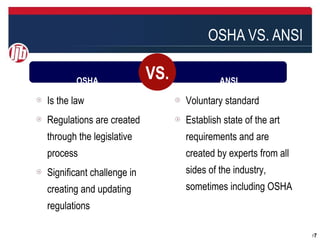
OSHA VS. ANSI

       OSHA
                           VS.            ANSI

Is the law                       Voluntary standard
Regulations are created          Establish state of the art
through the legislative          requirements and are
process                          created by experts from all
Significant challenge in         sides of the industry,
creating and updating            sometimes including OSHA
regulations

                                                               77
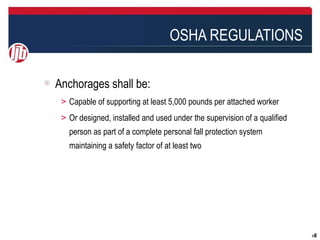
OSHA REGULATIONS

Anchorages shall be:
> Capable of supporting at least 5,000 pounds per attached worker
> Or designed, installed and used under the supervision of a qualified
   person as part of a complete personal fall protection system
   maintaining a safety factor of at least two


                                                                         88
ANSI Z359.2 STANDARD

Non-certified anchorages
> Shall be capable of supporting at least 5,000 pounds for fall arrest
> Designated by a competent person

Certified anchorages:
> Shall support two times the arresting force
> Designed by a qualified person


                                                                         99
ANSI Z359.6 STANDARD

Drawings and specifications
Equipment, materials, and other design requirements
Safety criteria
Fall protection system loads and forces
Clearances for fall arrest systems
Design assumptions and analytical methods

                                                      1010
TYPES OF ANCHORAGES

System types
> Fall arrest
> Work positioning
> Travel restraint
> Horizontal lifeline
> Rescue

Options
> Certified vs. non-certified

                                              1111
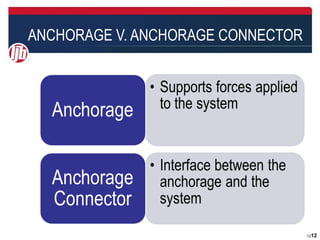
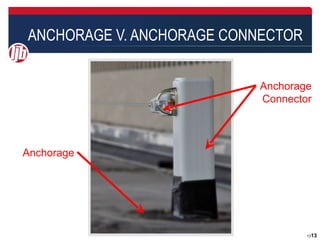
ANCHORAGE V. ANCHORAGE CONNECTOR


                                   1212
ANCHORAGE V. ANCHORAGE CONNECTOR


                           Anchorage
                           Connector


Anchorage


                                   1313
AGENDA

OSHA and ANSI requirements
Main considerations
Case studies
Closing


                                      1414
MAIN CONSIDERATIONS


Strength
Serviceability
 > Fall clearance
 > Consistency of options
 > Compatibility
 > Procedures
 > Installation


                                              1515
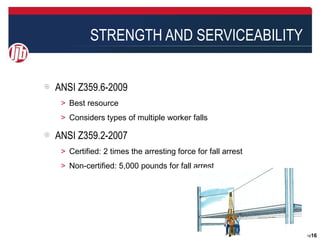
STRENGTH AND SERVICEABILITY


ANSI Z359.6-2009
> Best resource
> Considers types of multiple worker falls

ANSI Z359.2-2007
> Certified: 2 times the arresting force for fall arrest
> Non-certified: 5,000 pounds for fall arrest


                                                           1616
STRENGTH AND SERVICEABILITY


Don’t
> Have a competent person designate a 5,000-pound anchorage
   without any guidance
> Have a P.E. without fall protection experience designate
   anchorages
> Assume a Qualified Person has expertise to understand strength
   aspects
> Forget documentation


                                                                   1717
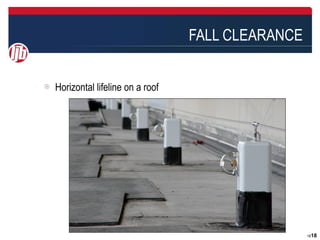
FALL CLEARANCE


Horizontal lifeline on a roof


                                                 1818
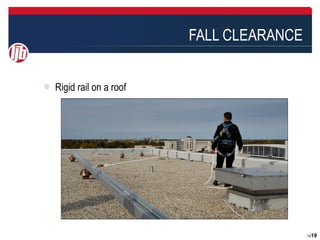
FALL CLEARANCE


Rigid rail on a roof


                                        1919
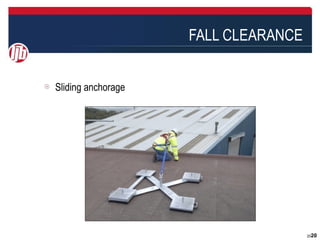
FALL CLEARANCE


Sliding anchorage


                                     2020
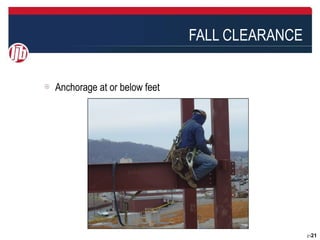
FALL CLEARANCE


Anchorage at or below feet


                                              2121
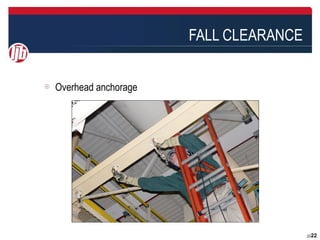
FALL CLEARANCE


Overhead anchorage


                                      2222
USE OF EQUIPMENT


Consistency
 > Fewer options is generally better
 > Use and limitations

Compatibility
 > Geometric
 > Environmental
 > Capacity


                                                   2323
PROCEDURES


Requirements
 > OSHA: “…designed, installed and used…”
 > Per ANSI Z359.2, section 4

Overall
 > Do they exist?
 > Are they written and available?
 > Are they specific to the system?
 > Do they address rescue?


                                                   2424
INSTALLATION


Consider fall protection for the person installing the system
Load testing
 > Existing systems
     • Testing of individual anchorages can be impractical
     • Target load to be carefully determined by a qualified person
 > New systems
     • Horizontal lifeline – swaged fitting test
     • Horizontal lifeline – system load test
 > Anchorage connectors vs. system components


                                                                      2525
AGENDA

OSHA and ANSI requirements
Main considerations
Case studies
Closing


                                      2626
CASE STUDY #1


CANNOT PUBLICLY SHARE PHOTO
Installation concerns
 > Baseplate with sizeable adhesive anchorages in each corner
 > Stainless steel eyebolt at center of baseplate


                                                                2727
THE DIFFERENCE IS LIFE V. DEATH


CANNOT PUBLICLY SHARE PHOTO
Load testing
 > System failed at just over 1,000 pounds, even though it
   was designed for 5,000 pounds


                                                             2828
ADEQUATE ANCHORAGE?


CANNOT PUBLICLY SHARE PHOTO
Installation concerns
 > Anchorage designed to be attached to building column
 > Instead, used adhesive to attach it to masonry wall


                                                          2929
ADEQUATE ANCHORAGE?


CANNOT PUBLICLY SHARE PHOTO
Installation concerns
 > Baseplate supposed to be attached to concrete roof deck
 > Instead, anchorages connected to topping concrete


                                                             3030
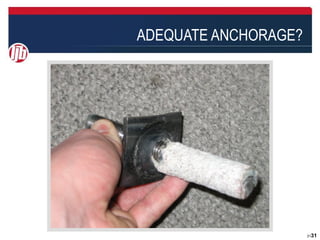
ADEQUATE ANCHORAGE?


                      3131
CASE STUDY #2 – STRENGTH


CANNOT PUBLICLY SHARE PHOTO
Strength concerns
> Observed rope attached to steel step


                                         3232
I WONDER WHAT THIS IS FOR . . .


CANNOT PUBLICLY SHARE PHOTO
Strength concerns
> Tied off to a system used for window cleaning
    • Not strong enough for active fall protection or window
      cleaning tie back


                                                               3333
CASE STUDY #2


CANNOT PUBLICLY SHARE PHOTO
Strength concerns
> Wire rope through hole in bottom chord of angle from roof
   structure
> Had stamped calculations from PE allowing use for two workers
    • Not strong enough for those loads
    • Not enough documentation


                                                                  3434
CASE STUDY #3


CANNOT PUBLICLY SHARE PHOTO
Swing fall and clearance issues
 > Lift system with guardrail
     • Workers lean out over guardrail to perform work
     • Good anchorage and equipment, but not enough clearance
          – Would hit ground before system engages


                                                                3535
CASE STUDY #4


CANNOT PUBLICLY SHARE PHOTO
Lack of procedures
> Workers attaching fall restraint to warning line cable, rather than run
   pole


                                                                        3636
AGENDA

OSHA and ANSI requirements
Main considerations
Case studies
Closing


                                      3737
SHORT ANSWER


1. Besides strength, what is your biggest concern with
   anchorages?
2. Why do you think anchorages are an often
   overlooked aspect of fall protection?
3. What do you do if you cannot find a qualified
   person?


                                                         3838
CALL TO ACTION

1. Determine where your fall protection anchorages are:
   > Certified
   > Non-certified
   > Other

2. Evaluate your documentation
3. Use fewer anchorages in the future
   > Prevention through Design (PtD)


                                                          3939
ASSESSING FALL PROTECTION
              ANCHORAGES
                         THOMAS E. KRAMER, P.E., C.S.P. - PRINCIPAL


                 TKramer@LJBInc.com; Phone: (937) 259-5120
     KIM MESSER, KMesser@LJBInc.com; Phone: (937) 259-5000

                  LJB University™ has been approved as an Authorized Provider by the International Association for
                  Continuing Education and Training (IACET), 1760 Old Meadow Road, Suite 500, McLean, VA 22102.      .

Addressing Fall Protection Anchorages

  • 1.
    ASSESSING FALL PROTECTION ANCHORAGES THOMAS E. KRAMER, P.E., C.S.P. - PRINCIPAL TKramer@LJBInc.com; Phone: (937) 259-5120 KIM MESSER, KMesser@LJBInc.com; Phone: (937) 259-5000 LJB University™ has been approved as an Authorized Provider by the International Association for Continuing Education and Training (IACET), 1760 Old Meadow Road, Suite 500, McLean, VA 22102. .
  • 2.
    INTRODUCTION Thom Kramer, P.E.,C.S.P. > Principal in LJB Safety division > 17+ years experience in fall protection industry > ANSI Z359 Senior Executive Committee • Chairman of ANSI Z359.6 • Chairman of ANSI Z359.17 > American Society of Safety Engineers • 2012 and 2013 PDC Planning Committee Chair > International Society for Fall Protection • President and Board Member 22
  • 3.
    BOTTOM LINE UPFRONT Options other than PPE should always be considered first If using PPE, the anchorage is the first thing to consider: > The best equipment won’t matter with an inadequate anchorage > Overall lack of guidance 33
  • 4.
    AGENDA OSHA and ANSIrequirements Main considerations Case studies Closing 44
  • 5.
    LEARNING OBECTIVES Summarize theregulations and standards that address fall protection anchorages List the main items to consider for assessing fall protection anchorages Identify action steps to improve the anchorages at your site 55
  • 6.
    CALL TO ACTION 1.Determine where your fall protection anchorages are: > Certified > Non-certified > Other 2. Evaluate your documentation 3. Use fewer anchorages in the future > Prevention through Design (PtD) 66
  • 7.
    OSHA VS. ANSI OSHA VS. ANSI Is the law Voluntary standard Regulations are created Establish state of the art through the legislative requirements and are process created by experts from all Significant challenge in sides of the industry, creating and updating sometimes including OSHA regulations 77
  • 8.
    OSHA REGULATIONS Anchorages shallbe: > Capable of supporting at least 5,000 pounds per attached worker > Or designed, installed and used under the supervision of a qualified person as part of a complete personal fall protection system maintaining a safety factor of at least two 88
  • 9.
    ANSI Z359.2 STANDARD Non-certifiedanchorages > Shall be capable of supporting at least 5,000 pounds for fall arrest > Designated by a competent person Certified anchorages: > Shall support two times the arresting force > Designed by a qualified person 99
  • 10.
    ANSI Z359.6 STANDARD Drawingsand specifications Equipment, materials, and other design requirements Safety criteria Fall protection system loads and forces Clearances for fall arrest systems Design assumptions and analytical methods 1010
  • 11.
    TYPES OF ANCHORAGES Systemtypes > Fall arrest > Work positioning > Travel restraint > Horizontal lifeline > Rescue Options > Certified vs. non-certified 1111
  • 12.
    ANCHORAGE V. ANCHORAGECONNECTOR 1212
  • 13.
    ANCHORAGE V. ANCHORAGECONNECTOR Anchorage Connector Anchorage 1313
  • 14.
    AGENDA OSHA and ANSIrequirements Main considerations Case studies Closing 1414
  • 15.
    MAIN CONSIDERATIONS Strength Serviceability >Fall clearance > Consistency of options > Compatibility > Procedures > Installation 1515
  • 16.
    STRENGTH AND SERVICEABILITY ANSIZ359.6-2009 > Best resource > Considers types of multiple worker falls ANSI Z359.2-2007 > Certified: 2 times the arresting force for fall arrest > Non-certified: 5,000 pounds for fall arrest 1616
  • 17.
    STRENGTH AND SERVICEABILITY Don’t >Have a competent person designate a 5,000-pound anchorage without any guidance > Have a P.E. without fall protection experience designate anchorages > Assume a Qualified Person has expertise to understand strength aspects > Forget documentation 1717
  • 18.
  • 19.
  • 20.
  • 21.
    FALL CLEARANCE Anchorage ator below feet 2121
  • 22.
  • 23.
    USE OF EQUIPMENT Consistency > Fewer options is generally better > Use and limitations Compatibility > Geometric > Environmental > Capacity 2323
  • 24.
    PROCEDURES Requirements > OSHA:“…designed, installed and used…” > Per ANSI Z359.2, section 4 Overall > Do they exist? > Are they written and available? > Are they specific to the system? > Do they address rescue? 2424
  • 25.
    INSTALLATION Consider fall protectionfor the person installing the system Load testing > Existing systems • Testing of individual anchorages can be impractical • Target load to be carefully determined by a qualified person > New systems • Horizontal lifeline – swaged fitting test • Horizontal lifeline – system load test > Anchorage connectors vs. system components 2525
  • 26.
    AGENDA OSHA and ANSIrequirements Main considerations Case studies Closing 2626
  • 27.
    CASE STUDY #1 CANNOTPUBLICLY SHARE PHOTO Installation concerns > Baseplate with sizeable adhesive anchorages in each corner > Stainless steel eyebolt at center of baseplate 2727
  • 28.
    THE DIFFERENCE ISLIFE V. DEATH CANNOT PUBLICLY SHARE PHOTO Load testing > System failed at just over 1,000 pounds, even though it was designed for 5,000 pounds 2828
  • 29.
    ADEQUATE ANCHORAGE? CANNOT PUBLICLYSHARE PHOTO Installation concerns > Anchorage designed to be attached to building column > Instead, used adhesive to attach it to masonry wall 2929
  • 30.
    ADEQUATE ANCHORAGE? CANNOT PUBLICLYSHARE PHOTO Installation concerns > Baseplate supposed to be attached to concrete roof deck > Instead, anchorages connected to topping concrete 3030
  • 31.
  • 32.
    CASE STUDY #2– STRENGTH CANNOT PUBLICLY SHARE PHOTO Strength concerns > Observed rope attached to steel step 3232
  • 33.
    I WONDER WHATTHIS IS FOR . . . CANNOT PUBLICLY SHARE PHOTO Strength concerns > Tied off to a system used for window cleaning • Not strong enough for active fall protection or window cleaning tie back 3333
  • 34.
    CASE STUDY #2 CANNOTPUBLICLY SHARE PHOTO Strength concerns > Wire rope through hole in bottom chord of angle from roof structure > Had stamped calculations from PE allowing use for two workers • Not strong enough for those loads • Not enough documentation 3434
  • 35.
    CASE STUDY #3 CANNOTPUBLICLY SHARE PHOTO Swing fall and clearance issues > Lift system with guardrail • Workers lean out over guardrail to perform work • Good anchorage and equipment, but not enough clearance – Would hit ground before system engages 3535
  • 36.
    CASE STUDY #4 CANNOTPUBLICLY SHARE PHOTO Lack of procedures > Workers attaching fall restraint to warning line cable, rather than run pole 3636
  • 37.
    AGENDA OSHA and ANSIrequirements Main considerations Case studies Closing 3737
  • 38.
    SHORT ANSWER 1. Besidesstrength, what is your biggest concern with anchorages? 2. Why do you think anchorages are an often overlooked aspect of fall protection? 3. What do you do if you cannot find a qualified person? 3838
  • 39.
    CALL TO ACTION 1.Determine where your fall protection anchorages are: > Certified > Non-certified > Other 2. Evaluate your documentation 3. Use fewer anchorages in the future > Prevention through Design (PtD) 3939
  • 40.
    ASSESSING FALL PROTECTION ANCHORAGES THOMAS E. KRAMER, P.E., C.S.P. - PRINCIPAL TKramer@LJBInc.com; Phone: (937) 259-5120 KIM MESSER, KMesser@LJBInc.com; Phone: (937) 259-5000 LJB University™ has been approved as an Authorized Provider by the International Association for Continuing Education and Training (IACET), 1760 Old Meadow Road, Suite 500, McLean, VA 22102. .

Editor's Notes

  • #3 Discuss how I love fall protection. While it is something that is just a part of your job, I, as well as many other at LJB, have dedicated our career to this topic. That is the reasons you see that I am registered as a PE and CSP. In fp, you never have a project that is completely safety or completely engineering. No matter what the solution, there are always aspects of both that need to be considered. For example for a personal fall arrest system, there are obvious structural aspects like the design of the rail or horizontal lifeline to which you attach, the connection to thee building structure, the building structure itself. On the other hand, making sure that a fall arrest system should even be used, is a safety related item. Same as specifying the correct equipment, procedures and training.
  • #8 Trend
  • #12 We are already talking about anchorages, so “of anchorages” is redundant.
  • #30 2b. Side pull on eye bolt and epoxy anchor not installed correctly.
  • #31 2b. Side pull on eye bolt and epoxy anchor not installed correctly.
  • #33 The next 15 or so pictures are from a project we did for a government facility in Michigan We were hired to identify, evaluate and prioritize, then abate their worst hazards. Most of the pictures are “before” pictures I want you to see some of the common hazards and think about how easy it would have been to simply design out the fall hazard before the buildings were ever built.
  • #34 The next 15 or so pictures are from a project we did for a government facility in Michigan We were hired to identify, evaluate and prioritize, then abate their worst hazards. Most of the pictures are “before” pictures I want you to see some of the common hazards and think about how easy it would have been to simply design out the fall hazard before the buildings were ever built.