Selective Redundancy in Network-as-a-Service:
Differentiated QoS in Multi-Tenant Clouds
Pradeeban Kathiravelu, Lu´ıs Veiga
INESC-ID Lisboa
Instituto Superior T´ecnico, Universidade de Lisboa
Lisbon, Portugal
11th
International Workshop on
Enterprise Integration, Interoperability and Networking (EI2N 2016)
26th
October 2016, Rhodes, Greece.
Pradeeban Kathiravelu SMART 1 / 28
Introduction
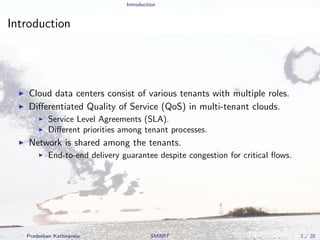
Introduction
Cloud data centers consist of various tenants with multiple roles.
Differentiated Quality of Service (QoS) in multi-tenant clouds.
Service Level Agreements (SLA).
Different priorities among tenant processes.
Network is shared among the tenants.
End-to-end delivery guarantee despite congestion for critical flows.
Pradeeban Kathiravelu SMART 2 / 28
Introduction
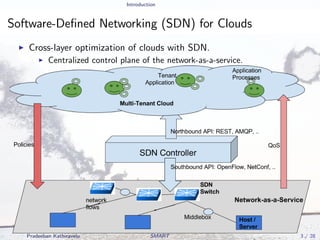
Software-Defined Networking (SDN) for Clouds
Cross-layer optimization of clouds with SDN.
Centralized control plane of the network-as-a-service.
Pradeeban Kathiravelu SMART 3 / 28
Introduction
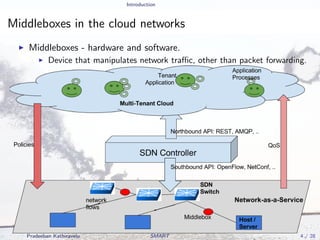
Middleboxes in the cloud networks
Middleboxes - hardware and software.
Device that manipulates network traffic, other than packet forwarding.
Pradeeban Kathiravelu SMART 4 / 28
Introduction
Motivation
How to offer differentiated QoS and SLA in multi-tenant networks?
Application-level user preferences and system policies.
Performance guarantees at the network-level.
Pradeeban Kathiravelu SMART 5 / 28
Introduction
Motivation
How to offer differentiated QoS and SLA in multi-tenant networks?
Application-level user preferences and system policies.
Performance guarantees at the network-level.
More potential in having them both!
SDN, Middleboxes, . . .
Pradeeban Kathiravelu SMART 6 / 28
Introduction
Goals
How to offer differentiated QoS and SLA in multi-tenant networks?
Leverage SDN to offer a selective partial redundancy in network flows.
FlowTags - Software middlebox to tag the flows with contextual
information.
Application-level preferences to the network control plane as tags.
Dynamic flow routing modifications based on the tags.
Pradeeban Kathiravelu SMART 7 / 28
Solution Architecture
SMART
An SDN Middlebox Architecture for Reliable Transfers.
An architectural enhancement for network flows allocation, routing,
and control.
Timely delivery of priority flows by dynamically diverting them to a
less congested path.
Cloning subflows of higher priority flows.
An adaptive approach in cloning and diverting of the flows.
Pradeeban Kathiravelu SMART 8 / 28
Solution Architecture
Contributions
A cross-layer architecture ensuring differentiated QoS.
A context-aware appraoch in load balancing the network.
servers supporting multihoming, connected topologies, . . .
Pradeeban Kathiravelu SMART 9 / 28
Solution Architecture
SMART Approach
Divert and clone subflows by setting breakpoints in the flows in their
route to avert congestion.
Trade-off of minimal redundancy to ensure the SLA of priority flows.
Adaptive execution with contextual information on the network.
Leverage FlowTags middlebox
to pass application-level system and user preferences to the network.
Pradeeban Kathiravelu SMART 10 / 28
Solution Architecture
SMART Enhancements
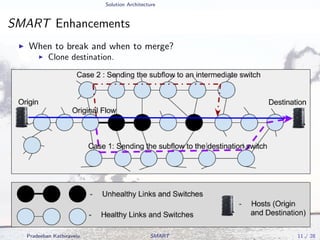
When to break and when to merge?
Clone destination.
Pradeeban Kathiravelu SMART 11 / 28
Solution Architecture
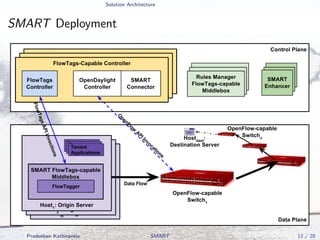
SMART Deployment
Pradeeban Kathiravelu SMART 12 / 28
SMART Workflow
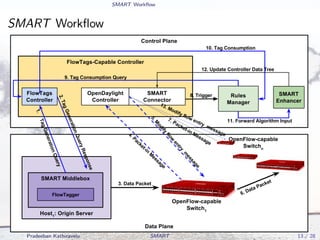
SMART Workflow
Pradeeban Kathiravelu SMART 13 / 28
SMART Workflow
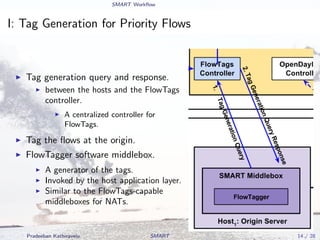
I: Tag Generation for Priority Flows
Tag generation query and response.
between the hosts and the FlowTags
controller.
A centralized controller for
FlowTags.
Tag the flows at the origin.
FlowTagger software middlebox.
A generator of the tags.
Invoked by the host application layer.
Similar to the FlowTags-capable
middleboxes for NATs.
Pradeeban Kathiravelu SMART 14 / 28
SMART Workflow
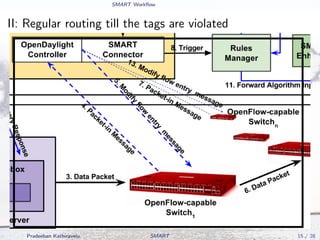
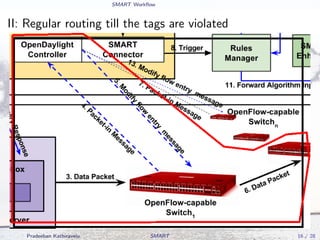
II: Regular routing till the tags are violated
Pradeeban Kathiravelu SMART 15 / 28
SMART Workflow
II: Regular routing till the tags are violated
Pradeeban Kathiravelu SMART 16 / 28
SMART Workflow
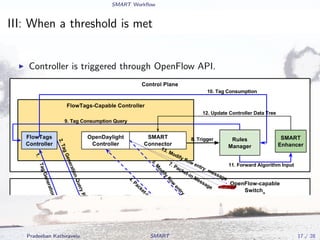
III: When a threshold is met
Controller is triggered through OpenFlow API.
Pradeeban Kathiravelu SMART 17 / 28
SMART Workflow
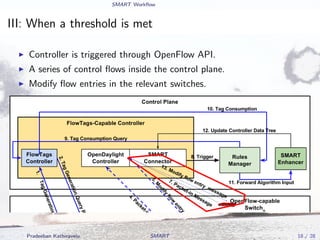
III: When a threshold is met
Controller is triggered through OpenFlow API.
A series of control flows inside the control plane.
Modify flow entries in the relevant switches.
Pradeeban Kathiravelu SMART 18 / 28
SMART Workflow
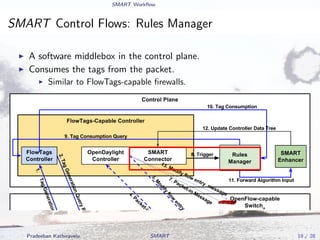
SMART Control Flows: Rules Manager
A software middlebox in the control plane.
Consumes the tags from the packet.
Similar to FlowTags-capable firewalls.
Pradeeban Kathiravelu SMART 19 / 28
SMART Workflow
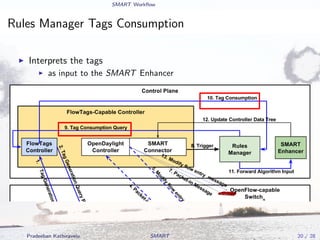
Rules Manager Tags Consumption
Interprets the tags
as input to the SMART Enhancer
Pradeeban Kathiravelu SMART 20 / 28
SMART Workflow
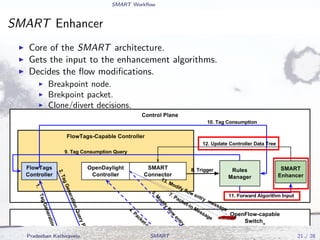
SMART Enhancer
Core of the SMART architecture.
Gets the input to the enhancement algorithms.
Decides the flow modifications.
Breakpoint node.
Brekpoint packet.
Clone/divert decisions.
Pradeeban Kathiravelu SMART 21 / 28
Implementation
Prototype Implementation
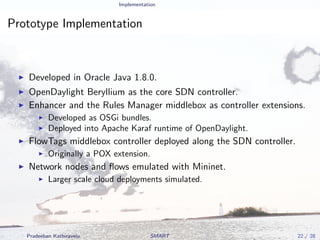
Developed in Oracle Java 1.8.0.
OpenDaylight Beryllium as the core SDN controller.
Enhancer and the Rules Manager middlebox as controller extensions.
Developed as OSGi bundles.
Deployed into Apache Karaf runtime of OpenDaylight.
FlowTags middlebox controller deployed along the SDN controller.
Originally a POX extension.
Network nodes and flows emulated with Mininet.
Larger scale cloud deployments simulated.
Pradeeban Kathiravelu SMART 22 / 28
Evaluation
Evaluation Strategy
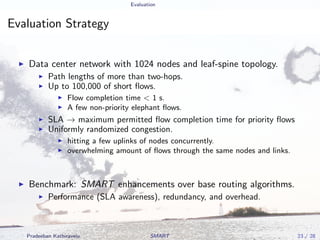
Data center network with 1024 nodes and leaf-spine topology.
Path lengths of more than two-hops.
Up to 100,000 of short flows.
Flow completion time < 1 s.
A few non-priority elephant flows.
SLA → maximum permitted flow completion time for priority flows
Uniformly randomized congestion.
hitting a few uplinks of nodes concurrently.
overwhelming amount of flows through the same nodes and links.
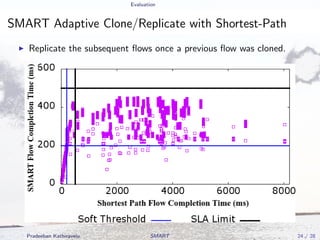
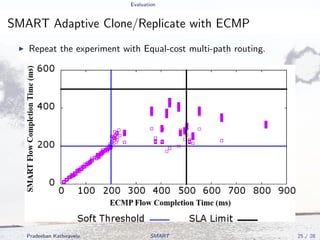
Benchmark: SMART enhancements over base routing algorithms.
Performance (SLA awareness), redundancy, and overhead.
Pradeeban Kathiravelu SMART 23 / 28
Evaluation
SMART Adaptive Clone/Replicate with Shortest-Path
Replicate the subsequent flows once a previous flow was cloned.
Pradeeban Kathiravelu SMART 24 / 28
Evaluation
SMART Adaptive Clone/Replicate with ECMP
Repeat the experiment with Equal-cost multi-path routing.
Pradeeban Kathiravelu SMART 25 / 28
Conclusion
Related Work
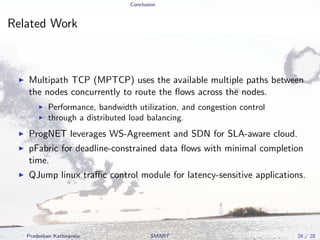
Multipath TCP (MPTCP) uses the available multiple paths between
the nodes concurrently to route the flows across the nodes.
Performance, bandwidth utilization, and congestion control
through a distributed load balancing.
ProgNET leverages WS-Agreement and SDN for SLA-aware cloud.
pFabric for deadline-constrained data flows with minimal completion
time.
QJump linux traffic control module for latency-sensitive applications.
Pradeeban Kathiravelu SMART 26 / 28
Conclusion
Conclusion
Conclusions
SMART leverages redundancy in the flows as a mean to improve the
SLA of the priority flows.
Opens an interesting research question leveraging SDN, middleboxes,
and redundancy.
Cross-layer optimizations through tagging the flows.
For differentiated QoS.
Future Work
Implementation of SMART on a real data center network.
Evaluate against the identified related work quantitatively.
Pradeeban Kathiravelu SMART 27 / 28
Conclusion
Conclusion
Conclusions
SMART leverages redundancy in the flows as a mean to improve the
SLA of the priority flows.
Opens an interesting research question leveraging SDN, middleboxes,
and redundancy.
Cross-layer optimizations through tagging the flows.
For differentiated QoS.
Future Work
Implementation of SMART on a real data center network.
Evaluate against the identified related work quantitatively.
Thank you!
Questions?
Pradeeban Kathiravelu SMART 28 / 28

Selective Redundancy in Network-as-a-Service: Differentiated QoS in Multi-Tenant Clouds

  • 1.
    Selective Redundancy inNetwork-as-a-Service: Differentiated QoS in Multi-Tenant Clouds Pradeeban Kathiravelu, Lu´ıs Veiga INESC-ID Lisboa Instituto Superior T´ecnico, Universidade de Lisboa Lisbon, Portugal 11th International Workshop on Enterprise Integration, Interoperability and Networking (EI2N 2016) 26th October 2016, Rhodes, Greece. Pradeeban Kathiravelu SMART 1 / 28
  • 2.
    Introduction Introduction Cloud data centersconsist of various tenants with multiple roles. Differentiated Quality of Service (QoS) in multi-tenant clouds. Service Level Agreements (SLA). Different priorities among tenant processes. Network is shared among the tenants. End-to-end delivery guarantee despite congestion for critical flows. Pradeeban Kathiravelu SMART 2 / 28
  • 3.
    Introduction Software-Defined Networking (SDN)for Clouds Cross-layer optimization of clouds with SDN. Centralized control plane of the network-as-a-service. Pradeeban Kathiravelu SMART 3 / 28
  • 4.
    Introduction Middleboxes in thecloud networks Middleboxes - hardware and software. Device that manipulates network traffic, other than packet forwarding. Pradeeban Kathiravelu SMART 4 / 28
  • 5.
    Introduction Motivation How to offerdifferentiated QoS and SLA in multi-tenant networks? Application-level user preferences and system policies. Performance guarantees at the network-level. Pradeeban Kathiravelu SMART 5 / 28
  • 6.
    Introduction Motivation How to offerdifferentiated QoS and SLA in multi-tenant networks? Application-level user preferences and system policies. Performance guarantees at the network-level. More potential in having them both! SDN, Middleboxes, . . . Pradeeban Kathiravelu SMART 6 / 28
  • 7.
    Introduction Goals How to offerdifferentiated QoS and SLA in multi-tenant networks? Leverage SDN to offer a selective partial redundancy in network flows. FlowTags - Software middlebox to tag the flows with contextual information. Application-level preferences to the network control plane as tags. Dynamic flow routing modifications based on the tags. Pradeeban Kathiravelu SMART 7 / 28
  • 8.
    Solution Architecture SMART An SDNMiddlebox Architecture for Reliable Transfers. An architectural enhancement for network flows allocation, routing, and control. Timely delivery of priority flows by dynamically diverting them to a less congested path. Cloning subflows of higher priority flows. An adaptive approach in cloning and diverting of the flows. Pradeeban Kathiravelu SMART 8 / 28
  • 9.
    Solution Architecture Contributions A cross-layerarchitecture ensuring differentiated QoS. A context-aware appraoch in load balancing the network. servers supporting multihoming, connected topologies, . . . Pradeeban Kathiravelu SMART 9 / 28
  • 10.
    Solution Architecture SMART Approach Divertand clone subflows by setting breakpoints in the flows in their route to avert congestion. Trade-off of minimal redundancy to ensure the SLA of priority flows. Adaptive execution with contextual information on the network. Leverage FlowTags middlebox to pass application-level system and user preferences to the network. Pradeeban Kathiravelu SMART 10 / 28
  • 11.
    Solution Architecture SMART Enhancements Whento break and when to merge? Clone destination. Pradeeban Kathiravelu SMART 11 / 28
  • 12.
  • 13.
  • 14.
    SMART Workflow I: TagGeneration for Priority Flows Tag generation query and response. between the hosts and the FlowTags controller. A centralized controller for FlowTags. Tag the flows at the origin. FlowTagger software middlebox. A generator of the tags. Invoked by the host application layer. Similar to the FlowTags-capable middleboxes for NATs. Pradeeban Kathiravelu SMART 14 / 28
  • 15.
    SMART Workflow II: Regularrouting till the tags are violated Pradeeban Kathiravelu SMART 15 / 28
  • 16.
    SMART Workflow II: Regularrouting till the tags are violated Pradeeban Kathiravelu SMART 16 / 28
  • 17.
    SMART Workflow III: Whena threshold is met Controller is triggered through OpenFlow API. Pradeeban Kathiravelu SMART 17 / 28
  • 18.
    SMART Workflow III: Whena threshold is met Controller is triggered through OpenFlow API. A series of control flows inside the control plane. Modify flow entries in the relevant switches. Pradeeban Kathiravelu SMART 18 / 28
  • 19.
    SMART Workflow SMART ControlFlows: Rules Manager A software middlebox in the control plane. Consumes the tags from the packet. Similar to FlowTags-capable firewalls. Pradeeban Kathiravelu SMART 19 / 28
  • 20.
    SMART Workflow Rules ManagerTags Consumption Interprets the tags as input to the SMART Enhancer Pradeeban Kathiravelu SMART 20 / 28
  • 21.
    SMART Workflow SMART Enhancer Coreof the SMART architecture. Gets the input to the enhancement algorithms. Decides the flow modifications. Breakpoint node. Brekpoint packet. Clone/divert decisions. Pradeeban Kathiravelu SMART 21 / 28
  • 22.
    Implementation Prototype Implementation Developed inOracle Java 1.8.0. OpenDaylight Beryllium as the core SDN controller. Enhancer and the Rules Manager middlebox as controller extensions. Developed as OSGi bundles. Deployed into Apache Karaf runtime of OpenDaylight. FlowTags middlebox controller deployed along the SDN controller. Originally a POX extension. Network nodes and flows emulated with Mininet. Larger scale cloud deployments simulated. Pradeeban Kathiravelu SMART 22 / 28
  • 23.
    Evaluation Evaluation Strategy Data centernetwork with 1024 nodes and leaf-spine topology. Path lengths of more than two-hops. Up to 100,000 of short flows. Flow completion time < 1 s. A few non-priority elephant flows. SLA → maximum permitted flow completion time for priority flows Uniformly randomized congestion. hitting a few uplinks of nodes concurrently. overwhelming amount of flows through the same nodes and links. Benchmark: SMART enhancements over base routing algorithms. Performance (SLA awareness), redundancy, and overhead. Pradeeban Kathiravelu SMART 23 / 28
  • 24.
    Evaluation SMART Adaptive Clone/Replicatewith Shortest-Path Replicate the subsequent flows once a previous flow was cloned. Pradeeban Kathiravelu SMART 24 / 28
  • 25.
    Evaluation SMART Adaptive Clone/Replicatewith ECMP Repeat the experiment with Equal-cost multi-path routing. Pradeeban Kathiravelu SMART 25 / 28
  • 26.
    Conclusion Related Work Multipath TCP(MPTCP) uses the available multiple paths between the nodes concurrently to route the flows across the nodes. Performance, bandwidth utilization, and congestion control through a distributed load balancing. ProgNET leverages WS-Agreement and SDN for SLA-aware cloud. pFabric for deadline-constrained data flows with minimal completion time. QJump linux traffic control module for latency-sensitive applications. Pradeeban Kathiravelu SMART 26 / 28
  • 27.
    Conclusion Conclusion Conclusions SMART leverages redundancyin the flows as a mean to improve the SLA of the priority flows. Opens an interesting research question leveraging SDN, middleboxes, and redundancy. Cross-layer optimizations through tagging the flows. For differentiated QoS. Future Work Implementation of SMART on a real data center network. Evaluate against the identified related work quantitatively. Pradeeban Kathiravelu SMART 27 / 28
  • 28.
    Conclusion Conclusion Conclusions SMART leverages redundancyin the flows as a mean to improve the SLA of the priority flows. Opens an interesting research question leveraging SDN, middleboxes, and redundancy. Cross-layer optimizations through tagging the flows. For differentiated QoS. Future Work Implementation of SMART on a real data center network. Evaluate against the identified related work quantitatively. Thank you! Questions? Pradeeban Kathiravelu SMART 28 / 28