Performance appraisal - Traditional approach   Traditionally,  performance appraisal  has been used as just a method for determining and justifying the salaries of the employees.  Then it began to be used a tool for determining rewards (a rise in the pay) and punishments (a cut in the pay) for the past performance of the employees.
Traditional approach This approach was a past oriented approach which focused only on the past performance of the employees i.e. during a past specified period of time.  This approach did not consider the developmental aspects of the employee performance i.e. his  training and development
Performance appraisal - Modern approach   More formal and structured.  As a tool to identify better performing employees from others,  As a tool to identify employees’ training needs,  As a tool to identify career development paths,  As a tool to identify rewards and bonuses  As a tool to identify promotions to the next levels.
Performance Appraisal Methods Individual Evaluation Methods   Confidential report  Essay evaluation  Critical incidents  Checklists  Graphic rating scale  Behaviorally anchored rating scale MBO
Confidential Report Descriptive report  Prepared at the end of the year Prepared by the employee’s immediate supervisor The report highlights the strengths and weaknesses of employees Prepared in Government organizations Does not offer any feedback to the employee
Essay evaluation The rater is asked to express the strong as well as weak points of  employee’s behavior The rater considers the employee’s : Job knowledge and potential Understanding of company’s programs, policies, objectives etc Relation with co-workers and supervisors Planning, organizing and controlling ability Attitude and perception
Critical incidents Manager prepares lists of statements of very effective and ineffective behavior of an employee These critical incidents represent the outstanding or poor behavior of the employees The manager periodically records critical incidents of employee’s behavior
Example: July 20 - Sales clerk patiently attended to the customers complaint. He is polite, prompt, enthusiastic in solving the customers’ problem July 20 - The sales assistant stayed 45 minutes beyond his break during the busiest part of the day. He failed to answer store manager’s call thrice. He is lazy, negligent, stubborn and uninterested in work
Critical Incident method Ex: A fire, sudden breakdown, accident Workers reaction scale A informed the supervisor immediately   5 B Become anxious on loss of output   4 C tried to repair the machine   3 D Complained for poor maintenance   2 E was happy to forced test   1
Checklists A checklist is a set of objectives or descriptive statements about the employee and his behavior. Under weighted checklist, value of each question may be weighted. Example: Is the employee really interested in the task assigned? Yes / No Is he respected by his colleagues? Yes / No
Checklist method Simple checklist method Weighted checklist method Forced choice method Simple checklist method: Is employee regular  Y/N Is employee respected by subordinate Y/N Is employee helpful Y/N Does he follow instruction  Y/N Does he keep the equipment in order Y/N
Weighted checklist method weights performance rating (scale 1 to 5 ) Regularity 0.5 Loyalty 1.5 Willing to help 1.5 Quality of work 1.5 Relationship 2.0
Forced choice method This method uses several sets of paired phrases, two of which may be positive and two negative The rater is asked to indicate which of the four phrases is the most and least descriptive of a particular worker Favorable qualities earn plus credit and unfavorable ones earn the reverse
Forced choice method Criteria Rating 1.Regularity on the job Most Least Always regular Inform in advance for delay Never regular Remain absent Neither regular nor irregular
Graphic Rating Scale A form is used to evaluate the performance of the employees A variety of traits may be used in this device, the most common being quality and quantity of work Easy to understand and use. Permits statistical tabulation of scores of employees
Graphic Rating Scale Continuous Rating Scale Discontinuous Rating Scale Employee name_________ Deptt_______ Rater’s name ___________ Date________ ------------------------------------------------------------------------ Exc. Good Acceptable Fair Poor   5   4   3   2   1  _  Dependability Initiative Overall output Attendance Attitude Cooperation Total score   Continuous Rating Scale
Discontinuous Rating Scale Attitude No Interest Indifferent Interested Enthusiastic Very enthusiastic
BARS( behaviorally Anchored rating scale) Step 1. Identify critical incidents Step 2. Select performance dimension Step 3. Retranslate the incidents Step 4. Assign scales to incidents Step 5. Develop final instrument
MBO Process Set organizational goals Defining performance target Performance review feedback
MBO MBO emphasizes collectively set goals that are tangible, verifiable, and measurable Focuses attention on goals rather than on methods Concentrates on Key Result Areas (KRA) Systematic and rational technique that allows management to attain maximum results from available resources by focusing on achievable goals
Key Elements Of MBO Arranging organizational goals in a means-ends chain Engaging in joint goal setting This process has the following steps: Identify KRAs Define expected results Assign specific responsibilities to employees Define authority and responsibility relationship Conducting periodic progress review Conducting annual performance review
Group Appraisal Ranking  Paired comparison  Forced distribution  Performance tests Field review technique   360 degree Appraisal Method Performance Appraisal Methods
Ranking method The evaluator rates the employee from highest to lowest on some overall criteria
Paired comparison method Each worker is compared with all other employees in a group For several traits paired comparisons are made, tabulated and then rank is assigned to each worker This method is not applicable when the group is large
Ranking method Employee Rank A 2 B 1 C 3 D 5 E 4
Paired comparison method A B C D E  Final Rank A - - - + + 3 B + - - + + 2 C + + - + + 1 D - - - - + 4 E - - - - - 5 No of Positive evaluation  Total no. of evaluation  * 100 = employee superior evaluation
Forced Distribution   Methods The rater is asked to appraise the employee according to predetermined distribution scale. Two criteria used for rating are: job performance and promotability.
Forced Distribution   Methods A five point performance scale is also used without mentioning any descriptive statements. The worker is placed between two extremes of “good” and “bad” performance.
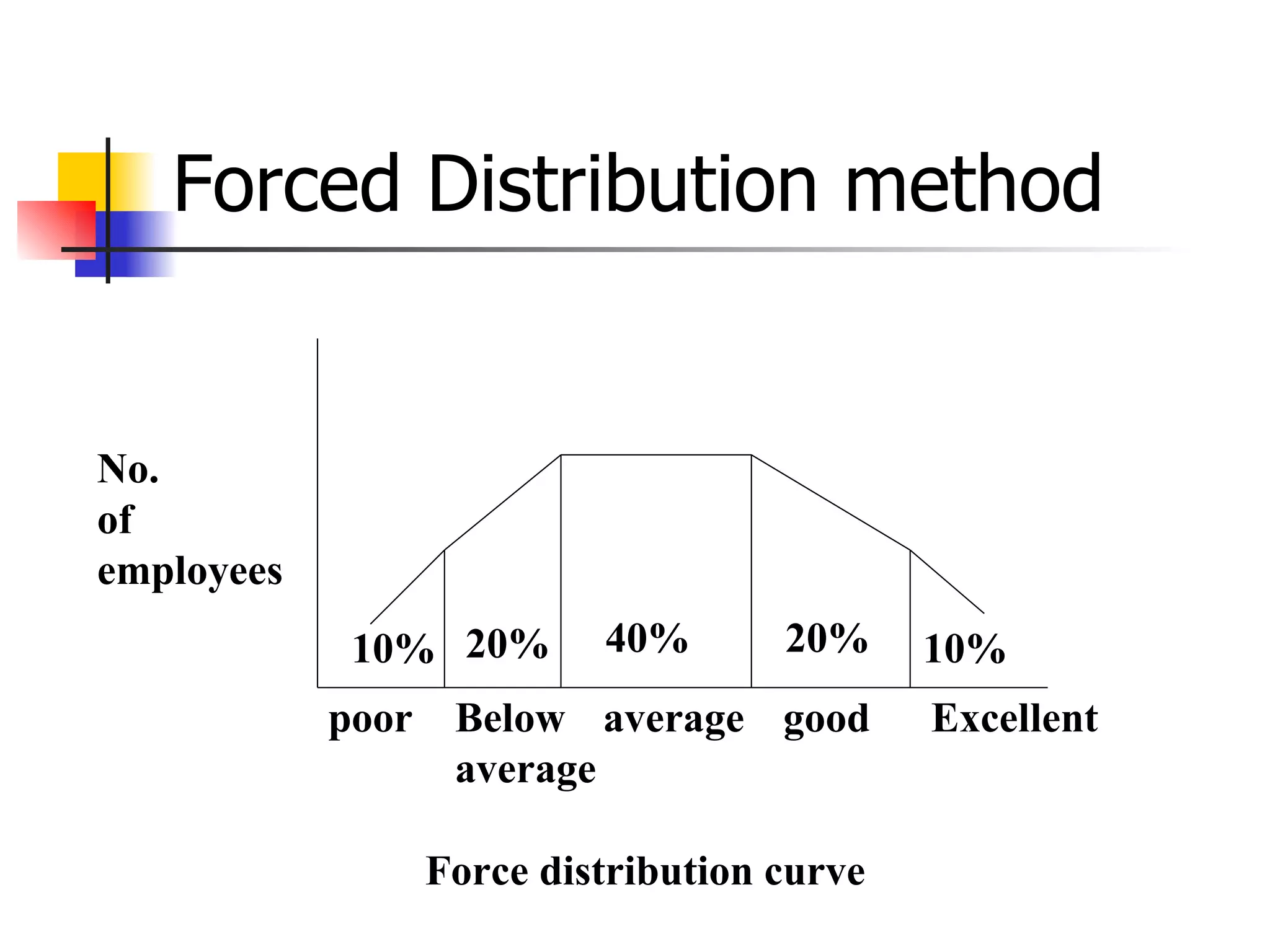
Forced Distribution method 10% 20% 40% 20% 10% poor Below average average good Excellent No.  of  employees Force distribution curve
Field review method The appraiser goes to the field and obtains the information about work performance of the employee by way of questioning the said individual, his peer group, and his superiors
Field review method Performance subordinate peers   superior customer Dimension Leadership   ^   ^ Communication   ^ ^ Interpersonal skills   ^ ^ Decision making ^   ^   ^ Technical skills ^   ^   ^ Motivation ^   ^   ^
360 o  Appraisal System It is a systematic collection and feedback of performance data on an individual or group, derived from a number of  stakeholders  Data is gathered and fed back to the individual participant in a clear way designed to promote understanding, acceptance and ultimately behavior
360 o  Appraisal System   Appraisal taken from: Boss (HOD) Subordinates Peers Immediate supervisor
Performance criteria for executives For top managers Return on capital employed Contribution to community development Degree of upward communication from middle-level executives Degree of growth and expansion of enterprise.
For middle level managers Departmental performance Coordination among employees Degree of upward communication from supervisors Degree of clarity about corporate goals and policies
For supervisors Quality and quantity of output in a given period  Labor cost per unit of output in a given period Material cost per unit in a given period Rate of absenteeism and turnover of employees No of accidents in a given period

Performance appraisal methods

  • 1.
    Performance appraisal -Traditional approach Traditionally, performance appraisal has been used as just a method for determining and justifying the salaries of the employees. Then it began to be used a tool for determining rewards (a rise in the pay) and punishments (a cut in the pay) for the past performance of the employees.
  • 2.
    Traditional approach Thisapproach was a past oriented approach which focused only on the past performance of the employees i.e. during a past specified period of time. This approach did not consider the developmental aspects of the employee performance i.e. his training and development
  • 3.
    Performance appraisal -Modern approach More formal and structured. As a tool to identify better performing employees from others, As a tool to identify employees’ training needs, As a tool to identify career development paths, As a tool to identify rewards and bonuses As a tool to identify promotions to the next levels.
  • 4.
    Performance Appraisal MethodsIndividual Evaluation Methods Confidential report Essay evaluation Critical incidents Checklists Graphic rating scale Behaviorally anchored rating scale MBO
  • 5.
    Confidential Report Descriptivereport Prepared at the end of the year Prepared by the employee’s immediate supervisor The report highlights the strengths and weaknesses of employees Prepared in Government organizations Does not offer any feedback to the employee
  • 6.
    Essay evaluation Therater is asked to express the strong as well as weak points of employee’s behavior The rater considers the employee’s : Job knowledge and potential Understanding of company’s programs, policies, objectives etc Relation with co-workers and supervisors Planning, organizing and controlling ability Attitude and perception
  • 7.
    Critical incidents Managerprepares lists of statements of very effective and ineffective behavior of an employee These critical incidents represent the outstanding or poor behavior of the employees The manager periodically records critical incidents of employee’s behavior
  • 8.
    Example: July 20- Sales clerk patiently attended to the customers complaint. He is polite, prompt, enthusiastic in solving the customers’ problem July 20 - The sales assistant stayed 45 minutes beyond his break during the busiest part of the day. He failed to answer store manager’s call thrice. He is lazy, negligent, stubborn and uninterested in work
  • 9.
    Critical Incident methodEx: A fire, sudden breakdown, accident Workers reaction scale A informed the supervisor immediately 5 B Become anxious on loss of output 4 C tried to repair the machine 3 D Complained for poor maintenance 2 E was happy to forced test 1
  • 10.
    Checklists A checklistis a set of objectives or descriptive statements about the employee and his behavior. Under weighted checklist, value of each question may be weighted. Example: Is the employee really interested in the task assigned? Yes / No Is he respected by his colleagues? Yes / No
  • 11.
    Checklist method Simplechecklist method Weighted checklist method Forced choice method Simple checklist method: Is employee regular Y/N Is employee respected by subordinate Y/N Is employee helpful Y/N Does he follow instruction Y/N Does he keep the equipment in order Y/N
  • 12.
    Weighted checklist methodweights performance rating (scale 1 to 5 ) Regularity 0.5 Loyalty 1.5 Willing to help 1.5 Quality of work 1.5 Relationship 2.0
  • 13.
    Forced choice methodThis method uses several sets of paired phrases, two of which may be positive and two negative The rater is asked to indicate which of the four phrases is the most and least descriptive of a particular worker Favorable qualities earn plus credit and unfavorable ones earn the reverse
  • 14.
    Forced choice methodCriteria Rating 1.Regularity on the job Most Least Always regular Inform in advance for delay Never regular Remain absent Neither regular nor irregular
  • 15.
    Graphic Rating ScaleA form is used to evaluate the performance of the employees A variety of traits may be used in this device, the most common being quality and quantity of work Easy to understand and use. Permits statistical tabulation of scores of employees
  • 16.
    Graphic Rating ScaleContinuous Rating Scale Discontinuous Rating Scale Employee name_________ Deptt_______ Rater’s name ___________ Date________ ------------------------------------------------------------------------ Exc. Good Acceptable Fair Poor 5 4 3 2 1 _ Dependability Initiative Overall output Attendance Attitude Cooperation Total score Continuous Rating Scale
  • 17.
    Discontinuous Rating ScaleAttitude No Interest Indifferent Interested Enthusiastic Very enthusiastic
  • 18.
    BARS( behaviorally Anchoredrating scale) Step 1. Identify critical incidents Step 2. Select performance dimension Step 3. Retranslate the incidents Step 4. Assign scales to incidents Step 5. Develop final instrument
  • 19.
    MBO Process Setorganizational goals Defining performance target Performance review feedback
  • 20.
    MBO MBO emphasizescollectively set goals that are tangible, verifiable, and measurable Focuses attention on goals rather than on methods Concentrates on Key Result Areas (KRA) Systematic and rational technique that allows management to attain maximum results from available resources by focusing on achievable goals
  • 21.
    Key Elements OfMBO Arranging organizational goals in a means-ends chain Engaging in joint goal setting This process has the following steps: Identify KRAs Define expected results Assign specific responsibilities to employees Define authority and responsibility relationship Conducting periodic progress review Conducting annual performance review
  • 22.
    Group Appraisal Ranking Paired comparison Forced distribution Performance tests Field review technique 360 degree Appraisal Method Performance Appraisal Methods
  • 23.
    Ranking method Theevaluator rates the employee from highest to lowest on some overall criteria
  • 24.
    Paired comparison methodEach worker is compared with all other employees in a group For several traits paired comparisons are made, tabulated and then rank is assigned to each worker This method is not applicable when the group is large
  • 25.
    Ranking method EmployeeRank A 2 B 1 C 3 D 5 E 4
  • 26.
    Paired comparison methodA B C D E Final Rank A - - - + + 3 B + - - + + 2 C + + - + + 1 D - - - - + 4 E - - - - - 5 No of Positive evaluation Total no. of evaluation * 100 = employee superior evaluation
  • 27.
    Forced Distribution Methods The rater is asked to appraise the employee according to predetermined distribution scale. Two criteria used for rating are: job performance and promotability.
  • 28.
    Forced Distribution Methods A five point performance scale is also used without mentioning any descriptive statements. The worker is placed between two extremes of “good” and “bad” performance.
  • 29.
    Forced Distribution method10% 20% 40% 20% 10% poor Below average average good Excellent No. of employees Force distribution curve
  • 30.
    Field review methodThe appraiser goes to the field and obtains the information about work performance of the employee by way of questioning the said individual, his peer group, and his superiors
  • 31.
    Field review methodPerformance subordinate peers superior customer Dimension Leadership ^ ^ Communication ^ ^ Interpersonal skills ^ ^ Decision making ^ ^ ^ Technical skills ^ ^ ^ Motivation ^ ^ ^
  • 32.
    360 o Appraisal System It is a systematic collection and feedback of performance data on an individual or group, derived from a number of stakeholders Data is gathered and fed back to the individual participant in a clear way designed to promote understanding, acceptance and ultimately behavior
  • 33.
    360 o Appraisal System Appraisal taken from: Boss (HOD) Subordinates Peers Immediate supervisor
  • 34.
    Performance criteria forexecutives For top managers Return on capital employed Contribution to community development Degree of upward communication from middle-level executives Degree of growth and expansion of enterprise.
  • 35.
    For middle levelmanagers Departmental performance Coordination among employees Degree of upward communication from supervisors Degree of clarity about corporate goals and policies
  • 36.
    For supervisors Qualityand quantity of output in a given period Labor cost per unit of output in a given period Material cost per unit in a given period Rate of absenteeism and turnover of employees No of accidents in a given period