Animal Behavior
Unit: Animal Form and Function
Chapter 51
Lecture Outline
Concepts:
 51.1 Stimuli causing simple and complex
behaviors
 51.2 Experience and Behavior
 51.3 Selection for Individual survival and
Reproductive success
 51.4 Fitness beyond individual survival
51.1 Stimuli and Mediation
 What stimulus elicits the behavior, and
what physiological mechanisms
mediate the response?
 Proximate causation: “How”
-environmental stimulus that triggers the
behavior
Fixed Action Patterns
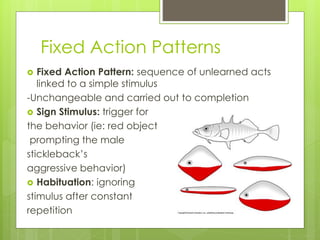
 Fixed Action Pattern: sequence of unlearned acts
linked to a simple stimulus
-Unchangeable and carried out to completion
 Sign Stimulus: trigger for
the behavior (ie: red object
prompting the male
stickleback’s
aggressive behavior)
 Habituation: ignoring
stimulus after constant
repetition
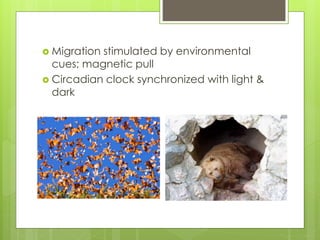
 Migration stimulated by environmental
cues; magnetic pull
 Circadian clock synchronized with light &
dark
Animal Signals and
Communication
 Pheromones: chemical signals emitted by
members of one species to affect other
members of same species
 Visual signals: physical signals to warn or
send a message to members of same
species (ie: white warning of mockingbird)
 Auditory signals: sound messages (ie:
screech of blue jay)
Choice Chamber Experiment
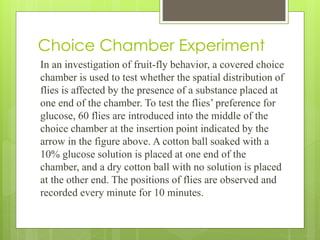
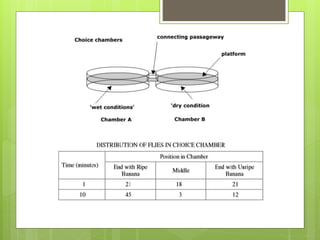
In an investigation of fruit-fly behavior, a covered choice
chamber is used to test whether the spatial distribution of
flies is affected by the presence of a substance placed at
one end of the chamber. To test the flies’ preference for
glucose, 60 flies are introduced into the middle of the
choice chamber at the insertion point indicated by the
arrow in the figure above. A cotton ball soaked with a
10% glucose solution is placed at one end of the
chamber, and a dry cotton ball with no solution is placed
at the other end. The positions of flies are observed and
recorded every minute for 10 minutes.
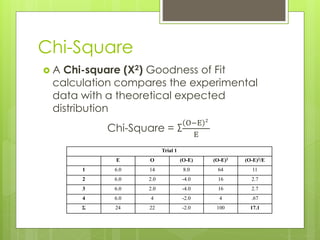
Chi-Square
 A Chi-square (Χ2) Goodness of Fit
calculation compares the experimental
data with a theoretical expected
distribution
Chi-Square = Σ
O−E 2
E
Trial 1
E O (O-E) (O-E)2 (O-E)2/E
1 6.0 14 8.0 64 11
2 6.0 2.0 -4.0 16 2.7
3 6.0 2.0 -4.0 16 2.7
4 6.0 4 -2.0 4 .67
Ʃ 24 22 -2.0 100 17.1
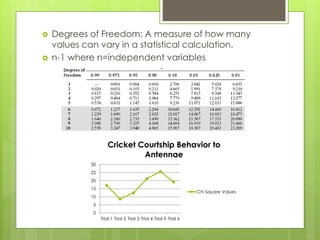
0
5
10
15
20
25
30
Trial 1 Trial 2 Trial 3 Trial 4 Trial 5 Trial 6
Cricket Courtship Behavior to
Antennae
Chi Square Values
 Degrees of Freedom: A measure of how many
values can vary in a statistical calculation.
 n-1 where n=independent variables
51.2 Experience and Behavior
 How does the animal’s experience during
growth and development influence the
response?
 Proximate causation: “How”
 The learning process that influences the
animal
Learning
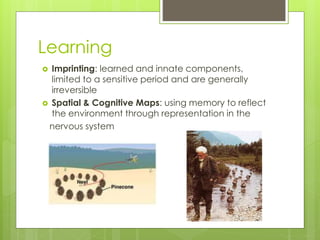
 Imprinting: learned and innate components,
limited to a sensitive period and are generally
irreversible
 Spatial & Cognitive Maps: using memory to reflect
the environment through representation in the
nervous system
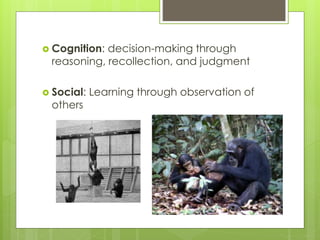
 Cognition: decision-making through
reasoning, recollection, and judgment
 Social: Learning through observation of
others
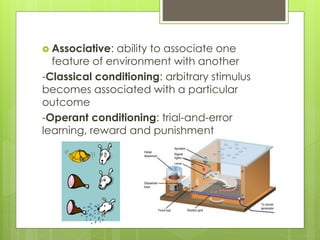
 Associative: ability to associate one
feature of environment with another
-Classical conditioning: arbitrary stimulus
becomes associated with a particular
outcome
-Operant conditioning: trial-and-error
learning, reward and punishment
51.3 Individual & Reproduction
 How does the behavior aid survival and
reproduction?
 Ultimate causation: “Why”
 How these behaviors increase the survival
and reproductive success
Foraging Behavior
 Foraging behavior is based on the efficiency of
the method.
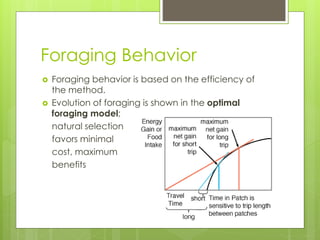
 Evolution of foraging is shown in the optimal
foraging model;
natural selection
favors minimal
cost, maximum
benefits
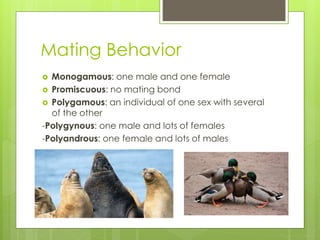
Mating Behavior
 Monogamous: one male and one female
 Promiscuous: no mating bond
 Polygamous: an individual of one sex with several
of the other
-Polygynous: one male and lots of females
-Polyandrous: one female and lots of males
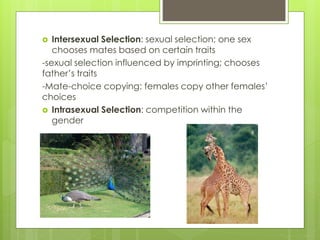
 Intersexual Selection: sexual selection; one sex
chooses mates based on certain traits
-sexual selection influenced by imprinting; chooses
father’s traits
-Mate-choice copying: females copy other females’
choices
 Intrasexual Selection: competition within the
gender
51.4 Evolution of Behavior
 What is the behavior’s evolutionary
history?
 Ultimate causation: “Why”
 Inclusive fitness benefits the population as
a whole
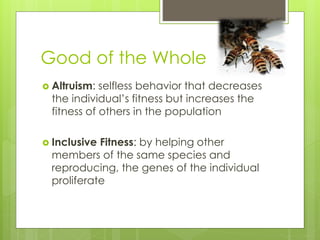
Good of the Whole
 Altruism: selfless behavior that decreases
the individual’s fitness but increases the
fitness of others in the population
 Inclusive Fitness: by helping other
members of the same species and
reproducing, the genes of the individual
proliferate

Animal Behavior Concept Review

  • 1.
    Animal Behavior Unit: AnimalForm and Function Chapter 51
  • 2.
    Lecture Outline Concepts:  51.1Stimuli causing simple and complex behaviors  51.2 Experience and Behavior  51.3 Selection for Individual survival and Reproductive success  51.4 Fitness beyond individual survival
  • 3.
    51.1 Stimuli andMediation  What stimulus elicits the behavior, and what physiological mechanisms mediate the response?  Proximate causation: “How” -environmental stimulus that triggers the behavior
  • 4.
    Fixed Action Patterns Fixed Action Pattern: sequence of unlearned acts linked to a simple stimulus -Unchangeable and carried out to completion  Sign Stimulus: trigger for the behavior (ie: red object prompting the male stickleback’s aggressive behavior)  Habituation: ignoring stimulus after constant repetition
  • 5.
     Migration stimulatedby environmental cues; magnetic pull  Circadian clock synchronized with light & dark
  • 6.
    Animal Signals and Communication Pheromones: chemical signals emitted by members of one species to affect other members of same species  Visual signals: physical signals to warn or send a message to members of same species (ie: white warning of mockingbird)  Auditory signals: sound messages (ie: screech of blue jay)
  • 7.
    Choice Chamber Experiment Inan investigation of fruit-fly behavior, a covered choice chamber is used to test whether the spatial distribution of flies is affected by the presence of a substance placed at one end of the chamber. To test the flies’ preference for glucose, 60 flies are introduced into the middle of the choice chamber at the insertion point indicated by the arrow in the figure above. A cotton ball soaked with a 10% glucose solution is placed at one end of the chamber, and a dry cotton ball with no solution is placed at the other end. The positions of flies are observed and recorded every minute for 10 minutes.
  • 9.
    Chi-Square  A Chi-square(Χ2) Goodness of Fit calculation compares the experimental data with a theoretical expected distribution Chi-Square = Σ O−E 2 E Trial 1 E O (O-E) (O-E)2 (O-E)2/E 1 6.0 14 8.0 64 11 2 6.0 2.0 -4.0 16 2.7 3 6.0 2.0 -4.0 16 2.7 4 6.0 4 -2.0 4 .67 Ʃ 24 22 -2.0 100 17.1
  • 10.
    0 5 10 15 20 25 30 Trial 1 Trial2 Trial 3 Trial 4 Trial 5 Trial 6 Cricket Courtship Behavior to Antennae Chi Square Values  Degrees of Freedom: A measure of how many values can vary in a statistical calculation.  n-1 where n=independent variables
  • 11.
    51.2 Experience andBehavior  How does the animal’s experience during growth and development influence the response?  Proximate causation: “How”  The learning process that influences the animal
  • 12.
    Learning  Imprinting: learnedand innate components, limited to a sensitive period and are generally irreversible  Spatial & Cognitive Maps: using memory to reflect the environment through representation in the nervous system
  • 13.
     Cognition: decision-makingthrough reasoning, recollection, and judgment  Social: Learning through observation of others
  • 14.
     Associative: abilityto associate one feature of environment with another -Classical conditioning: arbitrary stimulus becomes associated with a particular outcome -Operant conditioning: trial-and-error learning, reward and punishment
  • 15.
    51.3 Individual &Reproduction  How does the behavior aid survival and reproduction?  Ultimate causation: “Why”  How these behaviors increase the survival and reproductive success
  • 16.
    Foraging Behavior  Foragingbehavior is based on the efficiency of the method.  Evolution of foraging is shown in the optimal foraging model; natural selection favors minimal cost, maximum benefits
  • 17.
    Mating Behavior  Monogamous:one male and one female  Promiscuous: no mating bond  Polygamous: an individual of one sex with several of the other -Polygynous: one male and lots of females -Polyandrous: one female and lots of males
  • 18.
     Intersexual Selection:sexual selection; one sex chooses mates based on certain traits -sexual selection influenced by imprinting; chooses father’s traits -Mate-choice copying: females copy other females’ choices  Intrasexual Selection: competition within the gender
  • 19.
    51.4 Evolution ofBehavior  What is the behavior’s evolutionary history?  Ultimate causation: “Why”  Inclusive fitness benefits the population as a whole
  • 20.
    Good of theWhole  Altruism: selfless behavior that decreases the individual’s fitness but increases the fitness of others in the population  Inclusive Fitness: by helping other members of the same species and reproducing, the genes of the individual proliferate