OSAZONE TEST
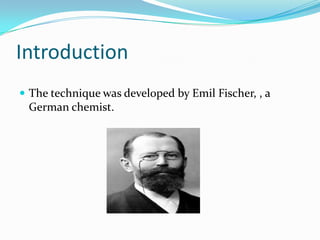
IntroductionThe technique was developed by Emil Fischer, , a German chemist.
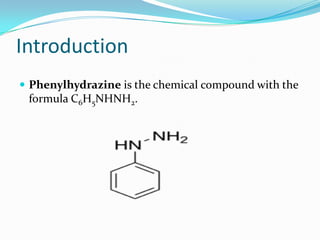
IntroductionPhenylhydrazine is the chemical compound with the formula C6H5NHNH2.
IntroductionOsazones are formed when the sugars react with a compound known as phenylhydrazine at boiling point.General  Reaction:
IntroductionThese sugars are reducing ones which have either  a free aldehyde or a ketone  group to react with the phenylhydrazine.
Procedures1. Pipette 1 ml of the phenylhydrazine mixture to a test tube.
Procedures2. Add 5 ml of the test solution
Procedures3. shake vigorously to insure complete solution
Procedures4. Stopper the mouth of the tube loosely with cotton
Procedures5. Place the tube immediately in a boiling water bath
Procedures6. Record the time
Procedures7. Observe the tube
Procedures8. If a precipitate is formed, record the time and remove the tube from the bath
Procedures9. Cool off the tube
Procedures10. Examine the crystals under low power objective
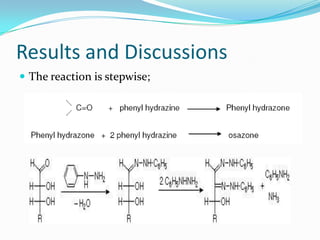
Results and DiscussionsThe reaction is stepwise;
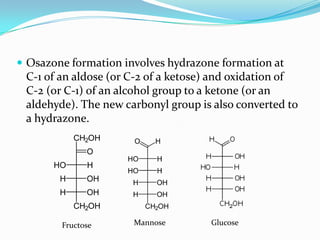
Osazone formation involves hydrazone formation at C-1 of an aldose (or C-2 of a ketose) and oxidation of C-2 (or C-1) of an alcohol group to a ketone (or an aldehyde). The new carbonyl group is also converted to a hydrazone. MannoseGlucoseFructose
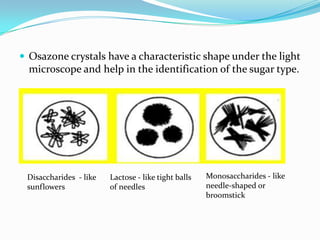
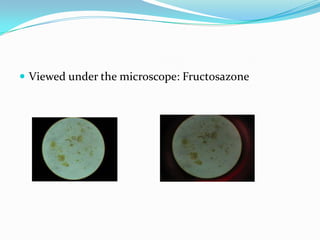
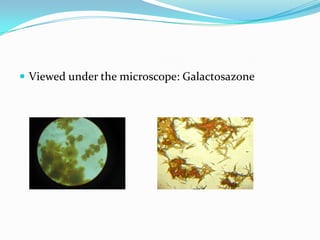
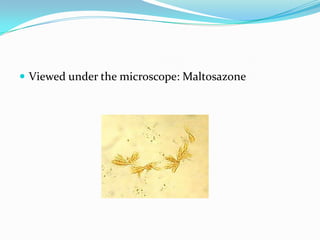
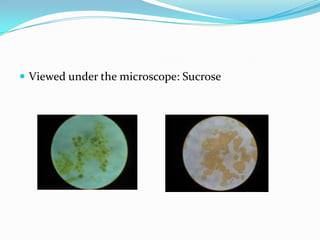
Osazone crystals have a characteristic shape under the light microscope and help in the identification of the sugar type.Monosaccharides - like needle-shaped or broomstickDisaccharides  - like sunflowersLactose - like tight balls of needles
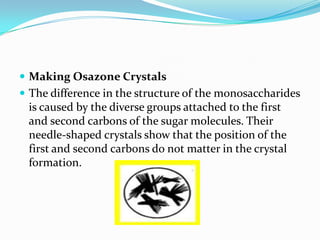
Making Osazone CrystalsThe difference in the structure of the monosaccharides is caused by the diverse groups attached to the first and second carbons of the sugar molecules. Their needle-shaped crystals show that the position of the first and second carbons do not matter in the crystal formation.
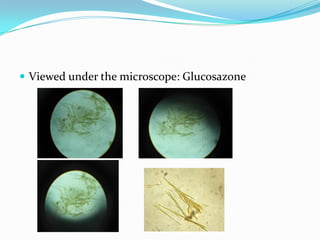
Viewed under the microscope: Glucosazone
Viewed under the microscope: Fructosazone
Viewed under the microscope: Galactosazone
Viewed under the microscope: Maltosazone
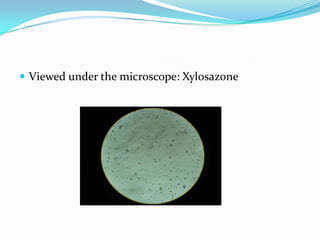
Viewed under the microscope: Xylosazone
Viewed under the microscope: Sucrose
Time to FormThe time needed to create osazone crystals varies among the various sugars involved, but helps to identify the sugars being tested. For an osazone crystal to be presented from a hot solution will take as long as follows:fructose, two minutes;
glucose, four to five minutes;
xylose, seven minutes;

Osazone test