❖ Important basisof the work in the laboratory:
1. Wear the lab coat.
2. Tie the hair.
3. Do not eat or drink in the lab.
4. Read the instruction of the experiment before working.
5. Use the safety tools.
6. Read the name of the chemical before using it.
7. Close the pack after use.
8. Do not smell, taste or touch any chemical.
9. If you are asked to smell any chemical, do not put directly into your nose.
10. When heating do not direct the nozzle of the tube to you or your colleague.
11. When using flammable materials, keep away from flame.
12. use the fume hood if an experiment that produces gases or odor.
13. Clean your place after work.
3.
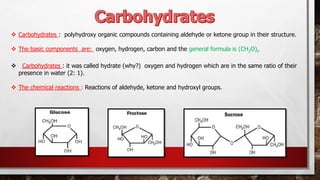
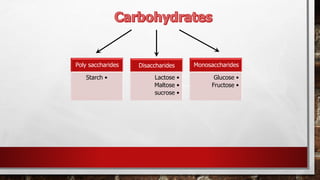
❖ Carbohydrates :polyhydroxy organic compounds containing aldehyde or ketone group in their structure.
❖ The basic components are: oxygen, hydrogen, carbon and the general formula is (CH2O)n
❖ Carbohydrates : it was called hydrate (why?) oxygen and hydrogen which are in the same ratio of their
presence in water (2: 1).
❖ The chemical reactions : Reactions of aldehyde, ketone and hydroxyl groups.
4.
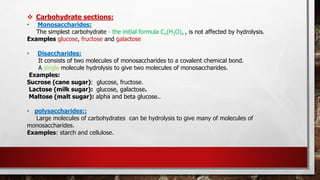
❖ Carbohydrate sections:
•Monosaccharides:
The simplest carbohydrate - the initial formula Cn(H2O)n , is not affected by hydrolysis.
Examples glucose, fructose and galactose
• Disaccharides:
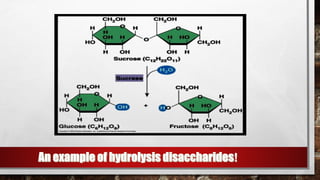
It consists of two molecules of monosaccharides to a covalent chemical bond.
A single molecule hydrolysis to give two molecules of monosaccharides.
Examples:
Sucrose (cane sugar): glucose, fructose.
Lactose (milk sugar): glucose, galactose.
Maltose (malt sugar): alpha and beta glucose..
• polysaccharides::
Large molecules of carbohydrates can be hydrolysis to give many of molecules of
monosaccharides.
Examples: starch and cellulose.
6.
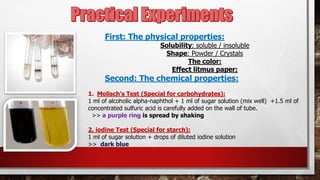
First: The physicalproperties:
Solubility: soluble / insoluble
Shape: Powder / Crystals
The color:
Effect litmus paper;
Second: The chemical properties:
1. Molisch's Test (Special for carbohydrates):
1 ml of alcoholic alpha-naphthol + 1 ml of sugar solution (mix well) +1.5 ml of
concentrated sulfuric acid is carefully added on the wall of tube.
>> a purple ring is spread by shaking
2. iodine Test (Special for starch):
1 ml of sugar solution + drops of diluted iodine solution
>> dark blue
7.
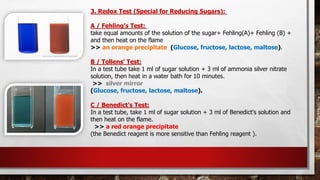
3. Redox Test(Special for Reducing Sugars):
A / Fehling’s Test:
take equal amounts of the solution of the sugar+ Fehling(A)+ Fehling (B) +
and then heat on the flame
>> an orange precipitate (Glucose, fructose, lactose, maltose).
B / Tollens’ Test:
In a test tube take 1 ml of sugar solution + 3 ml of ammonia silver nitrate
solution, then heat in a water bath for 10 minutes.
>> silver mirror
(Glucose, fructose, lactose, maltose).
C / Benedict’s Test:
In a test tube, take 1 ml of sugar solution + 3 ml of Benedict's solution and
then heat on the flame.
>> a red orange precipitate
(the Benedict reagent is more sensitive than Fehling reagent ).
8.
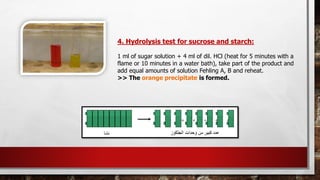
4. Hydrolysis testfor sucrose and starch:
1 ml of sugar solution + 4 ml of dil. HCl (heat for 5 minutes with a
flame or 10 minutes in a water bath), take part of the product and
add equal amounts of solution Fehling A, B and reheat.
>> The orange precipitate is formed.
9.
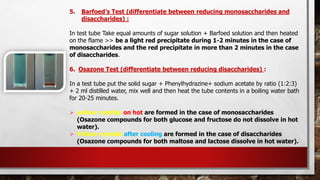
5. Barfoed’s Test(differentiate between reducing monosaccharides and
disaccharides) :
In test tube Take equal amounts of sugar solution + Barfoed solution and then heated
on the flame >> be a light red precipitate during 1-2 minutes in the case of
monosaccharides and the red precipitate in more than 2 minutes in the case
of disaccharides.
6. Osazone Test (differentiate between reducing disaccharides) :
In a test tube put the solid sugar + Phenylhydrazine+ sodium acetate by ratio (1:2:3)
+ 2 ml distilled water, mix well and then heat the tube contents in a boiling water bath
for 20-25 minutes.
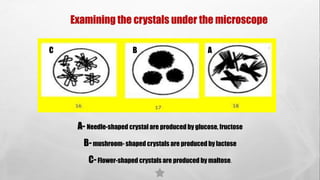
➢ yellow crystals on hot are formed in the case of monosaccharides
(Osazone compounds for both glucose and fructose do not dissolve in hot
water).
➢ Yellow crystals after cooling are formed in the case of disaccharides
(Osazone compounds for both maltose and lactose dissolve in hot water).
10.
A- Needle-shaped crystalare produced by glucose, fructose
B-mushroom- shaped crystals are produced by lactose
C-Flower-shaped crystals are produced by maltose.
C B A
Examining the crystals under the microscope
11.
7. Seliwanoff’s Test:(fructose characteristic):
1 ml of sugar solution + 1 ml of Seliwanoff’s reagent then heating on flame
>> Red color during 1 min in the case of fructose
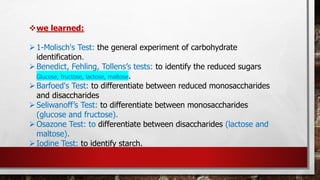
❖we learned:
➢1-Molisch's Test:the general experiment of carbohydrate
identification.
➢Benedict, Fehling, Tollens’s tests: to identify the reduced sugars
Glucose, fructose, lactose, maltose.
➢Barfoed's Test: to differentiate between reduced monosaccharides
and disaccharides
➢Seliwanoff’s Test: to differentiate between monosaccharides
(glucose and fructose).
➢Osazone Test: to differentiate between disaccharides (lactose and
maltose).
➢Iodine Test: to identify starch.
15.
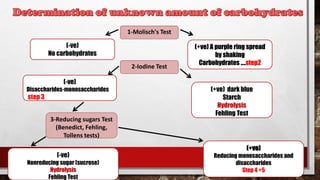
1-Molisch's Test
(+ve) Apurple ring spread
by shaking
Carbohydrates ….step2
(-ve)
No carbohydrates
2-Iodine Test
(+ve) dark blue
Starch
Hydrolysis
Fehling Test
(-ve)
Disaccharides-monosaccharides
step 3
3-Reducing sugars Test
(Benedict, Fehling,
Tollens tests)
(-ve)
Nonreducing sugar (sucrose)
Hydrolysis
Fehling Test
(+ve)
Reducing monosaccharides and
disaccharides
Step 4 +5
16.
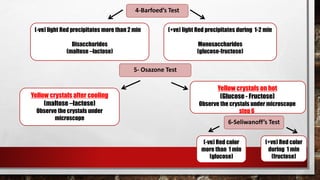
4-Barfoed’s Test
(-ve) lightRed precipitates more than 2 min
Disaccharides
(maltose –lactose)
(+ve) light Red precipitates during 1-2 min
Monosaccharides
(glucose-fructose)
5- Osazone Test
Yellow crystals on hot
(Glucose - Fructose)
Observe the crystals under microscope
step 6
Yellow crystals after cooling
(maltose –lactose)
Observe the crystals under
microscope
6-Seliwanoff’s Test
(+ve) Red color
during 1 min
(fructose)
(-ve) Red color
more than 1 min
(glucose)