Lesson 2:
Methods of
separating
mixtures
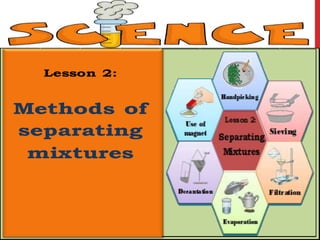
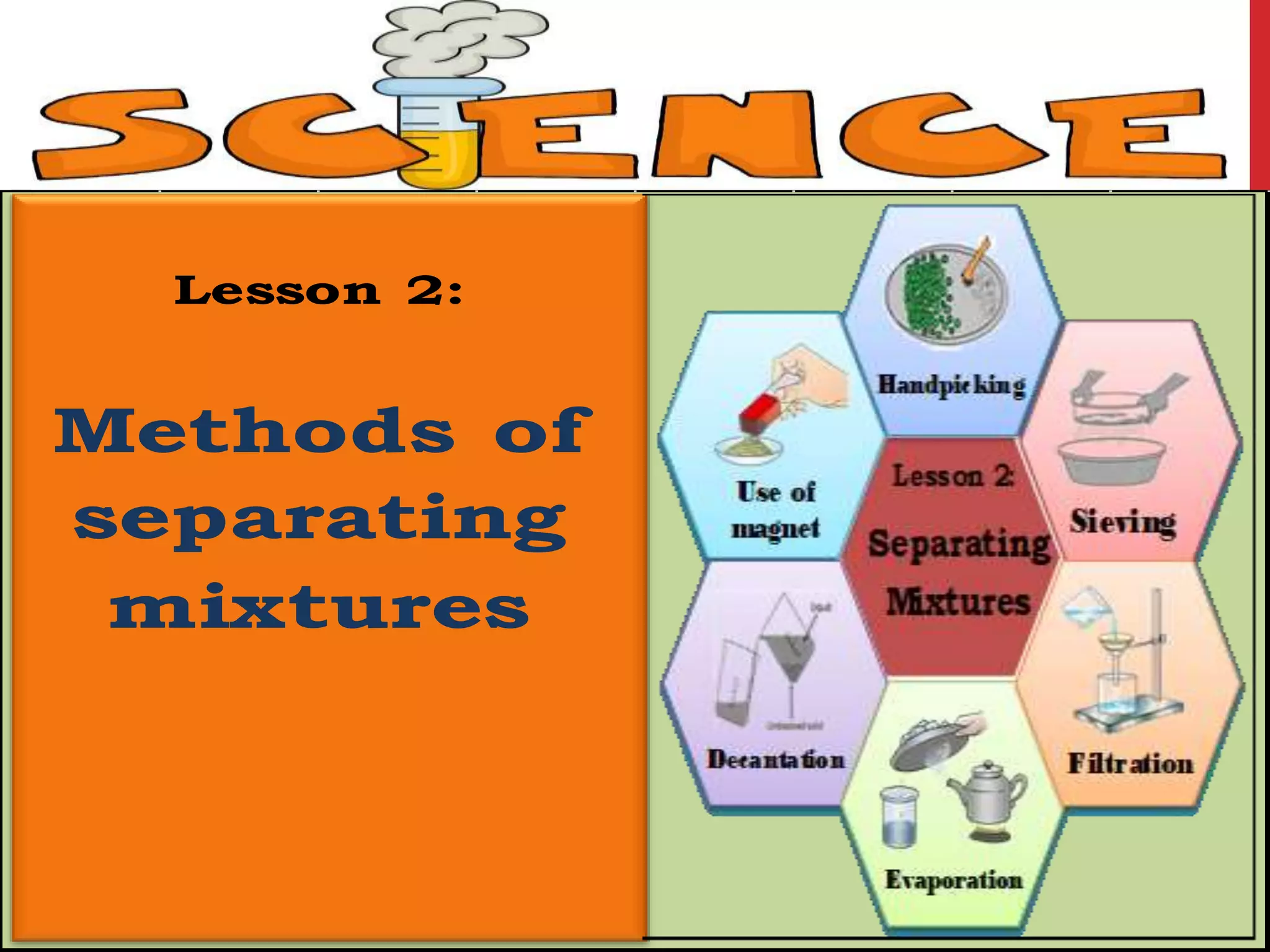
Lesson 2:
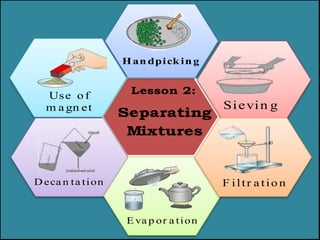
Separating
Mixtures
Han dpick in g
Use of
m a gn et
Deca n ta tion
E va p or a tion
F iltr a tion
Sievin g
DAY 1
Why are mixtures
important?
• Review
Reading of Important Science Terms in
flashcards or projected on the screen:
Mixtures colloids solution
suspension Emulsions foams
sol gel aerosols
• Drill
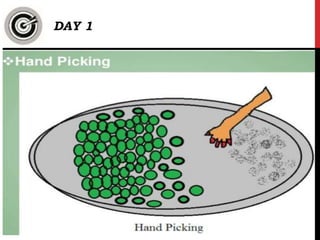
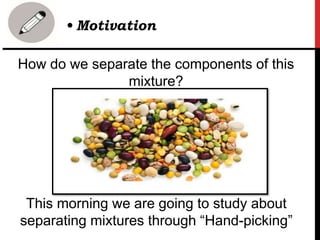
How do we separate the components of this
mixture?
• Motivation
This morning we are going to study about
separating mixtures through “Hand-picking”
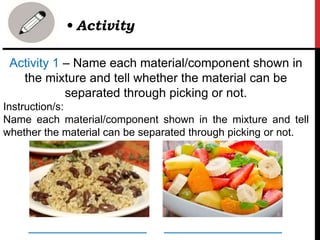
Activity 1 – Name each material/component shown in
the mixture and tell whether the material can be
separated through picking or not.
(Attachment A)
Activity 2 – Given set of pictures, the group will identify
the name of the materials/components of the mixtures
and separate them from each other (Attachment B)
Activity 3 – Giving sets of mixtures out of the given
sample materials (Attachment C)
• Activity
Activity 1 – Name each material/component shown in
the mixture and tell whether the material can be
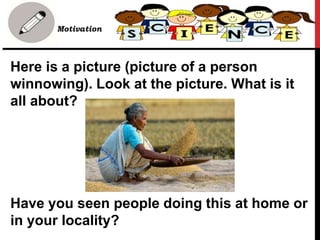
separated through picking or not.
Instruction/s:
Name each material/component shown in the mixture and tell
whether the material can be separated through picking or not.
• Activity
_________________ _________________
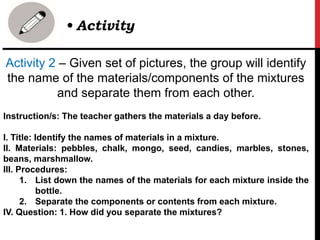
Activity 2 – Given set of pictures, the group will identify
the name of the materials/components of the mixtures
and separate them from each other.
Instruction/s: The teacher gathers the materials a day before.
I. Title: Identify the names of materials in a mixture.
II. Materials: pebbles, chalk, mongo, seed, candies, marbles, stones,
beans, marshmallow.
III. Procedures:
1. List down the names of the materials for each mixture inside the
bottle.
2. Separate the components or contents from each mixture.
IV. Question: 1. How did you separate the mixtures?
• Activity
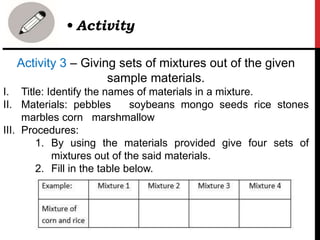
Activity 3 – Giving sets of mixtures out of the given
sample materials.
I. Title: Identify the names of materials in a mixture.
II. Materials: pebbles soybeans mongo seeds rice stones
marbles corn marshmallow
III. Procedures:
1. By using the materials provided give four sets of
mixtures out of the said materials.
2. Fill in the table below.
• Activity
1. For Activity A, what are the materials found in the
mixtures? Will it be easy for us to separate them?
Can we separate them through picking?
2. For Activity B, what are the materials/components of the
mixture? How did you separate them?
3. For Activity C, what are the mixtures you came up with
using the given materials? Can we separate them using
picking or manual separation?
• Analysis
In everyday life, we use several mixtures and one need to
separate useful components from the mixture. Thus, the
separation of substances is performed by various
methods like hand-picking.
Mixtures are combinations of two or more substances not
chemically bonded where each substance retains its
chemical entity and properties. One of the techniques of
separating mixtures is through picking. For instances, a
mixture of grains and corn can be separated through
picking by using our bare hands. When the components of
a mixture are slightly larger in size, it is easier for us to
pick and separate them.
• Abstraction
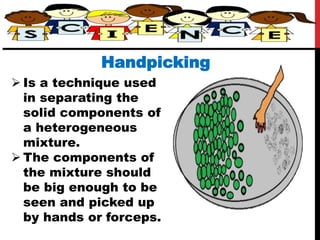
Handpicking
 Is a technique used
in separating the
solid components of
a heterogeneous
mixture.
 The components of
the mixture should
be big enough to be
seen and picked up
by hands or forceps.
A. Put a √ beside the mixtures that can be separated
through picking.
1. water and alcohol ________
2. sliced mixed fruits ________ (Ans. √)
3. mixed nuts _______ (Ans. √)
4. nails and iron strips _______ (Ans. √)
5. stones and pebbles _______ (Ans. √)
B. Give a particular situation in their houses especially in
the kitchen where separation of mixtures through
handpicking is being done.
• Application
1. What method of separating mixtures is being used when
materials in a mixture are slightly larger in size?
2. When do we use picking as a method of separating
mixtures?
3. What are the examples of mixtures that can be
separated through picking?
4. Why is separating of mixture through picking
important?
• Generalization
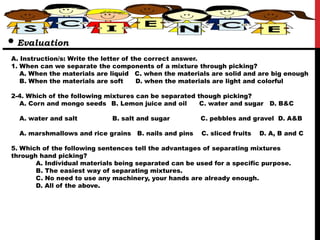
A. Instruction/s: Write the letter of the correct answer.
1. When can we separate the components of a mixture through picking?
A. When the materials are liquid C. when the materials are solid and are big enough
B. When the materials are soft D. when the materials are light and colorful
2-4. Which of the following mixtures can be separated though picking?
A. Corn and mongo seeds B. Lemon juice and oil C. water and sugar D. B&C
A. water and salt B. salt and sugar C. pebbles and gravel D. A&B
A. marshmallows and rice grains B. nails and pins C. sliced fruits D. A, B and C
5. Which of the following sentences tell the advantages of separating mixtures
through hand picking?
A. Individual materials being separated can be used for a specific purpose.
B. The easiest way of separating mixtures.
C. No need to use any machinery, your hands are already enough.
D. All of the above.
• Evaluation
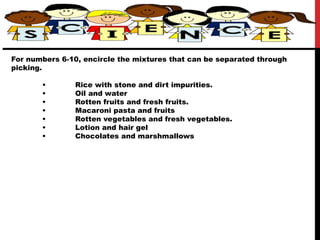
For numbers 6-10, encircle the mixtures that can be separated through
picking.
• Rice with stone and dirt impurities.
• Oil and water
• Rotten fruits and fresh fruits.
• Macaroni pasta and fruits
• Rotten vegetables and fresh vegetables.
• Lotion and hair gel
• Chocolates and marshmallows
Watch the video
https://www.youtube.com/watch?v=n5TFJ-y8aVk on
Separating Mixture through Hand Picking.
• Homework
Day 2
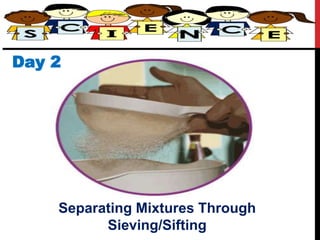
Separating Mixtures Through
Sieving/Sifting
Describe how the following mixtures can be
separated, through picking or not. Put a √ if it
can be separated through picking.
_____1. nails and stones
_____2. lemon juice
_____3. chocolates and marshmallows
_____4. pepper seeds and mongo seeds
_____5. corn and palay grains
• Review
Reading of Important Science Terms in
flashcards or projected on TV screen:
Picking rice hull sift
Dry mixtures rice grains sieve
• Review
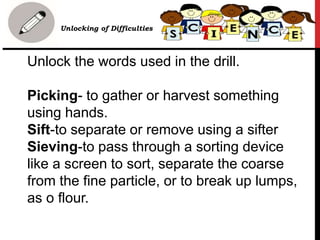
Unlock the words used in the drill.
Picking- to gather or harvest something
using hands.
Sift-to separate or remove using a sifter
Sieving-to pass through a sorting device
like a screen to sort, separate the coarse
from the fine particle, or to break up lumps,
as o flour.
• Unlocking of Difficulties
Unlock the words used in the drill.
Picking- to gather or harvest something
using hands.
Sift-to separate or remove using a sifter
Sieving-to pass through a sorting device
like a screen to sort, separate the coarse
from the fine particle, or to break up lumps,
as o flour.
• Unlocking of Difficulties
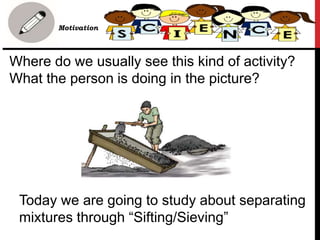
Where do we usually see this kind of activity?
What the person is doing in the picture?
• B. Motivation
Today we are going to study about separating
mixtures through “Sifting/Sieving”
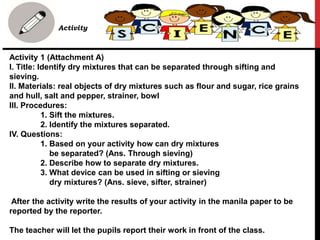
Activity 1 (Attachment A)
I. Title: Identify dry mixtures that can be separated through sifting and
sieving.
II. Materials: real objects of dry mixtures such as flour and sugar, rice grains
and hull, salt and pepper, strainer, bowl
III. Procedures:
1. Sift the mixtures.
2. Identify the mixtures separated.
IV. Questions:
1. Based on your activity how can dry mixtures
be separated? (Ans. Through sieving)
2. Describe how to separate dry mixtures.
3. What device can be used in sifting or sieving
dry mixtures? (Ans. sieve, sifter, strainer)
After the activity write the results of your activity in the manila paper to be
reported by the reporter.
The teacher will let the pupils report their work in front of the class.
• B. Activity
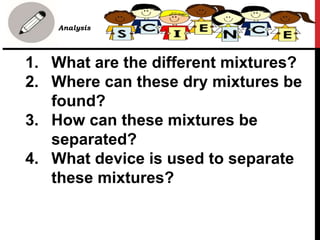
1. What are the different mixtures?
2. Where can these dry mixtures be
found?
3. How can these mixtures be
separated?
4. What device is used to separate
these mixtures?
• B. Analysis
1. What are the different mixtures?
2. Where can these dry mixtures be
found?
3. How can these mixtures be
separated?
4. What device is used to separate
these mixtures?
• B. Abstraction
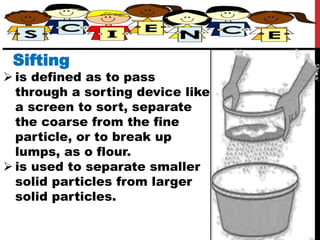
Sifting
 is defined as to pass
through a sorting device like
a screen to sort, separate
the coarse from the fine
particle, or to break up
lumps, as o flour.
 is used to separate smaller
solid particles from larger
solid particles.
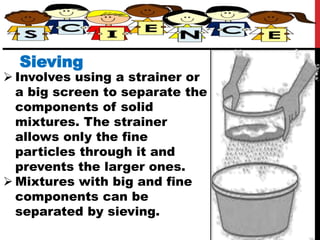
Sieving
 Involves using a strainer or
a big screen to separate the
components of solid
mixtures. The strainer
allows only the fine
particles through it and
prevents the larger ones.
 Mixtures with big and fine
components can be
separated by sieving.
Put a √ beside the mixtures that can
be separated through picking.
1. Sliced fruits ________
2. flour and sugar ________
3. beans and corn _______
4. sand and gravel _______
5. salt and pepper _______
• B. Application
Put a √ beside the mixtures that can be
separated through picking.
1. Sliced fruits ________
2. flour and sugar ________
3. beans and corn _______
4. sand and gravel _______
5. salt and pepper _______
Give a particular situation in their houses
especially in the kitchen where separation of
mixtures through sieving/sifting is being done.
________________________________________
• B. Application
1. What method of separating mixtures is
being used when separating dry mixtures?
2. What are the materials we used in
separating mixtures through sieving and
sifting?
3. What are the examples of mixtures that can
be separated through sieving and sifting?
4. Why is separating of mixture through
sieving and sifting important?
• B. Generalization
Describe how mixtures mentioned below are
separated. Write your answer on the space
provided after each number.
1. sugar and salt__________________
2. flour and rice___________________
3. sand and gravel_________________
4. marbles and stones______________
5. powdered milk and sugar_____________
• B. Evaluation
For numbers 6-10, identify what is being described in
each number. Write your answer in the space provided
before each number. Choose from the words inside the
box.
6. _______________mixture of these kinds is usually separated though
sifting and sieving.
7. _______________is used to separate smaller solid particles from larger
solid particles.
8. _______________a device containing tiny holes.
9. _______________ sift flour to get a smaller particle size for backing
leaving larger particles of flour in the sifter above the screen.
10. ______________ separate rocks into different sized particles for road
building.
• B. Evaluation
Dry mixtures sieve sifting
cooks construction companies
Watch the video
https://www.youtube.com/watch?v=zC3J
7Mdt8W4 on Separating Mixture through
Sifting/Sieving.
• B. Homework
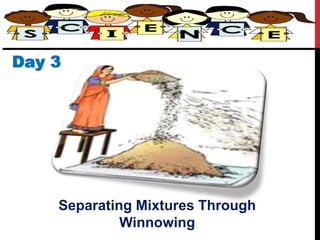
Day 3
Separating Mixtures Through
Winnowing
What was our lesson yesterday?
What do you mean by sifting or
sieving?
• Review
Reading of Important Science
Terms in flashcards or projected on
TV screen:
Winnow rice chaff
rice hull mongo pods
• Drill
Here is a picture (picture of a person
winnowing). Look at the picture. What is it
all about?
Have you seen people doing this at home or
in your locality?
• Motivation
Activity 1 – Observe how the person separates the materials using the process
of winnowing. Refer to the activity/task card for the instructions on what to do.
(Attachment A)
Activity 2 – Describe how mixtures are separated through winnowing
(Attachment B)
Activity 3 – Draw the winnower and describe how it is being used (Attachment
C)
Giving of Instructions:
1. Each group will choose a leader and a reporter.
2. Each group will be given an activity card.
3. The activity card serves as your guide on the activity
that you are going to perform.
4. All the members in the group must work as a team.
5. After the activity write the results of your activity in the manila paper to be
reported by the reporter.
The teacher will let the pupils report their work in front of the class.
• Activity
1. For Activity 1, What did you do? What happened to the
palay and hull after winnowing?
2. For Activity 2, what are the materials/components of the
mixture?
3. For Activity 3, how did you separate the components of
the mixtures?
• Analysis
• Abstraction
• Abstraction
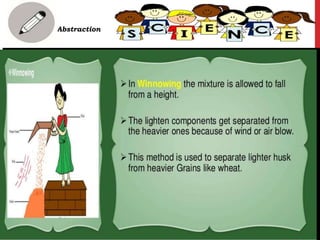
Winnowing is another way to separate mixtures. It
is the process of freeing (grain) from the lighter particles
of chaff, dirt, etc., especially by throwing it into the air and
allowing the wind or a forced current of air to blow away
impurities. Winnower is a tool used in this process of
separating mixtures called winnowing.
It is a farming method developed by ancient people
for separating grain from chaff. It is also used to remove
weevils or other pests from stored grain. Threshing,
which is the loosening of grain or seeds from the husks
and straw, comes before winnowing.
Generalization
In your own words, describe briefly how winnowing
is done in separating mixtures.
______________________________________
______________________________________
Give a particular activity where the process of
winnowing on separating components of mixture can be
used.
______________________________________
______________________________________
• Evaluation
Test A. Read each statement carefully. Write T if the statement
is true and F if it is false.
________1. Winnowing is separating heavier components of mixture
from the lighter substances with the help of the wind.
________2. In the process of winnowing, we use our hands to pick
each component of the mixture.
________3. This method is used for separating grains from husk after
the process of threshing.
________4. It is a farming method developed by ancient people.
________5. Winnowing can also describe the natural removal of fine
material from a coarser sediment by wind or flowing water.
Test B. Fill in the blanks to complete the concept.
Winnowing is another _____________ used in _____________
______________ by using a tool called _______________.
• Homework
Watch the video
https://www.youtube.com/watch?v=_AxxyA
KTZ-g on Separating Mixture through
Winnowing.
Day 4
Separating Mixtures Through
Filtration
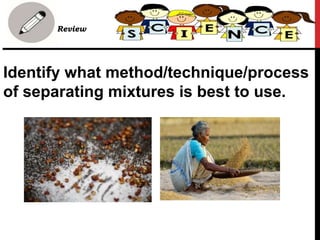
Identify what method/technique/process
of separating mixtures is best to use.
• Review
Reading of Important Science Terms in
flashcards or projected on TV screen:
filter filtration filtrate residue
solid liquid
• Drill
The teacher gives the meaning of difficult words.
1. filter – an apparatus containing a filter medium
2. filter medium – example filter paper or cloth
3. residue – a usual small amount of something that
remain after a process has been completed or a thing
has been removed
4. filtrate – something that remain after a process
has been completed or a thing has been removed.
Unlocking of Difficulties
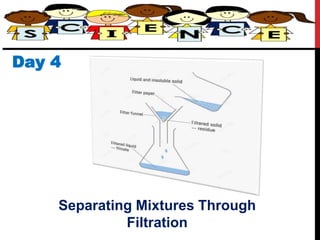
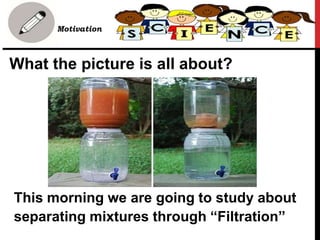
What the picture is all about?
• Motivation
This morning we are going to study about
separating mixtures through “Filtration”
Activity 1 – Separating mixtures through filtering. Refer to the
activity/task card for the instructions on what to do.
(Attachment A)
Activity 2 – Separating mixtures through filtering (Attachment
B)
Giving of Instructions:
1. Each group will choose a leader and a reporter.
2. Each group will be given an activity card.
3. The activity card serves as your guide on the activity
that you are going to perform.
4. All the members in the group must work as a team.
5. After the activity write the results of your activity in the
manila paper to be reported by the reporter.
• Activity
For Activity 1,
1.What did you do?
2. What are the materials you used?
3. What happened to the muddy water after filtering?
4. Are there remains of solid on the filter paper?
What about the water where did it go?
5. How can we separate solid-liquid mixtures?
For Activity 2,
1. What are the materials/components of the mixture?
2.How did you separate them?
3.What happened to the native coffee and water mixture after filtering?
4. Are there remains of solid on the filter paper?
5. How can we separate solid-liquid mixtures?
• Analysis
• Abstraction
• Abstraction
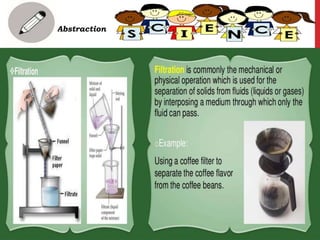
Filtration is the process of separating solid substances
from a liquid using a filter paper or any cloths that can be
used as a filtering medium. These solid residues are
trapped by the filter paper or cloth, which allow the liquid
substances to pass through in the process.
It is the process of separating an insoluble solid from the
liquid substance by allowing the liquid to pass through a
porous material. The porous material is usually a filter
paper. The method of separation applies only to
suspensions because solute and colloidal particles are too
small to be retained on the filter paper. In this process, the
filter paper allows the liquid to pass through it and retains
the solid particles. The solid is called the residue, while the
liquid is called the filtrate.
Application
Underline the mixtures that can be separated through
filtration.
Sand and water oil and water soil and water
Soybeans and water salt solution pepper and water
Rice grain and sugar grated coconut and coconut milk
You noticed that your water has small particles of sand.
What method can you use to make it clean and safe to
drink?
______________________________________
______________________________________
• Generalization
What do you mean by filtration? How
do you describe filtration as one of
the techniques in separating
mixture?
• Evaluation
Test A. Read each statement carefully. Write T if the statement is true
and F if it is false.
________1. A clean piece of cloth can also be used if filter paper is
not available.
________2. A mixture of liquid and tiny particles of solid which have
not been dissolved can be separated through filtration.
________3. Filtration is used in the process of making the muddy
water clean.
________4. It can also be used in separating rice grains from its
husks.
________5. Coconut milk can be separated from the remains of
grated coconut using a strainer.
• Evaluation
Test B. To explain the process of filtration, complete the
statement below by supplying with the appropriate words
found inside the box below.
Filtration, the process in which (1.)_________particles in
a liquid are (2.)________ using a (3.)_____________ that
permits the fluid to (4.)_________ through but
(5.)_________ the solid particles.
liquid solid retains pass
removed filter medium
• Homework
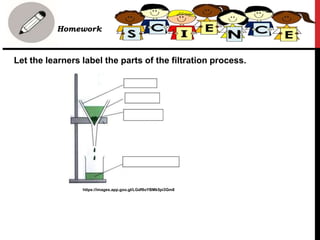
Let the learners label the parts of the filtration process.
https://images.app.goo.gl/LGdf8oYBMk5pi3Gm8
Separating Mixtures 1.pptx

Separating Mixtures 1.pptx

  • 1.
  • 2.
    Lesson 2: Separating Mixtures Han dpickin g Use of m a gn et Deca n ta tion E va p or a tion F iltr a tion Sievin g
  • 3.
  • 4.
  • 5.
    Reading of ImportantScience Terms in flashcards or projected on the screen: Mixtures colloids solution suspension Emulsions foams sol gel aerosols • Drill
  • 6.
    How do weseparate the components of this mixture? • Motivation This morning we are going to study about separating mixtures through “Hand-picking”
  • 7.
    Activity 1 –Name each material/component shown in the mixture and tell whether the material can be separated through picking or not. (Attachment A) Activity 2 – Given set of pictures, the group will identify the name of the materials/components of the mixtures and separate them from each other (Attachment B) Activity 3 – Giving sets of mixtures out of the given sample materials (Attachment C) • Activity
  • 8.
    Activity 1 –Name each material/component shown in the mixture and tell whether the material can be separated through picking or not. Instruction/s: Name each material/component shown in the mixture and tell whether the material can be separated through picking or not. • Activity _________________ _________________
  • 9.
    Activity 2 –Given set of pictures, the group will identify the name of the materials/components of the mixtures and separate them from each other. Instruction/s: The teacher gathers the materials a day before. I. Title: Identify the names of materials in a mixture. II. Materials: pebbles, chalk, mongo, seed, candies, marbles, stones, beans, marshmallow. III. Procedures: 1. List down the names of the materials for each mixture inside the bottle. 2. Separate the components or contents from each mixture. IV. Question: 1. How did you separate the mixtures? • Activity
  • 10.
    Activity 3 –Giving sets of mixtures out of the given sample materials. I. Title: Identify the names of materials in a mixture. II. Materials: pebbles soybeans mongo seeds rice stones marbles corn marshmallow III. Procedures: 1. By using the materials provided give four sets of mixtures out of the said materials. 2. Fill in the table below. • Activity
  • 11.
    1. For ActivityA, what are the materials found in the mixtures? Will it be easy for us to separate them? Can we separate them through picking? 2. For Activity B, what are the materials/components of the mixture? How did you separate them? 3. For Activity C, what are the mixtures you came up with using the given materials? Can we separate them using picking or manual separation? • Analysis
  • 12.
    In everyday life,we use several mixtures and one need to separate useful components from the mixture. Thus, the separation of substances is performed by various methods like hand-picking. Mixtures are combinations of two or more substances not chemically bonded where each substance retains its chemical entity and properties. One of the techniques of separating mixtures is through picking. For instances, a mixture of grains and corn can be separated through picking by using our bare hands. When the components of a mixture are slightly larger in size, it is easier for us to pick and separate them. • Abstraction
  • 13.
    Handpicking  Is atechnique used in separating the solid components of a heterogeneous mixture.  The components of the mixture should be big enough to be seen and picked up by hands or forceps.
  • 14.
    A. Put a√ beside the mixtures that can be separated through picking. 1. water and alcohol ________ 2. sliced mixed fruits ________ (Ans. √) 3. mixed nuts _______ (Ans. √) 4. nails and iron strips _______ (Ans. √) 5. stones and pebbles _______ (Ans. √) B. Give a particular situation in their houses especially in the kitchen where separation of mixtures through handpicking is being done. • Application
  • 15.
    1. What methodof separating mixtures is being used when materials in a mixture are slightly larger in size? 2. When do we use picking as a method of separating mixtures? 3. What are the examples of mixtures that can be separated through picking? 4. Why is separating of mixture through picking important? • Generalization
  • 16.
    A. Instruction/s: Writethe letter of the correct answer. 1. When can we separate the components of a mixture through picking? A. When the materials are liquid C. when the materials are solid and are big enough B. When the materials are soft D. when the materials are light and colorful 2-4. Which of the following mixtures can be separated though picking? A. Corn and mongo seeds B. Lemon juice and oil C. water and sugar D. B&C A. water and salt B. salt and sugar C. pebbles and gravel D. A&B A. marshmallows and rice grains B. nails and pins C. sliced fruits D. A, B and C 5. Which of the following sentences tell the advantages of separating mixtures through hand picking? A. Individual materials being separated can be used for a specific purpose. B. The easiest way of separating mixtures. C. No need to use any machinery, your hands are already enough. D. All of the above. • Evaluation
  • 17.
    For numbers 6-10,encircle the mixtures that can be separated through picking. • Rice with stone and dirt impurities. • Oil and water • Rotten fruits and fresh fruits. • Macaroni pasta and fruits • Rotten vegetables and fresh vegetables. • Lotion and hair gel • Chocolates and marshmallows
  • 18.
    Watch the video https://www.youtube.com/watch?v=n5TFJ-y8aVkon Separating Mixture through Hand Picking. • Homework
  • 20.
    Day 2 Separating MixturesThrough Sieving/Sifting
  • 21.
    Describe how thefollowing mixtures can be separated, through picking or not. Put a √ if it can be separated through picking. _____1. nails and stones _____2. lemon juice _____3. chocolates and marshmallows _____4. pepper seeds and mongo seeds _____5. corn and palay grains • Review
  • 22.
    Reading of ImportantScience Terms in flashcards or projected on TV screen: Picking rice hull sift Dry mixtures rice grains sieve • Review
  • 23.
    Unlock the wordsused in the drill. Picking- to gather or harvest something using hands. Sift-to separate or remove using a sifter Sieving-to pass through a sorting device like a screen to sort, separate the coarse from the fine particle, or to break up lumps, as o flour. • Unlocking of Difficulties
  • 24.
    Unlock the wordsused in the drill. Picking- to gather or harvest something using hands. Sift-to separate or remove using a sifter Sieving-to pass through a sorting device like a screen to sort, separate the coarse from the fine particle, or to break up lumps, as o flour. • Unlocking of Difficulties
  • 25.
    Where do weusually see this kind of activity? What the person is doing in the picture? • B. Motivation Today we are going to study about separating mixtures through “Sifting/Sieving”
  • 26.
    Activity 1 (AttachmentA) I. Title: Identify dry mixtures that can be separated through sifting and sieving. II. Materials: real objects of dry mixtures such as flour and sugar, rice grains and hull, salt and pepper, strainer, bowl III. Procedures: 1. Sift the mixtures. 2. Identify the mixtures separated. IV. Questions: 1. Based on your activity how can dry mixtures be separated? (Ans. Through sieving) 2. Describe how to separate dry mixtures. 3. What device can be used in sifting or sieving dry mixtures? (Ans. sieve, sifter, strainer) After the activity write the results of your activity in the manila paper to be reported by the reporter. The teacher will let the pupils report their work in front of the class. • B. Activity
  • 27.
    1. What arethe different mixtures? 2. Where can these dry mixtures be found? 3. How can these mixtures be separated? 4. What device is used to separate these mixtures? • B. Analysis
  • 28.
    1. What arethe different mixtures? 2. Where can these dry mixtures be found? 3. How can these mixtures be separated? 4. What device is used to separate these mixtures? • B. Abstraction
  • 29.
    Sifting  is definedas to pass through a sorting device like a screen to sort, separate the coarse from the fine particle, or to break up lumps, as o flour.  is used to separate smaller solid particles from larger solid particles.
  • 30.
    Sieving  Involves usinga strainer or a big screen to separate the components of solid mixtures. The strainer allows only the fine particles through it and prevents the larger ones.  Mixtures with big and fine components can be separated by sieving.
  • 31.
    Put a √beside the mixtures that can be separated through picking. 1. Sliced fruits ________ 2. flour and sugar ________ 3. beans and corn _______ 4. sand and gravel _______ 5. salt and pepper _______ • B. Application
  • 32.
    Put a √beside the mixtures that can be separated through picking. 1. Sliced fruits ________ 2. flour and sugar ________ 3. beans and corn _______ 4. sand and gravel _______ 5. salt and pepper _______ Give a particular situation in their houses especially in the kitchen where separation of mixtures through sieving/sifting is being done. ________________________________________ • B. Application
  • 33.
    1. What methodof separating mixtures is being used when separating dry mixtures? 2. What are the materials we used in separating mixtures through sieving and sifting? 3. What are the examples of mixtures that can be separated through sieving and sifting? 4. Why is separating of mixture through sieving and sifting important? • B. Generalization
  • 34.
    Describe how mixturesmentioned below are separated. Write your answer on the space provided after each number. 1. sugar and salt__________________ 2. flour and rice___________________ 3. sand and gravel_________________ 4. marbles and stones______________ 5. powdered milk and sugar_____________ • B. Evaluation
  • 35.
    For numbers 6-10,identify what is being described in each number. Write your answer in the space provided before each number. Choose from the words inside the box. 6. _______________mixture of these kinds is usually separated though sifting and sieving. 7. _______________is used to separate smaller solid particles from larger solid particles. 8. _______________a device containing tiny holes. 9. _______________ sift flour to get a smaller particle size for backing leaving larger particles of flour in the sifter above the screen. 10. ______________ separate rocks into different sized particles for road building. • B. Evaluation Dry mixtures sieve sifting cooks construction companies
  • 36.
    Watch the video https://www.youtube.com/watch?v=zC3J 7Mdt8W4on Separating Mixture through Sifting/Sieving. • B. Homework
  • 38.
    Day 3 Separating MixturesThrough Winnowing
  • 39.
    What was ourlesson yesterday? What do you mean by sifting or sieving? • Review
  • 40.
    Reading of ImportantScience Terms in flashcards or projected on TV screen: Winnow rice chaff rice hull mongo pods • Drill
  • 41.
    Here is apicture (picture of a person winnowing). Look at the picture. What is it all about? Have you seen people doing this at home or in your locality? • Motivation
  • 42.
    Activity 1 –Observe how the person separates the materials using the process of winnowing. Refer to the activity/task card for the instructions on what to do. (Attachment A) Activity 2 – Describe how mixtures are separated through winnowing (Attachment B) Activity 3 – Draw the winnower and describe how it is being used (Attachment C) Giving of Instructions: 1. Each group will choose a leader and a reporter. 2. Each group will be given an activity card. 3. The activity card serves as your guide on the activity that you are going to perform. 4. All the members in the group must work as a team. 5. After the activity write the results of your activity in the manila paper to be reported by the reporter. The teacher will let the pupils report their work in front of the class. • Activity
  • 43.
    1. For Activity1, What did you do? What happened to the palay and hull after winnowing? 2. For Activity 2, what are the materials/components of the mixture? 3. For Activity 3, how did you separate the components of the mixtures? • Analysis
  • 44.
  • 45.
    • Abstraction Winnowing isanother way to separate mixtures. It is the process of freeing (grain) from the lighter particles of chaff, dirt, etc., especially by throwing it into the air and allowing the wind or a forced current of air to blow away impurities. Winnower is a tool used in this process of separating mixtures called winnowing. It is a farming method developed by ancient people for separating grain from chaff. It is also used to remove weevils or other pests from stored grain. Threshing, which is the loosening of grain or seeds from the husks and straw, comes before winnowing.
  • 46.
    Generalization In your ownwords, describe briefly how winnowing is done in separating mixtures. ______________________________________ ______________________________________ Give a particular activity where the process of winnowing on separating components of mixture can be used. ______________________________________ ______________________________________
  • 47.
    • Evaluation Test A.Read each statement carefully. Write T if the statement is true and F if it is false. ________1. Winnowing is separating heavier components of mixture from the lighter substances with the help of the wind. ________2. In the process of winnowing, we use our hands to pick each component of the mixture. ________3. This method is used for separating grains from husk after the process of threshing. ________4. It is a farming method developed by ancient people. ________5. Winnowing can also describe the natural removal of fine material from a coarser sediment by wind or flowing water. Test B. Fill in the blanks to complete the concept. Winnowing is another _____________ used in _____________ ______________ by using a tool called _______________.
  • 48.
    • Homework Watch thevideo https://www.youtube.com/watch?v=_AxxyA KTZ-g on Separating Mixture through Winnowing.
  • 50.
    Day 4 Separating MixturesThrough Filtration
  • 51.
    Identify what method/technique/process ofseparating mixtures is best to use. • Review
  • 52.
    Reading of ImportantScience Terms in flashcards or projected on TV screen: filter filtration filtrate residue solid liquid • Drill
  • 53.
    The teacher givesthe meaning of difficult words. 1. filter – an apparatus containing a filter medium 2. filter medium – example filter paper or cloth 3. residue – a usual small amount of something that remain after a process has been completed or a thing has been removed 4. filtrate – something that remain after a process has been completed or a thing has been removed. Unlocking of Difficulties
  • 54.
    What the pictureis all about? • Motivation This morning we are going to study about separating mixtures through “Filtration”
  • 55.
    Activity 1 –Separating mixtures through filtering. Refer to the activity/task card for the instructions on what to do. (Attachment A) Activity 2 – Separating mixtures through filtering (Attachment B) Giving of Instructions: 1. Each group will choose a leader and a reporter. 2. Each group will be given an activity card. 3. The activity card serves as your guide on the activity that you are going to perform. 4. All the members in the group must work as a team. 5. After the activity write the results of your activity in the manila paper to be reported by the reporter. • Activity
  • 56.
    For Activity 1, 1.Whatdid you do? 2. What are the materials you used? 3. What happened to the muddy water after filtering? 4. Are there remains of solid on the filter paper? What about the water where did it go? 5. How can we separate solid-liquid mixtures? For Activity 2, 1. What are the materials/components of the mixture? 2.How did you separate them? 3.What happened to the native coffee and water mixture after filtering? 4. Are there remains of solid on the filter paper? 5. How can we separate solid-liquid mixtures? • Analysis
  • 57.
  • 58.
    • Abstraction Filtration isthe process of separating solid substances from a liquid using a filter paper or any cloths that can be used as a filtering medium. These solid residues are trapped by the filter paper or cloth, which allow the liquid substances to pass through in the process. It is the process of separating an insoluble solid from the liquid substance by allowing the liquid to pass through a porous material. The porous material is usually a filter paper. The method of separation applies only to suspensions because solute and colloidal particles are too small to be retained on the filter paper. In this process, the filter paper allows the liquid to pass through it and retains the solid particles. The solid is called the residue, while the liquid is called the filtrate.
  • 59.
    Application Underline the mixturesthat can be separated through filtration. Sand and water oil and water soil and water Soybeans and water salt solution pepper and water Rice grain and sugar grated coconut and coconut milk You noticed that your water has small particles of sand. What method can you use to make it clean and safe to drink? ______________________________________ ______________________________________
  • 60.
    • Generalization What doyou mean by filtration? How do you describe filtration as one of the techniques in separating mixture?
  • 61.
    • Evaluation Test A.Read each statement carefully. Write T if the statement is true and F if it is false. ________1. A clean piece of cloth can also be used if filter paper is not available. ________2. A mixture of liquid and tiny particles of solid which have not been dissolved can be separated through filtration. ________3. Filtration is used in the process of making the muddy water clean. ________4. It can also be used in separating rice grains from its husks. ________5. Coconut milk can be separated from the remains of grated coconut using a strainer.
  • 62.
    • Evaluation Test B.To explain the process of filtration, complete the statement below by supplying with the appropriate words found inside the box below. Filtration, the process in which (1.)_________particles in a liquid are (2.)________ using a (3.)_____________ that permits the fluid to (4.)_________ through but (5.)_________ the solid particles. liquid solid retains pass removed filter medium
  • 63.
    • Homework Let thelearners label the parts of the filtration process. https://images.app.goo.gl/LGdf8oYBMk5pi3Gm8