Consonants and vowels
John Goldsmith
Kinds of phonetics
• Transcribing: descriptive phonetics?
transcriptional phonetics? No standard name.
• Articulatory phonetics
• Acoustic phonetics
• Perceptual phonetics (Psychology)
• Computational phonetics (CS)
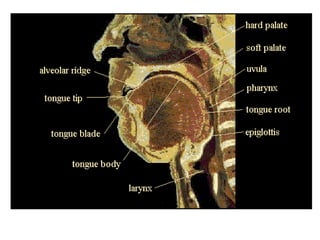
Articulatory apparatus
Some (not so happy) assumptions
generally made to do transcriptions
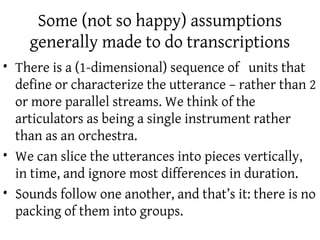
• There is a (1-dimensional) sequence of units that
define or characterize the utterance – rather than 2
or more parallel streams. We think of the
articulators as being a single instrument rather
than as an orchestra.
• We can slice the utterances into pieces vertically,
in time, and ignore most differences in duration.
• Sounds follow one another, and that’s it: there is no
packing of them into groups.
Sounds of English
Consonants: first, the stops:
• b as in bat, sob, cubby
• d as in date, hid, ado
• g as in gas, lag, ragged
• p as in pet, tap, repeat
• t as in tap, pet, attack
• k as in king, pick, picking
When we need to emphasize
that we are using a phonetic
transcription, we put square
brackets [b] around the symbols.
More consonants: fricatives
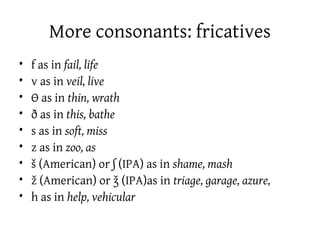
• f as in fail, life
• v as in veil, live
• Ɵ as in thin, wrath
• ð as in this, bathe
• s as in soft, miss
• z as in zoo, as
• š (American) or ʃ (IPA) as in shame, mash
• ž (American) or ǯ (IPA)as in triage, garage, azure,
• h as in help, vehicular
affricates
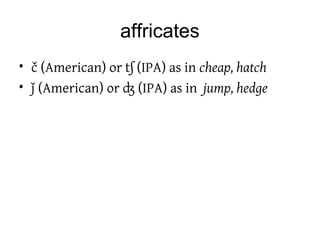
• č (American) or tʃ (IPA) as in cheap, hatch
• ǰ (American) or ʤ (IPA) as in jump, hedge
nasal consonants
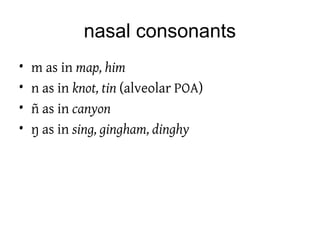
• m as in map, him
• n as in knot, tin (alveolar POA)
• ñ as in canyon
• ŋ as in sing, gingham, dinghy
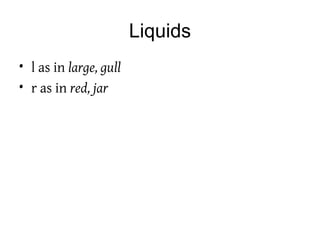
Liquids
• l as in large, gull
• r as in red, jar
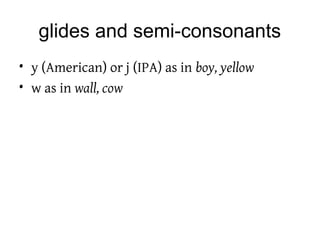
glides and semi-consonants
• y (American) or j (IPA) as in boy, yellow
• w as in wall, cow
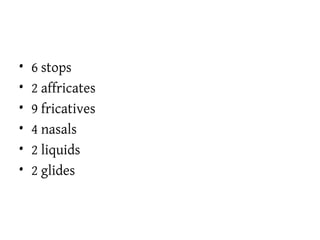
• 6 stops
• 2 affricates
• 9 fricatives
• 4 nasals
• 2 liquids
• 2 glides
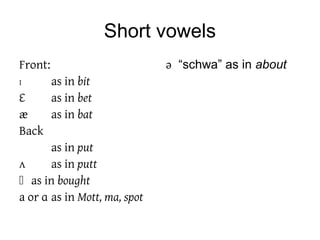
Short vowels
Front:
I as in bit
Ɛ as in bet
æ as in bat
Back
as in put
ʌ as in putt
 as in bought
a or ɑ as in Mott, ma, spot
ǝ “schwa” as in about
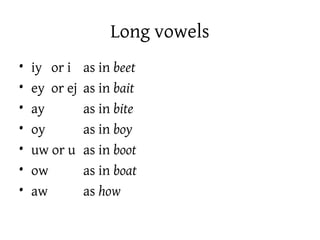
Long vowels
• iy or i as in beet
• ey or ej as in bait
• ay as in bite
• oy as in boy
• uw or u as in boot
• ow as in boat
• aw as how
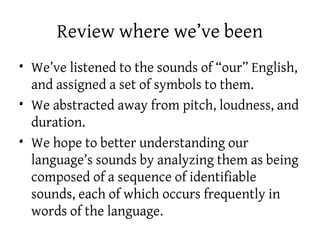
Review where we’ve been
• We’ve listened to the sounds of “our” English,
and assigned a set of symbols to them.
• We abstracted away from pitch, loudness, and
duration.
• We hope to better understanding our
language’s sounds by analyzing them as being
composed of a sequence of identifiable
sounds, each of which occurs frequently in
words of the language.
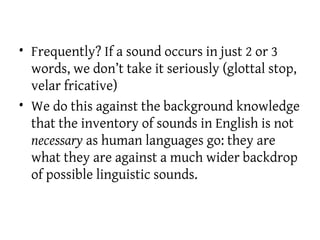
• Frequently? If a sound occurs in just 2 or 3
words, we don’t take it seriously (glottal stop,
velar fricative)
• We do this against the background knowledge
that the inventory of sounds in English is not
necessary as human languages go: they are
what they are against a much wider backdrop
of possible linguistic sounds.
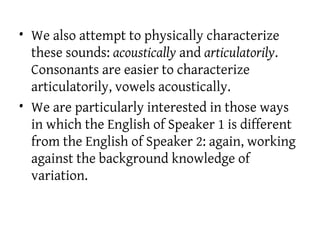
• We also attempt to physically characterize
these sounds: acoustically and articulatorily.
Consonants are easier to characterize
articulatorily, vowels acoustically.
• We are particularly interested in those ways
in which the English of Speaker 1 is different
from the English of Speaker 2: again, working
against the background knowledge of
variation.
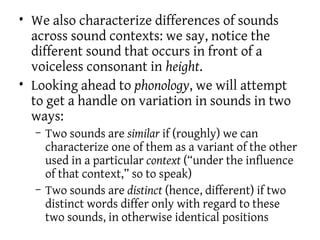
• We also characterize differences of sounds
across sound contexts: we say, notice the
different sound that occurs in front of a
voiceless consonant in height.
• Looking ahead to phonology, we will attempt
to get a handle on variation in sounds in two
ways:
– Two sounds are similar if (roughly) we can
characterize one of them as a variant of the other
used in a particular context (“under the influence
of that context,” so to speak)
– Two sounds are distinct (hence, different) if two
distinct words differ only with regard to these
two sounds, in otherwise identical positions
• We try to characterize the inventory of
sounds in a language, knowing that that
language chose one set of sounds when a vast
range of other possibilities might have been
chosen.
Symbols
• We assign symbols to these sounds; in
addition, we want to characterize them as
best we can articulatorily and acoustically.
Sounds can be divided into two major
groups, consonants and vowels; or set
along a continuum known as the sonority
hierarchy:
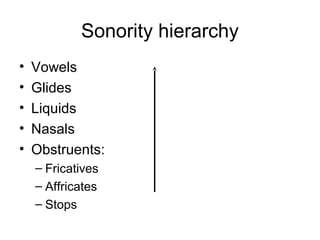
Sonority hierarchy
• Vowels
• Glides
• Liquids
• Nasals
• Obstruents:
– Fricatives
– Affricates
– Stops
Consonants
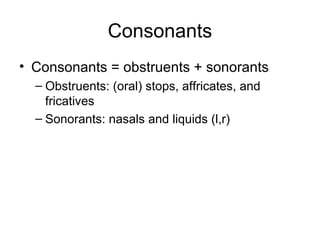
• Consonants = obstruents + sonorants
– Obstruents: (oral) stops, affricates, and
fricatives
– Sonorants: nasals and liquids (l,r)
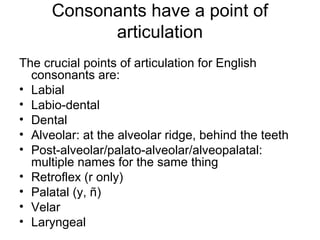
Consonants have a point of
articulation
The crucial points of articulation for English
consonants are:
• Labial
• Labio-dental
• Dental
• Alveolar: at the alveolar ridge, behind the teeth
• Post-alveolar/palato-alveolar/alveopalatal:
multiple names for the same thing
• Retroflex (r only)
• Palatal (y, ñ)
• Velar
• Laryngeal
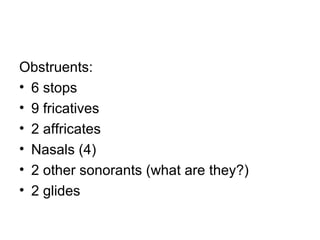
Obstruents:
• 6 stops
• 9 fricatives
• 2 affricates
• Nasals (4)
• 2 other sonorants (what are they?)
• 2 glides
Vowels
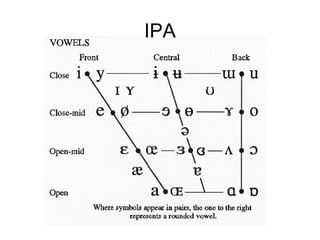
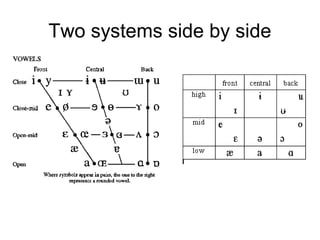
• Vowels are harder to characterize
articulatorily, but we try!
• The fact that it’s harder is reflected in the
fact that there is more than one way in
which it’s done. IPA is one way; American
is another.
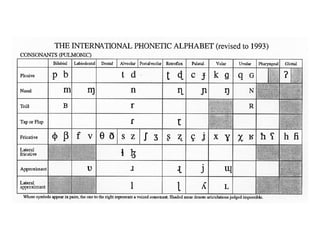
IPA
Two systems side by side
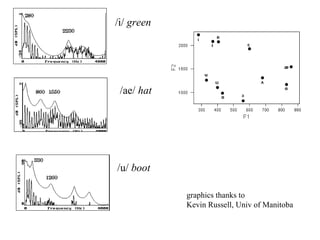
A phonetic chart based on the first
two formants
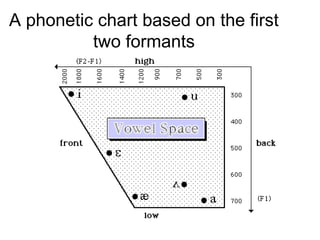
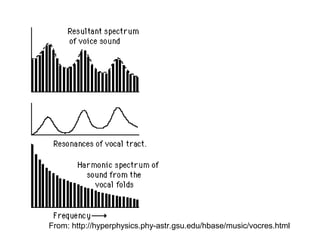
From: http://hyperphysics.phy-astr.gsu.edu/hbase/music/vocres.html
/i/ green
/ae/ hat
/u/ boot
graphics thanks to
Kevin Russell, Univ of Manitoba
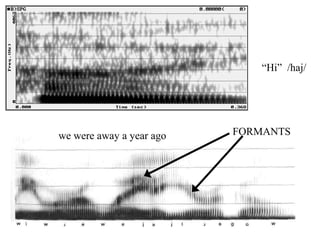
“Hi” /haj/
we were away a year ago FORMANTS

Consonants andvowels

  • 1.
  • 2.
    Kinds of phonetics •Transcribing: descriptive phonetics? transcriptional phonetics? No standard name. • Articulatory phonetics • Acoustic phonetics • Perceptual phonetics (Psychology) • Computational phonetics (CS)
  • 3.
  • 5.
    Some (not sohappy) assumptions generally made to do transcriptions • There is a (1-dimensional) sequence of units that define or characterize the utterance – rather than 2 or more parallel streams. We think of the articulators as being a single instrument rather than as an orchestra. • We can slice the utterances into pieces vertically, in time, and ignore most differences in duration. • Sounds follow one another, and that’s it: there is no packing of them into groups.
  • 6.
    Sounds of English Consonants:first, the stops: • b as in bat, sob, cubby • d as in date, hid, ado • g as in gas, lag, ragged • p as in pet, tap, repeat • t as in tap, pet, attack • k as in king, pick, picking When we need to emphasize that we are using a phonetic transcription, we put square brackets [b] around the symbols.
  • 7.
    More consonants: fricatives •f as in fail, life • v as in veil, live • Ɵ as in thin, wrath • ð as in this, bathe • s as in soft, miss • z as in zoo, as • š (American) or ʃ (IPA) as in shame, mash • ž (American) or ǯ (IPA)as in triage, garage, azure, • h as in help, vehicular
  • 8.
    affricates • č (American)or tʃ (IPA) as in cheap, hatch • ǰ (American) or ʤ (IPA) as in jump, hedge
  • 9.
    nasal consonants • mas in map, him • n as in knot, tin (alveolar POA) • ñ as in canyon • ŋ as in sing, gingham, dinghy
  • 10.
    Liquids • l asin large, gull • r as in red, jar
  • 11.
    glides and semi-consonants •y (American) or j (IPA) as in boy, yellow • w as in wall, cow
  • 12.
    • 6 stops •2 affricates • 9 fricatives • 4 nasals • 2 liquids • 2 glides
  • 13.
    Short vowels Front: I asin bit Ɛ as in bet æ as in bat Back as in put ʌ as in putt  as in bought a or ɑ as in Mott, ma, spot ǝ “schwa” as in about
  • 14.
    Long vowels • iyor i as in beet • ey or ej as in bait • ay as in bite • oy as in boy • uw or u as in boot • ow as in boat • aw as how
  • 15.
    Review where we’vebeen • We’ve listened to the sounds of “our” English, and assigned a set of symbols to them. • We abstracted away from pitch, loudness, and duration. • We hope to better understanding our language’s sounds by analyzing them as being composed of a sequence of identifiable sounds, each of which occurs frequently in words of the language.
  • 16.
    • Frequently? Ifa sound occurs in just 2 or 3 words, we don’t take it seriously (glottal stop, velar fricative) • We do this against the background knowledge that the inventory of sounds in English is not necessary as human languages go: they are what they are against a much wider backdrop of possible linguistic sounds.
  • 17.
    • We alsoattempt to physically characterize these sounds: acoustically and articulatorily. Consonants are easier to characterize articulatorily, vowels acoustically. • We are particularly interested in those ways in which the English of Speaker 1 is different from the English of Speaker 2: again, working against the background knowledge of variation.
  • 18.
    • We alsocharacterize differences of sounds across sound contexts: we say, notice the different sound that occurs in front of a voiceless consonant in height. • Looking ahead to phonology, we will attempt to get a handle on variation in sounds in two ways: – Two sounds are similar if (roughly) we can characterize one of them as a variant of the other used in a particular context (“under the influence of that context,” so to speak) – Two sounds are distinct (hence, different) if two distinct words differ only with regard to these two sounds, in otherwise identical positions
  • 19.
    • We tryto characterize the inventory of sounds in a language, knowing that that language chose one set of sounds when a vast range of other possibilities might have been chosen.
  • 20.
    Symbols • We assignsymbols to these sounds; in addition, we want to characterize them as best we can articulatorily and acoustically. Sounds can be divided into two major groups, consonants and vowels; or set along a continuum known as the sonority hierarchy:
  • 21.
    Sonority hierarchy • Vowels •Glides • Liquids • Nasals • Obstruents: – Fricatives – Affricates – Stops
  • 22.
    Consonants • Consonants =obstruents + sonorants – Obstruents: (oral) stops, affricates, and fricatives – Sonorants: nasals and liquids (l,r)
  • 23.
    Consonants have apoint of articulation The crucial points of articulation for English consonants are: • Labial • Labio-dental • Dental • Alveolar: at the alveolar ridge, behind the teeth • Post-alveolar/palato-alveolar/alveopalatal: multiple names for the same thing • Retroflex (r only) • Palatal (y, ñ) • Velar • Laryngeal
  • 24.
    Obstruents: • 6 stops •9 fricatives • 2 affricates • Nasals (4) • 2 other sonorants (what are they?) • 2 glides
  • 26.
    Vowels • Vowels areharder to characterize articulatorily, but we try! • The fact that it’s harder is reflected in the fact that there is more than one way in which it’s done. IPA is one way; American is another.
  • 27.
  • 28.
  • 29.
    A phonetic chartbased on the first two formants
  • 30.
  • 31.
    /i/ green /ae/ hat /u/boot graphics thanks to Kevin Russell, Univ of Manitoba
  • 32.
    “Hi” /haj/ we wereaway a year ago FORMANTS