What is circumcision? 
 Circumcision is the surgical removal of the foreskin in 
boys. Typically performed within hours or days of 
birth. 
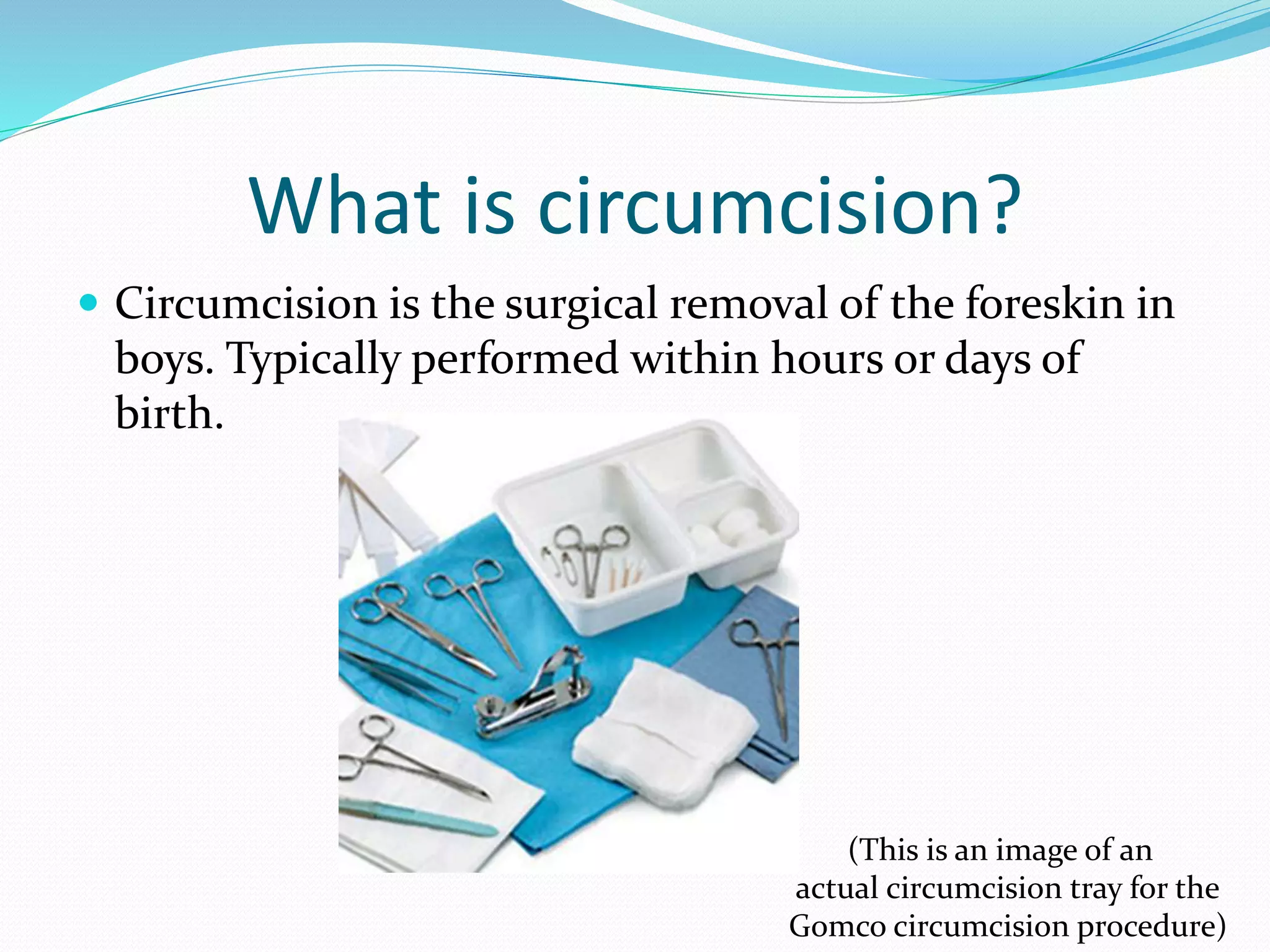
(This is an image of an 
actual circumcision tray for the 
Gomco circumcision procedure)
What is the foreskin? 
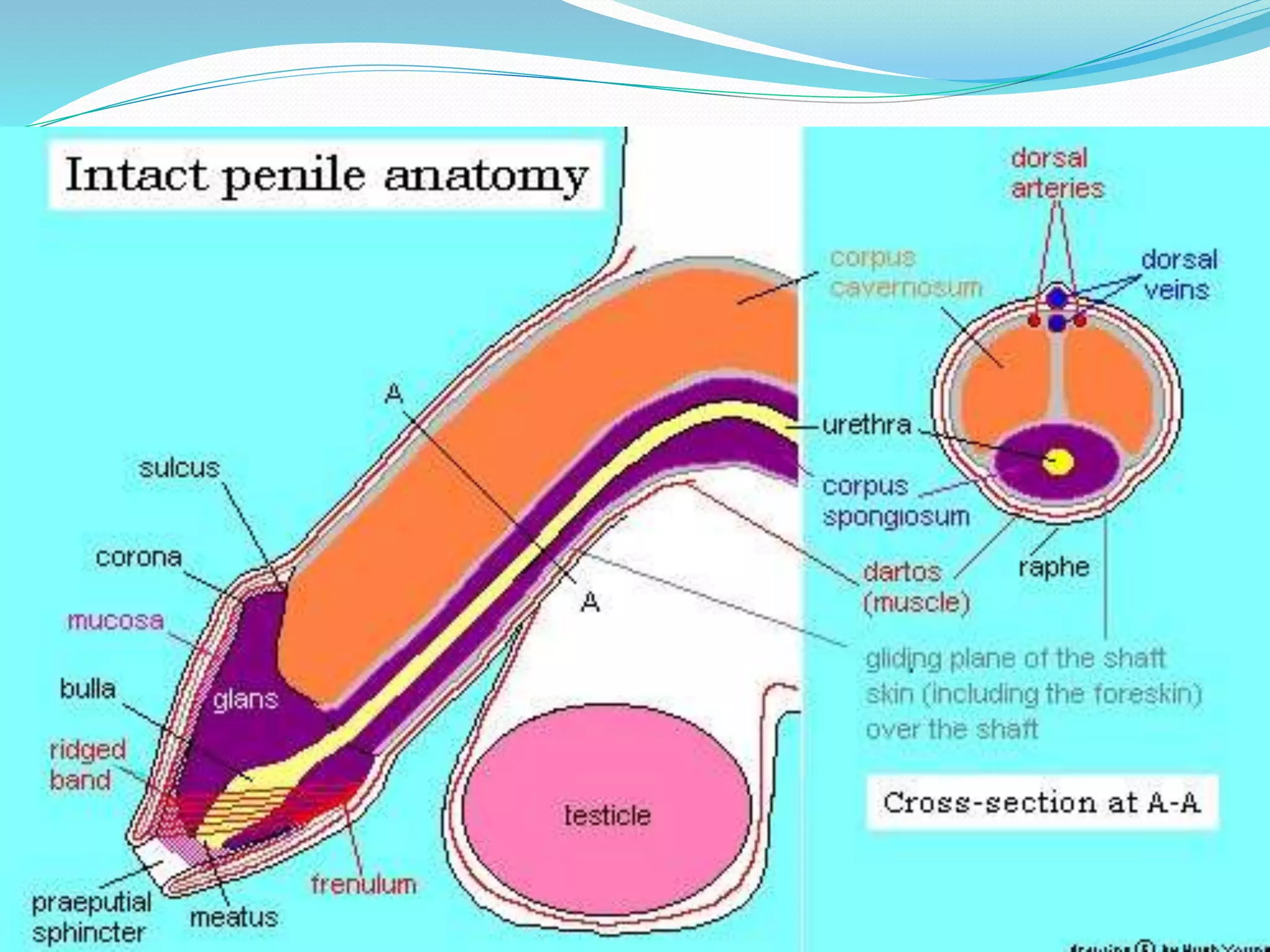
 The prepuce, or foreskin, is a highly erogenous organ with many 
anatomical structures. Some of the anatomy of the foreskin are: 
 The Frenulum (highly sensitive bundle of nerves) 
 Meissner’s Corpuscles (pleasure receptors) 
 Frenar or Ridged Bands (keeps the foreskin forward, protecting the 
glans when the penis is flaccid. When the penis becomes erect, the 
band expands, allowing the foreskin to slide over the glans) 
 Dartos Fascia (temperature receptors) 
 Several feet of blood vessels (aids in maintaining an erection) 
 Apocrine Glands (produces pheromones) 
 Sebaceous Glands (aids in natural lubrication) 
 Immunological System (antibodies, antibacterial, and antiviral)
How are circumcisions performed? 
(Warning! The next few slides are graphic, and not intended 
for individuals under 18 years of age) 
• Circumcisions are performed, most commonly, by 3 different 
methods: 
• The Gomco Clamp Method 
• The Mogan Clamp Method 
• The Plastibell Method 
• Today we are going to show the most common here in the 
United Stated, The GomcoMethod.
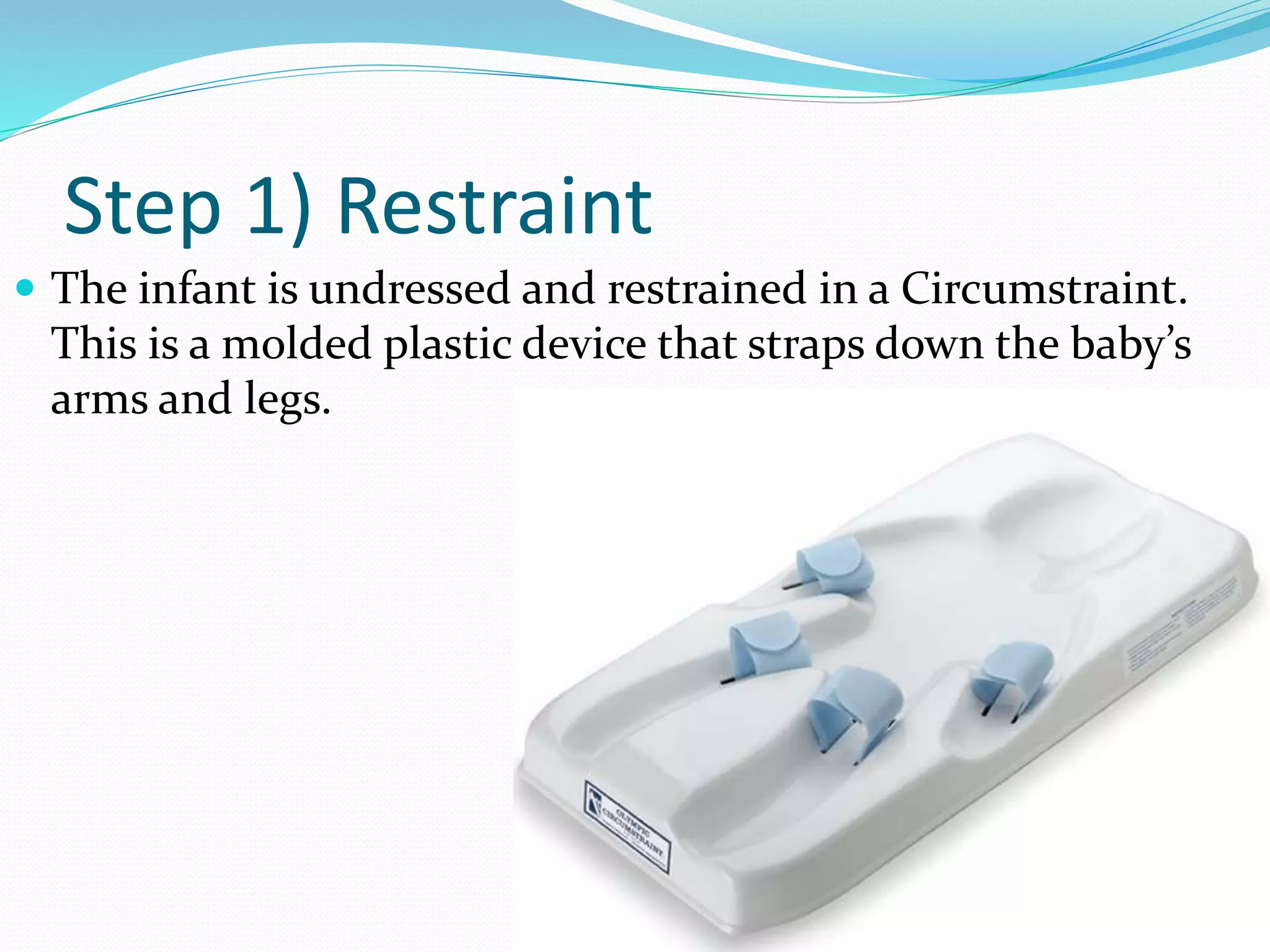
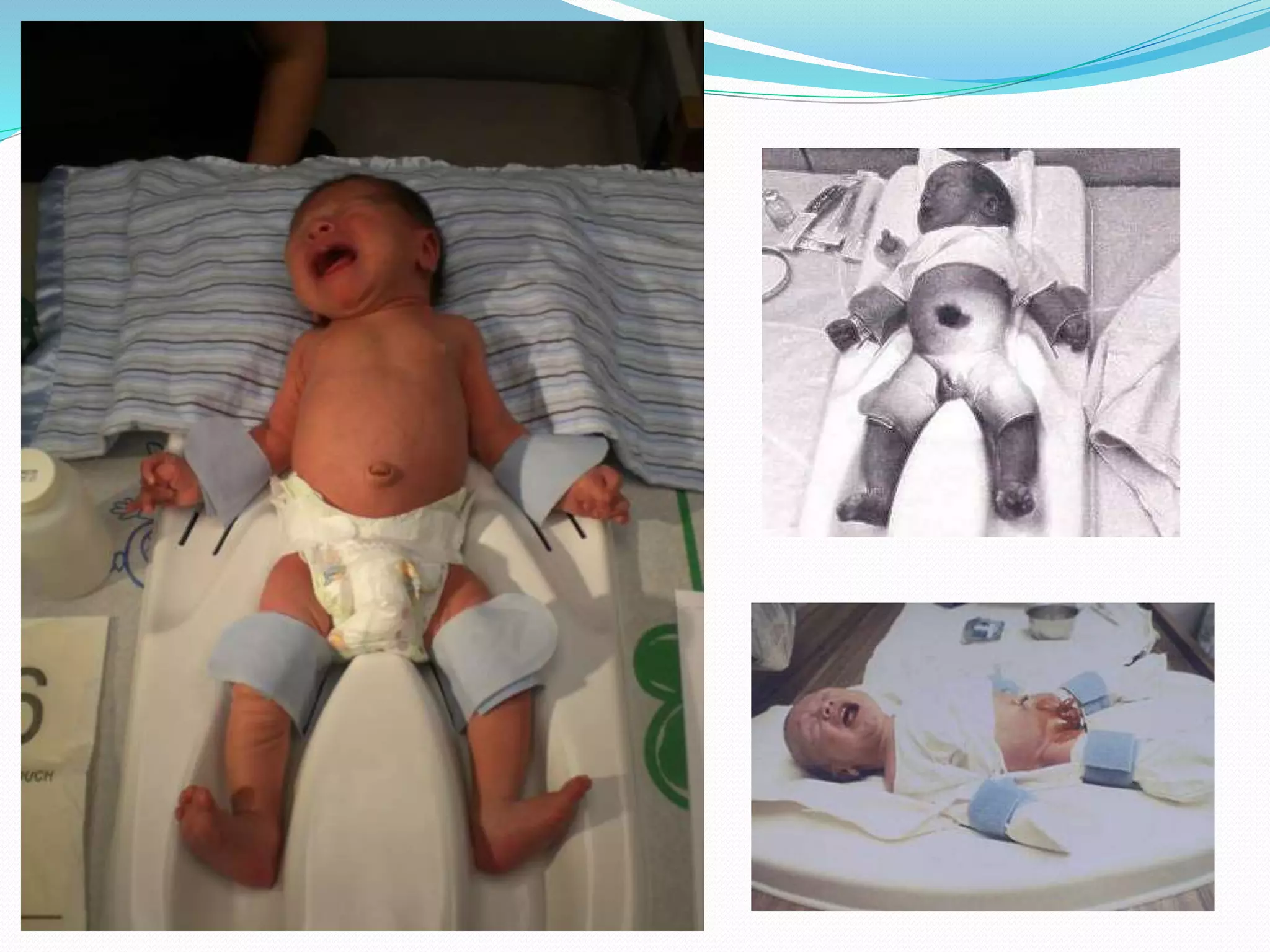
Step 1) Restraint 
 The infant is undressed and restrained in a Circumstraint. 
This is a molded plastic device that straps down the baby’s 
arms and legs.
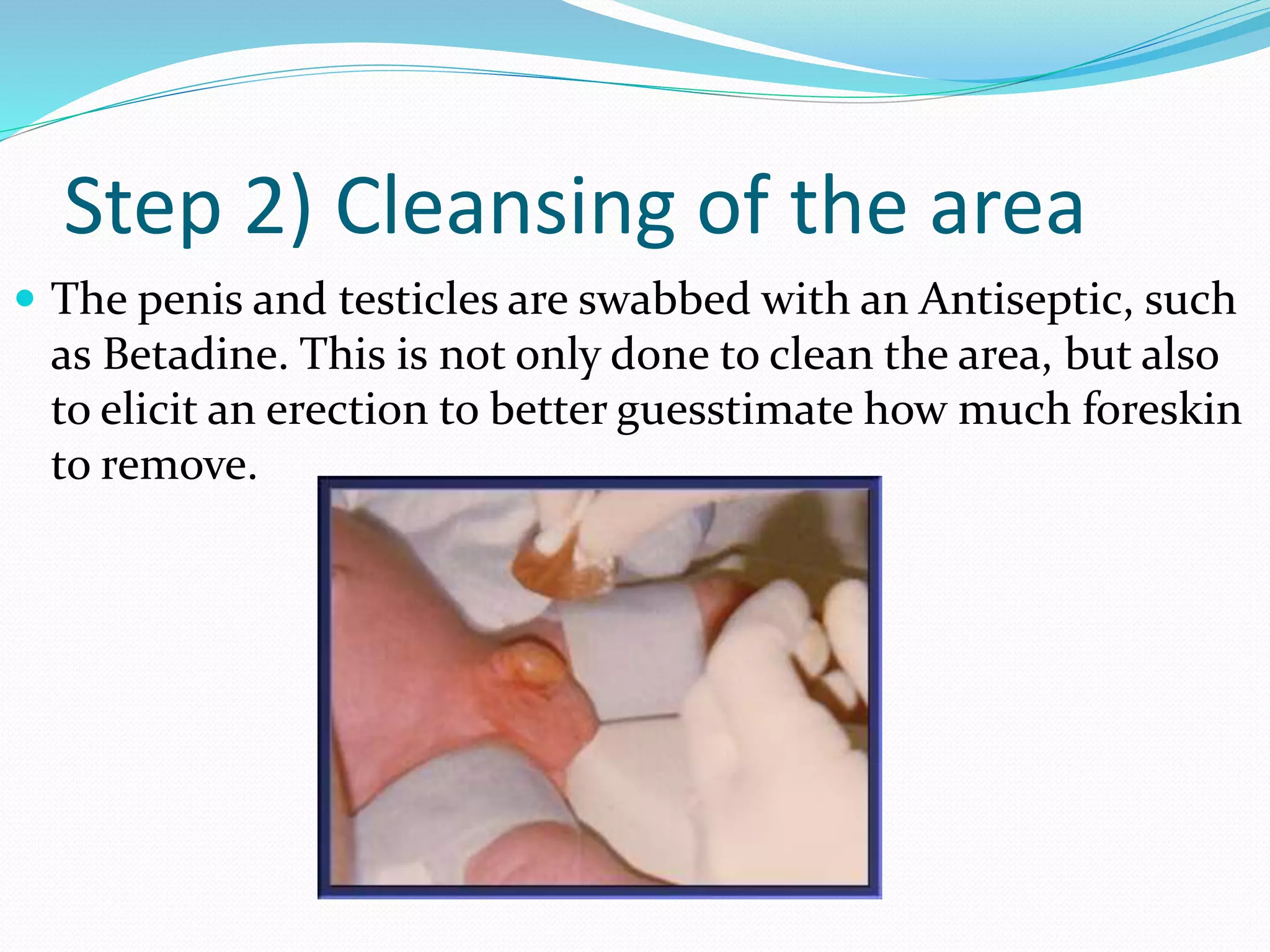
Step 2) Cleansing of the area 
 The penis and testicles are swabbed with an Antiseptic, such 
as Betadine. This is not only done to clean the area, but also 
to elicit an erection to better guesstimate how much foreskin 
to remove.
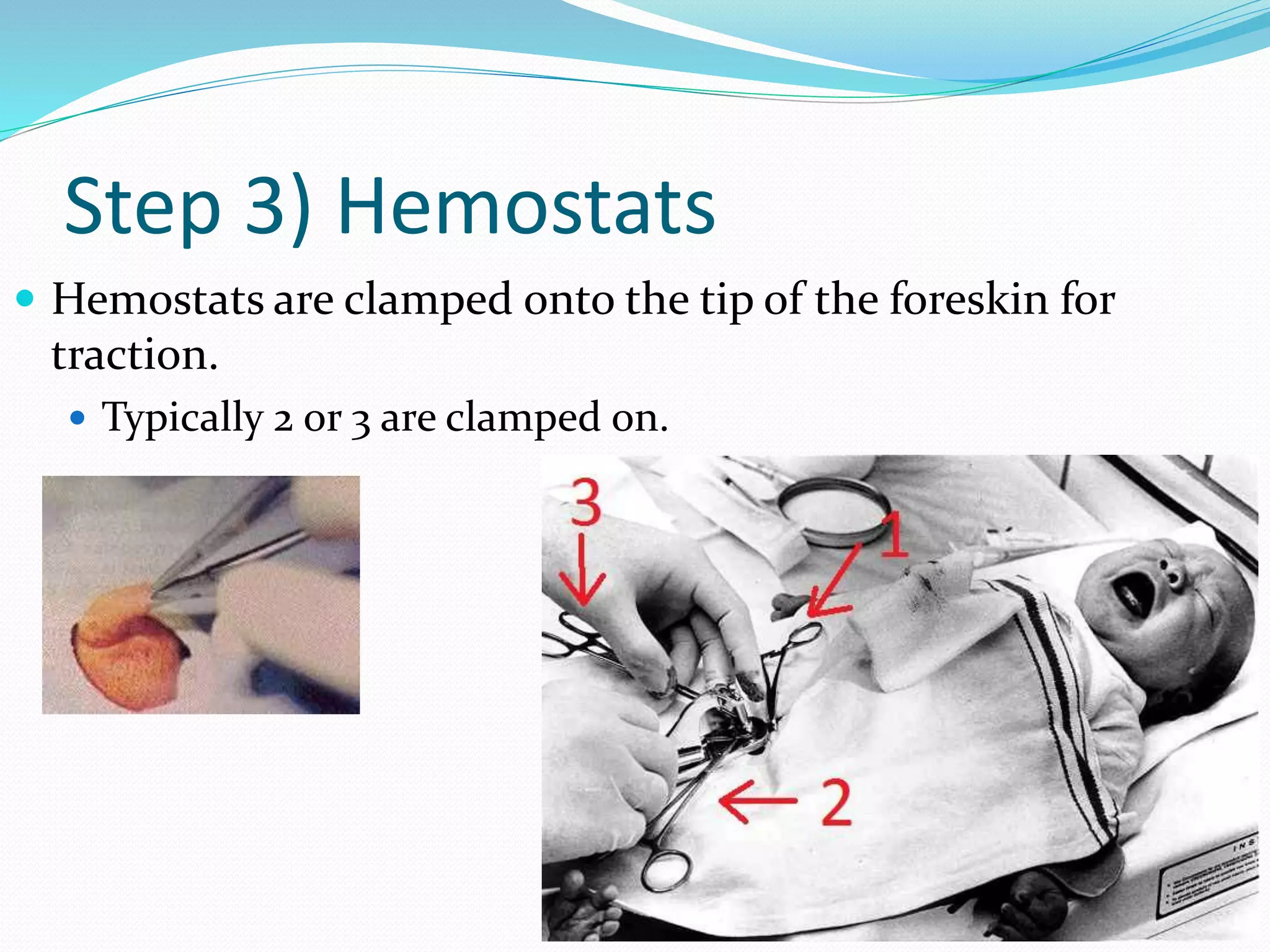
Step 3) Hemostats 
 Hemostats are clamped onto the tip of the foreskin for 
traction. 
 Typically 2 or 3 are clamped on.
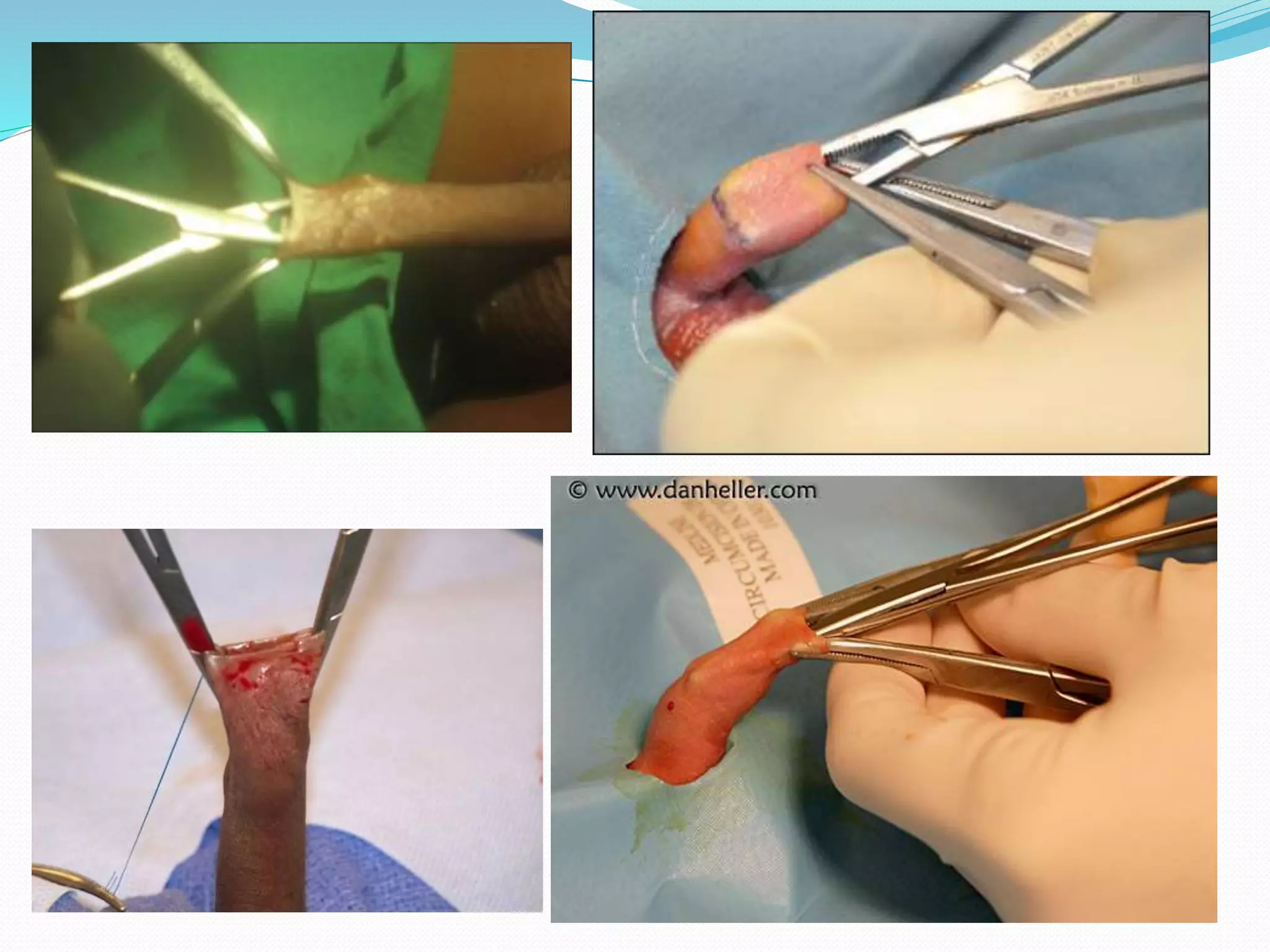
Step 4) Separation 
 At birth the foreskin is fused to the glans (head) of the penis, 
much like your fingernails are fused to the nail bedding 
matrix of your fingers. This fusion bond is called the 
balanopreputial lamina. The circumcision professional will 
force a blunt probe, surgical scissors, or a fine hemostat 
underneath the foreskin and tear this bond.
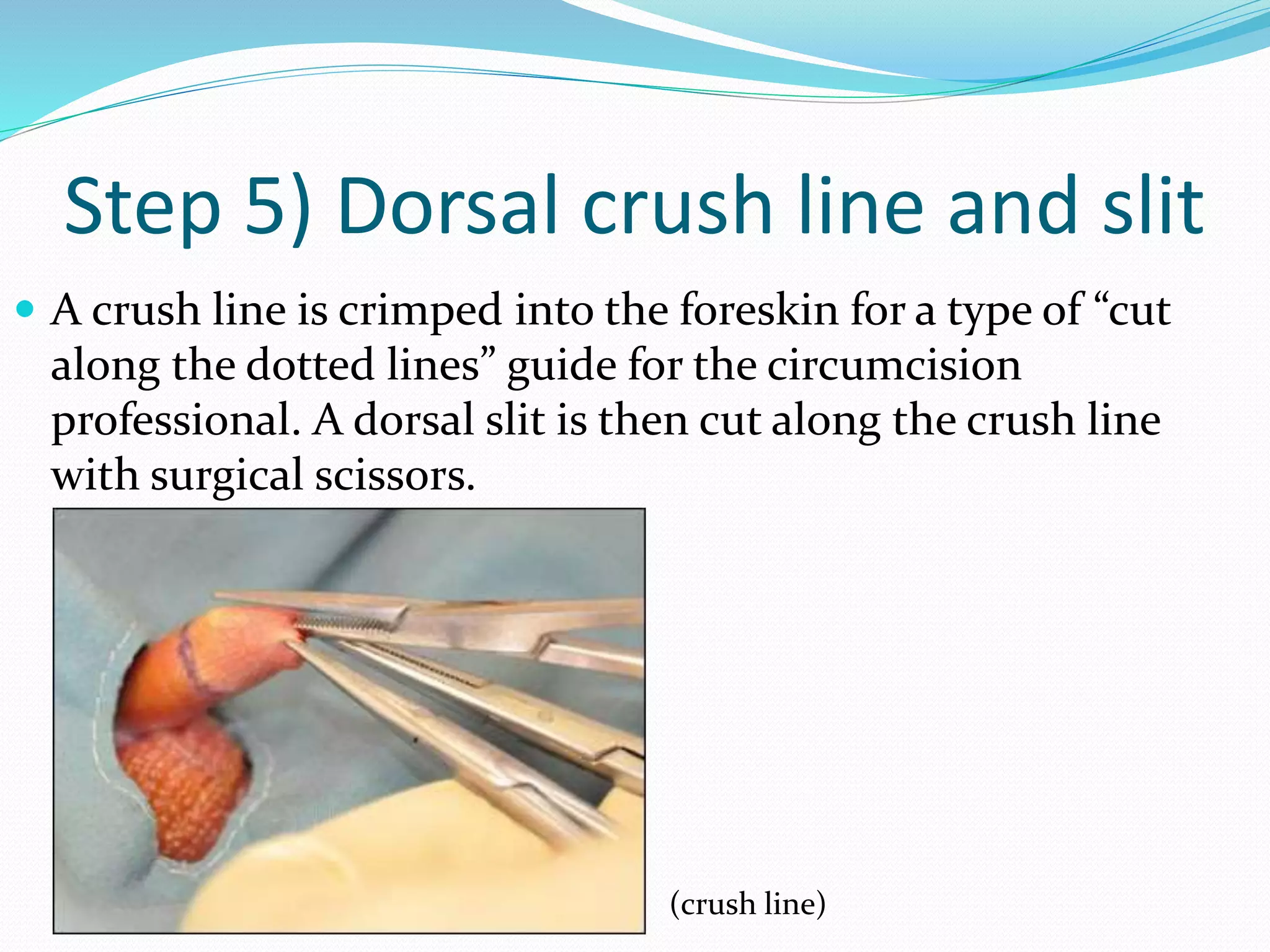
Step 5) Dorsal crush line and slit 
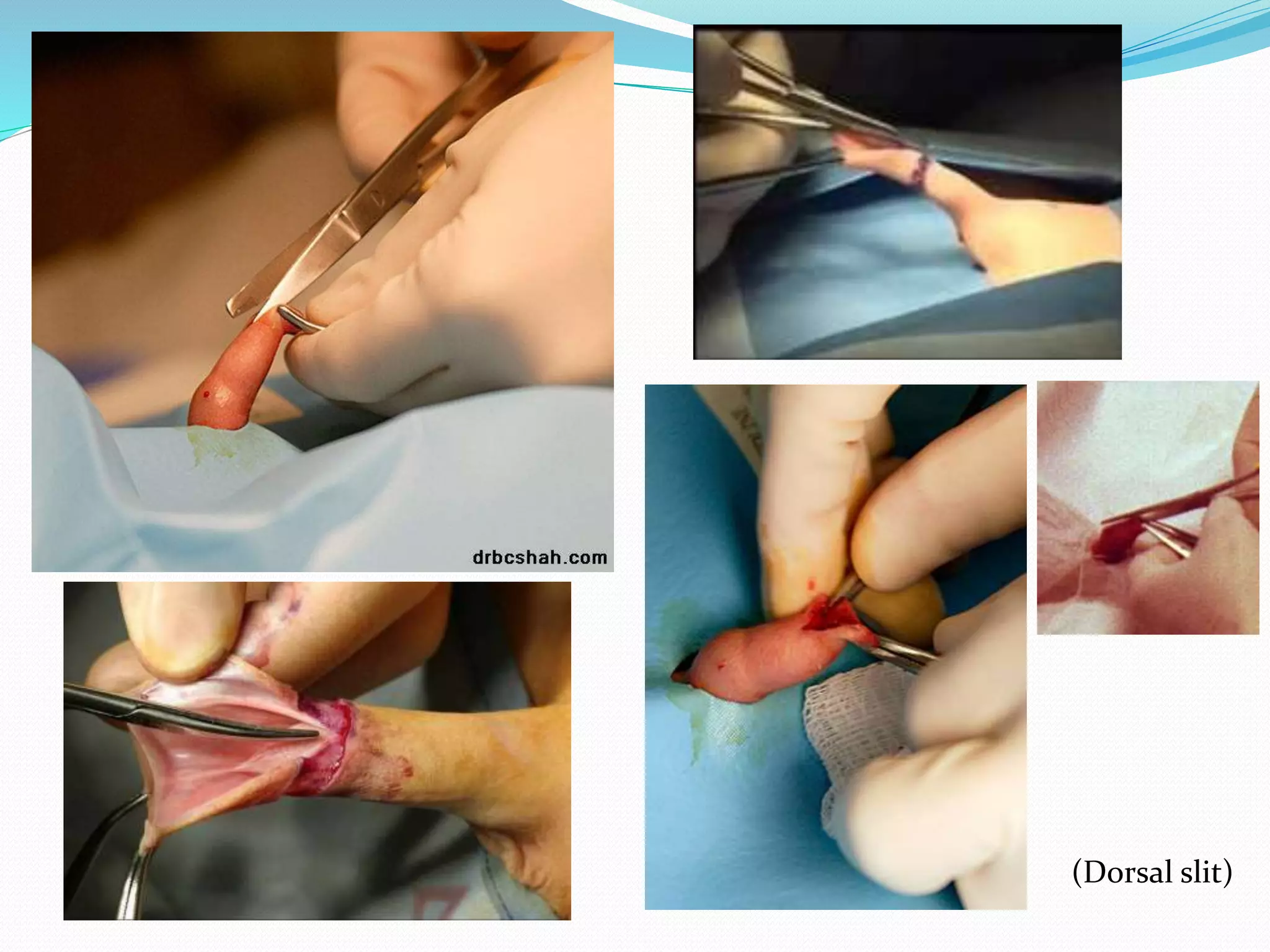
 A crush line is crimped into the foreskin for a type of “cut 
along the dotted lines” guide for the circumcision 
professional. A dorsal slit is then cut along the crush line 
with surgical scissors. 
(crush line)
(Dorsal slit)
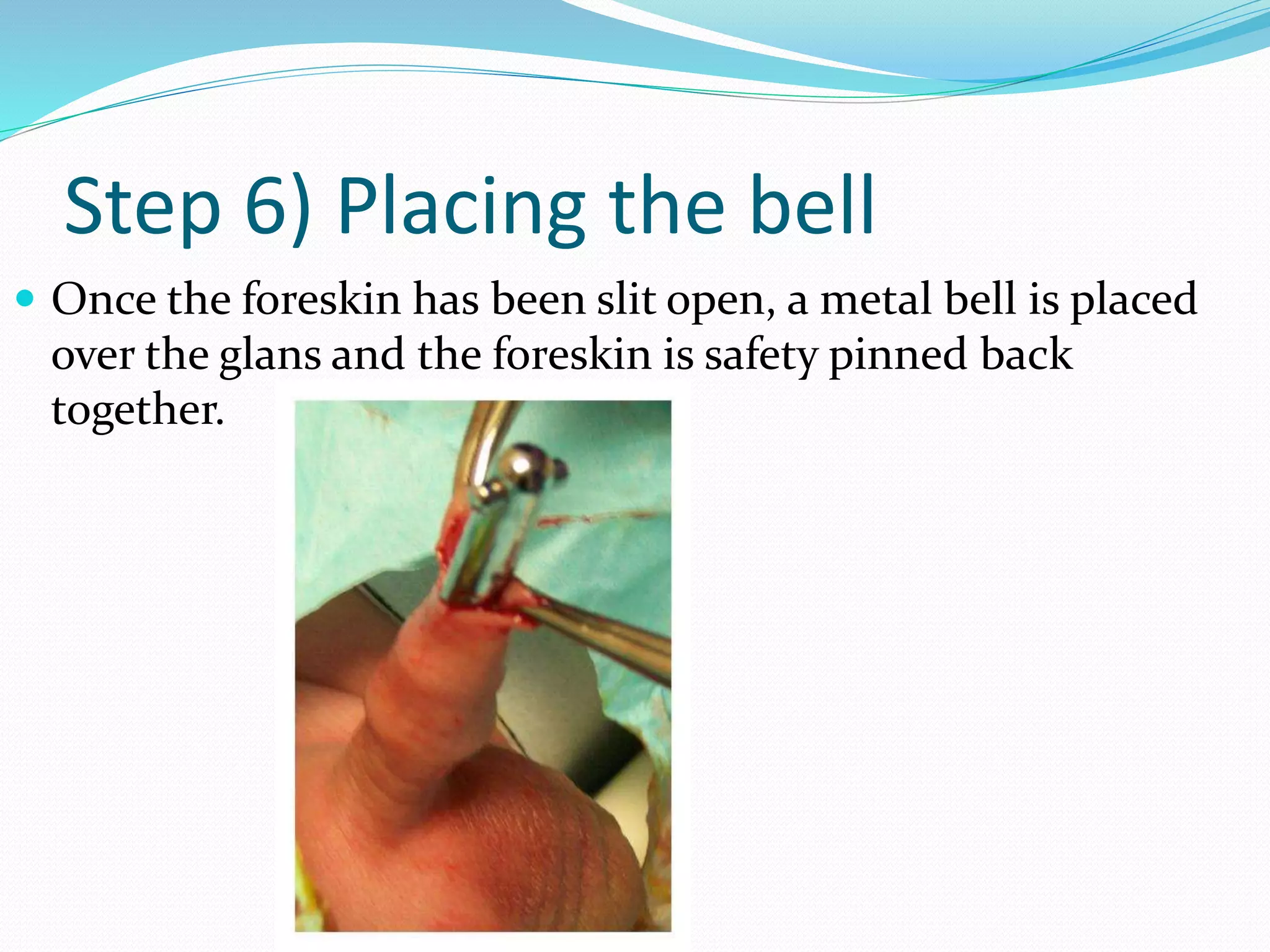
Step 6) Placing the bell 
 Once the foreskin has been slit open, a metal bell is placed 
over the glans and the foreskin is safety pinned back 
together.
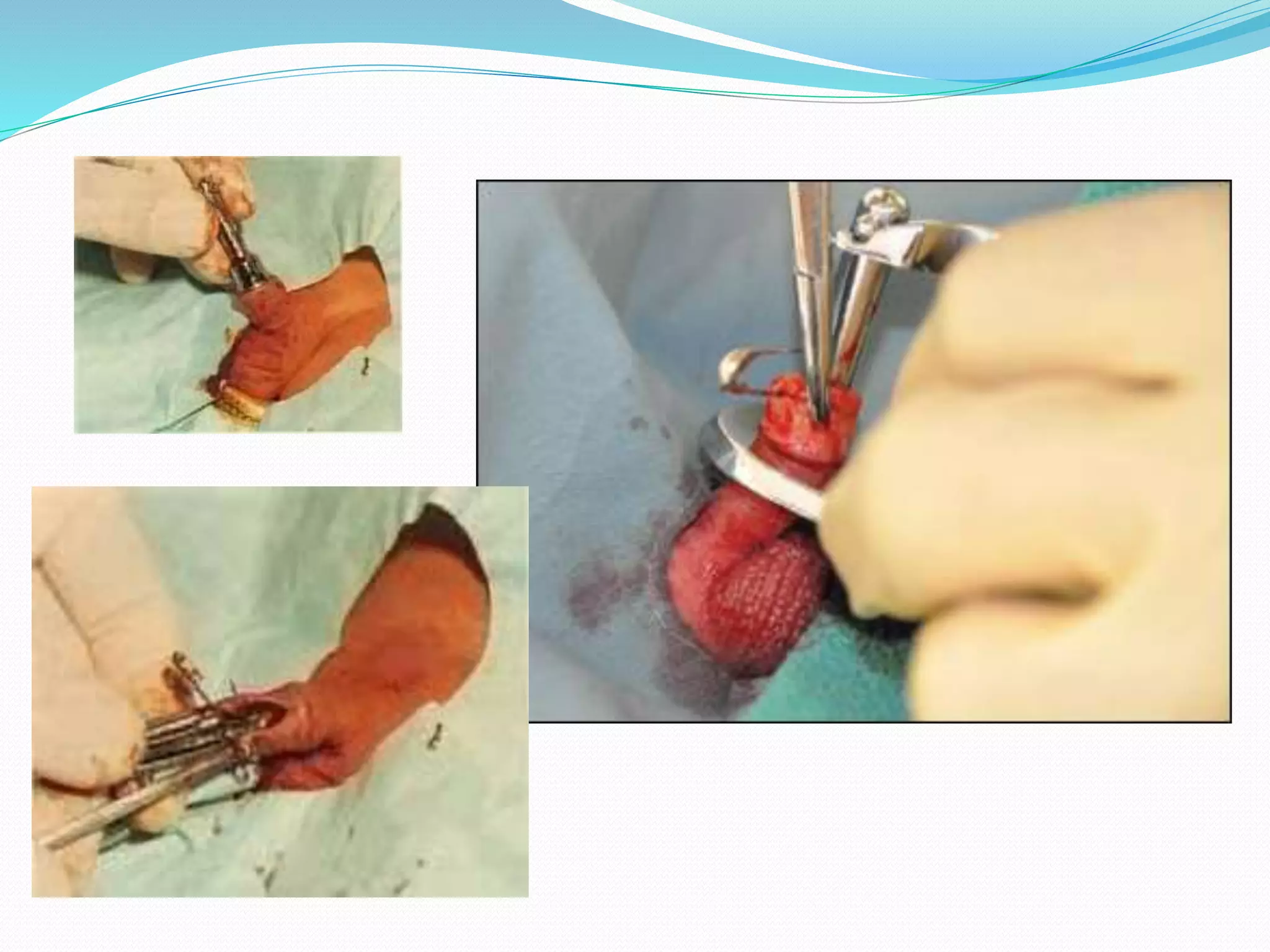
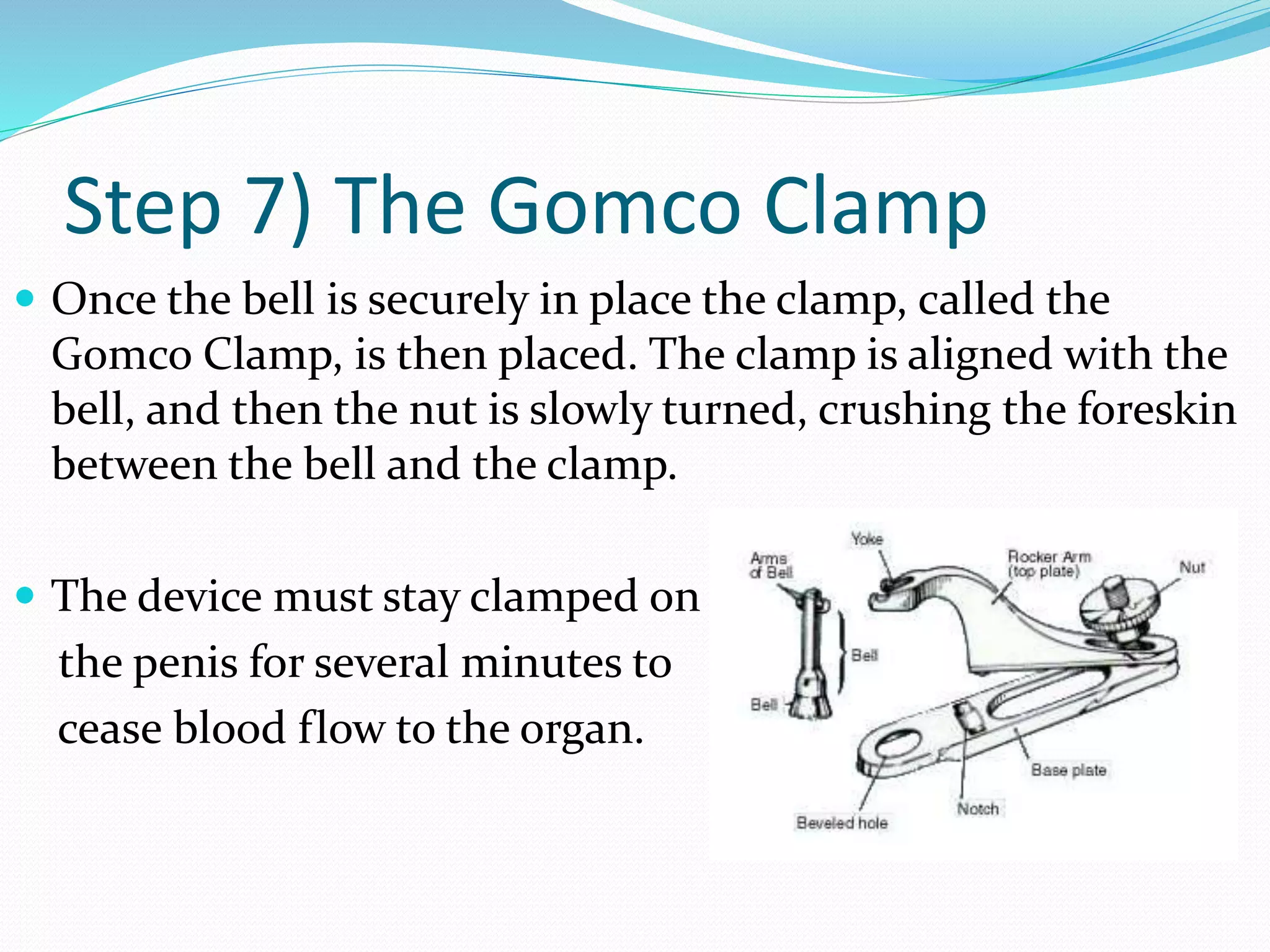
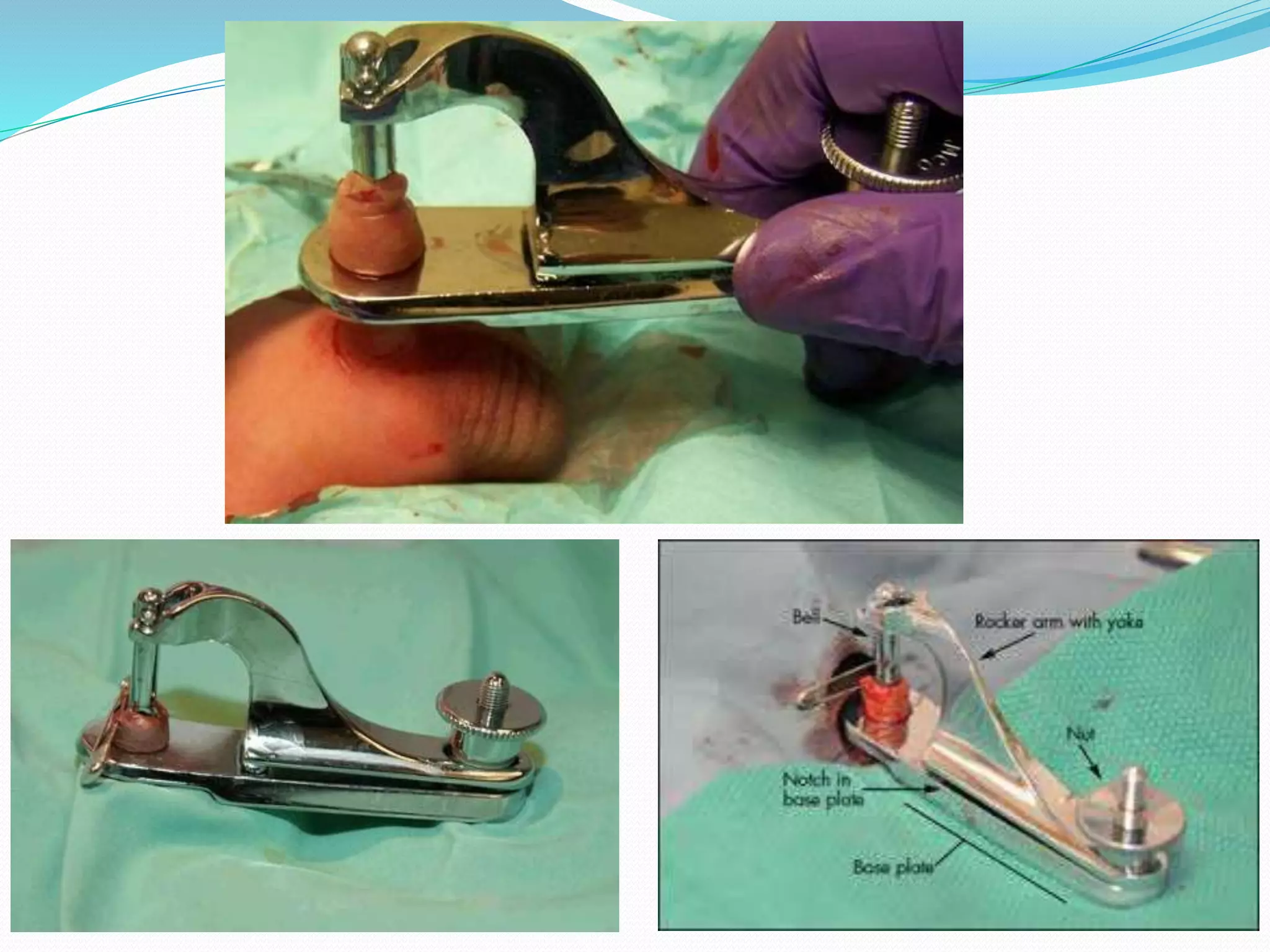
Step 7) The Gomco Clamp 
 Once the bell is securely in place the clamp, called the 
Gomco Clamp, is then placed. The clamp is aligned with the 
bell, and then the nut is slowly turned, crushing the foreskin 
between the bell and the clamp. 
 The device must stay clamped on 
the penis for several minutes to 
cease blood flow to the organ.
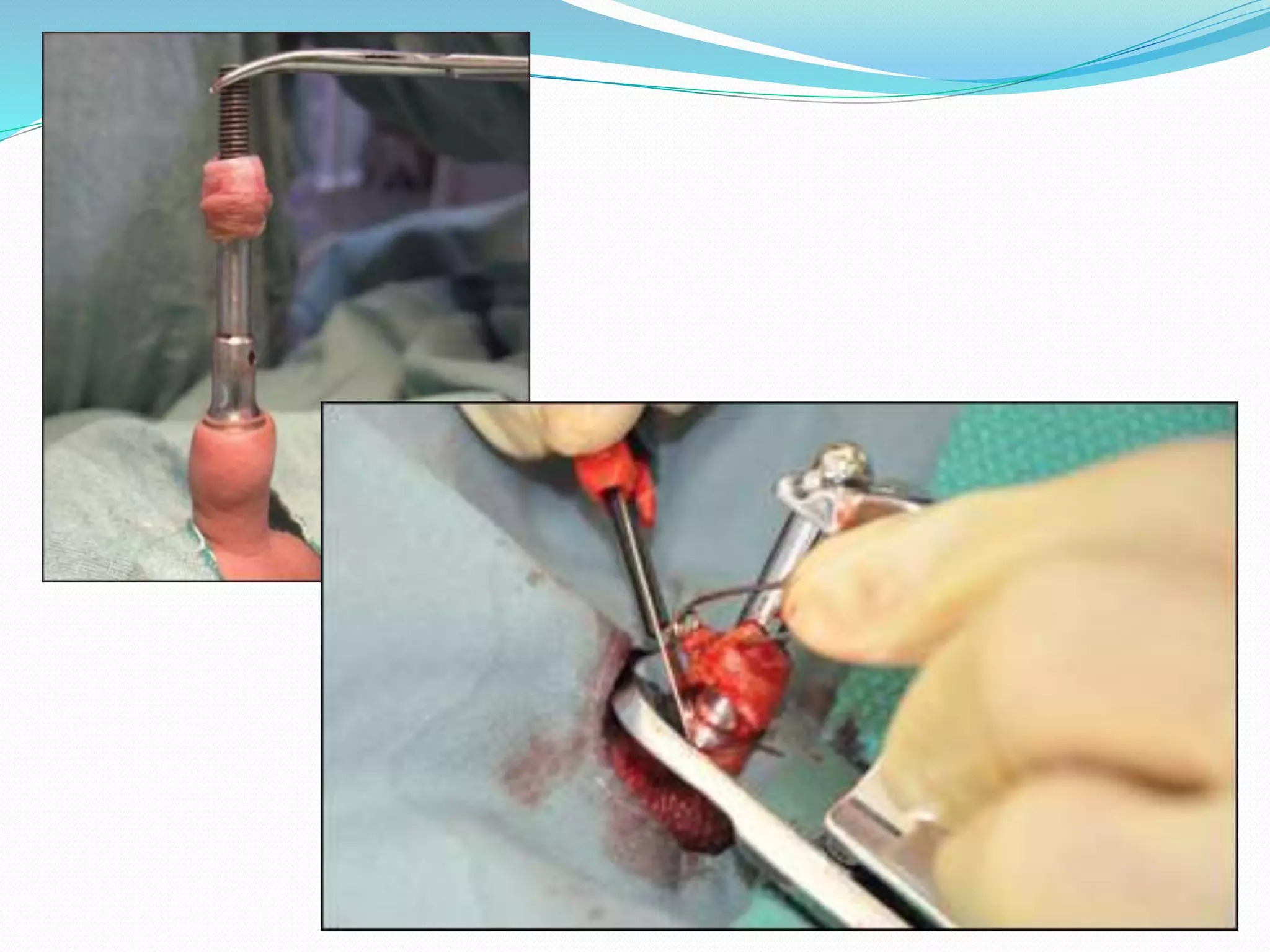
Step 8) Excision 
 Finally, after the foreskin has been through the trauma of 
hemostats, separation, crimping, cutting, crushing, and then 
clamped for an extended period of time, it is finally excised 
with a scalpel. The circumcision professional presses the 
blade of the scalpel against the bell and slices the foreskin off 
completely.
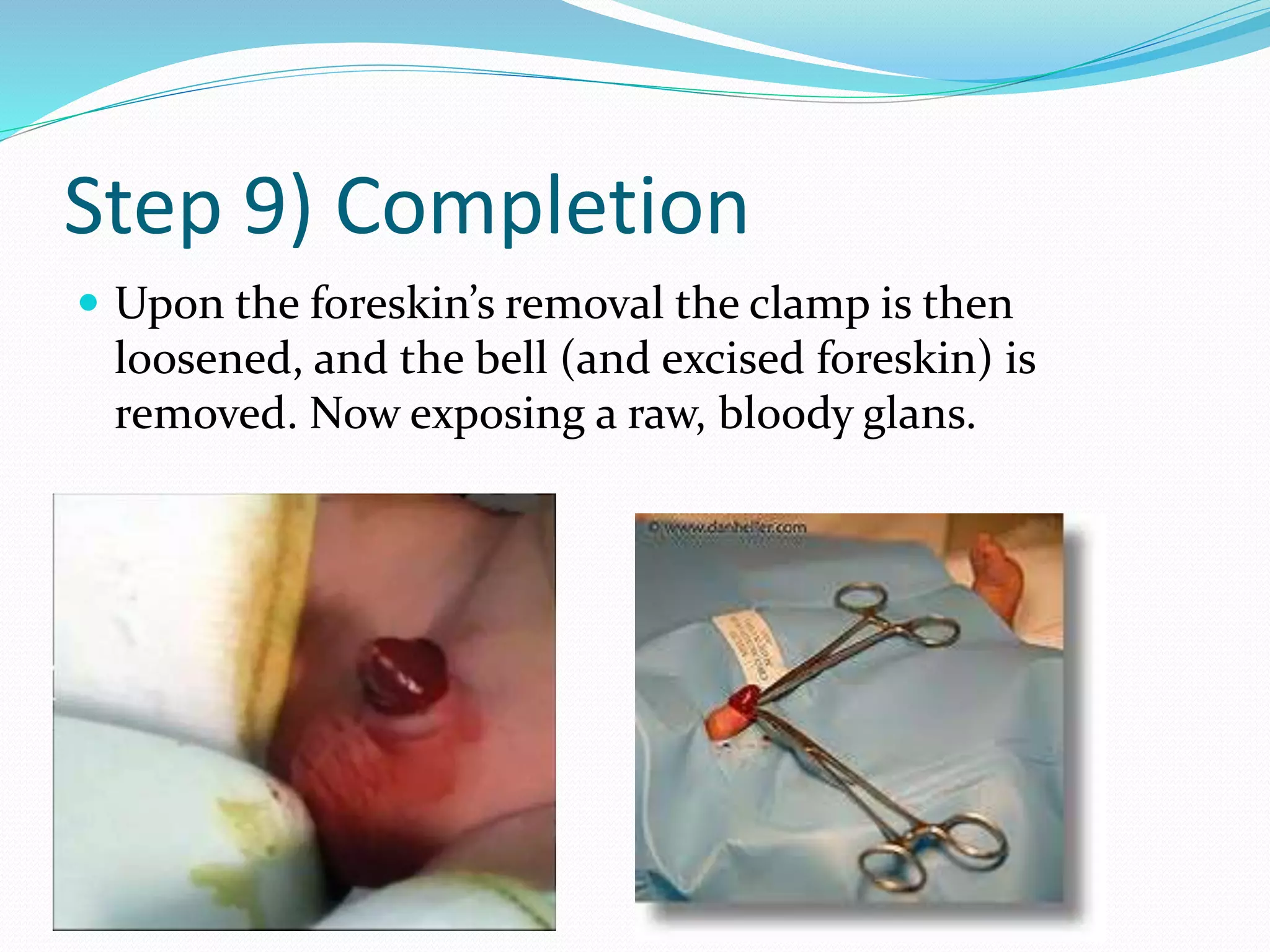
Step 9) Completion 
 Upon the foreskin’s removal the clamp is then 
loosened, and the bell (and excised foreskin) is 
removed. Now exposing a raw, bloody glans.
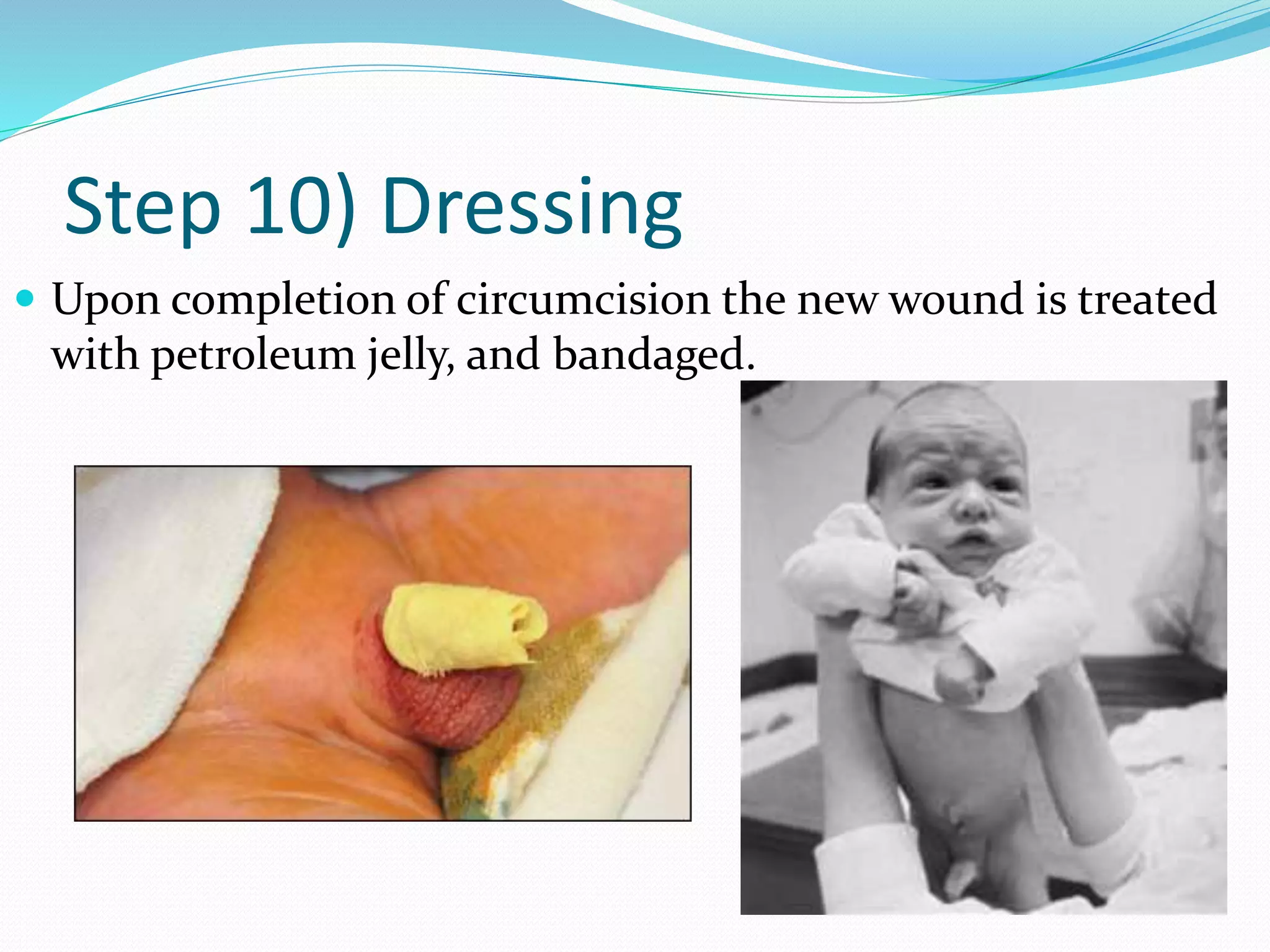
Step 10) Dressing 
 Upon completion of circumcision the new wound is treated 
with petroleum jelly, and bandaged.
Circ powerpoint

Circ powerpoint

  • 2.
    What is circumcision?  Circumcision is the surgical removal of the foreskin in boys. Typically performed within hours or days of birth. (This is an image of an actual circumcision tray for the Gomco circumcision procedure)
  • 3.
    What is theforeskin?  The prepuce, or foreskin, is a highly erogenous organ with many anatomical structures. Some of the anatomy of the foreskin are:  The Frenulum (highly sensitive bundle of nerves)  Meissner’s Corpuscles (pleasure receptors)  Frenar or Ridged Bands (keeps the foreskin forward, protecting the glans when the penis is flaccid. When the penis becomes erect, the band expands, allowing the foreskin to slide over the glans)  Dartos Fascia (temperature receptors)  Several feet of blood vessels (aids in maintaining an erection)  Apocrine Glands (produces pheromones)  Sebaceous Glands (aids in natural lubrication)  Immunological System (antibodies, antibacterial, and antiviral)
  • 5.
    How are circumcisionsperformed? (Warning! The next few slides are graphic, and not intended for individuals under 18 years of age) • Circumcisions are performed, most commonly, by 3 different methods: • The Gomco Clamp Method • The Mogan Clamp Method • The Plastibell Method • Today we are going to show the most common here in the United Stated, The GomcoMethod.
  • 6.
    Step 1) Restraint  The infant is undressed and restrained in a Circumstraint. This is a molded plastic device that straps down the baby’s arms and legs.
  • 8.
    Step 2) Cleansingof the area  The penis and testicles are swabbed with an Antiseptic, such as Betadine. This is not only done to clean the area, but also to elicit an erection to better guesstimate how much foreskin to remove.
  • 9.
    Step 3) Hemostats  Hemostats are clamped onto the tip of the foreskin for traction.  Typically 2 or 3 are clamped on.
  • 10.
    Step 4) Separation  At birth the foreskin is fused to the glans (head) of the penis, much like your fingernails are fused to the nail bedding matrix of your fingers. This fusion bond is called the balanopreputial lamina. The circumcision professional will force a blunt probe, surgical scissors, or a fine hemostat underneath the foreskin and tear this bond.
  • 12.
    Step 5) Dorsalcrush line and slit  A crush line is crimped into the foreskin for a type of “cut along the dotted lines” guide for the circumcision professional. A dorsal slit is then cut along the crush line with surgical scissors. (crush line)
  • 13.
  • 14.
    Step 6) Placingthe bell  Once the foreskin has been slit open, a metal bell is placed over the glans and the foreskin is safety pinned back together.
  • 16.
    Step 7) TheGomco Clamp  Once the bell is securely in place the clamp, called the Gomco Clamp, is then placed. The clamp is aligned with the bell, and then the nut is slowly turned, crushing the foreskin between the bell and the clamp.  The device must stay clamped on the penis for several minutes to cease blood flow to the organ.
  • 18.
    Step 8) Excision  Finally, after the foreskin has been through the trauma of hemostats, separation, crimping, cutting, crushing, and then clamped for an extended period of time, it is finally excised with a scalpel. The circumcision professional presses the blade of the scalpel against the bell and slices the foreskin off completely.
  • 20.
    Step 9) Completion  Upon the foreskin’s removal the clamp is then loosened, and the bell (and excised foreskin) is removed. Now exposing a raw, bloody glans.
  • 21.
    Step 10) Dressing  Upon completion of circumcision the new wound is treated with petroleum jelly, and bandaged.