Plant Phyla
But before we get into phyla . . .
 To what domain do plants belong?
                        EUKARYA!!
 To what kingdom do plants belong?
                      Plants (Plantae)
 What are some characteristics that ALL
 plants share?
  –   Cell nuclei (Eukarya)
  –   Cell walls
  –   Multicellular
  –   Photosynthesis
  –   Sexually Reproducing
Introduction to Plants
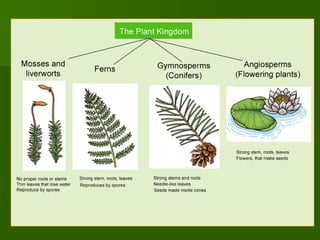
        Plants are classified into four main group:
1.       Mosses and Liverwort (Bryophyta)
2.       Ferns (Pteridophyta)
3.       Conifers (Gymnosperms)
4.       Flowering Plants (Angiosperms)
     –     All are different in appearance, structure and
           behaviour.
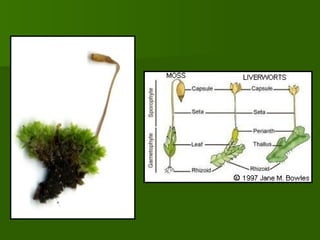
Mosses - Bryophyta
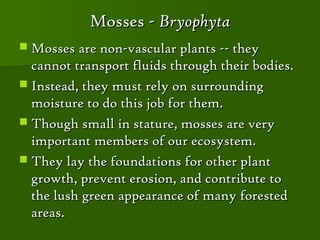
 Mosses are non-vascular plants -- they
  cannot transport fluids through their bodies.
 Instead, they must rely on surrounding
  moisture to do this job for them.
 Though small in stature, mosses are very
  important members of our ecosystem.
 They lay the foundations for other plant
  growth, prevent erosion, and contribute to
  the lush green appearance of many forested
  areas.
Mosses - 2
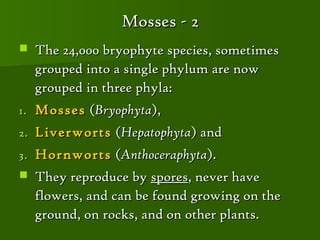
    The 24,000 bryophyte species, sometimes
     grouped into a single phylum are now
     grouped in three phyla:
1.   Mosses (Bryophyta),
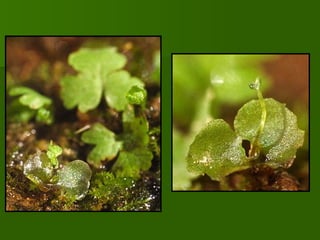
2.   Liverworts (Hepatophyta) and
3.   Hornworts (Anthoceraphyta).
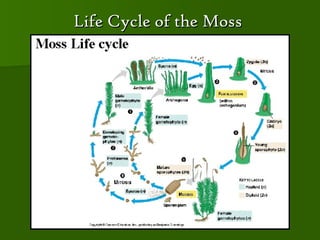
    They reproduce by spores, never have
     flowers, and can be found growing on the
     ground, on rocks, and on other plants.
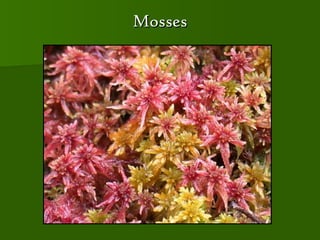
Mosses
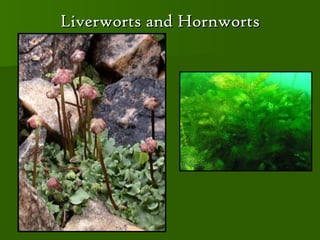
Liverworts and Hornworts
Life Cycle of the Moss
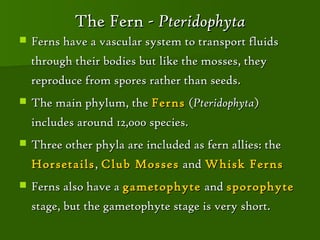
The Fern - Pteridophyta
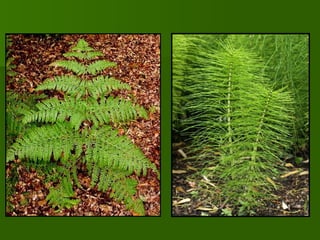
   Ferns have a vascular system to transport fluids
    through their bodies but like the mosses, they
    reproduce from spores rather than seeds.
   The main phylum, the Ferns (Pteridophyta)
    includes around 12,000 species.
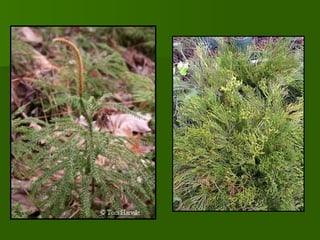
   Three other phyla are included as fern allies: the
    Horsetails , Club Mosses and Whisk Ferns
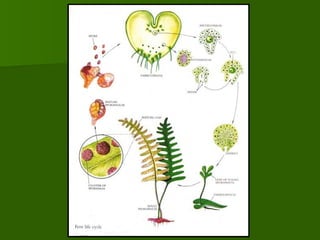
   Ferns also have a gametophyte and sporophyte
    stage, but the gametophyte stage is very short.
Conifers - Gymnosperms
   The gymnosperms reproduce from seeds instead of
    spores.
   The seeds, however, are "naked" (Greek: gummnos) --
    not covered by an ovary.
   Usually, the seed is produced inside a cone-like
    structure such as a pine cone which is why they are
    called "conifer."
   Some conifers, such as the Yew and Ginko, produce
    their seeds inside a berry-like structure.
   Conifers are fairly easy to identify: In addition to
    cones, these trees and shrubs typically have needle-like,
    scale-like or awl-like leaves.
   And they NEVER have flowers.
Conifers - 2
   Approximately 600 species are counted as conifers
    including the pines, firs, spruces, cedars, junipers,
    and yew.
   Species within the conifer ranks give us pine nuts --
    pesto's magic ingredient -- as well as juniper berries
    for gin.
   Conifer allies include three small phyla containing
    fewer than 200 species all together:
   Gingko (Ginkophyta)
   Cycads (Cycadophyta) ;
   And herb-like cone-bearing plants (Gnetophyta)
    such as Ephedra.
Angiosperms (Flowering Plants):
            Families
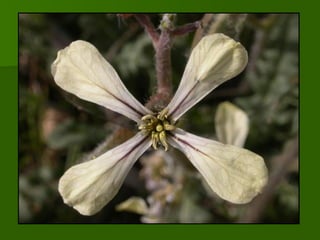
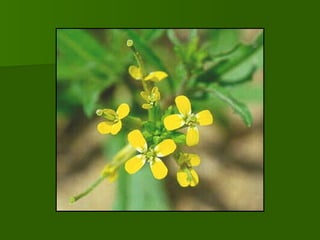
 Seed bearing plants of the Order

 Angiosperm are further classified into plant
 families.
 Plants belonging to the same family share a

 common trait, usually based on flower
 structure.
 The most important and common families

 are detailed next:
Plant Phyla
Plant Phyla

Plant Phyla

  • 1.
  • 2.
    But before weget into phyla . . .  To what domain do plants belong?  EUKARYA!!  To what kingdom do plants belong?  Plants (Plantae)  What are some characteristics that ALL plants share? – Cell nuclei (Eukarya) – Cell walls – Multicellular – Photosynthesis – Sexually Reproducing
  • 3.
    Introduction to Plants  Plants are classified into four main group: 1. Mosses and Liverwort (Bryophyta) 2. Ferns (Pteridophyta) 3. Conifers (Gymnosperms) 4. Flowering Plants (Angiosperms) – All are different in appearance, structure and behaviour.
  • 5.
    Mosses - Bryophyta Mosses are non-vascular plants -- they cannot transport fluids through their bodies.  Instead, they must rely on surrounding moisture to do this job for them.  Though small in stature, mosses are very important members of our ecosystem.  They lay the foundations for other plant growth, prevent erosion, and contribute to the lush green appearance of many forested areas.
  • 6.
    Mosses - 2  The 24,000 bryophyte species, sometimes grouped into a single phylum are now grouped in three phyla: 1. Mosses (Bryophyta), 2. Liverworts (Hepatophyta) and 3. Hornworts (Anthoceraphyta).  They reproduce by spores, never have flowers, and can be found growing on the ground, on rocks, and on other plants.
  • 7.
  • 8.
  • 10.
    Life Cycle ofthe Moss
  • 11.
    The Fern -Pteridophyta  Ferns have a vascular system to transport fluids through their bodies but like the mosses, they reproduce from spores rather than seeds.  The main phylum, the Ferns (Pteridophyta) includes around 12,000 species.  Three other phyla are included as fern allies: the Horsetails , Club Mosses and Whisk Ferns  Ferns also have a gametophyte and sporophyte stage, but the gametophyte stage is very short.
  • 16.
    Conifers - Gymnosperms  The gymnosperms reproduce from seeds instead of spores.  The seeds, however, are "naked" (Greek: gummnos) -- not covered by an ovary.  Usually, the seed is produced inside a cone-like structure such as a pine cone which is why they are called "conifer."  Some conifers, such as the Yew and Ginko, produce their seeds inside a berry-like structure.  Conifers are fairly easy to identify: In addition to cones, these trees and shrubs typically have needle-like, scale-like or awl-like leaves.  And they NEVER have flowers.
  • 17.
    Conifers - 2  Approximately 600 species are counted as conifers including the pines, firs, spruces, cedars, junipers, and yew.  Species within the conifer ranks give us pine nuts -- pesto's magic ingredient -- as well as juniper berries for gin.  Conifer allies include three small phyla containing fewer than 200 species all together:  Gingko (Ginkophyta)  Cycads (Cycadophyta) ;  And herb-like cone-bearing plants (Gnetophyta) such as Ephedra.
  • 18.
    Angiosperms (Flowering Plants): Families  Seed bearing plants of the Order Angiosperm are further classified into plant families.  Plants belonging to the same family share a common trait, usually based on flower structure.  The most important and common families are detailed next: