Watchdog
Journalism
“Watchdog journalism is to keep on turning over rocks. Journalism
                  that gives power to the people.”
       -Council of newspaper publishers and editors, Poynter.

• Watchdog journalism is the journalism that keeps people
  and organizations with power accountable for their actions.
• It involves criticism of public officials and institutions,
  checking their practices for legitimacy, and skeptically
  analyzing their actions.
• It is at the heart of a newspaper’s commitment to public
  service, seeking to empower citizens.
• In a 2009 Poynter research poll, 62% of Americans believe
  that the press’s criticism of political leaders keeps them
  from doing things they shouldn’t do.


What is it?
• One famous example of watchdog journalism is the
  Washington Post’s coverage of the Watergate scandal, an
  event in the early 1970 presidential election that
  ultimately led to the resignation of President Richard
  Nixon.
• Read through some of the coverage and find out how the
  Washington Post helped uncover the truth behind a break
  in at the Watergate office complex in Washington, D.C.
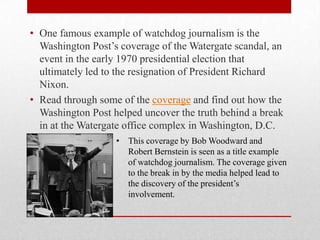
                   • This coverage by Bob Woodward and
                     Robert Bernstein is seen as a title example
                     of watchdog journalism. The coverage given
                     to the break in by the media helped lead to
                     the discovery of the president’s
                     involvement.
• The idea of a free press that is able to hold government accountable
  is based in the first amendment to the constitution:
  “Congress shall make no law respecting an establishment of religion,
  or prohibiting the free exercise thereof; or abridging the freedom of
  speech, or of the press; or the right of the people peaceably to
  assemble, and to petition the Government for a redress of
  grievances.”
• The press works independent of the state, and its freedoms are
  guaranteed by the government.
• The press is often called the fourth estate, an institution that exists
  outside primary government influence and exists as a check on those
  in public office, based on the premise that powerful states have to be
  prevented from overstepping their bounds.


A Free Press
• Watchdog journalism cannot easily take place in countries
  with more repressive governments. The nature of
  watchdog journalism requires that the press be protected
  if they publish content that can harm the reputation of
  someone or be critical of the government.
• The Watergate scandal, if published in a country like
  North Korea or China, would have probably resulted in
  the expulsion or death of the writers and the censorship of
  the story entirely.
• It is because of the first amendment that the media in
  America can freely print criticisms of public officials,
  institutions, or the government. Upon this basis does the
  media seek to be a watchdog for the people.
• Fact checking is the testing the truth of claims made for a
  publication. For the media, it is checking the truth behind
  the statements politicians make, such as statistics and
  other facts.
• Because the media seeks to publish the truth, it must fact
  check its stories to verify they are correct.
• While most media organizations have their own fact
  checkers, many independent websites have also taken to
  fact checking not only the government, but the media
  itself.


Fact Checking
• A few tips from Media Helping
  Media about the importance of fact
  checking:
• A journalist must never get into the
  position where they accept what
  they are told without scrutinizing
  the information.
• Journalists should take a skeptical
  view of every piece of information
  shared with them.
• They should not blindly trust
  contacts – even if those contacts
  have proved reliable in the past.


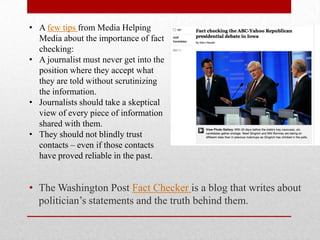
• The Washington Post Fact Checker is a blog that writes about
  politician’s statements and the truth behind them.
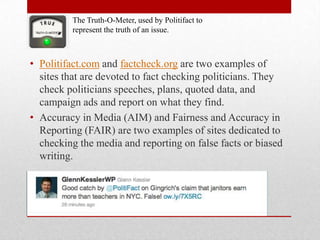
The Truth-O-Meter, used by Politifact to
         represent the truth of an issue.


• Politifact.com and factcheck.org are two examples of
  sites that are devoted to fact checking politicians. They
  check politicians speeches, plans, quoted data, and
  campaign ads and report on what they find.
• Accuracy in Media (AIM) and Fairness and Accuracy in
  Reporting (FAIR) are two examples of sites dedicated to
  checking the media and reporting on false facts or biased
  writing.
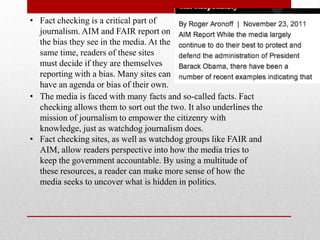
• Fact checking is a critical part of
  journalism. AIM and FAIR report on
  the bias they see in the media. At the
  same time, readers of these sites
  must decide if they are themselves
  reporting with a bias. Many sites can
  have an agenda or bias of their own.
• The media is faced with many facts and so-called facts. Fact
  checking allows them to sort out the two. It also underlines the
  mission of journalism to empower the citizenry with
  knowledge, just as watchdog journalism does.
• Fact checking sites, as well as watchdog groups like FAIR and
  AIM, allow readers perspective into how the media tries to
  keep the government accountable. By using a multitude of
  these resources, a reader can make more sense of how the
  media seeks to uncover what is hidden in politics.

Watchdog Journalism

  • 1.
  • 2.
    “Watchdog journalism isto keep on turning over rocks. Journalism that gives power to the people.” -Council of newspaper publishers and editors, Poynter. • Watchdog journalism is the journalism that keeps people and organizations with power accountable for their actions. • It involves criticism of public officials and institutions, checking their practices for legitimacy, and skeptically analyzing their actions. • It is at the heart of a newspaper’s commitment to public service, seeking to empower citizens. • In a 2009 Poynter research poll, 62% of Americans believe that the press’s criticism of political leaders keeps them from doing things they shouldn’t do. What is it?
  • 3.
    • One famousexample of watchdog journalism is the Washington Post’s coverage of the Watergate scandal, an event in the early 1970 presidential election that ultimately led to the resignation of President Richard Nixon. • Read through some of the coverage and find out how the Washington Post helped uncover the truth behind a break in at the Watergate office complex in Washington, D.C. • This coverage by Bob Woodward and Robert Bernstein is seen as a title example of watchdog journalism. The coverage given to the break in by the media helped lead to the discovery of the president’s involvement.
  • 4.
    • The ideaof a free press that is able to hold government accountable is based in the first amendment to the constitution: “Congress shall make no law respecting an establishment of religion, or prohibiting the free exercise thereof; or abridging the freedom of speech, or of the press; or the right of the people peaceably to assemble, and to petition the Government for a redress of grievances.” • The press works independent of the state, and its freedoms are guaranteed by the government. • The press is often called the fourth estate, an institution that exists outside primary government influence and exists as a check on those in public office, based on the premise that powerful states have to be prevented from overstepping their bounds. A Free Press
  • 5.
    • Watchdog journalismcannot easily take place in countries with more repressive governments. The nature of watchdog journalism requires that the press be protected if they publish content that can harm the reputation of someone or be critical of the government. • The Watergate scandal, if published in a country like North Korea or China, would have probably resulted in the expulsion or death of the writers and the censorship of the story entirely. • It is because of the first amendment that the media in America can freely print criticisms of public officials, institutions, or the government. Upon this basis does the media seek to be a watchdog for the people.
  • 6.
    • Fact checkingis the testing the truth of claims made for a publication. For the media, it is checking the truth behind the statements politicians make, such as statistics and other facts. • Because the media seeks to publish the truth, it must fact check its stories to verify they are correct. • While most media organizations have their own fact checkers, many independent websites have also taken to fact checking not only the government, but the media itself. Fact Checking
  • 7.
    • A fewtips from Media Helping Media about the importance of fact checking: • A journalist must never get into the position where they accept what they are told without scrutinizing the information. • Journalists should take a skeptical view of every piece of information shared with them. • They should not blindly trust contacts – even if those contacts have proved reliable in the past. • The Washington Post Fact Checker is a blog that writes about politician’s statements and the truth behind them.
  • 8.
    The Truth-O-Meter, usedby Politifact to represent the truth of an issue. • Politifact.com and factcheck.org are two examples of sites that are devoted to fact checking politicians. They check politicians speeches, plans, quoted data, and campaign ads and report on what they find. • Accuracy in Media (AIM) and Fairness and Accuracy in Reporting (FAIR) are two examples of sites dedicated to checking the media and reporting on false facts or biased writing.
  • 9.
    • Fact checkingis a critical part of journalism. AIM and FAIR report on the bias they see in the media. At the same time, readers of these sites must decide if they are themselves reporting with a bias. Many sites can have an agenda or bias of their own. • The media is faced with many facts and so-called facts. Fact checking allows them to sort out the two. It also underlines the mission of journalism to empower the citizenry with knowledge, just as watchdog journalism does. • Fact checking sites, as well as watchdog groups like FAIR and AIM, allow readers perspective into how the media tries to keep the government accountable. By using a multitude of these resources, a reader can make more sense of how the media seeks to uncover what is hidden in politics.