The Mirror, the Watchdog
and the Marketplace
Principles of News
JOUR 2300
Professor Neil Foote
Mayborn School of Journalism
2
Group Assignments
• Each group leader is responsible for:
1. Leading his/her group in a 20 – 30 minute

discussion during class time to respond to the
assigned questions based on the readings
2. Be ready – upon request – to personally
respond or have a team member respond to
key questions about the readings, e.g.
offering a summary of an article, highlighting
major themes or findings or identifying the
most significant sources or people featured in
story
3. Report attendance of group to the Graduate
Assistant
3
Group Assignments
• Each group should choose only one
of the following questions to prepare
for:
 Chapter One, Question No. 1, p. 27
 Chapter Two, Question No. 2, p. 57
 Chapter Three, Question No. 1, p. 81
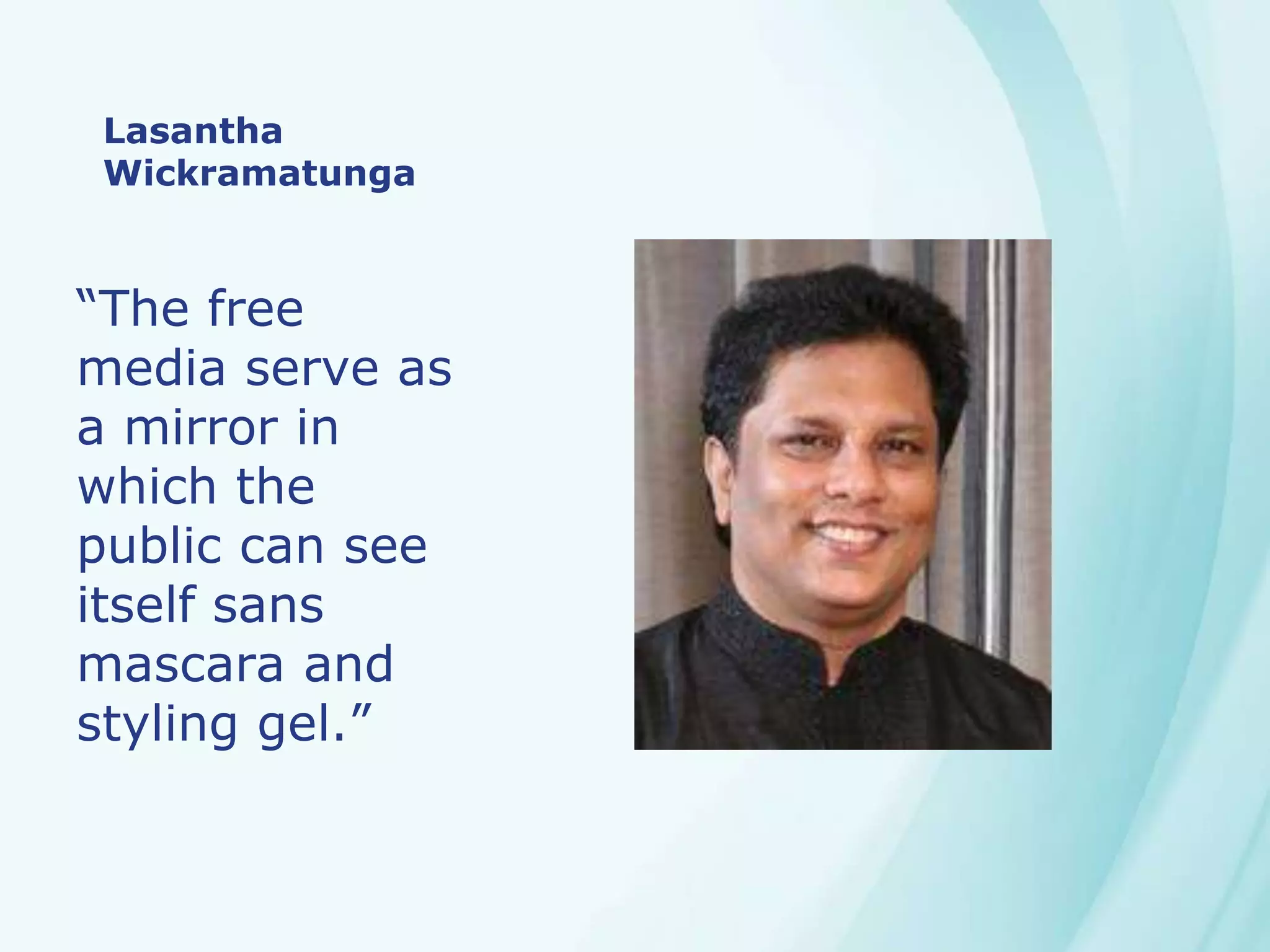
Lasantha
Wickramatunga
“The free
media serve as
a mirror in
which the
public can see
itself sans
mascara and
styling gel.”
5
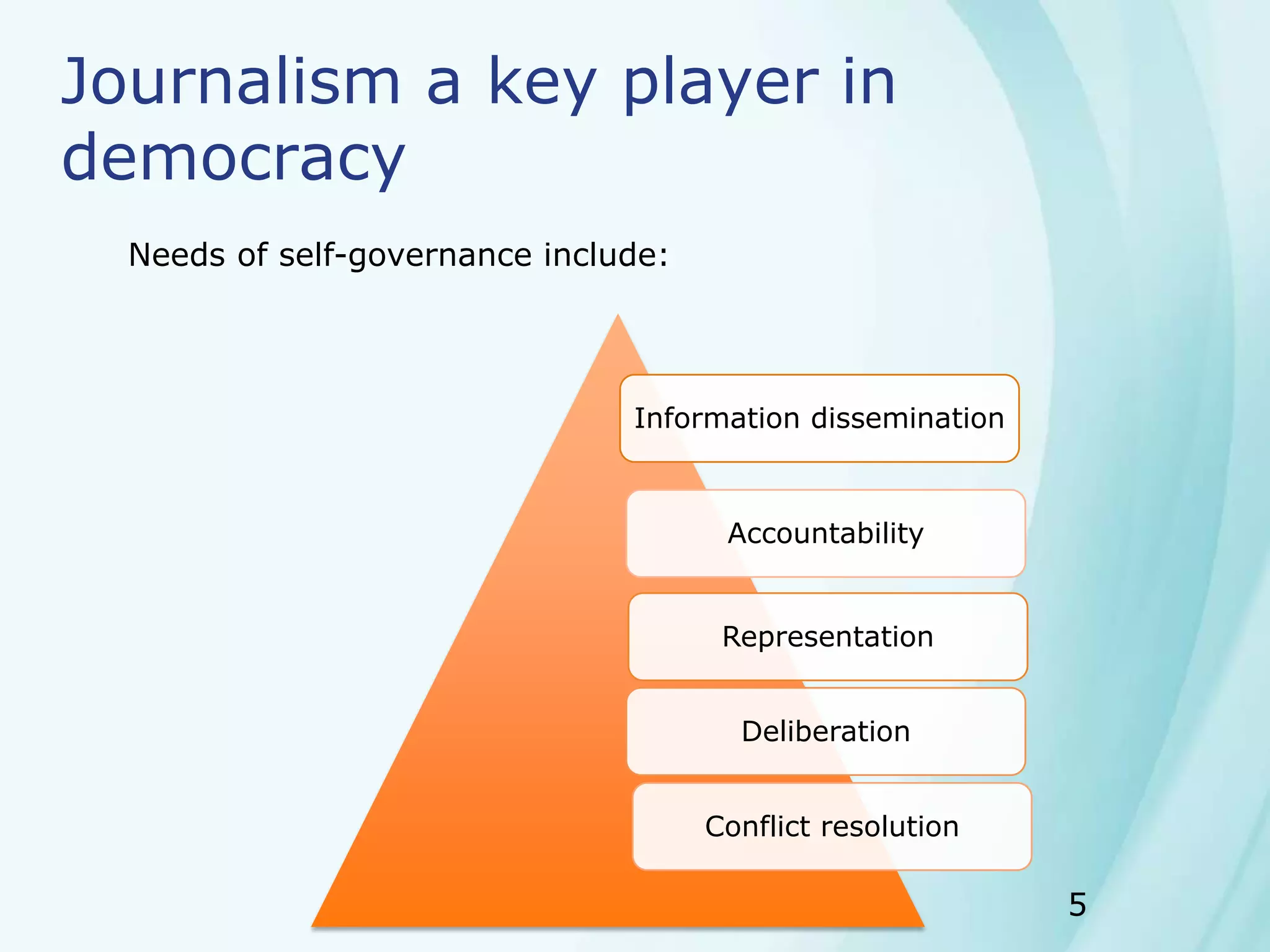
Journalism a key player in
democracy
Information dissemination
Representation
Deliberation
Conflict resolution
Accountability
Needs of self-governance include:
6
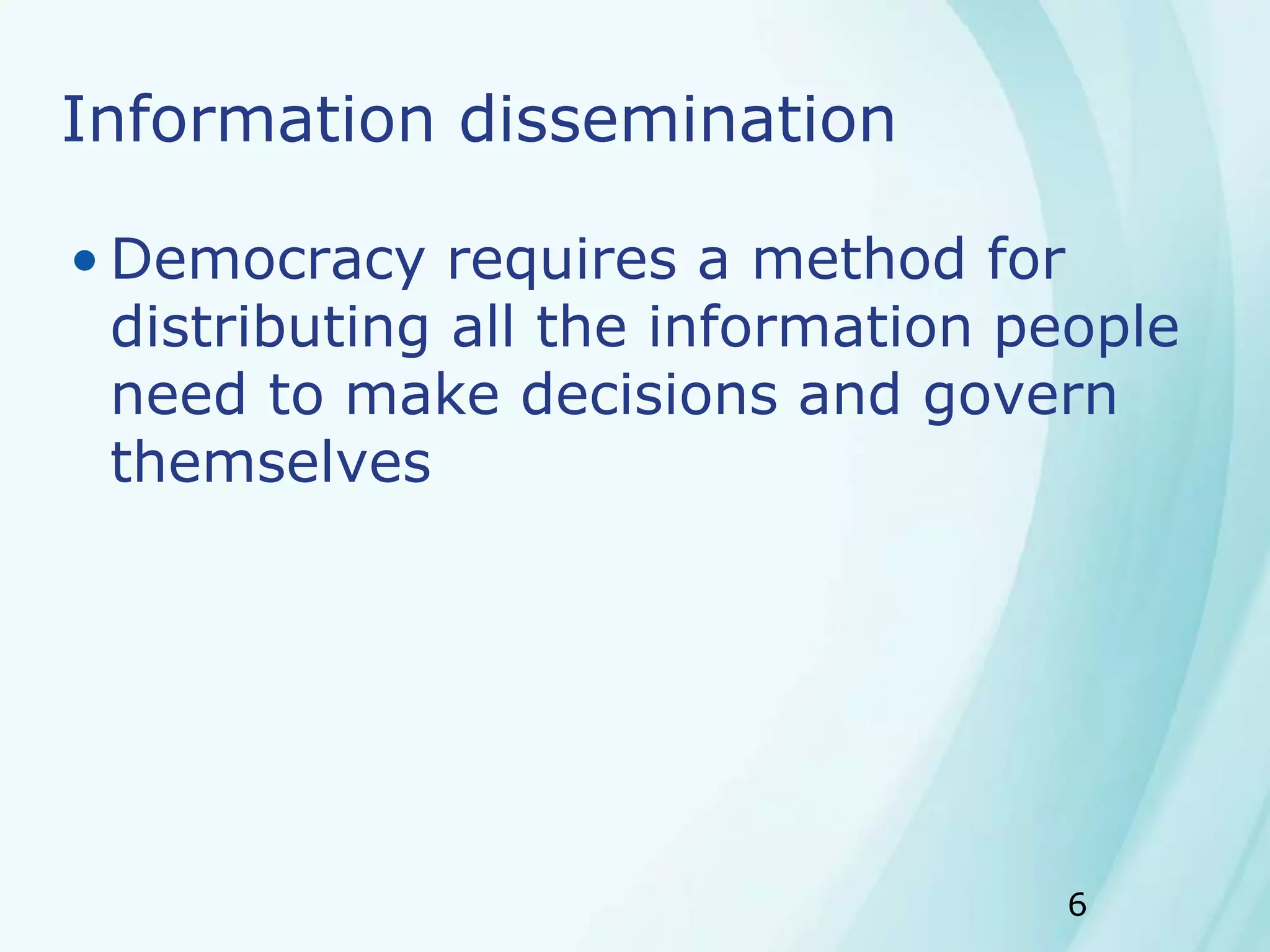
Information dissemination
• Democracy requires a method for
distributing all the information people
need to make decisions and govern
themselves
7
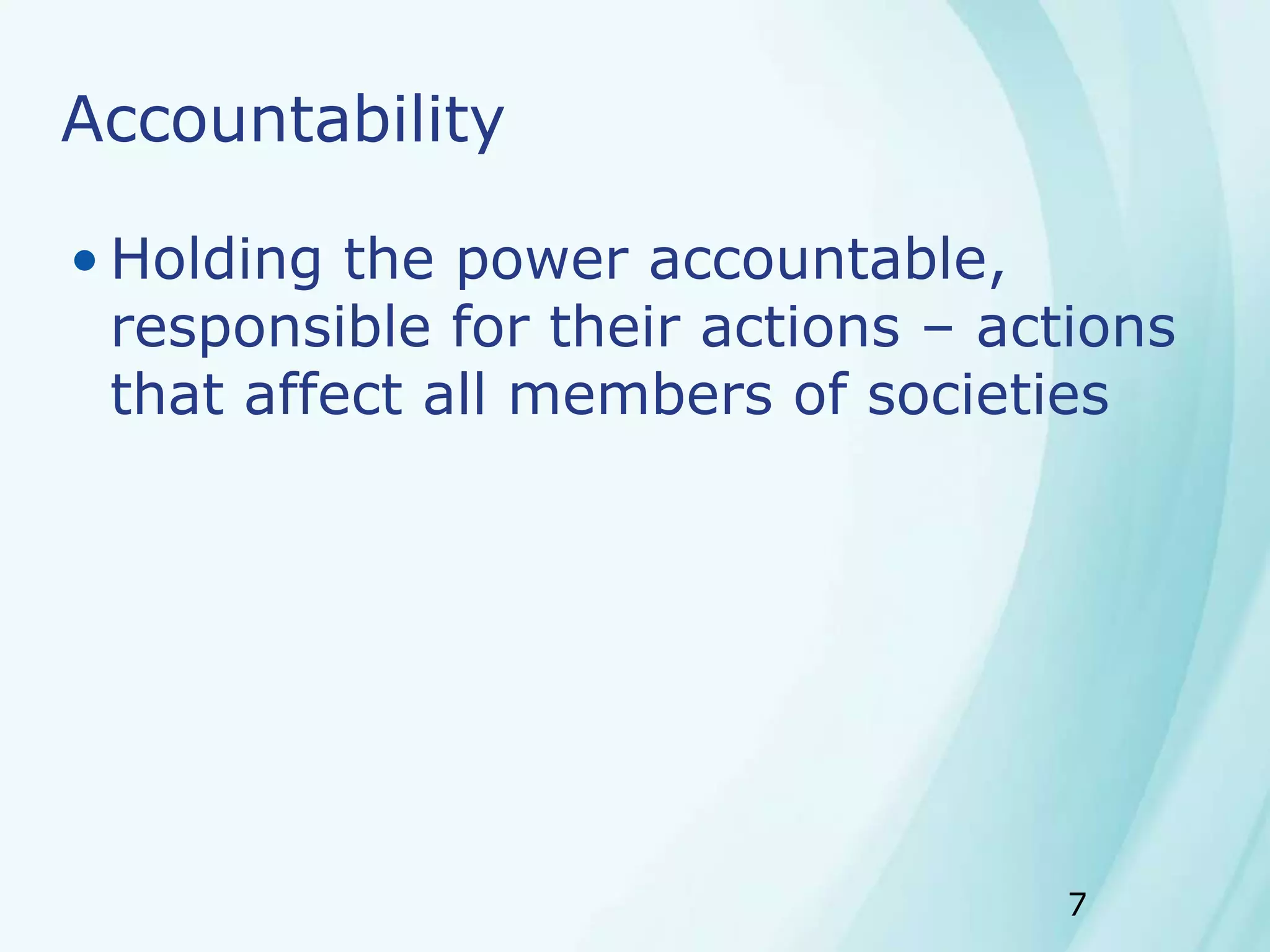
Accountability
• Holding the power accountable,
responsible for their actions – actions
that affect all members of societies
8
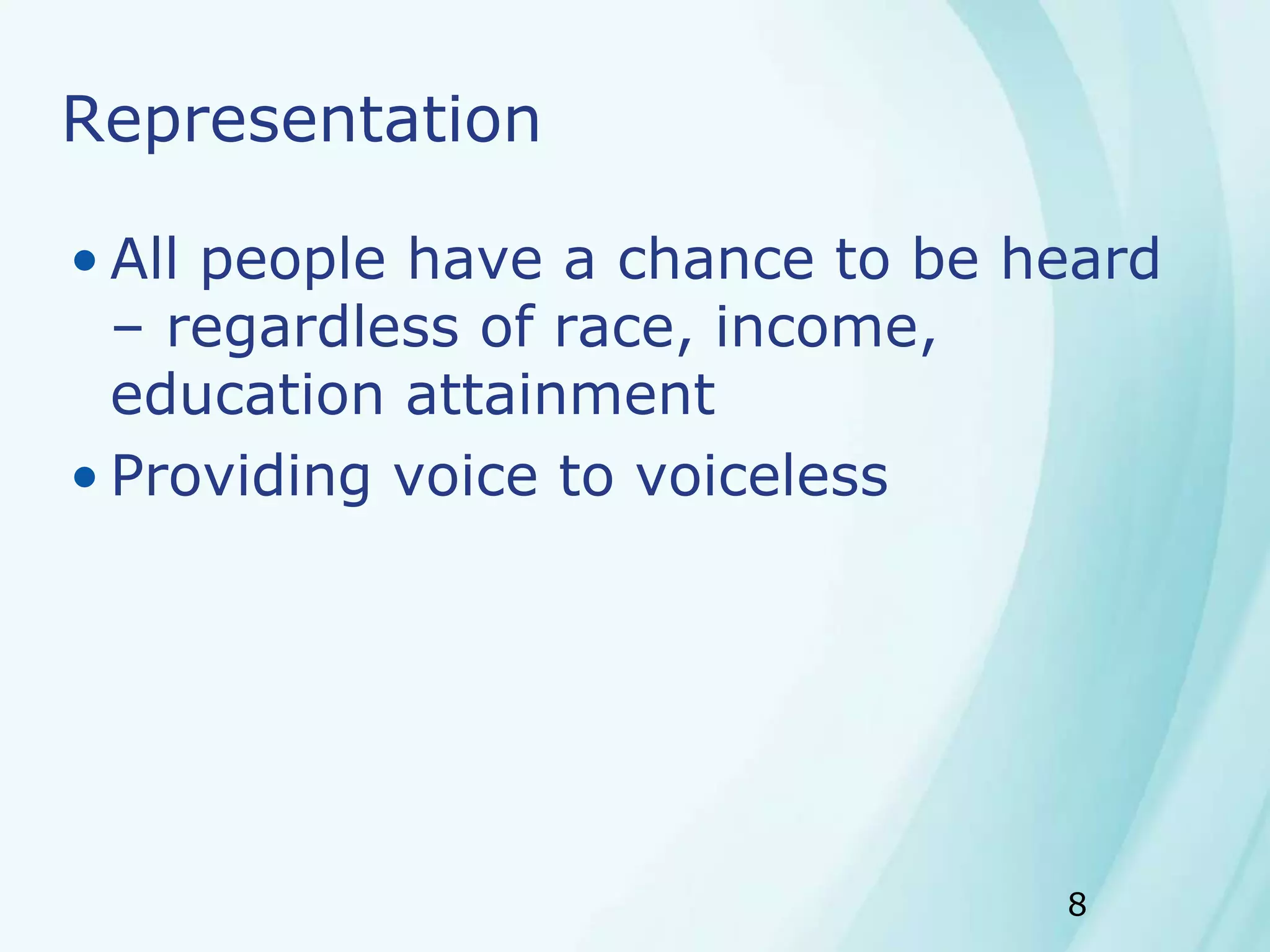
Representation
• All people have a chance to be heard
– regardless of race, income,
education attainment
• Providing voice to voiceless
9
Deliberation
• Create a forum in which the interests
of the public can be aired and
debated
10
Conflict resolution
• Allow for the diversity of ideas to be
discussed so some kind of conclusion
can be reached
11
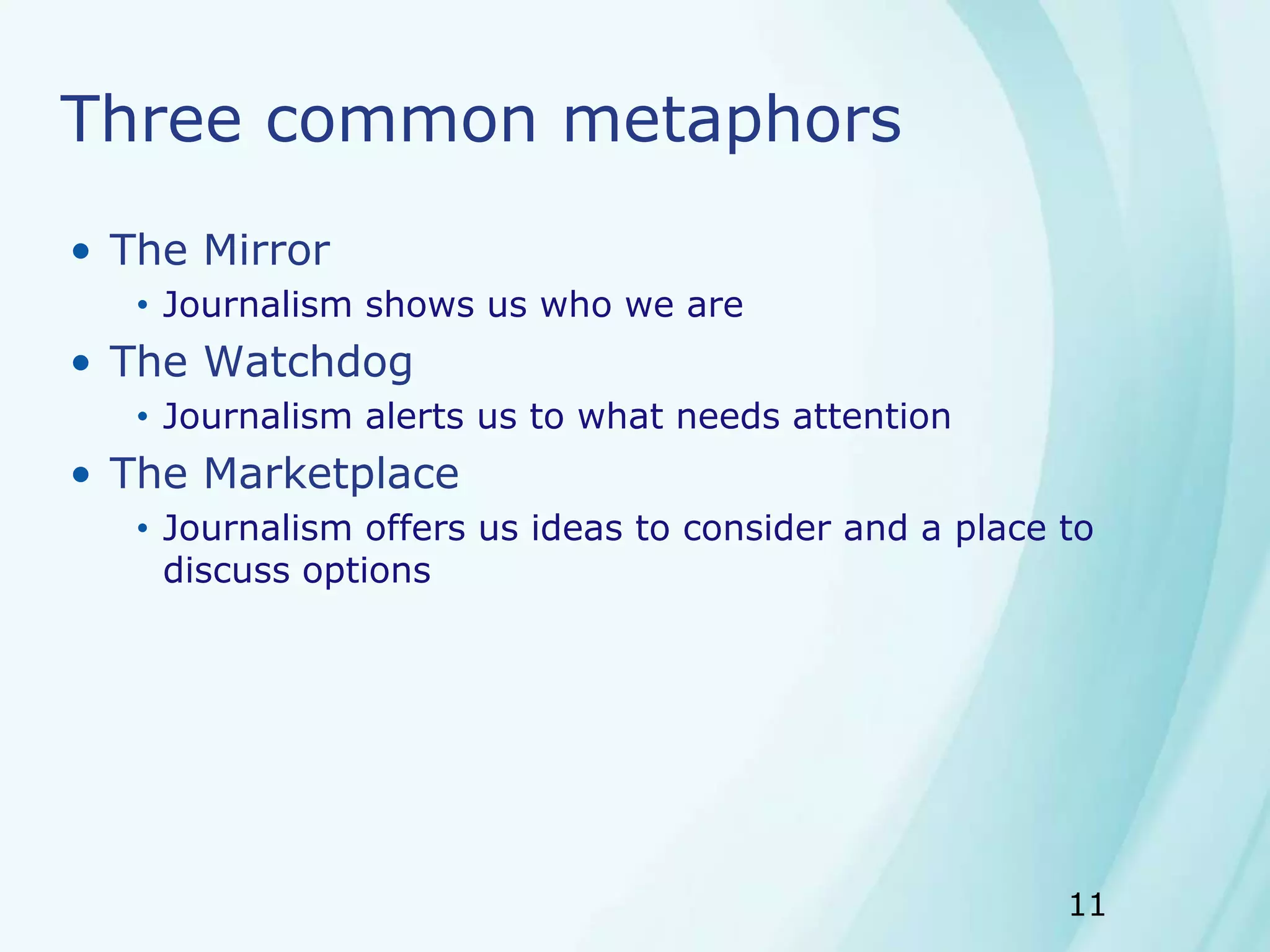
Three common metaphors
• The Mirror
• Journalism shows us who we are
• The Watchdog
• Journalism alerts us to what needs attention
• The Marketplace
• Journalism offers us ideas to consider and a place to
discuss options
12
The press as a mirror
• Fulfills democratic needs for:
•Information dissemination
•Representation
13
The press as a watchdog
•Fulfills democratic needs for:
•Accountability
•Information dissemination
14
The press as a marketplace
•Fulfills democratic needs for:
•Representation
•Deliberation
•Conflict resolution
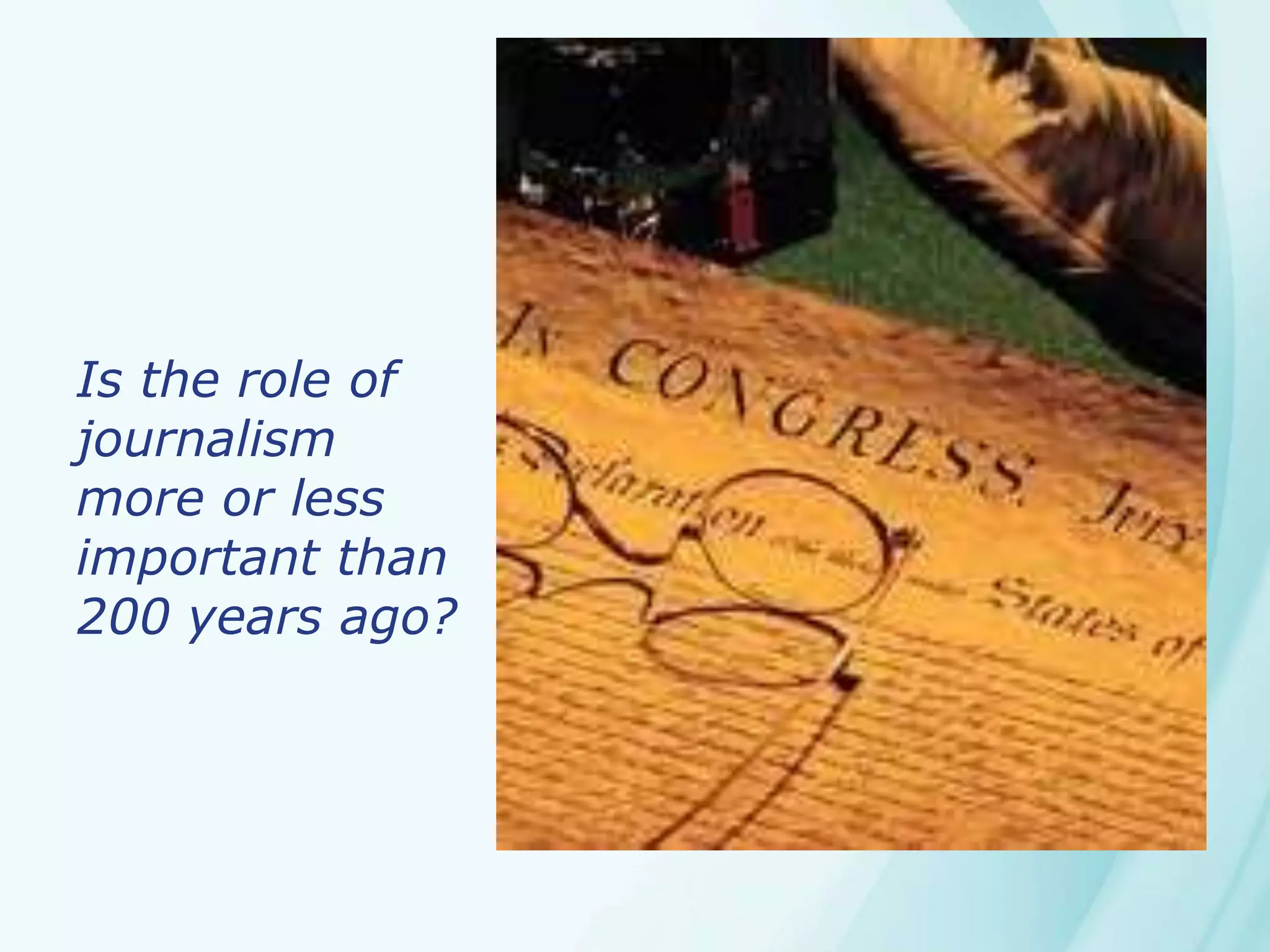
Is the role of
journalism
more or less
important than
200 years ago?
16
Journalism and democracy around
the world
• What does it mean for the press in a
country to be free?
• Free from what?
• Free to do what?
• Which nation’s press is most free? Least
free?
• What kinds of challenges to press freedom
exist in countries, both free and not so free?
• Why is press freedom important?
17
The vanguard of liberties
• “A popular Government, without popular
information, or the means of acquiring it, is but
Prologue to a Farce or a Tragedy; or, perhaps
both.”
James Madison
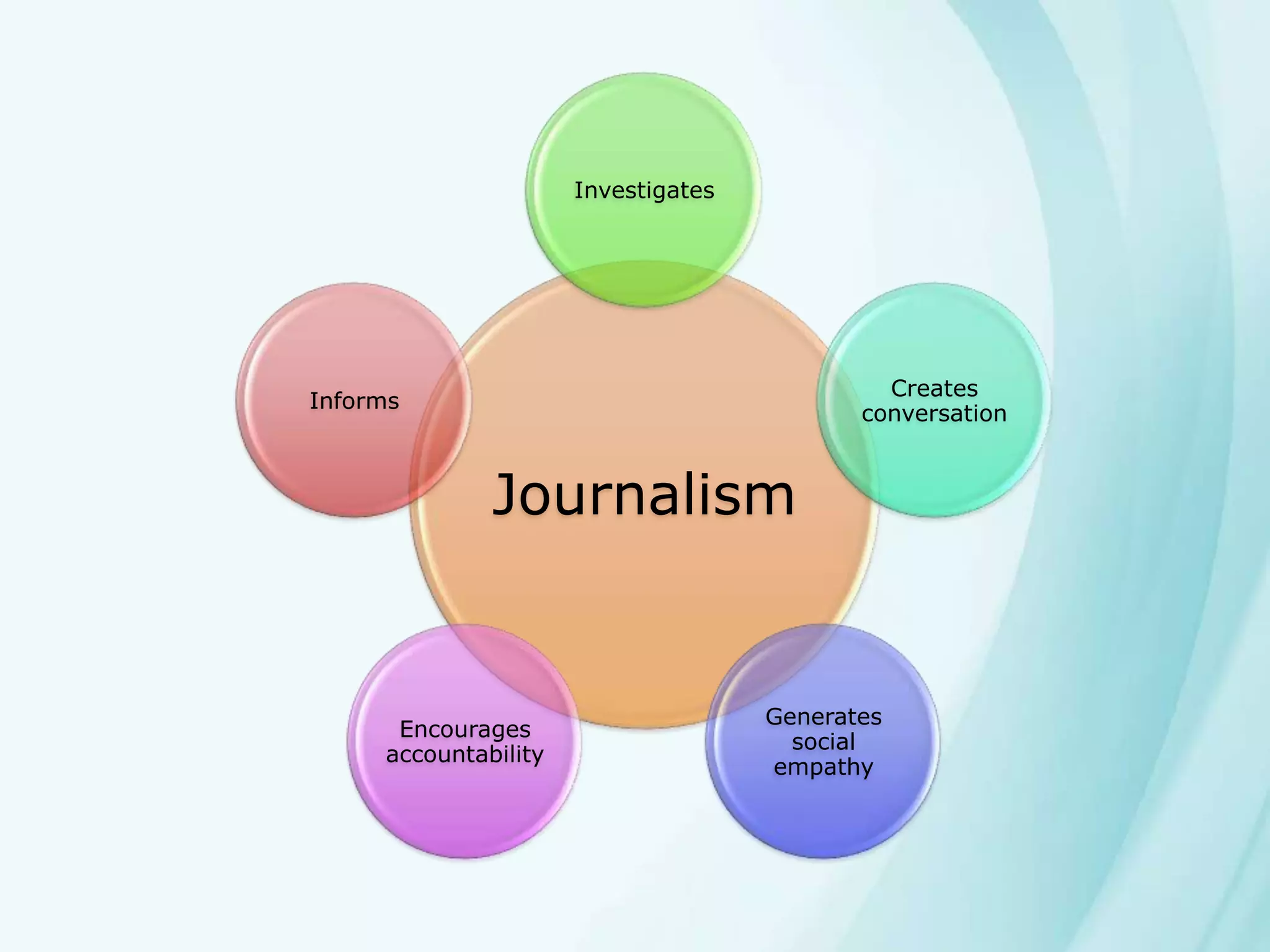
Journalism
Investigates
Creates
conversation
Generates
social
empathy
Encourages
accountability
Informs
19
Social responsibility theory
• What happens when the press doesn’t
perform those functions?
• Hutchins Commission: Free press in
danger
• In danger of what?
• What was to blame?
• “Behave, or else!”
• Gave rise to the idea of journalism as a
profession
• Along with freedoms come (public)
responsibilities
20
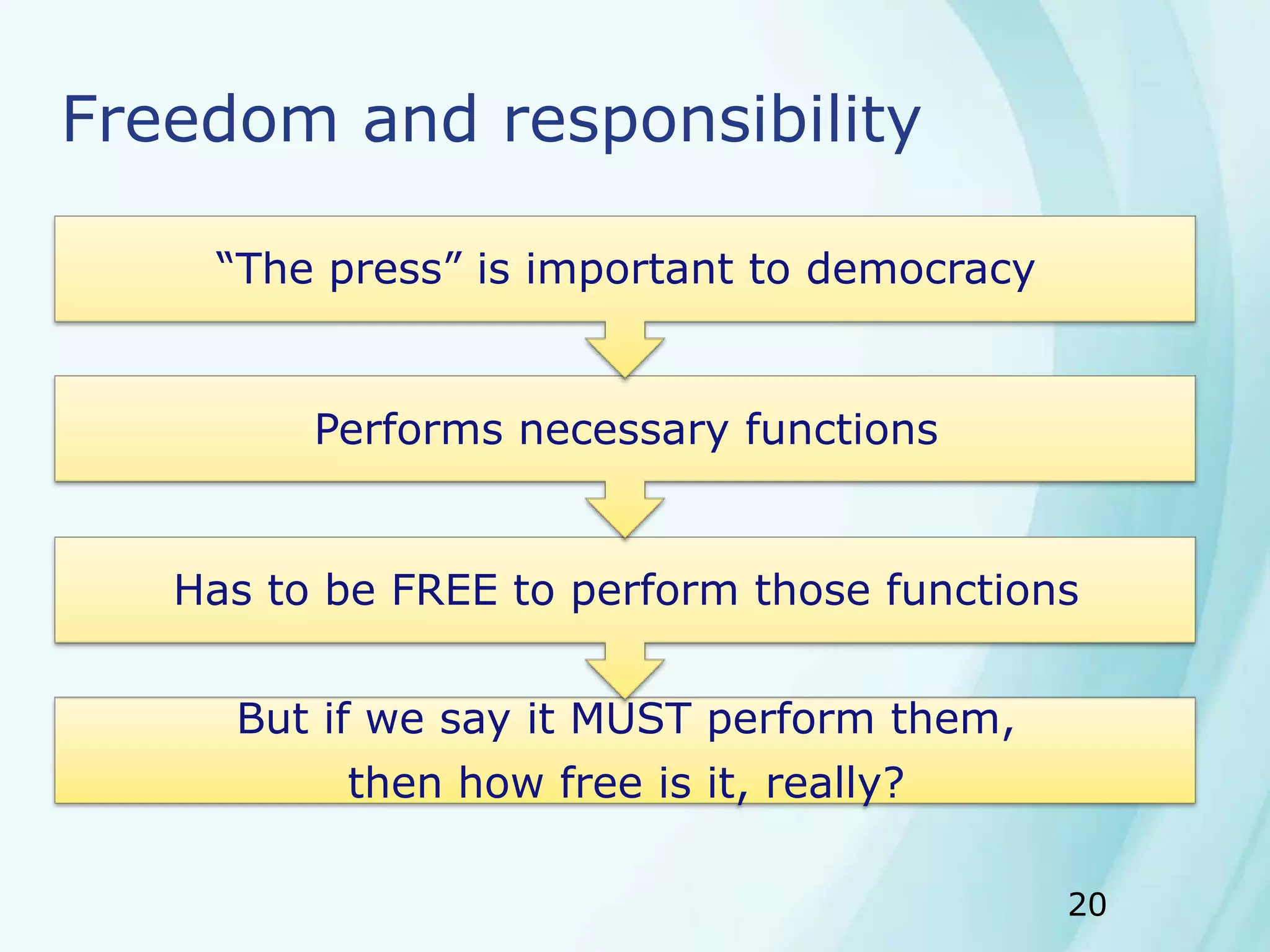
Freedom and responsibility
But if we say it MUST perform them,
then how free is it, really?
Has to be FREE to perform those functions
Performs necessary functions
“The press” is important to democracy
21
Chapter 1 - KEY Takeaways
• Journalism plays an important role in
democratic self-governance
• Performs functions related to
information dissemination,
accountability, representation,
deliberation and conflict resolution
• The mirror, watchdog and marketplace
metaphors are common ways of
describing those functions
22
Chapter 1 - KEY Takeaways
•Journalism must be free to
perform those functions, but also
responsible for doing so
•A key tension in journalism
•Many barriers to performing
necessary functions
• Elements of Hutchins Commission still
ring true today
23
What Is Journalism?
•You Define?????
24
Our definition
• Journalism is a set of transparent,
independent procedures aimed at
gathering, verifying and reporting
truthful information of consequence
to citizens in a democracy.
Key adjectives
Transparent
• About what?
• Open
• Accountable
• Similar to…?
• Necessary, but difficult
Independent
• From whom?
• Free
• No divided loyalties
• Similar to…?
• Also difficult
26
Kovach & Rosentiel:
Elements of journalism
1. Obligation to truth
2. Loyalty to citizens
3. Discipline of verification
4. Independence from those they cover
5. Monitor of power
6. Forum for criticism/compromise
7. Make the significant interesting and relevant
8. Comprehensive and proportional
9. Personal conscience
27
Let’s discuss
• Which news organizations do you
consider the most accurate and
credible? Why?
• What makes one news organization
more credible than the other?
• What drives the perception?
• Types of stories? Political viewpoint?
Quality of writing/reporting?
Pictures?
What does the definition omit?
Objective
• What does that really
mean?
• What’s in the definition
that addresses
objectivity-like
concerns?
Professional
• Suggests status or
authority
• Implies standards are
a defining feature
• So why not include?
29
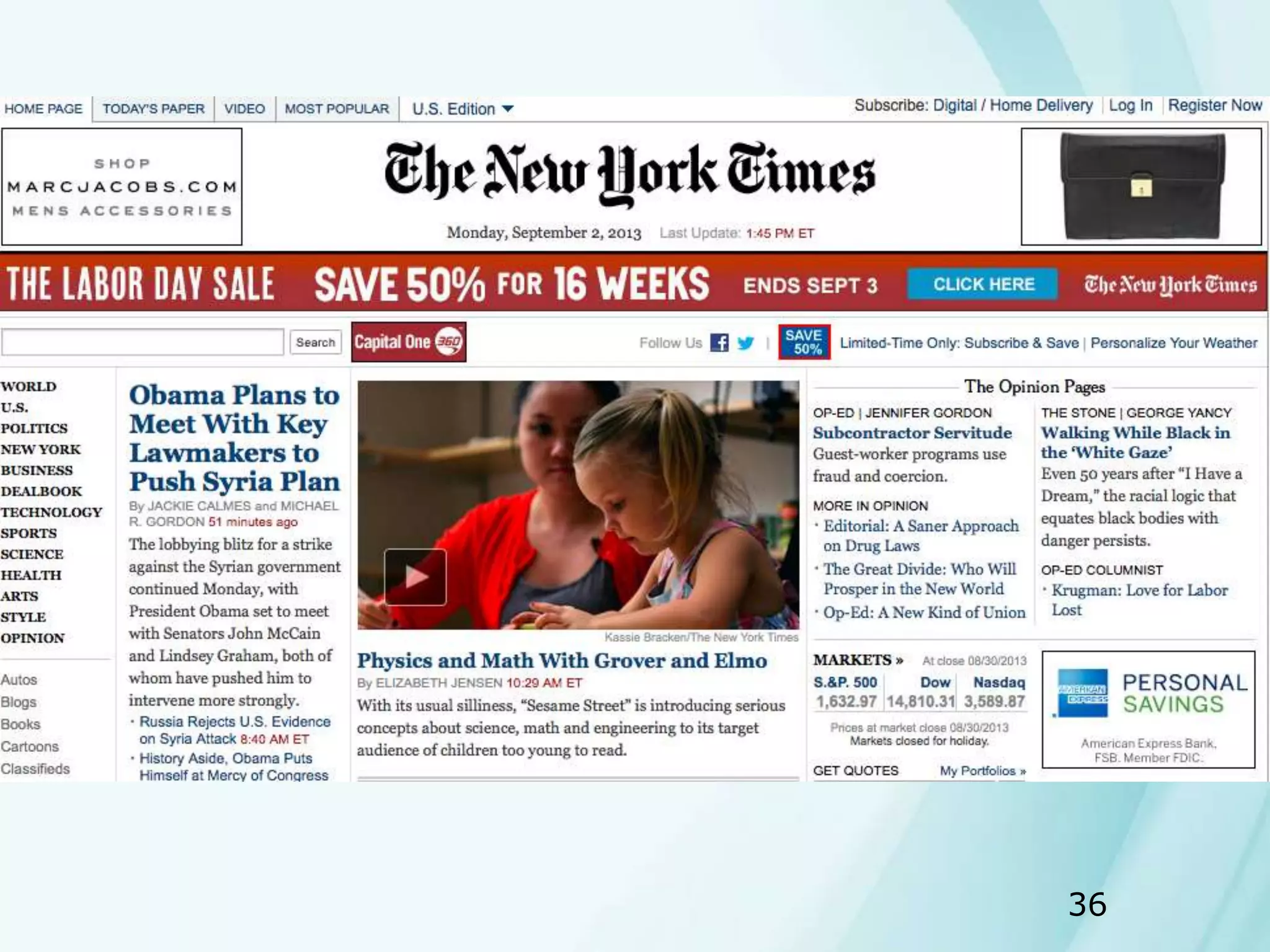
Aren’t “news” and “journalism” the
same thing?
• Check out this definition:
• “A current, reasoned reflection, in print or
telecommunications, of society’s events, needs and
values”
• News can mean different things in different
places
• Our definition suggests information is the raw
material of journalism.
• Is news the output? Why or why not?
30
A person or a practice?
• Less concerned about whether or
not to label a person a “journalist”
• More concerned about whether the
process is “journalistic”
• People committing “acts” of
journalism
Citizen journalism
• The idea behind citizen journalism is
that people without professional
journalism training can use the tools
of modern technology and the global
distribution of the Internet to create,
augment or fact-check media on their
own or in collaboration with others.
32
Credibility based on…
• Trustworthiness
• Expertise
• How do we know?
• Interestingly, the cues we’ve used for a long time might
be getting lost in the shuffle
Journalism is not…
PR or Advertising
• First loyalty to client,
not the public
Entertainment
• Entertainment, not
democratic
information, is primary
function
34
35
36
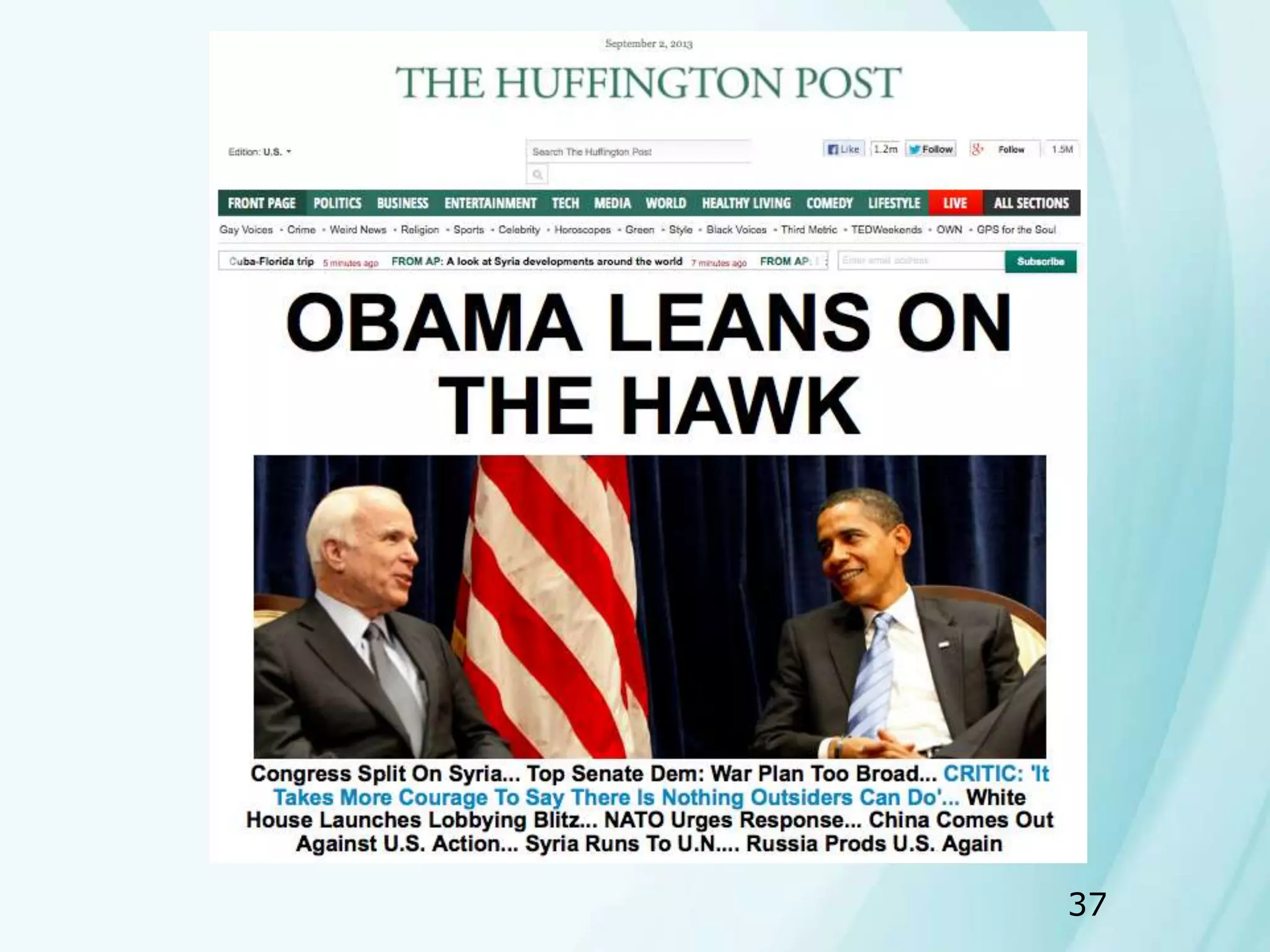
37
38
39
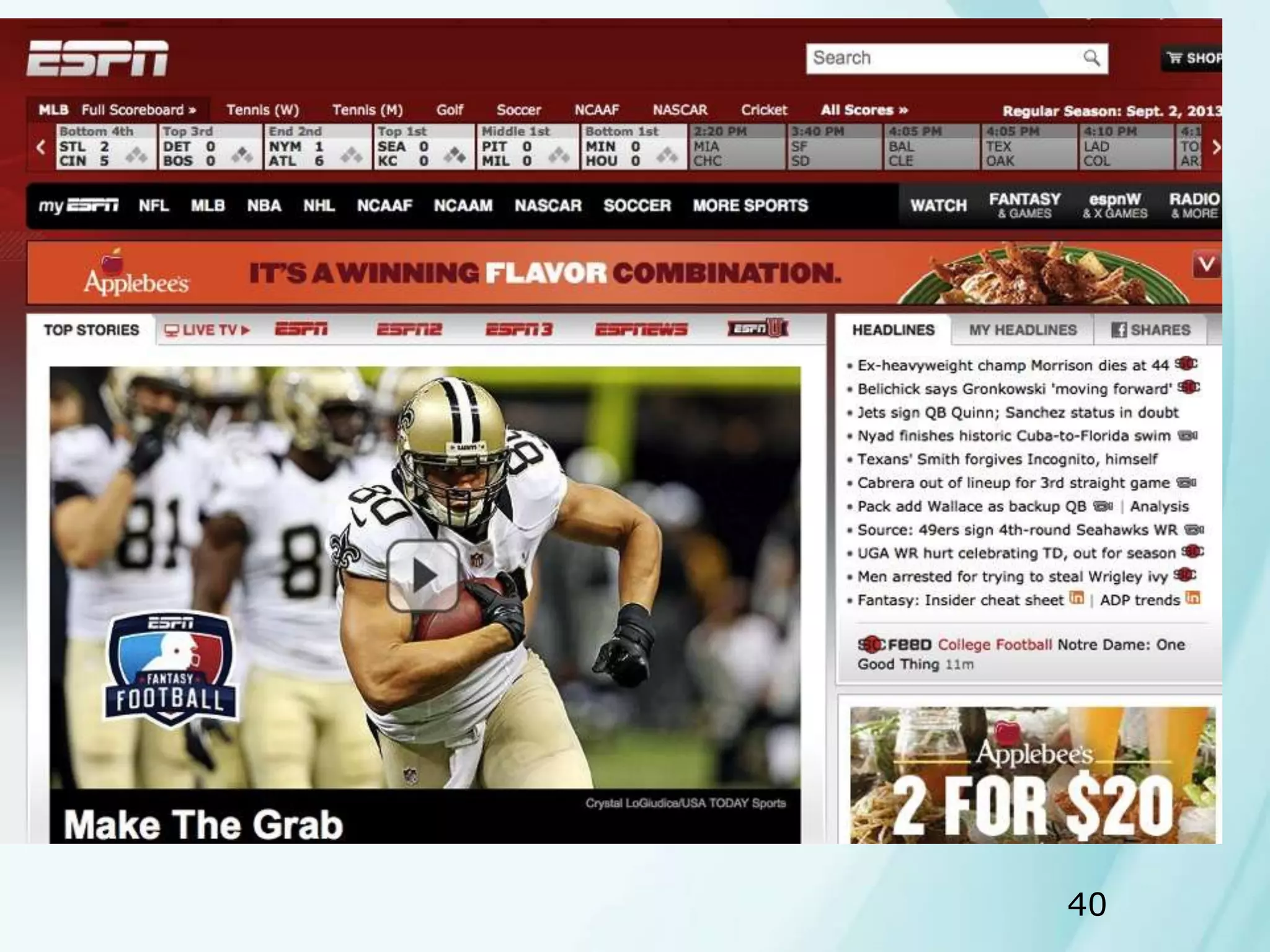
40
44
Chapter 3 – How News is Made
• Distinctions among news, information and
journalism
• Criteria of newsworthiness
• The news-making process
• Beats
• Enterprise stories
• Pseudo events
• News as a construction
• Commodification of news
45
Newsworthiness
Timeliness
Proximity
Unique
Human
Interest
Impact
Helpfulness
Celebrities
Entertainment
Dramatic
46
Where does news come from?
• Spontaneous
• Random
• Extraordinary
• Planned/staged: Press releases,
press conferences
• Beats
• Enterprise/investigative
News v. information?
• News
• Reported: interviews
with knowledgeable
sources
• Requires judgment
• Verified
• Transparent
• Organized
• Answers the questions:
who? What? Where?
Why? When?
• Information
• Anyone can share
information
• It’s everywhere –
become a
commodity
• Not always fact-
based
48
What’s news?
• Rescued Subway Kitties, Arthur and August,
Getting "Much-Needed TLC": ACC
• Service was suspended for about an hour on
the B and Q lines when the kittens ran on
the tracks last week
• http://www.nbcnewyork.com/news/local/Kittens-
Subway-Tracks-Brooklyn-MTA-Delays-Shut-
Down--221662261.html
49
Let’s discuss…
• Do readers and viewers understand
the difference between information?
News? Journalism?
• Examples????
50
Let’s discuss…
• Are certain types of media better at
conveying stories with certain types
of news values?
• Examples????

What isjournalism chapters 2

  • 1.
    The Mirror, theWatchdog and the Marketplace Principles of News JOUR 2300 Professor Neil Foote Mayborn School of Journalism
  • 2.
    2 Group Assignments • Eachgroup leader is responsible for: 1. Leading his/her group in a 20 – 30 minute discussion during class time to respond to the assigned questions based on the readings 2. Be ready – upon request – to personally respond or have a team member respond to key questions about the readings, e.g. offering a summary of an article, highlighting major themes or findings or identifying the most significant sources or people featured in story 3. Report attendance of group to the Graduate Assistant
  • 3.
    3 Group Assignments • Eachgroup should choose only one of the following questions to prepare for:  Chapter One, Question No. 1, p. 27  Chapter Two, Question No. 2, p. 57  Chapter Three, Question No. 1, p. 81
  • 4.
    Lasantha Wickramatunga “The free media serveas a mirror in which the public can see itself sans mascara and styling gel.”
  • 5.
    5 Journalism a keyplayer in democracy Information dissemination Representation Deliberation Conflict resolution Accountability Needs of self-governance include:
  • 6.
    6 Information dissemination • Democracyrequires a method for distributing all the information people need to make decisions and govern themselves
  • 7.
    7 Accountability • Holding thepower accountable, responsible for their actions – actions that affect all members of societies
  • 8.
    8 Representation • All peoplehave a chance to be heard – regardless of race, income, education attainment • Providing voice to voiceless
  • 9.
    9 Deliberation • Create aforum in which the interests of the public can be aired and debated
  • 10.
    10 Conflict resolution • Allowfor the diversity of ideas to be discussed so some kind of conclusion can be reached
  • 11.
    11 Three common metaphors •The Mirror • Journalism shows us who we are • The Watchdog • Journalism alerts us to what needs attention • The Marketplace • Journalism offers us ideas to consider and a place to discuss options
  • 12.
    12 The press asa mirror • Fulfills democratic needs for: •Information dissemination •Representation
  • 13.
    13 The press asa watchdog •Fulfills democratic needs for: •Accountability •Information dissemination
  • 14.
    14 The press asa marketplace •Fulfills democratic needs for: •Representation •Deliberation •Conflict resolution
  • 15.
    Is the roleof journalism more or less important than 200 years ago?
  • 16.
    16 Journalism and democracyaround the world • What does it mean for the press in a country to be free? • Free from what? • Free to do what? • Which nation’s press is most free? Least free? • What kinds of challenges to press freedom exist in countries, both free and not so free? • Why is press freedom important?
  • 17.
    17 The vanguard ofliberties • “A popular Government, without popular information, or the means of acquiring it, is but Prologue to a Farce or a Tragedy; or, perhaps both.” James Madison
  • 18.
  • 19.
    19 Social responsibility theory •What happens when the press doesn’t perform those functions? • Hutchins Commission: Free press in danger • In danger of what? • What was to blame? • “Behave, or else!” • Gave rise to the idea of journalism as a profession • Along with freedoms come (public) responsibilities
  • 20.
    20 Freedom and responsibility Butif we say it MUST perform them, then how free is it, really? Has to be FREE to perform those functions Performs necessary functions “The press” is important to democracy
  • 21.
    21 Chapter 1 -KEY Takeaways • Journalism plays an important role in democratic self-governance • Performs functions related to information dissemination, accountability, representation, deliberation and conflict resolution • The mirror, watchdog and marketplace metaphors are common ways of describing those functions
  • 22.
    22 Chapter 1 -KEY Takeaways •Journalism must be free to perform those functions, but also responsible for doing so •A key tension in journalism •Many barriers to performing necessary functions • Elements of Hutchins Commission still ring true today
  • 23.
  • 24.
    24 Our definition • Journalismis a set of transparent, independent procedures aimed at gathering, verifying and reporting truthful information of consequence to citizens in a democracy.
  • 25.
    Key adjectives Transparent • Aboutwhat? • Open • Accountable • Similar to…? • Necessary, but difficult Independent • From whom? • Free • No divided loyalties • Similar to…? • Also difficult
  • 26.
    26 Kovach & Rosentiel: Elementsof journalism 1. Obligation to truth 2. Loyalty to citizens 3. Discipline of verification 4. Independence from those they cover 5. Monitor of power 6. Forum for criticism/compromise 7. Make the significant interesting and relevant 8. Comprehensive and proportional 9. Personal conscience
  • 27.
    27 Let’s discuss • Whichnews organizations do you consider the most accurate and credible? Why? • What makes one news organization more credible than the other? • What drives the perception? • Types of stories? Political viewpoint? Quality of writing/reporting? Pictures?
  • 28.
    What does thedefinition omit? Objective • What does that really mean? • What’s in the definition that addresses objectivity-like concerns? Professional • Suggests status or authority • Implies standards are a defining feature • So why not include?
  • 29.
    29 Aren’t “news” and“journalism” the same thing? • Check out this definition: • “A current, reasoned reflection, in print or telecommunications, of society’s events, needs and values” • News can mean different things in different places • Our definition suggests information is the raw material of journalism. • Is news the output? Why or why not?
  • 30.
    30 A person ora practice? • Less concerned about whether or not to label a person a “journalist” • More concerned about whether the process is “journalistic” • People committing “acts” of journalism
  • 31.
    Citizen journalism • Theidea behind citizen journalism is that people without professional journalism training can use the tools of modern technology and the global distribution of the Internet to create, augment or fact-check media on their own or in collaboration with others.
  • 32.
    32 Credibility based on… •Trustworthiness • Expertise • How do we know? • Interestingly, the cues we’ve used for a long time might be getting lost in the shuffle
  • 33.
    Journalism is not… PRor Advertising • First loyalty to client, not the public Entertainment • Entertainment, not democratic information, is primary function
  • 34.
  • 35.
  • 36.
  • 37.
  • 38.
  • 39.
  • 40.
  • 44.
    44 Chapter 3 –How News is Made • Distinctions among news, information and journalism • Criteria of newsworthiness • The news-making process • Beats • Enterprise stories • Pseudo events • News as a construction • Commodification of news
  • 45.
  • 46.
    46 Where does newscome from? • Spontaneous • Random • Extraordinary • Planned/staged: Press releases, press conferences • Beats • Enterprise/investigative
  • 47.
    News v. information? •News • Reported: interviews with knowledgeable sources • Requires judgment • Verified • Transparent • Organized • Answers the questions: who? What? Where? Why? When? • Information • Anyone can share information • It’s everywhere – become a commodity • Not always fact- based
  • 48.
    48 What’s news? • RescuedSubway Kitties, Arthur and August, Getting "Much-Needed TLC": ACC • Service was suspended for about an hour on the B and Q lines when the kittens ran on the tracks last week • http://www.nbcnewyork.com/news/local/Kittens- Subway-Tracks-Brooklyn-MTA-Delays-Shut- Down--221662261.html
  • 49.
    49 Let’s discuss… • Doreaders and viewers understand the difference between information? News? Journalism? • Examples????
  • 50.
    50 Let’s discuss… • Arecertain types of media better at conveying stories with certain types of news values? • Examples????

Editor's Notes

  • #12 As you move through these metaphors, you’ll want to offer lots of current examples of stories that show the metaphor in action.
  • #17 Here it might be useful to use the maps and rankings of press freedom created by Freedom House or Reporters Without Borders to illustrate the basic point that the press seems to be most free in those places with democratic forms of government and, beyond that, to discuss differences in those democratic nations’ approaches to press freedom.
  • #19 As you go through these, you might consider not only giving examples of stories that perform each of these functions, but stories that at first glance look like they’re doing so, but are actually not/ This is a way of talking about the distinctions – visited again in Chapter 2 – among news, information and journalism, as well as of talking about all the kinds of things masquerading as journalism in the media.