Levers For Mrs. Berg’s Science Class
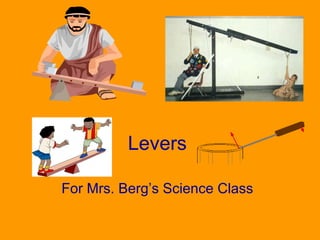
A lever consists of a rod or bar that rests and turns on a support called a  fulcrum . effort resistance
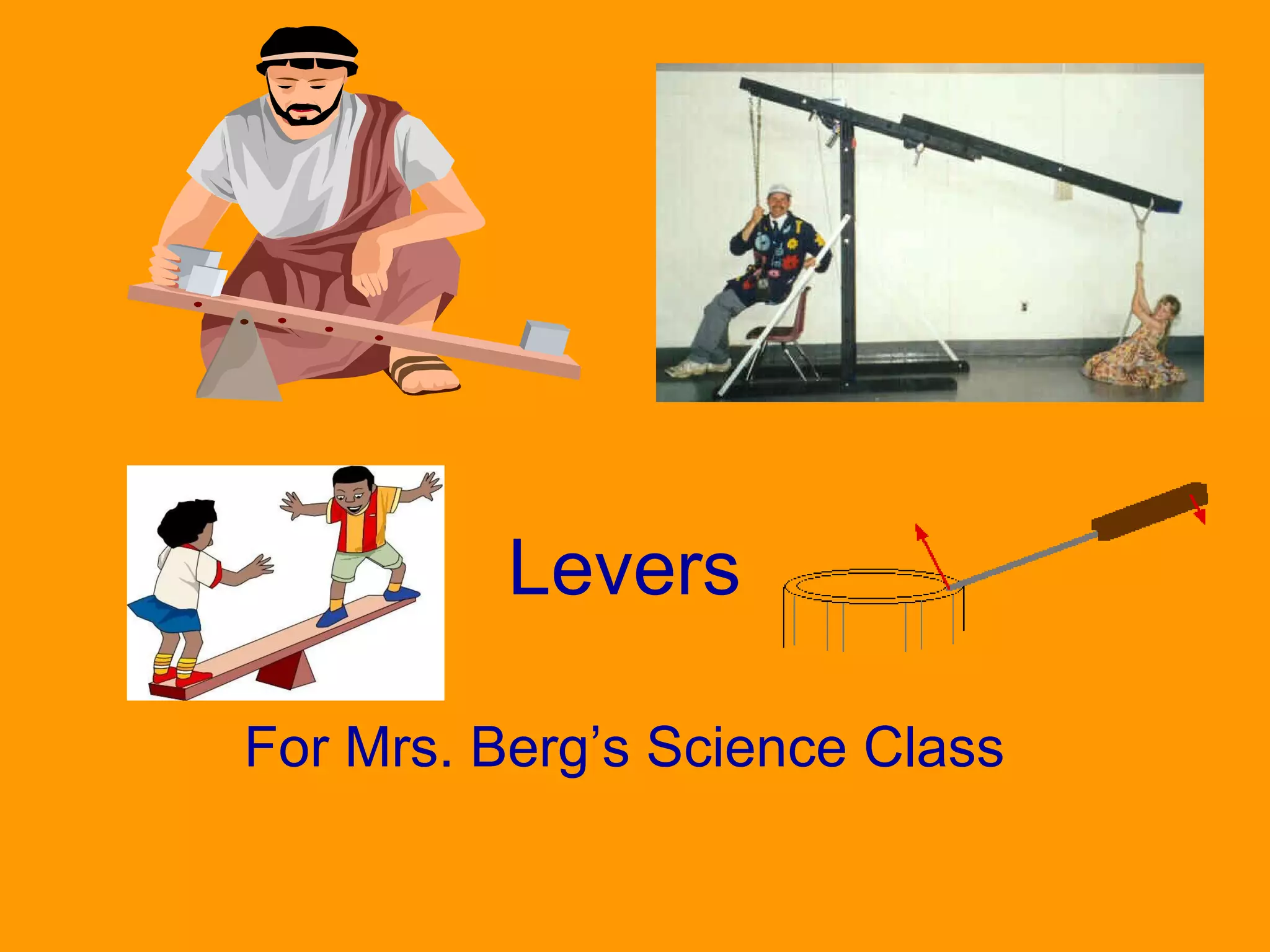
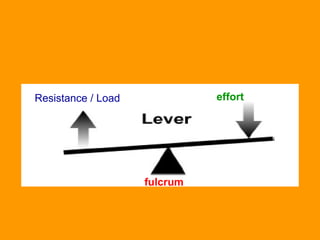
  A  force of effort  is applied at one end of the rod to lift a load placed at the other end. A lever can help lift a weight with less effort.  effort resistance fulcrum
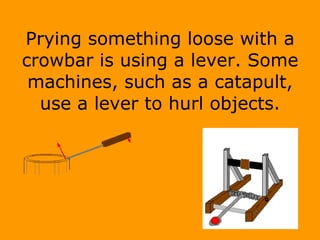
Prying something loose with a crowbar is using a lever. Some machines, such as a catapult, use a lever to hurl objects.
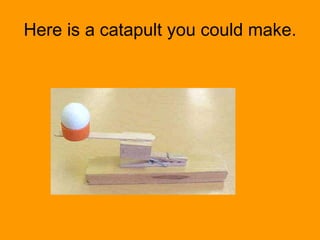
Here is a catapult you could make.
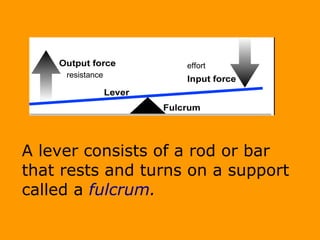
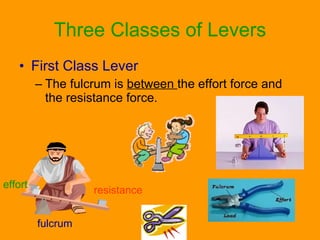
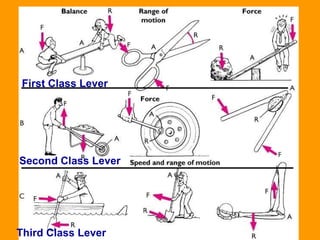
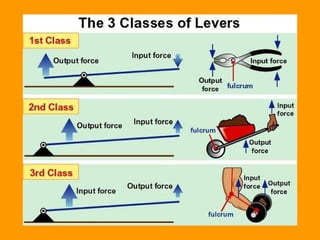
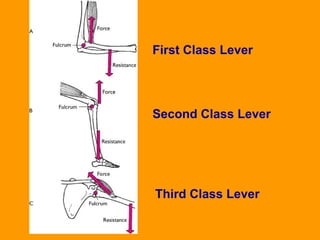
Three Classes of Levers First Class Lever The fulcrum is  between  the effort force and the resistance force. resistance fulcrum effort
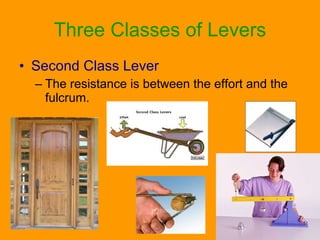
Three Classes of Levers Second Class Lever The resistance is between the effort and the fulcrum.
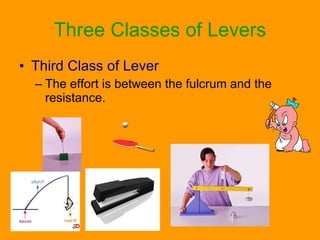
Three Classes of Levers Third Class of Lever The effort is between the fulcrum and the resistance.
First Class Lever Second Class Lever Third Class Lever
 
 
Levers on the internet Check out these websites! http://www.dynamicscience.com.au/tester/solutions/hydraulicus/simplemachineslevers1.htm LEVERS in our BODIES! http://www.dynamicscience.com.au/tester/solutions/hydraulicus/humanbody.htm http://www.montgomery.k12.ky.us/camargo/Projects/simplemachines/simplemachines.htm
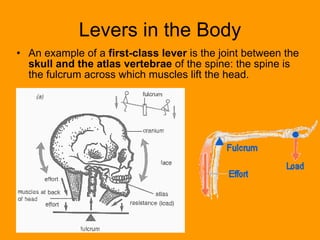
Levers in the Body An example of a  first-class lever  is the joint between the  skull and the atlas vertebrae  of the spine: the spine is the fulcrum across which muscles lift the head.
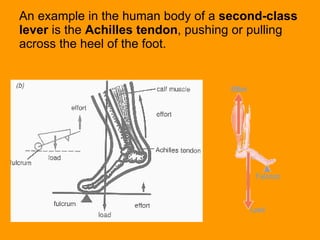
An example in the human body of a  second-class lever  is the  Achilles tendon , pushing or pulling across the heel of the foot.
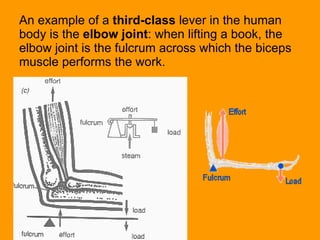
An example of a  third-class  lever in the human body is the  elbow joint : when lifting a book, the elbow joint is the fulcrum across which the biceps muscle performs the work.
First Class Lever Second Class Lever Third Class Lever
 
 
Key Concepts: A lever pivots on one fixed point – up and down or side to side. To use a lever, effort is applied to one end by pushing or pulling.  The lever transfers this force to move the load.
Key Concepts: A lever can make work easier in the following ways: Increasing the force being applied. Changing the direction of the force. Increasing the distance or speed at which the job is done.
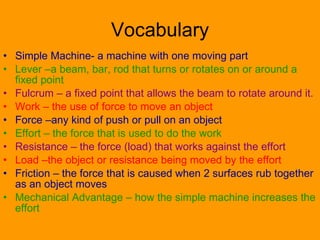
Vocabulary Simple Machine- a machine with one moving part Lever –a beam, bar, rod that turns or rotates on or around a fixed point Fulcrum – a fixed point that allows the beam to rotate around it. Work – the use of force to move an object Force –any kind of push or pull on an object Effort – the force that is used to do the work Resistance – the force (load) that works against the effort Load –the object or resistance being moved by the effort Friction – the force that is caused when 2 surfaces rub together as an object moves Mechanical Advantage – how the simple machine increases the effort
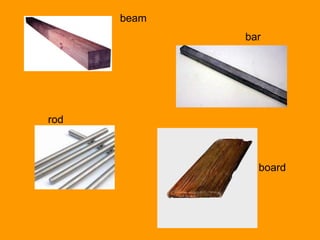
beam bar rod board
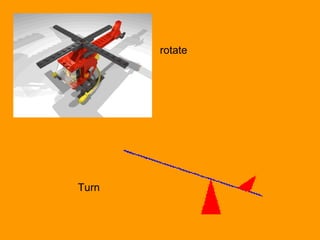
rotate Turn
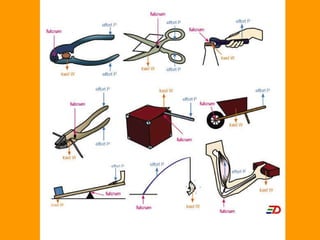
effort Resistance / Load fulcrum
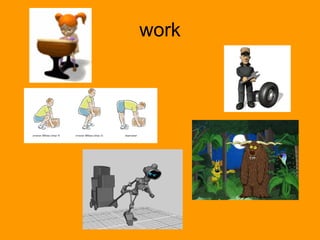
work
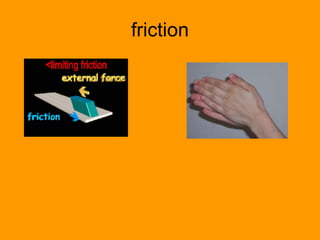
friction
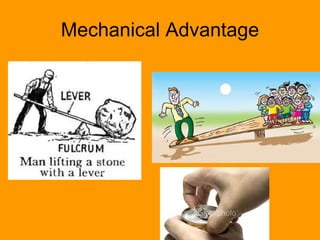
Mechanical Advantage

Levers

  • 1.
    Levers For Mrs.Berg’s Science Class
  • 2.
    A lever consistsof a rod or bar that rests and turns on a support called a fulcrum . effort resistance
  • 3.
    A force of effort is applied at one end of the rod to lift a load placed at the other end. A lever can help lift a weight with less effort. effort resistance fulcrum
  • 4.
    Prying something loosewith a crowbar is using a lever. Some machines, such as a catapult, use a lever to hurl objects.
  • 5.
    Here is acatapult you could make.
  • 6.
    Three Classes ofLevers First Class Lever The fulcrum is between the effort force and the resistance force. resistance fulcrum effort
  • 7.
    Three Classes ofLevers Second Class Lever The resistance is between the effort and the fulcrum.
  • 8.
    Three Classes ofLevers Third Class of Lever The effort is between the fulcrum and the resistance.
  • 9.
    First Class LeverSecond Class Lever Third Class Lever
  • 10.
  • 11.
  • 12.
    Levers on theinternet Check out these websites! http://www.dynamicscience.com.au/tester/solutions/hydraulicus/simplemachineslevers1.htm LEVERS in our BODIES! http://www.dynamicscience.com.au/tester/solutions/hydraulicus/humanbody.htm http://www.montgomery.k12.ky.us/camargo/Projects/simplemachines/simplemachines.htm
  • 13.
    Levers in theBody An example of a first-class lever is the joint between the skull and the atlas vertebrae of the spine: the spine is the fulcrum across which muscles lift the head.
  • 14.
    An example inthe human body of a second-class lever is the Achilles tendon , pushing or pulling across the heel of the foot.
  • 15.
    An example ofa third-class lever in the human body is the elbow joint : when lifting a book, the elbow joint is the fulcrum across which the biceps muscle performs the work.
  • 16.
    First Class LeverSecond Class Lever Third Class Lever
  • 17.
  • 18.
  • 19.
    Key Concepts: Alever pivots on one fixed point – up and down or side to side. To use a lever, effort is applied to one end by pushing or pulling. The lever transfers this force to move the load.
  • 20.
    Key Concepts: Alever can make work easier in the following ways: Increasing the force being applied. Changing the direction of the force. Increasing the distance or speed at which the job is done.
  • 21.
    Vocabulary Simple Machine-a machine with one moving part Lever –a beam, bar, rod that turns or rotates on or around a fixed point Fulcrum – a fixed point that allows the beam to rotate around it. Work – the use of force to move an object Force –any kind of push or pull on an object Effort – the force that is used to do the work Resistance – the force (load) that works against the effort Load –the object or resistance being moved by the effort Friction – the force that is caused when 2 surfaces rub together as an object moves Mechanical Advantage – how the simple machine increases the effort
  • 22.
  • 23.
  • 24.
    effort Resistance /Load fulcrum
  • 25.
  • 26.
  • 27.