CRITICAL
INFRASTRUCTURE
DR JOHN ROOKSBY
IN THIS LECTURE
What is infrastructure?
• National infrastructures
• Organisational infrastructures
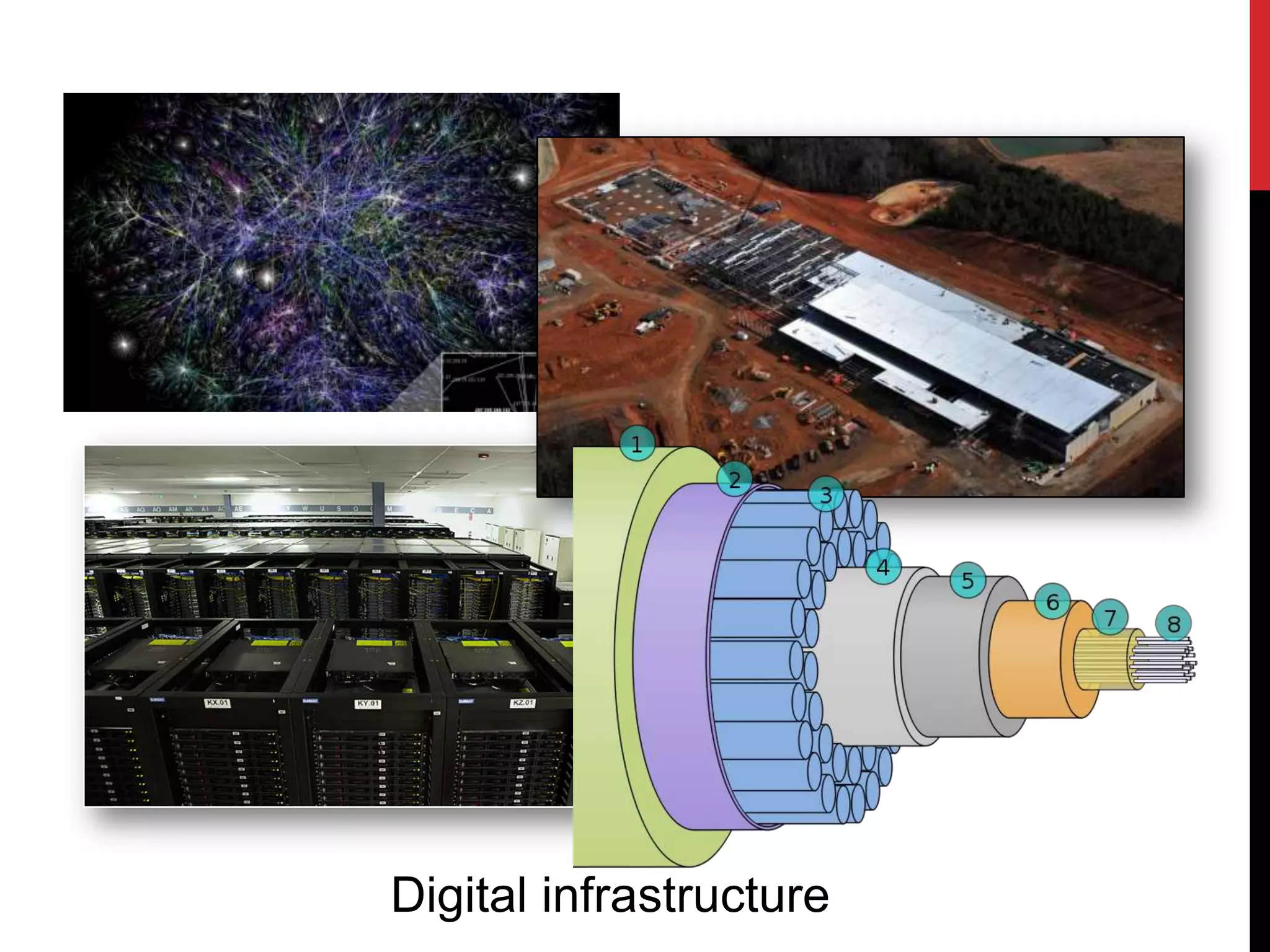
• Digital infrastructures
What is critical infrastructure?
• How is infrastructure vulnerable?
Understanding infrastructure
• Problems of understanding existing infrastructure
• Interdependencies in infrastructure
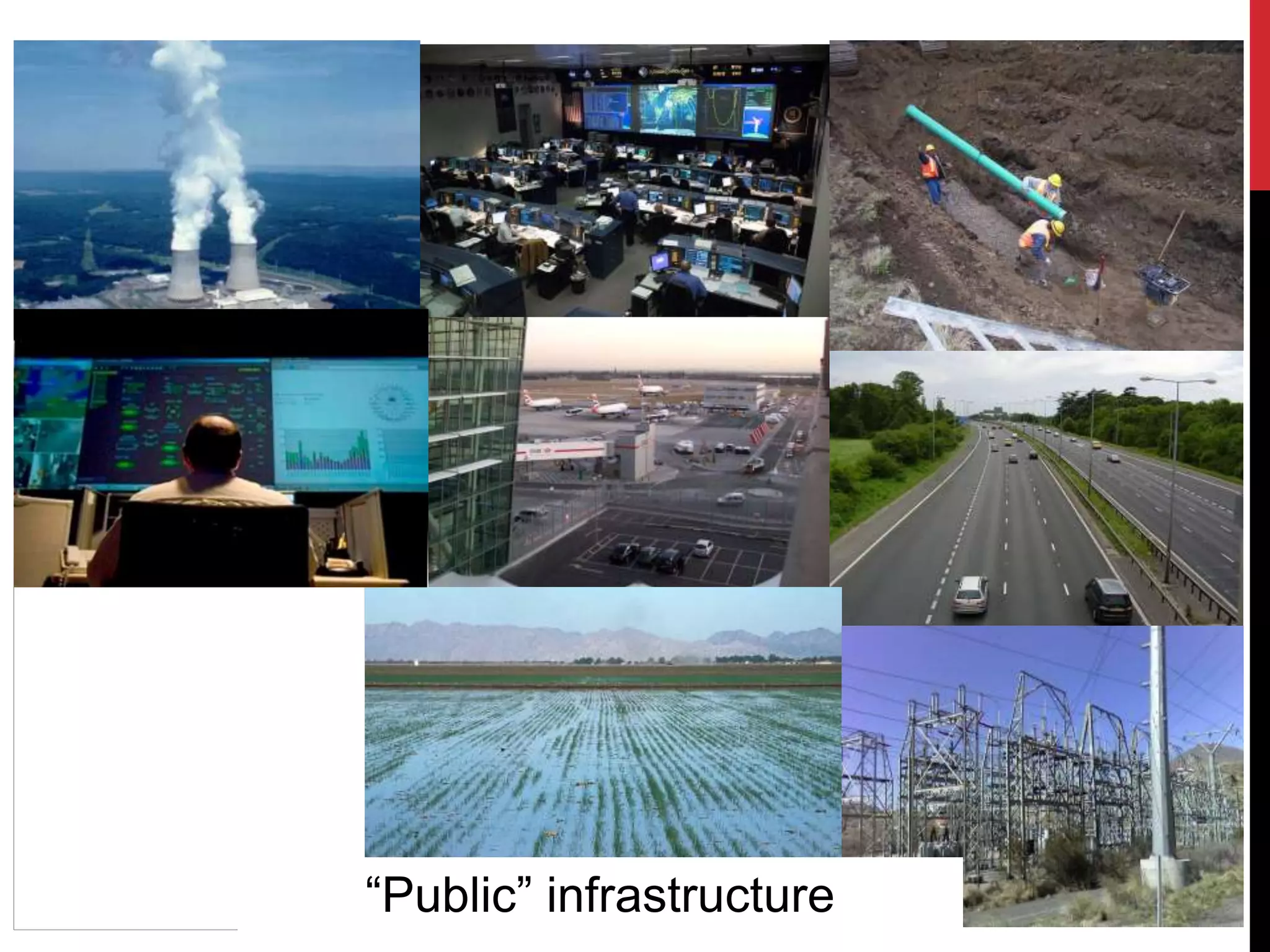
“Public” infrastructure
Digital infrastructure
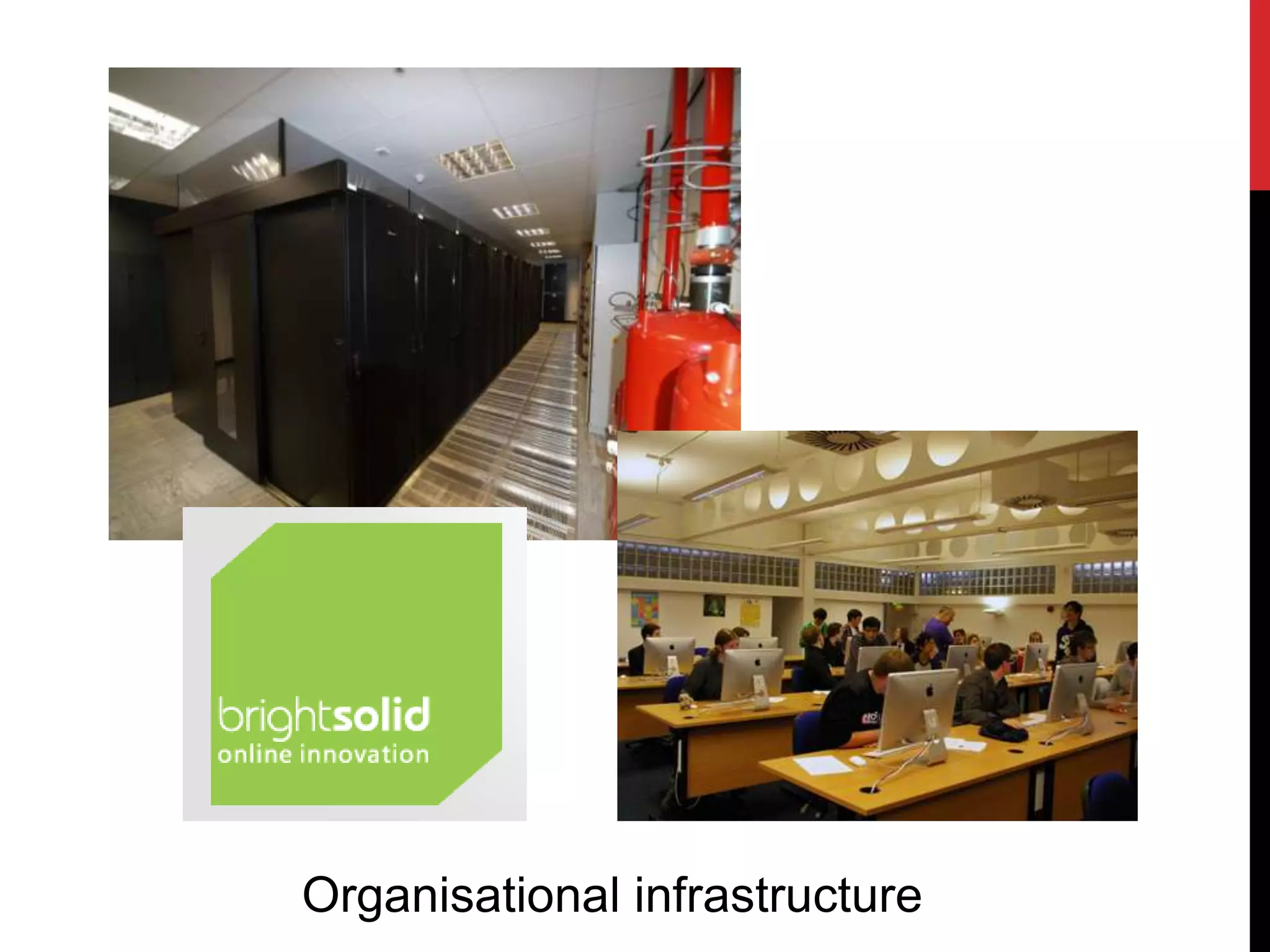
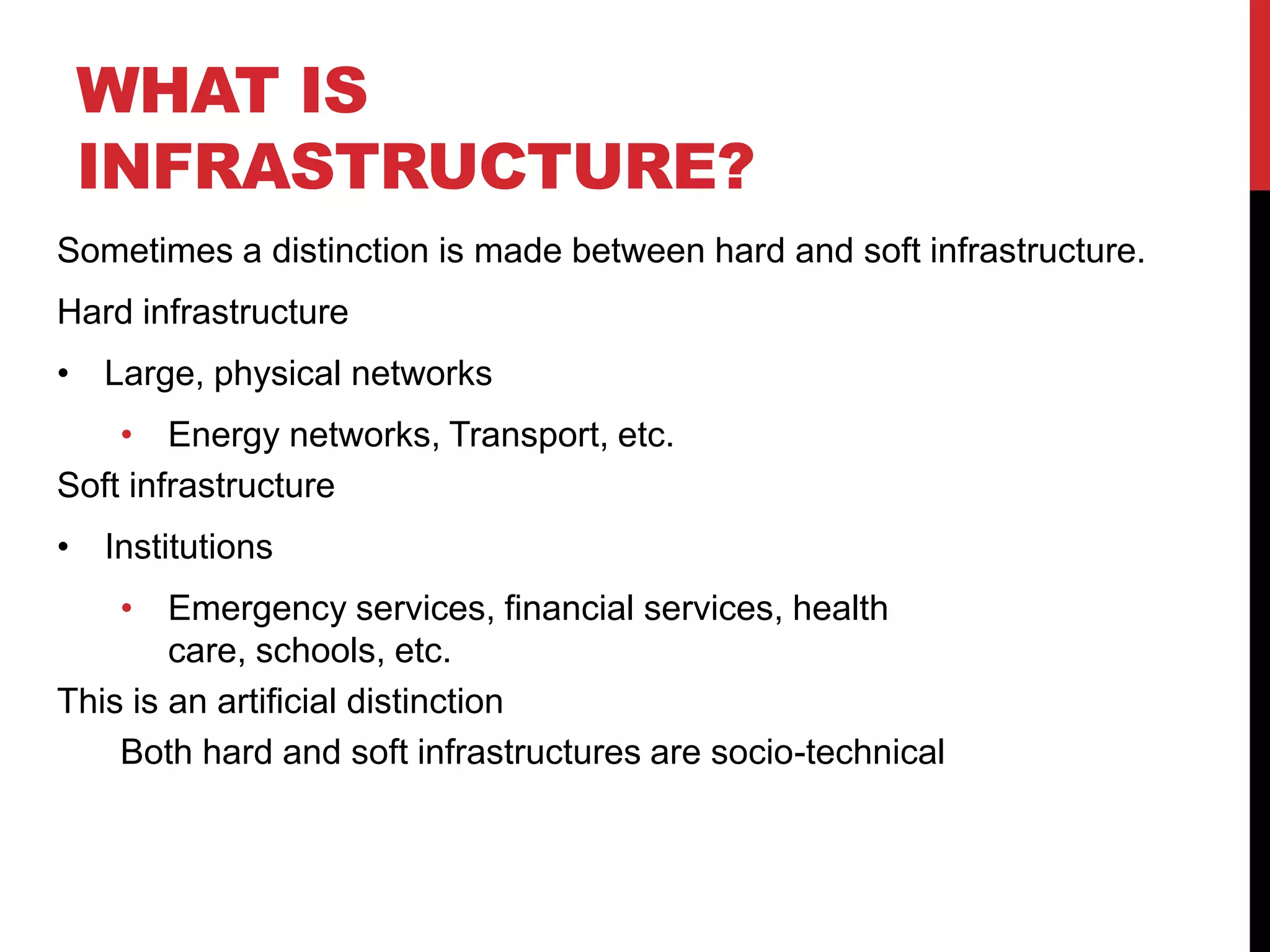
Organisational infrastructure
WHAT IS
 INFRASTRUCTURE?
The installed base upon which operations and systems can run
Public infrastructure
• National and international systems upon which societies operate:
  transport, energy, communications, etc. (Includes digital
  infrastructure).
• Used to be publicly owned, but in the UK and many other counties it
  has been privatised
Organisational infrastructure
• A much newer use of the term
• Physical and digital infrastructure used by an organisation
• Not necessarily owned by the organisation
WHAT IS
 INFRASTRUCTURE?
Sometimes a distinction is made between hard and soft infrastructure.
Hard infrastructure
• Large, physical networks
    • Energy networks, Transport, etc.
Soft infrastructure
• Institutions
    • Emergency services, financial services, health
        care, schools, etc.
This is an artificial distinction
    Both hard and soft infrastructures are socio-technical
CHARACTERISTICS OF
INFRASTRUCTURE
• Large Scale
      • Spread over large geographic areas
      • Regional/National/International
• Complex
      • Many components
      • Many interdependencies (internal and external)
• Reliance on standards
      • Heterogeneous parts rely on standards for interoperation
      • Standards are not always uniformly applied across an
        infrastructure
• Long term
      • Modern and legacy components
      • Emerges and changes over the long term
      • We have to live with decisions made a long time ago
ECONOMIC CHARACTERISTICS
 OF INFRASTRUCTURE
Rarely one single owner and authority
• Sub-systems and components are increasingly privatised
  • The theory is that privately operated infrastructure will be more
    efficient
  • However it is difficult to optimise an infrastructure when sections of it
    are run by self interested parties
• Crosses national and international boundaries
Often challenging to fund
• We are often reluctant to pay for infrastructure
• Where monopolies exist they are able to over-charge. However,
  competition where operational costs are low can lead to under-
  charging (and no re-investment).
SOCIAL CHARACTERISTICS
OF INFRASTRUCTURE
Learned as part of membership
•    The use, and styles of use, of particular infrastructures signifies and is
     often an essential marker of membership of a community.
Links with conventions of practice
•    Infrastructure both shapes and is shaped by the conventions of a
     community of practice, e.g. the ways that cycles of day-night work are
     affected by and affect electrical power rates
Taken for granted
•    Does not need to be re-invented every time we do something new
•    We often don’t pay much attention to it. The normally invisible quality of
     working infrastructure becomes visible when it breaks
Infrastructure is “a relation”
•    Whether something is infrastructure depends on perspective
     (particularly for digital infrastructure). A focus for one person can be
     infrastructure for another.
THE EMERGENCE OF
INFRASTRUCTURE
Infrastructures are engineered, but not at the system level. They
emerge through social and institutional processes
•   Begins with a “vision” (or visions). Later reality does not
    necessarily match this.
•   Competing designs emerge.
•   One or more local technologies become adopted as standard
•   We have to live with decisions made a long time ago
The history of power girds, sewer systems, railways and so on do not
portray a rational process in which an ideal system is designed and
built, but a chaotic one.
Cloud and grid computing are often likened to power grids
•   There is nothing inevitable about these becoming
    infrastructure, and the meaning of these terms continues to
    evolve.
WHAT IS CRITICAL
INFRASTRUCTURE?
As individuals we often take infrastructure for granted, but
organisations and governments cannot.
• Infrastructure needs to be maintained and adapted/modernised
• Strategic decisions must be made about what kind of
  infrastructure to invest in (and how)
• However, much infrastructure is not under control of a single
  organisation or authority
• Infrastructure is vulnerable
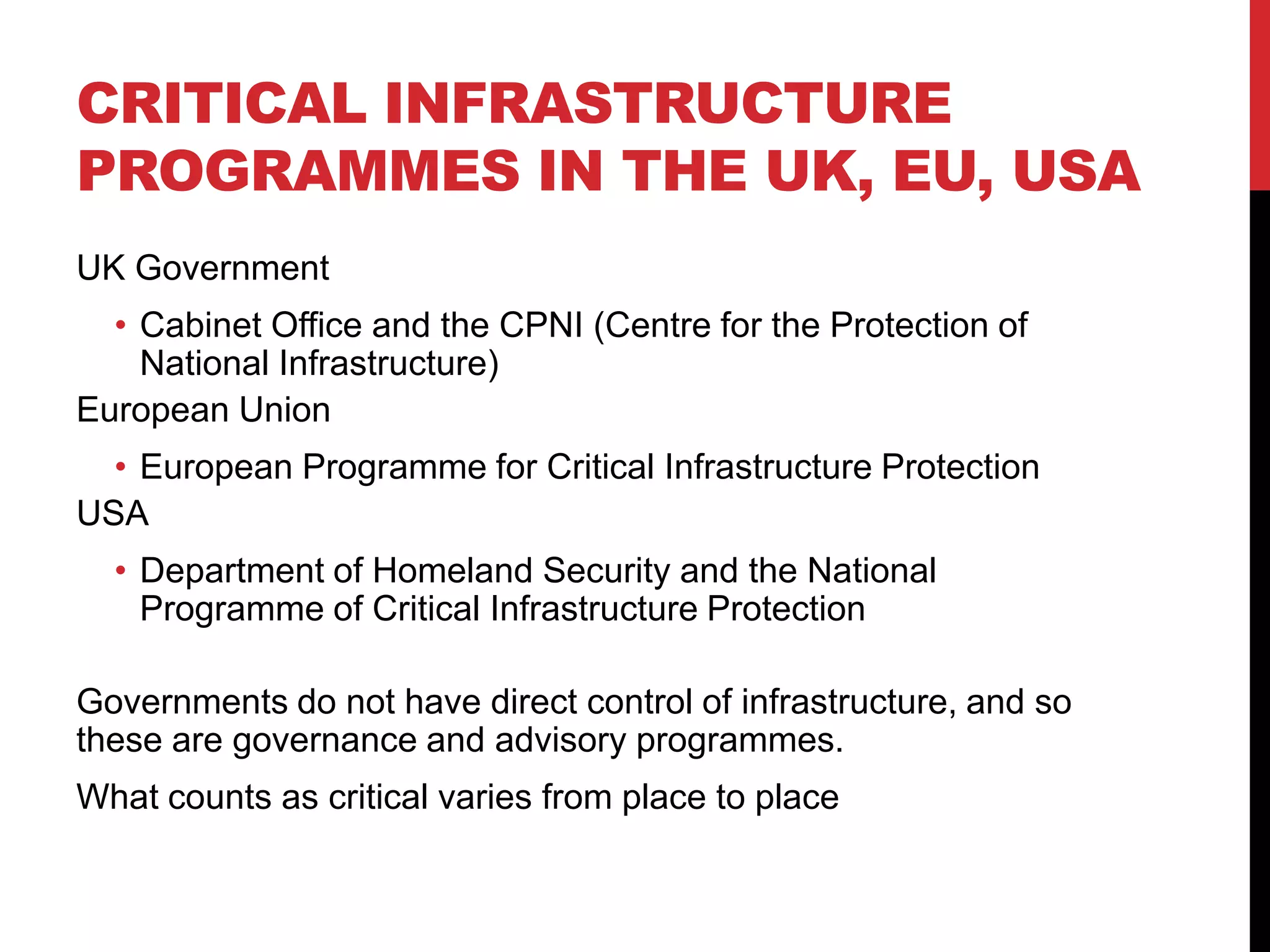
Many countries now have critical infrastructure programmes
CRITICAL INFRASTRUCTURE
PROGRAMMES IN THE UK, EU, USA
UK Government
  • Cabinet Office and the CPNI (Centre for the Protection of
    National Infrastructure)
European Union
  • European Programme for Critical Infrastructure Protection
USA
  • Department of Homeland Security and the National
    Programme of Critical Infrastructure Protection

Governments do not have direct control of infrastructure, and so
these are governance and advisory programmes.
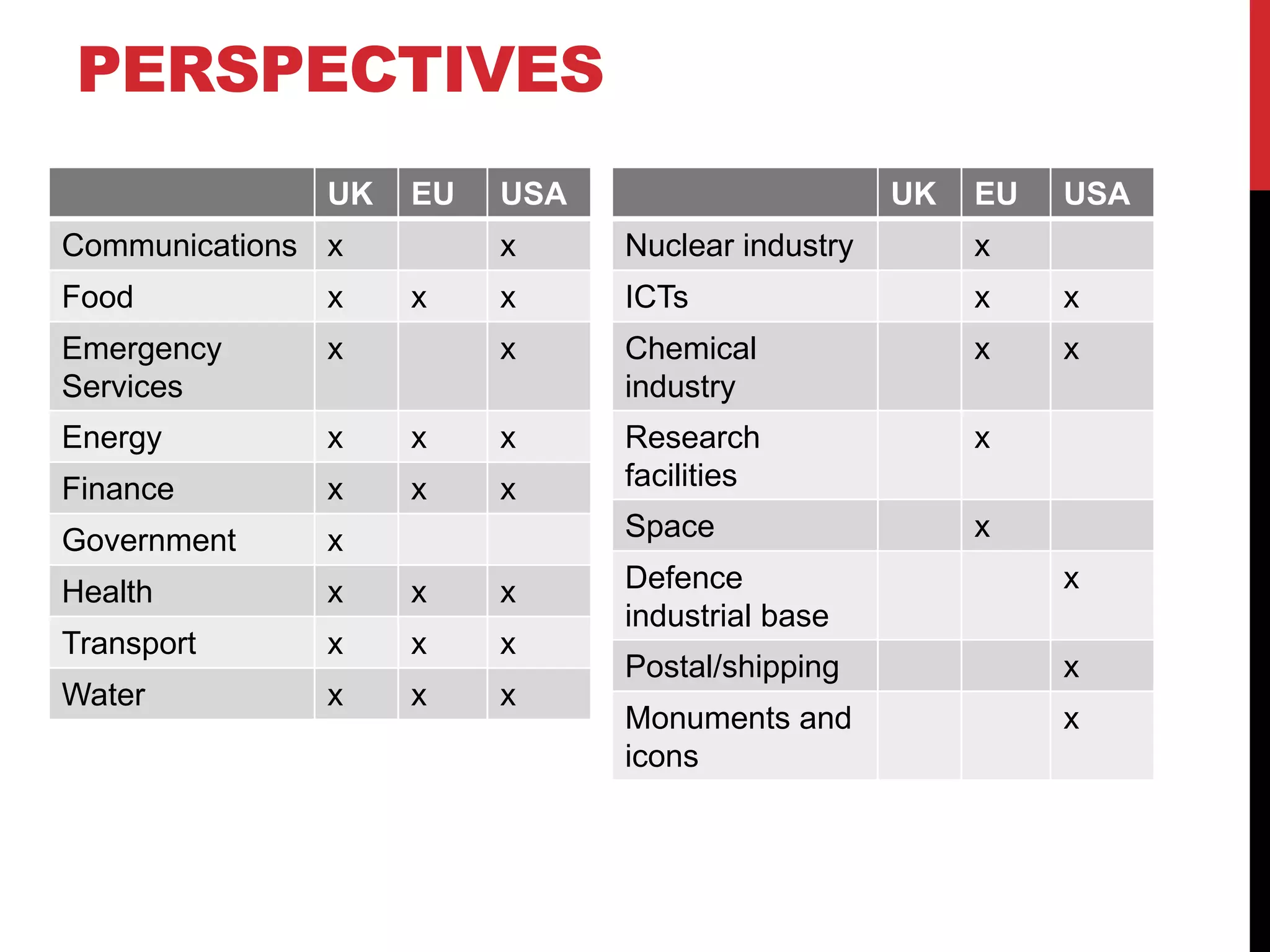
What counts as critical varies from place to place
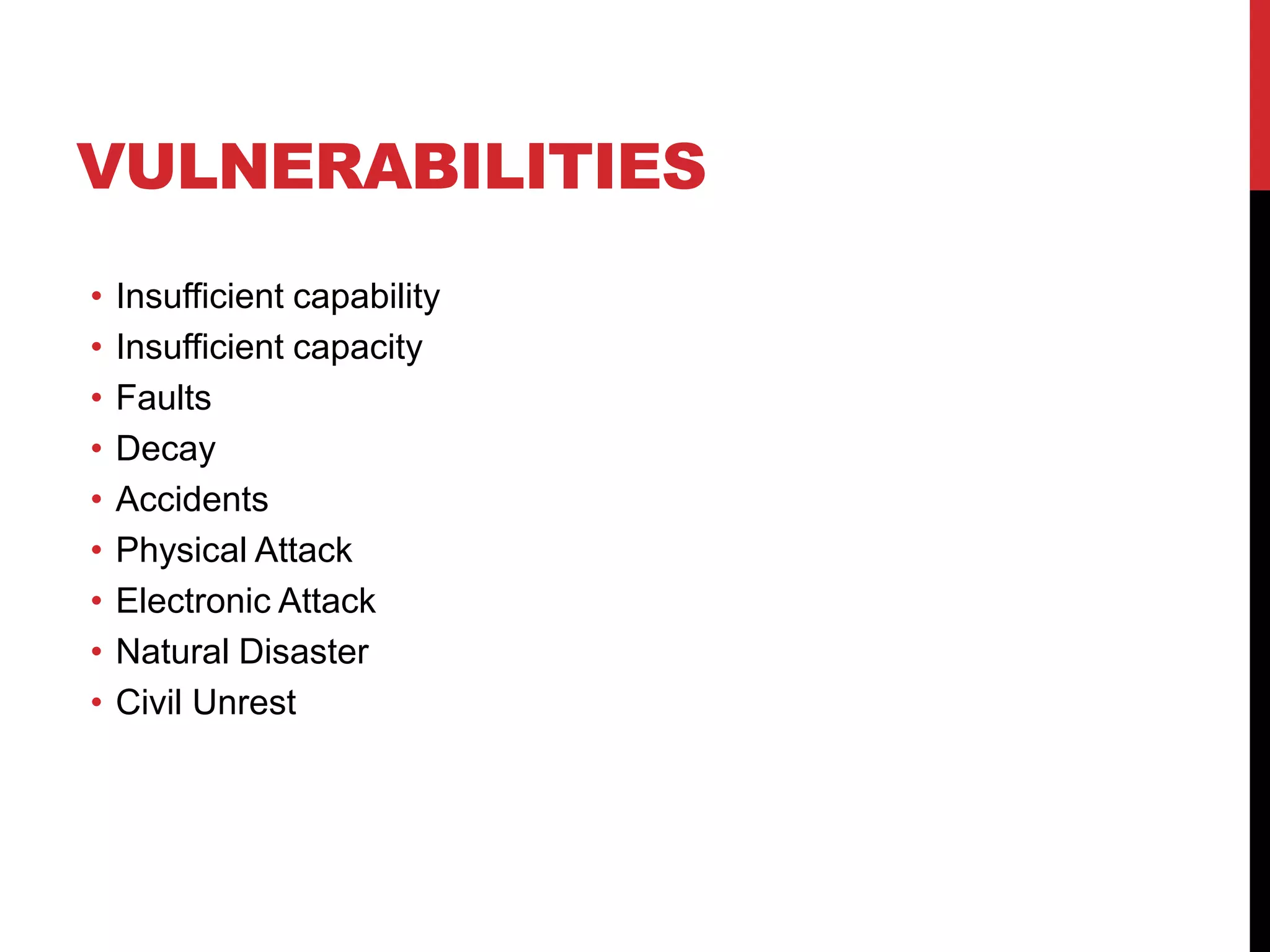
VULNERABILITIES
•   Insufficient capability
•   Insufficient capacity
•   Faults
•   Decay
•   Accidents
•   Physical Attack
•   Electronic Attack
•   Natural Disaster
•   Civil Unrest
PERSPECTIVES
               UK   EU   USA                      UK   EU   USA
Communications x         x     Nuclear industry        x
Food           x    x    x     ICTs                    x    x
Emergency      x         x     Chemical                x    x
Services                       industry
Energy         x    x    x     Research                x
Finance        x    x    x     facilities

Government     x               Space                   x

Health         x    x    x     Defence                      x
                               industrial base
Transport      x    x    x
                               Postal/shipping              x
Water          x    x    x
                               Monuments and                x
                               icons
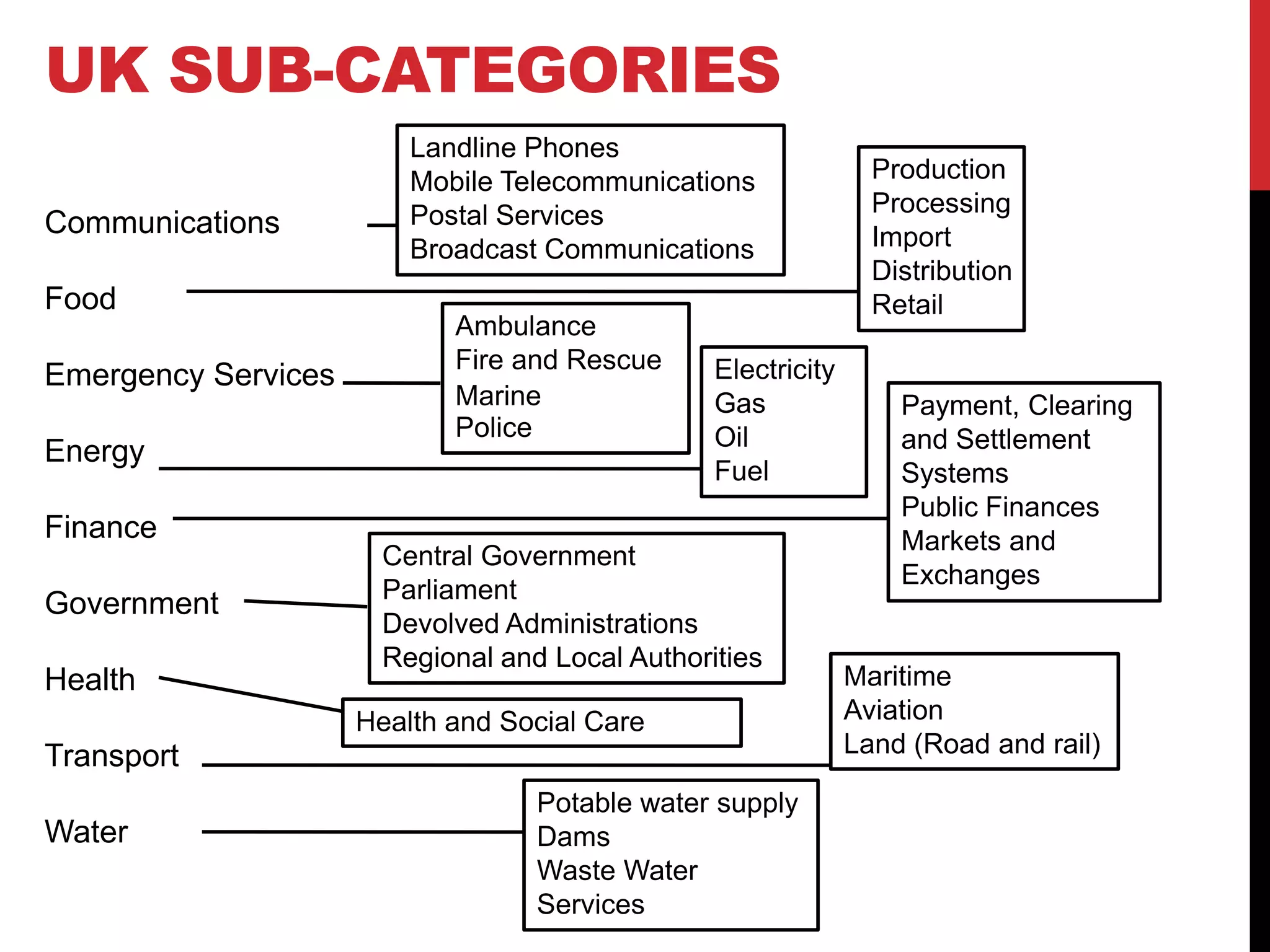
UK SUB-CATEGORIES
                         Landline Phones
                         Mobile Telecommunications               Production
                         Postal Services                         Processing
Communications                                                   Import
                         Broadcast Communications
                                                                 Distribution
Food                                                             Retail
                            Ambulance
                            Fire and Rescue      Electricity
Emergency Services
                            Marine               Gas               Payment, Clearing
                            Police               Oil               and Settlement
Energy
                                                 Fuel              Systems
                                                                   Public Finances
Finance                                                            Markets and
                       Central Government
                                                                   Exchanges
                       Parliament
Government
                       Devolved Administrations
                       Regional and Local Authorities
Health                                                         Maritime
                     Health and Social Care                    Aviation
Transport                                                      Land (Road and rail)

                                   Potable water supply
Water                              Dams
                                   Waste Water
                                   Services
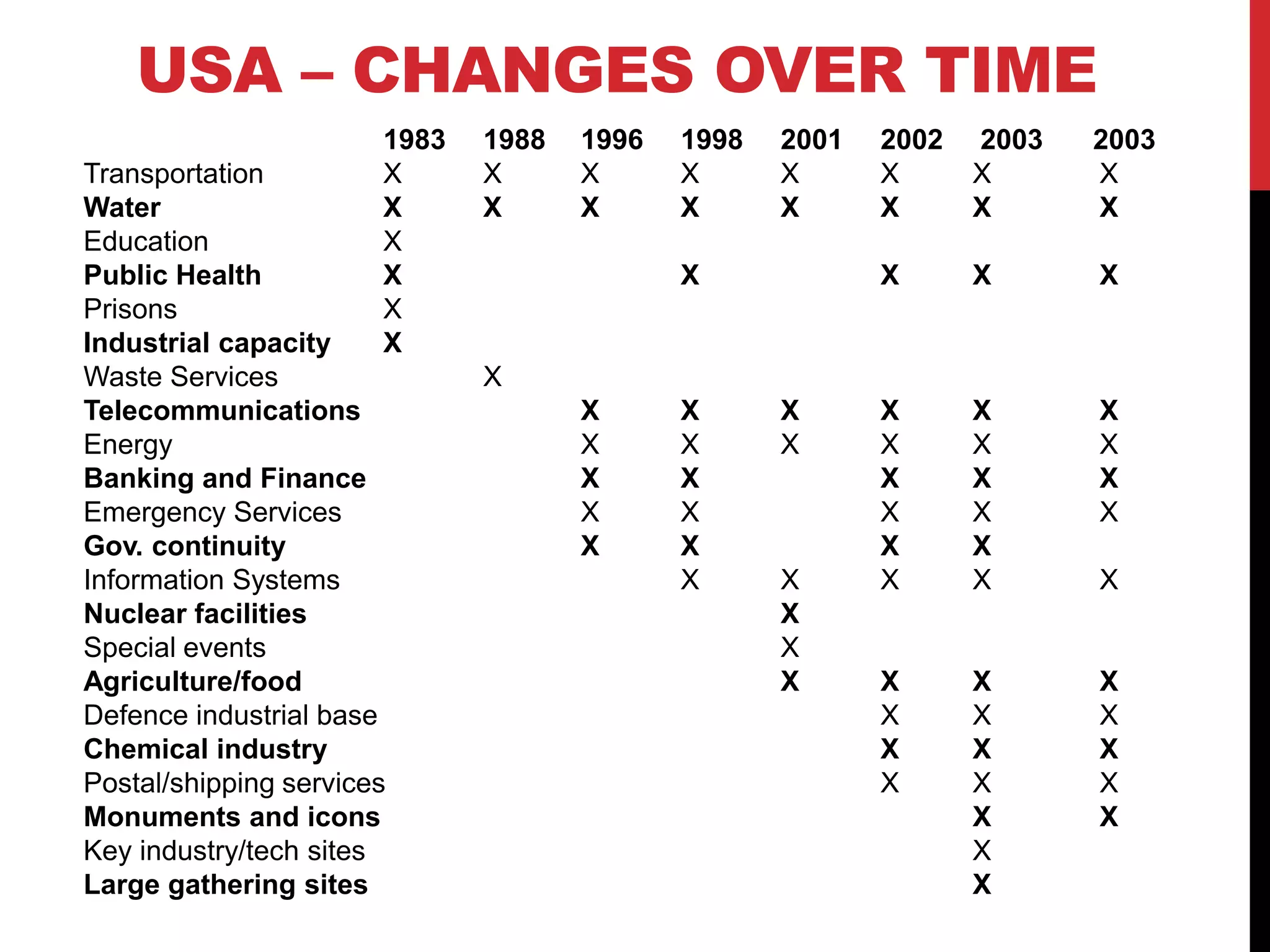
USA – CHANGES OVER TIME
                       1983   1988   1996   1998   2001   2002   2003   2003
Transportation         X      X      X      X      X      X      X      X
Water                  X      X      X      X      X      X      X      X
Education              X
Public Health          X                    X             X      X      X
Prisons                X
Industrial capacity    X
Waste Services                X
Telecommunications                   X      X      X      X      X      X
Energy                               X      X      X      X      X      X
Banking and Finance                  X      X             X      X      X
Emergency Services                   X      X             X      X      X
Gov. continuity                      X      X             X      X
Information Systems                         X      X      X      X      X
Nuclear facilities                                 X
Special events                                     X
Agriculture/food                                   X      X      X      X
Defence industrial base                                   X      X      X
Chemical industry                                         X      X      X
Postal/shipping services                                  X      X      X
Monuments and icons                                              X      X
Key industry/tech sites                                          X
Large gathering sites                                            X
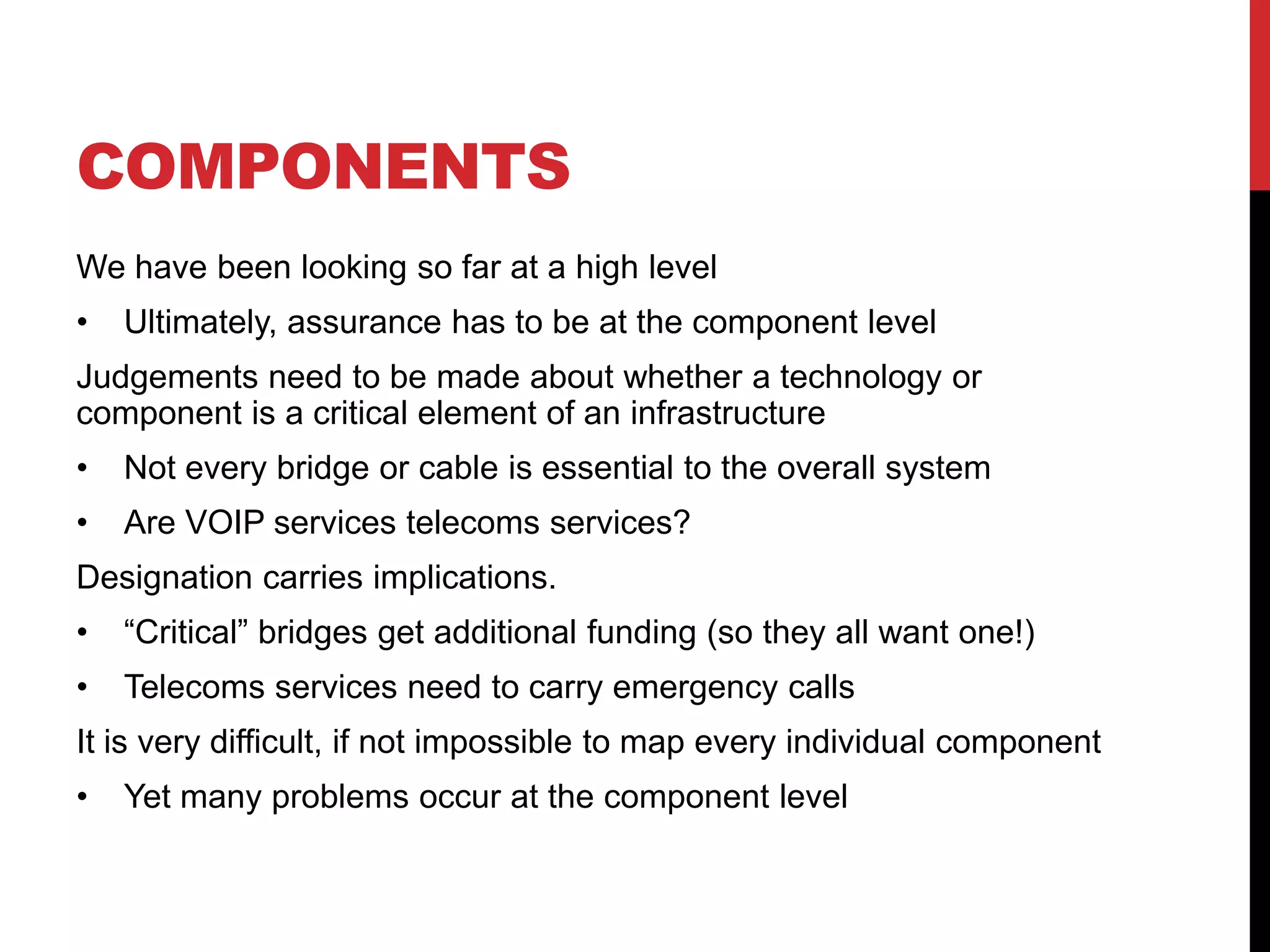
COMPONENTS
We have been looking so far at a high level
•   Ultimately, assurance has to be at the component level
Judgements need to be made about whether a technology or
component is a critical element of an infrastructure
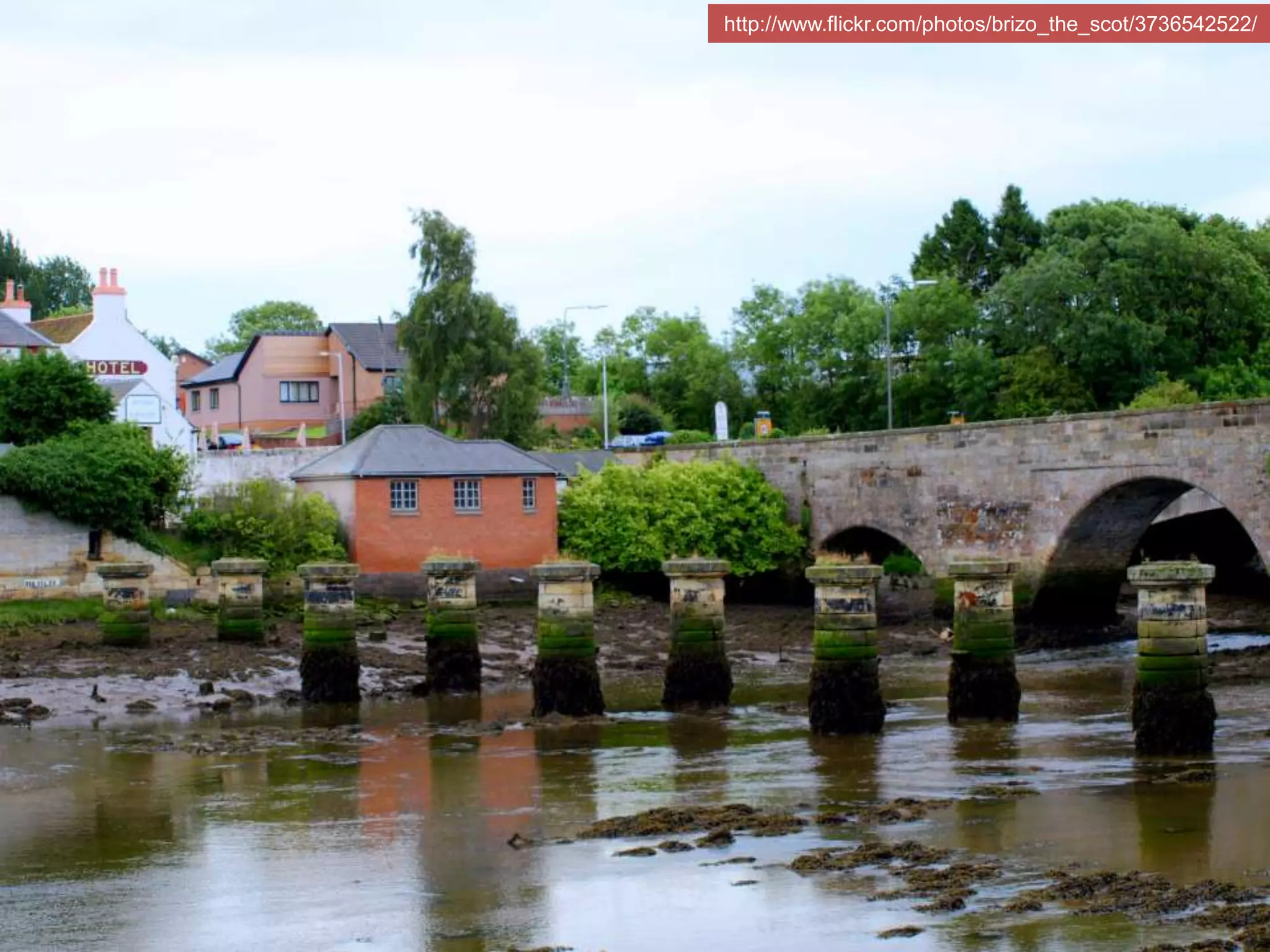
•   Not every bridge or cable is essential to the overall system
•   Are VOIP services telecoms services?
Designation carries implications.
•   “Critical” bridges get additional funding (so they all want one!)
•   Telecoms services need to carry emergency calls
It is very difficult, if not impossible to map every individual component
•   Yet many problems occur at the component level
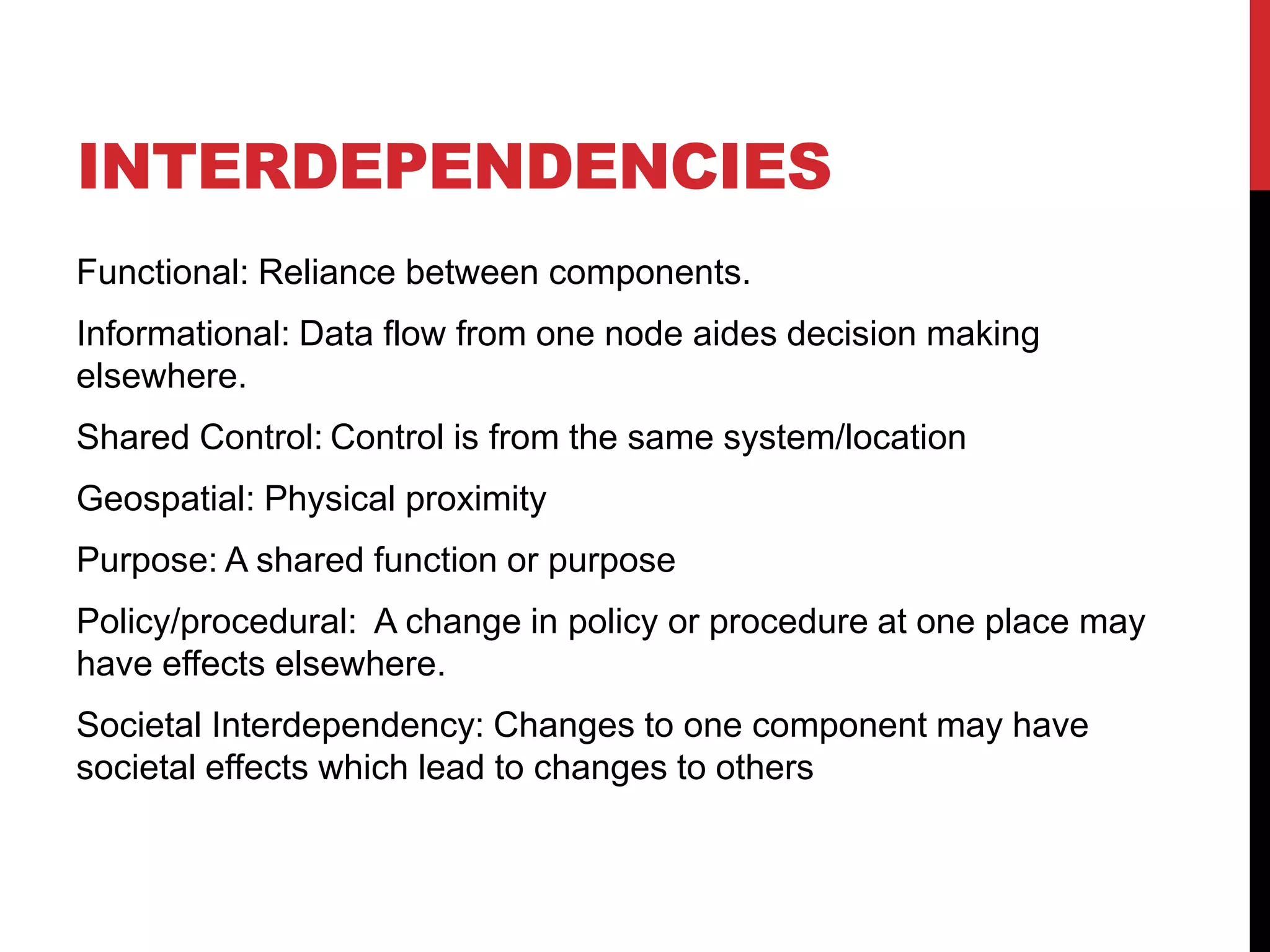
INTERDEPENDENCIES
Functional: Reliance between components.
Informational: Data flow from one node aides decision making
elsewhere.
Shared Control: Control is from the same system/location
Geospatial: Physical proximity
Purpose: A shared function or purpose
Policy/procedural: A change in policy or procedure at one place may
have effects elsewhere.
Societal Interdependency: Changes to one component may have
societal effects which lead to changes to others
http://www.flickr.com/photos/brizo_the_scot/3736542522/
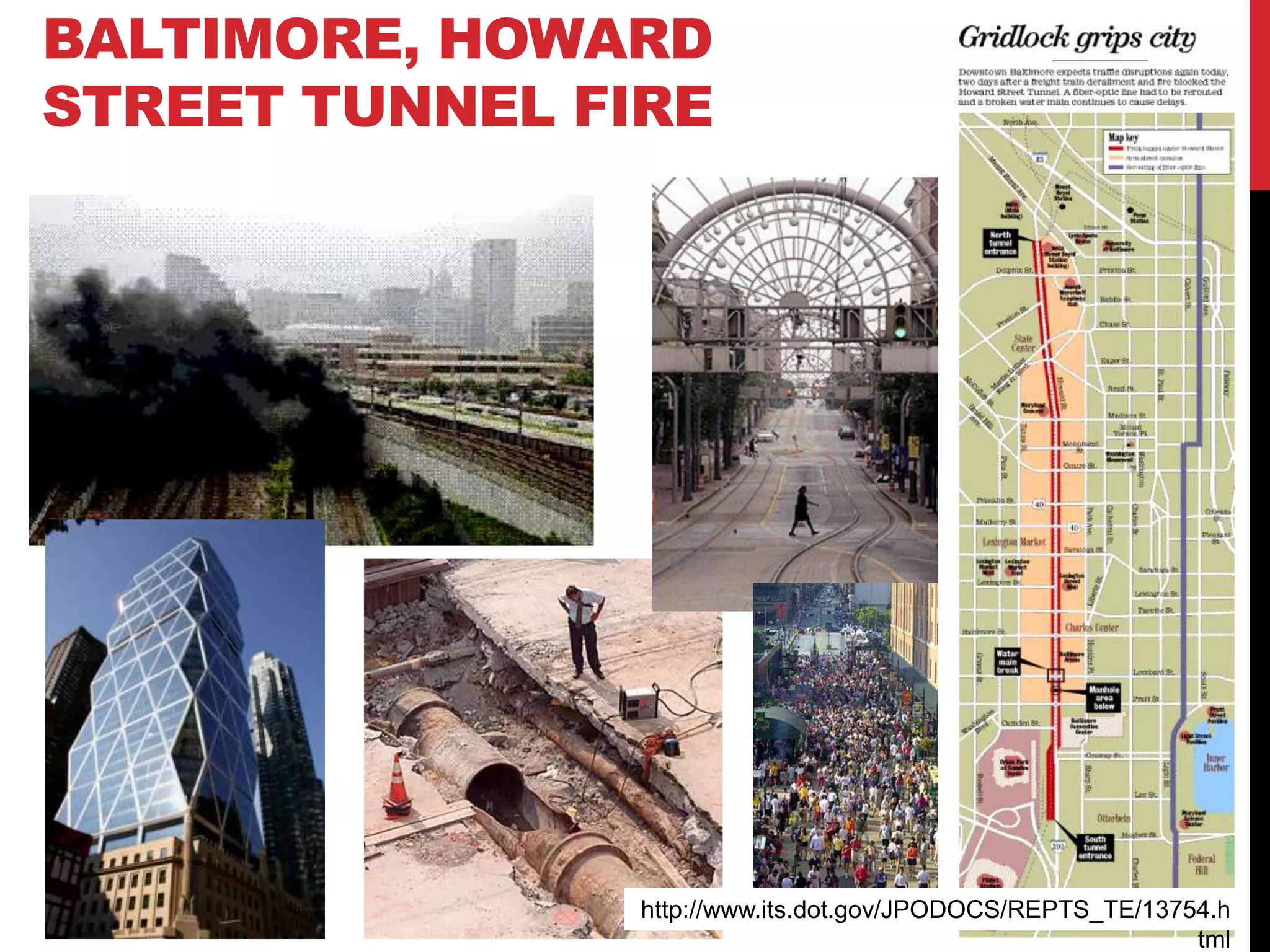
BALTIMORE, HOWARD
STREET TUNNEL FIRE


                http://www.its.dot.gov/JPODOCS/REPTS_TE/13754.h
                                                            tml
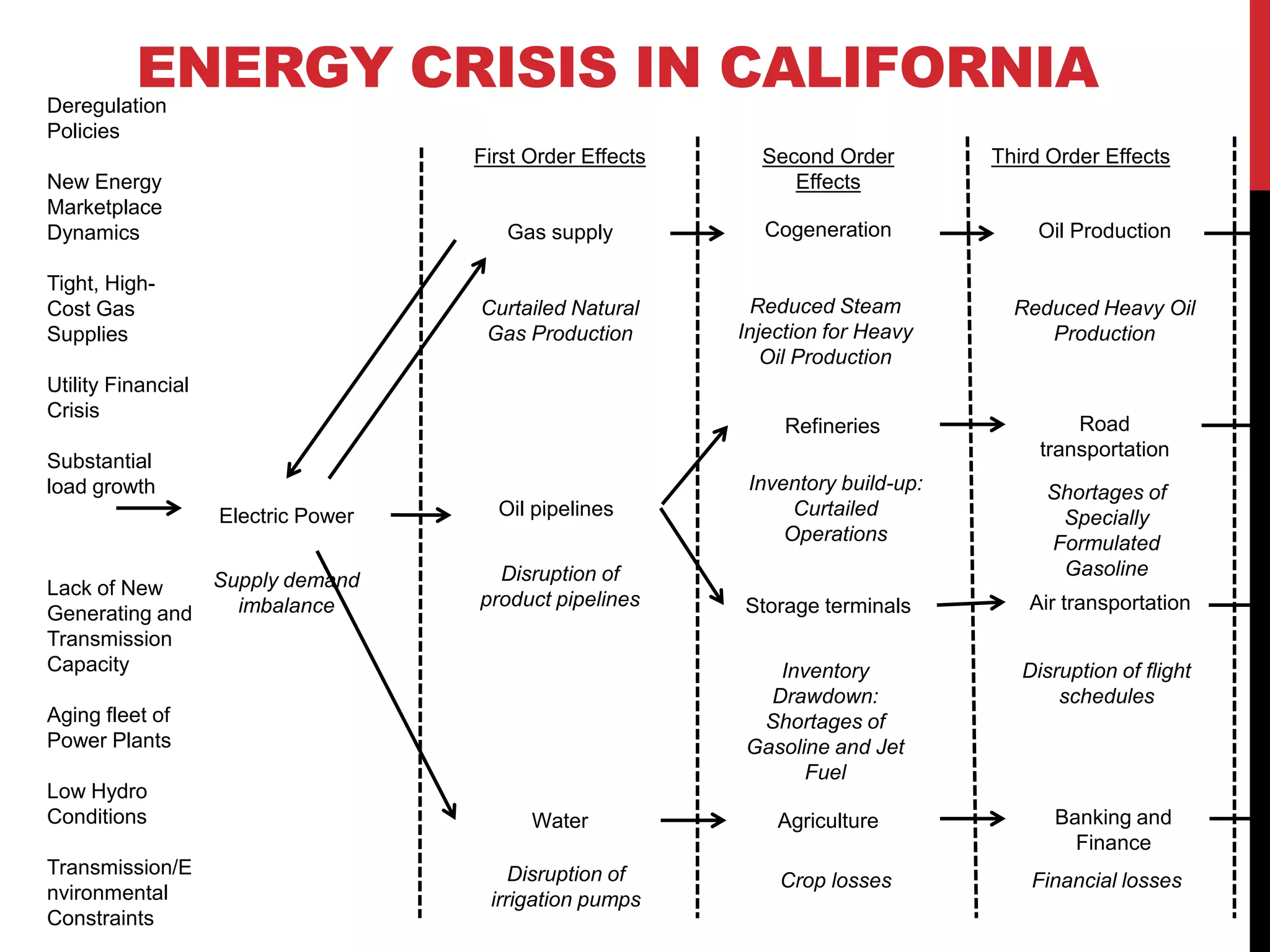
ENERGY CRISIS IN CALIFORNIA
Deregulation
Policies
                                     First Order Effects     Second Order         Third Order Effects
New Energy                                                      Effects
Marketplace
Dynamics                                Gas supply           Cogeneration             Oil Production

Tight, High-
Cost Gas                             Curtailed Natural       Reduced Steam          Reduced Heavy Oil
Supplies                             Gas Production        Injection for Heavy         Production
                                                              Oil Production
Utility Financial
Crisis
                                                                Refineries                 Road
                                                                                       transportation
Substantial
load growth                                                 Inventory build-up:        Shortages of
                    Electric Power     Oil pipelines             Curtailed              Specially
                                                                Operations             Formulated
                                       Disruption of                                    Gasoline
Lack of New    Supply demand
                 imbalance           product pipelines     Storage terminals          Air transportation
Generating and
Transmission
Capacity                                                      Inventory              Disruption of flight
                                                             Drawdown:                   schedules
Aging fleet of                                              Shortages of
Power Plants                                               Gasoline and Jet
                                                                 Fuel
Low Hydro
Conditions                                 Water               Agriculture              Banking and
                                                                                          Finance
Transmission/E                           Disruption of         Crop losses            Financial losses
nvironmental                          irrigation pumps
Constraints
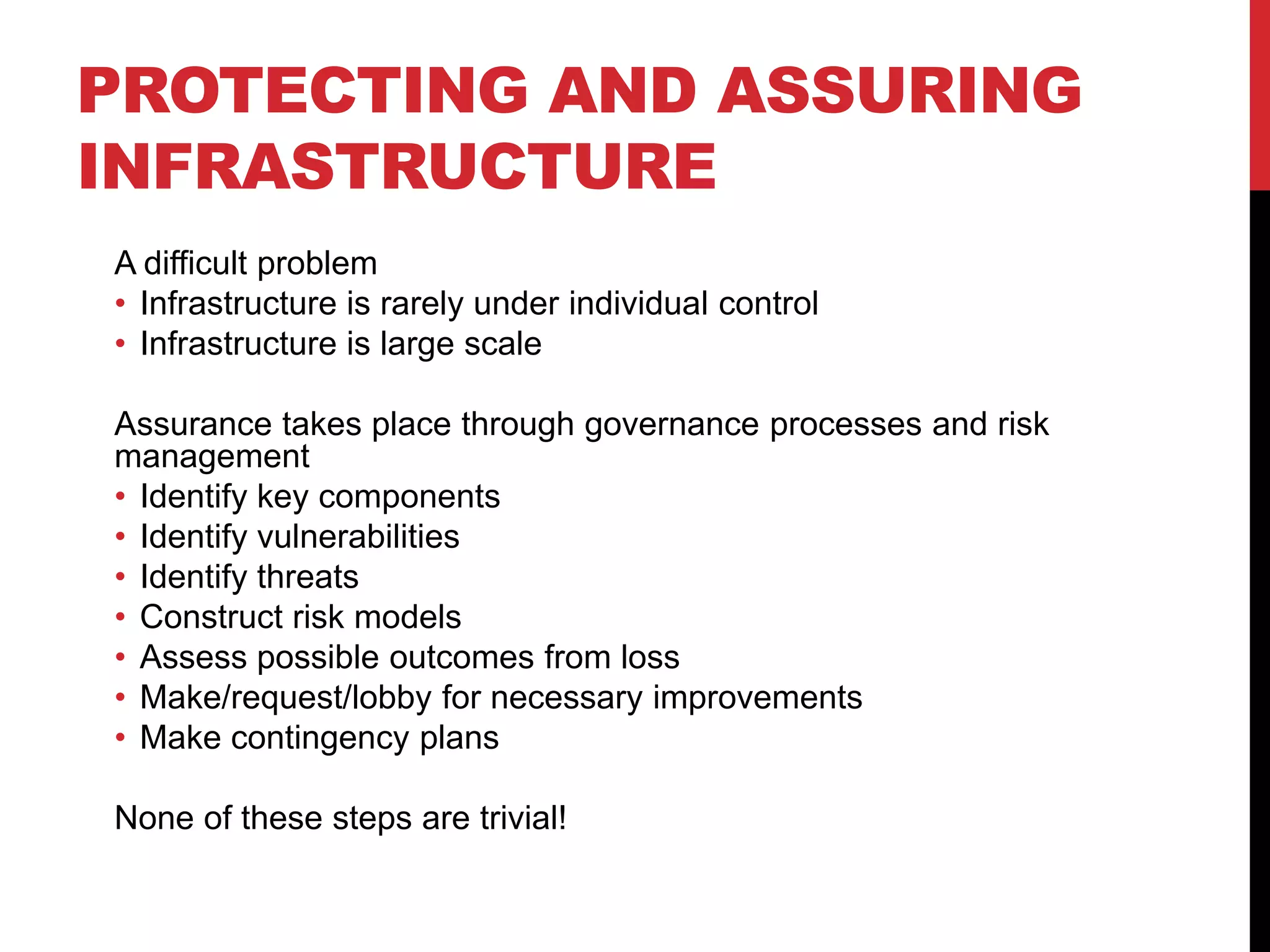
PROTECTING AND ASSURING
INFRASTRUCTURE
A difficult problem
• Infrastructure is rarely under individual control
• Infrastructure is large scale

Assurance takes place through governance processes and risk
management
• Identify key components
• Identify vulnerabilities
• Identify threats
• Construct risk models
• Assess possible outcomes from loss
• Make/request/lobby for necessary improvements
• Make contingency plans

None of these steps are trivial!
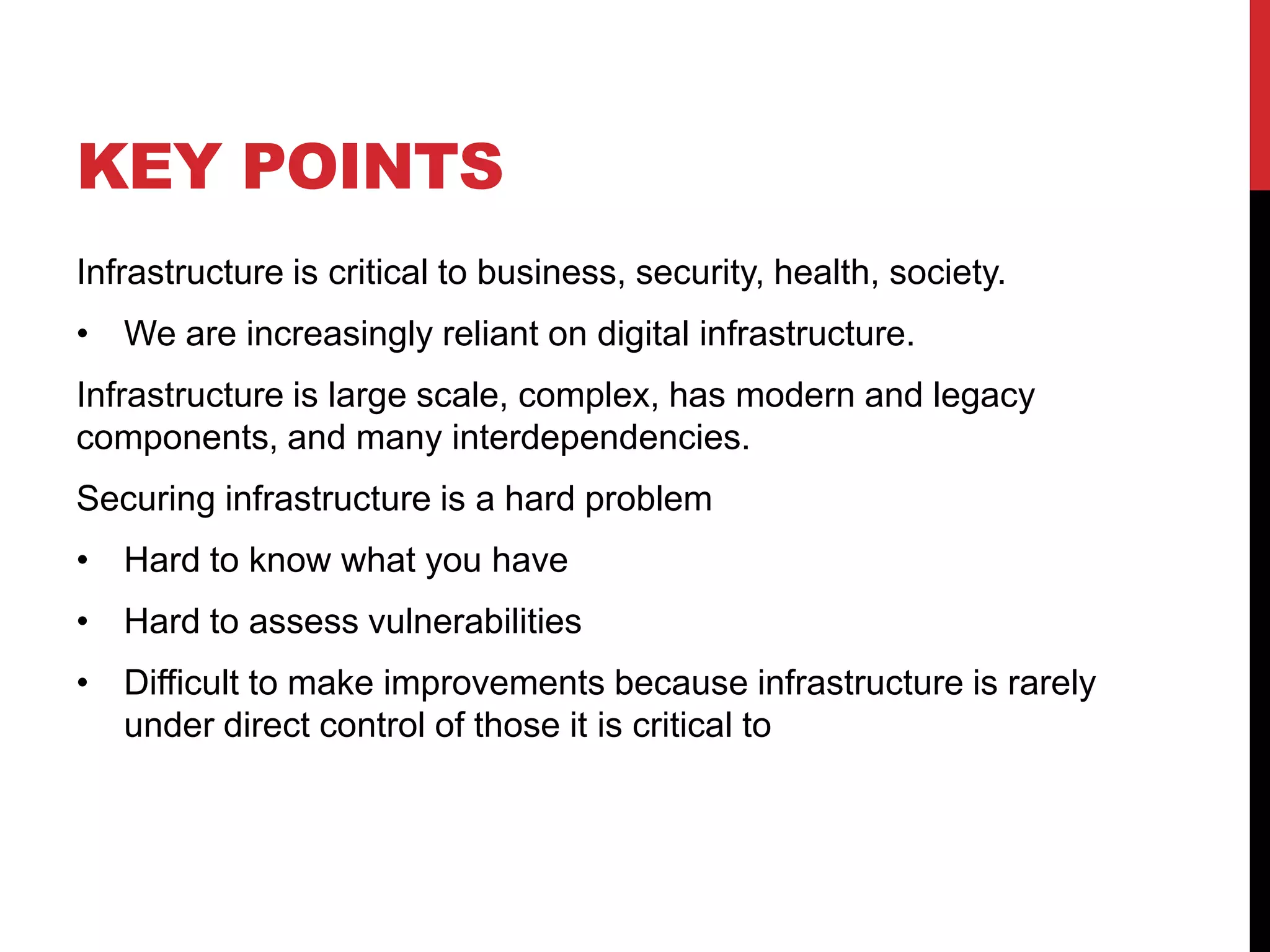
KEY POINTS
Infrastructure is critical to business, security, health, society.
• We are increasingly reliant on digital infrastructure.
Infrastructure is large scale, complex, has modern and legacy
components, and many interdependencies.
Securing infrastructure is a hard problem
• Hard to know what you have
• Hard to assess vulnerabilities
• Difficult to make improvements because infrastructure is rarely
  under direct control of those it is critical to
SOURCES
P. Pederson, D. Dudenhoeffer, S. Hartley, M. Permann (2006) Critical
Infrastructure Interdependency Modeling: A Survey of U.S. and International
Research. Idaho National Laboratory
John Moteff and Paul Parfomak (2004) Critical Infrastructure and Key Assets:
Definition and Identification. Report for Congress.
Susan Leigh Star, Karen Ruhleder, (1994) Steps Towards an Ecology of
Infrastructure: Complex Problems in Design and Access for Large-Scale
Collaborative Systems. CSCW 1994. ACM Press.
USA National Infrastructure Protection Plan
  • http://www.dhs.gov/files/programs/editorial_0827.shtm
UK Centre For Protection of National Infrastructure
   • http://www.cpni.gov.uk/

CS5032 Lecture 19: Dependable infrastructure

  • 1.
  • 2.
    IN THIS LECTURE Whatis infrastructure? • National infrastructures • Organisational infrastructures • Digital infrastructures What is critical infrastructure? • How is infrastructure vulnerable? Understanding infrastructure • Problems of understanding existing infrastructure • Interdependencies in infrastructure
  • 3.
  • 4.
  • 5.
  • 6.
    WHAT IS INFRASTRUCTURE? Theinstalled base upon which operations and systems can run Public infrastructure • National and international systems upon which societies operate: transport, energy, communications, etc. (Includes digital infrastructure). • Used to be publicly owned, but in the UK and many other counties it has been privatised Organisational infrastructure • A much newer use of the term • Physical and digital infrastructure used by an organisation • Not necessarily owned by the organisation
  • 7.
    WHAT IS INFRASTRUCTURE? Sometimesa distinction is made between hard and soft infrastructure. Hard infrastructure • Large, physical networks • Energy networks, Transport, etc. Soft infrastructure • Institutions • Emergency services, financial services, health care, schools, etc. This is an artificial distinction Both hard and soft infrastructures are socio-technical
  • 8.
    CHARACTERISTICS OF INFRASTRUCTURE • LargeScale • Spread over large geographic areas • Regional/National/International • Complex • Many components • Many interdependencies (internal and external) • Reliance on standards • Heterogeneous parts rely on standards for interoperation • Standards are not always uniformly applied across an infrastructure • Long term • Modern and legacy components • Emerges and changes over the long term • We have to live with decisions made a long time ago
  • 9.
    ECONOMIC CHARACTERISTICS OFINFRASTRUCTURE Rarely one single owner and authority • Sub-systems and components are increasingly privatised • The theory is that privately operated infrastructure will be more efficient • However it is difficult to optimise an infrastructure when sections of it are run by self interested parties • Crosses national and international boundaries Often challenging to fund • We are often reluctant to pay for infrastructure • Where monopolies exist they are able to over-charge. However, competition where operational costs are low can lead to under- charging (and no re-investment).
  • 10.
    SOCIAL CHARACTERISTICS OF INFRASTRUCTURE Learnedas part of membership • The use, and styles of use, of particular infrastructures signifies and is often an essential marker of membership of a community. Links with conventions of practice • Infrastructure both shapes and is shaped by the conventions of a community of practice, e.g. the ways that cycles of day-night work are affected by and affect electrical power rates Taken for granted • Does not need to be re-invented every time we do something new • We often don’t pay much attention to it. The normally invisible quality of working infrastructure becomes visible when it breaks Infrastructure is “a relation” • Whether something is infrastructure depends on perspective (particularly for digital infrastructure). A focus for one person can be infrastructure for another.
  • 11.
    THE EMERGENCE OF INFRASTRUCTURE Infrastructuresare engineered, but not at the system level. They emerge through social and institutional processes • Begins with a “vision” (or visions). Later reality does not necessarily match this. • Competing designs emerge. • One or more local technologies become adopted as standard • We have to live with decisions made a long time ago The history of power girds, sewer systems, railways and so on do not portray a rational process in which an ideal system is designed and built, but a chaotic one. Cloud and grid computing are often likened to power grids • There is nothing inevitable about these becoming infrastructure, and the meaning of these terms continues to evolve.
  • 12.
    WHAT IS CRITICAL INFRASTRUCTURE? Asindividuals we often take infrastructure for granted, but organisations and governments cannot. • Infrastructure needs to be maintained and adapted/modernised • Strategic decisions must be made about what kind of infrastructure to invest in (and how) • However, much infrastructure is not under control of a single organisation or authority • Infrastructure is vulnerable Many countries now have critical infrastructure programmes
  • 13.
    CRITICAL INFRASTRUCTURE PROGRAMMES INTHE UK, EU, USA UK Government • Cabinet Office and the CPNI (Centre for the Protection of National Infrastructure) European Union • European Programme for Critical Infrastructure Protection USA • Department of Homeland Security and the National Programme of Critical Infrastructure Protection Governments do not have direct control of infrastructure, and so these are governance and advisory programmes. What counts as critical varies from place to place
  • 14.
    VULNERABILITIES • Insufficient capability • Insufficient capacity • Faults • Decay • Accidents • Physical Attack • Electronic Attack • Natural Disaster • Civil Unrest
  • 15.
    PERSPECTIVES UK EU USA UK EU USA Communications x x Nuclear industry x Food x x x ICTs x x Emergency x x Chemical x x Services industry Energy x x x Research x Finance x x x facilities Government x Space x Health x x x Defence x industrial base Transport x x x Postal/shipping x Water x x x Monuments and x icons
  • 16.
    UK SUB-CATEGORIES Landline Phones Mobile Telecommunications Production Postal Services Processing Communications Import Broadcast Communications Distribution Food Retail Ambulance Fire and Rescue Electricity Emergency Services Marine Gas Payment, Clearing Police Oil and Settlement Energy Fuel Systems Public Finances Finance Markets and Central Government Exchanges Parliament Government Devolved Administrations Regional and Local Authorities Health Maritime Health and Social Care Aviation Transport Land (Road and rail) Potable water supply Water Dams Waste Water Services
  • 17.
    USA – CHANGESOVER TIME 1983 1988 1996 1998 2001 2002 2003 2003 Transportation X X X X X X X X Water X X X X X X X X Education X Public Health X X X X X Prisons X Industrial capacity X Waste Services X Telecommunications X X X X X X Energy X X X X X X Banking and Finance X X X X X Emergency Services X X X X X Gov. continuity X X X X Information Systems X X X X X Nuclear facilities X Special events X Agriculture/food X X X X Defence industrial base X X X Chemical industry X X X Postal/shipping services X X X Monuments and icons X X Key industry/tech sites X Large gathering sites X
  • 18.
    COMPONENTS We have beenlooking so far at a high level • Ultimately, assurance has to be at the component level Judgements need to be made about whether a technology or component is a critical element of an infrastructure • Not every bridge or cable is essential to the overall system • Are VOIP services telecoms services? Designation carries implications. • “Critical” bridges get additional funding (so they all want one!) • Telecoms services need to carry emergency calls It is very difficult, if not impossible to map every individual component • Yet many problems occur at the component level
  • 19.
    INTERDEPENDENCIES Functional: Reliance betweencomponents. Informational: Data flow from one node aides decision making elsewhere. Shared Control: Control is from the same system/location Geospatial: Physical proximity Purpose: A shared function or purpose Policy/procedural: A change in policy or procedure at one place may have effects elsewhere. Societal Interdependency: Changes to one component may have societal effects which lead to changes to others
  • 20.
  • 21.
    BALTIMORE, HOWARD STREET TUNNELFIRE http://www.its.dot.gov/JPODOCS/REPTS_TE/13754.h tml
  • 22.
    ENERGY CRISIS INCALIFORNIA Deregulation Policies First Order Effects Second Order Third Order Effects New Energy Effects Marketplace Dynamics Gas supply Cogeneration Oil Production Tight, High- Cost Gas Curtailed Natural Reduced Steam Reduced Heavy Oil Supplies Gas Production Injection for Heavy Production Oil Production Utility Financial Crisis Refineries Road transportation Substantial load growth Inventory build-up: Shortages of Electric Power Oil pipelines Curtailed Specially Operations Formulated Disruption of Gasoline Lack of New Supply demand imbalance product pipelines Storage terminals Air transportation Generating and Transmission Capacity Inventory Disruption of flight Drawdown: schedules Aging fleet of Shortages of Power Plants Gasoline and Jet Fuel Low Hydro Conditions Water Agriculture Banking and Finance Transmission/E Disruption of Crop losses Financial losses nvironmental irrigation pumps Constraints
  • 23.
    PROTECTING AND ASSURING INFRASTRUCTURE Adifficult problem • Infrastructure is rarely under individual control • Infrastructure is large scale Assurance takes place through governance processes and risk management • Identify key components • Identify vulnerabilities • Identify threats • Construct risk models • Assess possible outcomes from loss • Make/request/lobby for necessary improvements • Make contingency plans None of these steps are trivial!
  • 24.
    KEY POINTS Infrastructure iscritical to business, security, health, society. • We are increasingly reliant on digital infrastructure. Infrastructure is large scale, complex, has modern and legacy components, and many interdependencies. Securing infrastructure is a hard problem • Hard to know what you have • Hard to assess vulnerabilities • Difficult to make improvements because infrastructure is rarely under direct control of those it is critical to
  • 25.
    SOURCES P. Pederson, D.Dudenhoeffer, S. Hartley, M. Permann (2006) Critical Infrastructure Interdependency Modeling: A Survey of U.S. and International Research. Idaho National Laboratory John Moteff and Paul Parfomak (2004) Critical Infrastructure and Key Assets: Definition and Identification. Report for Congress. Susan Leigh Star, Karen Ruhleder, (1994) Steps Towards an Ecology of Infrastructure: Complex Problems in Design and Access for Large-Scale Collaborative Systems. CSCW 1994. ACM Press. USA National Infrastructure Protection Plan • http://www.dhs.gov/files/programs/editorial_0827.shtm UK Centre For Protection of National Infrastructure • http://www.cpni.gov.uk/

Editor's Notes

  • #11 Susan Leigh Star
  • #18 1983 and 1988 concerned with adequacy. 1996 onward, concerned with terrorism. (Oklahoma bombing 1995), List of 1700 assets
  • #20 From CPNI. Not sure…