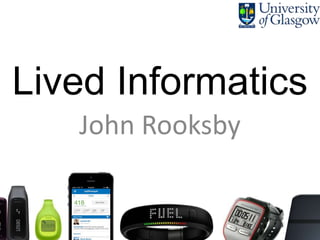
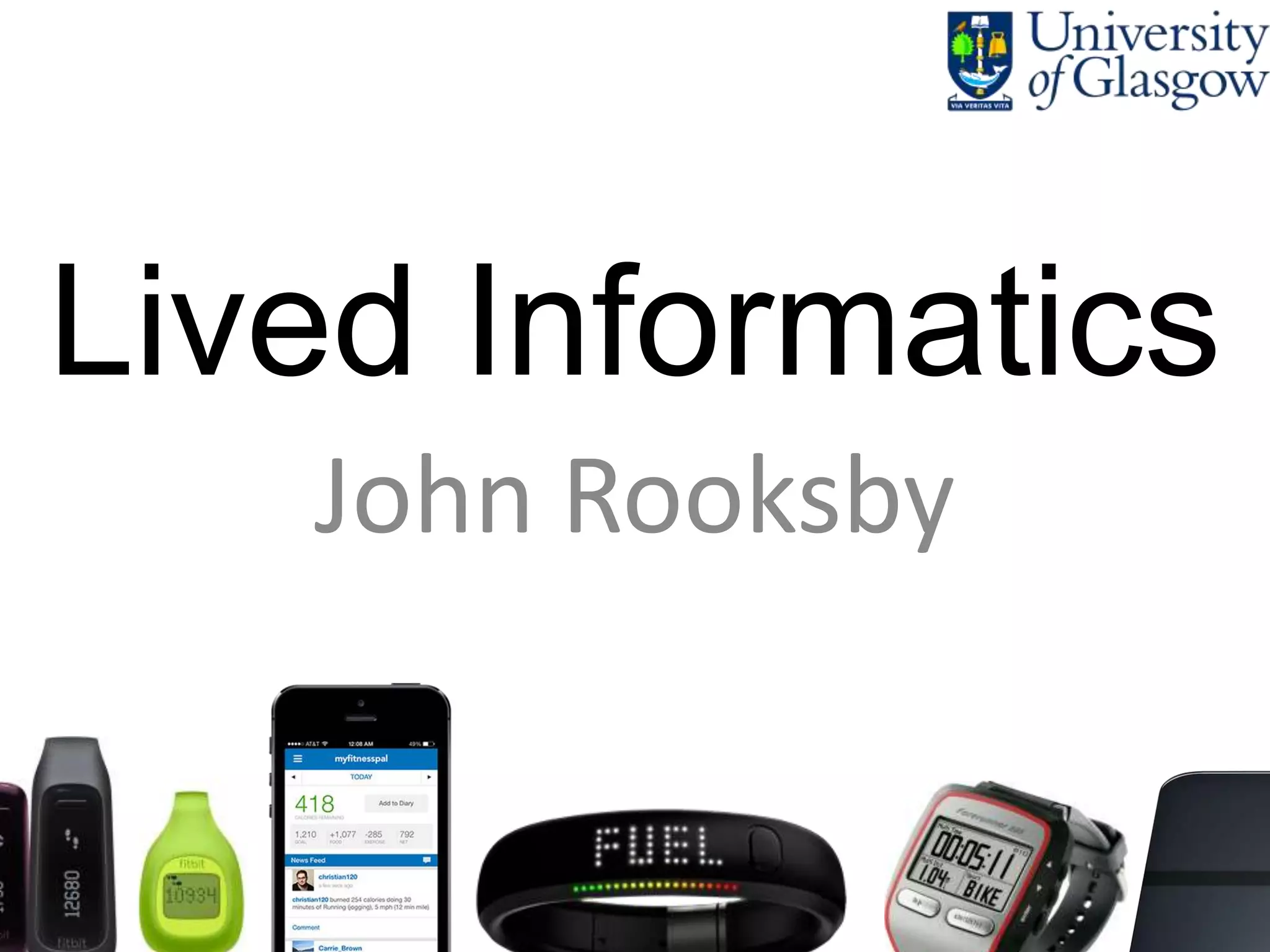
Lived Informatics
John Rooksby
Invited talk at Making Data,
Lancaster University, 22-23 Jan 2014.
http://www.lancaster.ac.uk/fass/events/making-data/index.htm
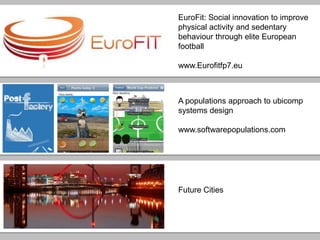
EuroFit: Social innovation to improve
physical activity and sedentary
behaviour through elite European
football
www.Eurofitfp7.eu

A populations approach to ubicomp
systems design

www.softwarepopulations.com

Future Cities
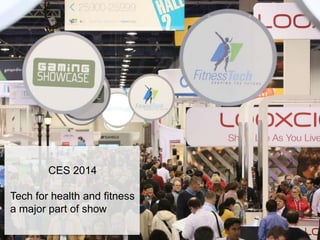
CES 2014
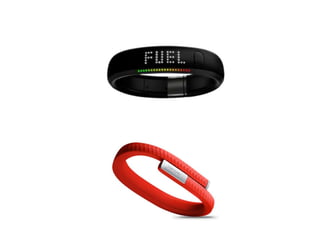
Tech for health and fitness
a major part of show
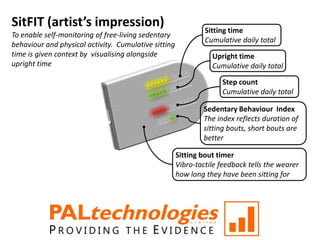
SitFIT (artist’s impression)
To enable self-monitoring of free-living sedentary
behaviour and physical activity. Cumulative sitting
time is given context by visualising alongside
upright time

Sitting time
Cumulative daily total
Upright time
Cumulative daily total
Step count
Cumulative daily total
Sedentary Behaviour Index
The index reflects duration of
sitting bouts, short bouts are
better
Sitting bout timer
Vibro-tactile feedback tells the wearer
how long they have been sitting for
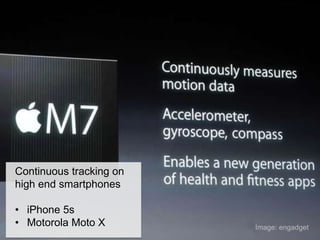
Continuous tracking on
high end smartphones

• iPhone 5s
• Motorola Moto X

Image: engadget
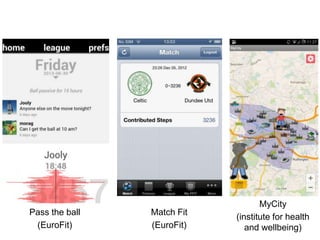
Pass the ball
(EuroFit)

Match Fit
(EuroFit)

MyCity
(institute for health
and wellbeing)
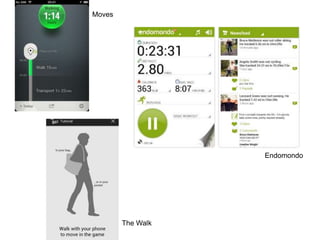
Moves

Endomondo

The Walk
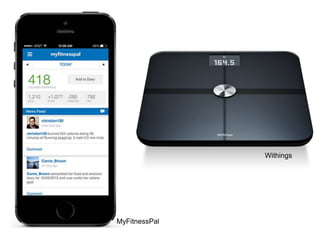
Withings

MyFitnessPal
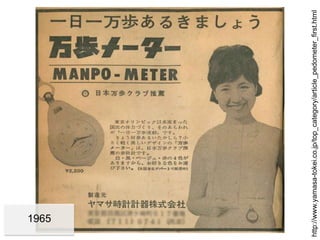
http://www.yamasa-tokei.co.jp/top_category/article_pedometer_first.html

1965
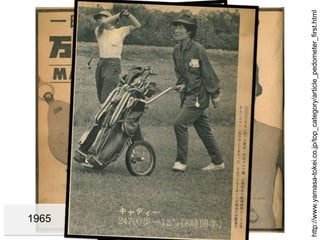
http://www.yamasa-tokei.co.jp/top_category/article_pedometer_first.html

1965
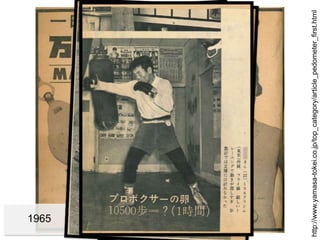
http://www.yamasa-tokei.co.jp/top_category/article_pedometer_first.html

1965
http://www.yamasa-tokei.co.jp/top_category/article_pedometer_first.html

1965
10000 is culturally
significant

http://en.wikipedia.org/wiki/Ten_thousand_years
The subject of walking is, in some sense, how we invest universal acts with
particular meanings. Like eating or drinking, it can be invested with wildly
different cultural meanings, from the erotic to the spiritual, from the
revolutionary to the artistic. Here this history begins to become part of the
history of the imagination and the culture, of what kind of pleasure, freedoms
and meanings are pursued at different times by different kinds of walks and
walkers.

“Like eating or drinking, [walking] can be invested with
The treadmill … allows travel to be measured entirely by time, bodily exertion, wildly
and mechanical motion. Space – as a landscape, terrain, spectacle, the spiritual,
different cultural meanings, from the erotic to experience
has vanished.”266

from the revolutionary to the artistic. “ (p3)

“The treadmill … allows travel to be measured entirely by time,
bodily exertion, and mechanical motion. Space – as a
landscape, terrain, spectacle, experience has vanished.” (p266)
Rebecca Solnit – Wanderlust: A History of Walking
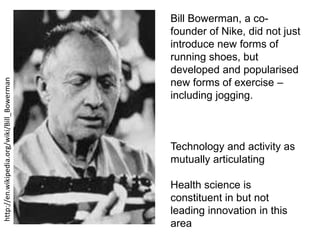
http://en.wikipedia.org/wiki/Bill_Bowerman

Bill Bowerman, a cofounder of Nike, did not just
introduce new forms of
running shoes, but
developed and popularised
new forms of exercise –
including jogging.

Technology and activity as
mutually articulating
Health science is
constituent in but not
leading innovation in this
area
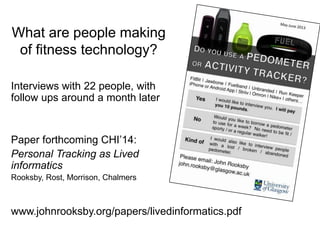
What are people making
of fitness technology?
Interviews with 22 people, with
follow ups around a month later

Paper forthcoming CHI’14:
Personal Tracking as Lived
informatics
Rooksby, Rost, Morrison, Chalmers

www.johnrooksby.org/papers/livedinformatics.pdf
• Interviewees used various apps and devices to track
– Walking
– Physical exercise
– Eating and Drinking
– Weight and size
– Sleep
• They were often tracking several things
• The interviewees were using trackers for
– Training and exercise routines
– Weight loss and/or maintenance
– In order to sleep well
– For enjoyment
• Interviewees were often tracking for more than one
purpose
• Interviewees could both hate and enjoy tracking
– Training, weight loss, etc. can be hard work
• Some trackers used alongside each other, some are
integrated
– MyFitnessPal a popular “hub”
– Integration can be problematic
• Sometimes several trackers with similar or the same
functionality were used
• It was common to switch between trackers
– Try new ones out
– Trackers given as gifts
– New phones
Most interviewees did not seek to track everything
• E.g. gym visits rarely tracked
• Often tracking used to get a sense of routine
One person wanted to track as much as he could but:
• “My girlfriend gets annoyed with me for all these things.
... You know if we‟re in bed [my Jawbone UP] is
comfortable for me, but it may not be comfortable for her.
... If we‟re in a restaurant ... she‟s like, you‟re allowed
thirty seconds and then put [the iPhone] away, cos its
rude. “
Tracking was rarely a long term data collection
• Sometimes event to event
“Every marathon I‟ve done since I got this, I‟ve got all
the training runs in a folder. I don‟t look at them. But at
the time, when you‟re training for something, [the data
is] really important.”
• Sometimes day to day
“If I get home at night and I‟ve done 7000 I‟ll go out and
do another 2000. So it‟s keeping me on that sort of
10,000 track.”
To track is to look forward
None of the interviewees posted data to social networks
• “I don‟t know, I find it kind of egotistical ... it‟s almost one
of those things where you set yourself up for failure”
(P10)
Most knew people who did post to social networks, and
could be scathing:
• “Pathetic”
• “5 whole miles!”
Yet, tracking was often social
Families and couples
• Togetherness – e.g. comparing data, or tracking „special‟
walks
• And rows “I said it‟s not about walking further than me. It‟s
about your own fitness and everything!”
Running partners and workmates sharing data
• “I was with her, running all the time, regularly at weekends, we
were running both at the same speed, same distance, we‟d
keep an eye on this thing together.”
• [Nurses rounds] “So they‟d be like, how many steps did we
walk? We were kind of using it like a collective. We all
discussed it and we‟d be like, oh that's shit, heh heh. It‟s only
that many calories for all we‟ve been doing ... But we lost
interest ... it was the same day in, day out.”
Implications…
• The design problem is not so much accurate tracking of
a pre-given activity, but allowing activities and tracking to
co-emerge.
• Don’t expect people to use a single tracker over the long
term. Consider how trackers can be interwoven and
switched between.
• (Re)consider social tracking, this is not just about
sharing on Facebook.
• Don’t assume people want to be data scientists or do
analytics – they want to do things like lose weight, run
marathons - to look forward, not backward
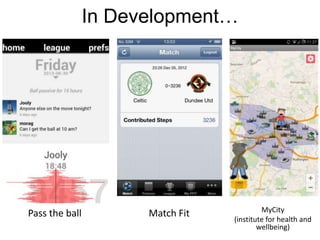
In Development…

Pass the ball

Match Fit

MyCity
(institute for health and
wellbeing)
Thank you
johnrooksby.org
@johnrooksby

Making data

  • 1.
  • 2.
    Invited talk atMaking Data, Lancaster University, 22-23 Jan 2014. http://www.lancaster.ac.uk/fass/events/making-data/index.htm
  • 3.
    EuroFit: Social innovationto improve physical activity and sedentary behaviour through elite European football www.Eurofitfp7.eu A populations approach to ubicomp systems design www.softwarepopulations.com Future Cities
  • 4.
    CES 2014 Tech forhealth and fitness a major part of show
  • 6.
    SitFIT (artist’s impression) Toenable self-monitoring of free-living sedentary behaviour and physical activity. Cumulative sitting time is given context by visualising alongside upright time Sitting time Cumulative daily total Upright time Cumulative daily total Step count Cumulative daily total Sedentary Behaviour Index The index reflects duration of sitting bouts, short bouts are better Sitting bout timer Vibro-tactile feedback tells the wearer how long they have been sitting for
  • 9.
    Continuous tracking on highend smartphones • iPhone 5s • Motorola Moto X Image: engadget
  • 10.
    Pass the ball (EuroFit) MatchFit (EuroFit) MyCity (institute for health and wellbeing)
  • 11.
  • 12.
  • 13.
  • 14.
  • 15.
  • 16.
  • 17.
  • 18.
    The subject ofwalking is, in some sense, how we invest universal acts with particular meanings. Like eating or drinking, it can be invested with wildly different cultural meanings, from the erotic to the spiritual, from the revolutionary to the artistic. Here this history begins to become part of the history of the imagination and the culture, of what kind of pleasure, freedoms and meanings are pursued at different times by different kinds of walks and walkers. “Like eating or drinking, [walking] can be invested with The treadmill … allows travel to be measured entirely by time, bodily exertion, wildly and mechanical motion. Space – as a landscape, terrain, spectacle, the spiritual, different cultural meanings, from the erotic to experience has vanished.”266 from the revolutionary to the artistic. “ (p3) “The treadmill … allows travel to be measured entirely by time, bodily exertion, and mechanical motion. Space – as a landscape, terrain, spectacle, experience has vanished.” (p266) Rebecca Solnit – Wanderlust: A History of Walking
  • 19.
    http://en.wikipedia.org/wiki/Bill_Bowerman Bill Bowerman, acofounder of Nike, did not just introduce new forms of running shoes, but developed and popularised new forms of exercise – including jogging. Technology and activity as mutually articulating Health science is constituent in but not leading innovation in this area
  • 20.
    What are peoplemaking of fitness technology? Interviews with 22 people, with follow ups around a month later Paper forthcoming CHI’14: Personal Tracking as Lived informatics Rooksby, Rost, Morrison, Chalmers www.johnrooksby.org/papers/livedinformatics.pdf
  • 21.
    • Interviewees usedvarious apps and devices to track – Walking – Physical exercise – Eating and Drinking – Weight and size – Sleep • They were often tracking several things
  • 22.
    • The intervieweeswere using trackers for – Training and exercise routines – Weight loss and/or maintenance – In order to sleep well – For enjoyment • Interviewees were often tracking for more than one purpose • Interviewees could both hate and enjoy tracking – Training, weight loss, etc. can be hard work
  • 23.
    • Some trackersused alongside each other, some are integrated – MyFitnessPal a popular “hub” – Integration can be problematic • Sometimes several trackers with similar or the same functionality were used • It was common to switch between trackers – Try new ones out – Trackers given as gifts – New phones
  • 24.
    Most interviewees didnot seek to track everything • E.g. gym visits rarely tracked • Often tracking used to get a sense of routine One person wanted to track as much as he could but: • “My girlfriend gets annoyed with me for all these things. ... You know if we‟re in bed [my Jawbone UP] is comfortable for me, but it may not be comfortable for her. ... If we‟re in a restaurant ... she‟s like, you‟re allowed thirty seconds and then put [the iPhone] away, cos its rude. “
  • 25.
    Tracking was rarelya long term data collection • Sometimes event to event “Every marathon I‟ve done since I got this, I‟ve got all the training runs in a folder. I don‟t look at them. But at the time, when you‟re training for something, [the data is] really important.” • Sometimes day to day “If I get home at night and I‟ve done 7000 I‟ll go out and do another 2000. So it‟s keeping me on that sort of 10,000 track.” To track is to look forward
  • 26.
    None of theinterviewees posted data to social networks • “I don‟t know, I find it kind of egotistical ... it‟s almost one of those things where you set yourself up for failure” (P10) Most knew people who did post to social networks, and could be scathing: • “Pathetic” • “5 whole miles!”
  • 27.
    Yet, tracking wasoften social Families and couples • Togetherness – e.g. comparing data, or tracking „special‟ walks • And rows “I said it‟s not about walking further than me. It‟s about your own fitness and everything!” Running partners and workmates sharing data • “I was with her, running all the time, regularly at weekends, we were running both at the same speed, same distance, we‟d keep an eye on this thing together.” • [Nurses rounds] “So they‟d be like, how many steps did we walk? We were kind of using it like a collective. We all discussed it and we‟d be like, oh that's shit, heh heh. It‟s only that many calories for all we‟ve been doing ... But we lost interest ... it was the same day in, day out.”
  • 28.
    Implications… • The designproblem is not so much accurate tracking of a pre-given activity, but allowing activities and tracking to co-emerge. • Don’t expect people to use a single tracker over the long term. Consider how trackers can be interwoven and switched between. • (Re)consider social tracking, this is not just about sharing on Facebook. • Don’t assume people want to be data scientists or do analytics – they want to do things like lose weight, run marathons - to look forward, not backward
  • 29.
    In Development… Pass theball Match Fit MyCity (institute for health and wellbeing)
  • 30.

Editor's Notes

  • #2 The idea of activity vis fitness techLived informatics – that people are dwelling in dataMobility as a practical problem – not just of doing, but making sense / understandingCommunity / neighbourhood < Social / Group / Family / weight watchersThis talk is about 3 thingsActivity trackersHow people use emOur experienecs of building them
  • #3 The idea of activity vis fitness techLived informatics – that people are dwelling in dataMobility as a practical problem – not just of doing, but making sense / understandingCommunity / neighbourhood < Social / Group / Family / weight watchersThis talk is about 3 thingsActivity trackersHow people use emOur experienecs of building them
  • #12 Often free to download
  • #14 http://www.yamasa-tokei.co.jp/top_category/article_pedometer_first.html
  • #15 http://www.yamasa-tokei.co.jp/top_category/article_pedometer_first.html
  • #16 http://www.yamasa-tokei.co.jp/top_category/article_pedometer_first.html
  • #17 http://www.yamasa-tokei.co.jp/top_category/article_pedometer_first.html
  • #18 http://www.yamasa-tokei.co.jp/top_category/article_pedometer_first.html
  • #19 Ingold’s Ways of WalkingBourdieu’s Techniques of the bodyDeCertau’s Walking in the City