Secondary Storage Devices
Storage devices
02/01/15
Store software programs and keep
permanent records of work.
When working on computer, RAM
holds current work and currently active
software program
RAM only temporary and information
discarded when you turn off computer’s
power
Must save work permanently to storage
device before quitting software
program or turning off power
Storage device used depends on amount
of storage required and speed of data
retrieval
Hard disk drives used most often
due to speed and storage capacities
Data transfer rate slower on CD
but can store large amounts of data
to be retrieved quickly
Tape drives slower at storing and
retrieving but can store large
amounts of data in compact and
economical form
Examples of Storage Devices
02/01/15
Hard disc
CD – Compact Disc
DVD – Digital Versatile Disc
Blu-Ray Disc (BD)
Floppy Disc
Zip disc
Pen drive
Memory cards
Tapes
Hard Disc
02/01/15
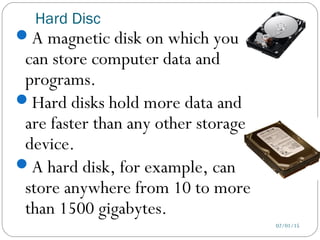
A magnetic disk on which you
can store computer data and
programs.
Hard disks hold more data and
are faster than any other storage
device.
A hard disk, for example, can
store anywhere from 10 to more
than 1500 gigabytes.
Compact Disc
02/01/15
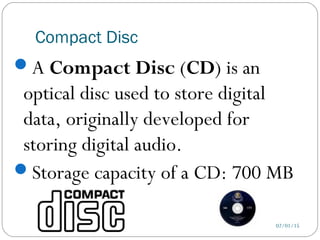
A Compact Disc (CD) is an
optical disc used to store digital
data, originally developed for
storing digital audio.
Storage capacity of a CD: 700 MB
DVDDVD
02/01/15
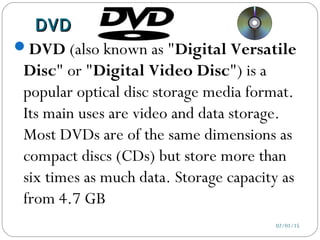
DVD (also known as "Digital Versatile
Disc" or "Digital Video Disc") is a
popular optical disc storage media format.
Its main uses are video and data storage.
Most DVDs are of the same dimensions as
compact discs (CDs) but store more than
six times as much data. Storage capacity as
from 4.7 GB
Floppy Disc
02/01/15
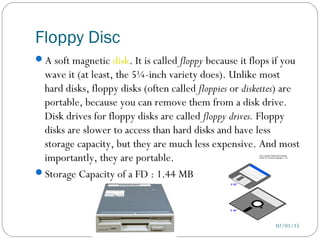
A soft magnetic disk. It is called floppy because it flops if you
wave it (at least, the 5¼-inch variety does). Unlike most
hard disks, floppy disks (often called floppies or diskettes) are
portable, because you can remove them from a disk drive.
Disk drives for floppy disks are called floppy drives. Floppy
disks are slower to access than hard disks and have less
storage capacity, but they are much less expensive. And most
importantly, they are portable.
Storage Capacity of a FD : 1.44 MB
Blu-ray Disc
02/01/15
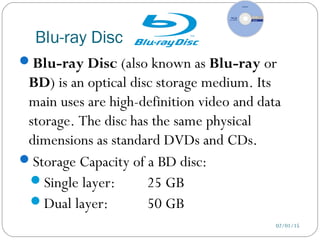
Blu-ray Disc (also known as Blu-ray or
BD) is an optical disc storage medium. Its
main uses are high-definition video and data
storage. The disc has the same physical
dimensions as standard DVDs and CDs.
Storage Capacity of a BD disc:
Single layer: 25 GB
Dual layer: 50 GB
Zip Discs
02/01/15
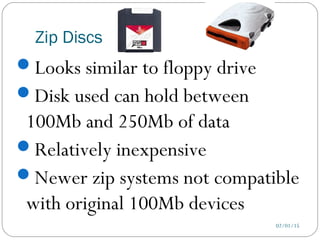
Looks similar to floppy drive
Disk used can hold between
100Mb and 250Mb of data
Relatively inexpensive
Newer zip systems not compatible
with original 100Mb devices
Pen Drive
02/01/15
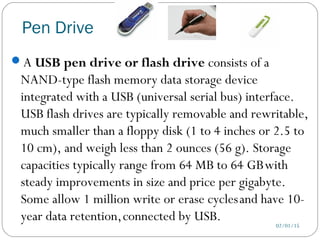
A USB pen drive or flash drive consists of a
NAND-type flash memory data storage device
integrated with a USB (universal serial bus) interface.
USB flash drives are typically removable and rewritable,
much smaller than a floppy disk (1 to 4 inches or 2.5 to
10 cm), and weigh less than 2 ounces (56 g). Storage
capacities typically range from 64 MB to 64 GBwith
steady improvements in size and price per gigabyte.
Some allow 1 million write or erase cyclesand have 10-
year data retention,connected by USB.
Memory Card
02/01/15
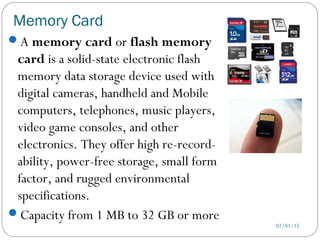
A memory card or flash memory
card is a solid-state electronic flash
memory data storage device used with
digital cameras, handheld and Mobile
computers, telephones, music players,
video game consoles, and other
electronics. They offer high re-record-
ability, power-free storage, small form
factor, and rugged environmental
specifications.
Capacity from 1 MB to 32 GB or more
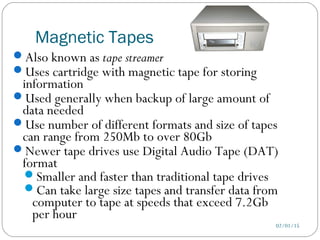
Magnetic Tapes
02/01/15
Also known as tape streamer
Uses cartridge with magnetic tape for storing
information
Used generally when backup of large amount of
data needed
Use number of different formats and size of tapes
can range from 250Mb to over 80Gb
Newer tape drives use Digital Audio Tape (DAT)
format
Smaller and faster than traditional tape drives
Can take large size tapes and transfer data from
computer to tape at speeds that exceed 7.2Gb
per hour
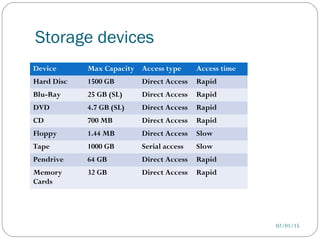
Storage devices
02/01/15
Device Max Capacity Access type Access time
Hard Disc 1500 GB Direct Access Rapid
Blu-Ray 25 GB (SL) Direct Access Rapid
DVD 4.7 GB (SL) Direct Access Rapid
CD 700 MB Direct Access Rapid
Floppy 1.44 MB Direct Access Slow
Tape 1000 GB Serial access Slow
Pendrive 64 GB Direct Access Rapid
Memory
Cards
32 GB Direct Access Rapid

Secondary storage devices

  • 1.
  • 2.
    Storage devices 02/01/15 Store softwareprograms and keep permanent records of work. When working on computer, RAM holds current work and currently active software program RAM only temporary and information discarded when you turn off computer’s power Must save work permanently to storage device before quitting software program or turning off power
  • 3.
    Storage device useddepends on amount of storage required and speed of data retrieval Hard disk drives used most often due to speed and storage capacities Data transfer rate slower on CD but can store large amounts of data to be retrieved quickly Tape drives slower at storing and retrieving but can store large amounts of data in compact and economical form
  • 4.
    Examples of StorageDevices 02/01/15 Hard disc CD – Compact Disc DVD – Digital Versatile Disc Blu-Ray Disc (BD) Floppy Disc Zip disc Pen drive Memory cards Tapes
  • 5.
    Hard Disc 02/01/15 A magneticdisk on which you can store computer data and programs. Hard disks hold more data and are faster than any other storage device. A hard disk, for example, can store anywhere from 10 to more than 1500 gigabytes.
  • 6.
    Compact Disc 02/01/15 A CompactDisc (CD) is an optical disc used to store digital data, originally developed for storing digital audio. Storage capacity of a CD: 700 MB
  • 7.
    DVDDVD 02/01/15 DVD (also knownas "Digital Versatile Disc" or "Digital Video Disc") is a popular optical disc storage media format. Its main uses are video and data storage. Most DVDs are of the same dimensions as compact discs (CDs) but store more than six times as much data. Storage capacity as from 4.7 GB
  • 8.
    Floppy Disc 02/01/15 A softmagnetic disk. It is called floppy because it flops if you wave it (at least, the 5¼-inch variety does). Unlike most hard disks, floppy disks (often called floppies or diskettes) are portable, because you can remove them from a disk drive. Disk drives for floppy disks are called floppy drives. Floppy disks are slower to access than hard disks and have less storage capacity, but they are much less expensive. And most importantly, they are portable. Storage Capacity of a FD : 1.44 MB
  • 9.
    Blu-ray Disc 02/01/15 Blu-ray Disc(also known as Blu-ray or BD) is an optical disc storage medium. Its main uses are high-definition video and data storage. The disc has the same physical dimensions as standard DVDs and CDs. Storage Capacity of a BD disc: Single layer: 25 GB Dual layer: 50 GB
  • 10.
    Zip Discs 02/01/15 Looks similarto floppy drive Disk used can hold between 100Mb and 250Mb of data Relatively inexpensive Newer zip systems not compatible with original 100Mb devices
  • 11.
    Pen Drive 02/01/15 A USBpen drive or flash drive consists of a NAND-type flash memory data storage device integrated with a USB (universal serial bus) interface. USB flash drives are typically removable and rewritable, much smaller than a floppy disk (1 to 4 inches or 2.5 to 10 cm), and weigh less than 2 ounces (56 g). Storage capacities typically range from 64 MB to 64 GBwith steady improvements in size and price per gigabyte. Some allow 1 million write or erase cyclesand have 10- year data retention,connected by USB.
  • 12.
    Memory Card 02/01/15 A memorycard or flash memory card is a solid-state electronic flash memory data storage device used with digital cameras, handheld and Mobile computers, telephones, music players, video game consoles, and other electronics. They offer high re-record- ability, power-free storage, small form factor, and rugged environmental specifications. Capacity from 1 MB to 32 GB or more
  • 13.
    Magnetic Tapes 02/01/15 Also knownas tape streamer Uses cartridge with magnetic tape for storing information Used generally when backup of large amount of data needed Use number of different formats and size of tapes can range from 250Mb to over 80Gb Newer tape drives use Digital Audio Tape (DAT) format Smaller and faster than traditional tape drives Can take large size tapes and transfer data from computer to tape at speeds that exceed 7.2Gb per hour
  • 14.
    Storage devices 02/01/15 Device MaxCapacity Access type Access time Hard Disc 1500 GB Direct Access Rapid Blu-Ray 25 GB (SL) Direct Access Rapid DVD 4.7 GB (SL) Direct Access Rapid CD 700 MB Direct Access Rapid Floppy 1.44 MB Direct Access Slow Tape 1000 GB Serial access Slow Pendrive 64 GB Direct Access Rapid Memory Cards 32 GB Direct Access Rapid