1 ©2002 Learning Zone Express Louanne Kaupa, RD, LN.
Nutrients 
 The food you eat is a source of 
nutrients. Nutrients are defined as 
the substances found in food that keep your 
body functioning. 
 Your body needs nutrients to… 
Fuel your energy. 
Help you grow. 
Repair itself. 
Maintain basic bodily functions. 
©2002 2 Learning Zone Express
Balance is Key 
For years, people held to the idea that there are “bad” 
nutrients and “good” nutrients when, in fact, all nutrients play a 
certain role in the body. Even those nutrients once considered 
“bad” such as fats and carbohydrates perform vital functions in 
the body and if one consumes too many “good” nutrients such as 
vitamins or minerals there can be harmful results, as well. 
These three are the framework of the Food Guide Pyramid: 
 Balance - Eat foods from all groups of the Food Guide Pyramid. 
 Variety - Eat different foods from each food group. 
 Moderation - Eat more foods from the bottom of the pyramid, and 
fewer and smaller portions of foods from the top of the pyramid. 
©2002 3 Learning Zone Express
The 6 Essential Nutrients 
Water 
 Carbohydrates 
 Protein 
 Fat 
 Vitamins 
 Minerals 
©2002 4 Learning Zone Express
Water 
 Did you know? 
 1/2 to 3/4 of the human body consists of water! 
 Functions in the Body: 
 Water carries nutrients to your cells and carries waste 
from your body. 
 Regulates body temperature. 
 Dissolves vitamins, minerals, amino acids and other 
nutrients. 
 Lubricates joints. 
It is recommended that teens drink 6-8 glasses (8 fl.oz each) of water each day. 
This is in addition to around 4 cups of water you get from food each day. 
©2002 5 Learning Zone Express
Carbohydrates 
Carbohydrates are the body’s main source of energy 
and provide the body’s need for dietary fiber. 
 Food Sources: 
 Pasta, breads, cereals, grains, rice, fruits, 
milk, yogurt and sweets. 
 Two types of Carbohydrates: 
 Starches or Complex Carbohydrates 
 Simple Carbohydrates 
©2002 6 Learning Zone Express
Simple Carbohydrates 
 Food Sources: 
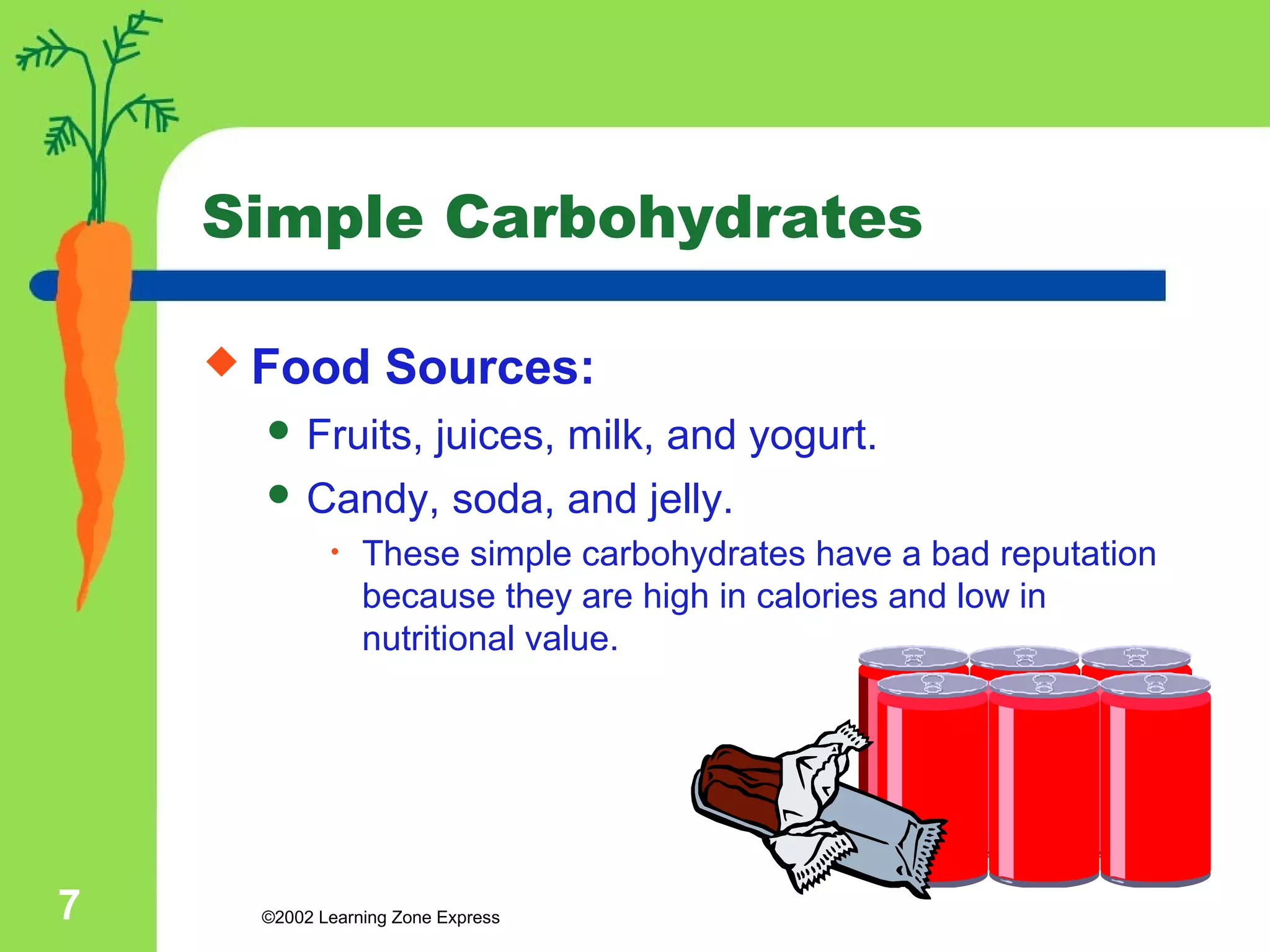
 Fruits, juices, milk, and yogurt. 
 Candy, soda, and jelly. 
• These simple carbohydrates have a bad reputation 
because they are high in calories and low in 
nutritional value. 
©2002 7 Learning Zone Express
Starches or 
Complex Carbohydrates 
 Food Sources: 
Whole grain breads and cereals, 
pasta, vegetables, rice, tortilla 
and legumes. 
 Function in the Body: 
 An excellent source of fuel (energy) 
for the body. 
 Rich in vitamins, minerals and fiber. 
©2002 8 Learning Zone Express
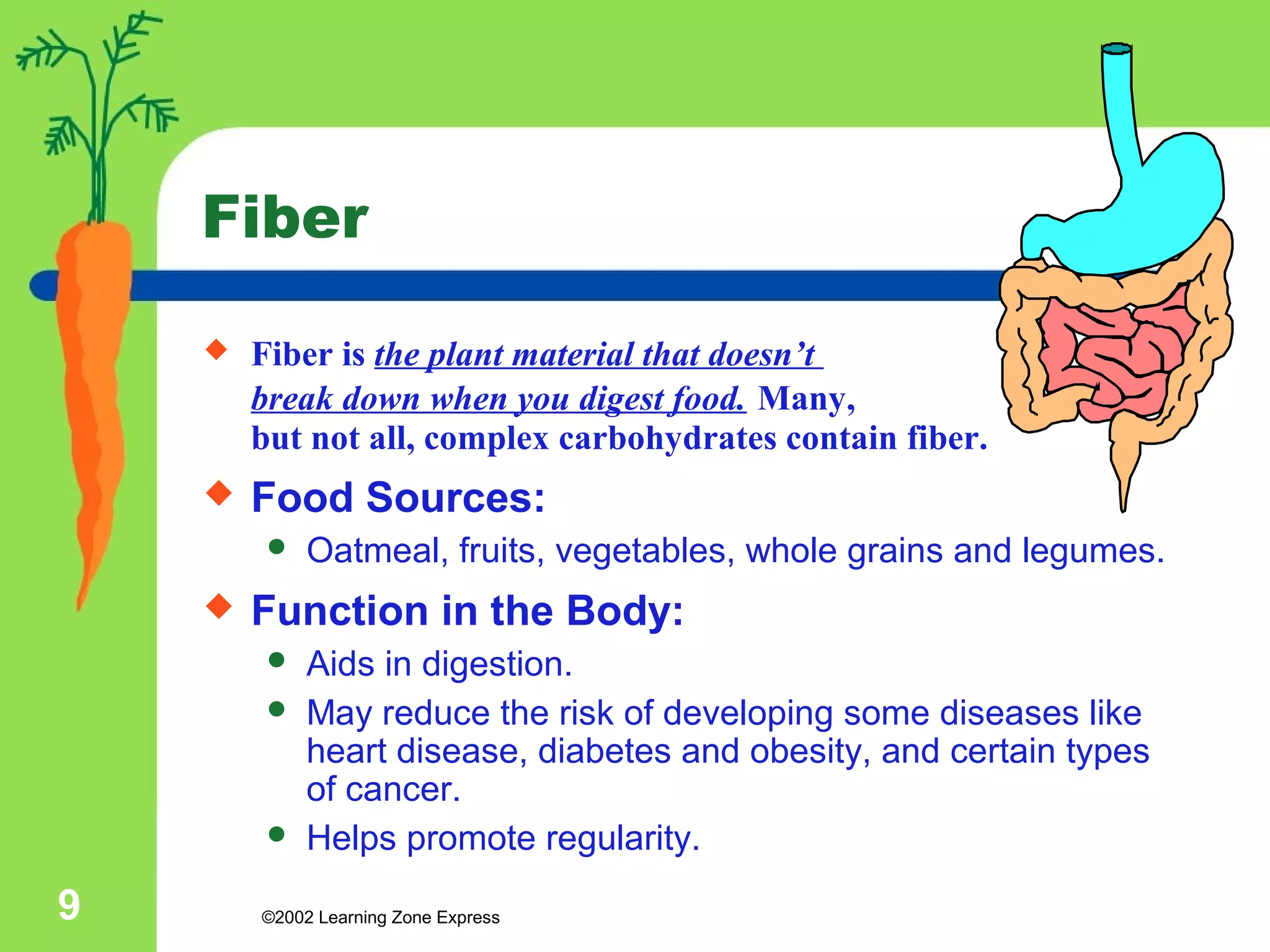
Fiber 
 Fiber is the plant material that doesn’t 
break down when you digest food. Many, 
but not all, complex carbohydrates contain fiber. 
 Food Sources: 
 Oatmeal, fruits, vegetables, whole grains and legumes. 
 Function in the Body: 
 Aids in digestion. 
 May reduce the risk of developing some diseases like 
heart disease, diabetes and obesity, and certain types 
of cancer. 
 Helps promote regularity. 
©2002 9 Learning Zone Express
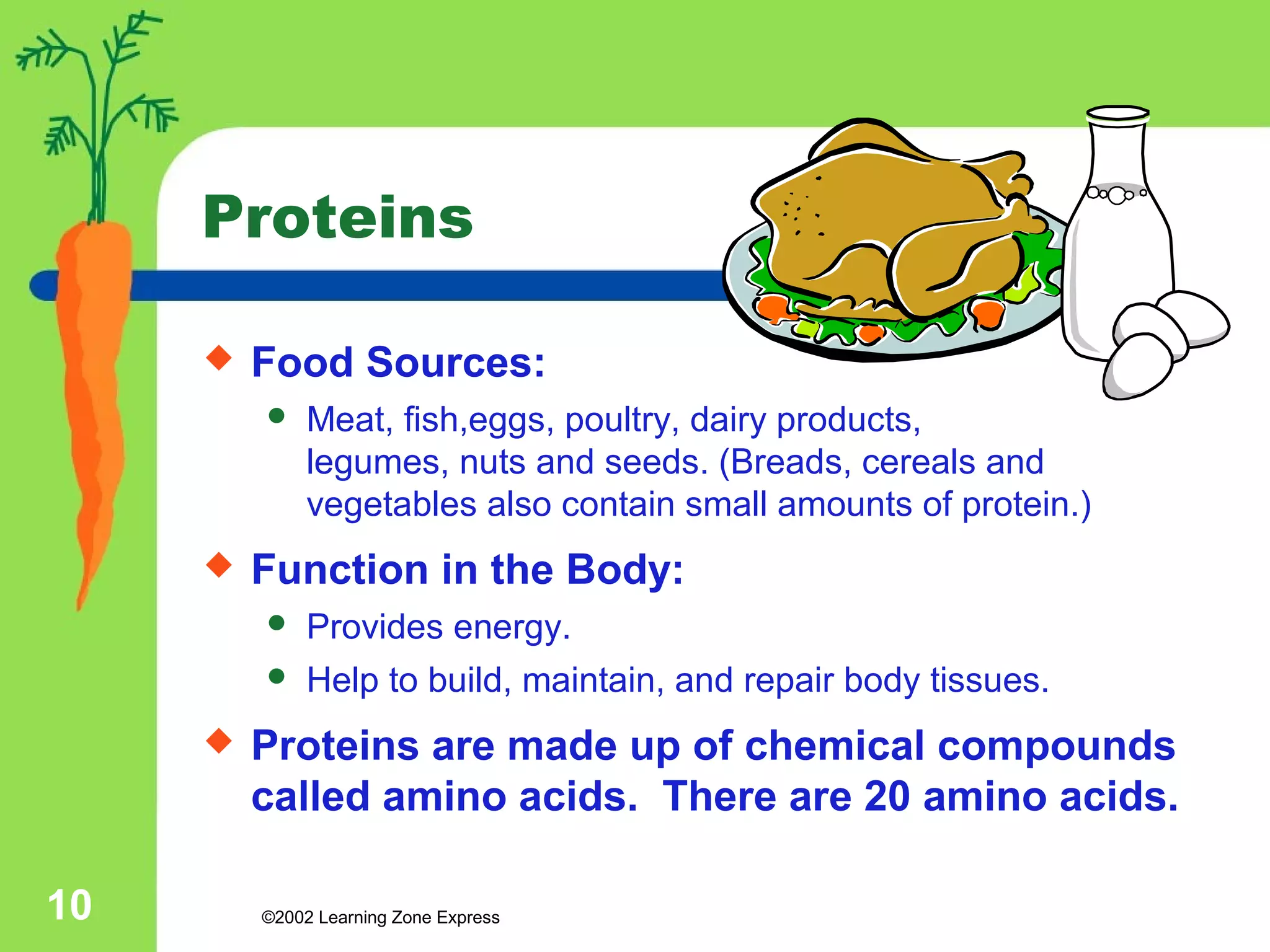
Proteins 
 Food Sources: 
 Meat, fish,eggs, poultry, dairy products, 
legumes, nuts and seeds. (Breads, cereals and 
vegetables also contain small amounts of protein.) 
 Function in the Body: 
 Provides energy. 
 Help to build, maintain, and repair body tissues. 
 Proteins are made up of chemical compounds 
called amino acids. There are 20 amino acids. 
©2002 10 Learning Zone Express
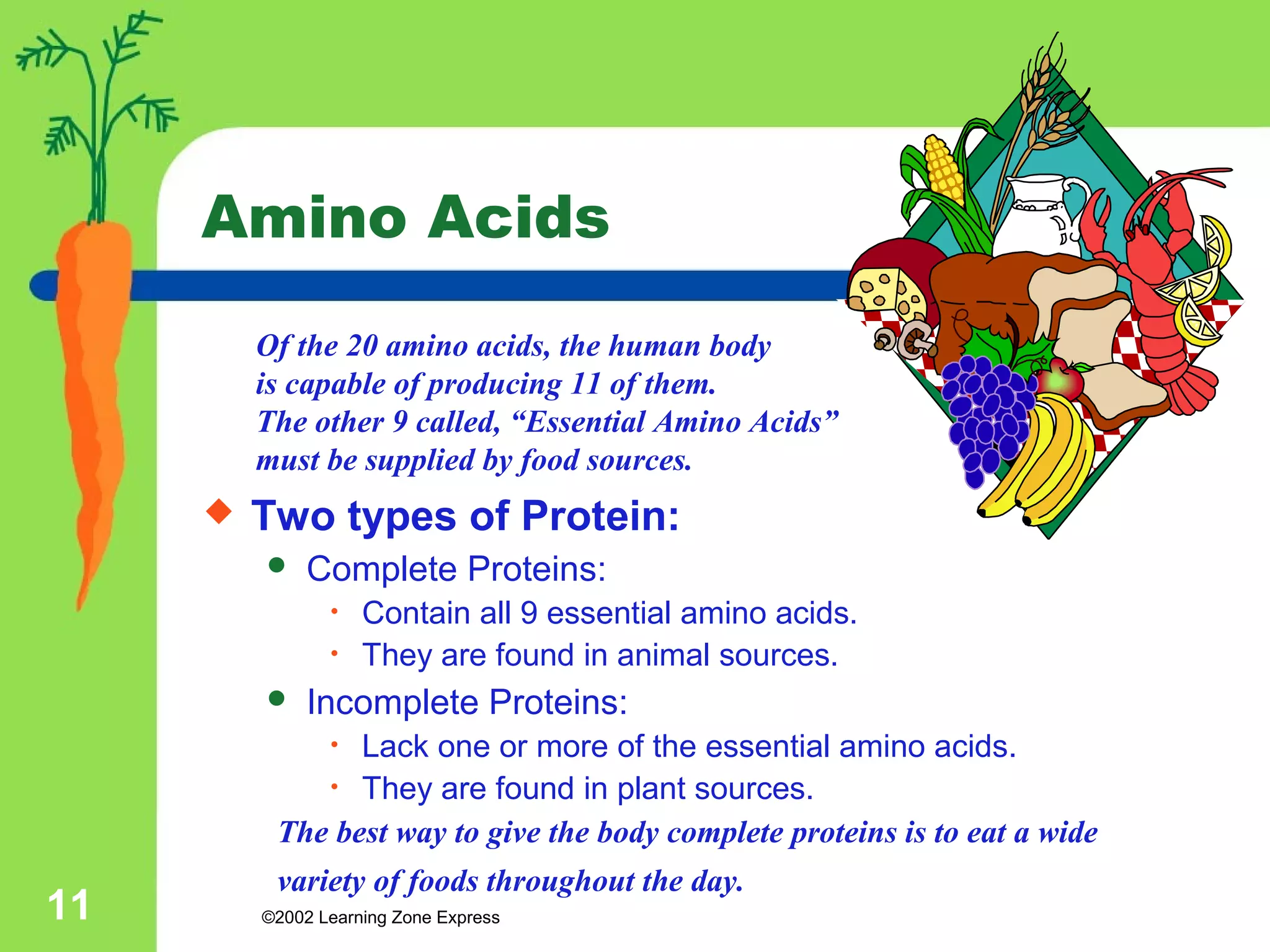
Amino Acids 
Of the 20 amino acids, the human body 
is capable of producing 11 of them. 
The other 9 called, “Essential Amino Acids” 
must be supplied by food sources. 
 Two types of Protein: 
 Complete Proteins: 
• Contain all 9 essential amino acids. 
• They are found in animal sources. 
 Incomplete Proteins: 
• Lack one or more of the essential amino acids. 
• They are found in plant sources. 
The best way to give the body complete proteins is to eat a wide 
variety of foods throughout the day. 
©2002 11 Learning Zone Express
Fat 
- The most concentrated form of food energy (calories). 
 Food Sources: 
 Butter, vegetable oils, salad dressings, nuts and 
seeds, dairy products made with whole milk 
or cream, and meats. 
 Function in the Body: 
 Provide substances needed for growth and healthy skin. 
 Enhance the taste and texture of food. 
 Required to carry “fat-soluble” 
vitamins throughout the body. 
 Provide energy. 
©2002 12 Learning Zone Express
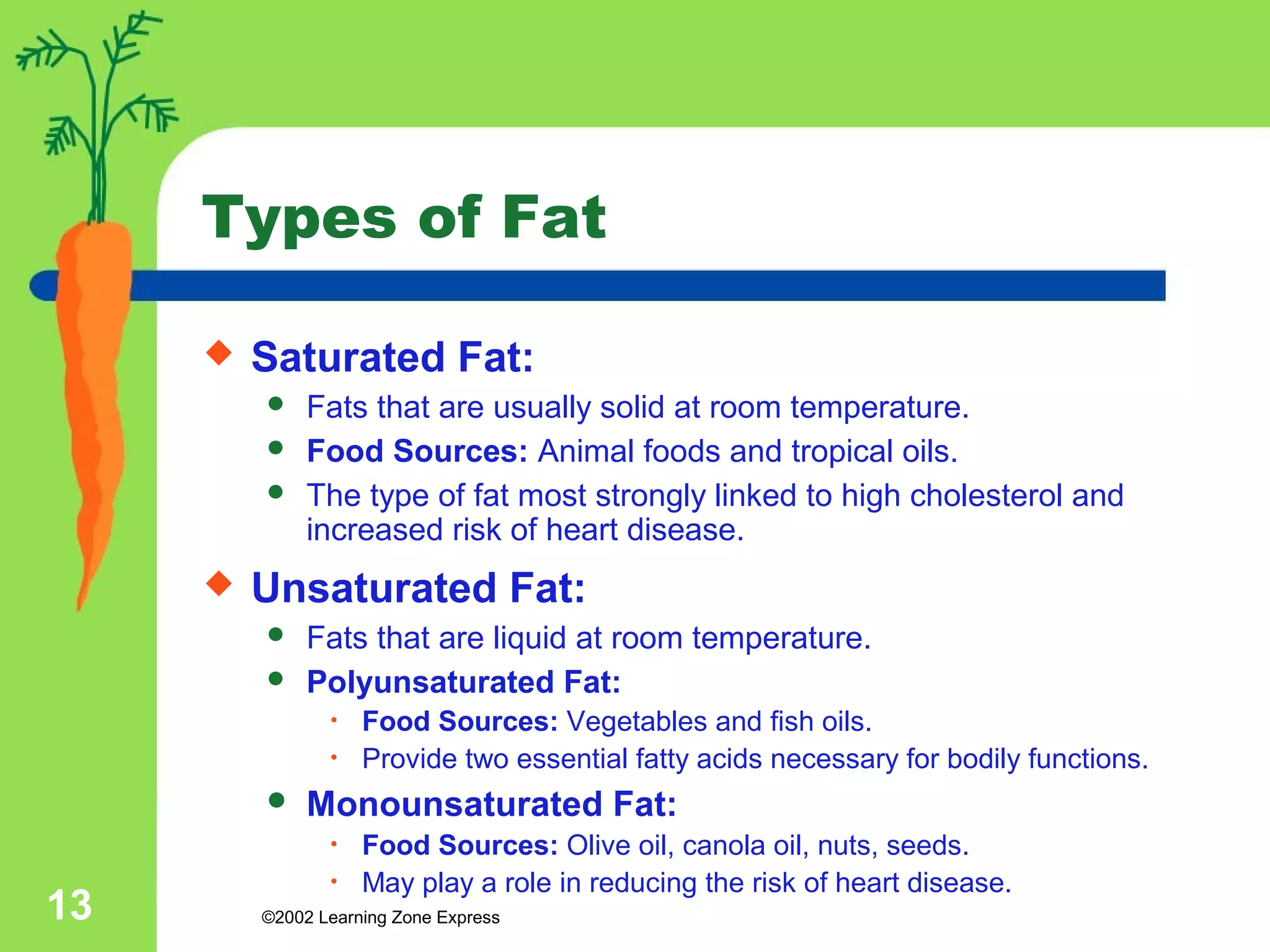
Types of Fat 
 Saturated Fat: 
 Fats that are usually solid at room temperature. 
 Food Sources: Animal foods and tropical oils. 
 The type of fat most strongly linked to high cholesterol and 
increased risk of heart disease. 
 Unsaturated Fat: 
 Fats that are liquid at room temperature. 
 Polyunsaturated Fat: 
• Food Sources: Vegetables and fish oils. 
• Provide two essential fatty acids necessary for bodily functions. 
 Monounsaturated Fat: 
• Food Sources: Olive oil, canola oil, nuts, seeds. 
• May play a role in reducing the risk of heart disease. 
©2002 13 Learning Zone Express
Cholesterol 
- A fat-like substance that is part of every cell of the body. 
 Function in the Body: 
 Helps the body make necessary cells including skin, 
and hormones. 
 Aids in digestion. 
 The human body manufactures all the cholesterol it 
needs. You also get cholesterol from animal food 
products you eat. 
 When cholesterol levels are high 
there is a greater risk for heart disease. 
 Do you know what the healthy cholesterol 
range is for teens your age? 
©2002 14 Learning Zone Express
Vitamins 
 Food Sources: 
 Fruits, vegetables, milk, whole-grain breads, 
cereals and legumes. 
 Unlike carbohydrates, fats, and proteins, 
vitamins DO NOT provide energy (calories). 
 Function in the Body: 
 Help regulate the many chemical processes in the body. 
 There are 13 different vitamins known to be required 
each day for good health. 
 Vitamins are separated into two types: Fat Soluble & 
Water Soluble Vitamins. 
©2002 15 Learning Zone Express
Fat/Water Soluble Vitamins 
 Fat Soluble Vitamins 
 Vitamins A, D, E, K 
 Require fat for the stomach to allow them to be carried 
into the blood stream for use (absorption). 
 Can be stored in the body for later use. 
 Water Soluble Vitamins 
 Vitamins C and B-complex 
 Require water for absorption. 
 Easily absorbed and passed through the body as 
waste. 
©2002 16 Learning Zone Express
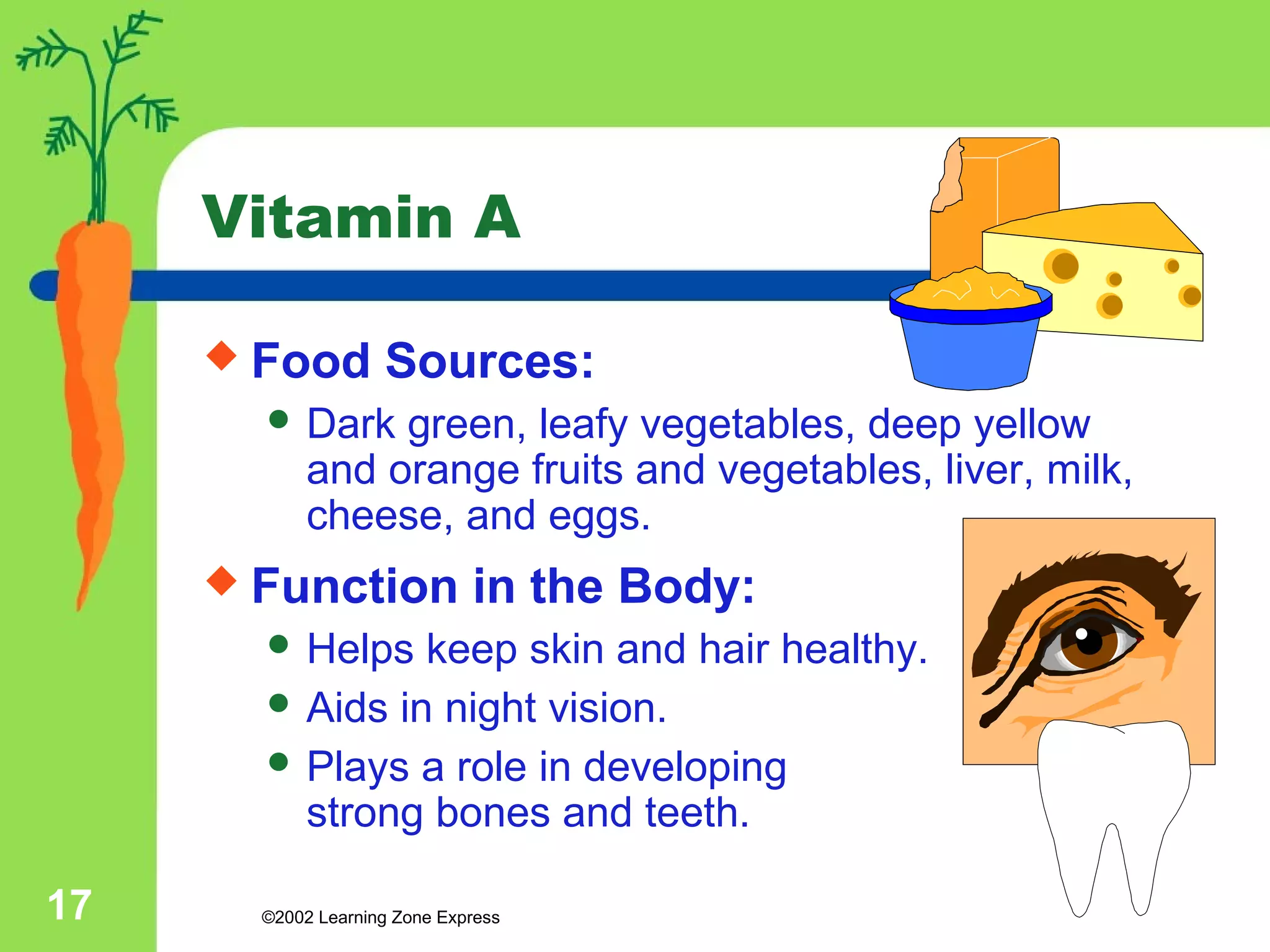
Vitamin A 
 Food Sources: 
 Dark green, leafy vegetables, deep yellow 
and orange fruits and vegetables, liver, milk, 
cheese, and eggs. 
 Function in the Body: 
 Helps keep skin and hair healthy. 
 Aids in night vision. 
 Plays a role in developing 
strong bones and teeth. 
©2002 17 Learning Zone Express
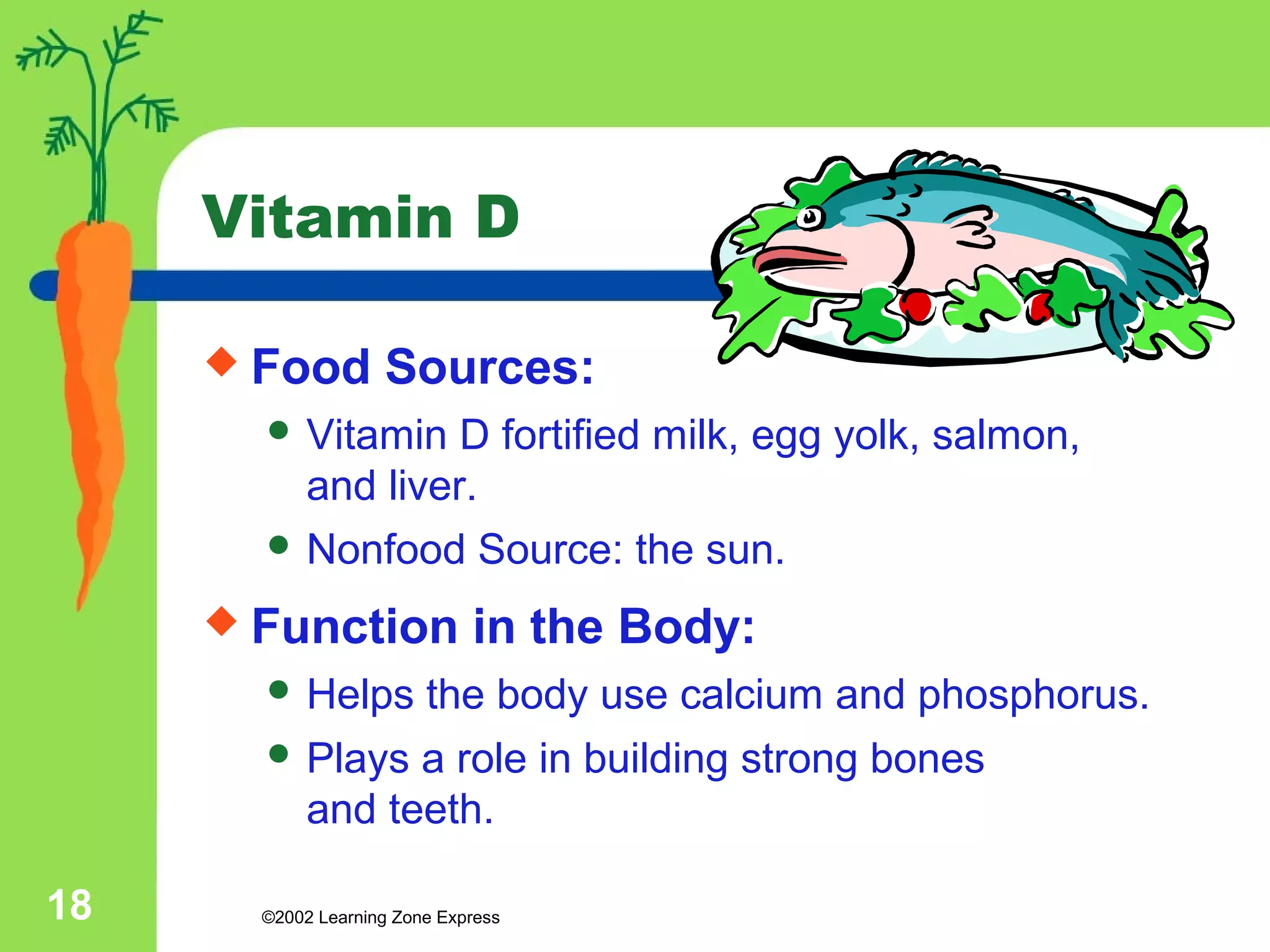
Vitamin D 
 Food Sources: 
 Vitamin D fortified milk, egg yolk, salmon, 
and liver. 
 Nonfood Source: the sun. 
 Function in the Body: 
 Helps the body use calcium and phosphorus. 
 Plays a role in building strong bones 
and teeth. 
©2002 18 Learning Zone Express
Vitamin E 
 Food Sources: 
Whole-grain breads and cereals; dark green, 
leafy vegetables; dry beans and peas; nuts 
and seeds; vegetable oils; margarine; liver. 
 Function in the Body: 
 Helps form red blood cells, muscles, and 
other tissues. 
©2002 19 Learning Zone Express
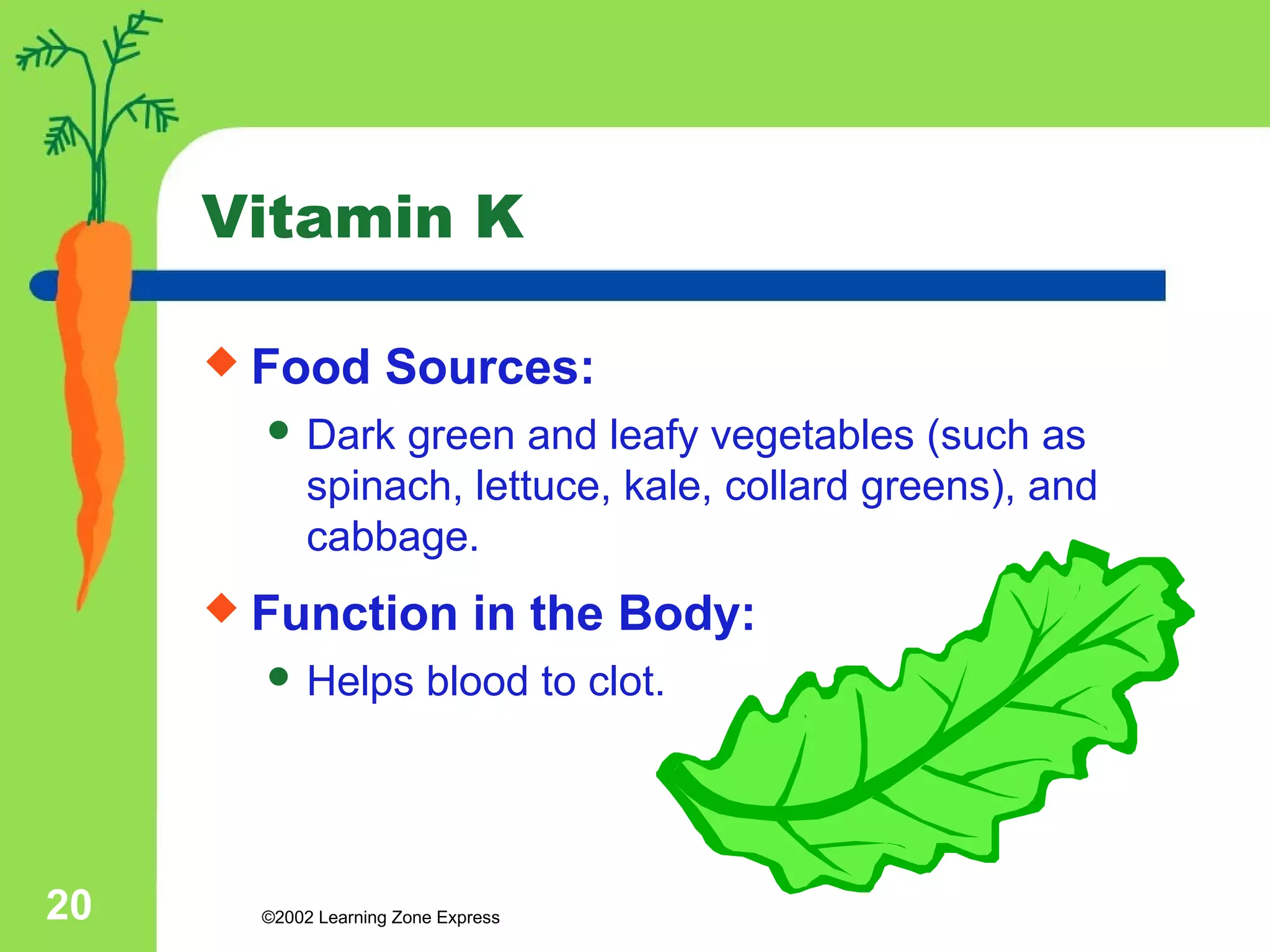
Vitamin K 
 Food Sources: 
 Dark green and leafy vegetables (such as 
spinach, lettuce, kale, collard greens), and 
cabbage. 
 Function in the Body: 
 Helps blood to clot. 
©2002 20 Learning Zone Express
Vitamin B-complex 
 Food Sources: 
Whole grain and enriched breads and cereals; 
dry bean and peas; peanut butter; nuts; meat; 
poultry; fish; eggs; milk. 
 Function in the Body: 
 Helps the body use the energy 
from the foods we eat. 
 Helps brain, nerves, and 
muscles function. 
©2002 21 Learning Zone Express
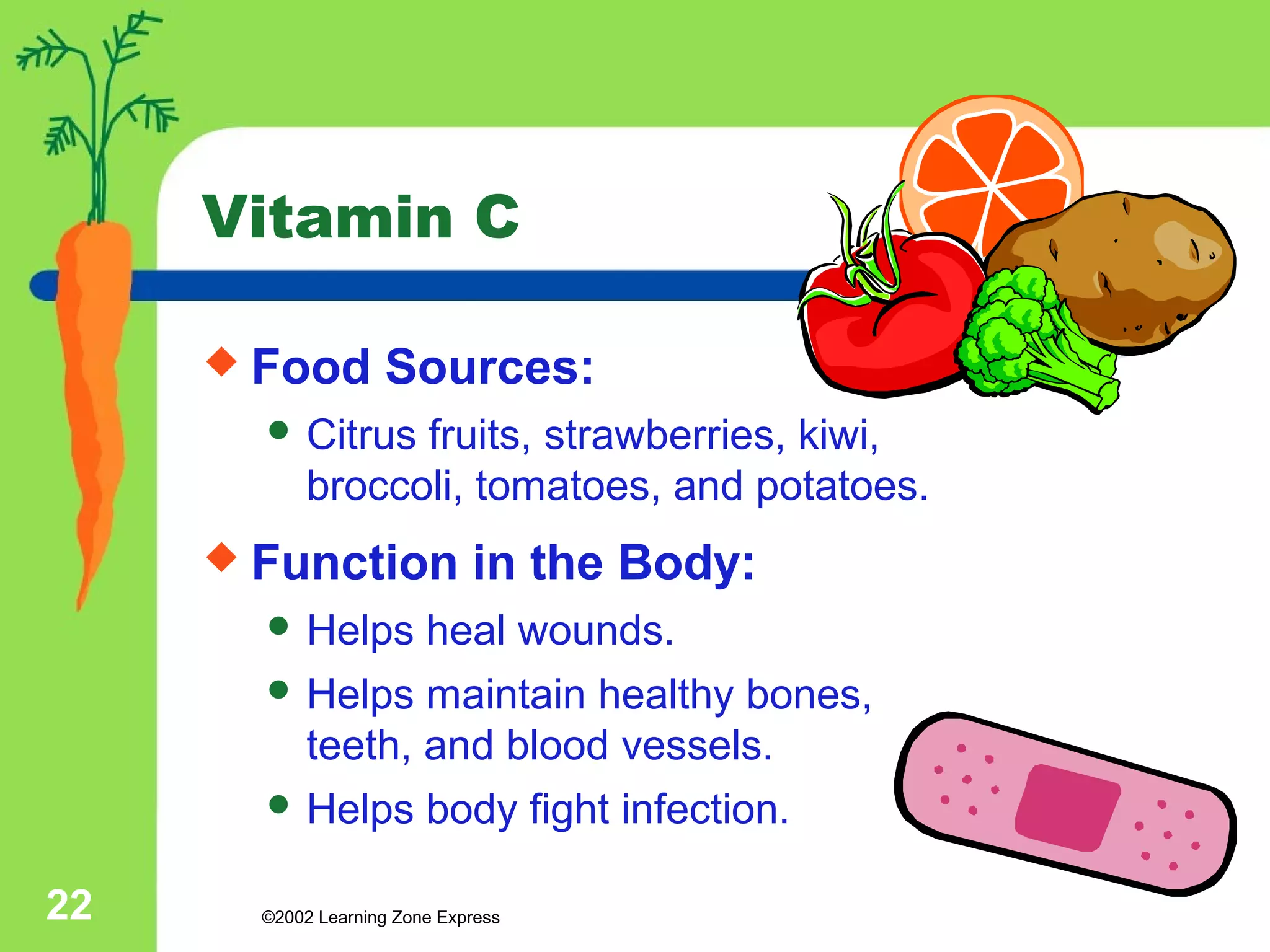
Vitamin C 
 Food Sources: 
 Citrus fruits, strawberries, kiwi, 
broccoli, tomatoes, and potatoes. 
 Function in the Body: 
 Helps heal wounds. 
 Helps maintain healthy bones, 
teeth, and blood vessels. 
 Helps body fight infection. 
©2002 22 Learning Zone Express
Minerals 
 Food Sources: 
 Meats, beans, nuts, fruits, vegetables, dairy 
products, and grains. 
 Functions in the Body: 
 The body depends on minerals for practically 
every process necessary for life. 
 Minerals actually become part of the body. 
 The body requires 16 minerals daily. 
©2002 23 Learning Zone Express
Minerals 
 Calcium 
 Phosphorus 
 Magnesium 
 Sodium 
 Potassium 
 Iron 
 Others include: 
 Iodine, Zinc, Copper, Sulfur, Chloride, etc. 
©2002 24 Learning Zone Express
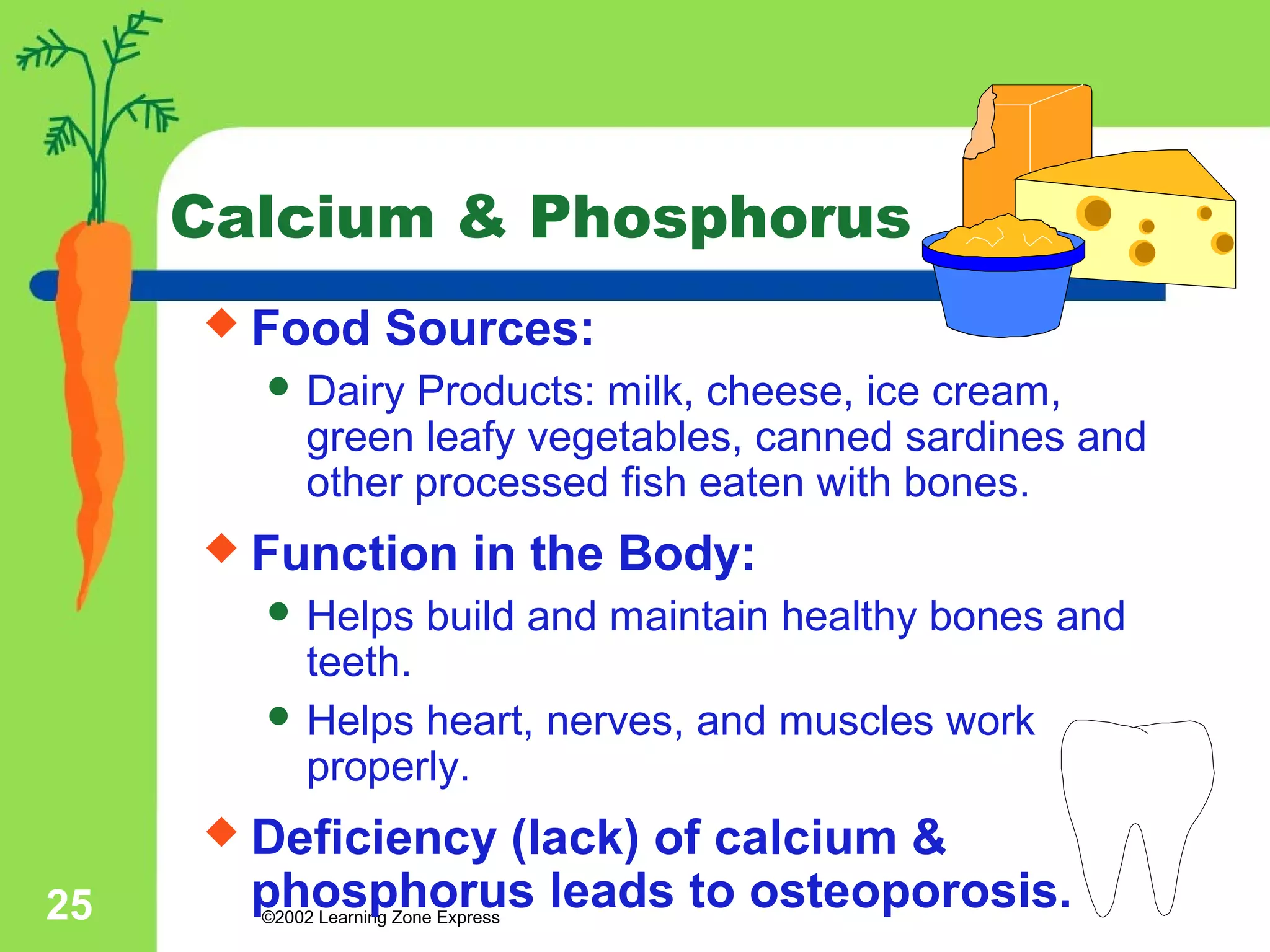
Calcium & Phosphorus 
 Food Sources: 
 Dairy Products: milk, cheese, ice cream, 
green leafy vegetables, canned sardines and 
other processed fish eaten with bones. 
 Function in the Body: 
 Helps build and maintain healthy bones and 
teeth. 
 Helps heart, nerves, and muscles work 
properly. 
 Deficiency (lack) of calcium & 
phosphorus leads to osteoporosis. 
©2002 25 Learning Zone Express
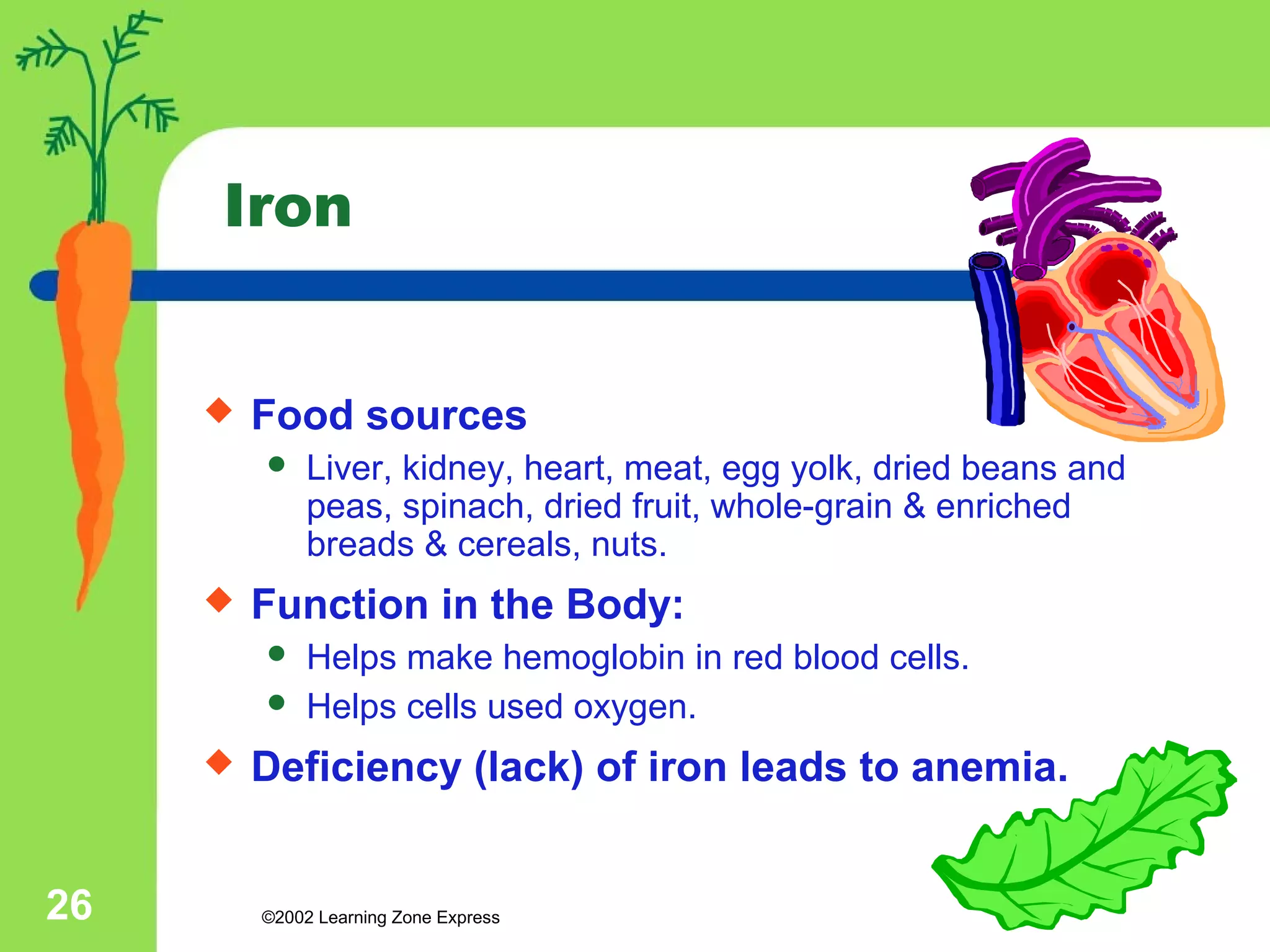
Iron 
 Food sources 
 Liver, kidney, heart, meat, egg yolk, dried beans and 
peas, spinach, dried fruit, whole-grain & enriched 
breads & cereals, nuts. 
 Function in the Body: 
 Helps make hemoglobin in red blood cells. 
 Helps cells used oxygen. 
 Deficiency (lack) of iron leads to anemia. 
©2002 26 Learning Zone Express
Sodium 
 Food sources 
 Processed & prepared foods. Canned 
vegetables, soups, pickles, lunch meats, 
ham, bacon, sausage, hotdogs, and frozen 
foods. Salt/sodium is used to preserve 
food and improve the taste and texture of 
food. 
 Condiments. Table salt, soy sauce, 
ketchup, mustard, BBQ sauce, steak 
sauce… 
 Natural sources. Some meats, poultry, 
dairy products (esp. cheeses) and 
vegetables. 
©2002 27 Learning Zone Express 
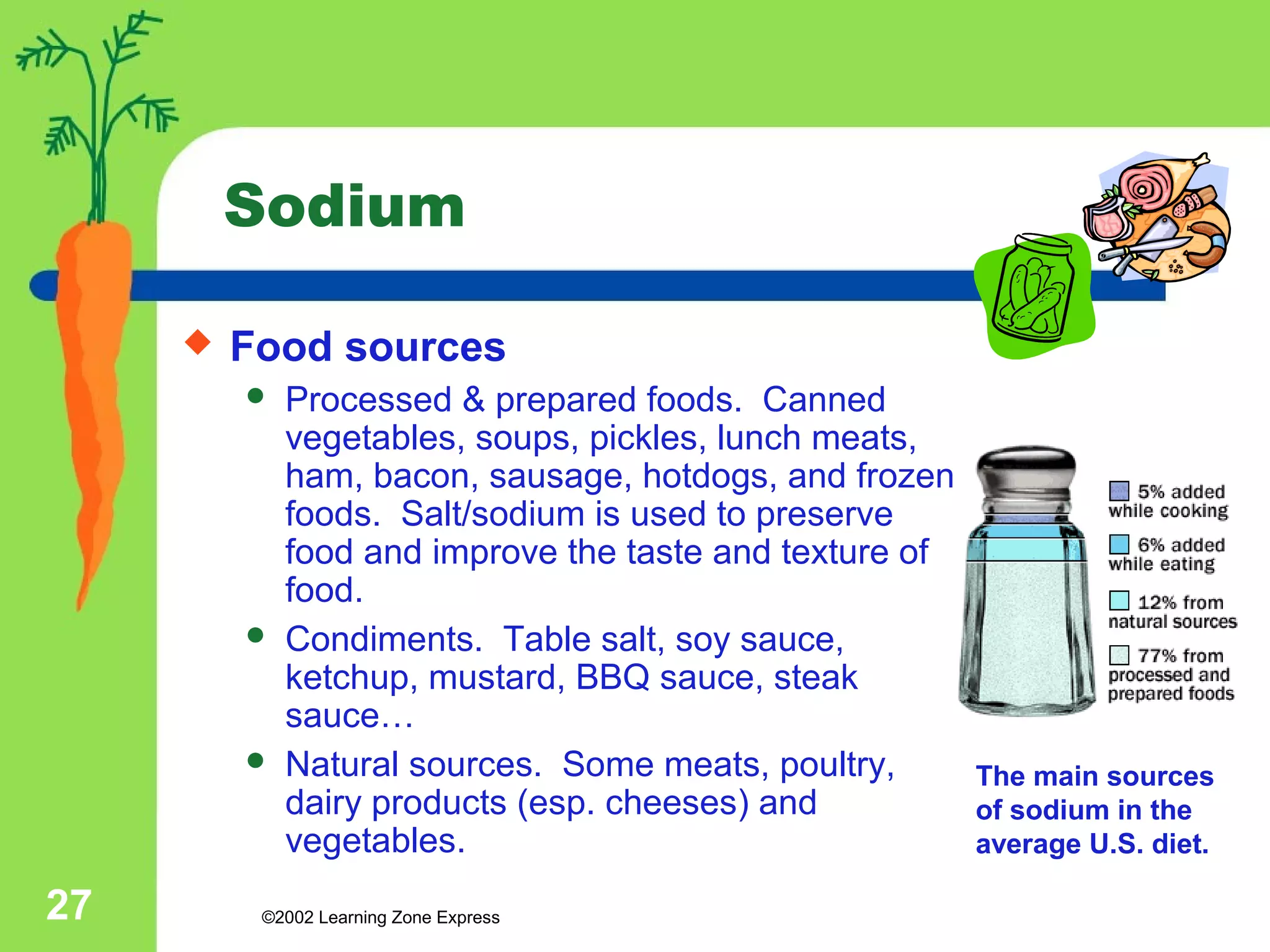
The main sources 
of sodium in the 
average U.S. diet.
Sodium 
 Function in the Body: 
 Helps maintain the right balance of fluids in your body. 
 Helps transmit nerve impulses. 
 Influences the contraction and relaxation of muscles. 
 Excess sodium can lead to hypertension 
(high blood pressure), a condition that can 
lead to cardiovascular and kidney diseases. 
©2002 28 Learning Zone Express
Nutrient Deficiency 
 A nutritional deficiency occurs when your 
body doesn’t get enough nutrients. 
 Symptoms: 
 At first the symptoms may not seem serious. They may 
include: tiredness, difficulty sleeping or concentrating, 
frequent colds, and weight loss or gains. 
 However, if the deficiency is not corrected the 
symptoms may get more serious and effect the skin, 
eyes, and bones. 
 The best way to avoid a nutrient deficiency is 
to eat a well balanced diet. 
©2002 29 Learning Zone Express
Nutrient Basics Quiz 
Fill in the blank with the appropriate nutrient. 
1. I serve many functions in the body. I help carry nutrients to the body’s cells 
and I also help regulate body temperature. I am____________. 
2. I can be converted into energy. I am also used to build, maintain and repair 
body tissues. I am_________. 
3. I have a bad reputation in many people’s minds but I do serve many functions 
in the body. For example, I am the most concentrated source of energy and I 
also am needed for growth and healthy skin. I am______________. 
4. I am the body’s main source of energy and I come in two forms, simple and 
complex. I am_______________. 
5. I do not provide energy (calories) but I do help regulate many of the chemical 
processes in the body. You need 13 different forms of me everyday. 
I am_____________. 
6. I am depended on for nearly every process necessary for life. The body 
requires 16 types of me everyday from calcium to iron. I am _________. 
©2002 30 Learning Zone Express
You’re the Expert… 
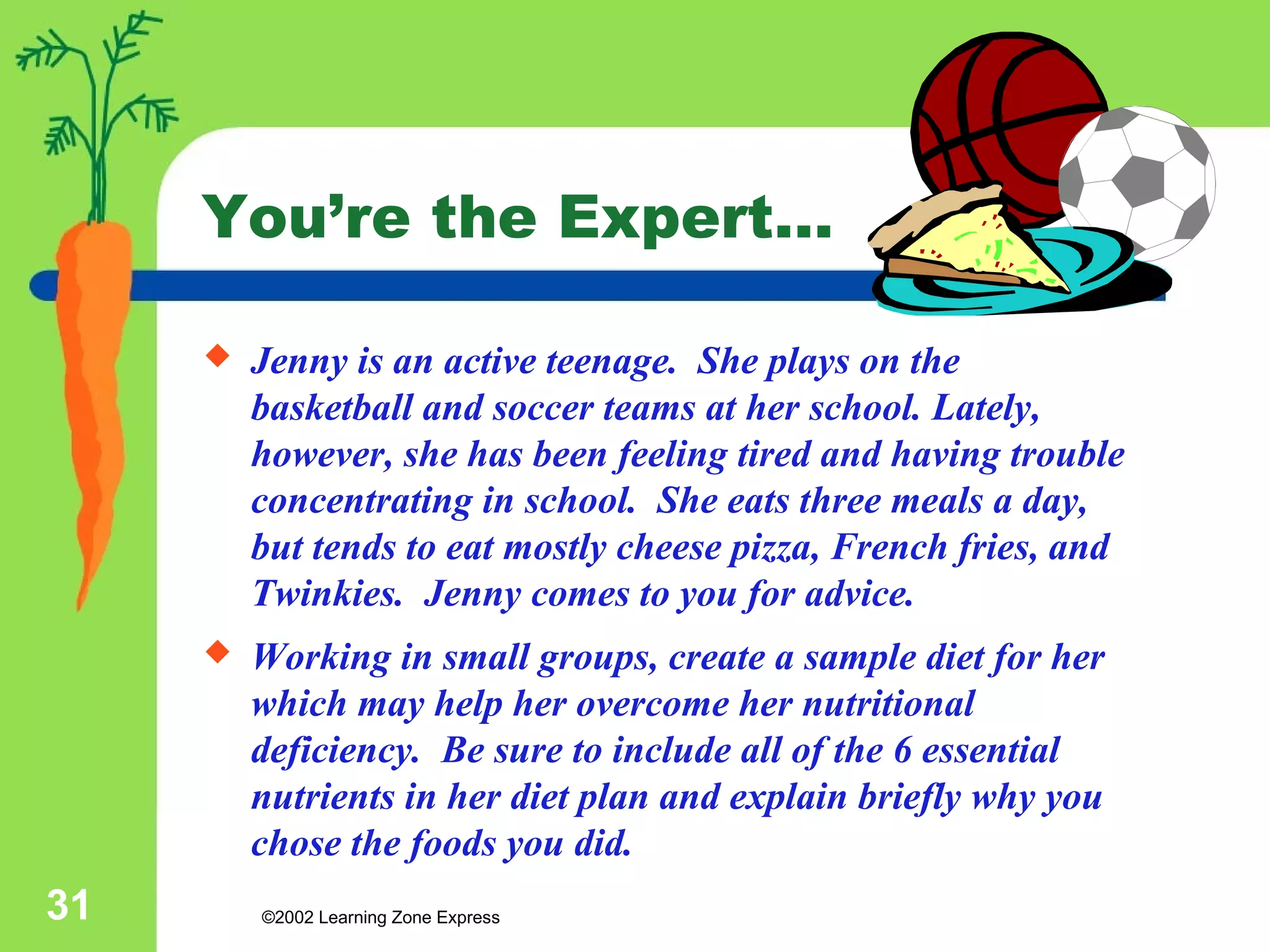
 Jenny is an active teenage. She plays on the 
basketball and soccer teams at her school. Lately, 
however, she has been feeling tired and having trouble 
concentrating in school. She eats three meals a day, 
but tends to eat mostly cheese pizza, French fries, and 
Twinkies. Jenny comes to you for advice. 
 Working in small groups, create a sample diet for her 
which may help her overcome her nutritional 
deficiency. Be sure to include all of the 6 essential 
nutrients in her diet plan and explain briefly why you 
chose the foods you did. 
©2002 31 Learning Zone Express
Applying What You Know 
Pick one of the following assignments to be completed outside of class. 
1. Record your diet for 3 days. Write down everything you eat and drink 
throughout the day. Then, go over your diet and evaluate it based on your 
nutritional needs. What nutrients are you consuming enough of? Are there 
any nutrients you need more of on a daily basis? In what ways will you make 
improvements. Write a one-page summary of your results. 
2. Research one of the well-known nutritional deficiency diseases. What 
are the major causes of the disease? How is it diagnosed? Is a certain age 
group more prone to the disease? Can it be cured? Write a one- two page 
report on your findings. 
3. Create a poster for teens your age describing the functions of the 6 
essential nutrients. Be sure to include visual examples of food sources, 
USDA serving guidelines, as well as any new facts you may discover 
regarding disease prevention. You will be graded on neatness and creativity, 
as well as content. 
©2002 32 Learning Zone Express
Exploring the Web 
 Here are some suggested sites you and your class may want to 
investigate for more information on nutrients. 
 http://www.nutrition.gov/home/index.php3 
• Nutrition facts and information 
 http://www.nal.usda.gov:8001/py/pmap.htm 
• USDA Food Guide Pyramid information 
 http://vm.cfsan.fda.gov/list.html 
• The US FDA Center for Food Safety and Applied Nutrition 
 http://www.nal.usda.gov/fnic/ 
• Food and Nutrition Information Center 
 Teachers: Please note that these addresses are constantly changing and being updated. 
You may need to revise this list. 
©2002 33 Learning Zone Express

PPT on Nutrients

  • 1.
    1 ©2002 LearningZone Express Louanne Kaupa, RD, LN.
  • 2.
    Nutrients  Thefood you eat is a source of nutrients. Nutrients are defined as the substances found in food that keep your body functioning.  Your body needs nutrients to… Fuel your energy. Help you grow. Repair itself. Maintain basic bodily functions. ©2002 2 Learning Zone Express
  • 3.
    Balance is Key For years, people held to the idea that there are “bad” nutrients and “good” nutrients when, in fact, all nutrients play a certain role in the body. Even those nutrients once considered “bad” such as fats and carbohydrates perform vital functions in the body and if one consumes too many “good” nutrients such as vitamins or minerals there can be harmful results, as well. These three are the framework of the Food Guide Pyramid:  Balance - Eat foods from all groups of the Food Guide Pyramid.  Variety - Eat different foods from each food group.  Moderation - Eat more foods from the bottom of the pyramid, and fewer and smaller portions of foods from the top of the pyramid. ©2002 3 Learning Zone Express
  • 4.
    The 6 EssentialNutrients Water  Carbohydrates  Protein  Fat  Vitamins  Minerals ©2002 4 Learning Zone Express
  • 5.
    Water  Didyou know?  1/2 to 3/4 of the human body consists of water!  Functions in the Body:  Water carries nutrients to your cells and carries waste from your body.  Regulates body temperature.  Dissolves vitamins, minerals, amino acids and other nutrients.  Lubricates joints. It is recommended that teens drink 6-8 glasses (8 fl.oz each) of water each day. This is in addition to around 4 cups of water you get from food each day. ©2002 5 Learning Zone Express
  • 6.
    Carbohydrates Carbohydrates arethe body’s main source of energy and provide the body’s need for dietary fiber.  Food Sources:  Pasta, breads, cereals, grains, rice, fruits, milk, yogurt and sweets.  Two types of Carbohydrates:  Starches or Complex Carbohydrates  Simple Carbohydrates ©2002 6 Learning Zone Express
  • 7.
    Simple Carbohydrates Food Sources:  Fruits, juices, milk, and yogurt.  Candy, soda, and jelly. • These simple carbohydrates have a bad reputation because they are high in calories and low in nutritional value. ©2002 7 Learning Zone Express
  • 8.
    Starches or ComplexCarbohydrates  Food Sources: Whole grain breads and cereals, pasta, vegetables, rice, tortilla and legumes.  Function in the Body:  An excellent source of fuel (energy) for the body.  Rich in vitamins, minerals and fiber. ©2002 8 Learning Zone Express
  • 9.
    Fiber  Fiberis the plant material that doesn’t break down when you digest food. Many, but not all, complex carbohydrates contain fiber.  Food Sources:  Oatmeal, fruits, vegetables, whole grains and legumes.  Function in the Body:  Aids in digestion.  May reduce the risk of developing some diseases like heart disease, diabetes and obesity, and certain types of cancer.  Helps promote regularity. ©2002 9 Learning Zone Express
  • 10.
    Proteins  FoodSources:  Meat, fish,eggs, poultry, dairy products, legumes, nuts and seeds. (Breads, cereals and vegetables also contain small amounts of protein.)  Function in the Body:  Provides energy.  Help to build, maintain, and repair body tissues.  Proteins are made up of chemical compounds called amino acids. There are 20 amino acids. ©2002 10 Learning Zone Express
  • 11.
    Amino Acids Ofthe 20 amino acids, the human body is capable of producing 11 of them. The other 9 called, “Essential Amino Acids” must be supplied by food sources.  Two types of Protein:  Complete Proteins: • Contain all 9 essential amino acids. • They are found in animal sources.  Incomplete Proteins: • Lack one or more of the essential amino acids. • They are found in plant sources. The best way to give the body complete proteins is to eat a wide variety of foods throughout the day. ©2002 11 Learning Zone Express
  • 12.
    Fat - Themost concentrated form of food energy (calories).  Food Sources:  Butter, vegetable oils, salad dressings, nuts and seeds, dairy products made with whole milk or cream, and meats.  Function in the Body:  Provide substances needed for growth and healthy skin.  Enhance the taste and texture of food.  Required to carry “fat-soluble” vitamins throughout the body.  Provide energy. ©2002 12 Learning Zone Express
  • 13.
    Types of Fat  Saturated Fat:  Fats that are usually solid at room temperature.  Food Sources: Animal foods and tropical oils.  The type of fat most strongly linked to high cholesterol and increased risk of heart disease.  Unsaturated Fat:  Fats that are liquid at room temperature.  Polyunsaturated Fat: • Food Sources: Vegetables and fish oils. • Provide two essential fatty acids necessary for bodily functions.  Monounsaturated Fat: • Food Sources: Olive oil, canola oil, nuts, seeds. • May play a role in reducing the risk of heart disease. ©2002 13 Learning Zone Express
  • 14.
    Cholesterol - Afat-like substance that is part of every cell of the body.  Function in the Body:  Helps the body make necessary cells including skin, and hormones.  Aids in digestion.  The human body manufactures all the cholesterol it needs. You also get cholesterol from animal food products you eat.  When cholesterol levels are high there is a greater risk for heart disease.  Do you know what the healthy cholesterol range is for teens your age? ©2002 14 Learning Zone Express
  • 15.
    Vitamins  FoodSources:  Fruits, vegetables, milk, whole-grain breads, cereals and legumes.  Unlike carbohydrates, fats, and proteins, vitamins DO NOT provide energy (calories).  Function in the Body:  Help regulate the many chemical processes in the body.  There are 13 different vitamins known to be required each day for good health.  Vitamins are separated into two types: Fat Soluble & Water Soluble Vitamins. ©2002 15 Learning Zone Express
  • 16.
    Fat/Water Soluble Vitamins  Fat Soluble Vitamins  Vitamins A, D, E, K  Require fat for the stomach to allow them to be carried into the blood stream for use (absorption).  Can be stored in the body for later use.  Water Soluble Vitamins  Vitamins C and B-complex  Require water for absorption.  Easily absorbed and passed through the body as waste. ©2002 16 Learning Zone Express
  • 17.
    Vitamin A Food Sources:  Dark green, leafy vegetables, deep yellow and orange fruits and vegetables, liver, milk, cheese, and eggs.  Function in the Body:  Helps keep skin and hair healthy.  Aids in night vision.  Plays a role in developing strong bones and teeth. ©2002 17 Learning Zone Express
  • 18.
    Vitamin D Food Sources:  Vitamin D fortified milk, egg yolk, salmon, and liver.  Nonfood Source: the sun.  Function in the Body:  Helps the body use calcium and phosphorus.  Plays a role in building strong bones and teeth. ©2002 18 Learning Zone Express
  • 19.
    Vitamin E Food Sources: Whole-grain breads and cereals; dark green, leafy vegetables; dry beans and peas; nuts and seeds; vegetable oils; margarine; liver.  Function in the Body:  Helps form red blood cells, muscles, and other tissues. ©2002 19 Learning Zone Express
  • 20.
    Vitamin K Food Sources:  Dark green and leafy vegetables (such as spinach, lettuce, kale, collard greens), and cabbage.  Function in the Body:  Helps blood to clot. ©2002 20 Learning Zone Express
  • 21.
    Vitamin B-complex Food Sources: Whole grain and enriched breads and cereals; dry bean and peas; peanut butter; nuts; meat; poultry; fish; eggs; milk.  Function in the Body:  Helps the body use the energy from the foods we eat.  Helps brain, nerves, and muscles function. ©2002 21 Learning Zone Express
  • 22.
    Vitamin C Food Sources:  Citrus fruits, strawberries, kiwi, broccoli, tomatoes, and potatoes.  Function in the Body:  Helps heal wounds.  Helps maintain healthy bones, teeth, and blood vessels.  Helps body fight infection. ©2002 22 Learning Zone Express
  • 23.
    Minerals  FoodSources:  Meats, beans, nuts, fruits, vegetables, dairy products, and grains.  Functions in the Body:  The body depends on minerals for practically every process necessary for life.  Minerals actually become part of the body.  The body requires 16 minerals daily. ©2002 23 Learning Zone Express
  • 24.
    Minerals  Calcium  Phosphorus  Magnesium  Sodium  Potassium  Iron  Others include:  Iodine, Zinc, Copper, Sulfur, Chloride, etc. ©2002 24 Learning Zone Express
  • 25.
    Calcium & Phosphorus  Food Sources:  Dairy Products: milk, cheese, ice cream, green leafy vegetables, canned sardines and other processed fish eaten with bones.  Function in the Body:  Helps build and maintain healthy bones and teeth.  Helps heart, nerves, and muscles work properly.  Deficiency (lack) of calcium & phosphorus leads to osteoporosis. ©2002 25 Learning Zone Express
  • 26.
    Iron  Foodsources  Liver, kidney, heart, meat, egg yolk, dried beans and peas, spinach, dried fruit, whole-grain & enriched breads & cereals, nuts.  Function in the Body:  Helps make hemoglobin in red blood cells.  Helps cells used oxygen.  Deficiency (lack) of iron leads to anemia. ©2002 26 Learning Zone Express
  • 27.
    Sodium  Foodsources  Processed & prepared foods. Canned vegetables, soups, pickles, lunch meats, ham, bacon, sausage, hotdogs, and frozen foods. Salt/sodium is used to preserve food and improve the taste and texture of food.  Condiments. Table salt, soy sauce, ketchup, mustard, BBQ sauce, steak sauce…  Natural sources. Some meats, poultry, dairy products (esp. cheeses) and vegetables. ©2002 27 Learning Zone Express The main sources of sodium in the average U.S. diet.
  • 28.
    Sodium  Functionin the Body:  Helps maintain the right balance of fluids in your body.  Helps transmit nerve impulses.  Influences the contraction and relaxation of muscles.  Excess sodium can lead to hypertension (high blood pressure), a condition that can lead to cardiovascular and kidney diseases. ©2002 28 Learning Zone Express
  • 29.
    Nutrient Deficiency A nutritional deficiency occurs when your body doesn’t get enough nutrients.  Symptoms:  At first the symptoms may not seem serious. They may include: tiredness, difficulty sleeping or concentrating, frequent colds, and weight loss or gains.  However, if the deficiency is not corrected the symptoms may get more serious and effect the skin, eyes, and bones.  The best way to avoid a nutrient deficiency is to eat a well balanced diet. ©2002 29 Learning Zone Express
  • 30.
    Nutrient Basics Quiz Fill in the blank with the appropriate nutrient. 1. I serve many functions in the body. I help carry nutrients to the body’s cells and I also help regulate body temperature. I am____________. 2. I can be converted into energy. I am also used to build, maintain and repair body tissues. I am_________. 3. I have a bad reputation in many people’s minds but I do serve many functions in the body. For example, I am the most concentrated source of energy and I also am needed for growth and healthy skin. I am______________. 4. I am the body’s main source of energy and I come in two forms, simple and complex. I am_______________. 5. I do not provide energy (calories) but I do help regulate many of the chemical processes in the body. You need 13 different forms of me everyday. I am_____________. 6. I am depended on for nearly every process necessary for life. The body requires 16 types of me everyday from calcium to iron. I am _________. ©2002 30 Learning Zone Express
  • 31.
    You’re the Expert…  Jenny is an active teenage. She plays on the basketball and soccer teams at her school. Lately, however, she has been feeling tired and having trouble concentrating in school. She eats three meals a day, but tends to eat mostly cheese pizza, French fries, and Twinkies. Jenny comes to you for advice.  Working in small groups, create a sample diet for her which may help her overcome her nutritional deficiency. Be sure to include all of the 6 essential nutrients in her diet plan and explain briefly why you chose the foods you did. ©2002 31 Learning Zone Express
  • 32.
    Applying What YouKnow Pick one of the following assignments to be completed outside of class. 1. Record your diet for 3 days. Write down everything you eat and drink throughout the day. Then, go over your diet and evaluate it based on your nutritional needs. What nutrients are you consuming enough of? Are there any nutrients you need more of on a daily basis? In what ways will you make improvements. Write a one-page summary of your results. 2. Research one of the well-known nutritional deficiency diseases. What are the major causes of the disease? How is it diagnosed? Is a certain age group more prone to the disease? Can it be cured? Write a one- two page report on your findings. 3. Create a poster for teens your age describing the functions of the 6 essential nutrients. Be sure to include visual examples of food sources, USDA serving guidelines, as well as any new facts you may discover regarding disease prevention. You will be graded on neatness and creativity, as well as content. ©2002 32 Learning Zone Express
  • 33.
    Exploring the Web  Here are some suggested sites you and your class may want to investigate for more information on nutrients.  http://www.nutrition.gov/home/index.php3 • Nutrition facts and information  http://www.nal.usda.gov:8001/py/pmap.htm • USDA Food Guide Pyramid information  http://vm.cfsan.fda.gov/list.html • The US FDA Center for Food Safety and Applied Nutrition  http://www.nal.usda.gov/fnic/ • Food and Nutrition Information Center  Teachers: Please note that these addresses are constantly changing and being updated. You may need to revise this list. ©2002 33 Learning Zone Express