REPLICATION
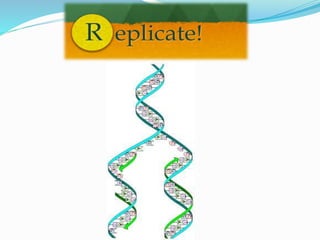
Replication is the is the duplication process by which
a DNA molecule produce exact copies of its own
organism.
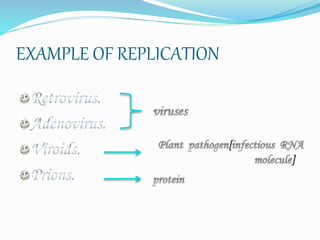
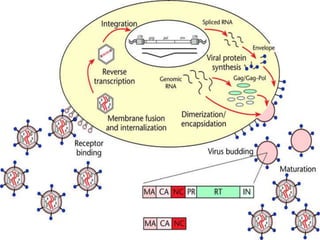
EXAMPLE OF REPLICATION
RETROVIRUS
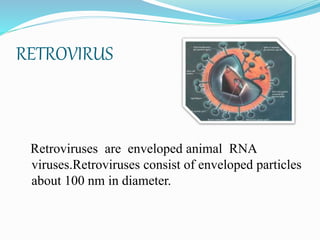
Retroviruses are enveloped animal RNA
viruses.Retroviruses consist of enveloped particles
about 100 nm in diameter.
GENOME STRUCTURE
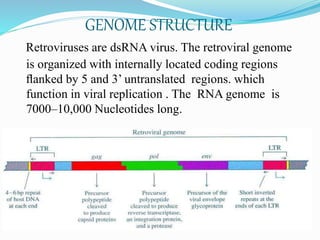
Retroviruses are dsRNA virus. The retroviral genome
is organized with internally located coding regions
flanked by 5 and 3’ untranslated regions. which
function in viral replication . The RNA genome is
7000–10,000 Nucleotides long.
Steps
 Adhesion
 Internalization
 Reverse transcription
 Integration
 Assembly
 Release
ADENOVIRUS
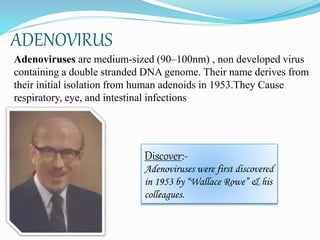
Discover:-
Adenoviruses were first discovered
in 1953 by “Wallace Rowe” & his
colleagues.
Adenoviruses are medium-sized (90–100nm) , non developed virus
containing a double stranded DNA genome. Their name derives from
their initial isolation from human adenoids in 1953.They Cause
respiratory, eye, and intestinal infections
GENOME STRUCTURE
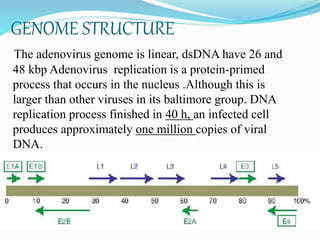
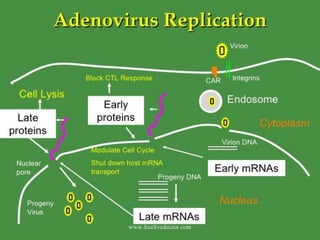
The adenovirus genome is linear, dsDNA have 26 and
48 kbp Adenovirus replication is a protein-primed
process that occurs in the nucleus .Although this is
larger than other viruses in its baltimore group. DNA
replication process finished in 40 h, an infected cell
produces approximately one million copies of viral
DNA.
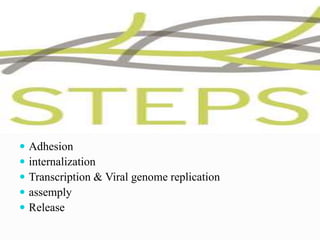
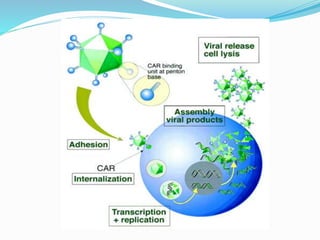
 Adhesion
 internalization
 Transcription & Viral genome replication
 assemply
 Release
VIROIDS
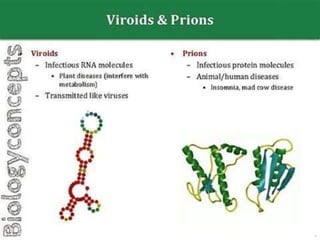
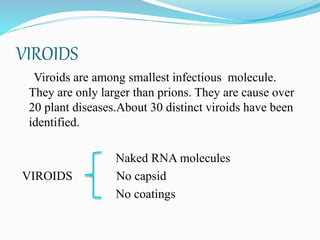
Viroids are among smallest infectious molecule.
They are only larger than prions. They are cause over
20 plant diseases.About 30 distinct viroids have been
identified.
Naked RNA molecules
VIROIDS No capsid
No coatings
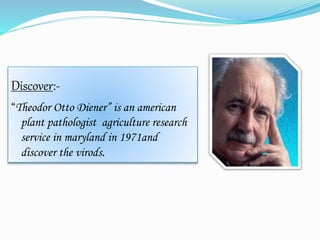
Discover:-
“Theodor Otto Diener” is an american
plant pathologist agriculture research
service in maryland in 1971and
discover the virods.
 They are too small to encode for even a single enzyme
 Don’t know how they cause disease
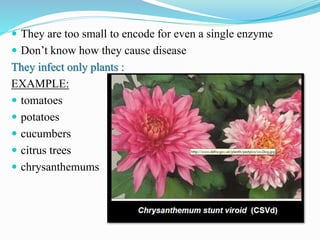
They infect only plants :
EXAMPLE:
 tomatoes
 potatoes
 cucumbers
 citrus trees
 chrysanthemums
The first viroid was identified was the
potato spindle tuber viroid [PSTVd.]
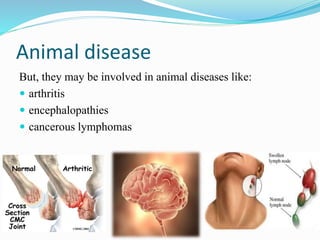
Animal disease
But, they may be involved in animal diseases like:
 arthritis
 encephalopathies
 cancerous lymphomas
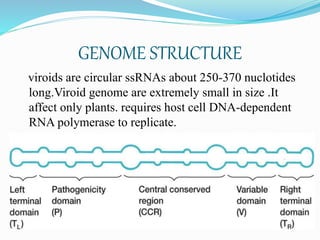
GENOME STRUCTURE
viroids are circular ssRNAs about 250-370 nuclotides
long.Viroid genome are extremely small in size .It
affect only plants. requires host cell DNA-dependent
RNA polymerase to replicate.
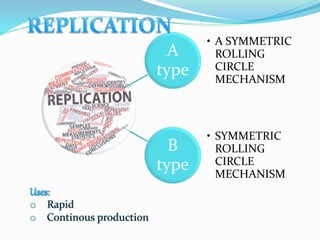
A
type
• A SYMMETRIC
ROLLING
CIRCLE
MECHANISM
B
type
• SYMMETRIC
ROLLING
CIRCLE
MECHANISM
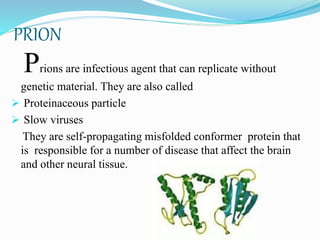
PRION
Prions are infectious agent that can replicate without
genetic material. They are also called
 Proteinaceous particle
 Slow viruses
They are self-propagating misfolded conformer protein that
is responsible for a number of disease that affect the brain
and other neural tissue.
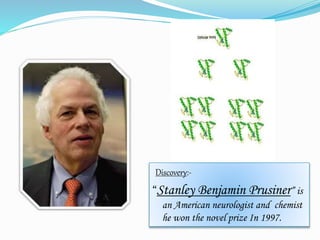
Discovery:-
“Stanley Benjamin Prusiner” is
an American neurologist and chemist
he won the novel prize In 1997.
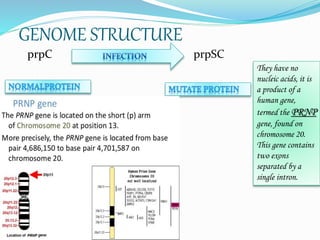
GENOME STRUCTURE
prpC prpSC
They have no
nucleic acids, it is
a product of a
human gene,
termed the PRNP
gene, found on
chromosome 20.
This gene contains
two exons
separated by a
single intron.
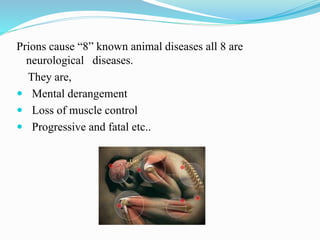
Prions cause “8” known animal diseases all 8 are
neurological diseases.
They are,
 Mental derangement
 Loss of muscle control
 Progressive and fatal etc..
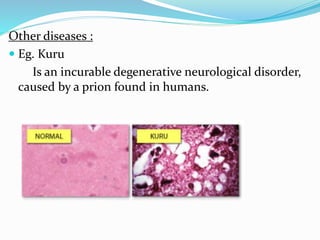
Other diseases :
 Eg. Kuru
Is an incurable degenerative neurological disorder,
caused by a prion found in humans.
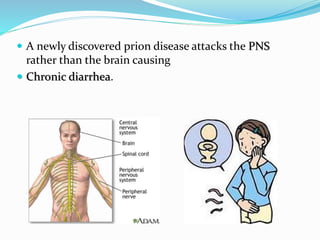
 A newly discovered prion disease attacks the PNS
rather than the brain causing
 Chronic diarrhea.
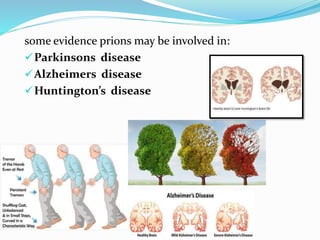
some evidence prions may be involved in:
Parkinsons disease
Alzheimers disease
Huntington’s disease
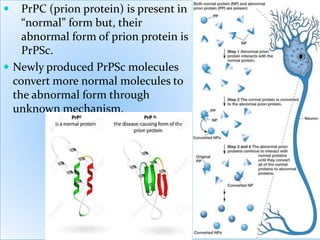
 PrPC (prion protein) is present in
“normal” form but, their
abnormal form of prion protein is
PrPSc.
 Newly produced PrPSc molecules
convert more normal molecules to
the abnormal form through
unknown mechanism.
Neural Loss :
 Evidence suggests that PrPC must be present for
neural degeneration to occur
 Interaction of PrPSc with PrPC may cause PrPC to
crosslink and trigger apoptosis
 PrPC conversion causes neuron loss, PrPSc is the
infectious agent
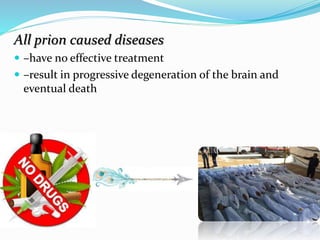
All prion caused diseases
 –have no effective treatment
 –result in progressive degeneration of the brain and
eventual death
Replication

Replication

  • 2.
    REPLICATION Replication is theis the duplication process by which a DNA molecule produce exact copies of its own organism.
  • 3.
  • 4.
    RETROVIRUS Retroviruses are envelopedanimal RNA viruses.Retroviruses consist of enveloped particles about 100 nm in diameter.
  • 5.
    GENOME STRUCTURE Retroviruses aredsRNA virus. The retroviral genome is organized with internally located coding regions flanked by 5 and 3’ untranslated regions. which function in viral replication . The RNA genome is 7000–10,000 Nucleotides long.
  • 7.
    Steps  Adhesion  Internalization Reverse transcription  Integration  Assembly  Release
  • 10.
    ADENOVIRUS Discover:- Adenoviruses were firstdiscovered in 1953 by “Wallace Rowe” & his colleagues. Adenoviruses are medium-sized (90–100nm) , non developed virus containing a double stranded DNA genome. Their name derives from their initial isolation from human adenoids in 1953.They Cause respiratory, eye, and intestinal infections
  • 11.
    GENOME STRUCTURE The adenovirusgenome is linear, dsDNA have 26 and 48 kbp Adenovirus replication is a protein-primed process that occurs in the nucleus .Although this is larger than other viruses in its baltimore group. DNA replication process finished in 40 h, an infected cell produces approximately one million copies of viral DNA.
  • 13.
     Adhesion  internalization Transcription & Viral genome replication  assemply  Release
  • 17.
    VIROIDS Viroids are amongsmallest infectious molecule. They are only larger than prions. They are cause over 20 plant diseases.About 30 distinct viroids have been identified. Naked RNA molecules VIROIDS No capsid No coatings
  • 18.
    Discover:- “Theodor Otto Diener”is an american plant pathologist agriculture research service in maryland in 1971and discover the virods.
  • 19.
     They aretoo small to encode for even a single enzyme  Don’t know how they cause disease They infect only plants : EXAMPLE:  tomatoes  potatoes  cucumbers  citrus trees  chrysanthemums
  • 20.
    The first viroidwas identified was the potato spindle tuber viroid [PSTVd.]
  • 21.
    Animal disease But, theymay be involved in animal diseases like:  arthritis  encephalopathies  cancerous lymphomas
  • 22.
    GENOME STRUCTURE viroids arecircular ssRNAs about 250-370 nuclotides long.Viroid genome are extremely small in size .It affect only plants. requires host cell DNA-dependent RNA polymerase to replicate.
  • 23.
  • 25.
    PRION Prions are infectiousagent that can replicate without genetic material. They are also called  Proteinaceous particle  Slow viruses They are self-propagating misfolded conformer protein that is responsible for a number of disease that affect the brain and other neural tissue.
  • 26.
    Discovery:- “Stanley Benjamin Prusiner”is an American neurologist and chemist he won the novel prize In 1997.
  • 27.
    GENOME STRUCTURE prpC prpSC Theyhave no nucleic acids, it is a product of a human gene, termed the PRNP gene, found on chromosome 20. This gene contains two exons separated by a single intron.
  • 28.
    Prions cause “8”known animal diseases all 8 are neurological diseases. They are,  Mental derangement  Loss of muscle control  Progressive and fatal etc..
  • 29.
    Other diseases : Eg. Kuru Is an incurable degenerative neurological disorder, caused by a prion found in humans.
  • 30.
     A newlydiscovered prion disease attacks the PNS rather than the brain causing  Chronic diarrhea.
  • 31.
    some evidence prionsmay be involved in: Parkinsons disease Alzheimers disease Huntington’s disease
  • 32.
     PrPC (prionprotein) is present in “normal” form but, their abnormal form of prion protein is PrPSc.  Newly produced PrPSc molecules convert more normal molecules to the abnormal form through unknown mechanism.
  • 33.
    Neural Loss : Evidence suggests that PrPC must be present for neural degeneration to occur  Interaction of PrPSc with PrPC may cause PrPC to crosslink and trigger apoptosis  PrPC conversion causes neuron loss, PrPSc is the infectious agent
  • 34.
    All prion causeddiseases  –have no effective treatment  –result in progressive degeneration of the brain and eventual death