MECHANICAL OPERATIONS
TOPIC : RIBBON BLENDER
(SOLID MIXING)
BRANCH : CHEMICAL ENGINEERING
INTRODUCTION ABOUT
MIXING
• Everyone has a general idea what mixing means.
• The goal of any mixing process is to distribute materials with
different characteristics, and usually in differing quantities, as
evenly as possible.
• A new homogeneous material with different properties
results.
• In mixing process there may be solid-solid mixing, solid-
liquid mixing, liquid-liquid mixing etc…………
Mixing of SOLOD with SOLID
 In this mixing solid is mixed with solid.
 In this type of mixing there is mixing of DRY POWDERS.
 Common equipments for this mixing are Ribbon Blender,
Tumbling Mixers, etc……
 In this mixing the power consumption of equipment is very
High
 Their Efficiency OR Effectiveness are lower then other type
of mixing
 Mixing time is also High
Ribbon Blender
BASIC INTRODUCTION
1) Flexible material selection:
 Material can be chosen from carbo steel, manganese steel,
ss304, 316L and 321; besides, different material can also be
used in combination.
 Material is different between the part contact with the raw
material and the parts don’t contact with the raw material.
BASIC INTRODUCTION
2) Reliable driven unit
 Options for motor: general motors, explosion-proof motors,
variable frequency motor, high efficiency and energy saving
motor.
 Commonly used reducers: R-series, K-series, and F-series
gear box; cycloid reducer, universal gear reducer, planetary
gear reducer.
BASIC INTRODUCTION
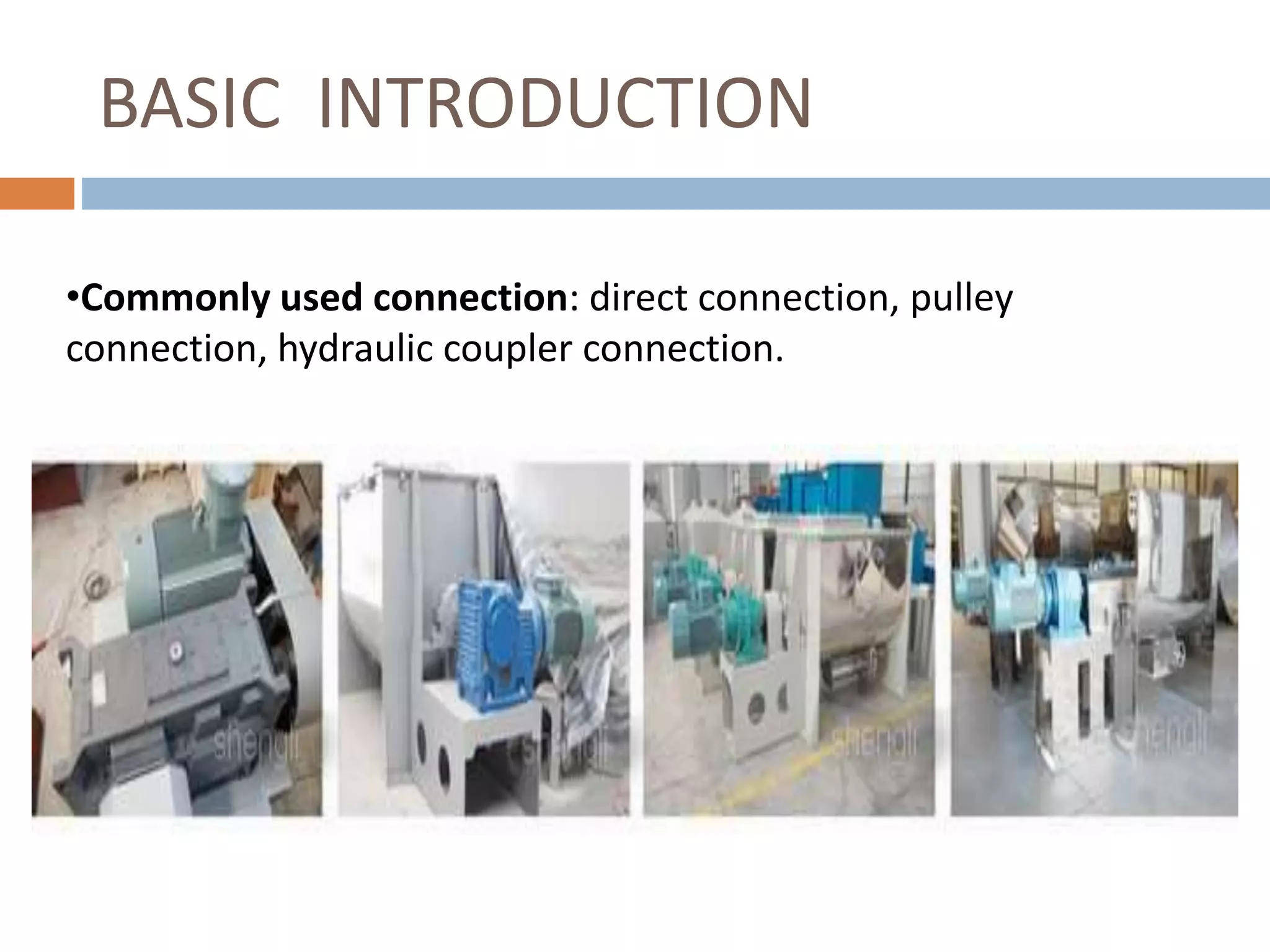
•Commonly used connection: direct connection, pulley
connection, hydraulic coupler connection.
BASIC INTRODUCTION
3) High efficiency mixing unit
 Materials commonly mixed are: different kinds of powder to
be mixed with each other, batches mixing for the same
material, powder with a small quantity of liquid, liquid with
some powder, like slurry, thickening or diluting slurry, granule
with powder, granule with granule, agglomerated material
breaking and mixing, and cooling or heating.
 The main shaft agitator could be: inner and outer ribbon,
paddle and ribbon, disconnected ribbon, and shaver-shaped
agitator.
BASIC INTRODUCTION
 Ribbon Blades
BASIC INTRODUCTION
4) Excellent discharging unit
 The drive types of valve are Manual, pneumatic, and electric.
 Valves for consideration: powder spherical valve, cylinder
valve, plum-blossom dislocation valve, butterfly valve, rotary
valve etc.
BASIC INTRODUCTION
5) Various inlets
 Various inlets on the top cover of the barrel can be designed
according to different situations.
 They can be used as man hole, cleaning door, feeding hole,
vent, and dust colleting hole.
 The top cover can be designed as fully-opened lid for easy
cleaning.
BASIC INTRODUCTION
6) Powerful auxiliary components
 Different heat medium requires different jacket, it can be
used for heating and cooling, while, the temperature should
be within 250 Celsius degree.
 If a small quantity of liquid is required during mixing, spraying
or atomizing unit is necessary in order to mix the liquid
evenly with the main ingredient.
 The liquid-adding system is basically composed by the three
parts: pressure source, liquid storage pot and spraying
nozzles.
BASIC INTRODUCTION
7) Tight shaft sealing
 Three types of main shaft sealing for mixer: packing sealing,
combined type air-purged sealing, mechanical sealing are
used for granule, powder, micron grade powder, liquid, and
slurry material.
Construction and Operation
 U-shaped horizontal trough
 A specially designed Double Helical Ribbon Agitator rotating
within.
 It provides a triple mixing action ensuring fast, efficient
blending.
 A drive system comprised of a motor, gearbox, and couplings.
 They are generally powered by 10 HP to 15 HP motor for 1000
kg of product mass to be blended.
 The specific power range from 3 to 12 kW/m3 depending on
the products to be blended.
Construction and Operation
 The area where the shaft exits the container is provided with a
sealing arrangement
 The charging of material is generally through nozzles or feed-
hoppers
 The inlet cover also provides maintenance and cleaning access
to the inside of the blender
 An external jacket can also be provided for heating or cooling
of product material
Construction and Operation
 The materials to be blended are loaded into the blender,
typically filling it to between 40 and 70 percent of the total
volume of the container.
 Up to the level of the outer ribbon’s tip.
 It is designed to operate at a peripheral speed (also known as
tip speed) of approximately 100 metres / minute
 A spray pipe for adding liquids can be mounted above the
ribbons.
Construction and Operation
 For materials that tend to form agglomerates, high speed
choppers can be provided for disintegration of the
agglomerates.
 The motion of the ribbons near the vessel walls can in result
in “pinch" points, or regions of high shear and compression,
which may damage materials and cause attrition. In some
case this can also lead to friction and heat generation
resulting in product degradation.
Working
 The outer ribbons of the agitator move the material from
the ends to the center while the inner ribbons move the
material from the center to ends.
 Radial movement is achieved because of the rotational
motion of the ribbons.
 The difference in the peripheral speeds of the outer and inner
ribbons results in axial movement of the material along the
horizontal axis of the blender.
 As a result of the radial and the counter-current axial
movement, homogenous blending is achieved in short time.
Working
 Blending is achieved within 15 to 20 minutes of start-up with
a 90 to 95 percent or better homogeneity.
 The particle size and its bulk density have the strongest
influence on the mixing efficiency of the ribbon blender.
 Ingredients with similar particle size and bulk densities tend
to mix faster as compared to ingredients with variation in
these attributes.
Working
 After blending, the material is discharged from a discharge
valve located at the bottom of the trough.
 The discharge valves can be slide-gate, butterfly, flush
bottom, spherical , etc……
 The operation of the valves can be manual or pneumatically
actuated.
 In a ribbon blender the material is discharged by rotation of
the ribbon agitator.
Working
 It is difficult to achieve 100% discharge in the ribbon blender.
 Also, higher clearances between the external periphery of the
outer ribbon and the container can result in unmixed spots at
the trough bottom and can lead to discharge problems.
Applications
 Ribbon blenders can be designed to operate in both batch
and continuous modes.
 Batch type blenders can be built up to capacities of 50 m3.
 The ribbon blender’s versatility for blending solids combined
with it ability to perform heating, cooling, coating, and other
processes make it a very popular blender.
Applications
 The following are the applications of
the Ribbon Blender:
1) Blending large volumes of dry solids.
2) Dry powder to wet phase mixing.
3) Mixing of bulk drugs, chemicals, and cosmetic powders.
4) Dry Blending of capsule formulations.
5) Lubrication of dry granules in large quantity.
6) Heating, cooling, and drying of materials.
7) Coating solid particles with small amounts of liquids to
produce formulations.
01) Abrasives
02) Engineered plastic resins
03) Pesticides and herbicides
04) Animal feeds
05) Epoxy resins
06) Pet foods
07) Bakery premixes
08) Eye shadow
09) Pharmaceuticals
10) Bird seeds
11) Face powders
12) Pigments Cake mixes
13) Instant drink blends
14) Talcum powders
15) Fertilizers
16) Plastic powders
17) Carbon black
18) Fire retardants
19) Polyethylene
20) Chemicals
21) Gypsum
22) PVC compounding
23) Cleaning compounds
24) Instant breakfast cereals
25) Spice blends
26) Dietary supplements
27) Dried food products
28) Laundry detergents
Materials commonly blended in the ribbon blender are
as follows:
Ribbon Blender (Construction and Working)

Ribbon Blender (Construction and Working)

  • 1.
    MECHANICAL OPERATIONS TOPIC :RIBBON BLENDER (SOLID MIXING) BRANCH : CHEMICAL ENGINEERING
  • 2.
    INTRODUCTION ABOUT MIXING • Everyonehas a general idea what mixing means. • The goal of any mixing process is to distribute materials with different characteristics, and usually in differing quantities, as evenly as possible. • A new homogeneous material with different properties results. • In mixing process there may be solid-solid mixing, solid- liquid mixing, liquid-liquid mixing etc…………
  • 3.
    Mixing of SOLODwith SOLID  In this mixing solid is mixed with solid.  In this type of mixing there is mixing of DRY POWDERS.  Common equipments for this mixing are Ribbon Blender, Tumbling Mixers, etc……  In this mixing the power consumption of equipment is very High  Their Efficiency OR Effectiveness are lower then other type of mixing  Mixing time is also High
  • 4.
  • 5.
    BASIC INTRODUCTION 1) Flexiblematerial selection:  Material can be chosen from carbo steel, manganese steel, ss304, 316L and 321; besides, different material can also be used in combination.  Material is different between the part contact with the raw material and the parts don’t contact with the raw material.
  • 6.
    BASIC INTRODUCTION 2) Reliabledriven unit  Options for motor: general motors, explosion-proof motors, variable frequency motor, high efficiency and energy saving motor.  Commonly used reducers: R-series, K-series, and F-series gear box; cycloid reducer, universal gear reducer, planetary gear reducer.
  • 7.
    BASIC INTRODUCTION •Commonly usedconnection: direct connection, pulley connection, hydraulic coupler connection.
  • 8.
    BASIC INTRODUCTION 3) Highefficiency mixing unit  Materials commonly mixed are: different kinds of powder to be mixed with each other, batches mixing for the same material, powder with a small quantity of liquid, liquid with some powder, like slurry, thickening or diluting slurry, granule with powder, granule with granule, agglomerated material breaking and mixing, and cooling or heating.  The main shaft agitator could be: inner and outer ribbon, paddle and ribbon, disconnected ribbon, and shaver-shaped agitator.
  • 9.
  • 10.
    BASIC INTRODUCTION 4) Excellentdischarging unit  The drive types of valve are Manual, pneumatic, and electric.  Valves for consideration: powder spherical valve, cylinder valve, plum-blossom dislocation valve, butterfly valve, rotary valve etc.
  • 11.
    BASIC INTRODUCTION 5) Variousinlets  Various inlets on the top cover of the barrel can be designed according to different situations.  They can be used as man hole, cleaning door, feeding hole, vent, and dust colleting hole.  The top cover can be designed as fully-opened lid for easy cleaning.
  • 12.
    BASIC INTRODUCTION 6) Powerfulauxiliary components  Different heat medium requires different jacket, it can be used for heating and cooling, while, the temperature should be within 250 Celsius degree.  If a small quantity of liquid is required during mixing, spraying or atomizing unit is necessary in order to mix the liquid evenly with the main ingredient.  The liquid-adding system is basically composed by the three parts: pressure source, liquid storage pot and spraying nozzles.
  • 13.
    BASIC INTRODUCTION 7) Tightshaft sealing  Three types of main shaft sealing for mixer: packing sealing, combined type air-purged sealing, mechanical sealing are used for granule, powder, micron grade powder, liquid, and slurry material.
  • 14.
    Construction and Operation U-shaped horizontal trough  A specially designed Double Helical Ribbon Agitator rotating within.  It provides a triple mixing action ensuring fast, efficient blending.  A drive system comprised of a motor, gearbox, and couplings.  They are generally powered by 10 HP to 15 HP motor for 1000 kg of product mass to be blended.  The specific power range from 3 to 12 kW/m3 depending on the products to be blended.
  • 15.
    Construction and Operation The area where the shaft exits the container is provided with a sealing arrangement  The charging of material is generally through nozzles or feed- hoppers  The inlet cover also provides maintenance and cleaning access to the inside of the blender  An external jacket can also be provided for heating or cooling of product material
  • 16.
    Construction and Operation The materials to be blended are loaded into the blender, typically filling it to between 40 and 70 percent of the total volume of the container.  Up to the level of the outer ribbon’s tip.  It is designed to operate at a peripheral speed (also known as tip speed) of approximately 100 metres / minute  A spray pipe for adding liquids can be mounted above the ribbons.
  • 17.
    Construction and Operation For materials that tend to form agglomerates, high speed choppers can be provided for disintegration of the agglomerates.  The motion of the ribbons near the vessel walls can in result in “pinch" points, or regions of high shear and compression, which may damage materials and cause attrition. In some case this can also lead to friction and heat generation resulting in product degradation.
  • 18.
    Working  The outerribbons of the agitator move the material from the ends to the center while the inner ribbons move the material from the center to ends.  Radial movement is achieved because of the rotational motion of the ribbons.  The difference in the peripheral speeds of the outer and inner ribbons results in axial movement of the material along the horizontal axis of the blender.  As a result of the radial and the counter-current axial movement, homogenous blending is achieved in short time.
  • 19.
    Working  Blending isachieved within 15 to 20 minutes of start-up with a 90 to 95 percent or better homogeneity.  The particle size and its bulk density have the strongest influence on the mixing efficiency of the ribbon blender.  Ingredients with similar particle size and bulk densities tend to mix faster as compared to ingredients with variation in these attributes.
  • 20.
    Working  After blending,the material is discharged from a discharge valve located at the bottom of the trough.  The discharge valves can be slide-gate, butterfly, flush bottom, spherical , etc……  The operation of the valves can be manual or pneumatically actuated.  In a ribbon blender the material is discharged by rotation of the ribbon agitator.
  • 21.
    Working  It isdifficult to achieve 100% discharge in the ribbon blender.  Also, higher clearances between the external periphery of the outer ribbon and the container can result in unmixed spots at the trough bottom and can lead to discharge problems.
  • 22.
    Applications  Ribbon blenderscan be designed to operate in both batch and continuous modes.  Batch type blenders can be built up to capacities of 50 m3.  The ribbon blender’s versatility for blending solids combined with it ability to perform heating, cooling, coating, and other processes make it a very popular blender.
  • 23.
    Applications  The followingare the applications of the Ribbon Blender: 1) Blending large volumes of dry solids. 2) Dry powder to wet phase mixing. 3) Mixing of bulk drugs, chemicals, and cosmetic powders. 4) Dry Blending of capsule formulations. 5) Lubrication of dry granules in large quantity. 6) Heating, cooling, and drying of materials. 7) Coating solid particles with small amounts of liquids to produce formulations.
  • 24.
    01) Abrasives 02) Engineeredplastic resins 03) Pesticides and herbicides 04) Animal feeds 05) Epoxy resins 06) Pet foods 07) Bakery premixes 08) Eye shadow 09) Pharmaceuticals 10) Bird seeds 11) Face powders 12) Pigments Cake mixes 13) Instant drink blends 14) Talcum powders 15) Fertilizers 16) Plastic powders 17) Carbon black 18) Fire retardants 19) Polyethylene 20) Chemicals 21) Gypsum 22) PVC compounding 23) Cleaning compounds 24) Instant breakfast cereals 25) Spice blends 26) Dietary supplements 27) Dried food products 28) Laundry detergents Materials commonly blended in the ribbon blender are as follows: