 Powered, aerial vehicles
 Can fly autonomously or be piloted remotely
 Can carry weapons or surveillance
equipment
 Drones are more formally known as UAV.
 UAV stands for Unmanned Areal Vehicle.
 UAV is an aircraft without a human pilot on board.
 It is controlled by a human on ground via a remote
device.
 It can also be controlled autonomously by using
computers.
 The autonomous control is increasingly being
employed. The reason being the threat from human
errors.
BIRTH OF UAV
The first attempt of developing UAV was by A.M.LAW named
“Aerial target” in 1916
First UAV was developed in 1959
It was developed due to fear of loosing pilots
It was first used in war applications in august 2nd & 4th 1964(2nd
world war).
It was used by US Navy
FEATURES OF DRONE
 Advanced communication system(radio waves 2.3Gz to 5Gz)
 Advanced weapon sensor
 Enhanced Navigation system
 Collision avoidance system
 Geo fencing
 Delivery
 Security
 Watch guard
 Babysitter
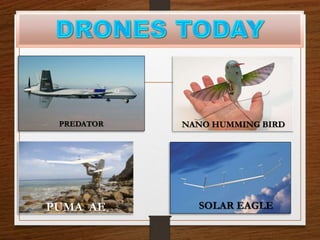
PREDATOR NANO HUMMING BIRD
PUMA AE SOLAR EAGLE
NEXT GENERATIONS
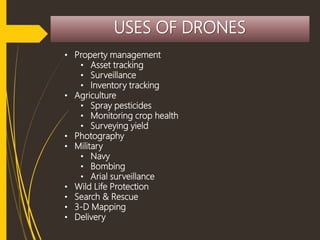
USES OF DRONES
• Property management
• Asset tracking
• Surveillance
• Inventory tracking
• Agriculture
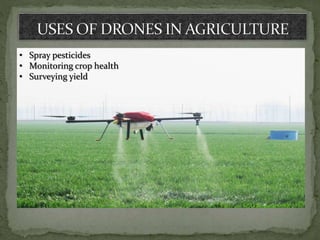
• Spray pesticides
• Monitoring crop health
• Surveying yield
• Photography
• Military
• Navy
• Bombing
• Arial surveillance
• Wild Life Protection
• Search & Rescue
• 3-D Mapping
• Delivery
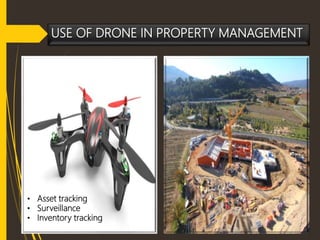
USE OF DRONE IN PROPERTY MANAGEMENT
• Asset tracking
• Surveillance
• Inventory tracking
• Spray pesticides
• Monitoring crop health
• Surveying yield
DRONES USED IN PHOTOGRAPHY
DRONES USED IN MILITARY FOR
BOMBING
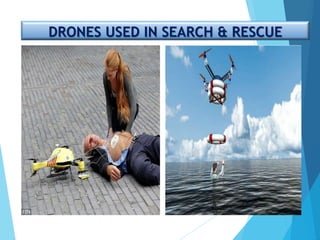
DRONES USED IN SEARCH & RESCUE
DRONES USED FOR 3-D
MAPPING
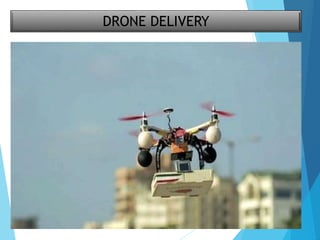
DRONE DELIVERY
• Saves Lives: They reduce putting military personnel in harm in combat.
• Low Cost: They are significantly cheaper to purchase, fuel, and maintain
• Low Risk: Since drones are smaller and can fly lower than traditional airplanes,
there is less risk to military hardware.
• Operational Hours: Without a human pilot, drones can stay in operation for
significantly longer hours of operation without fatigue.
• Accuracy: Drones can have more pinpoint accuracy from greater distances, thus
reducing collateral damage to civilians and infrastructure.
• Spying: Years before drones were used in combat; drones have proven to increase
surveillance and general military intelligence.
• Limited Abilities: They cannot communicate with civilians for more detailed
intelligence, cannot capture surrendering military personnel, abandoned
hardware, or military bases.
• Civilian Losses: Drone warfare often causes collateral damages in civilian lives
and property.
• Too Easy: By making drone warfare very similar to video games, drone warfare
makes combat too easy by diminishing ethical decisions.
• Take Over: Finally, the worst case scenario is when drones or a fleet of drones
have been commandeered or taken control by the enemy. While security
measures help make this possibility more difficult, it will never be impossible.1
 Currently, the expansion of the drone
market is inhibited
 Due to the absence of an adequate
regulatory framework in most
countries
 They need to obtain individual
authorizations from each country
where manufacturers would like to
sell or where providers would like to
operate.
 The development of drones for civil
applications requires ensuring that
none of them could represent a
threat to citizen’s privacy or physical
integrity
FUTURE OF DRONE …….!
THANK YOU

Drones and all about it seminar

  • 2.
     Powered, aerialvehicles  Can fly autonomously or be piloted remotely  Can carry weapons or surveillance equipment  Drones are more formally known as UAV.
  • 3.
     UAV standsfor Unmanned Areal Vehicle.  UAV is an aircraft without a human pilot on board.  It is controlled by a human on ground via a remote device.  It can also be controlled autonomously by using computers.  The autonomous control is increasingly being employed. The reason being the threat from human errors.
  • 4.
    BIRTH OF UAV Thefirst attempt of developing UAV was by A.M.LAW named “Aerial target” in 1916 First UAV was developed in 1959 It was developed due to fear of loosing pilots It was first used in war applications in august 2nd & 4th 1964(2nd world war). It was used by US Navy
  • 5.
    FEATURES OF DRONE Advanced communication system(radio waves 2.3Gz to 5Gz)  Advanced weapon sensor  Enhanced Navigation system  Collision avoidance system  Geo fencing  Delivery  Security  Watch guard  Babysitter
  • 6.
    PREDATOR NANO HUMMINGBIRD PUMA AE SOLAR EAGLE
  • 7.
  • 8.
    USES OF DRONES •Property management • Asset tracking • Surveillance • Inventory tracking • Agriculture • Spray pesticides • Monitoring crop health • Surveying yield • Photography • Military • Navy • Bombing • Arial surveillance • Wild Life Protection • Search & Rescue • 3-D Mapping • Delivery
  • 9.
    USE OF DRONEIN PROPERTY MANAGEMENT • Asset tracking • Surveillance • Inventory tracking
  • 10.
    • Spray pesticides •Monitoring crop health • Surveying yield
  • 11.
    DRONES USED INPHOTOGRAPHY
  • 12.
    DRONES USED INMILITARY FOR BOMBING
  • 14.
    DRONES USED INSEARCH & RESCUE
  • 15.
    DRONES USED FOR3-D MAPPING
  • 16.
  • 17.
    • Saves Lives:They reduce putting military personnel in harm in combat. • Low Cost: They are significantly cheaper to purchase, fuel, and maintain • Low Risk: Since drones are smaller and can fly lower than traditional airplanes, there is less risk to military hardware. • Operational Hours: Without a human pilot, drones can stay in operation for significantly longer hours of operation without fatigue. • Accuracy: Drones can have more pinpoint accuracy from greater distances, thus reducing collateral damage to civilians and infrastructure. • Spying: Years before drones were used in combat; drones have proven to increase surveillance and general military intelligence.
  • 18.
    • Limited Abilities:They cannot communicate with civilians for more detailed intelligence, cannot capture surrendering military personnel, abandoned hardware, or military bases. • Civilian Losses: Drone warfare often causes collateral damages in civilian lives and property. • Too Easy: By making drone warfare very similar to video games, drone warfare makes combat too easy by diminishing ethical decisions. • Take Over: Finally, the worst case scenario is when drones or a fleet of drones have been commandeered or taken control by the enemy. While security measures help make this possibility more difficult, it will never be impossible.1
  • 19.
     Currently, theexpansion of the drone market is inhibited  Due to the absence of an adequate regulatory framework in most countries  They need to obtain individual authorizations from each country where manufacturers would like to sell or where providers would like to operate.  The development of drones for civil applications requires ensuring that none of them could represent a threat to citizen’s privacy or physical integrity
  • 21.
    FUTURE OF DRONE…….!
  • 22.