Emergent Reader
and Emergent
Writer
Characteristics of An
Emergent Writer
• Emergent Reading – pertains
to the first stage in a child’s
growth toward literacy.
Particularly , this stage relates to
the beginning experiences or
the child’s first experiences with
print in the home and continues
through early years of formal
schooling.
• However, this reading
behavior does not begin at
a particular age but
emerges continually, thus
the term called emergent
reading.
Harris and Hodges (1981)

• Refer to this period of
acquiring the specific skills
and abilities that allow reading
to take place as preparedness
allows him/her to cope with a
learning task.
This is significantly determined by a
complex pattern of:

• Intellectual
• Motivational

• Maturational
• Experiential factors
Further, reading readiness is viewed as
a set of:

• Social

• Emotional

• Physical
• Cognitive competencies
• Since the beginning of emergent
reading is not determined at a
particular age, it is helpful to
recognize the various stages of
reading development that a child
undergoes and to monitor his/her
progress through these stages.
• Children pass through stages at
different levels of maturity. Similarity,
not all children pass through all
stages of reading, all at the same
time and in the same order. Most
significantly, each child is identified as
an individual emergent reader
developing at his/her own pace and
rate.
Stages of Reading Process
• A number of models on reading
development have been designed
and have guided reading instruction
in identifying the stages of reading
where a particular child is in and
where children in a heterogeneous
class belong.
• The basic and progressive
stages of reading generally
serve as a guide in
determining the reading skills
of a particular child or of the
whole class.
• However, it is important to note that,
not all children pass through the
same stages simultaneously and
possess all the same skills.
Therefore, an individual reader
maybe identified in terms of his
readiness, skills and own pace.
• Marie Clay (1991) and
Fountas and Pinnell (2001)
have noted five main stages of
literacy development that
relate to both reading and
writing.
Stage 1 – Emergent Readers
• The age of emergent readers generally
ranges from 2-7 years old. They begin
to familiarize themselves with the
concepts of print related to
directionality, one-to-one
correspondence between the spoken
and written word, and the value of
picture clues to the meaning of a story.
• They also develop an understanding
that the printed word carries the
meaning of a story.
• They begin to make text-to-world
connections and may be able to
extend on what is written on the
page.
Stage 2 – Early Readers

• Picking up from the concepts
attained as an emergent
reader, early readers now
begin to rely more heavily on
the printed text than on the
pictures in a book.
• Most often, they begin to developed
word recognition strategies such as:
• Monitoring
• Searching
• Cross-checking
• Self-correction.
• This type of readers also begins to develop a
data bank of sight words that allows them to
read with increased speed as they are read
more often in phrases rather than single words.
• As a general rule, early readers are between the
ages of 5-7. Because readers develop at varying
rates, a teacher may have a class containing
both emergent and early readers as well as
readers in the next development stage, the
transitional reader.
Stage 3- Transitional Readers

Transitional readers make the
leap into fluent reading as they are
generally able to read in meaningful
phrases with comfortable pace and
appropriate voice intonation.
Transitional readers are able to read
more lengthy texts with the little
reliance on pictures for text meaning,
these readers tend to range from5 to
7 years.
Stage 4- Self-Extending Readers
Readers, progress into reading
independence in the fourth developmental stage.
They often read a variety of textual genres and use
reading as a tool for gaining new knowledge or
building upon existing knowledge. This type of
readers are able to read more complex texts and
begin to read for variety of purposes. Often these
readers range in age from 6 to 9 years of age.
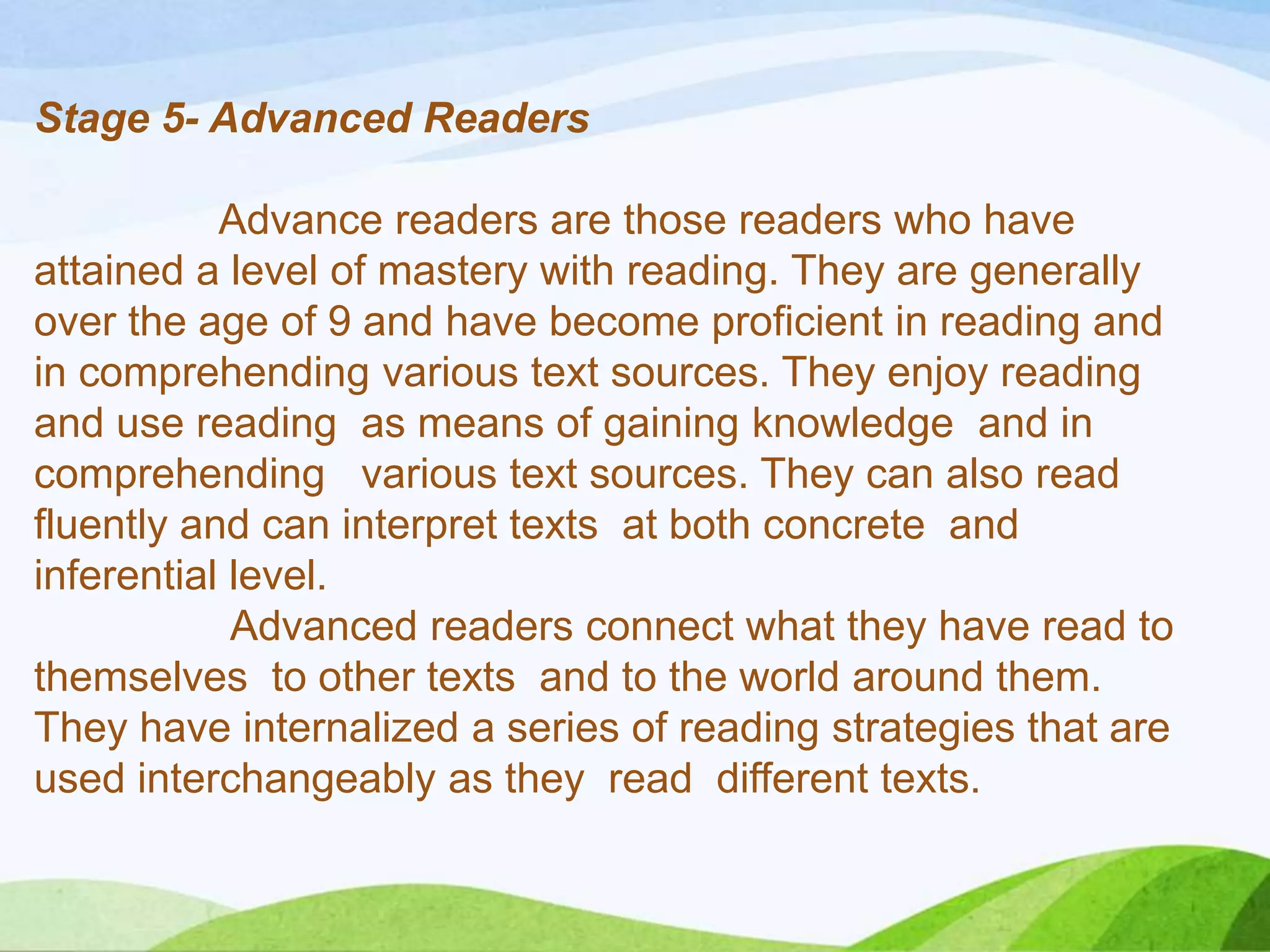
Stage 5- Advanced Readers
Advance readers are those readers who have
attained a level of mastery with reading. They are generally
over the age of 9 and have become proficient in reading and
in comprehending various text sources. They enjoy reading
and use reading as means of gaining knowledge and in
comprehending various text sources. They can also read
fluently and can interpret texts at both concrete and
inferential level.
Advanced readers connect what they have read to
themselves to other texts and to the world around them.
They have internalized a series of reading strategies that are
used interchangeably as they read different texts.
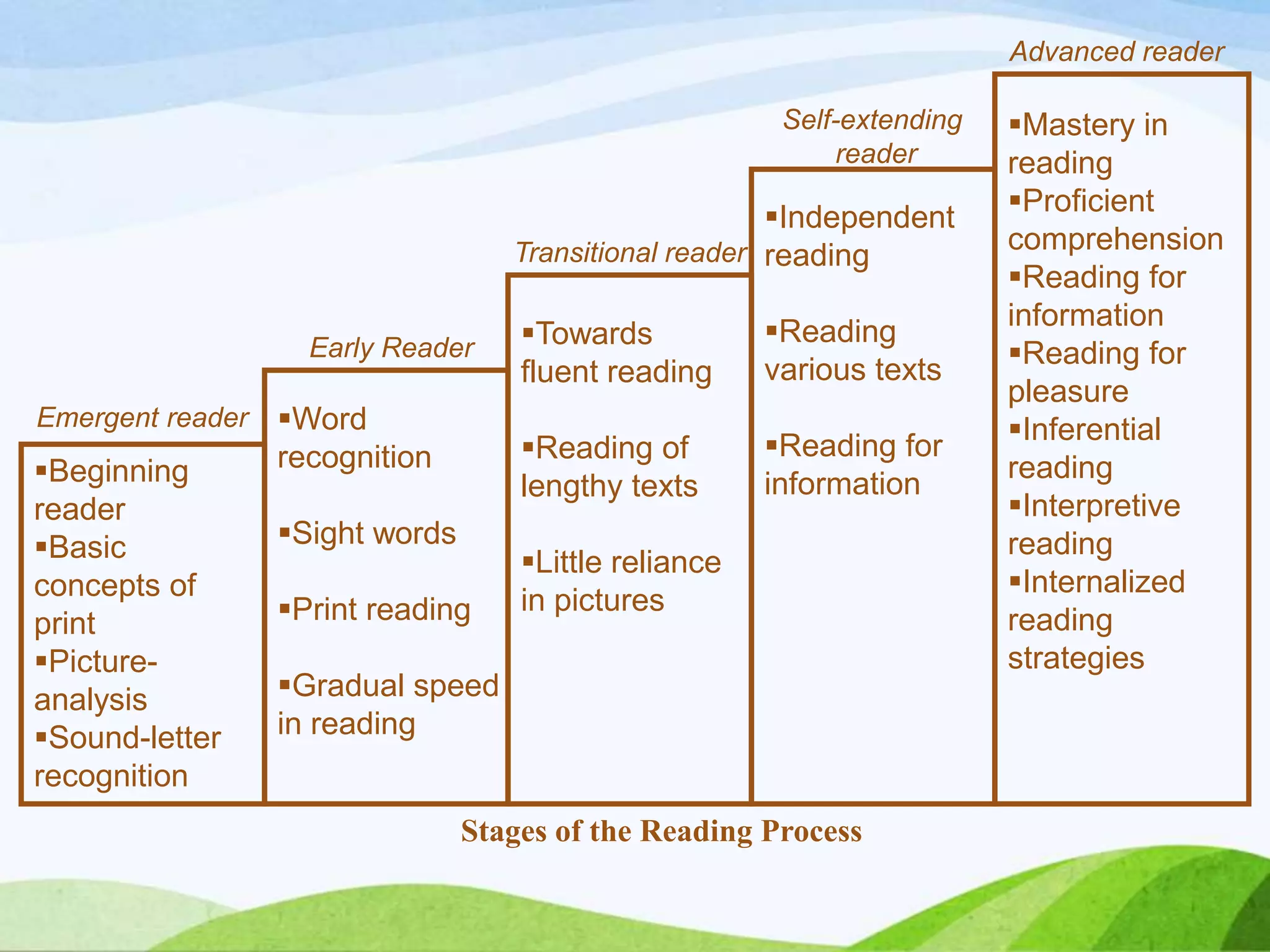
Advanced reader
Self-extending
reader

Independent
Transitional reader reading

Emergent reader

Beginning
reader
Basic
concepts of
print
Pictureanalysis
Sound-letter
recognition

Word
recognition

Sight words
Print reading

Towards
fluent reading

Reading
various texts

Reading of
lengthy texts

Early Reader

Reading for
information

Little reliance
in pictures

Gradual speed
in reading
Stages of the Reading Process

Mastery in
reading
Proficient
comprehension
Reading for
information
Reading for
pleasure
Inferential
reading
Interpretive
reading
Internalized
reading
strategies
Factors that influence
the development of an
Emergent Reader
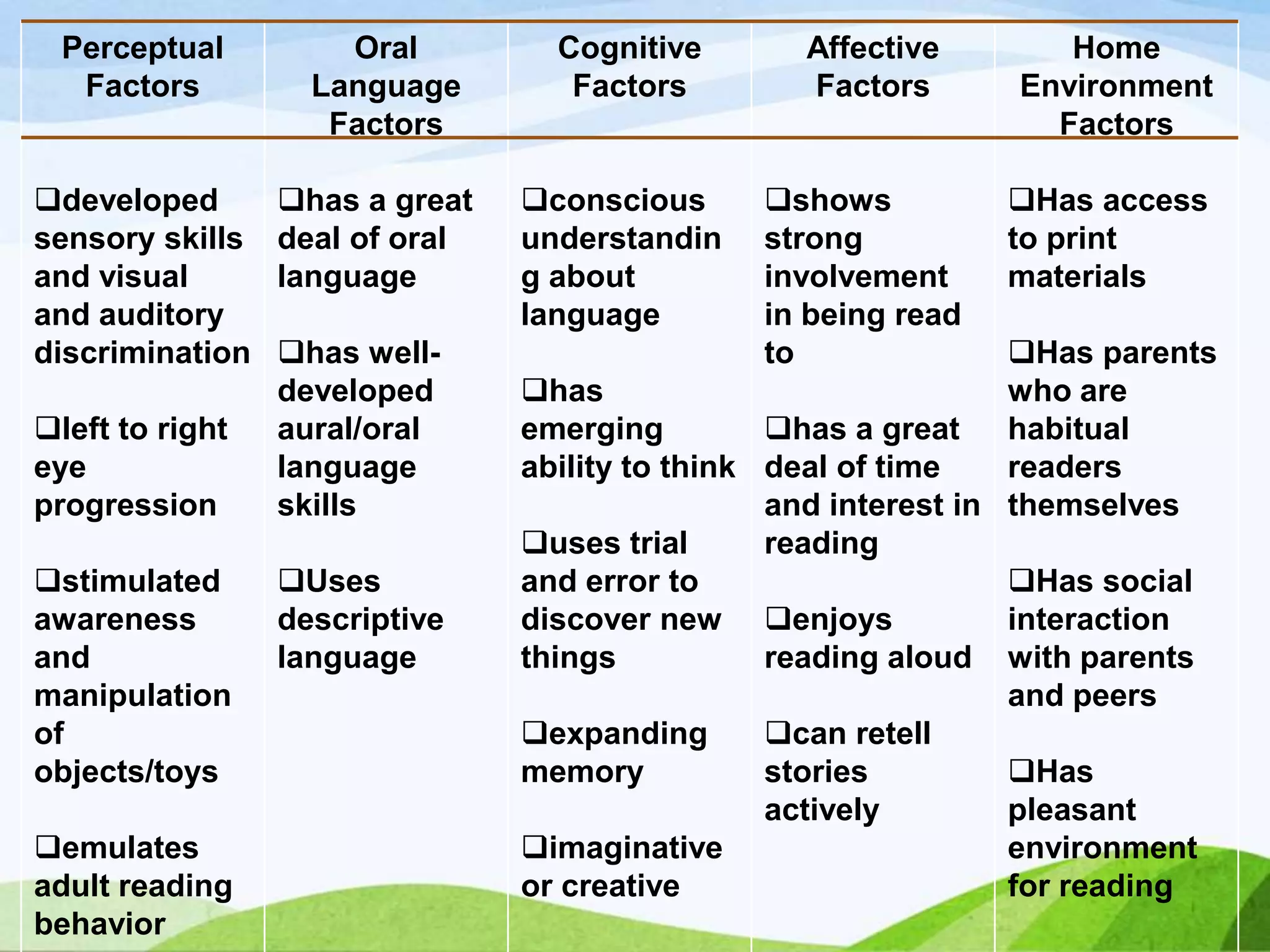
Perceptual
Factors
developed
sensory skills
and visual
and auditory
discrimination
left to right
eye
progression
stimulated
awareness
and
manipulation
of
objects/toys
emulates
adult reading
behavior

Oral
Language
Factors

Cognitive
Factors

Affective
Factors

has a great
deal of oral
language

conscious
understandin
g about
language

has welldeveloped
aural/oral
language
skills

Has parents
has
who are
emerging
has a great
habitual
ability to think deal of time
readers
and interest in themselves
uses trial
reading
and error to
Has social
discover new enjoys
interaction
things
reading aloud with parents
and peers
expanding
can retell
memory
stories
Has
actively
pleasant
imaginative
environment
or creative
for reading

Uses
descriptive
language

shows
strong
involvement
in being read
to

Home
Environment
Factors
Has access
to print
materials

Characteristics of emergent reader

  • 1.
  • 2.
    Characteristics of An EmergentWriter • Emergent Reading – pertains to the first stage in a child’s growth toward literacy.
  • 3.
    Particularly , thisstage relates to the beginning experiences or the child’s first experiences with print in the home and continues through early years of formal schooling.
  • 4.
    • However, thisreading behavior does not begin at a particular age but emerges continually, thus the term called emergent reading.
  • 5.
    Harris and Hodges(1981) • Refer to this period of acquiring the specific skills and abilities that allow reading to take place as preparedness allows him/her to cope with a learning task.
  • 6.
    This is significantlydetermined by a complex pattern of: • Intellectual • Motivational • Maturational • Experiential factors
  • 7.
    Further, reading readinessis viewed as a set of: • Social • Emotional • Physical • Cognitive competencies
  • 8.
    • Since thebeginning of emergent reading is not determined at a particular age, it is helpful to recognize the various stages of reading development that a child undergoes and to monitor his/her progress through these stages.
  • 9.
    • Children passthrough stages at different levels of maturity. Similarity, not all children pass through all stages of reading, all at the same time and in the same order. Most significantly, each child is identified as an individual emergent reader developing at his/her own pace and rate.
  • 10.
    Stages of ReadingProcess • A number of models on reading development have been designed and have guided reading instruction in identifying the stages of reading where a particular child is in and where children in a heterogeneous class belong.
  • 11.
    • The basicand progressive stages of reading generally serve as a guide in determining the reading skills of a particular child or of the whole class.
  • 12.
    • However, itis important to note that, not all children pass through the same stages simultaneously and possess all the same skills. Therefore, an individual reader maybe identified in terms of his readiness, skills and own pace.
  • 13.
    • Marie Clay(1991) and Fountas and Pinnell (2001) have noted five main stages of literacy development that relate to both reading and writing.
  • 14.
    Stage 1 –Emergent Readers • The age of emergent readers generally ranges from 2-7 years old. They begin to familiarize themselves with the concepts of print related to directionality, one-to-one correspondence between the spoken and written word, and the value of picture clues to the meaning of a story.
  • 15.
    • They alsodevelop an understanding that the printed word carries the meaning of a story. • They begin to make text-to-world connections and may be able to extend on what is written on the page.
  • 16.
    Stage 2 –Early Readers • Picking up from the concepts attained as an emergent reader, early readers now begin to rely more heavily on the printed text than on the pictures in a book.
  • 17.
    • Most often,they begin to developed word recognition strategies such as: • Monitoring • Searching • Cross-checking • Self-correction.
  • 18.
    • This typeof readers also begins to develop a data bank of sight words that allows them to read with increased speed as they are read more often in phrases rather than single words. • As a general rule, early readers are between the ages of 5-7. Because readers develop at varying rates, a teacher may have a class containing both emergent and early readers as well as readers in the next development stage, the transitional reader.
  • 19.
    Stage 3- TransitionalReaders Transitional readers make the leap into fluent reading as they are generally able to read in meaningful phrases with comfortable pace and appropriate voice intonation. Transitional readers are able to read more lengthy texts with the little reliance on pictures for text meaning, these readers tend to range from5 to 7 years.
  • 20.
    Stage 4- Self-ExtendingReaders Readers, progress into reading independence in the fourth developmental stage. They often read a variety of textual genres and use reading as a tool for gaining new knowledge or building upon existing knowledge. This type of readers are able to read more complex texts and begin to read for variety of purposes. Often these readers range in age from 6 to 9 years of age.
  • 21.
    Stage 5- AdvancedReaders Advance readers are those readers who have attained a level of mastery with reading. They are generally over the age of 9 and have become proficient in reading and in comprehending various text sources. They enjoy reading and use reading as means of gaining knowledge and in comprehending various text sources. They can also read fluently and can interpret texts at both concrete and inferential level. Advanced readers connect what they have read to themselves to other texts and to the world around them. They have internalized a series of reading strategies that are used interchangeably as they read different texts.
  • 22.
    Advanced reader Self-extending reader Independent Transitional readerreading Emergent reader Beginning reader Basic concepts of print Pictureanalysis Sound-letter recognition Word recognition Sight words Print reading Towards fluent reading Reading various texts Reading of lengthy texts Early Reader Reading for information Little reliance in pictures Gradual speed in reading Stages of the Reading Process Mastery in reading Proficient comprehension Reading for information Reading for pleasure Inferential reading Interpretive reading Internalized reading strategies
  • 23.
    Factors that influence thedevelopment of an Emergent Reader
  • 24.
    Perceptual Factors developed sensory skills and visual andauditory discrimination left to right eye progression stimulated awareness and manipulation of objects/toys emulates adult reading behavior Oral Language Factors Cognitive Factors Affective Factors has a great deal of oral language conscious understandin g about language has welldeveloped aural/oral language skills Has parents has who are emerging has a great habitual ability to think deal of time readers and interest in themselves uses trial reading and error to Has social discover new enjoys interaction things reading aloud with parents and peers expanding can retell memory stories Has actively pleasant imaginative environment or creative for reading Uses descriptive language shows strong involvement in being read to Home Environment Factors Has access to print materials