The Global Achievement Gap Tony Wagner, Co-Director Change Leadership Group  Harvard University, Graduate School of Education  [email_address] www.gse.harvard.edu/clg www.schoolchange.org
“ The formulation of the problem is often more essential than the solution. ”  Einstein What is the “crisis” in the American education really all about—what’s the “problem”?  If it ain’t broke, don’t fix it! Their  schools are the problem, not  ours!   School reform is just another fad. Incremental change is the only way to go
The New Educational Challenges:  “The Rock & The Hard Place” The Rock: NEW SKILLS for Work, Continuous Learning & Citizenship in a “knowledge society” for ALL STUDENTS Convergence of skills needed for careers, college, citizenship Students lacking skills relegated to marginal employment & citizenship The Hard Place: The “Net Generation” is differently motivated to learn Re-Framing the Problem: Reform vs. Reinvention  We do not know how to teach ALL students NEW skills. This is a new education challenge that requires development of new accountability structures, different ways of teaching and testing, and new ways of working together and with our students.
The Seven Survival Skills  for Careers, College, And Citizenship  Critical Thinking and Problem-Solving  Collaboration Across Networks and Leading by Influence Agility and Adaptability Initiative and Entrepreneurialism Effective Oral and Written Communication Accessing and Analyzing Information Curiosity and Imagination from  The Global Achievement Gap: Why Even Our Best Schools Don’t Teach The New Survival Skills Our Children Need—And What We Can Do About It,  by Tony Wagner (Basic Books, 2008)
What is The “Global Achievement Gap”? The Global Achievement Gap is the gap between what even our  best  schools are teaching and testing  Versus The skills  all  students will need for careers, college, and citizenship in the 21 st  century
What Motivates The “Net” Generation? Accustomed to instant gratification and “always-on” connection Use the web for 1) extending friendships, 2) interest-driven, self-directed learning, and 3) as a tool for self-expression Constantly connected, creating, and multitasking in a multimedia world—everywhere except in school Less fear and respect for authority—accustomed to learning from peers; want coaching, but only from adults who don’t “talk down” to them  Want to make a difference and do interesting/worthwhile work
The Three Cornerstones of “Re-Invention” Holding Ourselves Accountable for What Matters Most “ AYP” versus Attainment— track % of students graduating, attending and persisting with post-secondary (National Student Clearinghouse) Use The College and Work Readiness Assessment to assess analytic reasoning, critical thinking, problem-solving, and writing  video focus groups with recent grads Doing the New Work: teaching & testing the skills that matter most Start with the 3 C’s: Critical Thinking, Communication,  and Collaboration—in every class and at all grade levels Require all students to do internships and group service projects Doing the New Work  in New Ways Every student has an adult advocate for his/her success Every teacher on teams to learn new approaches: Isolation is the enemy of improvement
Rigor in The Classroom: 5 “Habits of Mind”  Critical Thinking = Learning to Ask The Right Questions Weighing Evidence   How do we know what’s true and false?  What is the evidence, and is it credible? Awareness of Varying Viewpoints What viewpoint are we hearing?  Who is the author, and what are his or her intentions?  How might it look to someone with a different history? Seeing Connections/Cause & Effect Is there a pattern? How are things connected?  Where have we seen this before? Speculating on Possibilities/Conjecture What if?  Supposing that?  Can we imagine alternatives? Assessing Value—Both Socially and Personally What difference does it make?  Who cares?  So what? From  www.missionhillschool.org   See also Deborah Meier  The Power of Their Ideas
Rigor in Adult Meetings 5 “Habits of Mind” for Change Leaders What’s the problem you’re trying to solve? What does it have to do with improving teaching and learning?  What data (qualitative & quantitative) have you used to understand the problem? What is your strategy for solving this problem? Why did you choose this strategy?  What others did you consider?  Can you clearly explain your “theory of action” i.e. how you think this strategy will solve the problem you’ve identified? Who (teachers, parents, community) needs to know what to “own” the problem and support the change work? Who is accountable for what to solve this problem? What do they need to get the job done? What data will you track to tell you whether you’re making progress in solving this problem?
For more information: www.schoolchange.org
For Still More Information . . .
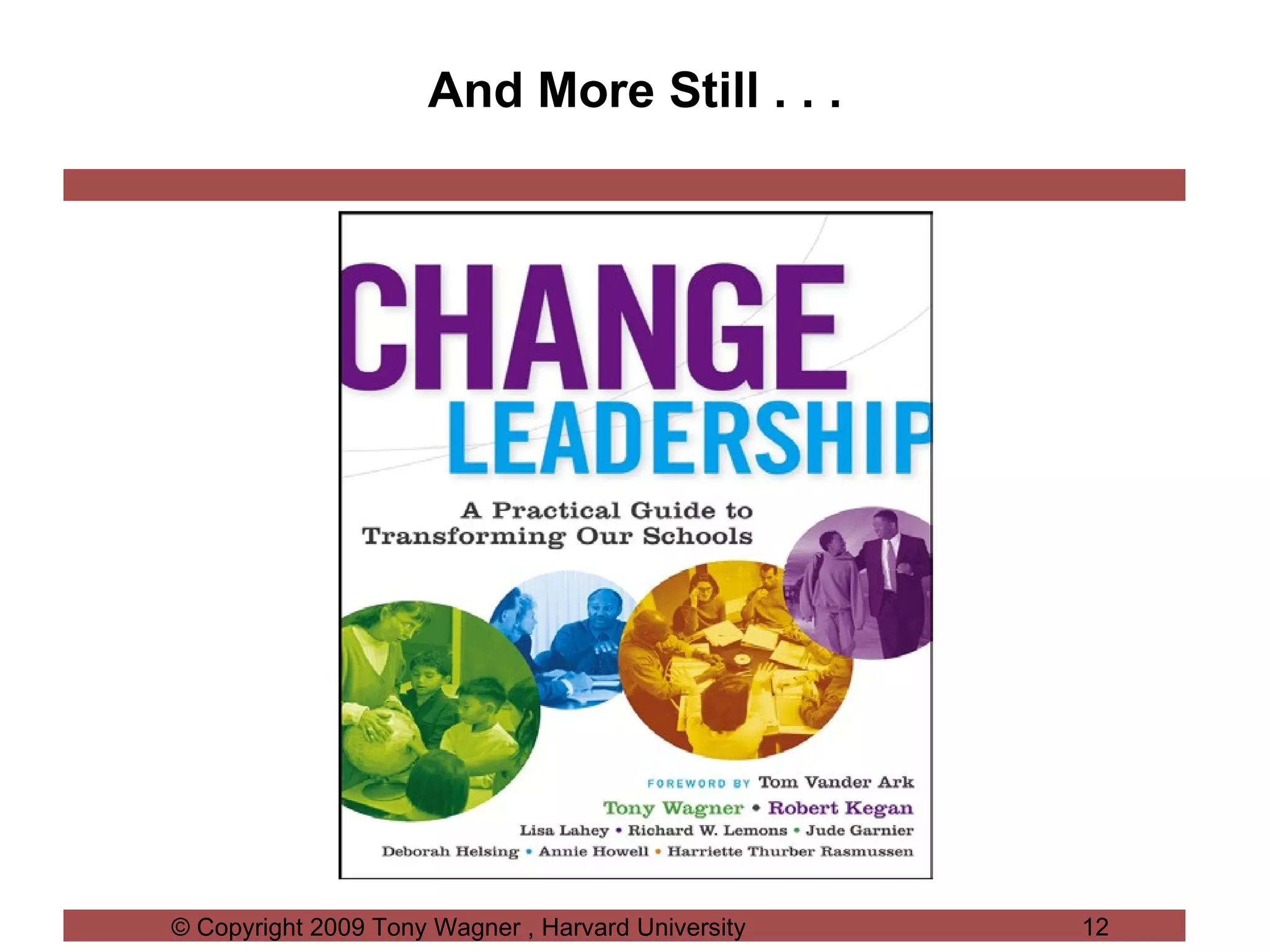
And More Still . . .
Resources The College and Work Readiness Assessment  http:// www.cae.org/content/pro_collegework.htm “ Problem-Solving For Tomorrow’s World,” PISA 2003  http://www.oecd.org/dataoecd/25/12/34009000.pdf Other PISA tests:  www.pisa.oecd.org ETS “ISkills Test”  www.ets.org/iskills “ Towards a More Comprehensive Conception of College Readiness” by David Conley  http://www.gatesfoundation.org/nr/downloads/ed/researchevaluation/CollegeReadinessPaper.pdf “ How the World’s Best-Performing School Systems Come Out on Top”  http://www.mckinsey.com/clientservice/socialsector/resources/pdf/Worlds_School_Systems_Final.pdf National Student Clearinghouse  http:// studentclearinghouse.org/highschools/default.htm
Resources High Tech High website (videos, curriculum, digital portfolios)  http:// www.hightechhigh.org / Coalition of Essential Schools website (videos, workshops, other resources)  http:// www.essentialschools.org / Francis Parker Essential School (7-12)  www.parker.org Mission Hill School (k-8)  www.missionhillschool.org   Catalina Foothills 21 st  century skills overview  http://www.cfsd16.org/public/_century/centMain.aspx Mary Jo Conery, Assistant Superintendent for 21st Century Learning, Catalina Foothills School District, 2101 E. River Road, Tucson, Arizona 85718, (520) 209-7500,  [email_address] “ Two Million Minutes,” a documentary film comparing 6 high school students in the US, China, and India  http://www.2mminutes.com/index.html Partnership for 21 st  Century Skills  http://21stcenturyskills.org/ NY Performance Standards Consortium (28 high schools using coming assessments)  http:// performanceassessment.org/index.html
Resources - Videos Video 1—10 th  Grade English Class:  http://www.gse.harvard.edu/clg/books/1.html#video Video 2—”Looking for An Argument.” See also “Teaching American History” for an excellent example of an “inquiry” approach to teaching subject content  http:// store.tcpress.com/cgi/sc/productsearch.cgi?storeid = tcpress Quest High School Senior Project Video—excellent example of performance assessment  http://store.essentialstore.org/ces-essentialvisions-disc-2-student-achievemen.html BERC Group videos—varying quality, good for discussion  http:// www.bercgroup.com/products.php Highline School District high school student focus group video  http://www.hsd401.org/parentinfo/hsredesign/studentvoices.htm A video on how to do focus groups: “Creating Community Consensus: Dialogues for Learning & Engagement”  http:// www.seattleschools.org/area/ibc/tw.xml

The Global Achievement Gap

  • 1.
    The Global AchievementGap Tony Wagner, Co-Director Change Leadership Group Harvard University, Graduate School of Education [email_address] www.gse.harvard.edu/clg www.schoolchange.org
  • 2.
    “ The formulationof the problem is often more essential than the solution. ” Einstein What is the “crisis” in the American education really all about—what’s the “problem”? If it ain’t broke, don’t fix it! Their schools are the problem, not ours! School reform is just another fad. Incremental change is the only way to go
  • 3.
    The New EducationalChallenges: “The Rock & The Hard Place” The Rock: NEW SKILLS for Work, Continuous Learning & Citizenship in a “knowledge society” for ALL STUDENTS Convergence of skills needed for careers, college, citizenship Students lacking skills relegated to marginal employment & citizenship The Hard Place: The “Net Generation” is differently motivated to learn Re-Framing the Problem: Reform vs. Reinvention We do not know how to teach ALL students NEW skills. This is a new education challenge that requires development of new accountability structures, different ways of teaching and testing, and new ways of working together and with our students.
  • 4.
    The Seven SurvivalSkills for Careers, College, And Citizenship Critical Thinking and Problem-Solving Collaboration Across Networks and Leading by Influence Agility and Adaptability Initiative and Entrepreneurialism Effective Oral and Written Communication Accessing and Analyzing Information Curiosity and Imagination from The Global Achievement Gap: Why Even Our Best Schools Don’t Teach The New Survival Skills Our Children Need—And What We Can Do About It, by Tony Wagner (Basic Books, 2008)
  • 5.
    What is The“Global Achievement Gap”? The Global Achievement Gap is the gap between what even our best schools are teaching and testing Versus The skills all students will need for careers, college, and citizenship in the 21 st century
  • 6.
    What Motivates The“Net” Generation? Accustomed to instant gratification and “always-on” connection Use the web for 1) extending friendships, 2) interest-driven, self-directed learning, and 3) as a tool for self-expression Constantly connected, creating, and multitasking in a multimedia world—everywhere except in school Less fear and respect for authority—accustomed to learning from peers; want coaching, but only from adults who don’t “talk down” to them Want to make a difference and do interesting/worthwhile work
  • 7.
    The Three Cornerstonesof “Re-Invention” Holding Ourselves Accountable for What Matters Most “ AYP” versus Attainment— track % of students graduating, attending and persisting with post-secondary (National Student Clearinghouse) Use The College and Work Readiness Assessment to assess analytic reasoning, critical thinking, problem-solving, and writing video focus groups with recent grads Doing the New Work: teaching & testing the skills that matter most Start with the 3 C’s: Critical Thinking, Communication, and Collaboration—in every class and at all grade levels Require all students to do internships and group service projects Doing the New Work in New Ways Every student has an adult advocate for his/her success Every teacher on teams to learn new approaches: Isolation is the enemy of improvement
  • 8.
    Rigor in TheClassroom: 5 “Habits of Mind” Critical Thinking = Learning to Ask The Right Questions Weighing Evidence How do we know what’s true and false? What is the evidence, and is it credible? Awareness of Varying Viewpoints What viewpoint are we hearing? Who is the author, and what are his or her intentions? How might it look to someone with a different history? Seeing Connections/Cause & Effect Is there a pattern? How are things connected? Where have we seen this before? Speculating on Possibilities/Conjecture What if? Supposing that? Can we imagine alternatives? Assessing Value—Both Socially and Personally What difference does it make? Who cares? So what? From www.missionhillschool.org See also Deborah Meier The Power of Their Ideas
  • 9.
    Rigor in AdultMeetings 5 “Habits of Mind” for Change Leaders What’s the problem you’re trying to solve? What does it have to do with improving teaching and learning? What data (qualitative & quantitative) have you used to understand the problem? What is your strategy for solving this problem? Why did you choose this strategy? What others did you consider? Can you clearly explain your “theory of action” i.e. how you think this strategy will solve the problem you’ve identified? Who (teachers, parents, community) needs to know what to “own” the problem and support the change work? Who is accountable for what to solve this problem? What do they need to get the job done? What data will you track to tell you whether you’re making progress in solving this problem?
  • 10.
    For more information:www.schoolchange.org
  • 11.
    For Still MoreInformation . . .
  • 12.
  • 13.
    Resources The Collegeand Work Readiness Assessment http:// www.cae.org/content/pro_collegework.htm “ Problem-Solving For Tomorrow’s World,” PISA 2003 http://www.oecd.org/dataoecd/25/12/34009000.pdf Other PISA tests: www.pisa.oecd.org ETS “ISkills Test” www.ets.org/iskills “ Towards a More Comprehensive Conception of College Readiness” by David Conley http://www.gatesfoundation.org/nr/downloads/ed/researchevaluation/CollegeReadinessPaper.pdf “ How the World’s Best-Performing School Systems Come Out on Top” http://www.mckinsey.com/clientservice/socialsector/resources/pdf/Worlds_School_Systems_Final.pdf National Student Clearinghouse http:// studentclearinghouse.org/highschools/default.htm
  • 14.
    Resources High TechHigh website (videos, curriculum, digital portfolios) http:// www.hightechhigh.org / Coalition of Essential Schools website (videos, workshops, other resources) http:// www.essentialschools.org / Francis Parker Essential School (7-12) www.parker.org Mission Hill School (k-8) www.missionhillschool.org Catalina Foothills 21 st century skills overview http://www.cfsd16.org/public/_century/centMain.aspx Mary Jo Conery, Assistant Superintendent for 21st Century Learning, Catalina Foothills School District, 2101 E. River Road, Tucson, Arizona 85718, (520) 209-7500, [email_address] “ Two Million Minutes,” a documentary film comparing 6 high school students in the US, China, and India http://www.2mminutes.com/index.html Partnership for 21 st Century Skills http://21stcenturyskills.org/ NY Performance Standards Consortium (28 high schools using coming assessments) http:// performanceassessment.org/index.html
  • 15.
    Resources - VideosVideo 1—10 th Grade English Class: http://www.gse.harvard.edu/clg/books/1.html#video Video 2—”Looking for An Argument.” See also “Teaching American History” for an excellent example of an “inquiry” approach to teaching subject content http:// store.tcpress.com/cgi/sc/productsearch.cgi?storeid = tcpress Quest High School Senior Project Video—excellent example of performance assessment http://store.essentialstore.org/ces-essentialvisions-disc-2-student-achievemen.html BERC Group videos—varying quality, good for discussion http:// www.bercgroup.com/products.php Highline School District high school student focus group video  http://www.hsd401.org/parentinfo/hsredesign/studentvoices.htm A video on how to do focus groups: “Creating Community Consensus: Dialogues for Learning & Engagement” http:// www.seattleschools.org/area/ibc/tw.xml