How to Turn $2000 in Duplo®
into $20M in Value Through
Visible Architecture
Luke Hohmann, Conteneo.co
1
2
Agenda
3
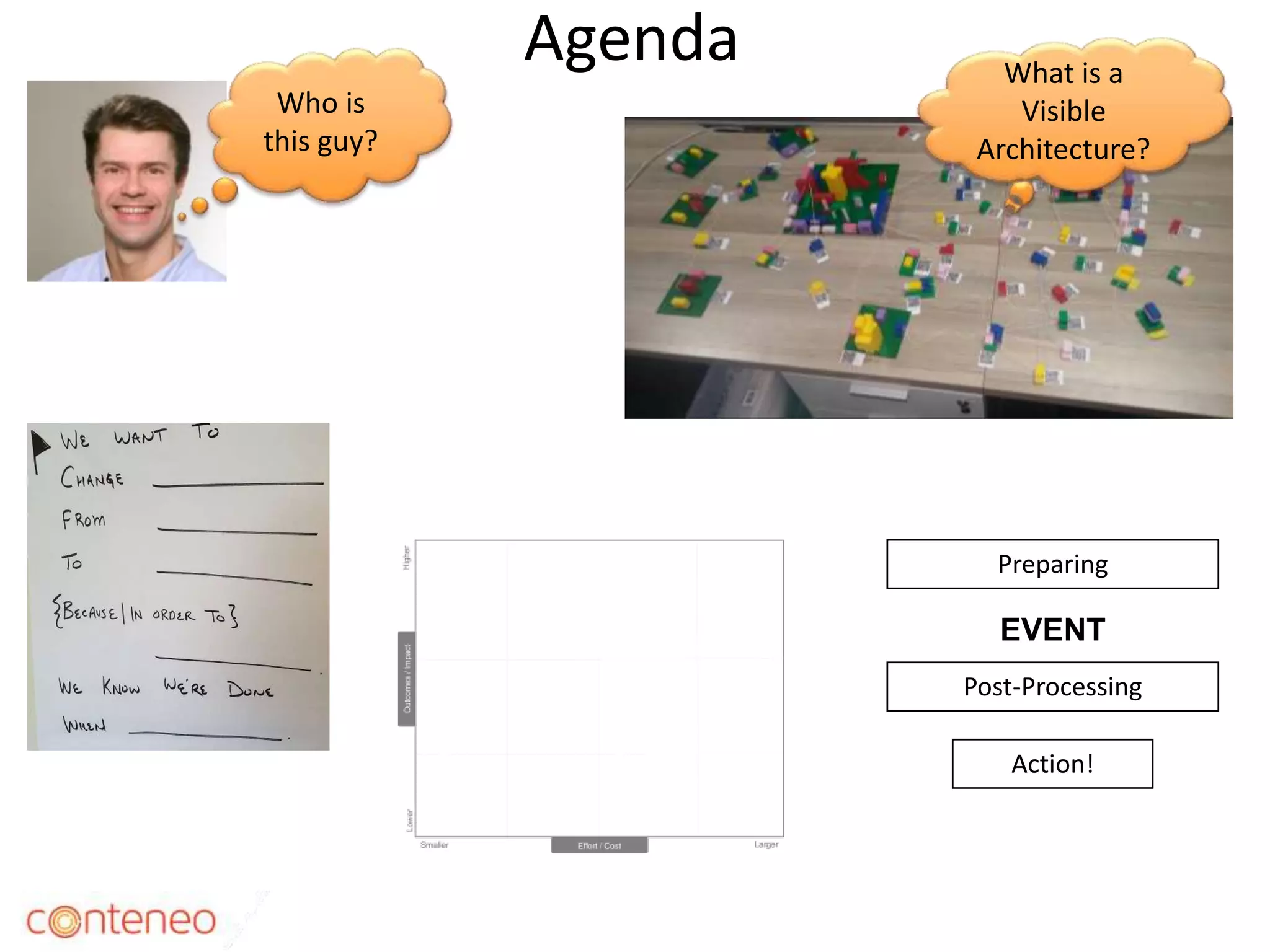
What is a
Visible
Architecture?
Who is
this guy?
Action!
Preparing
EVENT
Post-Processing
About Luke Hohmann
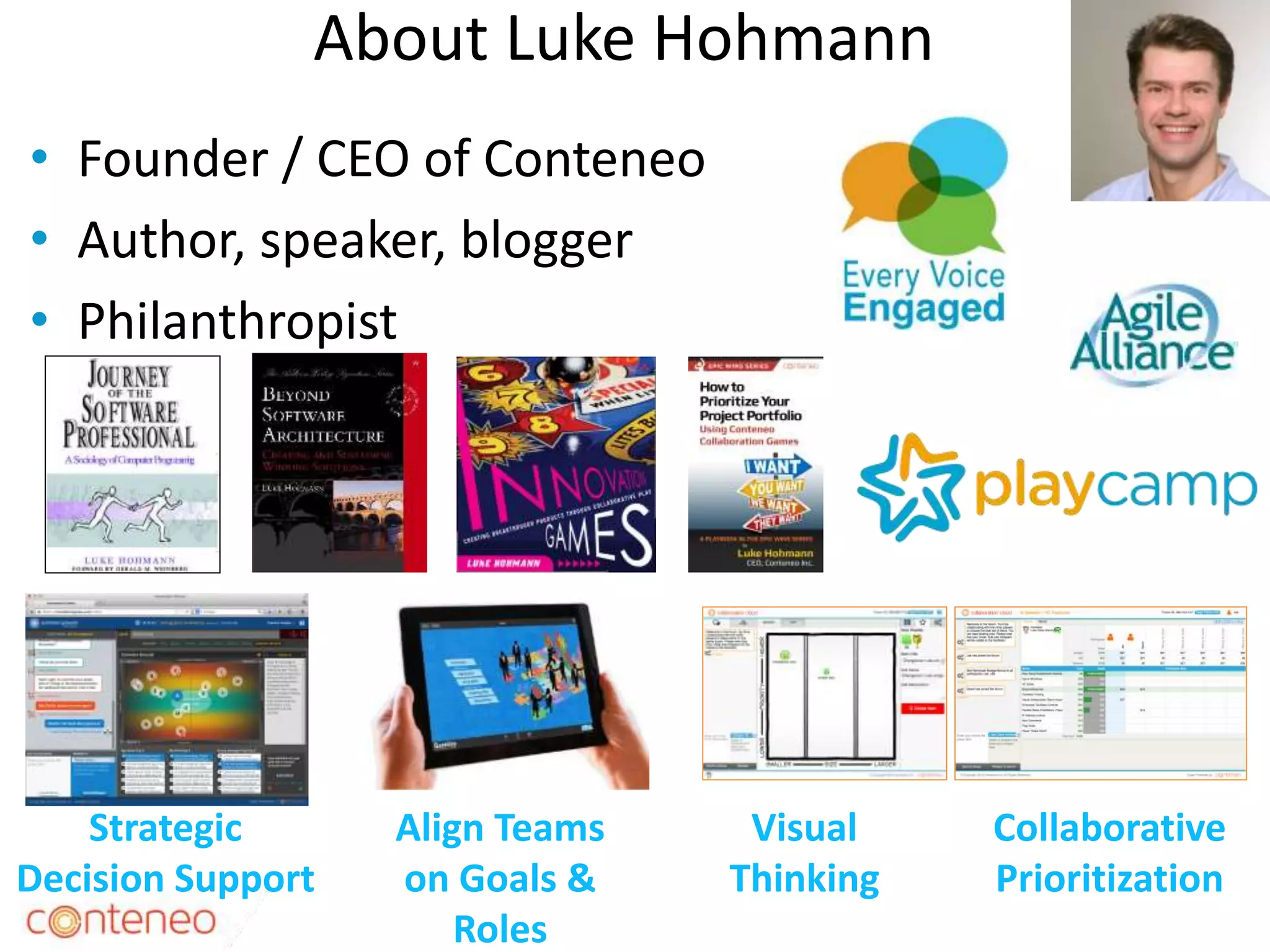
• Founder / CEO of Conteneo
• Author, speaker, blogger
• Philanthropist
4
Strategic
Decision Support
Align Teams
on Goals &
Roles
Collaborative
Prioritization
Visual
Thinking
Visible Architectures
5
Visible Architecture
6
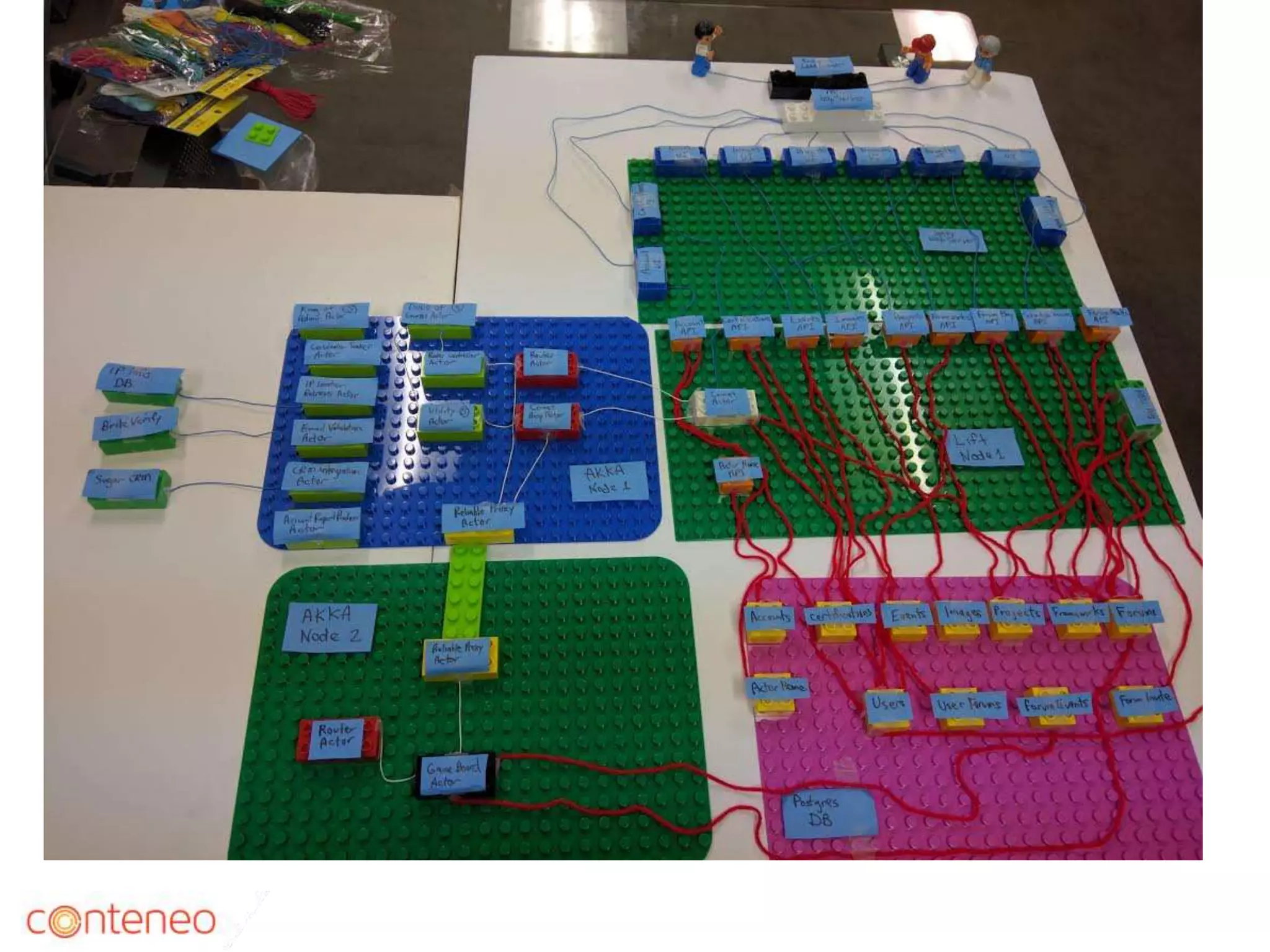
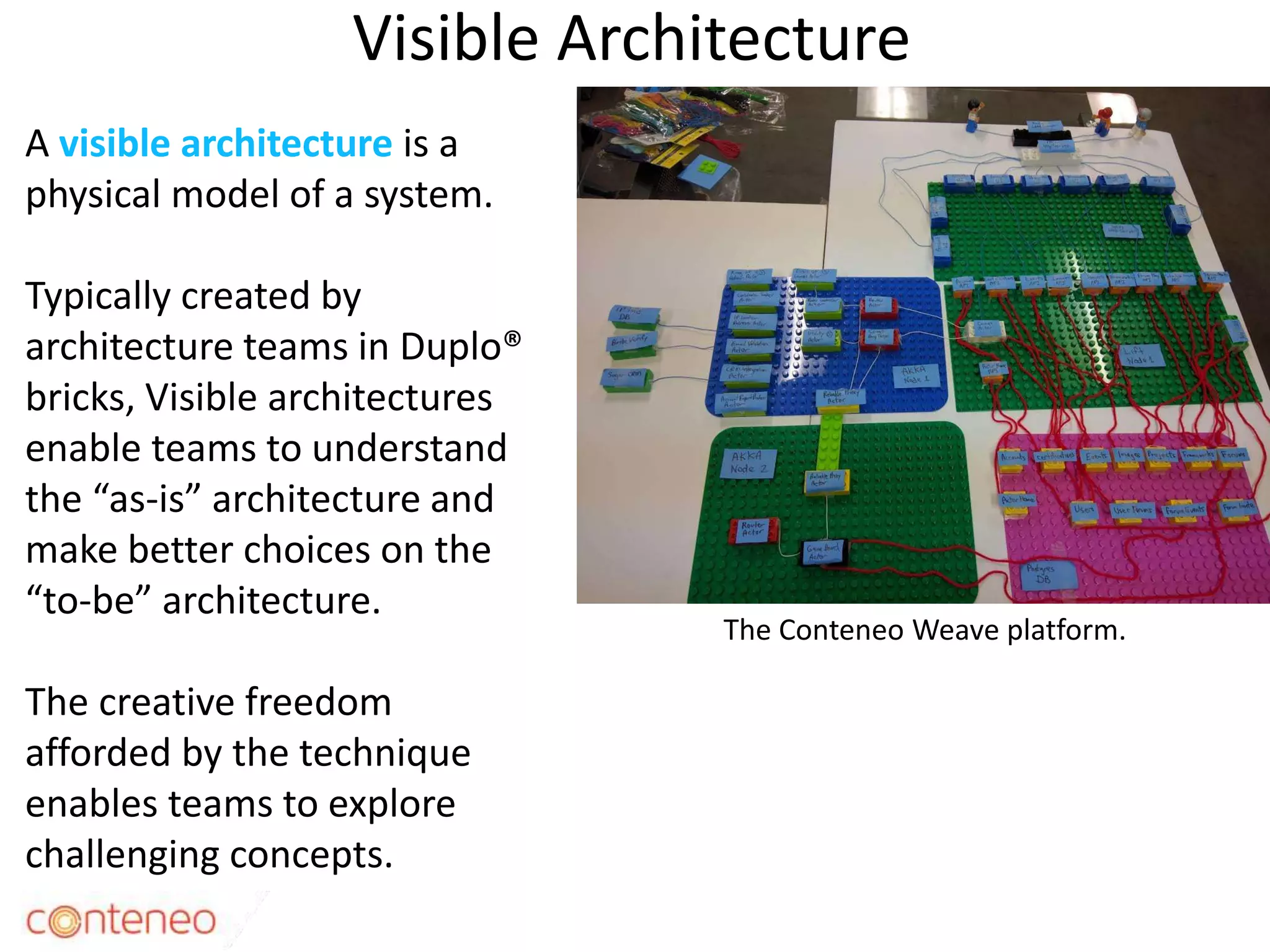
A visible architecture is a
physical model of a system.
Typically created by
architecture teams in Duplo®
bricks, Visible architectures
enable teams to understand
the “as-is” architecture and
make better choices on the
“to-be” architecture.
The creative freedom
afforded by the technique
enables teams to explore
challenging concepts.
The Conteneo Weave platform.
WHY?
• Business leaders don't understand architectures
• Architects don't often understand each other
• Architects don't know how to speak in ways that
business leaders can understand and support
• Can't make choices that align business and tech
• Lots of conflicting ways to communicate (TOFAL,
ITIL, SEMAT, UML...)
• Dev teams are lost – what’s a microservice? What’s
a shared library? What’s a framework?
7
Expressing Desired Improvements
8
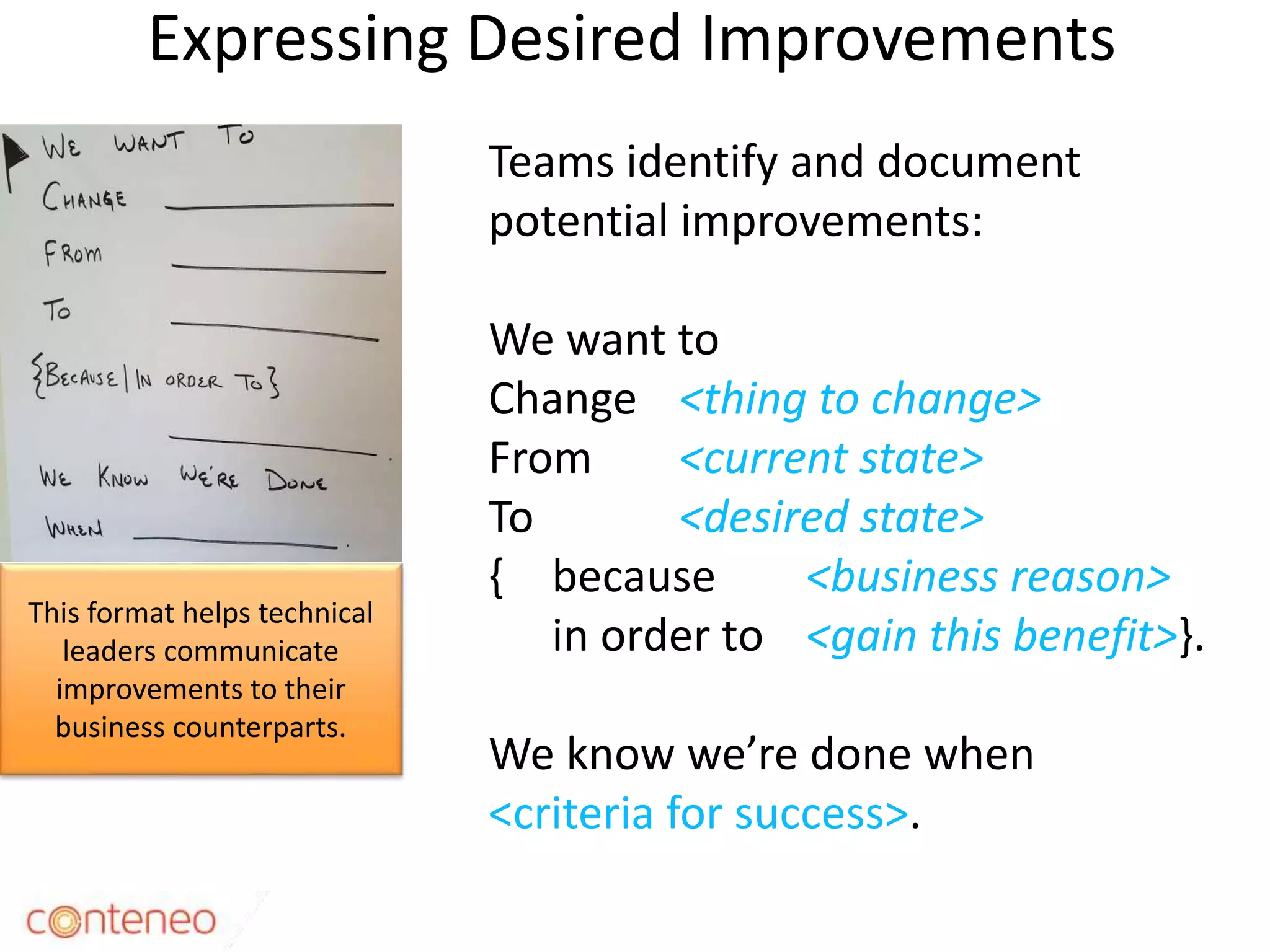
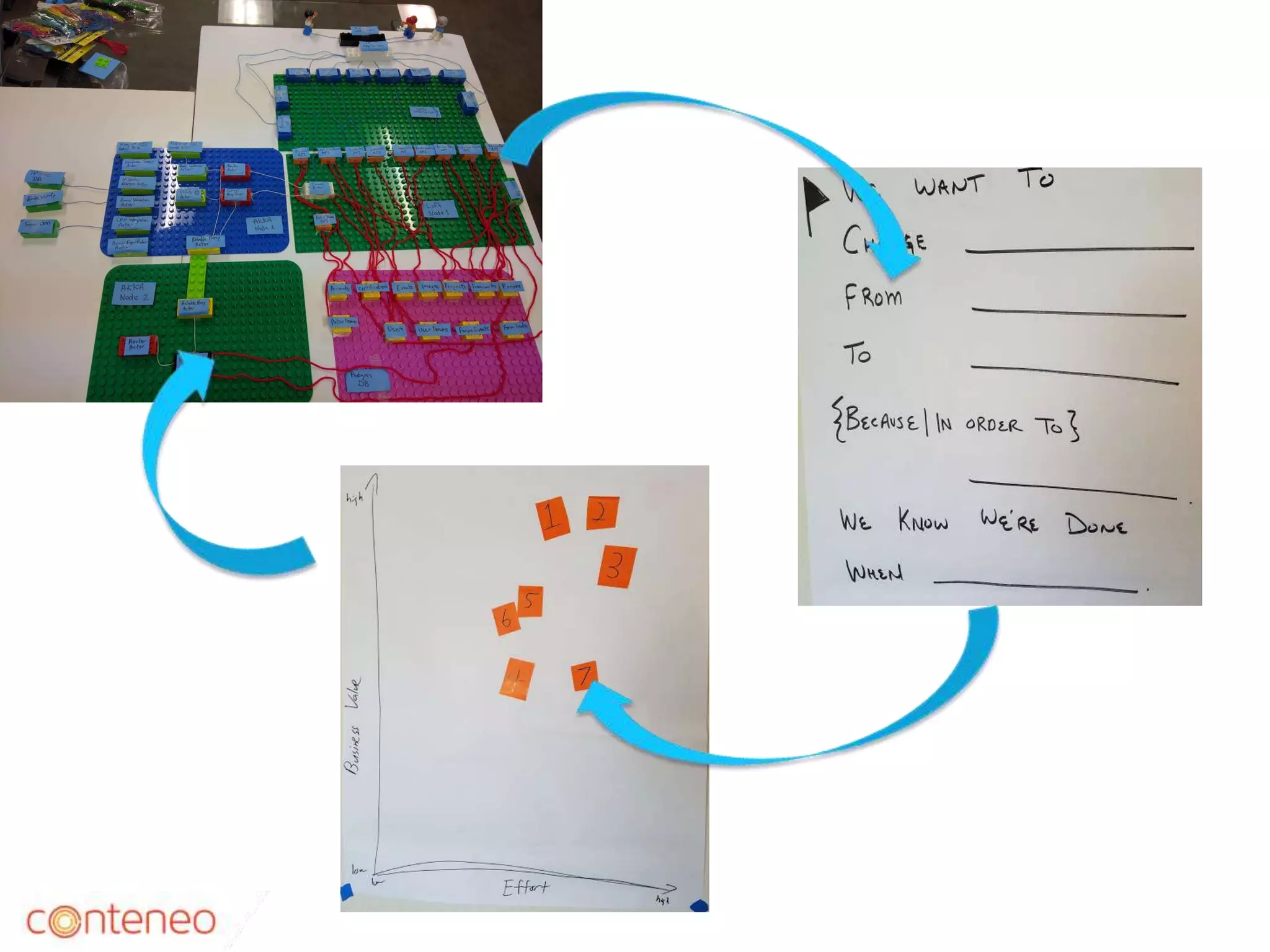
Teams identify and document
potential improvements:
We want to
Change <thing to change>
From <current state>
To <desired state>
{ because <business reason>
in order to <gain this benefit>}.
We know we’re done when
<criteria for success>.
This format helps technical
leaders communicate
improvements to their
business counterparts.
Impact – Effort Matrices
9
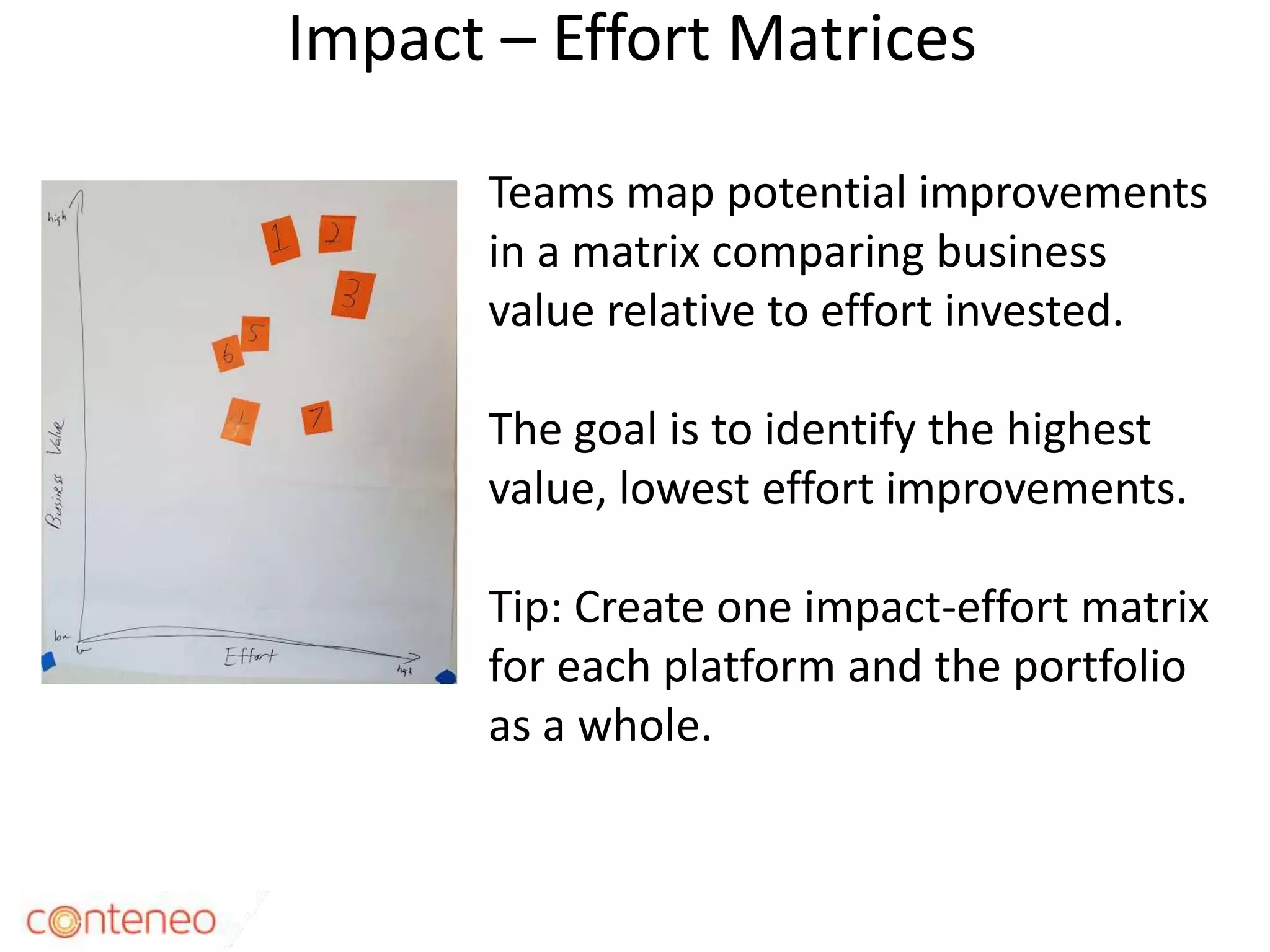
Teams map potential improvements
in a matrix comparing business
value relative to effort invested.
The goal is to identify the highest
value, lowest effort improvements.
Tip: Create one impact-effort matrix
for each platform and the portfolio
as a whole.
Planning the Event
10
Step 0: Framing the Discussion
You can’t just run around
yelling “Technical Debt” to make (or scare) the
business team into “doing what you want”.
11
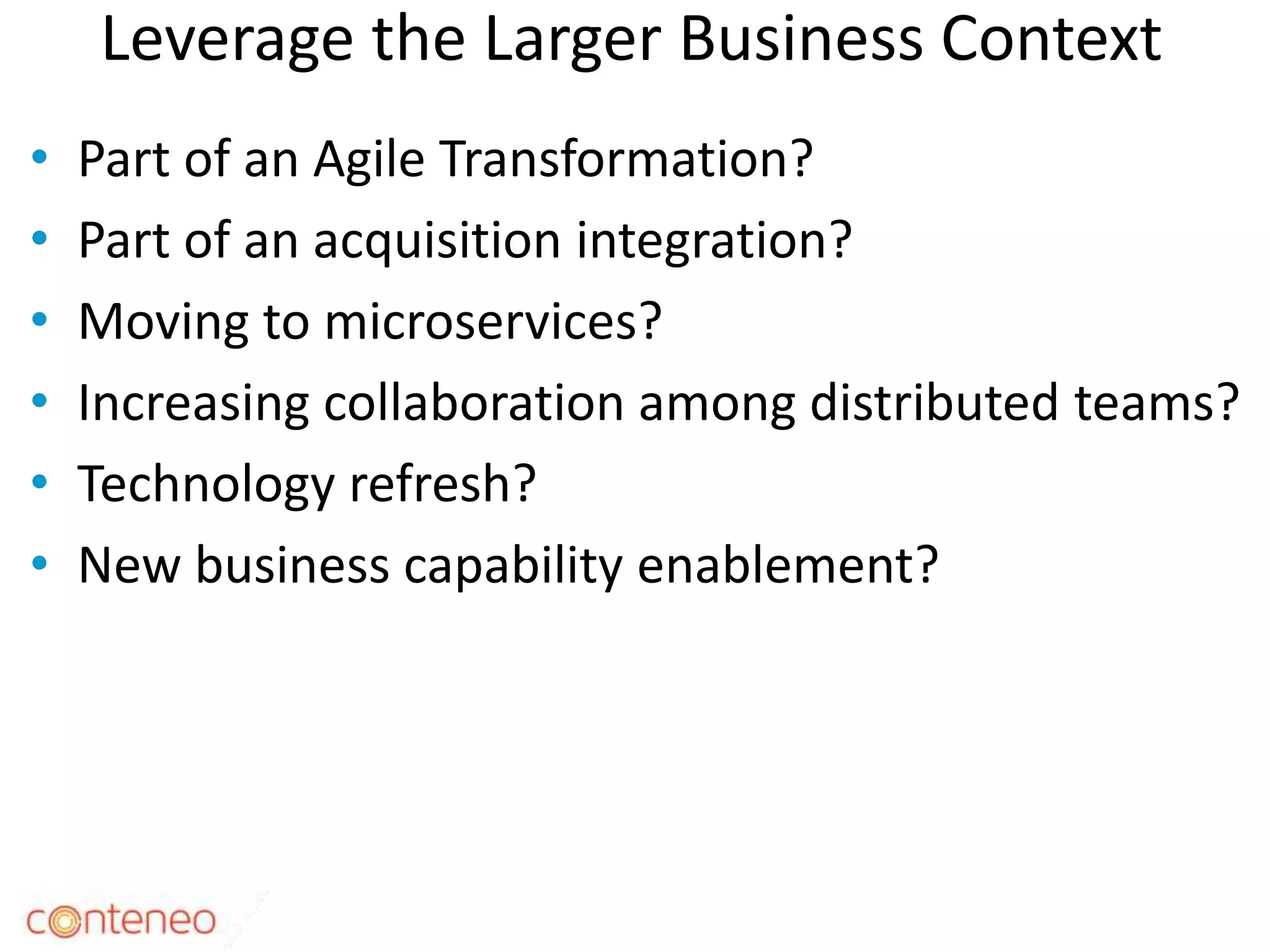
Leverage the Larger Business Context
• Part of an Agile Transformation?
• Part of an acquisition integration?
• Moving to microservices?
• Increasing collaboration among distributed teams?
• Technology refresh?
• New business capability enablement?
12
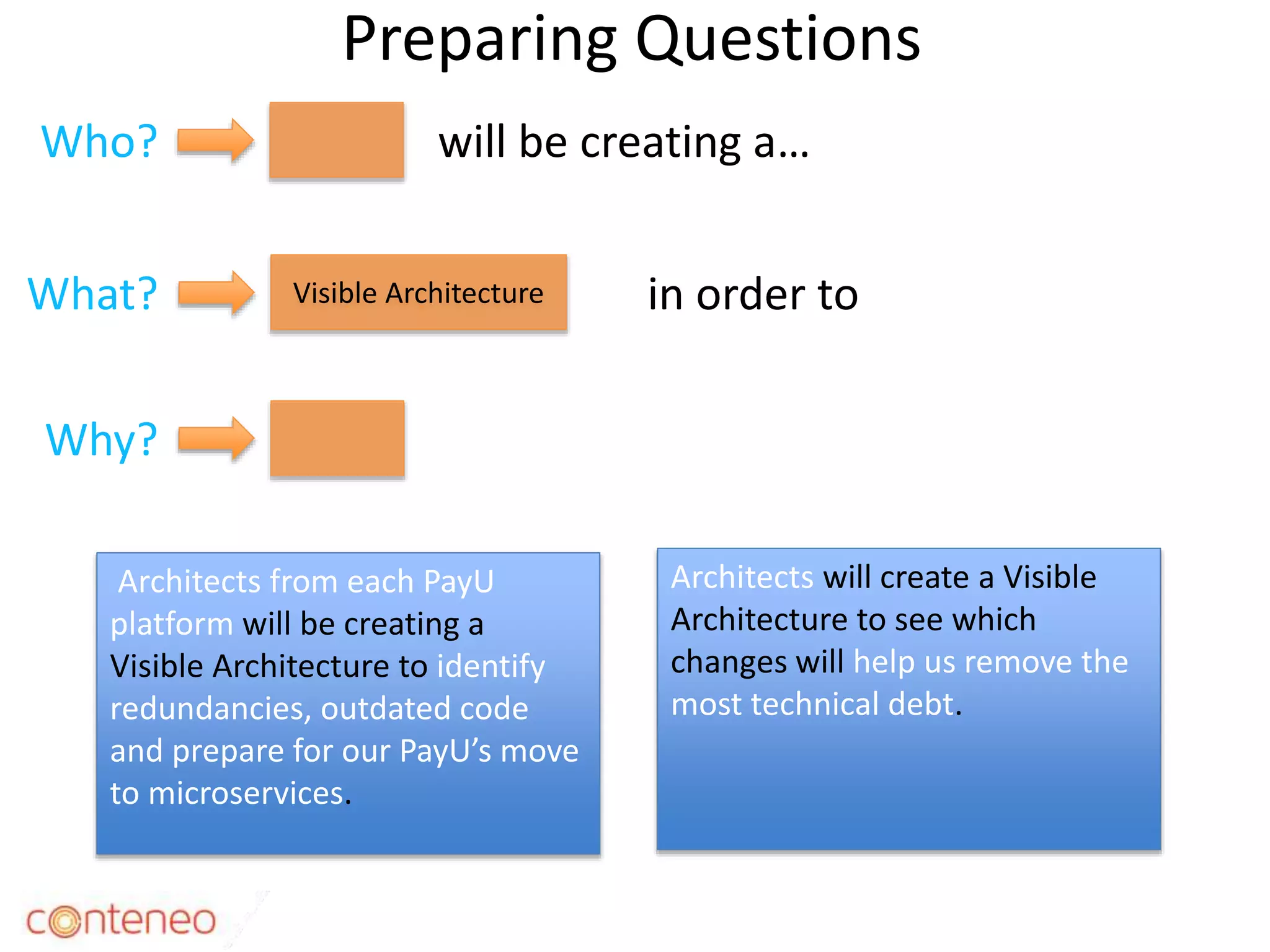
Preparing Questions
13
will be creating a…
in order toVisible Architecture
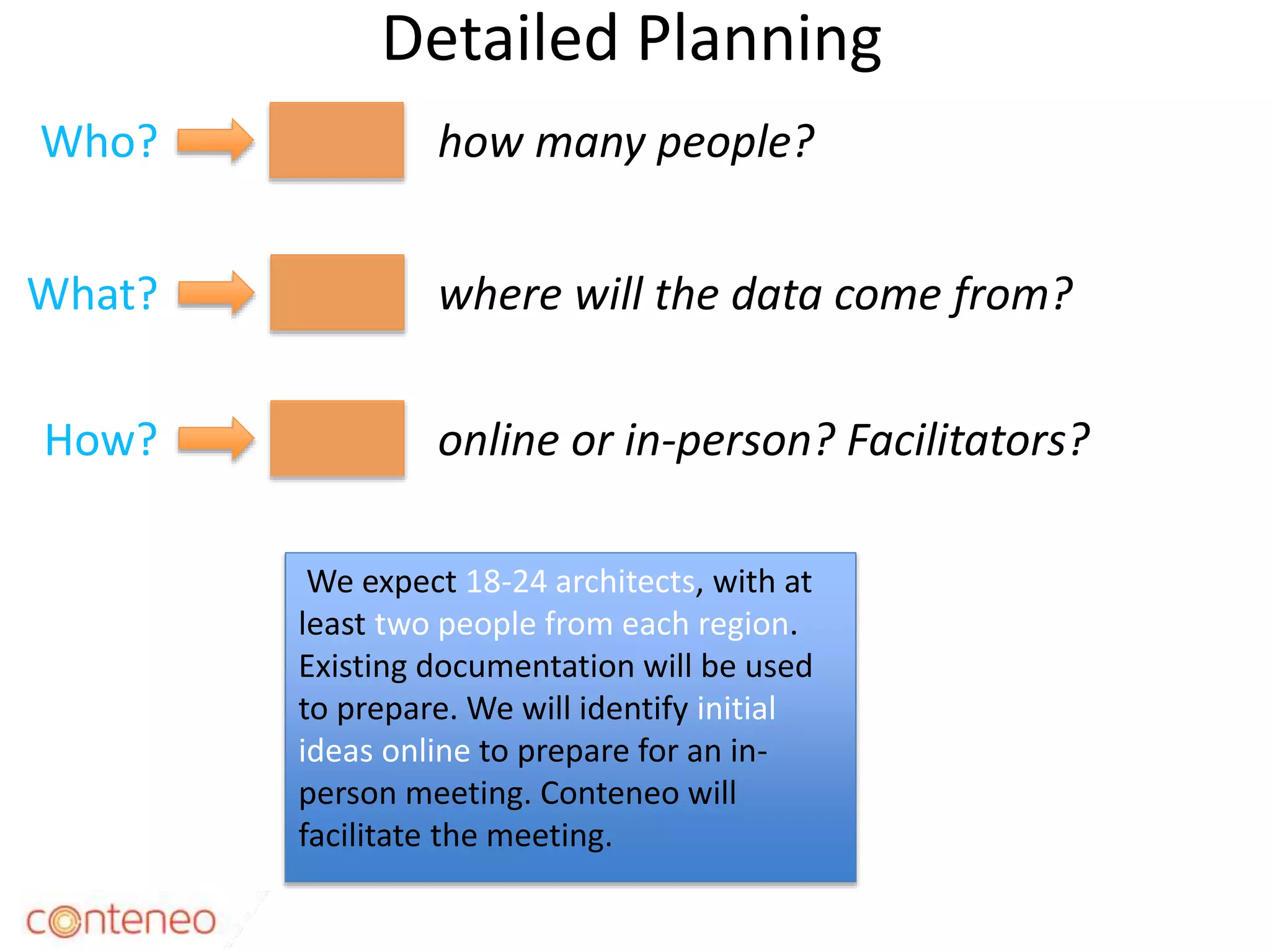
Who?
What?
Why?
Architects from each PayU
platform will be creating a
Visible Architecture to identify
redundancies, outdated code
and prepare for our PayU’s move
to microservices.
Architects will create a Visible
Architecture to see which
changes will help us remove the
most technical debt.
Detailed Planning
14
how many people?
where will the data come from?
Who?
What?
How? online or in-person? Facilitators?
We expect 18-24 architects, with at
least two people from each region.
Existing documentation will be used
to prepare. We will identify initial
ideas online to prepare for an in-
person meeting. Conteneo will
facilitate the meeting.
Gathering Pre-Event Data
15
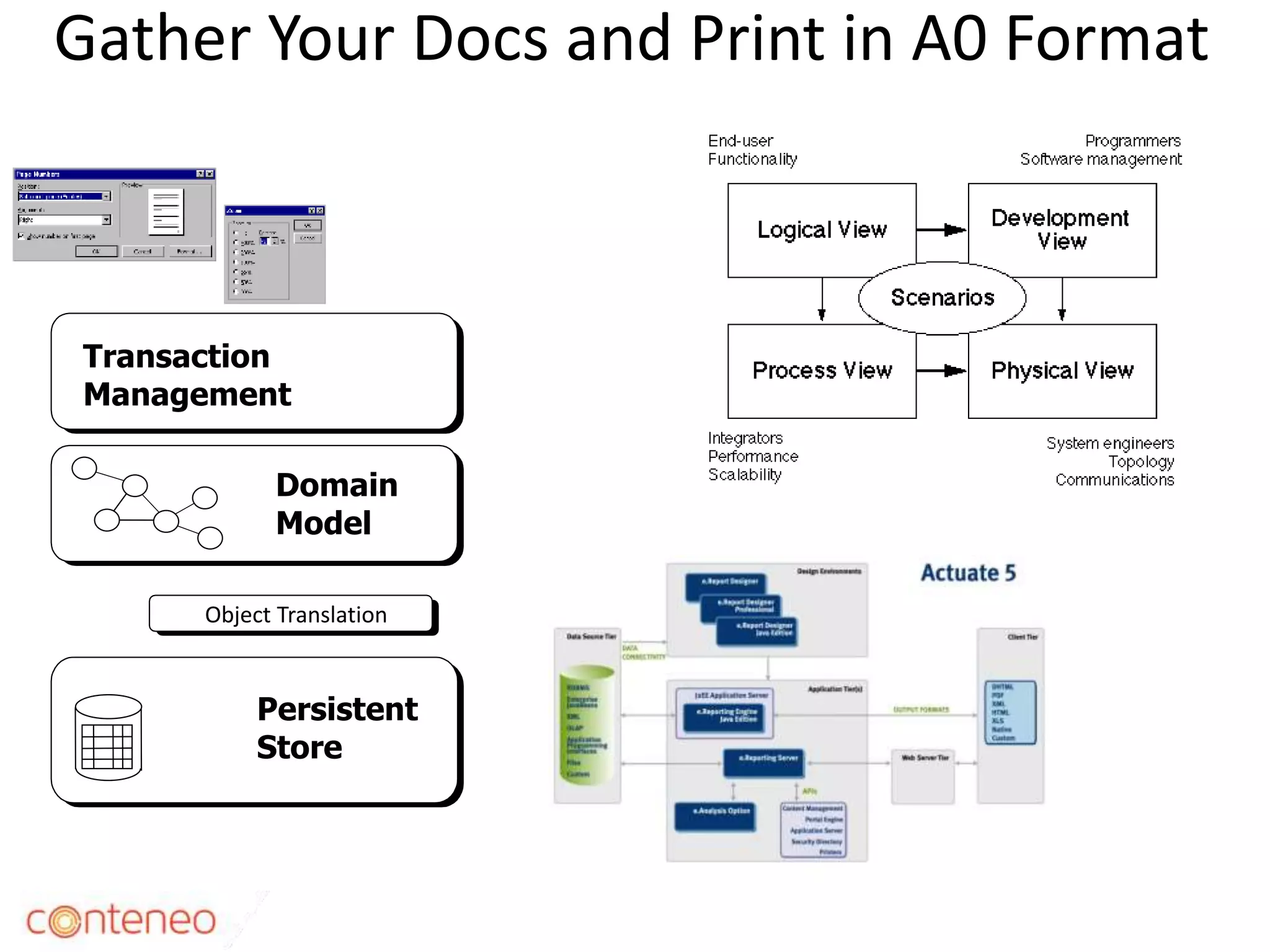
Gather Your Docs and Print in A0 Format
16
Object Translation
Transaction
Management
Domain
Model
Persistent
Store
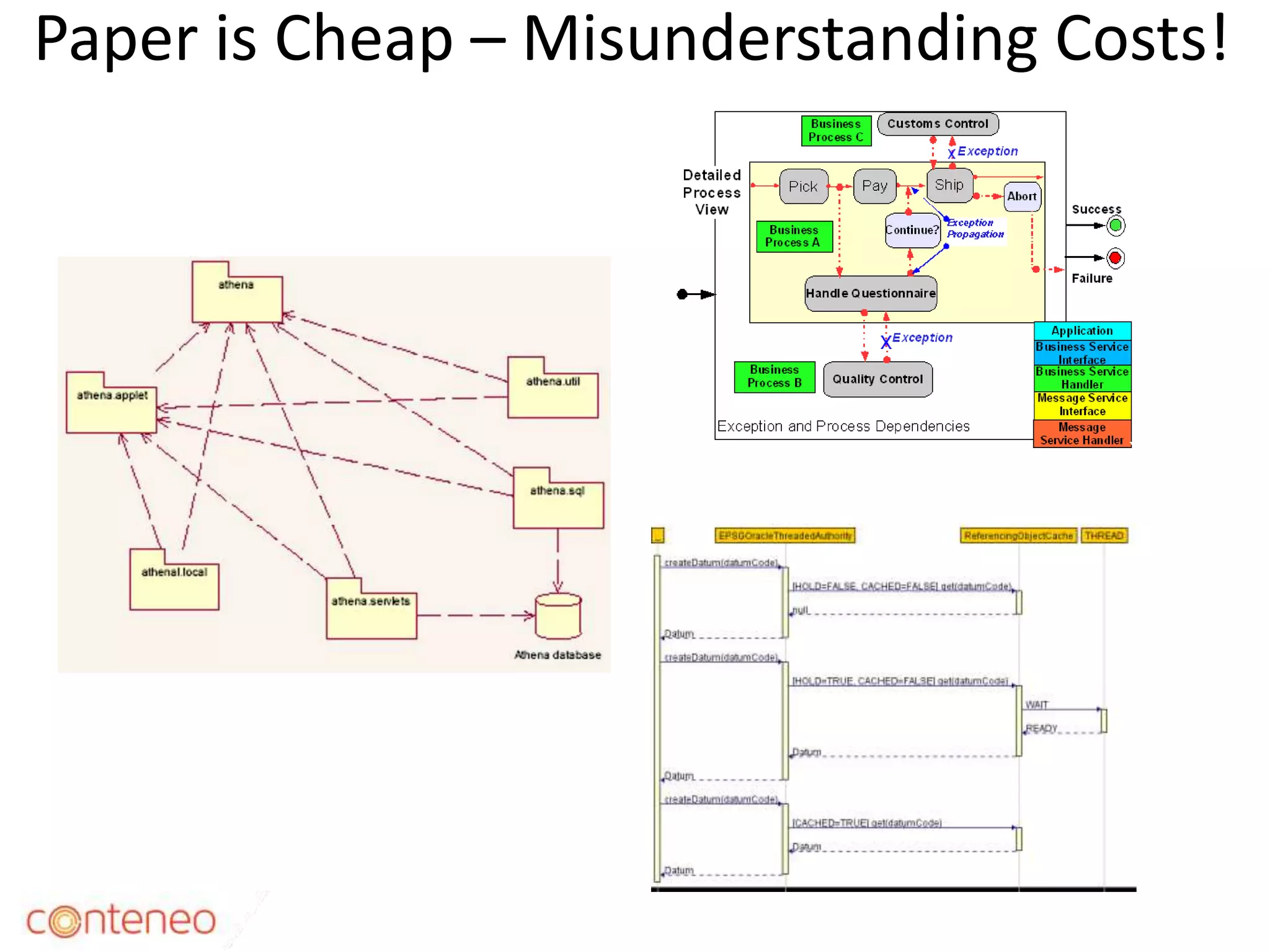
Paper is Cheap – Misunderstanding Costs!
17
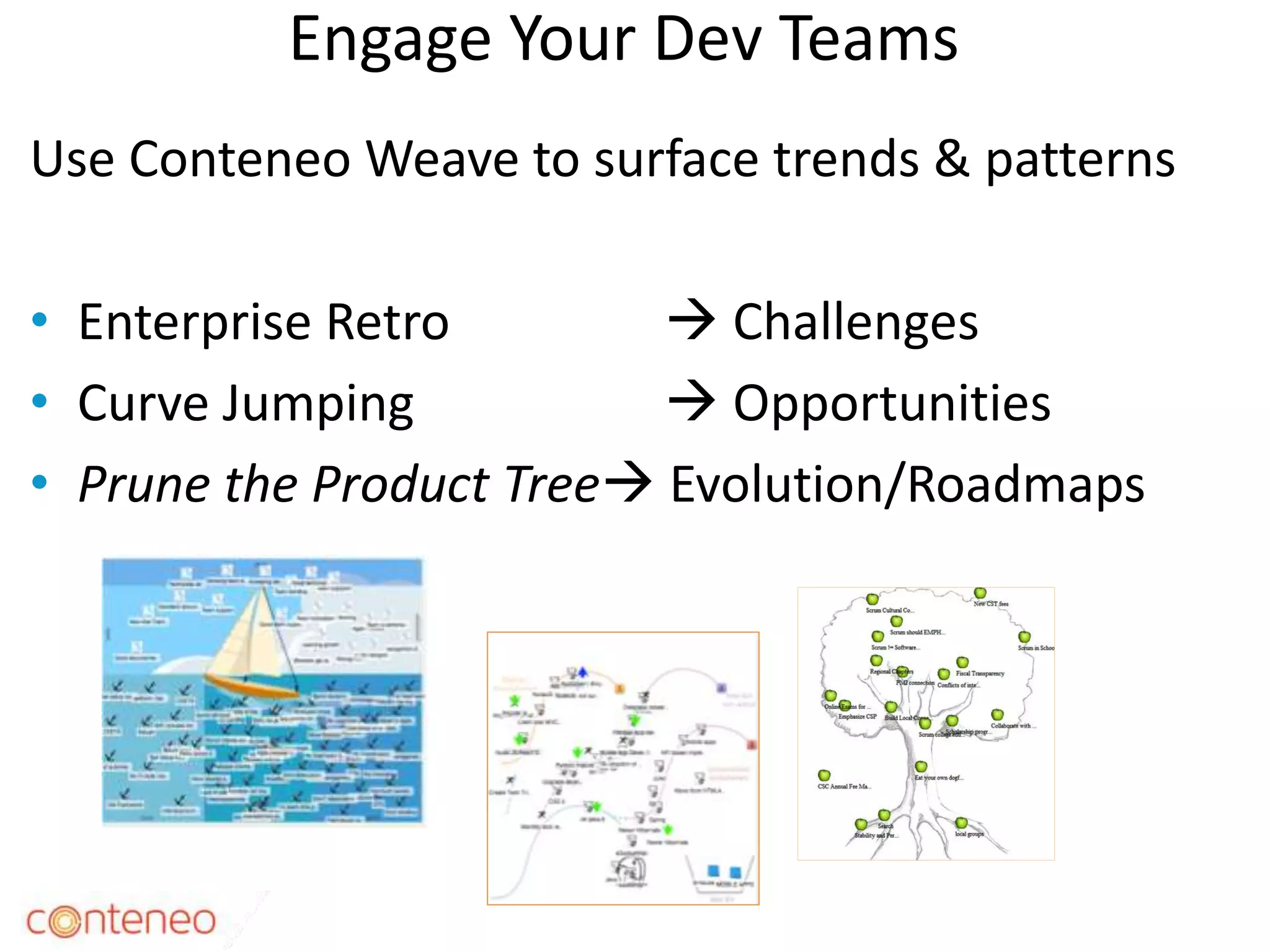
Engage Your Dev Teams
Use Conteneo Weave to surface trends & patterns
• Enterprise Retro  Challenges
• Curve Jumping  Opportunities
• Prune the Product Tree Evolution/Roadmaps
18
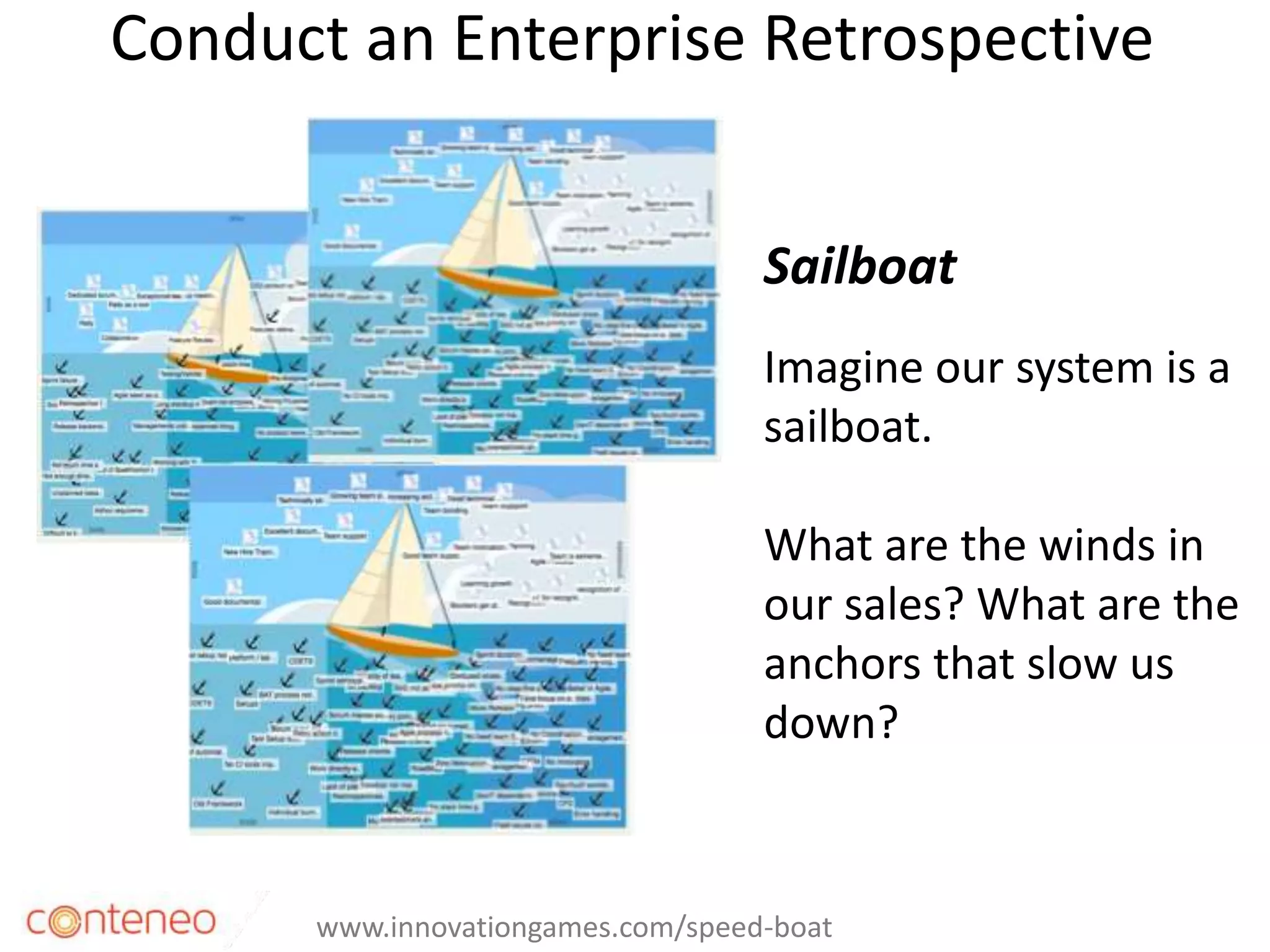
Conduct an Enterprise Retrospective
19
Sailboat
Imagine our system is a
sailboat.
What are the winds in
our sales? What are the
anchors that slow us
down?
www.innovationgames.com/speed-boat
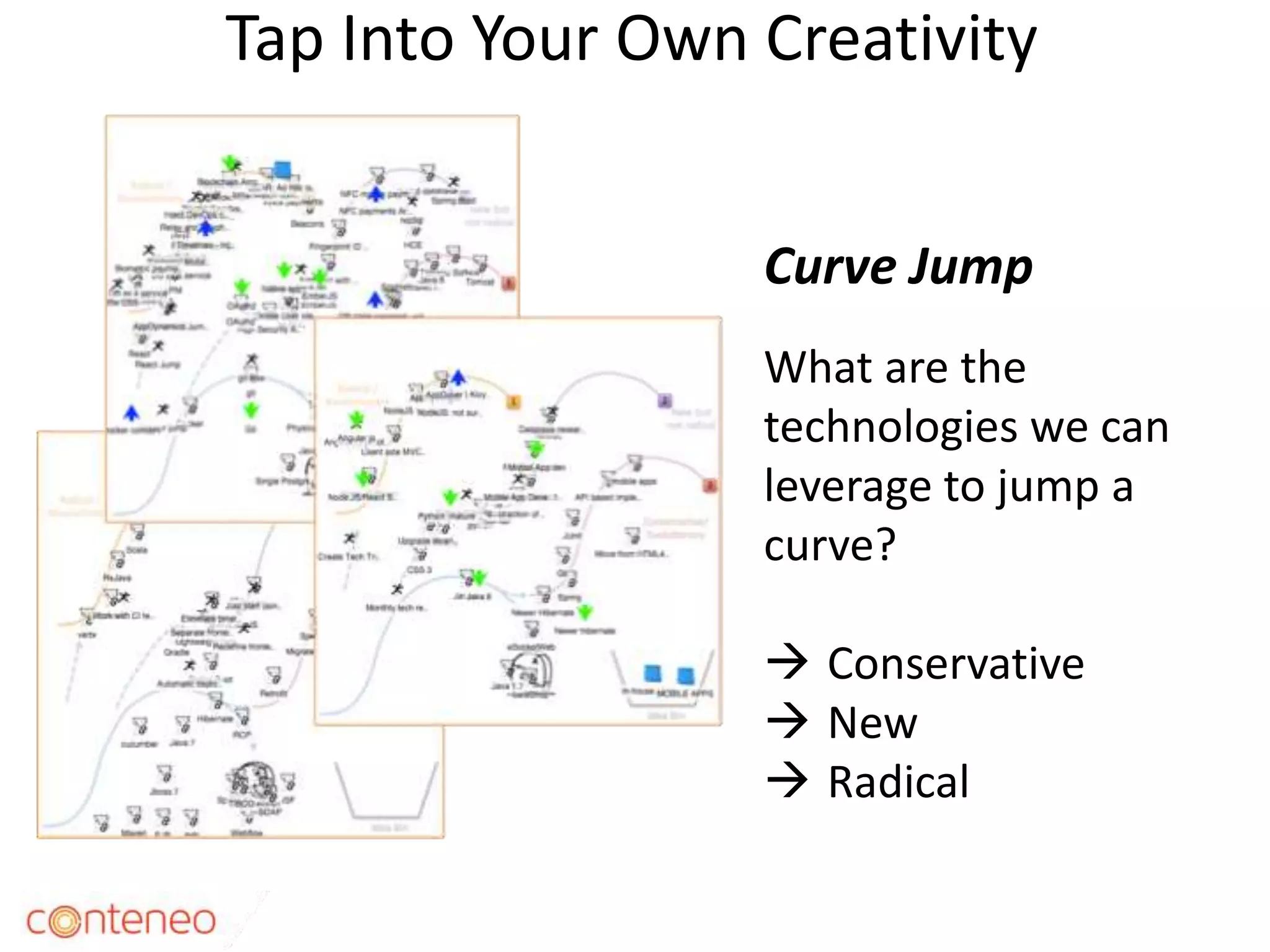
Tap Into Your Own Creativity
20
Curve Jump
What are the
technologies we can
leverage to jump a
curve?
 Conservative
 New
 Radical
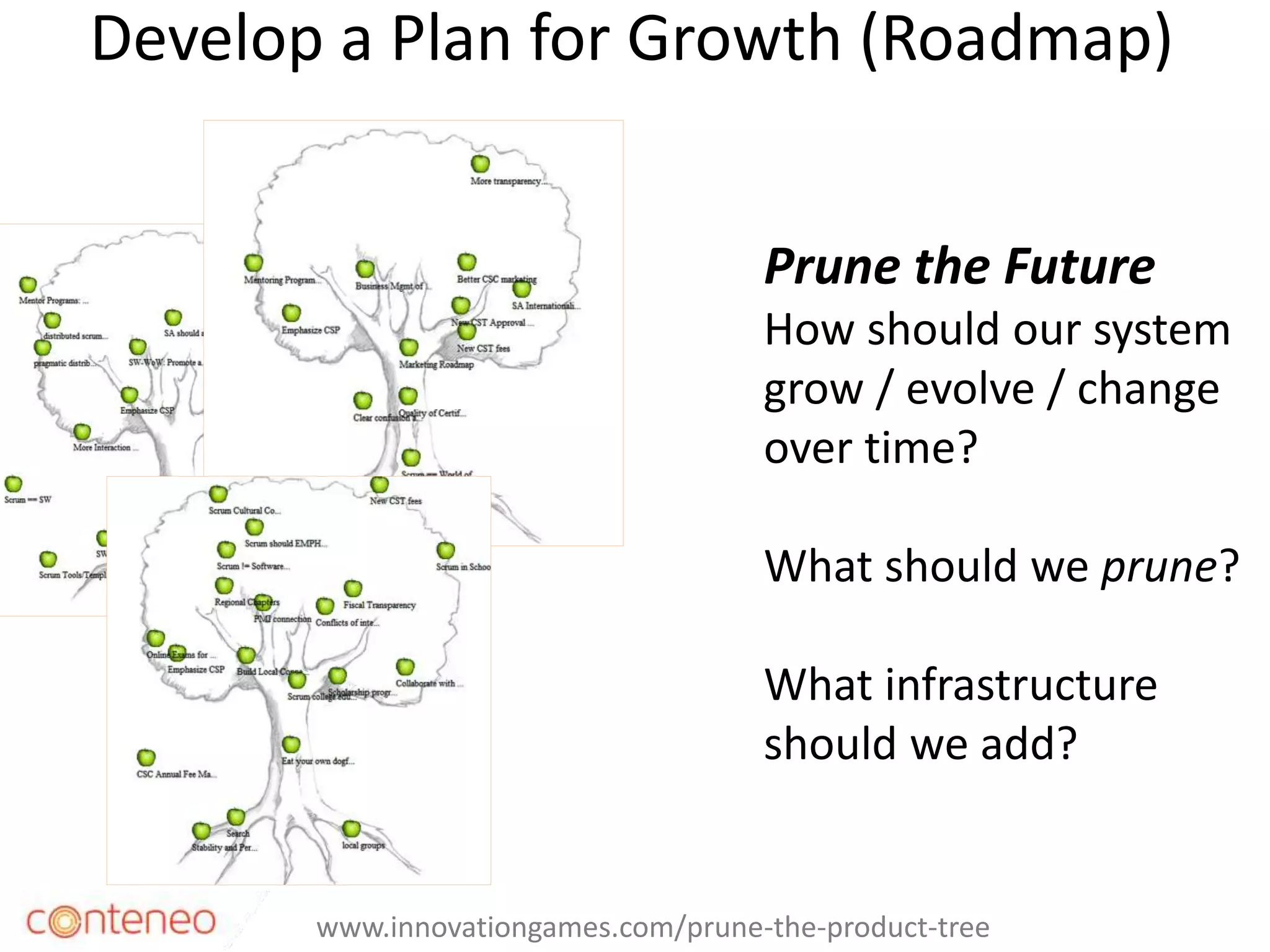
Develop a Plan for Growth (Roadmap)
21
Prune the Future
How should our system
grow / evolve / change
over time?
What should we prune?
What infrastructure
should we add?
www.innovationgames.com/prune-the-product-tree
You Need Gear and a Place to Play
22
23
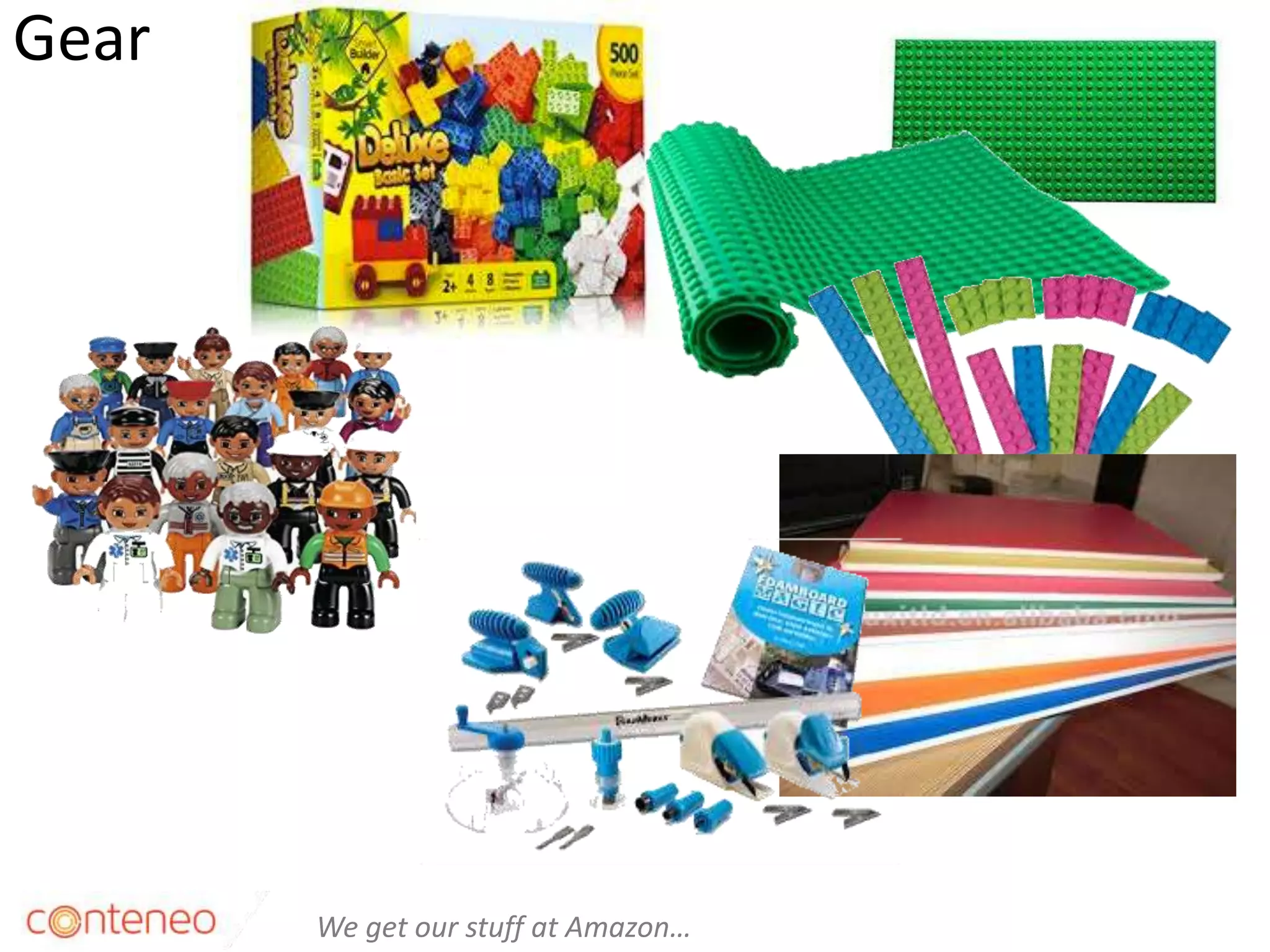
Gear
We get our stuff at Amazon…
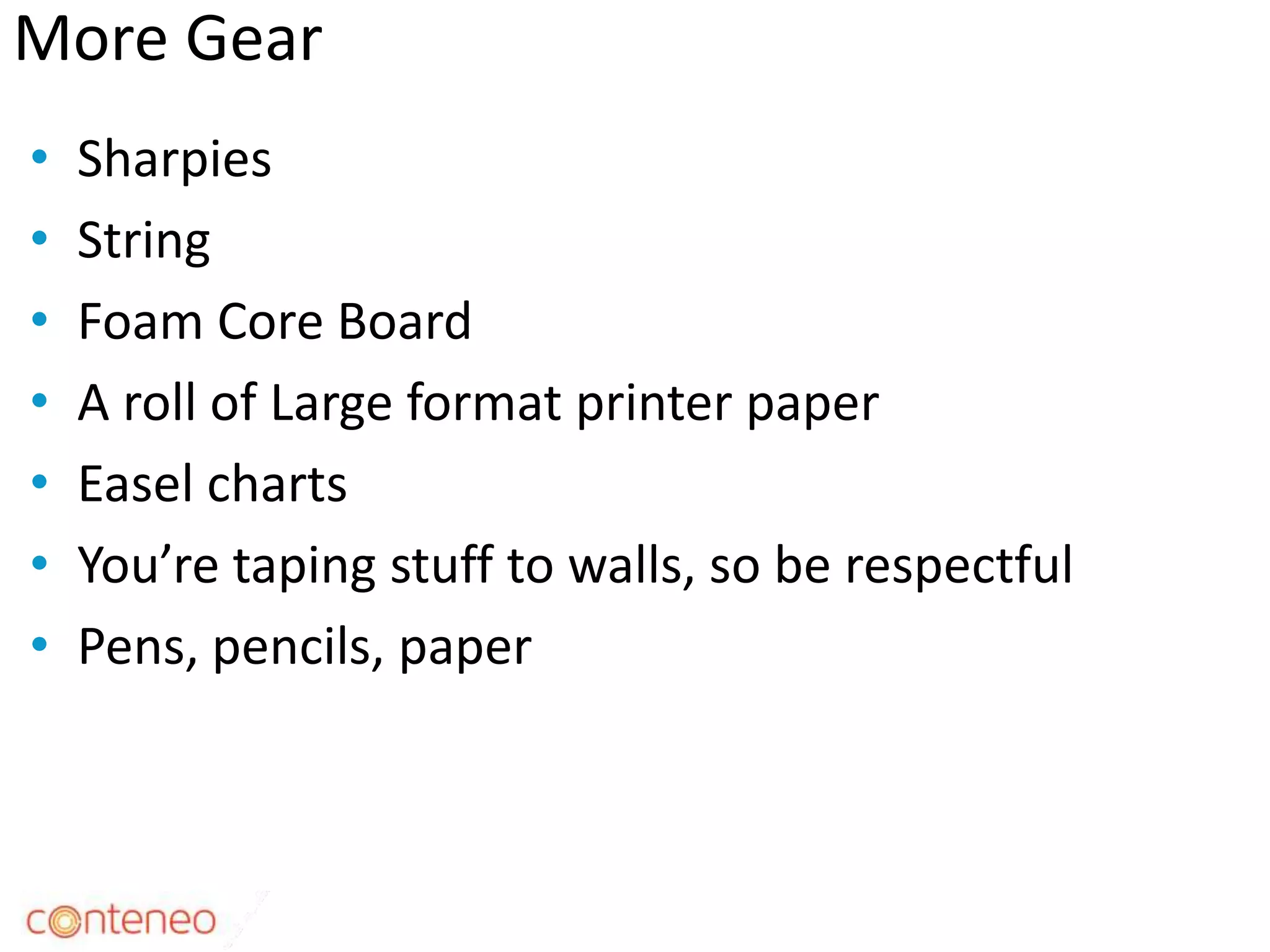
More Gear
• Sharpies
• String
• Foam Core Board
• A roll of Large format printer paper
• Easel charts
• You’re taping stuff to walls, so be respectful
• Pens, pencils, paper
24
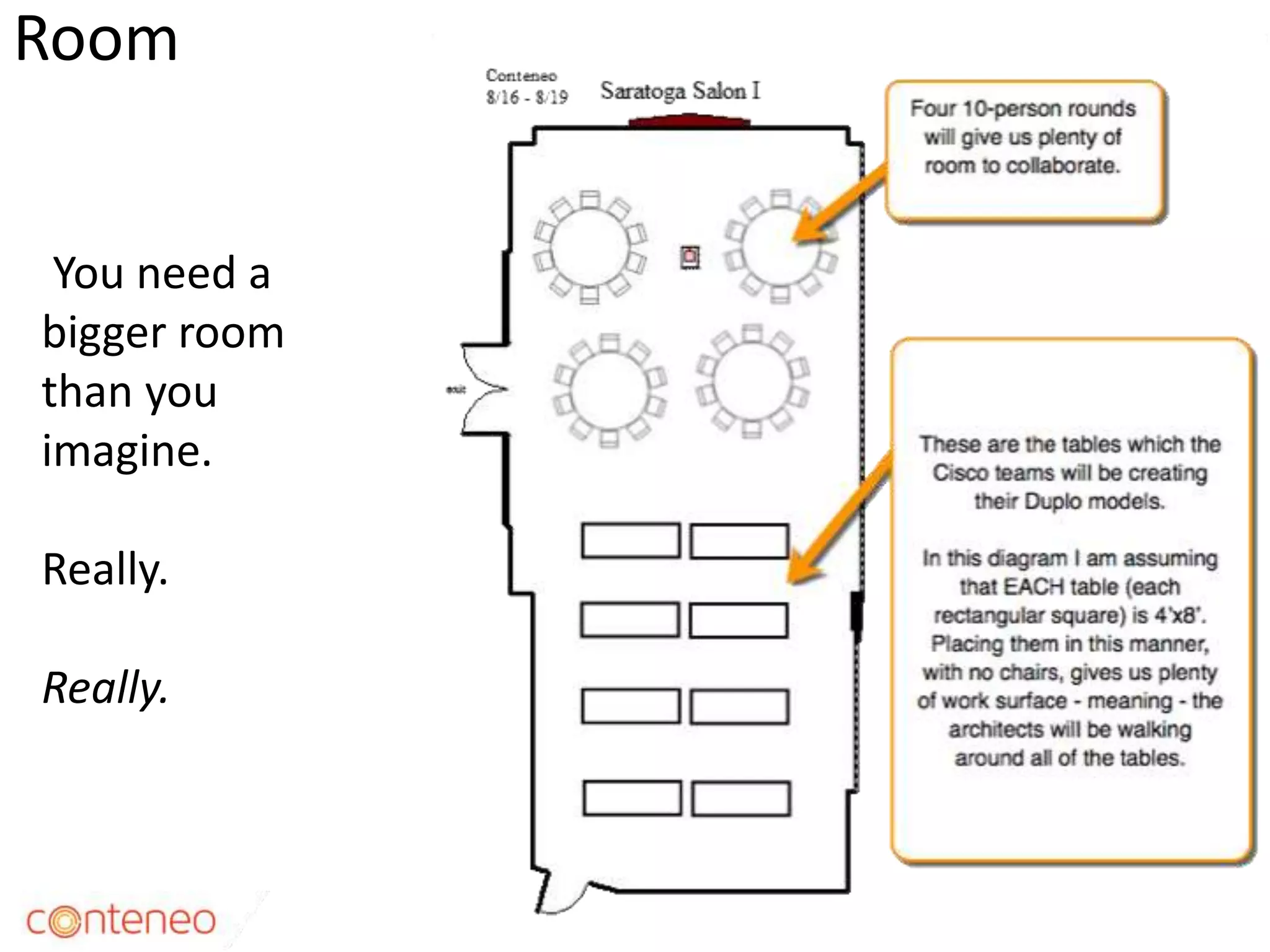
Room
25
You need a
bigger room
than you
imagine.
Really.
Really.
Event Structure
Don’t pack it in… Allow time…
26
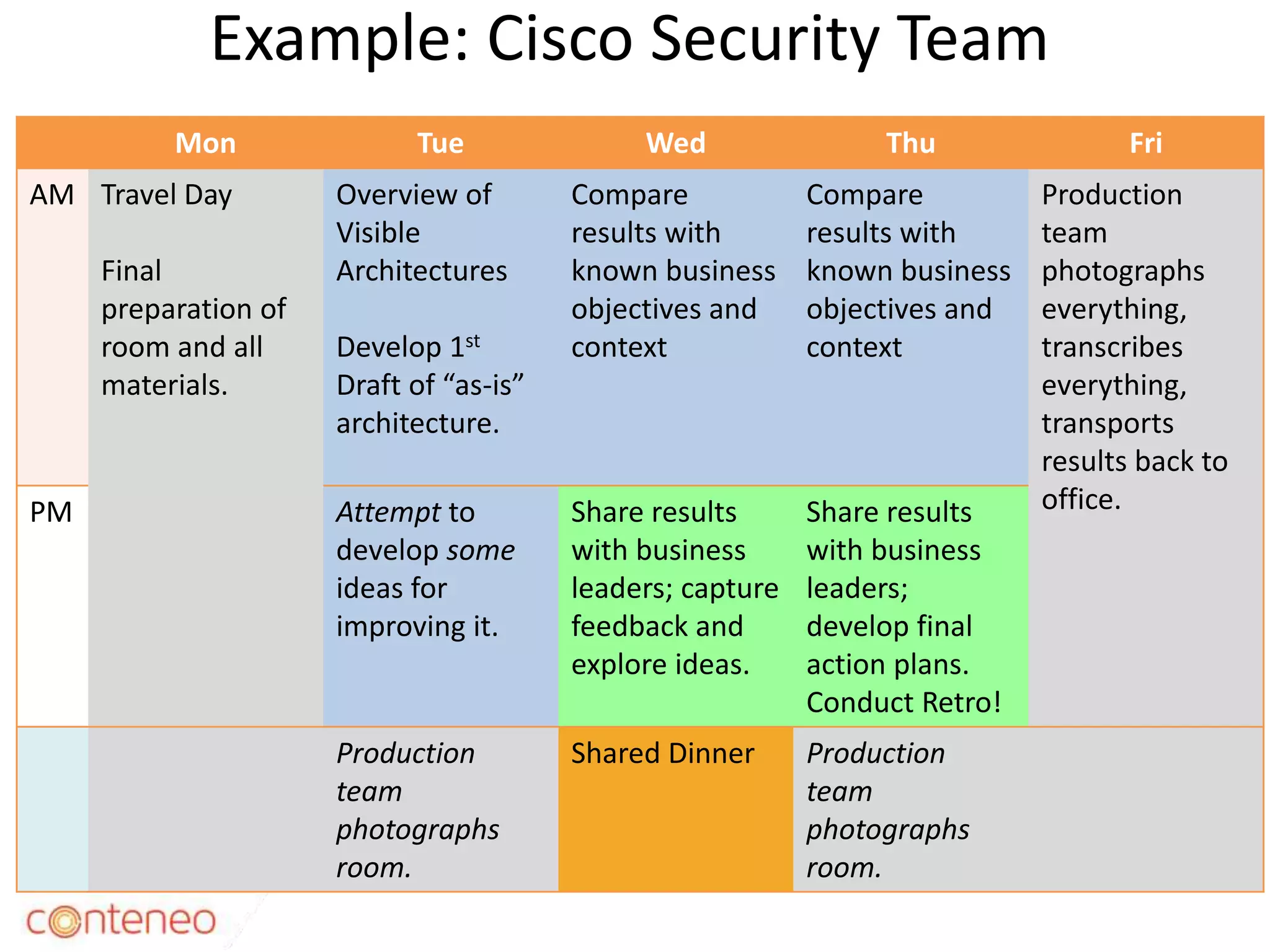
Example: Cisco Security Team
Mon Tue Wed Thu Fri
AM Travel Day
Final
preparation of
room and all
materials.
Overview of
Visible
Architectures
Develop 1st
Draft of “as-is”
architecture.
Compare
results with
known business
objectives and
context
Compare
results with
known business
objectives and
context
Production
team
photographs
everything,
transcribes
everything,
transports
results back to
office.PM Attempt to
develop some
ideas for
improving it.
Share results
with business
leaders; capture
feedback and
explore ideas.
Share results
with business
leaders;
develop final
action plans.
Conduct Retro!
Production
team
photographs
room.
Shared Dinner Production
team
photographs
room.
27
28
Tips
• Either pre-define meaning of bricks or let the
meaning emerge, but either way, keep it clear.
• Let teams extend the core activity
• Cisco added monsters, dinosaurs
• PayU draw a lot of extended diagrams
29
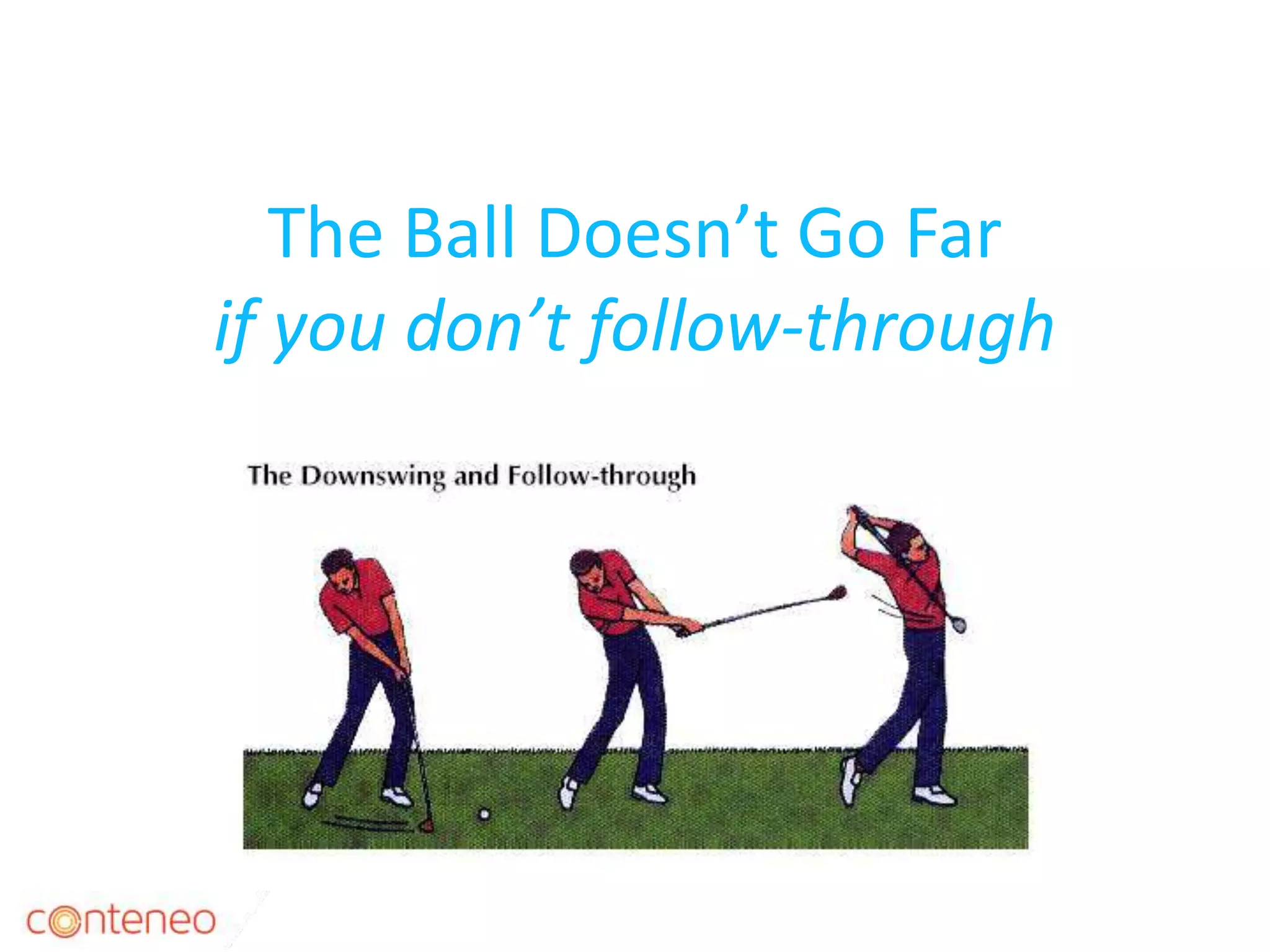
The Ball Doesn’t Go Far
if you don’t follow-through
30
Develop Concrete Projects
• Ideas surfaced in the session need to be converted
into project(s).
• You might need investigative stories, spike sprints,
training tasks, business reviews (e.g., open source
license agreements).
• Try and integrate agility into this.
31
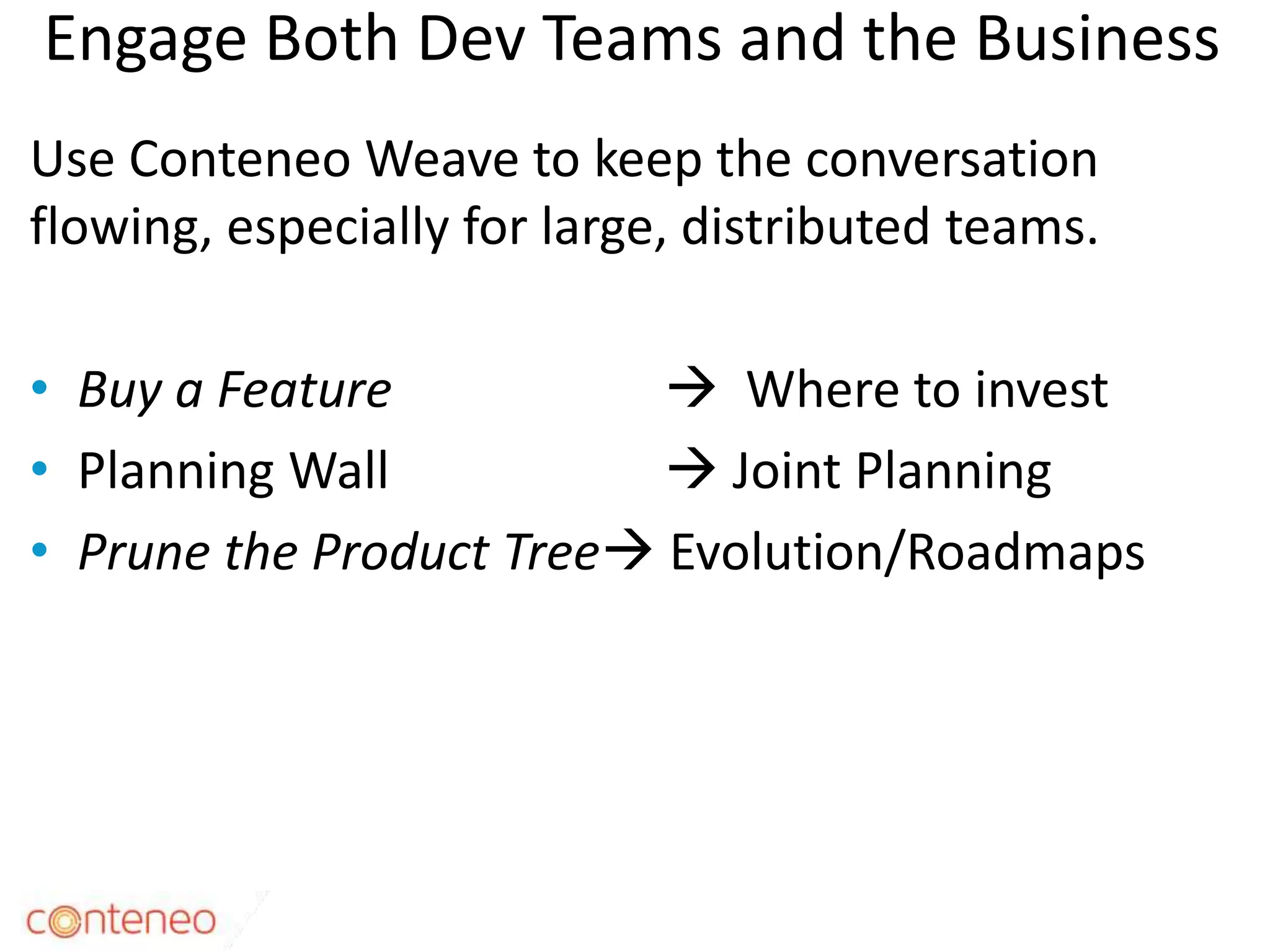
Engage Both Dev Teams and the Business
Use Conteneo Weave to keep the conversation
flowing, especially for large, distributed teams.
• Buy a Feature  Where to invest
• Planning Wall  Joint Planning
• Prune the Product Tree Evolution/Roadmaps
32
If You’re Really Collaborative…
33
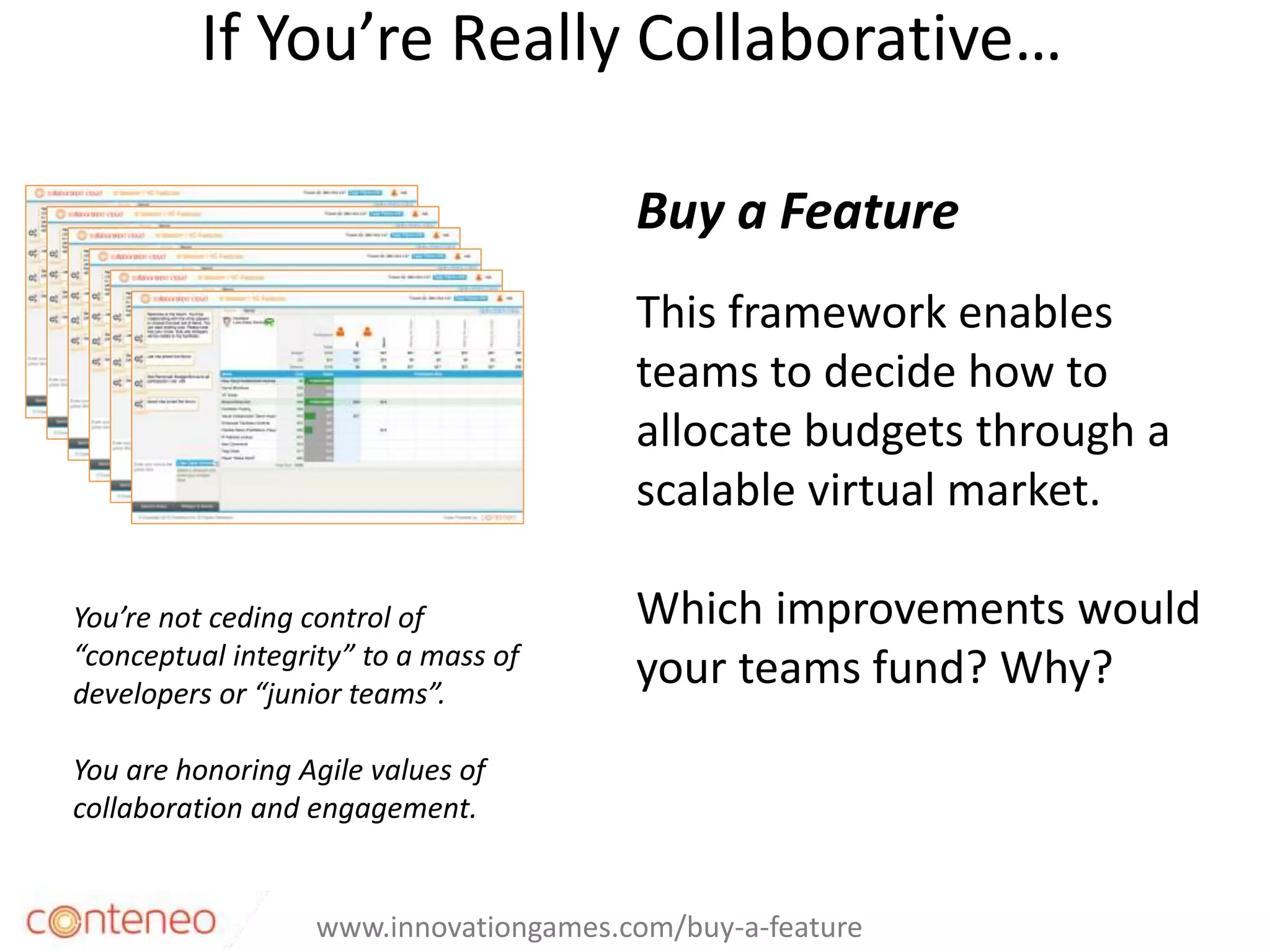
Buy a Feature
This framework enables
teams to decide how to
allocate budgets through a
scalable virtual market.
Which improvements would
your teams fund? Why?
www.innovationgames.com/buy-a-feature
You’re not ceding control of
“conceptual integrity” to a mass of
developers or “junior teams”.
You are honoring Agile values of
collaboration and engagement.
Impact / Effort Matrix (Planning Wall)
34
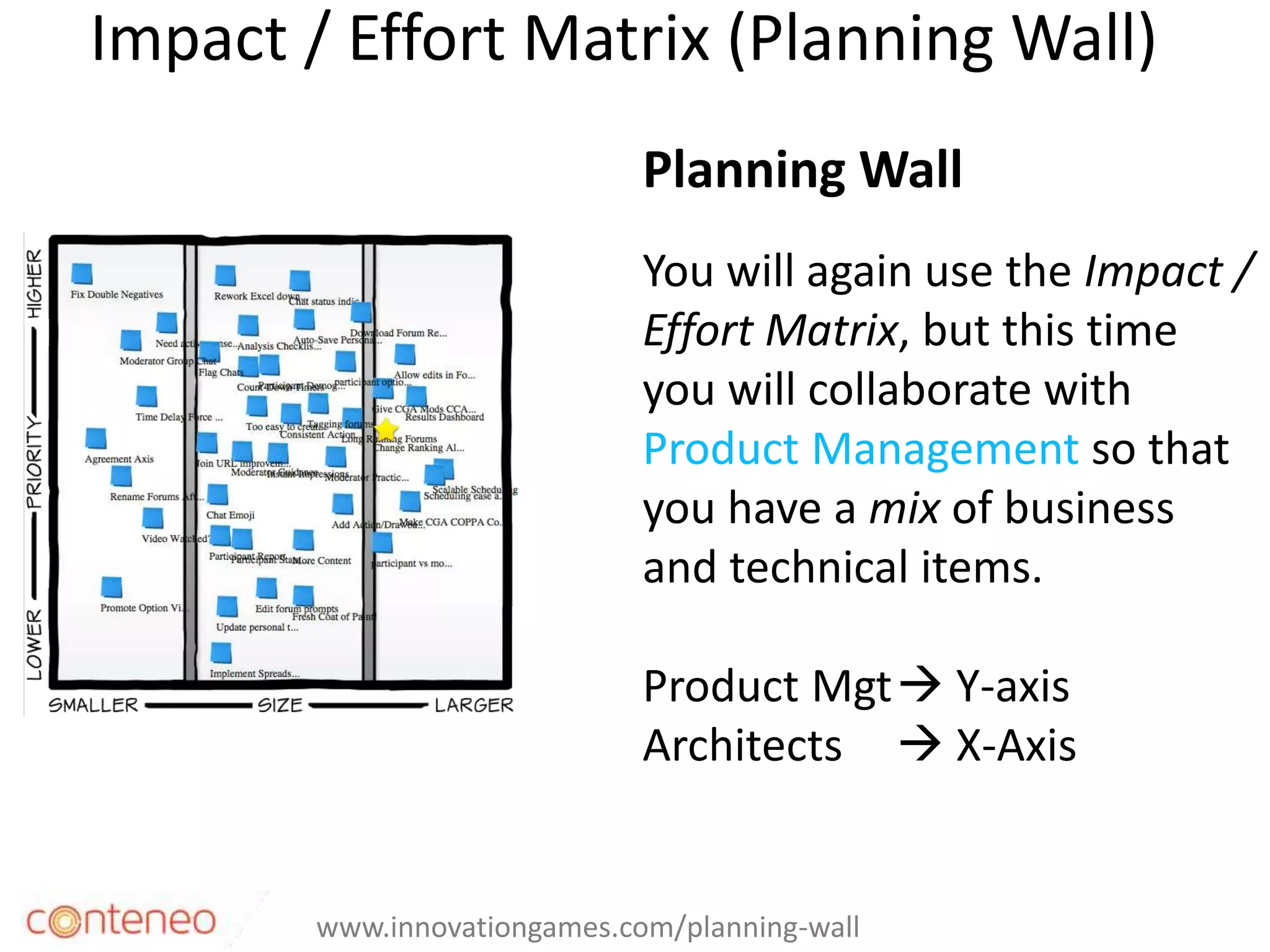
Planning Wall
You will again use the Impact /
Effort Matrix, but this time
you will collaborate with
Product Management so that
you have a mix of business
and technical items.
Product Mgt Y-axis
Architects  X-Axis
www.innovationgames.com/planning-wall
To-beAs-is
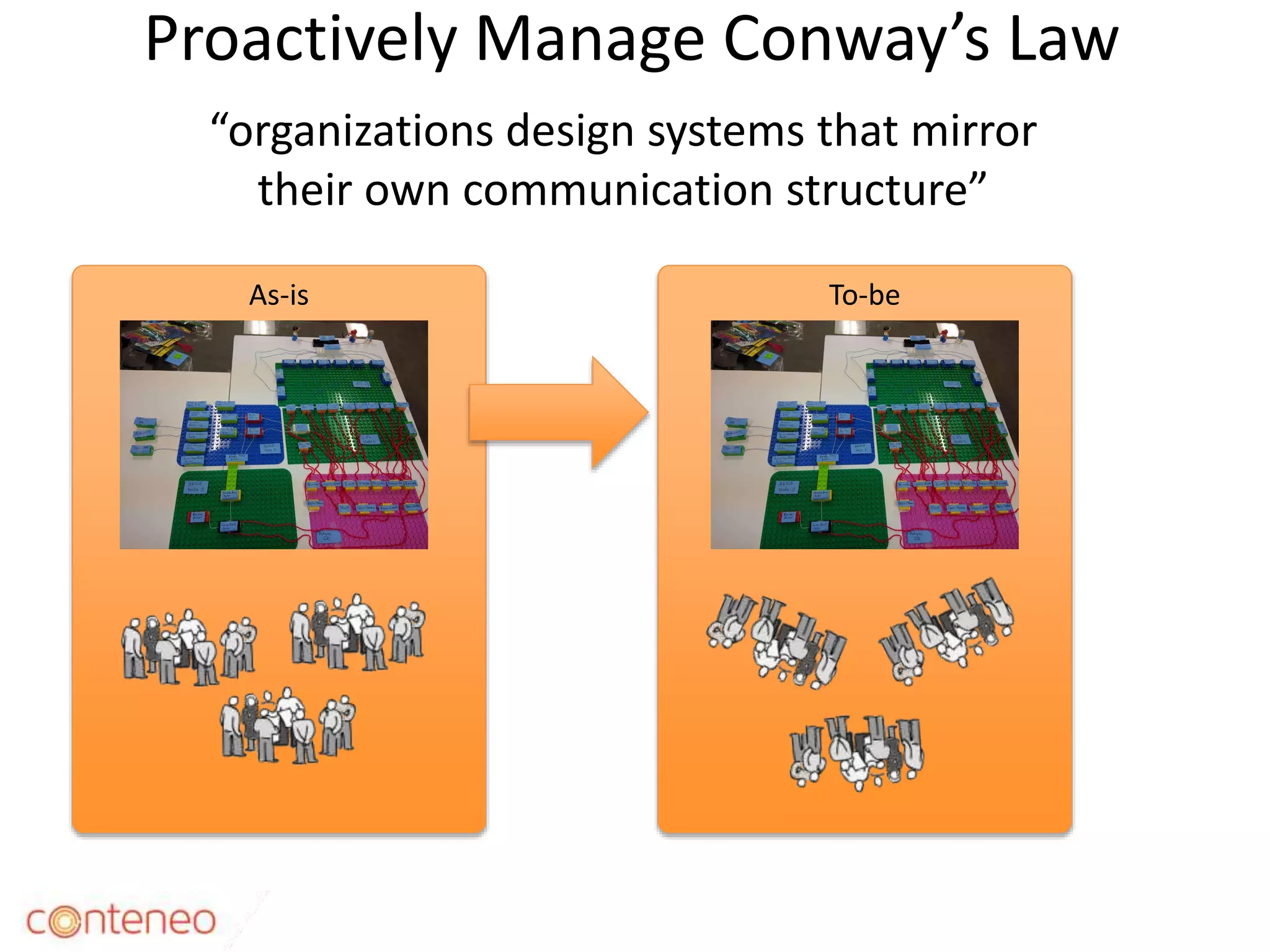
Proactively Manage Conway’s Law
35
“organizations design systems that mirror
their own communication structure”
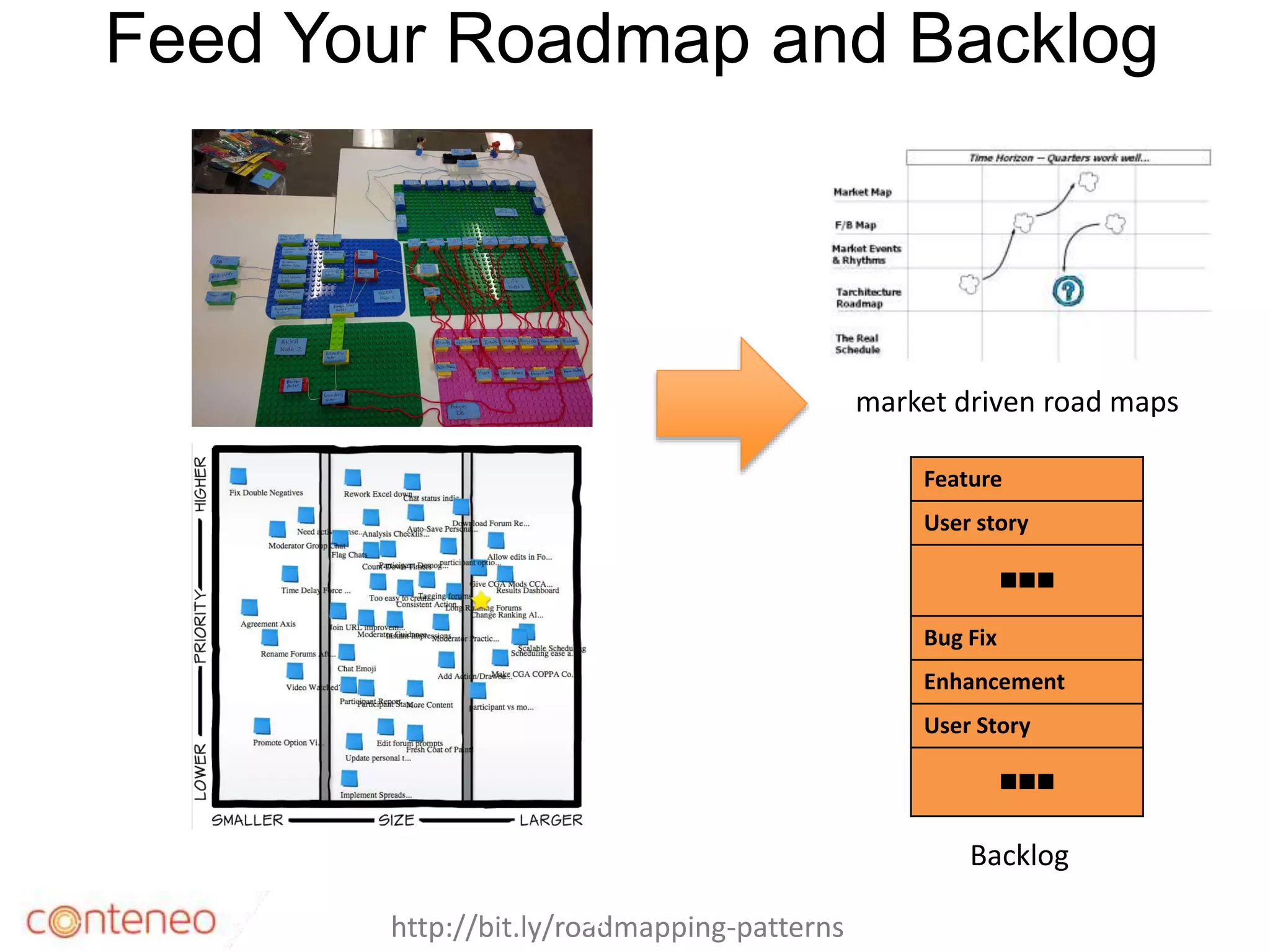
Feed Your Roadmap and Backlog
market driven road maps
Feature
User story

Bug Fix
Enhancement
User Story

Backlog
http://bit.ly/roadmapping-patterns36
Tips
• Keep the visible Architecture, well, visible.
• PayU placed their architecture
directly in their shared meeting
space and used QR codes to
connect Visible Architecture to
intranet.
• Videotape architects presenting the Visible
Architecture to help educate newbies.
37
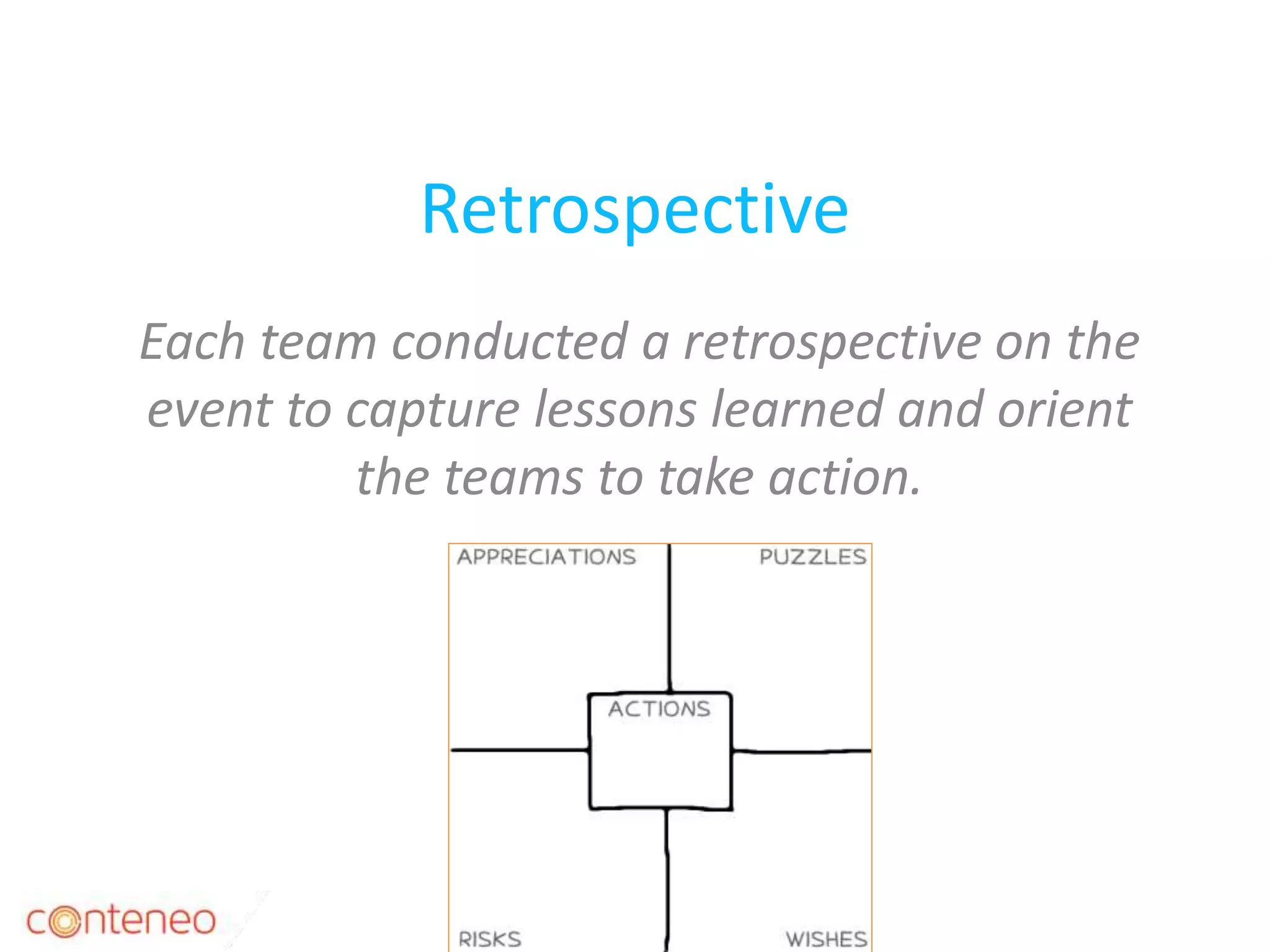
Retrospective
Each team conducted a retrospective on the
event to capture lessons learned and orient
the teams to take action.
38
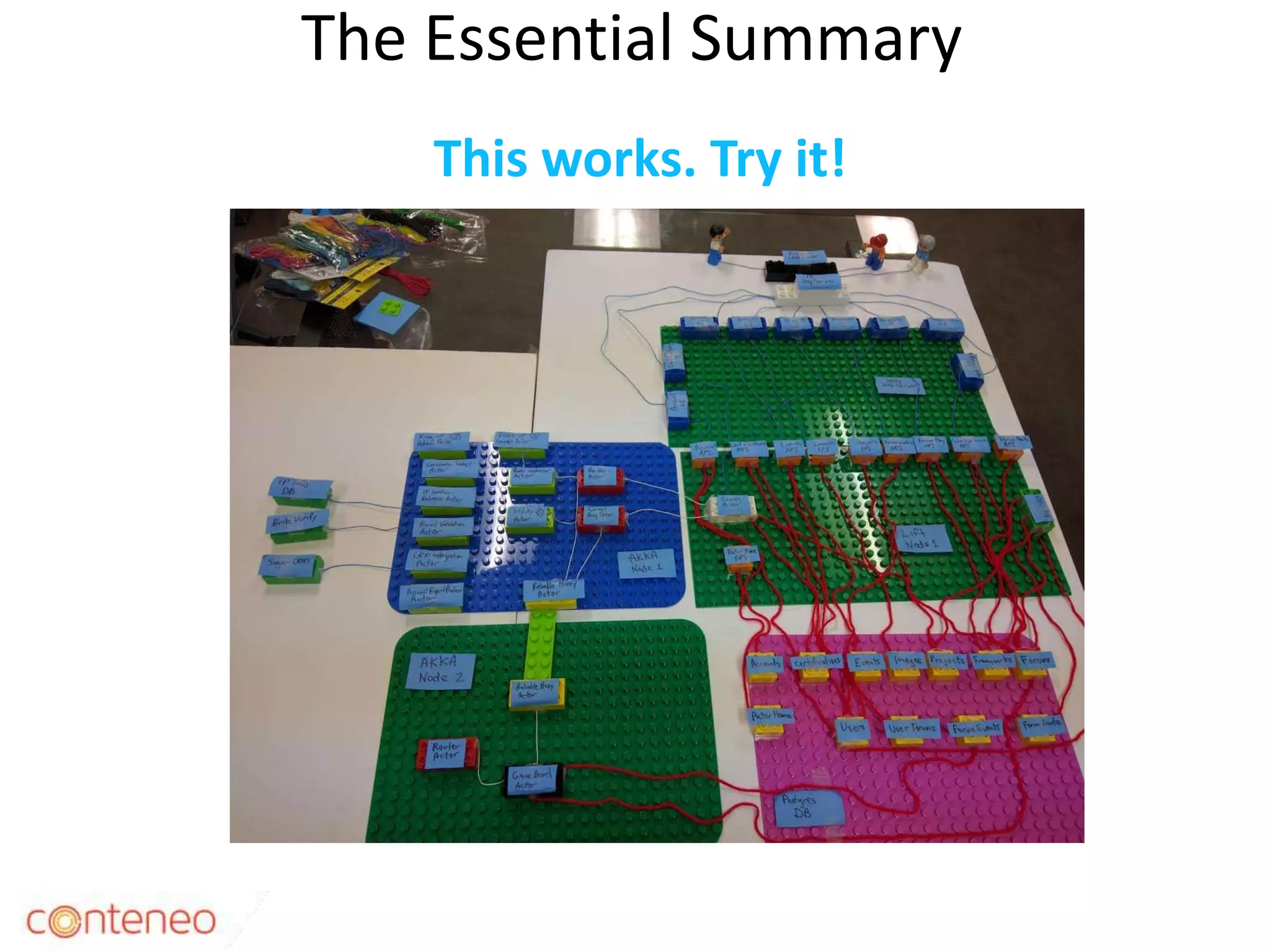
The Essential Summary
This works. Try it!
39
40
1296 Kifer Rd. Suite 601
Sunnyvale, CA 94086
mobile: (408) 529-0319
luke.hohmann@conteneo.co

Visible Architectures

  • 1.
    How to Turn$2000 in Duplo® into $20M in Value Through Visible Architecture Luke Hohmann, Conteneo.co 1
  • 2.
  • 3.
    Agenda 3 What is a Visible Architecture? Whois this guy? Action! Preparing EVENT Post-Processing
  • 4.
    About Luke Hohmann •Founder / CEO of Conteneo • Author, speaker, blogger • Philanthropist 4 Strategic Decision Support Align Teams on Goals & Roles Collaborative Prioritization Visual Thinking
  • 5.
  • 6.
    Visible Architecture 6 A visiblearchitecture is a physical model of a system. Typically created by architecture teams in Duplo® bricks, Visible architectures enable teams to understand the “as-is” architecture and make better choices on the “to-be” architecture. The creative freedom afforded by the technique enables teams to explore challenging concepts. The Conteneo Weave platform.
  • 7.
    WHY? • Business leadersdon't understand architectures • Architects don't often understand each other • Architects don't know how to speak in ways that business leaders can understand and support • Can't make choices that align business and tech • Lots of conflicting ways to communicate (TOFAL, ITIL, SEMAT, UML...) • Dev teams are lost – what’s a microservice? What’s a shared library? What’s a framework? 7
  • 8.
    Expressing Desired Improvements 8 Teamsidentify and document potential improvements: We want to Change <thing to change> From <current state> To <desired state> { because <business reason> in order to <gain this benefit>}. We know we’re done when <criteria for success>. This format helps technical leaders communicate improvements to their business counterparts.
  • 9.
    Impact – EffortMatrices 9 Teams map potential improvements in a matrix comparing business value relative to effort invested. The goal is to identify the highest value, lowest effort improvements. Tip: Create one impact-effort matrix for each platform and the portfolio as a whole.
  • 10.
  • 11.
    Step 0: Framingthe Discussion You can’t just run around yelling “Technical Debt” to make (or scare) the business team into “doing what you want”. 11
  • 12.
    Leverage the LargerBusiness Context • Part of an Agile Transformation? • Part of an acquisition integration? • Moving to microservices? • Increasing collaboration among distributed teams? • Technology refresh? • New business capability enablement? 12
  • 13.
    Preparing Questions 13 will becreating a… in order toVisible Architecture Who? What? Why? Architects from each PayU platform will be creating a Visible Architecture to identify redundancies, outdated code and prepare for our PayU’s move to microservices. Architects will create a Visible Architecture to see which changes will help us remove the most technical debt.
  • 14.
    Detailed Planning 14 how manypeople? where will the data come from? Who? What? How? online or in-person? Facilitators? We expect 18-24 architects, with at least two people from each region. Existing documentation will be used to prepare. We will identify initial ideas online to prepare for an in- person meeting. Conteneo will facilitate the meeting.
  • 15.
  • 16.
    Gather Your Docsand Print in A0 Format 16 Object Translation Transaction Management Domain Model Persistent Store
  • 17.
    Paper is Cheap– Misunderstanding Costs! 17
  • 18.
    Engage Your DevTeams Use Conteneo Weave to surface trends & patterns • Enterprise Retro  Challenges • Curve Jumping  Opportunities • Prune the Product Tree Evolution/Roadmaps 18
  • 19.
    Conduct an EnterpriseRetrospective 19 Sailboat Imagine our system is a sailboat. What are the winds in our sales? What are the anchors that slow us down? www.innovationgames.com/speed-boat
  • 20.
    Tap Into YourOwn Creativity 20 Curve Jump What are the technologies we can leverage to jump a curve?  Conservative  New  Radical
  • 21.
    Develop a Planfor Growth (Roadmap) 21 Prune the Future How should our system grow / evolve / change over time? What should we prune? What infrastructure should we add? www.innovationgames.com/prune-the-product-tree
  • 22.
    You Need Gearand a Place to Play 22
  • 23.
    23 Gear We get ourstuff at Amazon…
  • 24.
    More Gear • Sharpies •String • Foam Core Board • A roll of Large format printer paper • Easel charts • You’re taping stuff to walls, so be respectful • Pens, pencils, paper 24
  • 25.
    Room 25 You need a biggerroom than you imagine. Really. Really.
  • 26.
    Event Structure Don’t packit in… Allow time… 26
  • 27.
    Example: Cisco SecurityTeam Mon Tue Wed Thu Fri AM Travel Day Final preparation of room and all materials. Overview of Visible Architectures Develop 1st Draft of “as-is” architecture. Compare results with known business objectives and context Compare results with known business objectives and context Production team photographs everything, transcribes everything, transports results back to office.PM Attempt to develop some ideas for improving it. Share results with business leaders; capture feedback and explore ideas. Share results with business leaders; develop final action plans. Conduct Retro! Production team photographs room. Shared Dinner Production team photographs room. 27
  • 28.
  • 29.
    Tips • Either pre-definemeaning of bricks or let the meaning emerge, but either way, keep it clear. • Let teams extend the core activity • Cisco added monsters, dinosaurs • PayU draw a lot of extended diagrams 29
  • 30.
    The Ball Doesn’tGo Far if you don’t follow-through 30
  • 31.
    Develop Concrete Projects •Ideas surfaced in the session need to be converted into project(s). • You might need investigative stories, spike sprints, training tasks, business reviews (e.g., open source license agreements). • Try and integrate agility into this. 31
  • 32.
    Engage Both DevTeams and the Business Use Conteneo Weave to keep the conversation flowing, especially for large, distributed teams. • Buy a Feature  Where to invest • Planning Wall  Joint Planning • Prune the Product Tree Evolution/Roadmaps 32
  • 33.
    If You’re ReallyCollaborative… 33 Buy a Feature This framework enables teams to decide how to allocate budgets through a scalable virtual market. Which improvements would your teams fund? Why? www.innovationgames.com/buy-a-feature You’re not ceding control of “conceptual integrity” to a mass of developers or “junior teams”. You are honoring Agile values of collaboration and engagement.
  • 34.
    Impact / EffortMatrix (Planning Wall) 34 Planning Wall You will again use the Impact / Effort Matrix, but this time you will collaborate with Product Management so that you have a mix of business and technical items. Product Mgt Y-axis Architects  X-Axis www.innovationgames.com/planning-wall
  • 35.
    To-beAs-is Proactively Manage Conway’sLaw 35 “organizations design systems that mirror their own communication structure”
  • 36.
    Feed Your Roadmapand Backlog market driven road maps Feature User story  Bug Fix Enhancement User Story  Backlog http://bit.ly/roadmapping-patterns36
  • 37.
    Tips • Keep thevisible Architecture, well, visible. • PayU placed their architecture directly in their shared meeting space and used QR codes to connect Visible Architecture to intranet. • Videotape architects presenting the Visible Architecture to help educate newbies. 37
  • 38.
    Retrospective Each team conducteda retrospective on the event to capture lessons learned and orient the teams to take action. 38
  • 39.
    The Essential Summary Thisworks. Try it! 39
  • 40.
    40 1296 Kifer Rd.Suite 601 Sunnyvale, CA 94086 mobile: (408) 529-0319 luke.hohmann@conteneo.co

Editor's Notes

  • #2 Copyright (c) 2006 by Luke Hohmann
  • #3 * We're going to talk about * A totally playful way to describe system architecture * Something a child (or someone who has little time) can understand * High quality & bandwidth communication This is a visible architecture. We think you should build one. This talk will outline why and how.
  • #4 Our agenda… Who is David and Luke? 1. What is a VA? 2. How to identify as-is and to-be 3. How to prioritize 4. How to make sure your event is a success.
  • #5 Copyright (c) 2010 Enthiosys
  • #6 Copyright (c) 2006 by Luke Hohmann
  • #11 Copyright (c) 2006 by Luke Hohmann
  • #16 Copyright (c) 2006 by Luke Hohmann
  • #17 Yeah, we know they are probably out of date, but gather them anyway
  • #23 Copyright (c) 2006 by Luke Hohmann
  • #24 Add: Sharpies, tape, rolls of paper, Easel paper, flip charts, etc.
  • #27 Copyright (c) 2006 by Luke Hohmann
  • #31 Copyright (c) 2006 by Luke Hohmann
  • #32 Add photo of South Africa team
  • #37 Copyright (c) 2001-2008 by Luke Hohmann
  • #38 Add photo of South Africa team
  • #39 Copyright (c) 2006 by Luke Hohmann