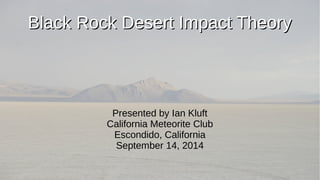
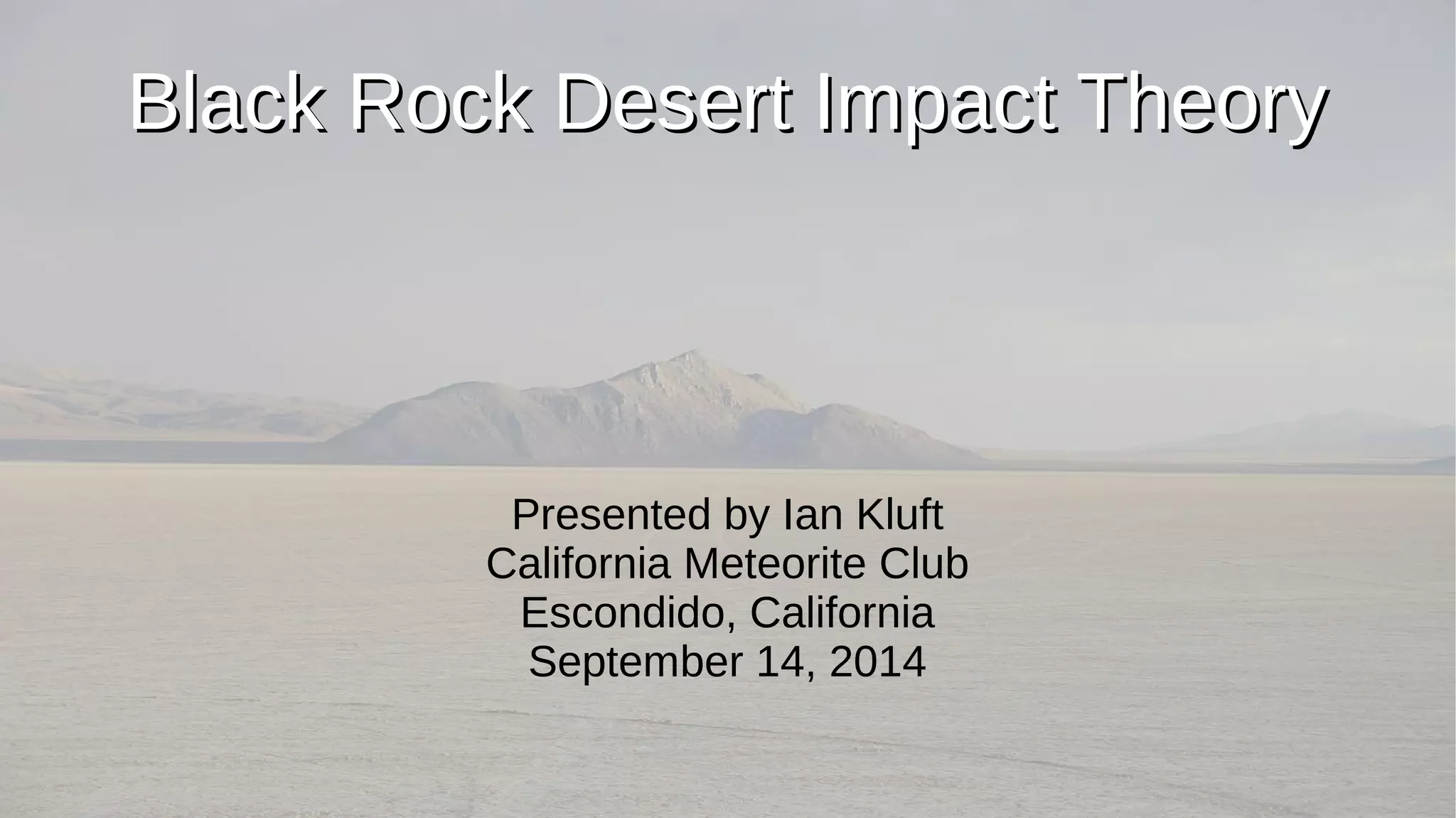
BBllaacckk RRoocckk DDeesseerrtt IImmppaacctt TThheeoorryy 
Presented by Ian Kluft 
California Meteorite Club 
Escondido, California 
September 14, 2014
Black Rock Desert Impact Theory 
● Black Rock Desert is in northwest Nevada 
– 2 hour drive north of Reno 
● This theory proposes an impact structure (eroded crater) 
● Presentation order 
– How the theory started 
– Science of impact craters on Earth 
– Current observations at Black Rock 
– Upcoming research plans
Current research status 
● Scientific method usually goes in this order 
– Propose and test hypotheses 
– Investigate theories 
– Publish peer-reviewed papers 
● This is currently a theory 
● There isn't a peer reviewed paper... yet 
– But that's the goal 
● The evidence one way or the other exists in the rocks 
– The data will tell the story
How the Black Rock Crater Theory started 
● attempts at 1st amateur rocket to space 1998-2004 
● exploring Black Rock Range in rocket search area 2002-2005 
● bizarre rocks, "strangest volcano I've ever seen" 2002-2006 
– I've seen large & small, old and young volcanoes at Mt Shasta area 
– At Black Rock I didn't see volcanic structures: lava flows, cinder cones, etc 
– Some rocks are the right color to look like lava 
● impact crater theory 2007-present 
● outline found in mountains 2009 
● I had to learn about the science of impact crater recognition...
Science of Impact Craters 
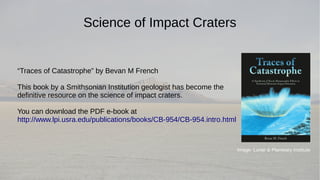
“Traces of Catastrophe” by Bevan M French 
This book by a Smithsonian Institution geologist has become the 
definitive resource on the science of impact craters. 
You can download the PDF e-book at 
http://www.lpi.usra.edu/publications/books/CB-954/CB-954.intro.html 
Image: Lunar & Planetary Institute
Science of Impact Craters 
Differences from traditional Geology 
● "Cryptoexplosion structures" 
– Until the 1960's, geologists didn't believe there were any impact craters on Earth 
– “cryptoexplosion” was used for unexplained explosion structures 
● Slow processes vs instantaneous 
– Traditional geology wants all processes to be over millions of years 
● Impacts are rare on Earth 
– Unlike other rocky bodies in the solar system, Earth slowly erases its craters 
● Enormously energetic 
– Asteroids never make soft landings 
– These are violent explosions that entirely destroy the impactor
Science of Impact Craters 
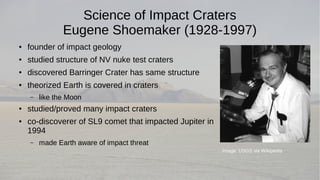
Eugene Shoemaker (1928-1997) 
● founder of impact geology 
● studied structure of NV nuke test craters 
● discovered Barringer Crater has same structure 
● theorized Earth is covered in craters 
– like the Moon 
● studied/proved many impact craters 
● co-discoverer of SL9 comet that impacted Jupiter in 
1994 
– made Earth aware of impact threat 
Image: USGS via Wikipedia
Science of Impact Craters 
Formation of impacts 
● Crater about 10-20 times diameter of impactor 
– Depends mostly on speed - minimum 25,000 mph 
● hypervelocity impact destroys impactor 
– mostly melted 
● contact/compression stage 
– extreme shock on rocks 
● excavation stage 
– explosion blows out crater
Science of Impact Craters 
Formation of impacts (cont'd) 
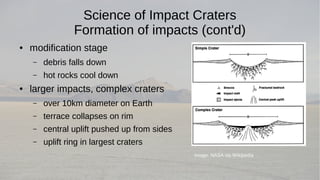
● modification stage 
– debris falls down 
– hot rocks cool down 
● larger impacts, complex craters 
– over 10km diameter on Earth 
– terrace collapses on rim 
– central uplift pushed up from sides 
– uplift ring in largest craters 
Image: NASA via Wikipedia
Science of Impact Craters 
Decay Processes 
● Earth slowly destroys its craters 
● Erosion wears them away 
● Faulting distorts them 
● New layers bury them 
● Plate tectonics slowly erases and renews the crust 
● But the Moon still shows what firing line the Earth is in
Science of Impact Craters 
How to Recognize Them 
● from Traces of Catastrophe, Appendix 1 
● occurs in any kind of bedrock 
● generally single structures 
● generally circular 
● nearly any size: <1km to >100km 
● relatively shallow, not a deep structure
Science of Impact Craters 
How to Recognize Them (cont'd) 
● anomalous feature within region 
– unusual geology in circular area 
– local deformation, faulting, breccias 
– unusual breccias within structure 
– possible central uplift peak or ring 
– shatter cones 
● one form of proof of impact 
● conical shock fractures – even volcanoes can't make them
Science of Impact Craters 
How to Recognize Them (cont'd) 
● Look for geologic mysteries in literature 
– intense, sudden, localized 
– conventional explanations fail 
– unusual “volcanic” explosions 
● Measure geophysical attributes 
– gravity 
– magnetic 
– seismic
Science of Impact Craters 
How to Recognize Them (cont'd) 
● rock types 
– breccias 
● Broken up and re-cemented rocks 
● Always present in impacts, can be formed other ways too 
– melt rocks 
● Igneous rocks, but contents come from melting local target rocks 
● microscopic shock effects 
– Deformation, fracturing, melting 
– Most proof of impact requires an electron microscope
Science of Impact Craters 
How to Recognize Them (cont'd) 
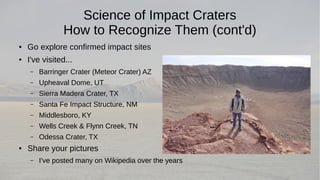
● Go explore confirmed impact sites 
● I've visited... 
– Barringer Crater (Meteor Crater) AZ 
– Upheaval Dome, UT 
– Sierra Madera Crater, TX 
– Santa Fe Impact Structure, NM 
– Middlesboro, KY 
– Wells Creek & Flynn Creek, TN 
– Odessa Crater, TX 
● Share your pictures 
– I've posted many on Wikipedia over the years
Current observations 
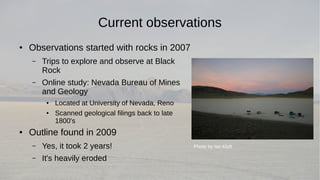
● Observations started with rocks in 2007 
– Trips to explore and observe at Black 
Rock 
– Online study: Nevada Bureau of Mines 
and Geology 
● Located at University of Nevada, Reno 
● Scanned geological filings back to late 
1800's 
● Outline found in 2009 
– Yes, it took 2 years! 
– It's heavily eroded 
Photo by Ian Kluft
Current observations 
(cont'd) 
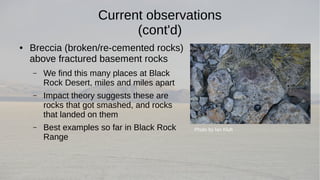
● Breccia (broken/re-cemented rocks) 
above fractured basement rocks 
– We find this many places at Black 
Rock Desert, miles and miles apart 
– Impact theory suggests these are 
rocks that got smashed, and rocks 
that landed on them 
– Best examples so far in Black Rock 
Range 
Photo by Ian Kluft
Current observations 
(cont'd) 
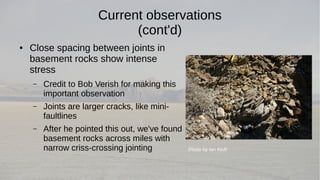
● Close spacing between joints in 
basement rocks show intense 
stress 
– Credit to Bob Verish for making this 
important observation 
– Joints are larger cracks, like mini-faultlines 
– After he pointed this out, we've found 
basement rocks across miles with 
narrow criss-crossing jointing Photo by Ian Kluft
Current observations 
(cont'd) 
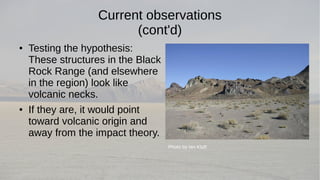
● Testing the hypothesis: 
These structures in the Black 
Rock Range (and elsewhere 
in the region) look like 
volcanic necks. 
● If they are, it would point 
toward volcanic origin and 
away from the impact theory. 
Photo by Ian Kluft
Current observations 
(cont'd) 
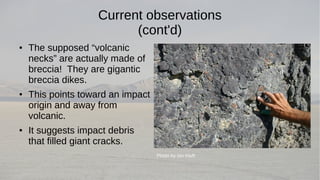
● The supposed “volcanic 
necks” are actually made of 
breccia! They are gigantic 
breccia dikes. 
● This points toward an impact 
origin and away from 
volcanic. 
● It suggests impact debris 
that filled giant cracks. 
Photo by Ian Kluft
Current observations 
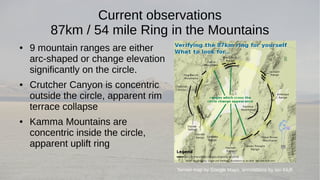
87km / 54 mile Ring in the Mountains 
● 9 mountain ranges are either 
arc-shaped or change elevation 
significantly on the circle. 
● Crutcher Canyon is concentric 
outside the circle, apparent rim 
terrace collapse 
● Kamma Mountains are 
concentric inside the circle, 
apparent uplift ring 
Terrain map by Google Maps, annotations by Ian Kluft
Current observations 
87km / 54 mile Ring in the Mountains (cont'd) 
● All the highest peaks of the Black Rock region are on the circle. 
● All streams in the Black Rock watershed flow into the circle and 
sink into the playa. 
– The Quinn River Sink (lowest point) is at the center of the circle. 
● Volcanoes do not make nice circles on this scale! 
– Compare to Yellowstone Caldera: 55x72km / 34x45 miles 
– The scale and quality of the circle point to an impact, not a volcano
Current observations 
Why no shatter cones? 
● Shatter cones are only proof of impact that don't require an 
electron microscope 
● At first I wanted to focus on looking for them 
– It seemed easier 
● Shatter cones occur in a very small percentage of the radius 
– At Black Rock, there is apparently an uplift ring 
– So the bedrock at the center is buried under the lakebed 
● I realized this while visiting Middlesboro Crater in Kentucky
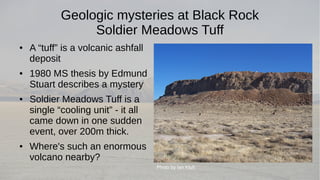
Geologic mysteries at Black Rock 
Soldier Meadows Tuff 
● A “tuff” is a volcanic ashfall 
deposit 
● 1980 MS thesis by Edmund 
Stuart describes a mystery 
● Soldier Meadows Tuff is a 
single “cooling unit” - it all 
came down in one sudden 
event, over 200m thick. 
● Where's such an enormous 
volcano nearby? 
Photo by Ian Kluft
Geologic mysteries at Black Rock 
Soldier Meadows Tuff (cont'd) 
● Impact theory suggestions about Soldier Meadows Tuff 
– It is located just outside the 87km ring where ejecta is expected 
– It would have landed in one sudden event, as observed 
– It would be very thick just outside the rim, as observed 
– Under the impact theory, it should be an impact ejecta layer 
– For an impact this size, the ejecta layer should be very thick
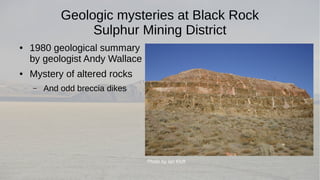
Geologic mysteries at Black Rock 
Sulphur Mining District 
● 1980 geological summary 
by geologist Andy Wallace 
● Mystery of altered rocks 
– And odd breccia dikes 
Photo by Ian Kluft
Geologic mysteries at Black Rock 
Sulphur Mining District (cont'd) 
● “White breccia” rock layer feeds down into cracks 
– Mystery how those were altered but not the rocks below 
– Also increasing “volcanic” rocks as layers go up 
● still old rocks from below too 
● impacts do that – volcanoes don't 
– Doesn't fit well with presumed hydrothermal alteration 
– Fits well with alteration and melting from an impact 
● Big fragments land first, followed by smaller rocks, increasing melt 
● Suggests the “volcanic” rocks are actually impact melt
Upcoming research plans 
● Find an electron microscope 
– Not just any scope 
– We need a lab with experience recognizing impact shock effects 
● For example, shocked quartz 
● Aerial video of mountains around rim 
– Not proof itself, potential for interesting data collection 
● Write a paper 
– Co-authored with Bob Verish and others who contribute to the effort
Conclusions 
● An 87km / 54mile impact structure at Black Rock, if confirmed, 
would be the second largest in America. 
– The largest is the 90km Chesapeake Bay Crater. 
– You can't visit Chesapeake Bay crater because it's all buried. 
● Most of Black Rock region is federal lands 
– Anyone can go there. 
– It's a tremendous opportunity for any researchers to study it. 
– It could be a big resource for education about impacts.
Questions? 
Thank you!

Black Rock Desert Impact Theory

  • 1.
    BBllaacckk RRoocckk DDeesseerrttIImmppaacctt TThheeoorryy Presented by Ian Kluft California Meteorite Club Escondido, California September 14, 2014
  • 2.
    Black Rock DesertImpact Theory ● Black Rock Desert is in northwest Nevada – 2 hour drive north of Reno ● This theory proposes an impact structure (eroded crater) ● Presentation order – How the theory started – Science of impact craters on Earth – Current observations at Black Rock – Upcoming research plans
  • 3.
    Current research status ● Scientific method usually goes in this order – Propose and test hypotheses – Investigate theories – Publish peer-reviewed papers ● This is currently a theory ● There isn't a peer reviewed paper... yet – But that's the goal ● The evidence one way or the other exists in the rocks – The data will tell the story
  • 4.
    How the BlackRock Crater Theory started ● attempts at 1st amateur rocket to space 1998-2004 ● exploring Black Rock Range in rocket search area 2002-2005 ● bizarre rocks, "strangest volcano I've ever seen" 2002-2006 – I've seen large & small, old and young volcanoes at Mt Shasta area – At Black Rock I didn't see volcanic structures: lava flows, cinder cones, etc – Some rocks are the right color to look like lava ● impact crater theory 2007-present ● outline found in mountains 2009 ● I had to learn about the science of impact crater recognition...
  • 5.
    Science of ImpactCraters “Traces of Catastrophe” by Bevan M French This book by a Smithsonian Institution geologist has become the definitive resource on the science of impact craters. You can download the PDF e-book at http://www.lpi.usra.edu/publications/books/CB-954/CB-954.intro.html Image: Lunar & Planetary Institute
  • 6.
    Science of ImpactCraters Differences from traditional Geology ● "Cryptoexplosion structures" – Until the 1960's, geologists didn't believe there were any impact craters on Earth – “cryptoexplosion” was used for unexplained explosion structures ● Slow processes vs instantaneous – Traditional geology wants all processes to be over millions of years ● Impacts are rare on Earth – Unlike other rocky bodies in the solar system, Earth slowly erases its craters ● Enormously energetic – Asteroids never make soft landings – These are violent explosions that entirely destroy the impactor
  • 7.
    Science of ImpactCraters Eugene Shoemaker (1928-1997) ● founder of impact geology ● studied structure of NV nuke test craters ● discovered Barringer Crater has same structure ● theorized Earth is covered in craters – like the Moon ● studied/proved many impact craters ● co-discoverer of SL9 comet that impacted Jupiter in 1994 – made Earth aware of impact threat Image: USGS via Wikipedia
  • 8.
    Science of ImpactCraters Formation of impacts ● Crater about 10-20 times diameter of impactor – Depends mostly on speed - minimum 25,000 mph ● hypervelocity impact destroys impactor – mostly melted ● contact/compression stage – extreme shock on rocks ● excavation stage – explosion blows out crater
  • 9.
    Science of ImpactCraters Formation of impacts (cont'd) ● modification stage – debris falls down – hot rocks cool down ● larger impacts, complex craters – over 10km diameter on Earth – terrace collapses on rim – central uplift pushed up from sides – uplift ring in largest craters Image: NASA via Wikipedia
  • 10.
    Science of ImpactCraters Decay Processes ● Earth slowly destroys its craters ● Erosion wears them away ● Faulting distorts them ● New layers bury them ● Plate tectonics slowly erases and renews the crust ● But the Moon still shows what firing line the Earth is in
  • 11.
    Science of ImpactCraters How to Recognize Them ● from Traces of Catastrophe, Appendix 1 ● occurs in any kind of bedrock ● generally single structures ● generally circular ● nearly any size: <1km to >100km ● relatively shallow, not a deep structure
  • 12.
    Science of ImpactCraters How to Recognize Them (cont'd) ● anomalous feature within region – unusual geology in circular area – local deformation, faulting, breccias – unusual breccias within structure – possible central uplift peak or ring – shatter cones ● one form of proof of impact ● conical shock fractures – even volcanoes can't make them
  • 13.
    Science of ImpactCraters How to Recognize Them (cont'd) ● Look for geologic mysteries in literature – intense, sudden, localized – conventional explanations fail – unusual “volcanic” explosions ● Measure geophysical attributes – gravity – magnetic – seismic
  • 14.
    Science of ImpactCraters How to Recognize Them (cont'd) ● rock types – breccias ● Broken up and re-cemented rocks ● Always present in impacts, can be formed other ways too – melt rocks ● Igneous rocks, but contents come from melting local target rocks ● microscopic shock effects – Deformation, fracturing, melting – Most proof of impact requires an electron microscope
  • 15.
    Science of ImpactCraters How to Recognize Them (cont'd) ● Go explore confirmed impact sites ● I've visited... – Barringer Crater (Meteor Crater) AZ – Upheaval Dome, UT – Sierra Madera Crater, TX – Santa Fe Impact Structure, NM – Middlesboro, KY – Wells Creek & Flynn Creek, TN – Odessa Crater, TX ● Share your pictures – I've posted many on Wikipedia over the years
  • 16.
    Current observations ●Observations started with rocks in 2007 – Trips to explore and observe at Black Rock – Online study: Nevada Bureau of Mines and Geology ● Located at University of Nevada, Reno ● Scanned geological filings back to late 1800's ● Outline found in 2009 – Yes, it took 2 years! – It's heavily eroded Photo by Ian Kluft
  • 17.
    Current observations (cont'd) ● Breccia (broken/re-cemented rocks) above fractured basement rocks – We find this many places at Black Rock Desert, miles and miles apart – Impact theory suggests these are rocks that got smashed, and rocks that landed on them – Best examples so far in Black Rock Range Photo by Ian Kluft
  • 18.
    Current observations (cont'd) ● Close spacing between joints in basement rocks show intense stress – Credit to Bob Verish for making this important observation – Joints are larger cracks, like mini-faultlines – After he pointed this out, we've found basement rocks across miles with narrow criss-crossing jointing Photo by Ian Kluft
  • 19.
    Current observations (cont'd) ● Testing the hypothesis: These structures in the Black Rock Range (and elsewhere in the region) look like volcanic necks. ● If they are, it would point toward volcanic origin and away from the impact theory. Photo by Ian Kluft
  • 20.
    Current observations (cont'd) ● The supposed “volcanic necks” are actually made of breccia! They are gigantic breccia dikes. ● This points toward an impact origin and away from volcanic. ● It suggests impact debris that filled giant cracks. Photo by Ian Kluft
  • 21.
    Current observations 87km/ 54 mile Ring in the Mountains ● 9 mountain ranges are either arc-shaped or change elevation significantly on the circle. ● Crutcher Canyon is concentric outside the circle, apparent rim terrace collapse ● Kamma Mountains are concentric inside the circle, apparent uplift ring Terrain map by Google Maps, annotations by Ian Kluft
  • 22.
    Current observations 87km/ 54 mile Ring in the Mountains (cont'd) ● All the highest peaks of the Black Rock region are on the circle. ● All streams in the Black Rock watershed flow into the circle and sink into the playa. – The Quinn River Sink (lowest point) is at the center of the circle. ● Volcanoes do not make nice circles on this scale! – Compare to Yellowstone Caldera: 55x72km / 34x45 miles – The scale and quality of the circle point to an impact, not a volcano
  • 23.
    Current observations Whyno shatter cones? ● Shatter cones are only proof of impact that don't require an electron microscope ● At first I wanted to focus on looking for them – It seemed easier ● Shatter cones occur in a very small percentage of the radius – At Black Rock, there is apparently an uplift ring – So the bedrock at the center is buried under the lakebed ● I realized this while visiting Middlesboro Crater in Kentucky
  • 24.
    Geologic mysteries atBlack Rock Soldier Meadows Tuff ● A “tuff” is a volcanic ashfall deposit ● 1980 MS thesis by Edmund Stuart describes a mystery ● Soldier Meadows Tuff is a single “cooling unit” - it all came down in one sudden event, over 200m thick. ● Where's such an enormous volcano nearby? Photo by Ian Kluft
  • 25.
    Geologic mysteries atBlack Rock Soldier Meadows Tuff (cont'd) ● Impact theory suggestions about Soldier Meadows Tuff – It is located just outside the 87km ring where ejecta is expected – It would have landed in one sudden event, as observed – It would be very thick just outside the rim, as observed – Under the impact theory, it should be an impact ejecta layer – For an impact this size, the ejecta layer should be very thick
  • 26.
    Geologic mysteries atBlack Rock Sulphur Mining District ● 1980 geological summary by geologist Andy Wallace ● Mystery of altered rocks – And odd breccia dikes Photo by Ian Kluft
  • 27.
    Geologic mysteries atBlack Rock Sulphur Mining District (cont'd) ● “White breccia” rock layer feeds down into cracks – Mystery how those were altered but not the rocks below – Also increasing “volcanic” rocks as layers go up ● still old rocks from below too ● impacts do that – volcanoes don't – Doesn't fit well with presumed hydrothermal alteration – Fits well with alteration and melting from an impact ● Big fragments land first, followed by smaller rocks, increasing melt ● Suggests the “volcanic” rocks are actually impact melt
  • 28.
    Upcoming research plans ● Find an electron microscope – Not just any scope – We need a lab with experience recognizing impact shock effects ● For example, shocked quartz ● Aerial video of mountains around rim – Not proof itself, potential for interesting data collection ● Write a paper – Co-authored with Bob Verish and others who contribute to the effort
  • 29.
    Conclusions ● An87km / 54mile impact structure at Black Rock, if confirmed, would be the second largest in America. – The largest is the 90km Chesapeake Bay Crater. – You can't visit Chesapeake Bay crater because it's all buried. ● Most of Black Rock region is federal lands – Anyone can go there. – It's a tremendous opportunity for any researchers to study it. – It could be a big resource for education about impacts.
  • 30.