Scriptwriting- Structures
Learning Aims
• MUST be able to discuss various script structures in
your research and generate your own script
structure
• SHOULD be able to write out your own plot
structure based on what you have learned in your
proposal
• COULD use the terminology related to structure in
your proposal
10 minute research task- carrying on from last
session.
• What is the heros journey technique?
• What is the sequence approach?
• What is the 11 step story structure?
• Use the research links on Moodle and add to your research portfolio with
your own comments and interpretation of them.
• This is only a short task!
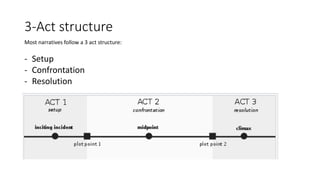
3-Act structure
Most narratives follow a 3 act structure:
- Setup
- Confrontation
- Resolution
Drama as the story progresses
• As the story progresses the plot usually poses a question (act 2,
confrontation) for example:
• Will the hero win?
• Will the boy get the girl?
• Will the detective solve the mystery?
• Is he a good guy or a bad guy?
These questions are then often answered in the climax of the story. (act 3
resolution)
What question do you want to pose
throughout your script?
• Write this down in your script proposal.
The First Act
• The first act is usually used to establish the main characters and deliver
exposition (background information).
• Then something happens in the first act known as the inciting incident, this
triggers events that confront the main character.
• The protagonist (main character) attempts to deal with this, and this leads
to a second more dramatic incident known as the first plot point.
• This does the following
• signals the end of the first act,
• ensures that life will never be the same for the protagonist
• Raises a dramatic question
Give examples of the following for your story:
• Your protagonist
• Exposition
• Inciting incident
• The first plot point
The Second Act
• This can be referred to as the rising action and usually depicts the protagonists attempts
to resolve the problem posed in the first plot point. This usually results in worsening
problems.
• At this point the protagonist does not always have the skills to deal with the forces of
antagonism.
• They must learn new skills, and in doing so they often learn more about who they are
and what they are capable of, which in turn changes who they are (character arc).
• Often they can not achieve this alone and need mentors, or co-protagonists to help
them.
• This usually ends with them setting out to conquer their conflict/ antagonist known as
the second sub plot
Discuss your story with your partner, be ready
to share.
• How your protagonist responds after plot point 1?
• How does this make the situation worse?
• What skills are they lacking?
• How does this make them question who they are?
• What help do they need?
• How do they set out to change their situation?
• What do they need to do next?
The Third Act
• This is the resolution of the story and it’s sub plots
• The climax is the most intense part of the story and where those
initial questions are answered.
• This leaves the protagonist with a greater sense of who they really
are.
Write down
• What is the big dramatic ending?
• How does the conflict in the final scene end?
• What does this mean for your character?
• How has your initial question been answered?
• What does this mean for your character now/ how has this changed
them?
This can be easily explained in a fairy-tale
story format
• Once upon a time there live a… (protagonist)
• Who….. (exposition)
• But…. (inciting incident)
• So one day it happened that…. (plot point one)
• And as a result of which…. (resolution)
In your script proposal, write your plans for
the following:
• Setup
• Plot point 1
• Conflict
• Plot point 2
• Resolution
• Take into account what you have learned and integrate this into your
proposal

Scriptwriting hnd wk5

  • 1.
  • 2.
    Learning Aims • MUSTbe able to discuss various script structures in your research and generate your own script structure • SHOULD be able to write out your own plot structure based on what you have learned in your proposal • COULD use the terminology related to structure in your proposal
  • 3.
    10 minute researchtask- carrying on from last session. • What is the heros journey technique? • What is the sequence approach? • What is the 11 step story structure? • Use the research links on Moodle and add to your research portfolio with your own comments and interpretation of them. • This is only a short task!
  • 4.
    3-Act structure Most narrativesfollow a 3 act structure: - Setup - Confrontation - Resolution
  • 5.
    Drama as thestory progresses • As the story progresses the plot usually poses a question (act 2, confrontation) for example: • Will the hero win? • Will the boy get the girl? • Will the detective solve the mystery? • Is he a good guy or a bad guy? These questions are then often answered in the climax of the story. (act 3 resolution)
  • 6.
    What question doyou want to pose throughout your script? • Write this down in your script proposal.
  • 7.
    The First Act •The first act is usually used to establish the main characters and deliver exposition (background information). • Then something happens in the first act known as the inciting incident, this triggers events that confront the main character. • The protagonist (main character) attempts to deal with this, and this leads to a second more dramatic incident known as the first plot point. • This does the following • signals the end of the first act, • ensures that life will never be the same for the protagonist • Raises a dramatic question
  • 8.
    Give examples ofthe following for your story: • Your protagonist • Exposition • Inciting incident • The first plot point
  • 9.
    The Second Act •This can be referred to as the rising action and usually depicts the protagonists attempts to resolve the problem posed in the first plot point. This usually results in worsening problems. • At this point the protagonist does not always have the skills to deal with the forces of antagonism. • They must learn new skills, and in doing so they often learn more about who they are and what they are capable of, which in turn changes who they are (character arc). • Often they can not achieve this alone and need mentors, or co-protagonists to help them. • This usually ends with them setting out to conquer their conflict/ antagonist known as the second sub plot
  • 10.
    Discuss your storywith your partner, be ready to share. • How your protagonist responds after plot point 1? • How does this make the situation worse? • What skills are they lacking? • How does this make them question who they are? • What help do they need? • How do they set out to change their situation? • What do they need to do next?
  • 11.
    The Third Act •This is the resolution of the story and it’s sub plots • The climax is the most intense part of the story and where those initial questions are answered. • This leaves the protagonist with a greater sense of who they really are.
  • 12.
    Write down • Whatis the big dramatic ending? • How does the conflict in the final scene end? • What does this mean for your character? • How has your initial question been answered? • What does this mean for your character now/ how has this changed them?
  • 13.
    This can beeasily explained in a fairy-tale story format • Once upon a time there live a… (protagonist) • Who….. (exposition) • But…. (inciting incident) • So one day it happened that…. (plot point one) • And as a result of which…. (resolution)
  • 14.
    In your scriptproposal, write your plans for the following: • Setup • Plot point 1 • Conflict • Plot point 2 • Resolution • Take into account what you have learned and integrate this into your proposal