The OPAC and the Web:
           Harmonious Future or Perpetual Discord?

                     Heather Lea Moulaison and Rebecca Thompson
                              Missouri Library Association
                               2011 Annual Conference
                                    October 6, 2011
                    (Awareness session : basic information on a topic)


Slide 1, The OPAC and the web
H. L. Moulaison & R. Thompson
Presenter: Heather Lea Moulaison, @libacat
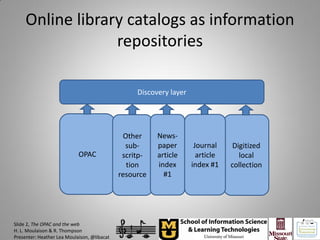
Online library catalogs as information
                  repositories

                                                  Discovery layer


                                              Other     News-
                                               sub-     paper        Journal     Digitized
                            OPAC              scritp-   article       article      local
                                               tion     index       index #1    collection
                                             resource     #1


Slide 2, The OPAC and the web
H. L. Moulaison & R. Thompson
Presenter: Heather Lea Moulaison, @libacat
Other information repositories
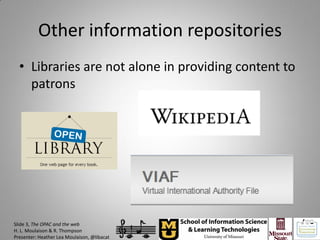
  • Libraries are not alone in providing content to
    patrons


Slide 3, The OPAC and the web
H. L. Moulaison & R. Thompson
Presenter: Heather Lea Moulaison, @libacat
Changes afoot: Library users
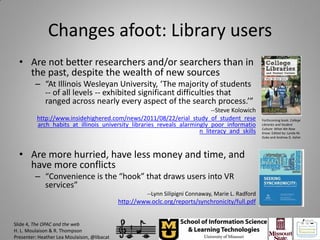
  • Are not better researchers and/or searchers than in
    the past, despite the wealth of new sources
         – “At Illinois Wesleyan University, ‘The majority of students
           -- of all levels -- exhibited significant difficulties that
           ranged across nearly every aspect of the search process.’”
                                                                           --Steve Kolowich
          http://www.insidehighered.com/news/2011/08/22/erial_study_of_student_rese                  Forthcoming book: College
          arch_habits_at_illinois_university_libraries_reveals_alarmingly_poor_informatio            Libraries and Student
                                                                                                     Culture: What We Now
                                                                      n_literacy_and_skills          Know. Edited by: Lynda M.
                                                                                                     Duke and Andrew D. Asher


  • Are more hurried, have less money and time, and
    have more conflicts
         – “Convenience is the “hook” that draws users into VR
           services”
                                                       --Lynn Silipigni Connaway, Marie L. Radford
                                             http://www.oclc.org/reports/synchronicity/full.pdf


Slide 4, The OPAC and the web
H. L. Moulaison & R. Thompson
Presenter: Heather Lea Moulaison, @libacat
Changes afoot: Library systems
  • In our systems
         – Web-accessible content
         – System navigation
         – Community-generated content
         – Discovery model promoting “discovery” of
           resources
  • Beyond our systems
         – Web-accessible curated collections of information

Slide 5, The OPAC and the web
H. L. Moulaison & R. Thompson
Presenter: Heather Lea Moulaison, @libacat
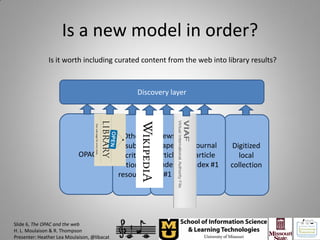
Is a new model in order?
               Is it worth including curated content from the web into library results?


                                                  Discovery layer


                                              Other     News-
                                               sub-     paper        Journal     Digitized
                            OPAC              scritp-   article       article      local
                                               tion     index       index #1    collection
                                             resource     #1


Slide 6, The OPAC and the web
H. L. Moulaison & R. Thompson
Presenter: Heather Lea Moulaison, @libacat
Agenda
  • The intelligent web (i.e. the semantic web)
         – Definition
         – What it might mean to libraries and library users
         – Examples of interesting projects
  • Transaction log analysis
         – Rationale
         – Method
         – Results
  • Discussion
  • Conclusions

Slide 7, The OPAC and the web
H. L. Moulaison & R. Thompson
Presenter: Heather Lea Moulaison, @libacat
The semantic web: An ideal
  • Tim Berners-Lee’s vision: computers that could
    understand each other
         – Semantic web
                • The intelligent web
                • Web 3.0
                • The web of data
         – No need for human intervention at each step
                • Technology and protocols need to be in place
  • As of right now, the semantic web isn’t fully
    functioning – but things are improving all the
    time

Slide 8, The OPAC and the web
H. L. Moulaison & R. Thompson
Presenter: Heather Lea Moulaison, @libacat
Semantic web and discovery
  “The Semantic Web isn't just about putting data
  on the web. It is about making links, so that a
  person or machine can explore the web of
  data. With linked data, when you have some of
  it, you can find other, related, data.”
                                                                    --Tim Berners-Lee
                                             http://www.w3.org/DesignIssues/LinkedData.html


Slide 9, The OPAC and the web
H. L. Moulaison & R. Thompson
Presenter: Heather Lea Moulaison, @libacat
Linked data
  “"Linked Data" refers to data published in
  accordance with principles designed to facilitate
  linkages among datasets, element sets, and
  value vocabularies.”
              --Library Linked Data Incubator Group Final Report
        http://www.w3.org/2005/Incubator/lld/wiki/DraftReportWithTransclusion


Slide 10, The OPAC and the web
H. L. Moulaison & R. Thompson
Presenter: Heather Lea Moulaison, @libacat
Some linked data projects of interest
              to the library world
  An overview of selected linked data repositories:
  • Open Library
  • NNDB Mapper
  • New York Times Linked Open Data
  • Library of Congress (LOC) Names
  • Virtual International Authority File (VIAF)
  • DBpedia
  • Freebase

  For more information on many of these and on other vocabularies of interest to libraries, see the section on value
  vocabularies in W3C Library Linked Data Incubator Group: Datasets, Value Vocabularies, and Metadata Element Sets:
  http://www.w3.org/2005/Incubator/lld/wiki/Vocabulary_and_Dataset
  See also: Goddard, L., & Byrne, G. (2010). Linked data tools: Semantic web for the masses. First Monday, 15(11).
  Available online: http://firstmonday.org/htbin/cgiwrap/bin/ojs/index.php/fm/article/view/3120/2633


Slide 11, The OPAC and the web
H. L. Moulaison & R. Thompson
Presenter: Heather Lea Moulaison, @libacat
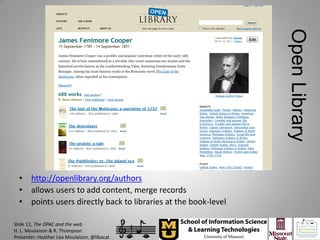
Open Library
  • http://openlibrary.org/authors
  • allows users to add content, merge records
  • points users directly back to libraries at the book-level

Slide 12, The OPAC and the web
H. L. Moulaison & R. Thompson
Presenter: Heather Lea Moulaison, @libacat
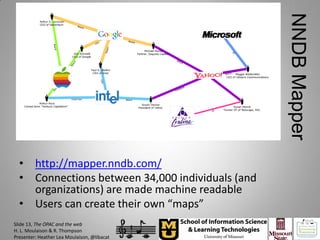
NNDB Mapper
  • http://mapper.nndb.com/
  • Connections between 34,000 individuals (and
    organizations) are made machine readable
  • Users can create their own “maps”
Slide 13, The OPAC and the web
H. L. Moulaison & R. Thompson
Presenter: Heather Lea Moulaison, @libacat
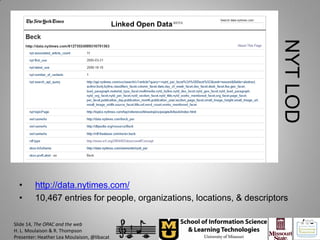
NYT LOD
  •      http://data.nytimes.com/
  •      10,467 entries for people, organizations, locations, & descriptors

Slide 14, The OPAC and the web
H. L. Moulaison & R. Thompson
Presenter: Heather Lea Moulaison, @libacat
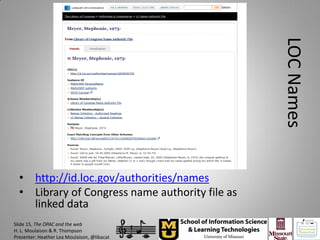
LOC Names
  • http://id.loc.gov/authorities/names
  • Library of Congress name authority file as
    linked data
Slide 15, The OPAC and the web
H. L. Moulaison & R. Thompson
Presenter: Heather Lea Moulaison, @libacat
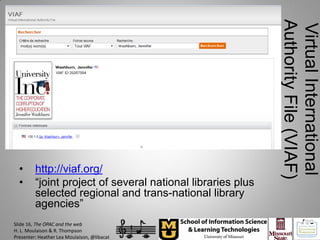
Authority File (VIAF)
                                                             Virtual International
  •      http://viaf.org/
  •      “joint project of several national libraries plus
         selected regional and trans-national library
         agencies”
Slide 16, The OPAC and the web
H. L. Moulaison & R. Thompson
Presenter: Heather Lea Moulaison, @libacat
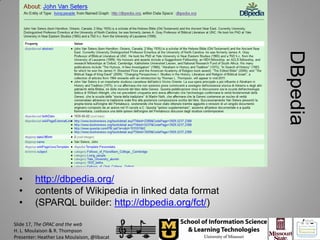
DBpedia
  •      http://dbpedia.org/
  •      contents of Wikipedia in linked data format
  •      (SPARQL builder: http://dbpedia.org/fct/)

Slide 17, The OPAC and the web
H. L. Moulaison & R. Thompson
Presenter: Heather Lea Moulaison, @libacat
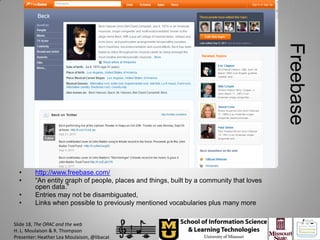
Freebase
  •      http://www.freebase.com/
  •      “An entity graph of people, places and things, built by a community that loves
         open data.”
  •      Entries may not be disambiguated,
  •      Links when possible to previously mentioned vocabularies plus many more


Slide 18, The OPAC and the web
H. L. Moulaison & R. Thompson
Presenter: Heather Lea Moulaison, @libacat
Linked data and libraries?
  • The semantic web idea assumes certain kinds of
    data of interest to the library community can be
    encoded in a way that is machine-readable
  • Currently library data is structured using MARC
         – MARC is not web-ready!
         – MARC encoding permits display in libraries
         – MARC isn’t used outside o f the library community
  • Online catalog queries are made using
    unstructured textual strings in particular indexes
         – This is not the most effective way to search or browse
Slide 20, The OPAC and the web
H. L. Moulaison & R. Thompson
Presenter: Heather Lea Moulaison, @libacat
Rationale for the current study
   Transaction log analyses have demonstrated that users do not
    query OPACs effectively
   Linked data initiatives are a way to link out to curated data on the
    web
   To limit the focus of the current study, it is advisable to concentrate
    on “authors” in general and personal names in particular
   The connection between library content, user searches, and linked
    data is worth exploring in the current library environment

  • By investigating a certain class of queries and matching them
    against the contents of various linked data repositories, it will be
    possible to gauge the degree of effectiveness a semantic online
    library catalog might have.


Slide 22, The OPAC and the web
H. L. Moulaison & R. Thompson
Presenter: Heather Lea Moulaison, @libacat
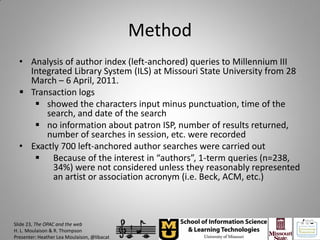
Method
  • Analysis of author index (left-anchored) queries to Millennium III
    Integrated Library System (ILS) at Missouri State University from 28
    March – 6 April, 2011.
   Transaction logs
      showed the characters input minus punctuation, time of the
        search, and date of the search
      no information about patron ISP, number of results returned,
        number of searches in session, etc. were recorded
  • Exactly 700 left-anchored author searches were carried out
      Because of the interest in “authors”, 1-term queries (n=238,
          34%) were not considered unless they reasonably represented
          an artist or association acronym (i.e. Beck, ACM, etc.)


Slide 23, The OPAC and the web
H. L. Moulaison & R. Thompson
Presenter: Heather Lea Moulaison, @libacat
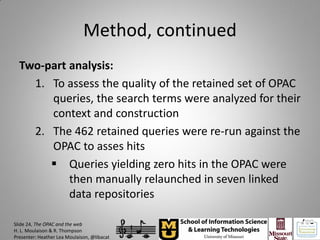
Method, continued
  Two-part analysis:
    1. To assess the quality of the retained set of OPAC
       queries, the search terms were analyzed for their
       context and construction
    2. The 462 retained queries were re-run against the
       OPAC to asses hits
        Queries yielding zero hits in the OPAC were
           then manually relaunched in seven linked
           data repositories

Slide 24, The OPAC and the web
H. L. Moulaison & R. Thompson
Presenter: Heather Lea Moulaison, @libacat
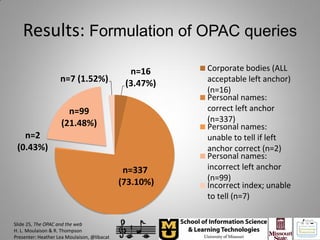
Results: Formulation of OPAC queries
                                               n=16     Corporate bodies (ALL
                    n=7 (1.52%)               (3.47%)   acceptable left anchor)
                                                        (n=16)
                                                        Personal names:
                      n=99                              correct left anchor
                    (21.48%)                            (n=337)
                                                        Personal names:
   n=2                                                  unable to tell if left
 (0.43%)                                                anchor correct (n=2)
                                                        Personal names:
                                              n=337     incorrect left anchor
                                                        (n=99)
                                             (73.10%)   Incorrect index; unable
                                                        to tell (n=7)


Slide 25, The OPAC and the web
H. L. Moulaison & R. Thompson
Presenter: Heather Lea Moulaison, @libacat
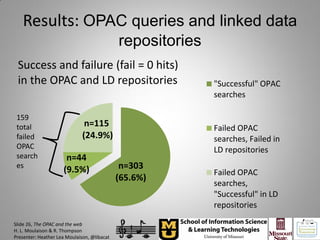
Results: OPAC queries and linked data
                                             repositories
 Success and failure (fail = 0 hits)
 in the OPAC and LD repositories                            "Successful" OPAC
                                                            searches

 159
 total                         n=115                        Failed OPAC
 failed                       (24.9%)                       searches, Failed in
 OPAC                                                       LD repositories
 search               n=44
 es
                     (9.5%)                   n=303
                                                            Failed OPAC
                                             (65.6%)
                                                            searches,
                                                            "Successful" in LD
                                                            repositories

Slide 26, The OPAC and the web
H. L. Moulaison & R. Thompson
Presenter: Heather Lea Moulaison, @libacat
Results: OPAC queries and linked data
           repositories, continued
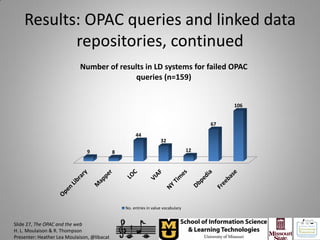
                             Number of results in LD systems for failed OPAC
                                            queries (n=159)


                                                                                             106


                                                                                        67

                                                      44
                                                                    32

                                9            8                                     12


                                                 No. entries in value vocabulary


Slide 27, The OPAC and the web
H. L. Moulaison & R. Thompson
Presenter: Heather Lea Moulaison, @libacat
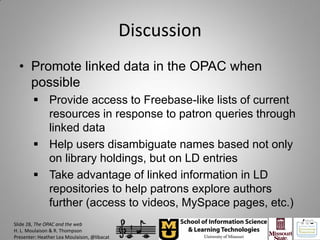
Discussion
  • Promote linked data in the OPAC when
    possible
         Provide access to Freebase-like lists of current
          resources in response to patron queries through
          linked data
         Help users disambiguate names based not only
          on library holdings, but on LD entries
         Take advantage of linked information in LD
          repositories to help patrons explore authors
          further (access to videos, MySpace pages, etc.)
Slide 28, The OPAC and the web
H. L. Moulaison & R. Thompson
Presenter: Heather Lea Moulaison, @libacat
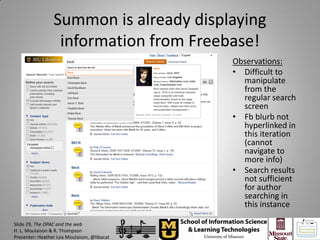
Summon is already displaying
                  information from Freebase!
                                             Observations:
                                             • Difficult to
                                               manipulate
                                               from the
                                               regular search
                                               screen
                                             • Fb blurb not
                                               hyperlinked in
                                               this iteration
                                               (cannot
                                               navigate to
                                               more info)
                                             • Search results
                                               not sufficient
                                               for author
                                               searching in
                                               this instance

Slide 29, The OPAC and the web
H. L. Moulaison & R. Thompson
Presenter: Heather Lea Moulaison, @libacat
Discussion
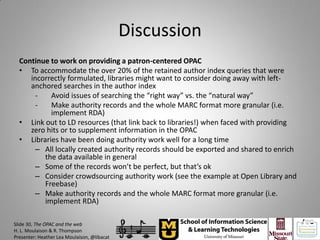
  Continue to work on providing a patron-centered OPAC
  • To accommodate the over 20% of the retained author index queries that were
     incorrectly formulated, libraries might want to consider doing away with left-
     anchored searches in the author index
       -   Avoid issues of searching the “right way” vs. the “natural way”
       -   Make authority records and the whole MARC format more granular (i.e.
           implement RDA)
  • Link out to LD resources (that link back to libraries!) when faced with providing
     zero hits or to supplement information in the OPAC
  • Libraries have been doing authority work well for a long time
       – All locally created authority records should be exported and shared to enrich
         the data available in general
       – Some of the records won’t be perfect, but that’s ok
       – Consider crowdsourcing authority work (see the example at Open Library and
         Freebase)
       – Make authority records and the whole MARC format more granular (i.e.
         implement RDA)

Slide 30, The OPAC and the web
H. L. Moulaison & R. Thompson
Presenter: Heather Lea Moulaison, @libacat
Recommendations from the LLD XG
  • “That library standards bodies increase library
    participation in Semantic Web standardization,
    develop library data standards that are
    compatible with Linked Data, and disseminate
    best-practice design patterns tailored to library
    Linked Data; That data and systems designers
    design enhanced user services based on Linked
    Data capabilities, create URIs for the items in
    library datasets, develop policies for managing
    RDF vocabularies and their URIs, and express
    library data by re-using or mapping to existing
    Linked Data vocabularies”
Slide 31, The OPAC and the web
H. L. Moulaison & R. Thompson
Presenter: Heather Lea Moulaison, @libacat
Recommendations based on this study
  • Continue to strive to provide the resources
    patrons want at the point of need
         – Consider if linked data within library systems can
           assist in this mission
  • Continue to innovate, while using standards
    that are accepted by the web at large
         – Do library-only standards like MARC still have a
           place?

Slide 33, The OPAC and the web
H. L. Moulaison & R. Thompson
Presenter: Heather Lea Moulaison, @libacat
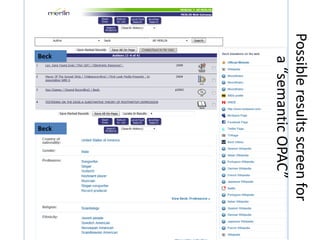
Possible results screen for
   a “semantic OPAC”
   Beck


              Beck
Desirability of a semantic OPAC?
  • Data quality for linked data portions would have to be
    vetted outside of the library
         – WWW domains would be key to decisions to trust, but
           would not be foolproof
         – Users who surf away from the library gateway *may*not
           come back
                • Yet we know they don’t begin their searches in the OPAC anyway,
                  so is it wrong to “reward” with the info they want users who
                  actually come to the library OPAC and find little?
  • Machine matching inherently flawed
         – Human intervention still necessary for complete assurance
           of proper disambiguation
                • Human intervention can be crowdsourced! (c.f. Open Library)

Slide 35, The OPAC and the web
H. L. Moulaison & R. Thompson
Presenter: Heather Lea Moulaison, @libacat
machine matching
                                                    Limitations to
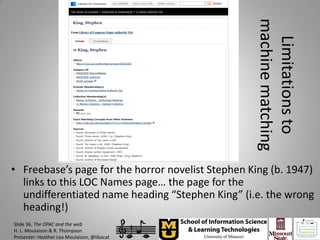
• Freebase’s page for the horror novelist Stephen King (b. 1947)
  links to this LOC Names page… the page for the
  undifferentiated name heading “Stephen King” (i.e. the wrong
  heading!)
Slide 36, The OPAC and the web
H. L. Moulaison & R. Thompson
Presenter: Heather Lea Moulaison, @libacat
Limitations to the current study
  • Transaction logs very limited in information
    provided
         – Unable to isolate librarian searches, in-library or on-
           campus searches, and off-campus searches
         – Results as seen by patrons not explicit
                • Over time, some of the books were acquired
         – Search sessions not identified
    • Transaction log analysis cannot infer patron
          – Intent
          – Success and/or satisfaction
          – Knowledge

Slide 37, The OPAC and the web
H. L. Moulaison & R. Thompson
Presenter: Heather Lea Moulaison, @libacat
Future studies
  • Future work should consider the need to
         – Build a prototype semantic OPAC and to test it on
           users
         – Continue analyzing patron OPAC queries
                • To ascertain the extent to which local collections meet
                  user needs above and beyond the abilities of curated
                  linked data repositories, it would be beneficial to
                  examine all successful queries and to compare them
                  with the results in LD repositories


Slide 38, The OPAC and the web
H. L. Moulaison & R. Thompson
Presenter: Heather Lea Moulaison, @libacat
Conclusion: The OPAC and the Web:
    Harmonious Future or Perpetual Discord?
  • In the context of the rapidly changing information
    environment, it is recommended that libraries
    further embrace web resources as a way of
    providing patrons with the information they seek.
    This may mean integrating them into the OPAC,
    and removing the OPAC from the deep web to
    integrate it with the web at large.
  • Libraries must continue to be a vital part of the
    information ecosystem, and exploiting existing
    resources like linked data is one way that can take
    place.

Slide 39, The OPAC and the web
H. L. Moulaison & R. Thompson
Presenter: Heather Lea Moulaison, @libacat

The opac and the web

  • 1.
    The OPAC andthe Web: Harmonious Future or Perpetual Discord? Heather Lea Moulaison and Rebecca Thompson Missouri Library Association 2011 Annual Conference October 6, 2011 (Awareness session : basic information on a topic) Slide 1, The OPAC and the web H. L. Moulaison & R. Thompson Presenter: Heather Lea Moulaison, @libacat
  • 2.
    Online library catalogsas information repositories Discovery layer Other News- sub- paper Journal Digitized OPAC scritp- article article local tion index index #1 collection resource #1 Slide 2, The OPAC and the web H. L. Moulaison & R. Thompson Presenter: Heather Lea Moulaison, @libacat
  • 3.
    Other information repositories • Libraries are not alone in providing content to patrons Slide 3, The OPAC and the web H. L. Moulaison & R. Thompson Presenter: Heather Lea Moulaison, @libacat
  • 4.
    Changes afoot: Libraryusers • Are not better researchers and/or searchers than in the past, despite the wealth of new sources – “At Illinois Wesleyan University, ‘The majority of students -- of all levels -- exhibited significant difficulties that ranged across nearly every aspect of the search process.’” --Steve Kolowich http://www.insidehighered.com/news/2011/08/22/erial_study_of_student_rese Forthcoming book: College arch_habits_at_illinois_university_libraries_reveals_alarmingly_poor_informatio Libraries and Student Culture: What We Now n_literacy_and_skills Know. Edited by: Lynda M. Duke and Andrew D. Asher • Are more hurried, have less money and time, and have more conflicts – “Convenience is the “hook” that draws users into VR services” --Lynn Silipigni Connaway, Marie L. Radford http://www.oclc.org/reports/synchronicity/full.pdf Slide 4, The OPAC and the web H. L. Moulaison & R. Thompson Presenter: Heather Lea Moulaison, @libacat
  • 5.
    Changes afoot: Librarysystems • In our systems – Web-accessible content – System navigation – Community-generated content – Discovery model promoting “discovery” of resources • Beyond our systems – Web-accessible curated collections of information Slide 5, The OPAC and the web H. L. Moulaison & R. Thompson Presenter: Heather Lea Moulaison, @libacat
  • 6.
    Is a newmodel in order? Is it worth including curated content from the web into library results? Discovery layer Other News- sub- paper Journal Digitized OPAC scritp- article article local tion index index #1 collection resource #1 Slide 6, The OPAC and the web H. L. Moulaison & R. Thompson Presenter: Heather Lea Moulaison, @libacat
  • 7.
    Agenda •The intelligent web (i.e. the semantic web) – Definition – What it might mean to libraries and library users – Examples of interesting projects • Transaction log analysis – Rationale – Method – Results • Discussion • Conclusions Slide 7, The OPAC and the web H. L. Moulaison & R. Thompson Presenter: Heather Lea Moulaison, @libacat
  • 8.
    The semantic web:An ideal • Tim Berners-Lee’s vision: computers that could understand each other – Semantic web • The intelligent web • Web 3.0 • The web of data – No need for human intervention at each step • Technology and protocols need to be in place • As of right now, the semantic web isn’t fully functioning – but things are improving all the time Slide 8, The OPAC and the web H. L. Moulaison & R. Thompson Presenter: Heather Lea Moulaison, @libacat
  • 9.
    Semantic web anddiscovery “The Semantic Web isn't just about putting data on the web. It is about making links, so that a person or machine can explore the web of data. With linked data, when you have some of it, you can find other, related, data.” --Tim Berners-Lee http://www.w3.org/DesignIssues/LinkedData.html Slide 9, The OPAC and the web H. L. Moulaison & R. Thompson Presenter: Heather Lea Moulaison, @libacat
  • 10.
    Linked data “"Linked Data" refers to data published in accordance with principles designed to facilitate linkages among datasets, element sets, and value vocabularies.” --Library Linked Data Incubator Group Final Report http://www.w3.org/2005/Incubator/lld/wiki/DraftReportWithTransclusion Slide 10, The OPAC and the web H. L. Moulaison & R. Thompson Presenter: Heather Lea Moulaison, @libacat
  • 11.
    Some linked dataprojects of interest to the library world An overview of selected linked data repositories: • Open Library • NNDB Mapper • New York Times Linked Open Data • Library of Congress (LOC) Names • Virtual International Authority File (VIAF) • DBpedia • Freebase For more information on many of these and on other vocabularies of interest to libraries, see the section on value vocabularies in W3C Library Linked Data Incubator Group: Datasets, Value Vocabularies, and Metadata Element Sets: http://www.w3.org/2005/Incubator/lld/wiki/Vocabulary_and_Dataset See also: Goddard, L., & Byrne, G. (2010). Linked data tools: Semantic web for the masses. First Monday, 15(11). Available online: http://firstmonday.org/htbin/cgiwrap/bin/ojs/index.php/fm/article/view/3120/2633 Slide 11, The OPAC and the web H. L. Moulaison & R. Thompson Presenter: Heather Lea Moulaison, @libacat
  • 12.
    Open Library • http://openlibrary.org/authors • allows users to add content, merge records • points users directly back to libraries at the book-level Slide 12, The OPAC and the web H. L. Moulaison & R. Thompson Presenter: Heather Lea Moulaison, @libacat
  • 13.
    NNDB Mapper • http://mapper.nndb.com/ • Connections between 34,000 individuals (and organizations) are made machine readable • Users can create their own “maps” Slide 13, The OPAC and the web H. L. Moulaison & R. Thompson Presenter: Heather Lea Moulaison, @libacat
  • 14.
    NYT LOD • http://data.nytimes.com/ • 10,467 entries for people, organizations, locations, & descriptors Slide 14, The OPAC and the web H. L. Moulaison & R. Thompson Presenter: Heather Lea Moulaison, @libacat
  • 15.
    LOC Names • http://id.loc.gov/authorities/names • Library of Congress name authority file as linked data Slide 15, The OPAC and the web H. L. Moulaison & R. Thompson Presenter: Heather Lea Moulaison, @libacat
  • 16.
    Authority File (VIAF) Virtual International • http://viaf.org/ • “joint project of several national libraries plus selected regional and trans-national library agencies” Slide 16, The OPAC and the web H. L. Moulaison & R. Thompson Presenter: Heather Lea Moulaison, @libacat
  • 17.
    DBpedia • http://dbpedia.org/ • contents of Wikipedia in linked data format • (SPARQL builder: http://dbpedia.org/fct/) Slide 17, The OPAC and the web H. L. Moulaison & R. Thompson Presenter: Heather Lea Moulaison, @libacat
  • 18.
    Freebase • http://www.freebase.com/ • “An entity graph of people, places and things, built by a community that loves open data.” • Entries may not be disambiguated, • Links when possible to previously mentioned vocabularies plus many more Slide 18, The OPAC and the web H. L. Moulaison & R. Thompson Presenter: Heather Lea Moulaison, @libacat
  • 19.
    Linked data andlibraries? • The semantic web idea assumes certain kinds of data of interest to the library community can be encoded in a way that is machine-readable • Currently library data is structured using MARC – MARC is not web-ready! – MARC encoding permits display in libraries – MARC isn’t used outside o f the library community • Online catalog queries are made using unstructured textual strings in particular indexes – This is not the most effective way to search or browse Slide 20, The OPAC and the web H. L. Moulaison & R. Thompson Presenter: Heather Lea Moulaison, @libacat
  • 20.
    Rationale for thecurrent study  Transaction log analyses have demonstrated that users do not query OPACs effectively  Linked data initiatives are a way to link out to curated data on the web  To limit the focus of the current study, it is advisable to concentrate on “authors” in general and personal names in particular  The connection between library content, user searches, and linked data is worth exploring in the current library environment • By investigating a certain class of queries and matching them against the contents of various linked data repositories, it will be possible to gauge the degree of effectiveness a semantic online library catalog might have. Slide 22, The OPAC and the web H. L. Moulaison & R. Thompson Presenter: Heather Lea Moulaison, @libacat
  • 21.
    Method •Analysis of author index (left-anchored) queries to Millennium III Integrated Library System (ILS) at Missouri State University from 28 March – 6 April, 2011.  Transaction logs  showed the characters input minus punctuation, time of the search, and date of the search  no information about patron ISP, number of results returned, number of searches in session, etc. were recorded • Exactly 700 left-anchored author searches were carried out  Because of the interest in “authors”, 1-term queries (n=238, 34%) were not considered unless they reasonably represented an artist or association acronym (i.e. Beck, ACM, etc.) Slide 23, The OPAC and the web H. L. Moulaison & R. Thompson Presenter: Heather Lea Moulaison, @libacat
  • 22.
    Method, continued Two-part analysis: 1. To assess the quality of the retained set of OPAC queries, the search terms were analyzed for their context and construction 2. The 462 retained queries were re-run against the OPAC to asses hits  Queries yielding zero hits in the OPAC were then manually relaunched in seven linked data repositories Slide 24, The OPAC and the web H. L. Moulaison & R. Thompson Presenter: Heather Lea Moulaison, @libacat
  • 23.
    Results: Formulation ofOPAC queries n=16 Corporate bodies (ALL n=7 (1.52%) (3.47%) acceptable left anchor) (n=16) Personal names: n=99 correct left anchor (21.48%) (n=337) Personal names: n=2 unable to tell if left (0.43%) anchor correct (n=2) Personal names: n=337 incorrect left anchor (n=99) (73.10%) Incorrect index; unable to tell (n=7) Slide 25, The OPAC and the web H. L. Moulaison & R. Thompson Presenter: Heather Lea Moulaison, @libacat
  • 24.
    Results: OPAC queriesand linked data repositories Success and failure (fail = 0 hits) in the OPAC and LD repositories "Successful" OPAC searches 159 total n=115 Failed OPAC failed (24.9%) searches, Failed in OPAC LD repositories search n=44 es (9.5%) n=303 Failed OPAC (65.6%) searches, "Successful" in LD repositories Slide 26, The OPAC and the web H. L. Moulaison & R. Thompson Presenter: Heather Lea Moulaison, @libacat
  • 25.
    Results: OPAC queriesand linked data repositories, continued Number of results in LD systems for failed OPAC queries (n=159) 106 67 44 32 9 8 12 No. entries in value vocabulary Slide 27, The OPAC and the web H. L. Moulaison & R. Thompson Presenter: Heather Lea Moulaison, @libacat
  • 26.
    Discussion •Promote linked data in the OPAC when possible  Provide access to Freebase-like lists of current resources in response to patron queries through linked data  Help users disambiguate names based not only on library holdings, but on LD entries  Take advantage of linked information in LD repositories to help patrons explore authors further (access to videos, MySpace pages, etc.) Slide 28, The OPAC and the web H. L. Moulaison & R. Thompson Presenter: Heather Lea Moulaison, @libacat
  • 27.
    Summon is alreadydisplaying information from Freebase! Observations: • Difficult to manipulate from the regular search screen • Fb blurb not hyperlinked in this iteration (cannot navigate to more info) • Search results not sufficient for author searching in this instance Slide 29, The OPAC and the web H. L. Moulaison & R. Thompson Presenter: Heather Lea Moulaison, @libacat
  • 28.
    Discussion Continueto work on providing a patron-centered OPAC • To accommodate the over 20% of the retained author index queries that were incorrectly formulated, libraries might want to consider doing away with left- anchored searches in the author index - Avoid issues of searching the “right way” vs. the “natural way” - Make authority records and the whole MARC format more granular (i.e. implement RDA) • Link out to LD resources (that link back to libraries!) when faced with providing zero hits or to supplement information in the OPAC • Libraries have been doing authority work well for a long time – All locally created authority records should be exported and shared to enrich the data available in general – Some of the records won’t be perfect, but that’s ok – Consider crowdsourcing authority work (see the example at Open Library and Freebase) – Make authority records and the whole MARC format more granular (i.e. implement RDA) Slide 30, The OPAC and the web H. L. Moulaison & R. Thompson Presenter: Heather Lea Moulaison, @libacat
  • 29.
    Recommendations from theLLD XG • “That library standards bodies increase library participation in Semantic Web standardization, develop library data standards that are compatible with Linked Data, and disseminate best-practice design patterns tailored to library Linked Data; That data and systems designers design enhanced user services based on Linked Data capabilities, create URIs for the items in library datasets, develop policies for managing RDF vocabularies and their URIs, and express library data by re-using or mapping to existing Linked Data vocabularies” Slide 31, The OPAC and the web H. L. Moulaison & R. Thompson Presenter: Heather Lea Moulaison, @libacat
  • 30.
    Recommendations based onthis study • Continue to strive to provide the resources patrons want at the point of need – Consider if linked data within library systems can assist in this mission • Continue to innovate, while using standards that are accepted by the web at large – Do library-only standards like MARC still have a place? Slide 33, The OPAC and the web H. L. Moulaison & R. Thompson Presenter: Heather Lea Moulaison, @libacat
  • 31.
    Possible results screenfor a “semantic OPAC” Beck Beck
  • 32.
    Desirability of asemantic OPAC? • Data quality for linked data portions would have to be vetted outside of the library – WWW domains would be key to decisions to trust, but would not be foolproof – Users who surf away from the library gateway *may*not come back • Yet we know they don’t begin their searches in the OPAC anyway, so is it wrong to “reward” with the info they want users who actually come to the library OPAC and find little? • Machine matching inherently flawed – Human intervention still necessary for complete assurance of proper disambiguation • Human intervention can be crowdsourced! (c.f. Open Library) Slide 35, The OPAC and the web H. L. Moulaison & R. Thompson Presenter: Heather Lea Moulaison, @libacat
  • 33.
    machine matching Limitations to • Freebase’s page for the horror novelist Stephen King (b. 1947) links to this LOC Names page… the page for the undifferentiated name heading “Stephen King” (i.e. the wrong heading!) Slide 36, The OPAC and the web H. L. Moulaison & R. Thompson Presenter: Heather Lea Moulaison, @libacat
  • 34.
    Limitations to thecurrent study • Transaction logs very limited in information provided – Unable to isolate librarian searches, in-library or on- campus searches, and off-campus searches – Results as seen by patrons not explicit • Over time, some of the books were acquired – Search sessions not identified • Transaction log analysis cannot infer patron – Intent – Success and/or satisfaction – Knowledge Slide 37, The OPAC and the web H. L. Moulaison & R. Thompson Presenter: Heather Lea Moulaison, @libacat
  • 35.
    Future studies • Future work should consider the need to – Build a prototype semantic OPAC and to test it on users – Continue analyzing patron OPAC queries • To ascertain the extent to which local collections meet user needs above and beyond the abilities of curated linked data repositories, it would be beneficial to examine all successful queries and to compare them with the results in LD repositories Slide 38, The OPAC and the web H. L. Moulaison & R. Thompson Presenter: Heather Lea Moulaison, @libacat
  • 36.
    Conclusion: The OPACand the Web: Harmonious Future or Perpetual Discord? • In the context of the rapidly changing information environment, it is recommended that libraries further embrace web resources as a way of providing patrons with the information they seek. This may mean integrating them into the OPAC, and removing the OPAC from the deep web to integrate it with the web at large. • Libraries must continue to be a vital part of the information ecosystem, and exploiting existing resources like linked data is one way that can take place. Slide 39, The OPAC and the web H. L. Moulaison & R. Thompson Presenter: Heather Lea Moulaison, @libacat