Perspectives on geographic location: The Muslim West in two classification systemsbyHeather Lea Moulaison, PhDOctober 15, 2010Conversation de la recherche - ResearchconversationSchool of Information Studies, University of Ottawa
Bias in classificationWhen humans intervene and begin grouping “like” things together (Olson), we expect a certain amount of bias in the end productPatterns identified (Bates, 2005) and “buckets” construed Can be linked to sense making (Weick, 1995 cited in Lambe, 2007)Babel Instinct “when we can organise things around us differently from other people, we will do so” (Lambe, 2007, p, xvi)Few classification systems are completely independent of human interpretation Modern biologists care about spines, but others have divided the animal kingdom in different ways based on other characteristics (blood?, etc.)Shirky (2005) claims that not all elements of the Periodic Table fit neatly
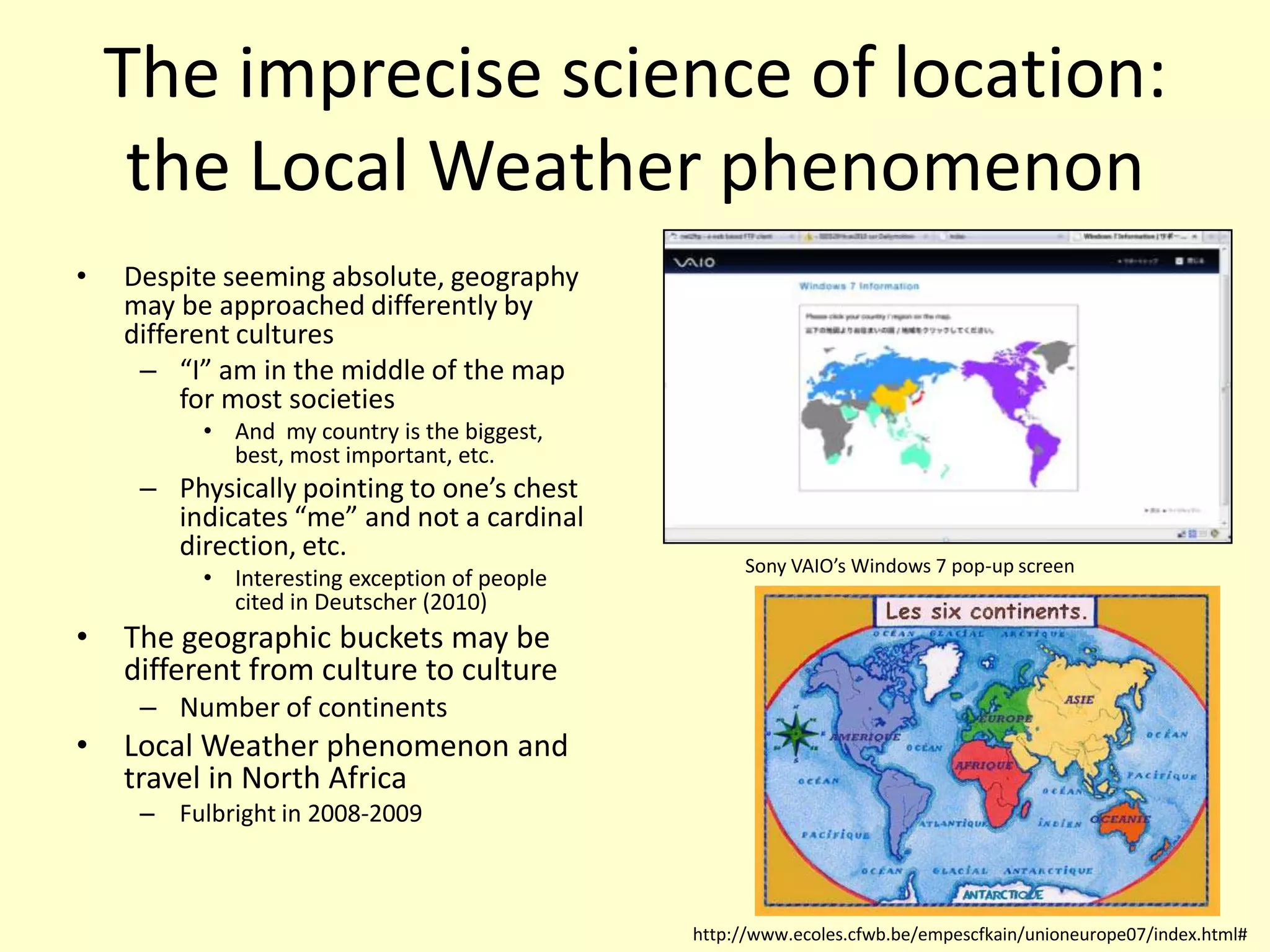
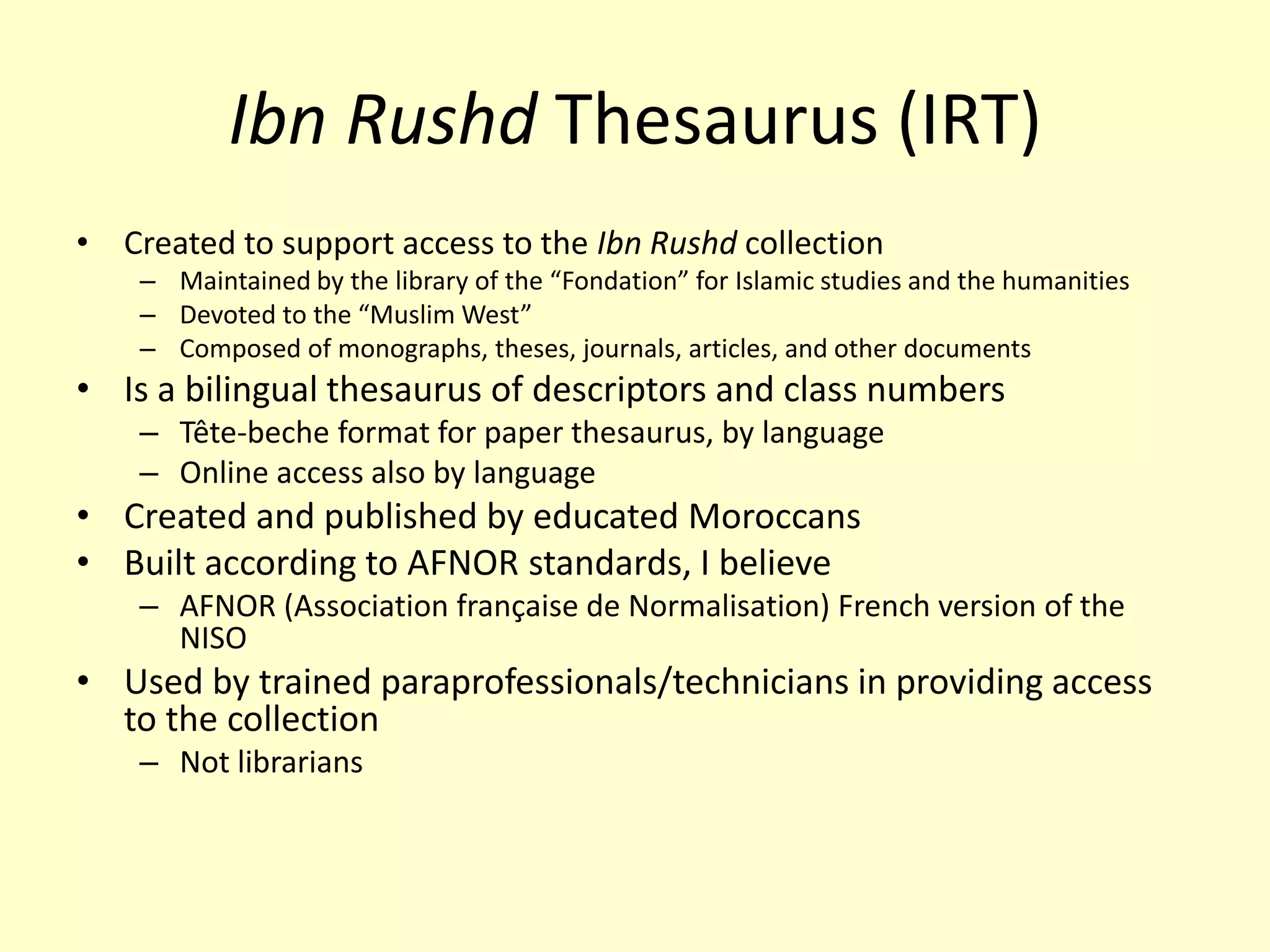
The imprecise science of location: the Local Weather phenomenonDespite seeming absolute, geography may be approached differently by different cultures“I” am in the middle of the map for most societiesAnd  my country is the biggest, best, most important, etc.Physically pointing to one’s chest indicates “me” and not a cardinal direction, etc.Interesting exception of people cited in Deutscher (2010)The geographic buckets may be different from culture to cultureNumber of continentsLocal Weather phenomenon and travel in North AfricaFulbright in 2008-2009Sony VAIO’s Windows 7 pop-up screenhttp://www.ecoles.cfwb.be/empescfkain/unioneurope07/index.html#
Ibn Rushd Thesaurus (IRT)Created to support access to theIbnRushdcollectionMaintained by the library of the “Fondation” for Islamic studies and the humanitiesDevoted to the “Muslim West”Composed of monographs, theses, journals, articles, and other documentsIs a bilingual thesaurus of descriptors and class numbersTête-becheformat for paper thesaurus, by languageOnline access also by languageCreated and published by educated MoroccansBuilt according to AFNOR standards, I believeAFNOR (Association françaisede Normalisation) French version of the NISOUsed by trained paraprofessionals/technicians in providing access to the collectionNot librarians
Research questionsWhat differences exist in the way that IRT and the DDC provide intellectual access to geographic locations in the Muslim West?Can a universal classification scheme like DDC offer adequate geographic access to a specialized collection focusing on a non-Western culture?
AssumptionsIn devising a classification scheme treating geographic location, the biases of the creators of that scheme will be present. This is not necessarily a bad thing if it is intuitive in terms of:Users accessing systemMaterials being classedWestern classification systems will reflect Western culture and approachesNon-Western classification systems will reflect Non-Western cultures and approachesLee (2008) discusses ancient Chinese approaches to classificationA thesaurus for a specialized collection can provide access to the materials in that collection if it is well-constructed and systematically implemented.
Assumptions, cont.Classification schemes will adopt different approaches based on their purpose Dewey Decimal Classification (DDC)/Universal Decimal Classifiation (UDC) are “universal” IRT is meant to class a certain collection (personal communication, 2009)Example: Edward Sapir, anthropologist, worked with Marius Barbeau at the Canadian Museum of Civilization in 1910 to devise a taxonomy of Amer-Indian peoples. Peoples were primarily grouped by language and locationLetters of the alphabet were used to indicate classThose of European descent were classed “Z”
Geography in the IRTPreliminary observationsThe Muslim West is the first class (of 8) designated in the geography portion of the classification systemMuslim West = North Africa and Moorish Iberian PeninsulaHistorically, parts of Spain were Muslim before the Arabs were driven Some of the approach to creating classes sees Western or French groupings by continentshe Americas as one continentOther groupings are by alliances, proximity, etc. (OPEC countries,  Scandinavia, etc.)Seems consistent with  a worldview of a collectivist culture
Review of the Lit: Criticism of Dewey and DDCDDC has been criticized for having a Western bias (e.g. Olson, 2001) Results in the needless and arbitrary dispersal of national literatures in the collectionCanadian literature-English 810Canadian literature-French 840Canadian literature-Inuit 897.12 (Olson, 2001, p. 119)Shirky (2005) reminds us that classification schemes like DDC are created to provide a physical shelf location. In the digital world, there is no shelf.Weinberger (2007) makes fun of the pigeonholes and finds Dewey’s “original schema […] embarrassing in the modern era” (p. 48).
Use and appeal of DDCPossible reasons for use and appeal outside of Western culturesNon-Western cultures may be adequately represented in the schedules and tablesnumber-building permits the creation of sufficiently close classification numbers  for the breadth and depth of library collectionsThe publications collected and made available may reflect more or less the publishing patterns evidenced in Anglo-American librariesBe few enough that close classification is not necessary.Ex: Morocco published 918 books in 1996; Egypt published 2215 books in 1995 (UNESCO)There is something fundamentally appealing about arranging the world into compartments of ten (Bates)Schemes based on DDC have been successfulUDCA Classification System for Libraries of Judaica(3rd edition) by David and Daniel Elazar.Editors at DDC are constantly trying to update and include other worldviews, provide extension tables, allow for local creation of numbers, etc.
MethodologyGoal: To compare the treatment of the geography of the Muslim West in the IRT and DDCGeographic terms from the IRT “N” class (Muslim West) were listed in a spreadsheet Corresponding classification notation was indicatedone letter and a series of meaningful numbers based on the level of hierarchy representedClassification notation explicitly showed the hierarchies underlying the order in the listIn practice, these thesaurus terms can be used as descriptors in the database and can accompany other descriptors bringing out additional facetsThe Iberian Peninsula and Morocco/Western Sahara were selected for further studyIberian Peninsula = Europe (covered well in DDC?)Morocco/Western Sahara = Africa (not covered well in DDC?)
Methodology, cont.Classification notations from IRT for the selected areas were compared directly with the notation in the DDC Auxiliary Table 2 DDC auxiliary tables allow for number building in the DDC systemNumbers from the tables are added to a base number taken from the schedulesWhen in doubt, locations from the IRT were searched in the Thesaurus of Geographic Names (TGN) maintained by the Getty
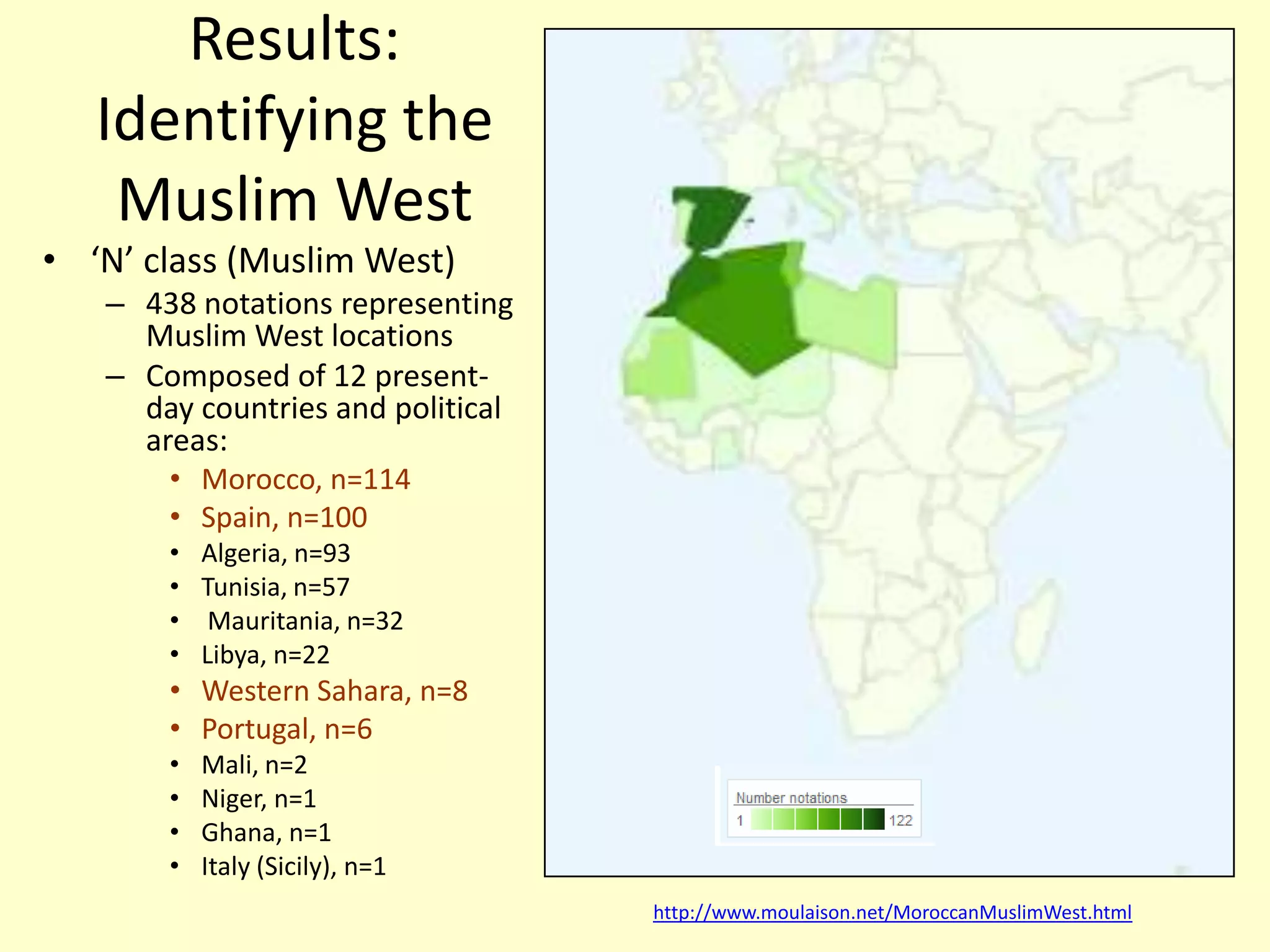
Results: Identifying the Muslim West‘N’ class (Muslim West)438 notations representing Muslim West locations Composed of 12 present-day countries and political areas: Morocco, n=114Spain, n=100Algeria, n=93Tunisia, n=57 Mauritania, n=32Libya, n=22Western Sahara, n=8Portugal, n=6Mali, n=2Niger, n=1Ghana, n=1Italy (Sicily), n=1http://www.moulaison.net/MoroccanMuslimWest.html
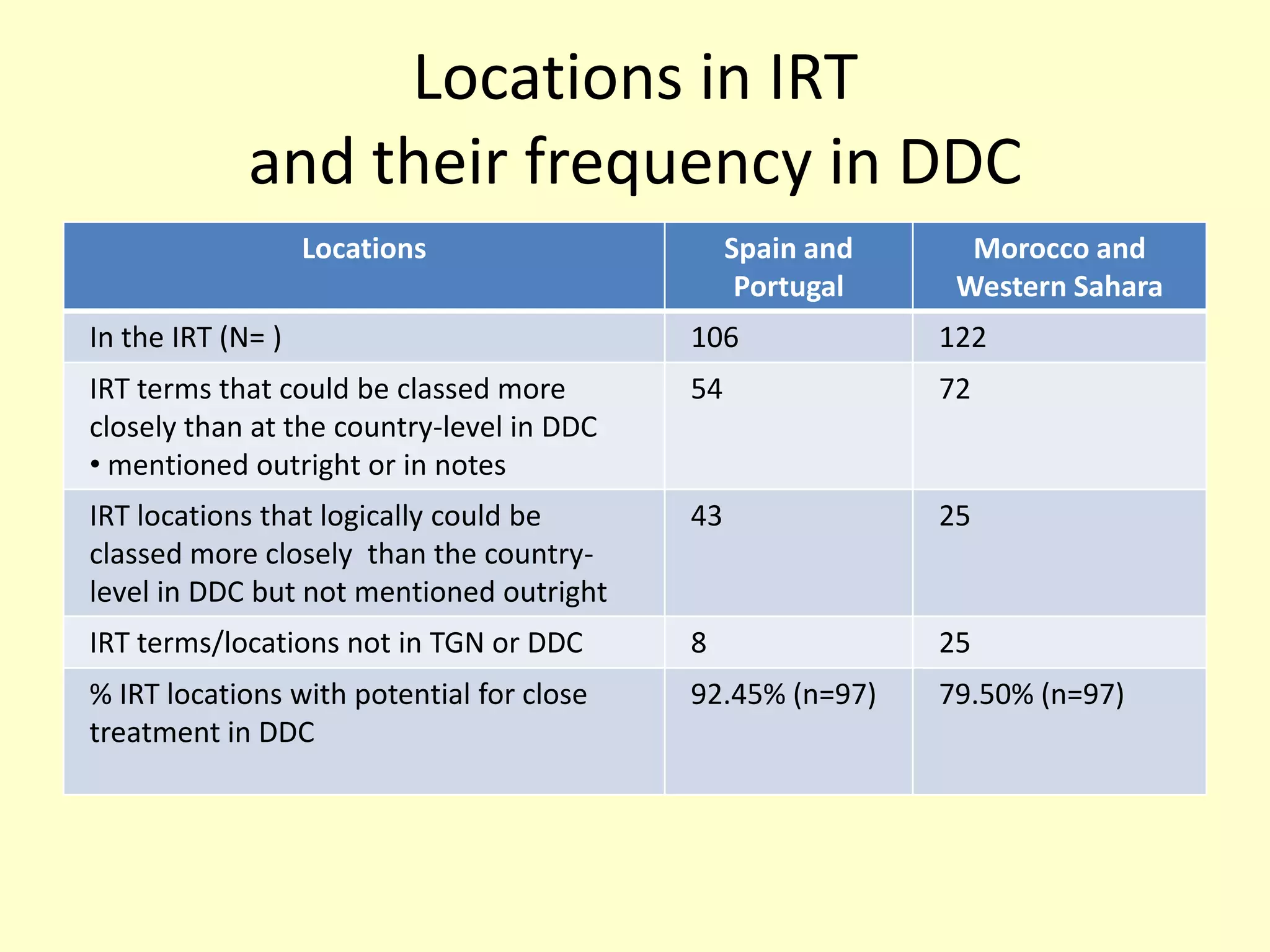
Locations in IRT and their frequency in DDC
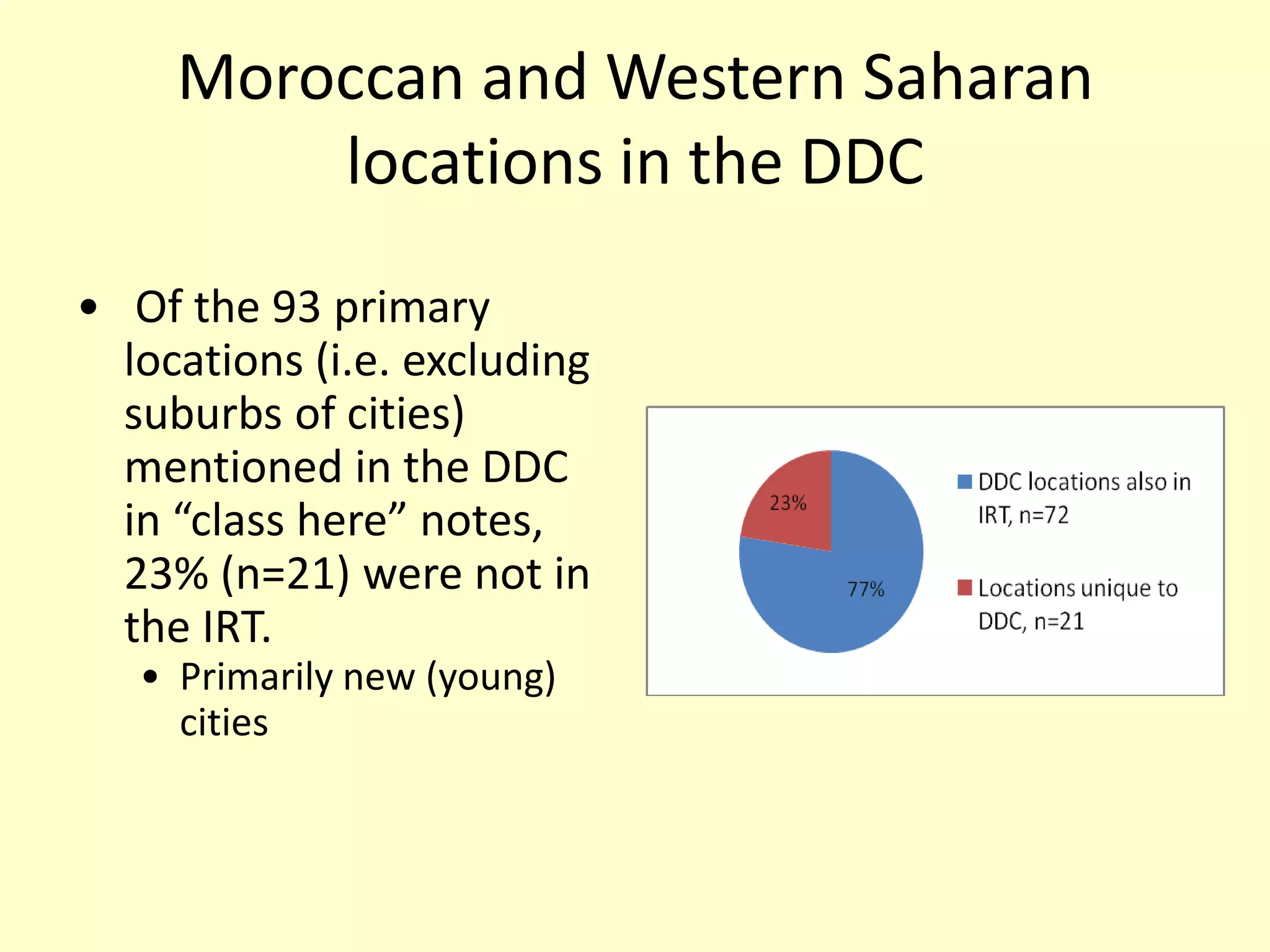
Moroccan and Western Saharan locations in the DDC Of the 93 primary locations (i.e. excluding suburbs of cities) mentioned in the DDC in “class here” notes, 23% (n=21) were not in the IRT.
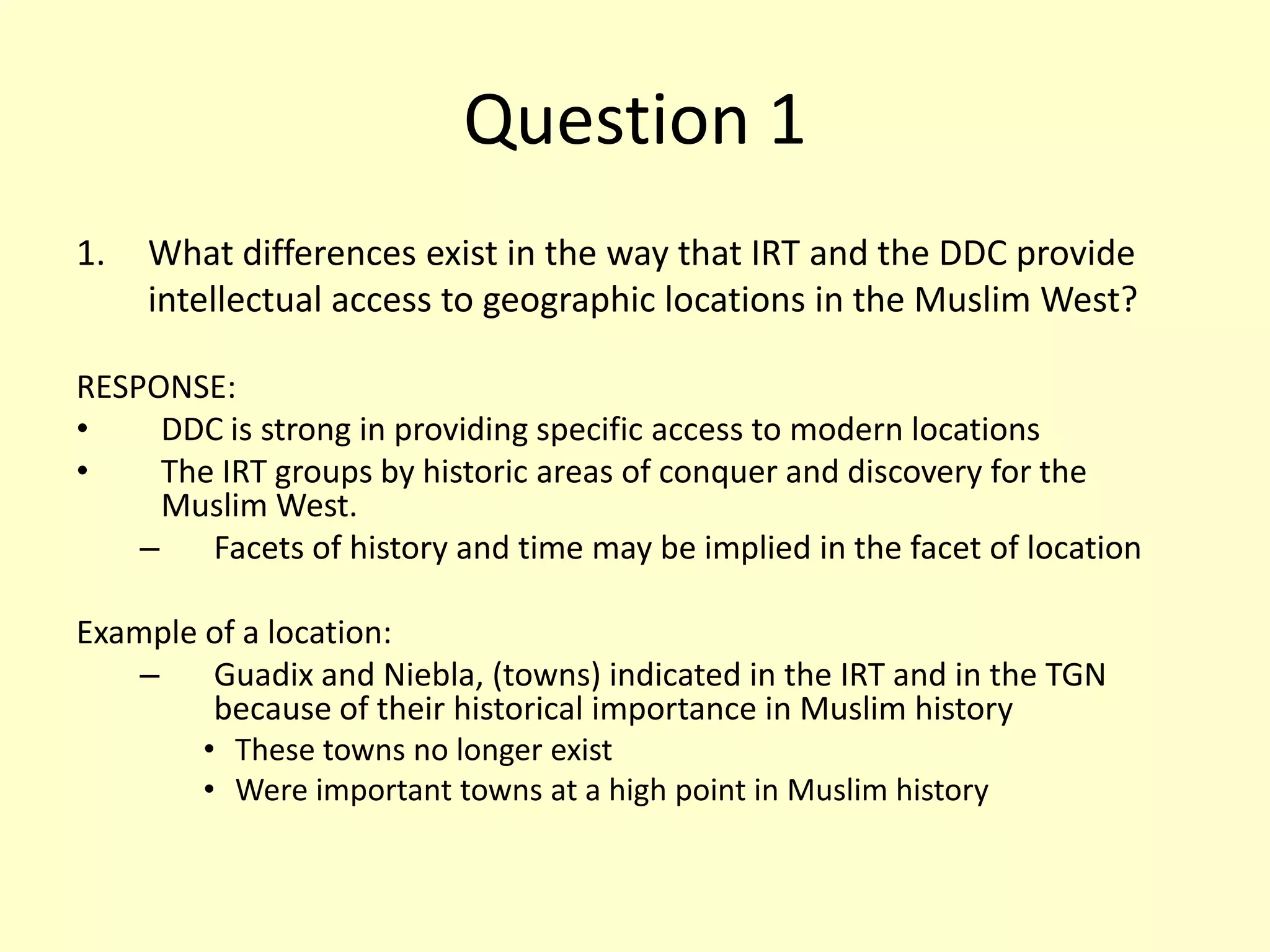
Primarily new (young) citiesQuestion 1What differences exist in the way that IRT and the DDC provide intellectual access to geographic locations in the Muslim West?RESPONSE:DDC is strong in providing specific access to modern locationsThe IRT groups by historic areas of conquer and discovery for the Muslim West. 	Facets of history and time may be implied in the facet of locationExample of a location:Guadix and Niebla, (towns) indicated in the IRT and in the TGN because of their historical importance in Muslim historyThese towns no longer existWere important towns at a high point in Muslim history
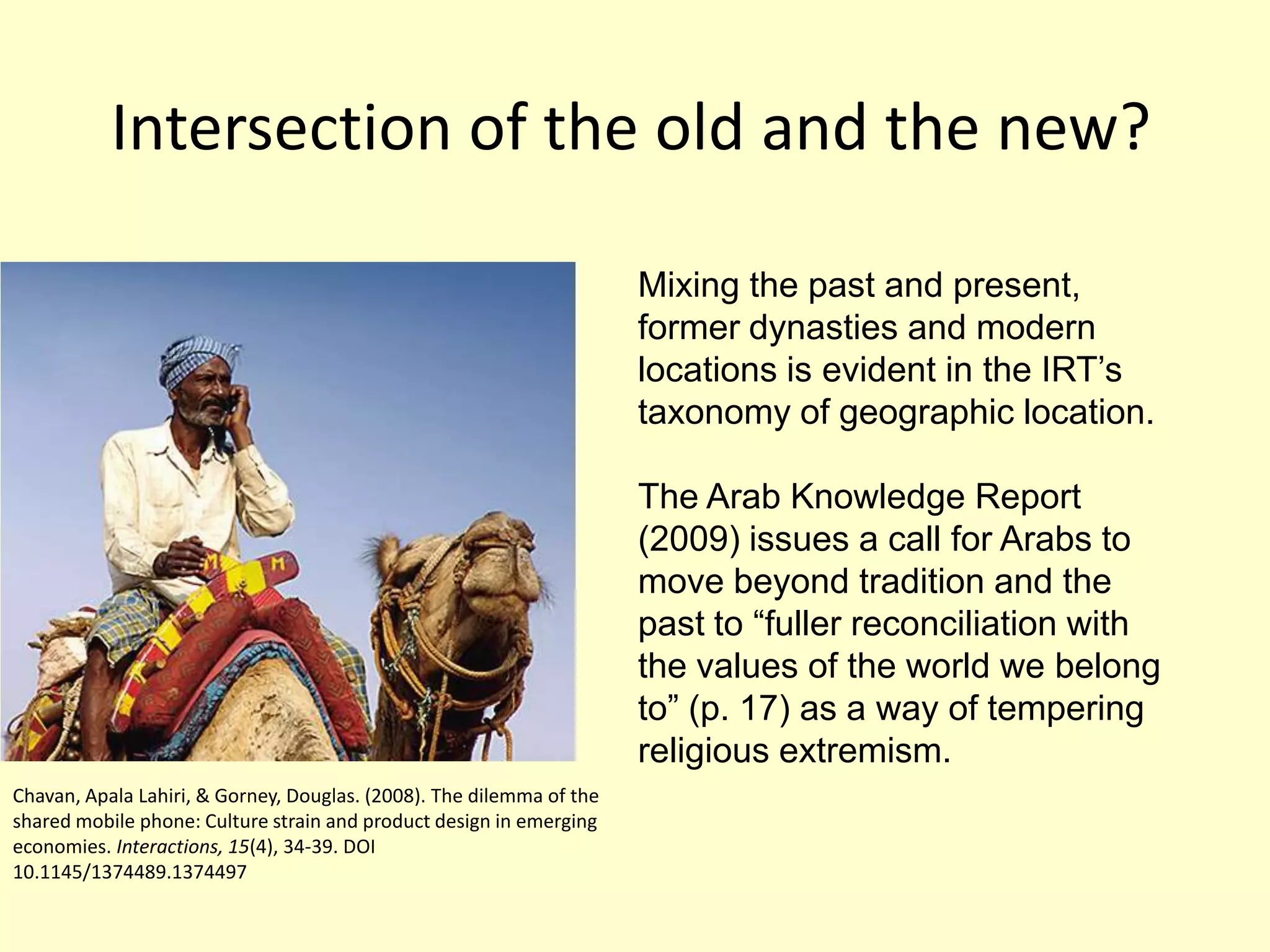
Intersection of the old and the new?Mixing the past and present, former dynasties and modern locations is evident in the IRT’s taxonomy of geographic location. The Arab Knowledge Report (2009) issues a call for Arabs to move beyond tradition and the past to “fuller reconciliation with the values of the world we belong to” (p. 17) as a way of tempering religious extremism. Chavan, Apala Lahiri, & Gorney, Douglas. (2008). The dilemma of the shared mobile phone: Culture strain and product design in emerging economies. Interactions, 15(4), 34-39. DOI 10.1145/1374489.1374497
Question 2Can a universal classification scheme like DDC offer adequate geographic access to a specialized collection focusing on a non-Western culture? RESPONSE: Tentative yes. DDC is able to represent closely 80% of the locations of interest in Morocco and over 90% of locations important to Western Islamic studies on the Iberian Peninsula without requiring the use of a thesaurus other than the TGNThe assumption is that at least these percentages of library materials would be classed closely and correctly in a library using full Dewey. The need for such close classification, even very specialized libraries can be discussedIn light of publishing patterns on specialized topics.Even in a specialized collection, somewhat broad classification can be argued as a means of shortening otherwise overly-precise and long call numbers and facilitating user access.
DiscussionExtent of adequacy of DDC to class places of importance in the Muslim WestSurprisingly extensiveDoes better than the 80/20 ruleContinued question of how adequate this schema is for usersAnecdotal approval by students at ESIReality of access in the developing worldProblems of collection development, unmechanized libraries (3 ILSs in 2009), and limited access to technology require that shelf locations work
Limitations to the studyTwo systems not designed to be used in the same way IRT terms may be used as descriptorsDDC notation primarily meant to be added to base numbers to provide closer notationThe bilingual nature of the Moroccan workThesaurus is bilingual, created by and accessible to educated Moroccans (i.e. bilingual)The collection is multilingual
Summary and conclusionsThis research presents a comparison of terms and intellectual access for geographic location in the Muslim West through the DDC and the IRT, a specialized classification scheme. The DDC has been criticized for being overly culturally biased, not providing equitable access to non-Western ideasLike the IRT, it has a goal of providing a physical location for materials in librariesDDC’s access, although more inclusive of European locations than African ones, appears to be sufficient for geographic access despite fundamental differences in the underlying approaches to perceiving location in space and time
Future study based on this projectRelated study:Uses of DDC in non-Western collections vs othersContent analysis of DDC adaptations made by non-Western peoples (e.g. Egyptian efforts)Whether discovery for Muslim Arab researchers in Western libraries is hindered by Western biases in class schemesCan and should information policies in Arab countries incorporate Western distinctions between past and present when addressing the question of geography?If we accept that classification is less important in online environments, and that DDC is able to provide access across different worldviews, is it possible to build an internationally viable verbal subject access tool based on a decimal approach? Can location be accessed via map interfaces?
AcknowledgementsTravel and stay in Morocco during the 2008-2009 academic year were funded by a Fulbright Scholar grant from the US Dept. of State. The Fondation Al Saoud in Casablanca graciously provided me with a copy of their IbnRushdthesaurus.OCLC generously donated two full copies of DDC 22nd for teaching.
BibliographyAman, M. M. (2006). The impact of technology on libraries and collection in the Arab countries of the Middle East and North Africa. In R. N. Sharma (Ed.), The impact of technology on Asian, African, and Middle Eastern library collections. Lanham, MD: Scarecrow Press. ANSI/NISO Z39.19-2005 (2005). Guidelines for the construction, format, and management of monolingual controlled vocabularies. Bethesda, MD: National Information Standards Organization. Retrieved from http://www.niso.org/kst/reports/standards?step=2&gid=None&project_key=7cc9b583cb5a62e8c15d3099e0bb46bbae9cf38aArab knowledge report 2009: Towards productive intercommunication for knowledge. (2009). Mohammed bin Rashid Al Maktoum Foundation (MBRF) and the United Nations Development Programme/Regional Bureau for Arab States (UNDP/RBAS). Retrieved from http://www.mbrfoundation.ae/English/Documents/AKR-2009-En/AKR-English.pdfBates, M. J. (1998). Indexing and access for digital libraries and the internet: Human, database, and domain factors. Journal of the American Society for Information Science 49(13), 1185-1205.Bates, M. J. (2005). Information and knowledge: An evolutionary framework for information science. Information research, 10(4). Retrieved from http://informationr.net/ir/10-4/paper239.htmlCountries with UDC users. (2009). UDC Consortium. Retrieved May 28, 2010 from http://www.udcc.org/countries.htmDewey decimal classification and relative index. (2003). Mitchell, J. S., Beall, J., Martin, G., Matthews, W. E., & New, G. R. (Eds.). 22nd ed. Dublin, OH: OCLC.
Bibliography, cont.Dewey is the world's most widely used library classification system. (2010). OCLC. Retrieved May 28, 2010 from http://www.oclc.org/ca/en/dewey/about/translations/default.htmHodge, G. (2000). Systems of knowledge organization for digital libraries. Washington, DC: Digital Library Federation and the Council on Library and Information Resources. Retrievedfromhttp://www.diglib.org/pubs/dlf090/dlf090.pdfIbn Rushd: Thésaurus arabe-français relatif au Maghreb et à son environnement historico-culturel andalou et africain. (1998). 1ère éd. Casablanca, Maroc: Fondation du Roi Abdul-Aziz Al Saoud pour les Etudes Islamiques et les Sciences Humaines. Partially available online: http://www.fondation.org.ma/fonda/ibnrushd/bibomw.asp?lango=2Lambe, P. (2007). Lee, H.-L. (2008). Origins of the main classes in the first Chinese bibliographic classification. In C. Arsenault & J. T. Tennis (Eds.), Culture and identity in knowledge organization: Proceedings of the Tenth International ISKO Conference, 5-8 August 2008, Montréal, Canada (pp. 275-281). Würzburg, Germany: ErgonVerlag.Olson, H. A. (2001). Sameness and difference: A cultural foundation of classification. Library Resources & Technical Services 45(3), 115-122.Présentation de la Fondation. (2003). Fondation du Roi Abdul Aziz Al Saoud pour les Etudes Islamiques et les Sciences Humaines. Retrieved May 28, 2010 from http://www.fondation.org.ma/fondlatin/fondatio.htmShirky, C. (2005). Ontology is overrated: Categories, Links, and Tags. Clay Shirky's Writings About the Internet. Retrieved from http://www.shirky.com/writings/ontology_overrated.htmlWeinberger, D. (2007). Everything is miscellaneous: The power of the new digital disorder. New York: Times Books.

ESIS Research Conversation Presentation

  • 1.
    Perspectives on geographiclocation: The Muslim West in two classification systemsbyHeather Lea Moulaison, PhDOctober 15, 2010Conversation de la recherche - ResearchconversationSchool of Information Studies, University of Ottawa
  • 2.
    Bias in classificationWhenhumans intervene and begin grouping “like” things together (Olson), we expect a certain amount of bias in the end productPatterns identified (Bates, 2005) and “buckets” construed Can be linked to sense making (Weick, 1995 cited in Lambe, 2007)Babel Instinct “when we can organise things around us differently from other people, we will do so” (Lambe, 2007, p, xvi)Few classification systems are completely independent of human interpretation Modern biologists care about spines, but others have divided the animal kingdom in different ways based on other characteristics (blood?, etc.)Shirky (2005) claims that not all elements of the Periodic Table fit neatly
  • 3.
    The imprecise scienceof location: the Local Weather phenomenonDespite seeming absolute, geography may be approached differently by different cultures“I” am in the middle of the map for most societiesAnd my country is the biggest, best, most important, etc.Physically pointing to one’s chest indicates “me” and not a cardinal direction, etc.Interesting exception of people cited in Deutscher (2010)The geographic buckets may be different from culture to cultureNumber of continentsLocal Weather phenomenon and travel in North AfricaFulbright in 2008-2009Sony VAIO’s Windows 7 pop-up screenhttp://www.ecoles.cfwb.be/empescfkain/unioneurope07/index.html#
  • 4.
    Ibn Rushd Thesaurus(IRT)Created to support access to theIbnRushdcollectionMaintained by the library of the “Fondation” for Islamic studies and the humanitiesDevoted to the “Muslim West”Composed of monographs, theses, journals, articles, and other documentsIs a bilingual thesaurus of descriptors and class numbersTête-becheformat for paper thesaurus, by languageOnline access also by languageCreated and published by educated MoroccansBuilt according to AFNOR standards, I believeAFNOR (Association françaisede Normalisation) French version of the NISOUsed by trained paraprofessionals/technicians in providing access to the collectionNot librarians
  • 5.
    Research questionsWhat differencesexist in the way that IRT and the DDC provide intellectual access to geographic locations in the Muslim West?Can a universal classification scheme like DDC offer adequate geographic access to a specialized collection focusing on a non-Western culture?
  • 6.
    AssumptionsIn devising aclassification scheme treating geographic location, the biases of the creators of that scheme will be present. This is not necessarily a bad thing if it is intuitive in terms of:Users accessing systemMaterials being classedWestern classification systems will reflect Western culture and approachesNon-Western classification systems will reflect Non-Western cultures and approachesLee (2008) discusses ancient Chinese approaches to classificationA thesaurus for a specialized collection can provide access to the materials in that collection if it is well-constructed and systematically implemented.
  • 7.
    Assumptions, cont.Classification schemeswill adopt different approaches based on their purpose Dewey Decimal Classification (DDC)/Universal Decimal Classifiation (UDC) are “universal” IRT is meant to class a certain collection (personal communication, 2009)Example: Edward Sapir, anthropologist, worked with Marius Barbeau at the Canadian Museum of Civilization in 1910 to devise a taxonomy of Amer-Indian peoples. Peoples were primarily grouped by language and locationLetters of the alphabet were used to indicate classThose of European descent were classed “Z”
  • 8.
    Geography in theIRTPreliminary observationsThe Muslim West is the first class (of 8) designated in the geography portion of the classification systemMuslim West = North Africa and Moorish Iberian PeninsulaHistorically, parts of Spain were Muslim before the Arabs were driven Some of the approach to creating classes sees Western or French groupings by continentshe Americas as one continentOther groupings are by alliances, proximity, etc. (OPEC countries, Scandinavia, etc.)Seems consistent with a worldview of a collectivist culture
  • 9.
    Review of theLit: Criticism of Dewey and DDCDDC has been criticized for having a Western bias (e.g. Olson, 2001) Results in the needless and arbitrary dispersal of national literatures in the collectionCanadian literature-English 810Canadian literature-French 840Canadian literature-Inuit 897.12 (Olson, 2001, p. 119)Shirky (2005) reminds us that classification schemes like DDC are created to provide a physical shelf location. In the digital world, there is no shelf.Weinberger (2007) makes fun of the pigeonholes and finds Dewey’s “original schema […] embarrassing in the modern era” (p. 48).
  • 10.
    Use and appealof DDCPossible reasons for use and appeal outside of Western culturesNon-Western cultures may be adequately represented in the schedules and tablesnumber-building permits the creation of sufficiently close classification numbers for the breadth and depth of library collectionsThe publications collected and made available may reflect more or less the publishing patterns evidenced in Anglo-American librariesBe few enough that close classification is not necessary.Ex: Morocco published 918 books in 1996; Egypt published 2215 books in 1995 (UNESCO)There is something fundamentally appealing about arranging the world into compartments of ten (Bates)Schemes based on DDC have been successfulUDCA Classification System for Libraries of Judaica(3rd edition) by David and Daniel Elazar.Editors at DDC are constantly trying to update and include other worldviews, provide extension tables, allow for local creation of numbers, etc.
  • 11.
    MethodologyGoal: To comparethe treatment of the geography of the Muslim West in the IRT and DDCGeographic terms from the IRT “N” class (Muslim West) were listed in a spreadsheet Corresponding classification notation was indicatedone letter and a series of meaningful numbers based on the level of hierarchy representedClassification notation explicitly showed the hierarchies underlying the order in the listIn practice, these thesaurus terms can be used as descriptors in the database and can accompany other descriptors bringing out additional facetsThe Iberian Peninsula and Morocco/Western Sahara were selected for further studyIberian Peninsula = Europe (covered well in DDC?)Morocco/Western Sahara = Africa (not covered well in DDC?)
  • 12.
    Methodology, cont.Classification notationsfrom IRT for the selected areas were compared directly with the notation in the DDC Auxiliary Table 2 DDC auxiliary tables allow for number building in the DDC systemNumbers from the tables are added to a base number taken from the schedulesWhen in doubt, locations from the IRT were searched in the Thesaurus of Geographic Names (TGN) maintained by the Getty
  • 13.
    Results: Identifying theMuslim West‘N’ class (Muslim West)438 notations representing Muslim West locations Composed of 12 present-day countries and political areas: Morocco, n=114Spain, n=100Algeria, n=93Tunisia, n=57 Mauritania, n=32Libya, n=22Western Sahara, n=8Portugal, n=6Mali, n=2Niger, n=1Ghana, n=1Italy (Sicily), n=1http://www.moulaison.net/MoroccanMuslimWest.html
  • 14.
    Locations in IRTand their frequency in DDC
  • 15.
    Moroccan and WesternSaharan locations in the DDC Of the 93 primary locations (i.e. excluding suburbs of cities) mentioned in the DDC in “class here” notes, 23% (n=21) were not in the IRT.
  • 16.
    Primarily new (young)citiesQuestion 1What differences exist in the way that IRT and the DDC provide intellectual access to geographic locations in the Muslim West?RESPONSE:DDC is strong in providing specific access to modern locationsThe IRT groups by historic areas of conquer and discovery for the Muslim West. Facets of history and time may be implied in the facet of locationExample of a location:Guadix and Niebla, (towns) indicated in the IRT and in the TGN because of their historical importance in Muslim historyThese towns no longer existWere important towns at a high point in Muslim history
  • 17.
    Intersection of theold and the new?Mixing the past and present, former dynasties and modern locations is evident in the IRT’s taxonomy of geographic location. The Arab Knowledge Report (2009) issues a call for Arabs to move beyond tradition and the past to “fuller reconciliation with the values of the world we belong to” (p. 17) as a way of tempering religious extremism. Chavan, Apala Lahiri, & Gorney, Douglas. (2008). The dilemma of the shared mobile phone: Culture strain and product design in emerging economies. Interactions, 15(4), 34-39. DOI 10.1145/1374489.1374497
  • 18.
    Question 2Can auniversal classification scheme like DDC offer adequate geographic access to a specialized collection focusing on a non-Western culture? RESPONSE: Tentative yes. DDC is able to represent closely 80% of the locations of interest in Morocco and over 90% of locations important to Western Islamic studies on the Iberian Peninsula without requiring the use of a thesaurus other than the TGNThe assumption is that at least these percentages of library materials would be classed closely and correctly in a library using full Dewey. The need for such close classification, even very specialized libraries can be discussedIn light of publishing patterns on specialized topics.Even in a specialized collection, somewhat broad classification can be argued as a means of shortening otherwise overly-precise and long call numbers and facilitating user access.
  • 19.
    DiscussionExtent of adequacyof DDC to class places of importance in the Muslim WestSurprisingly extensiveDoes better than the 80/20 ruleContinued question of how adequate this schema is for usersAnecdotal approval by students at ESIReality of access in the developing worldProblems of collection development, unmechanized libraries (3 ILSs in 2009), and limited access to technology require that shelf locations work
  • 20.
    Limitations to thestudyTwo systems not designed to be used in the same way IRT terms may be used as descriptorsDDC notation primarily meant to be added to base numbers to provide closer notationThe bilingual nature of the Moroccan workThesaurus is bilingual, created by and accessible to educated Moroccans (i.e. bilingual)The collection is multilingual
  • 21.
    Summary and conclusionsThisresearch presents a comparison of terms and intellectual access for geographic location in the Muslim West through the DDC and the IRT, a specialized classification scheme. The DDC has been criticized for being overly culturally biased, not providing equitable access to non-Western ideasLike the IRT, it has a goal of providing a physical location for materials in librariesDDC’s access, although more inclusive of European locations than African ones, appears to be sufficient for geographic access despite fundamental differences in the underlying approaches to perceiving location in space and time
  • 22.
    Future study basedon this projectRelated study:Uses of DDC in non-Western collections vs othersContent analysis of DDC adaptations made by non-Western peoples (e.g. Egyptian efforts)Whether discovery for Muslim Arab researchers in Western libraries is hindered by Western biases in class schemesCan and should information policies in Arab countries incorporate Western distinctions between past and present when addressing the question of geography?If we accept that classification is less important in online environments, and that DDC is able to provide access across different worldviews, is it possible to build an internationally viable verbal subject access tool based on a decimal approach? Can location be accessed via map interfaces?
  • 23.
    AcknowledgementsTravel and stayin Morocco during the 2008-2009 academic year were funded by a Fulbright Scholar grant from the US Dept. of State. The Fondation Al Saoud in Casablanca graciously provided me with a copy of their IbnRushdthesaurus.OCLC generously donated two full copies of DDC 22nd for teaching.
  • 24.
    BibliographyAman, M. M.(2006). The impact of technology on libraries and collection in the Arab countries of the Middle East and North Africa. In R. N. Sharma (Ed.), The impact of technology on Asian, African, and Middle Eastern library collections. Lanham, MD: Scarecrow Press. ANSI/NISO Z39.19-2005 (2005). Guidelines for the construction, format, and management of monolingual controlled vocabularies. Bethesda, MD: National Information Standards Organization. Retrieved from http://www.niso.org/kst/reports/standards?step=2&gid=None&project_key=7cc9b583cb5a62e8c15d3099e0bb46bbae9cf38aArab knowledge report 2009: Towards productive intercommunication for knowledge. (2009). Mohammed bin Rashid Al Maktoum Foundation (MBRF) and the United Nations Development Programme/Regional Bureau for Arab States (UNDP/RBAS). Retrieved from http://www.mbrfoundation.ae/English/Documents/AKR-2009-En/AKR-English.pdfBates, M. J. (1998). Indexing and access for digital libraries and the internet: Human, database, and domain factors. Journal of the American Society for Information Science 49(13), 1185-1205.Bates, M. J. (2005). Information and knowledge: An evolutionary framework for information science. Information research, 10(4). Retrieved from http://informationr.net/ir/10-4/paper239.htmlCountries with UDC users. (2009). UDC Consortium. Retrieved May 28, 2010 from http://www.udcc.org/countries.htmDewey decimal classification and relative index. (2003). Mitchell, J. S., Beall, J., Martin, G., Matthews, W. E., & New, G. R. (Eds.). 22nd ed. Dublin, OH: OCLC.
  • 25.
    Bibliography, cont.Dewey isthe world's most widely used library classification system. (2010). OCLC. Retrieved May 28, 2010 from http://www.oclc.org/ca/en/dewey/about/translations/default.htmHodge, G. (2000). Systems of knowledge organization for digital libraries. Washington, DC: Digital Library Federation and the Council on Library and Information Resources. Retrievedfromhttp://www.diglib.org/pubs/dlf090/dlf090.pdfIbn Rushd: Thésaurus arabe-français relatif au Maghreb et à son environnement historico-culturel andalou et africain. (1998). 1ère éd. Casablanca, Maroc: Fondation du Roi Abdul-Aziz Al Saoud pour les Etudes Islamiques et les Sciences Humaines. Partially available online: http://www.fondation.org.ma/fonda/ibnrushd/bibomw.asp?lango=2Lambe, P. (2007). Lee, H.-L. (2008). Origins of the main classes in the first Chinese bibliographic classification. In C. Arsenault & J. T. Tennis (Eds.), Culture and identity in knowledge organization: Proceedings of the Tenth International ISKO Conference, 5-8 August 2008, Montréal, Canada (pp. 275-281). Würzburg, Germany: ErgonVerlag.Olson, H. A. (2001). Sameness and difference: A cultural foundation of classification. Library Resources & Technical Services 45(3), 115-122.Présentation de la Fondation. (2003). Fondation du Roi Abdul Aziz Al Saoud pour les Etudes Islamiques et les Sciences Humaines. Retrieved May 28, 2010 from http://www.fondation.org.ma/fondlatin/fondatio.htmShirky, C. (2005). Ontology is overrated: Categories, Links, and Tags. Clay Shirky's Writings About the Internet. Retrieved from http://www.shirky.com/writings/ontology_overrated.htmlWeinberger, D. (2007). Everything is miscellaneous: The power of the new digital disorder. New York: Times Books.

Editor's Notes

  • #3 Generally acknowledged that human beings organize (e.g. Hodge, 2000; Taylor & Joudrey, 2009, etc.)Pattern identification may be an evolutionary feature in animal brains (Bates, 2005)Organization permits retrieval at a later timeCan be linked to sense making (Weick, 1995 cited in Lambe, 2007)Both involve “ordering things, explaining deviations, simplification and explaining relationships” (Lambe, 2007, p. 26)One aspect of organization is classificationGrouping together like things based on shared characteristicsPlacing them in a “bucket”
  • #5 The library of the “Fondation” for Islamic studies and the humanitiesResearch library attached to a Saudi-sponsored foundation for Islamic studies and the humanities in Casablanca, MoroccoAutomated library using MARC 21Creators of Moroccan “index”Non-circulating collections Open stacksMaintains collections such as the
  • #17 What differences exist in the way that IRT and the DDC provide intellectual access to geographic locations in the Muslim West?Can a universal classification scheme like DDC offer adequate geographic access to a specialized collection focusing on a non-Western culture?