6 Proven Strategies for Engaging Physicians
and 4 Ways to Fail ― Bryan Oshiro, MD
© 2014 Health Catalyst
www.healthcatalyst.com
Proprietary. Feel free to share but we would appreciate a Health Catalyst citation.
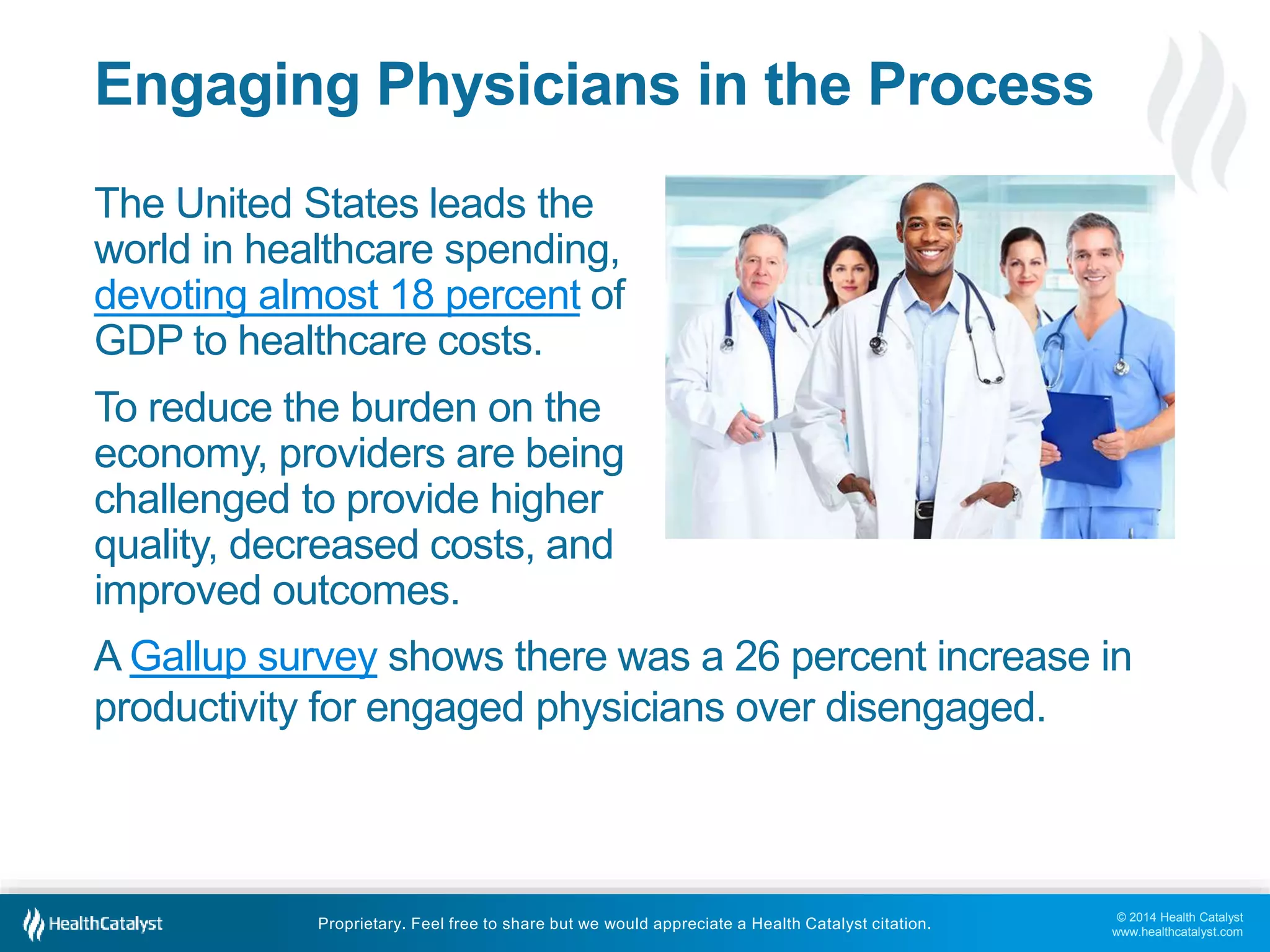
Engaging Physicians in the Process
The United States leads the
world in healthcare spending,
devoting almost 18 percent of
GDP to healthcare costs.
To reduce the burden on the
economy, providers are being
challenged to provide higher
quality, decreased costs, and
improved outcomes.
A Gallup survey shows there was a 26 percent increase in
productivity for engaged physicians over disengaged.
© 2014 Health Catalyst
www.healthcatalyst.com
Proprietary. Feel free to share but we would appreciate a Health Catalyst citation.
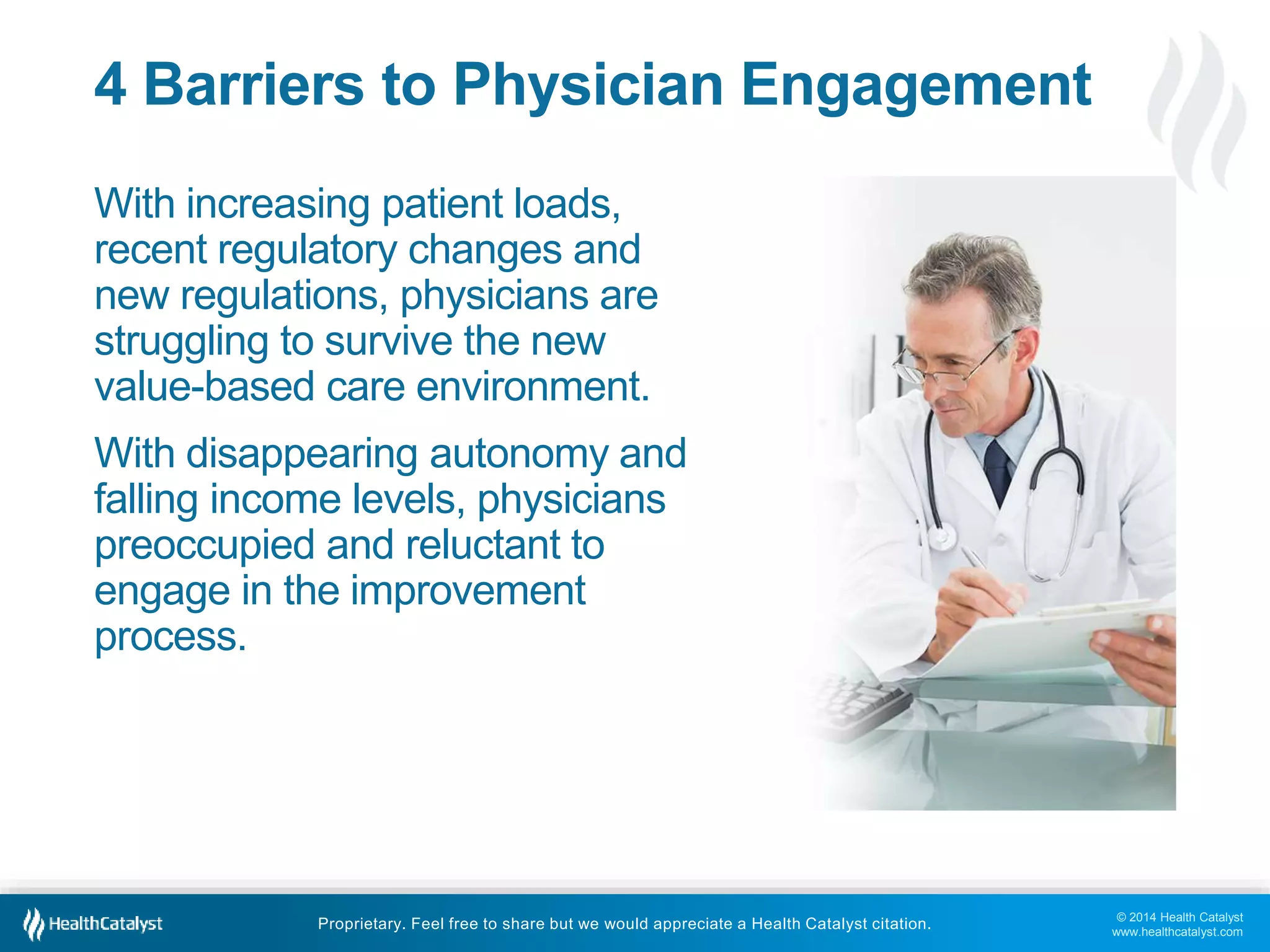
4 Barriers to Physician Engagement
With increasing patient loads,
recent regulatory changes and
new regulations, physicians are
struggling to survive the new
value-based care environment.
With disappearing autonomy and
falling income levels, physicians
preoccupied and reluctant to
engage in the improvement
process.
© 2014 Health Catalyst
www.healthcatalyst.com
Proprietary. Feel free to share but we would appreciate a Health Catalyst citation.
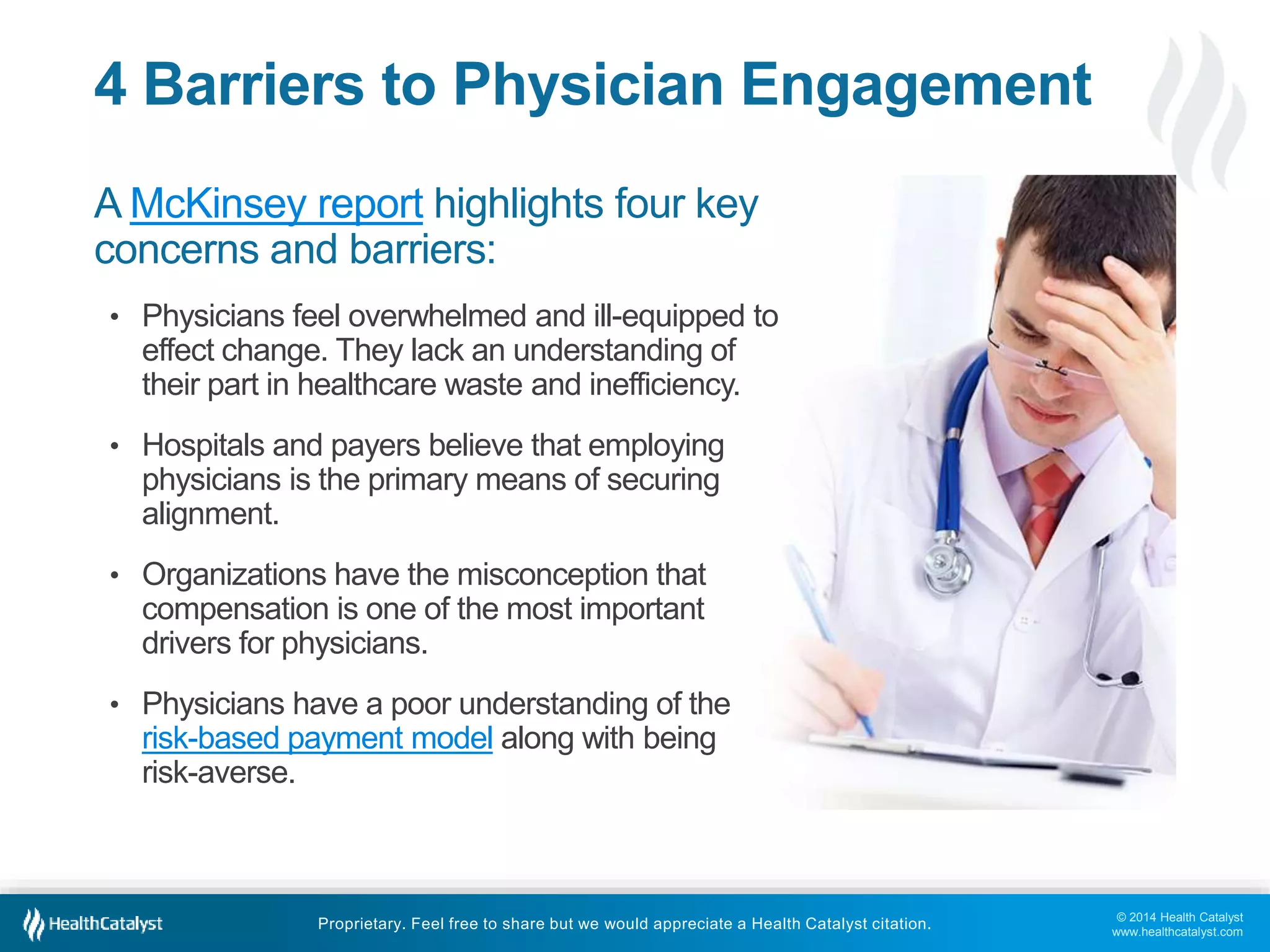
4 Barriers to Physician Engagement
A McKinsey report highlights four key
concerns and barriers:
• Physicians feel overwhelmed and ill-equipped to
effect change. They lack an understanding of
their part in healthcare waste and inefficiency.
• Hospitals and payers believe that employing
physicians is the primary means of securing
alignment.
• Organizations have the misconception that
compensation is one of the most important
drivers for physicians.
• Physicians have a poor understanding of the
risk-based payment model along with being
risk-averse.
© 2014 Health Catalyst
www.healthcatalyst.com
Proprietary. Feel free to share but we would appreciate a Health Catalyst citation.
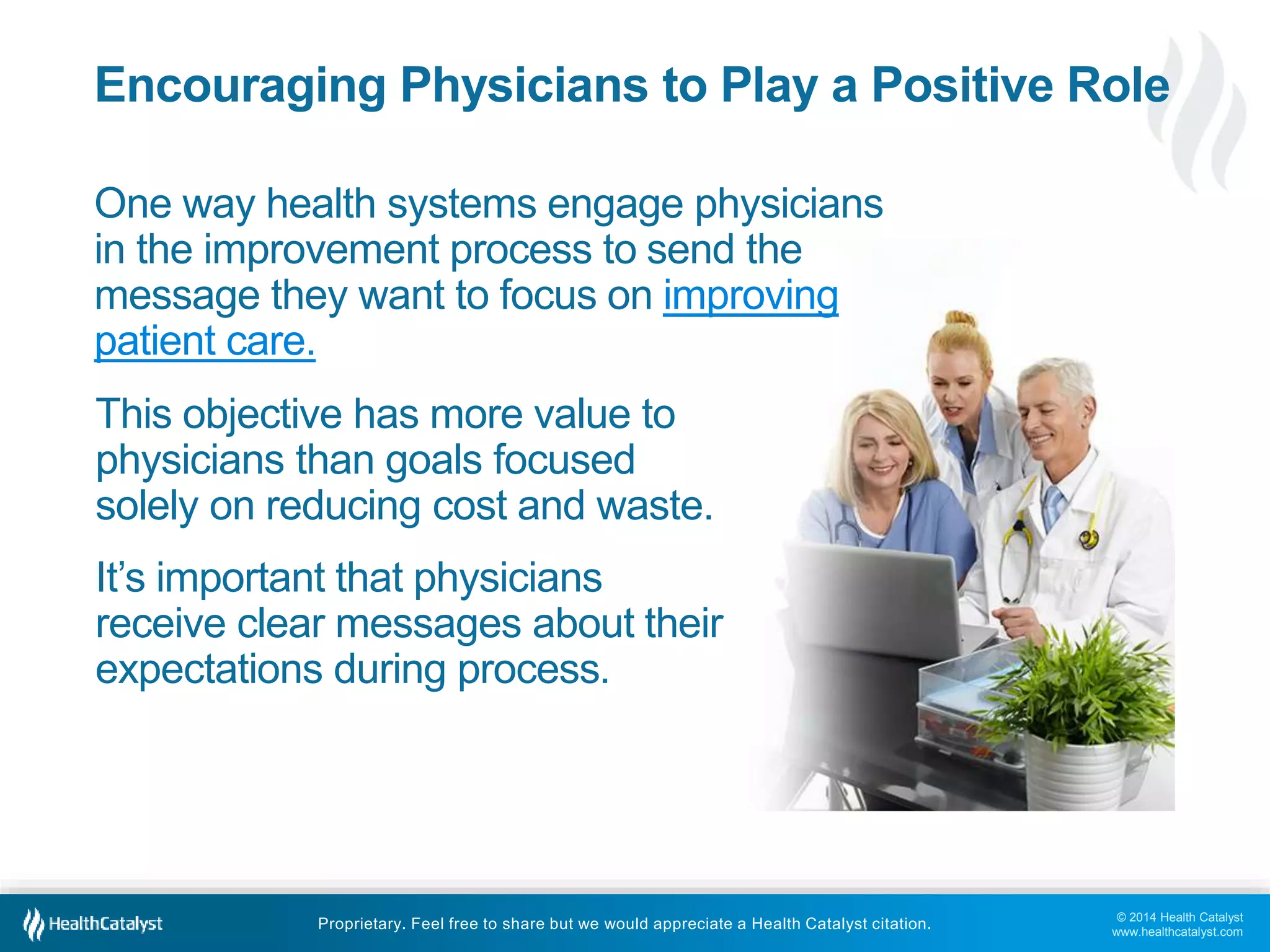
Encouraging Physicians to Play a Positive Role
One way health systems engage physicians
in the improvement process to send the
message they want to focus on improving
patient care.
This objective has more value to
physicians than goals focused
solely on reducing cost and waste.
It’s important that physicians
receive clear messages about their
expectations during process.
© 2014 Health Catalyst
www.healthcatalyst.com
Proprietary. Feel free to share but we would appreciate a Health Catalyst citation.
Dos and Don’ts for Effective Buy-In Strategies
While there are different types
of strategies an organization
can use to encourage physician
buy-in, some have proven to be
successful while others simply
don’t work:
• Inspiration speeches
• Leadership position appointments
• Financial incentives
• Sharing best practices
© 2014 Health Catalyst
www.healthcatalyst.com
Proprietary. Feel free to share but we would appreciate a Health Catalyst citation.
Dos and Don’ts for Effective Buy-In Strategies
What does work is:
• Having great leadership
• Creating focus on a shared vision.
• Viewing healthcare problems as
challenges to be overcome
• Being a partner to the physician
© 2014 Health Catalyst
www.healthcatalyst.com
Proprietary. Feel free to share but we would appreciate a Health Catalyst citation.
6 Steps to Gain Physician Buy-in
The Institute for Healthcare Improvement put
together a framework of six elements to
encourage physician buy-in for a shared
quality agenda:
• Discover a common purpose
• Adopt an engaging style and talk about rewards
• Reframe values and beliefs
• Segment the engagement plan and provide
education
• Use “engaging” improvement methods
• Show courage and provide backup
© 2014 Health Catalyst
www.healthcatalyst.com
Proprietary. Feel free to share but we would appreciate a Health Catalyst citation.
Developing an Action Plan
Achieving improvements in today’s
world of value-based care requires
physician buy-in because their
decisions drive the majority of
quality and cost outcomes.
Provide administrative support, data
analytics and reporting, and the
training needed for improvement.
Listen to and address physician’s
concerns to gain their trust and get
buy-in and enthusiasm for quality
improvement efforts.
© 2014 Health Catalyst
www.healthcatalyst.com
Proprietary. Feel free to share but we would appreciate a Health Catalyst citation.
More about this topic
7 Tips for Increasing Physician Engagement
Kevin Croston, MD, North Memorial Health Care
3 Steps to Prioritize Quality Improvement in Healthcare
Bobbi Brown, VP
Quality Improvement in Healthcare: Where is the Best Place to Start?
Eric Just, VP
Planning for Healthcare Improvement: A Goal Without a Plan Is Just a Wish
John Haughom, MD, Senior Advisor
A Physician’s Story: My Wake-up Call
Bryan Oshiro, MD, Senior Advisor
Link to original article for a more in-depth discussion.
6 Proven Strategies for Engaging Physicians—and 4 Ways to Fail
© 2014 Health Catalyst
www.healthcatalyst.com
Proprietary. Feel free to share but we would appreciate a Health Catalyst citation.
For more information:
© 2014 Health Catalyst
www.healthcatalyst.com
Proprietary. Feel free to share but we would appreciate a Health Catalyst citation.
Other Clinical Quality Improvement Resources
Click to read additional information at www.healthcatalyst.com
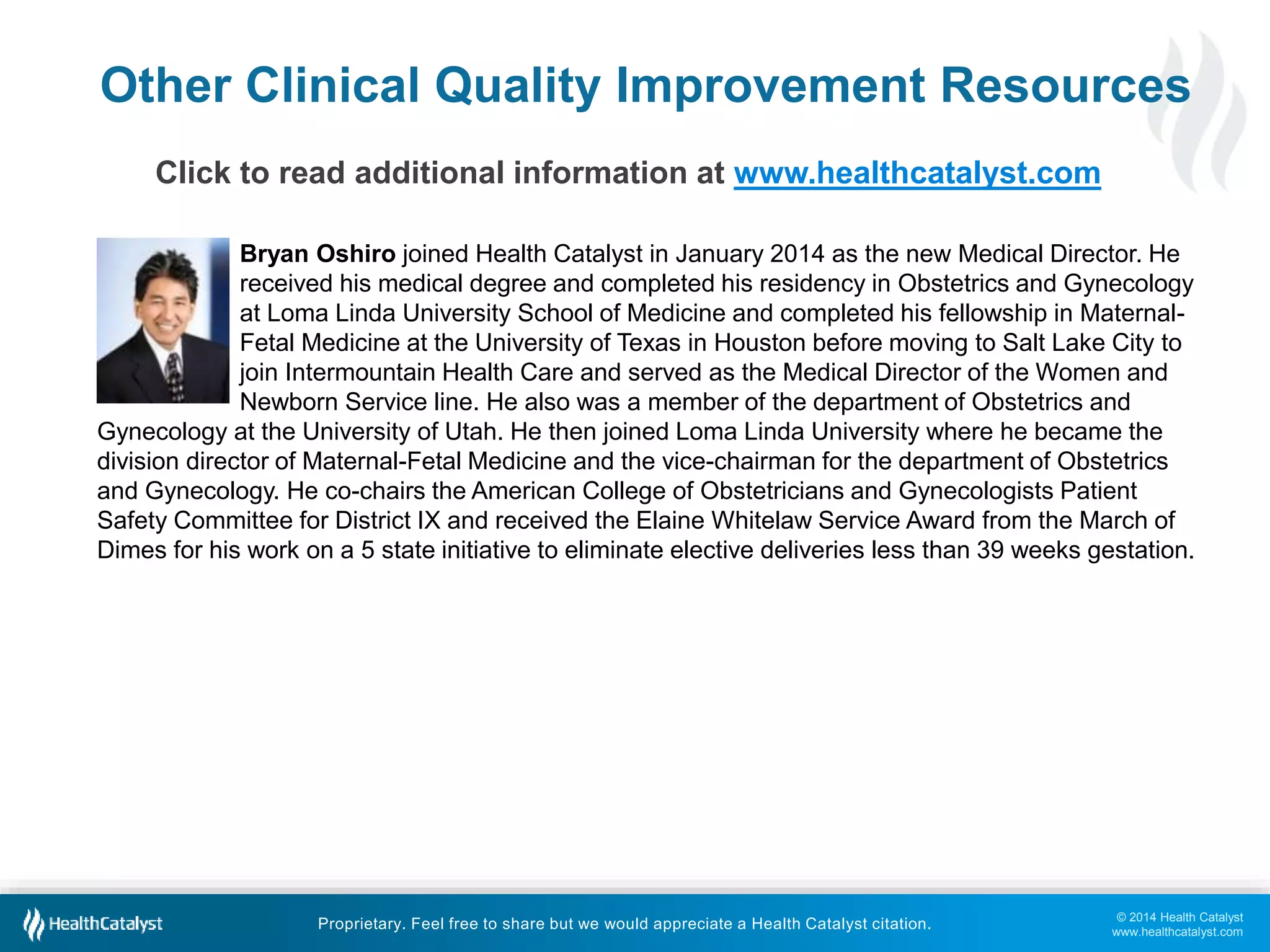
Bryan Oshiro joined Health Catalyst in January 2014 as the new Medical Director. He
received his medical degree and completed his residency in Obstetrics and Gynecology
at Loma Linda University School of Medicine and completed his fellowship in Maternal-
Fetal Medicine at the University of Texas in Houston before moving to Salt Lake City to
join Intermountain Health Care and served as the Medical Director of the Women and
Newborn Service line. He also was a member of the department of Obstetrics and
Gynecology at the University of Utah. He then joined Loma Linda University where he became the
division director of Maternal-Fetal Medicine and the vice-chairman for the department of Obstetrics
and Gynecology. He co-chairs the American College of Obstetricians and Gynecologists Patient
Safety Committee for District IX and received the Elaine Whitelaw Service Award from the March of
Dimes for his work on a 5 state initiative to eliminate elective deliveries less than 39 weeks gestation.

6 Proven Strategies for Engaging Physicians—and 4 Ways to Fail

  • 1.
    6 Proven Strategiesfor Engaging Physicians and 4 Ways to Fail ― Bryan Oshiro, MD
  • 2.
    © 2014 HealthCatalyst www.healthcatalyst.com Proprietary. Feel free to share but we would appreciate a Health Catalyst citation. Engaging Physicians in the Process The United States leads the world in healthcare spending, devoting almost 18 percent of GDP to healthcare costs. To reduce the burden on the economy, providers are being challenged to provide higher quality, decreased costs, and improved outcomes. A Gallup survey shows there was a 26 percent increase in productivity for engaged physicians over disengaged.
  • 3.
    © 2014 HealthCatalyst www.healthcatalyst.com Proprietary. Feel free to share but we would appreciate a Health Catalyst citation. 4 Barriers to Physician Engagement With increasing patient loads, recent regulatory changes and new regulations, physicians are struggling to survive the new value-based care environment. With disappearing autonomy and falling income levels, physicians preoccupied and reluctant to engage in the improvement process.
  • 4.
    © 2014 HealthCatalyst www.healthcatalyst.com Proprietary. Feel free to share but we would appreciate a Health Catalyst citation. 4 Barriers to Physician Engagement A McKinsey report highlights four key concerns and barriers: • Physicians feel overwhelmed and ill-equipped to effect change. They lack an understanding of their part in healthcare waste and inefficiency. • Hospitals and payers believe that employing physicians is the primary means of securing alignment. • Organizations have the misconception that compensation is one of the most important drivers for physicians. • Physicians have a poor understanding of the risk-based payment model along with being risk-averse.
  • 5.
    © 2014 HealthCatalyst www.healthcatalyst.com Proprietary. Feel free to share but we would appreciate a Health Catalyst citation. Encouraging Physicians to Play a Positive Role One way health systems engage physicians in the improvement process to send the message they want to focus on improving patient care. This objective has more value to physicians than goals focused solely on reducing cost and waste. It’s important that physicians receive clear messages about their expectations during process.
  • 6.
    © 2014 HealthCatalyst www.healthcatalyst.com Proprietary. Feel free to share but we would appreciate a Health Catalyst citation. Dos and Don’ts for Effective Buy-In Strategies While there are different types of strategies an organization can use to encourage physician buy-in, some have proven to be successful while others simply don’t work: • Inspiration speeches • Leadership position appointments • Financial incentives • Sharing best practices
  • 7.
    © 2014 HealthCatalyst www.healthcatalyst.com Proprietary. Feel free to share but we would appreciate a Health Catalyst citation. Dos and Don’ts for Effective Buy-In Strategies What does work is: • Having great leadership • Creating focus on a shared vision. • Viewing healthcare problems as challenges to be overcome • Being a partner to the physician
  • 8.
    © 2014 HealthCatalyst www.healthcatalyst.com Proprietary. Feel free to share but we would appreciate a Health Catalyst citation. 6 Steps to Gain Physician Buy-in The Institute for Healthcare Improvement put together a framework of six elements to encourage physician buy-in for a shared quality agenda: • Discover a common purpose • Adopt an engaging style and talk about rewards • Reframe values and beliefs • Segment the engagement plan and provide education • Use “engaging” improvement methods • Show courage and provide backup
  • 9.
    © 2014 HealthCatalyst www.healthcatalyst.com Proprietary. Feel free to share but we would appreciate a Health Catalyst citation. Developing an Action Plan Achieving improvements in today’s world of value-based care requires physician buy-in because their decisions drive the majority of quality and cost outcomes. Provide administrative support, data analytics and reporting, and the training needed for improvement. Listen to and address physician’s concerns to gain their trust and get buy-in and enthusiasm for quality improvement efforts.
  • 10.
    © 2014 HealthCatalyst www.healthcatalyst.com Proprietary. Feel free to share but we would appreciate a Health Catalyst citation. More about this topic 7 Tips for Increasing Physician Engagement Kevin Croston, MD, North Memorial Health Care 3 Steps to Prioritize Quality Improvement in Healthcare Bobbi Brown, VP Quality Improvement in Healthcare: Where is the Best Place to Start? Eric Just, VP Planning for Healthcare Improvement: A Goal Without a Plan Is Just a Wish John Haughom, MD, Senior Advisor A Physician’s Story: My Wake-up Call Bryan Oshiro, MD, Senior Advisor Link to original article for a more in-depth discussion. 6 Proven Strategies for Engaging Physicians—and 4 Ways to Fail
  • 11.
    © 2014 HealthCatalyst www.healthcatalyst.com Proprietary. Feel free to share but we would appreciate a Health Catalyst citation. For more information:
  • 12.
    © 2014 HealthCatalyst www.healthcatalyst.com Proprietary. Feel free to share but we would appreciate a Health Catalyst citation. Other Clinical Quality Improvement Resources Click to read additional information at www.healthcatalyst.com Bryan Oshiro joined Health Catalyst in January 2014 as the new Medical Director. He received his medical degree and completed his residency in Obstetrics and Gynecology at Loma Linda University School of Medicine and completed his fellowship in Maternal- Fetal Medicine at the University of Texas in Houston before moving to Salt Lake City to join Intermountain Health Care and served as the Medical Director of the Women and Newborn Service line. He also was a member of the department of Obstetrics and Gynecology at the University of Utah. He then joined Loma Linda University where he became the division director of Maternal-Fetal Medicine and the vice-chairman for the department of Obstetrics and Gynecology. He co-chairs the American College of Obstetricians and Gynecologists Patient Safety Committee for District IX and received the Elaine Whitelaw Service Award from the March of Dimes for his work on a 5 state initiative to eliminate elective deliveries less than 39 weeks gestation.