© 2014 Health Catalyst
www.healthcatalyst.com
Proprietary and Confidential
© 2014 Health Catalyst
www.healthcatalyst.comProprietary and Confidential
March 11, 2015
Physician Engagement
Bryan T. Oshiro, MD Chief Medical Officer, Health
Catalyst
© 2014 Health Catalyst
www.healthcatalyst.com
Proprietary and Confidential
Learning Objectives
• To describe the importance of physician engagement
in quality improvement (the “why”)
• To describe the challenges and barriers to truly have
physicians lead quality improvement (the “what”)
• To identify strategies to enhance physician
engagement (the “how”)
© 2014 Health Catalyst
www.healthcatalyst.com
Proprietary and Confidential
Best in the World!
• Most American hospitals and physicians provide safe
and effective care for the vast majority of patients, the
vast majority of the time
• Where did Italian Prime Minister Silvio Berlusconi go
when he needed a heart operation in 2011? the
Cleveland Clinic.
• When the late King Hussein of Jordan needed
treatment for lymphoma, where did he go?
• Western medicine’s ability to save and extend life,
and to improve the quality of life for the ill and injured
is nothing short of miraculous
© 2014 Health Catalyst
www.healthcatalyst.com
Proprietary and Confidential
But are We?
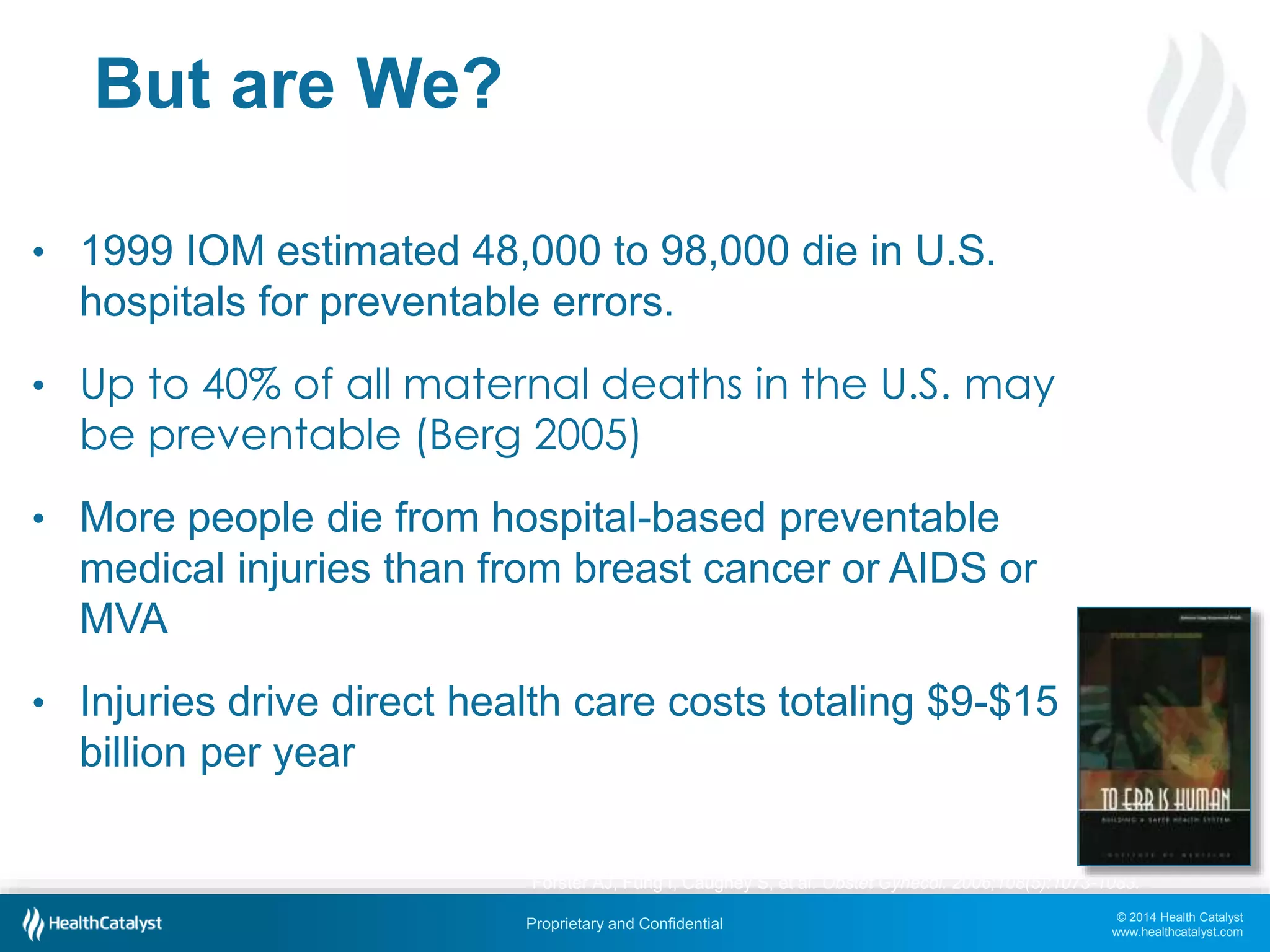
• 1999 IOM estimated 48,000 to 98,000 die in U.S.
hospitals for preventable errors.
• Up to 40% of all maternal deaths in the U.S. may
be preventable (Berg 2005)
• More people die from hospital-based preventable
medical injuries than from breast cancer or AIDS or
MVA
• Injuries drive direct health care costs totaling $9-$15
billion per year
Forster AJ, Fung I, Caughey S, et al. Obstet Gynecol. 2006;108(5):1073-1083.
© 2014 Health Catalyst
www.healthcatalyst.com
Proprietary and Confidential
American health care
"gets it right”
54.9%
of the time.
McGlynn EA, Asch SM, Adams J, et al. The quality of health care delivered to
adults in the United States. N Engl J Med; 2003;2635-2645
© 2014 Health Catalyst
www.healthcatalyst.com
Proprietary and Confidential
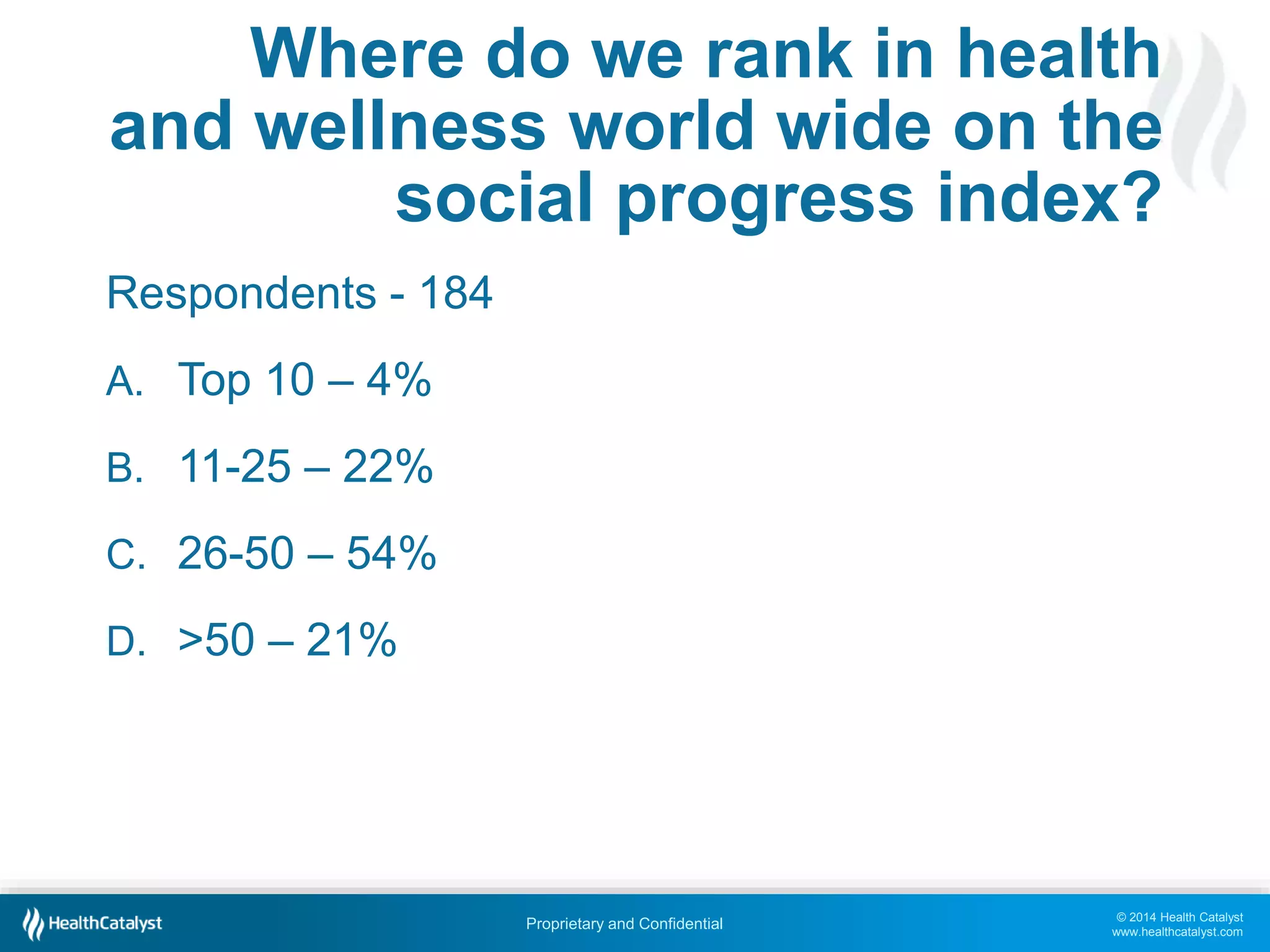
Where do we rank in health
and wellness world wide on the
social progress index?
Respondents - 184
A. Top 10 – 4%
B. 11-25 – 22%
C. 26-50 – 54%
D. >50 – 21%
© 2014 Health Catalyst
www.healthcatalyst.com
Proprietary and Confidential
7
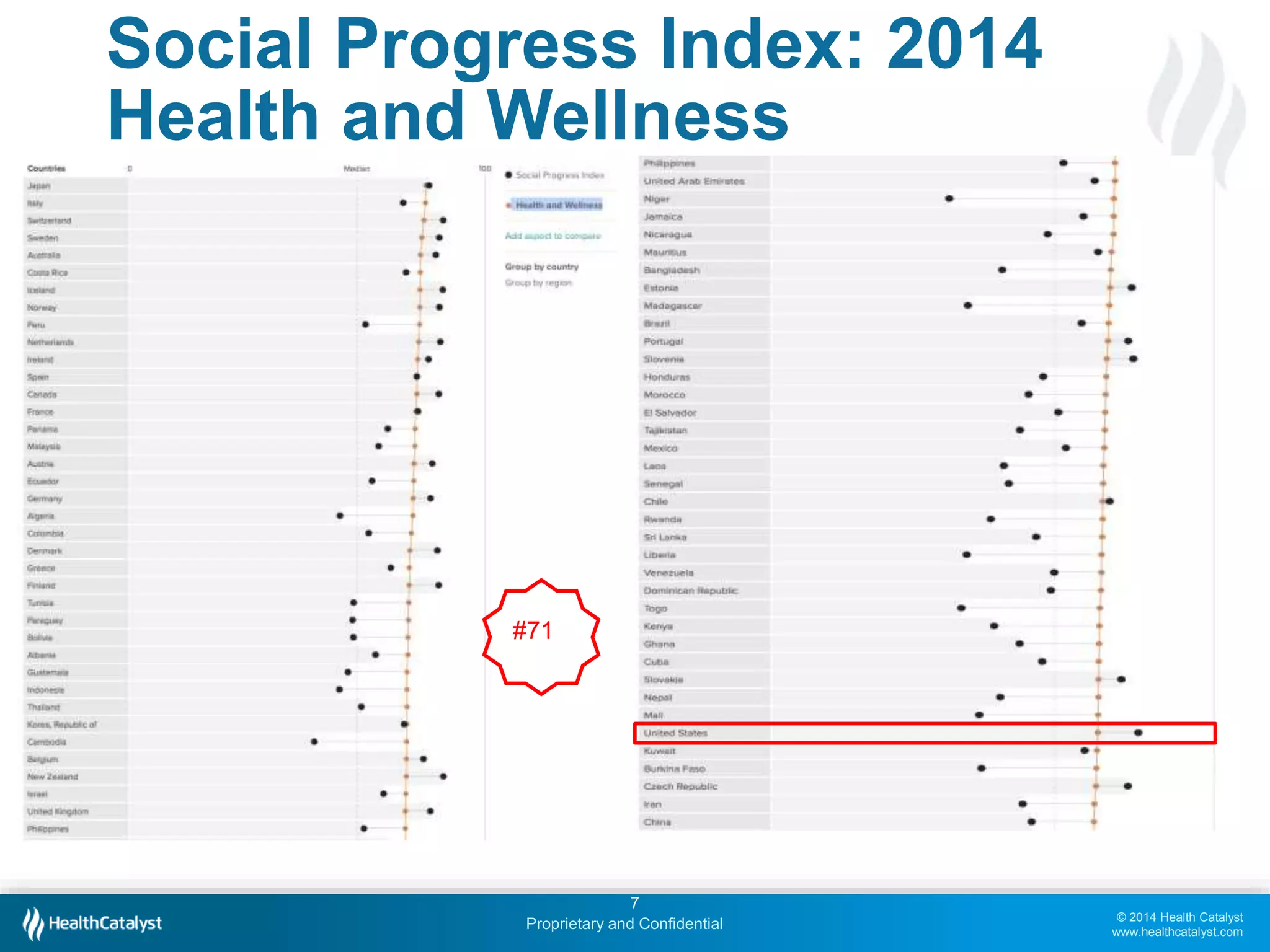
Social Progress Index: 2014
Health and Wellness
#71
© 2014 Health Catalyst
www.healthcatalyst.com
Proprietary and Confidential
8
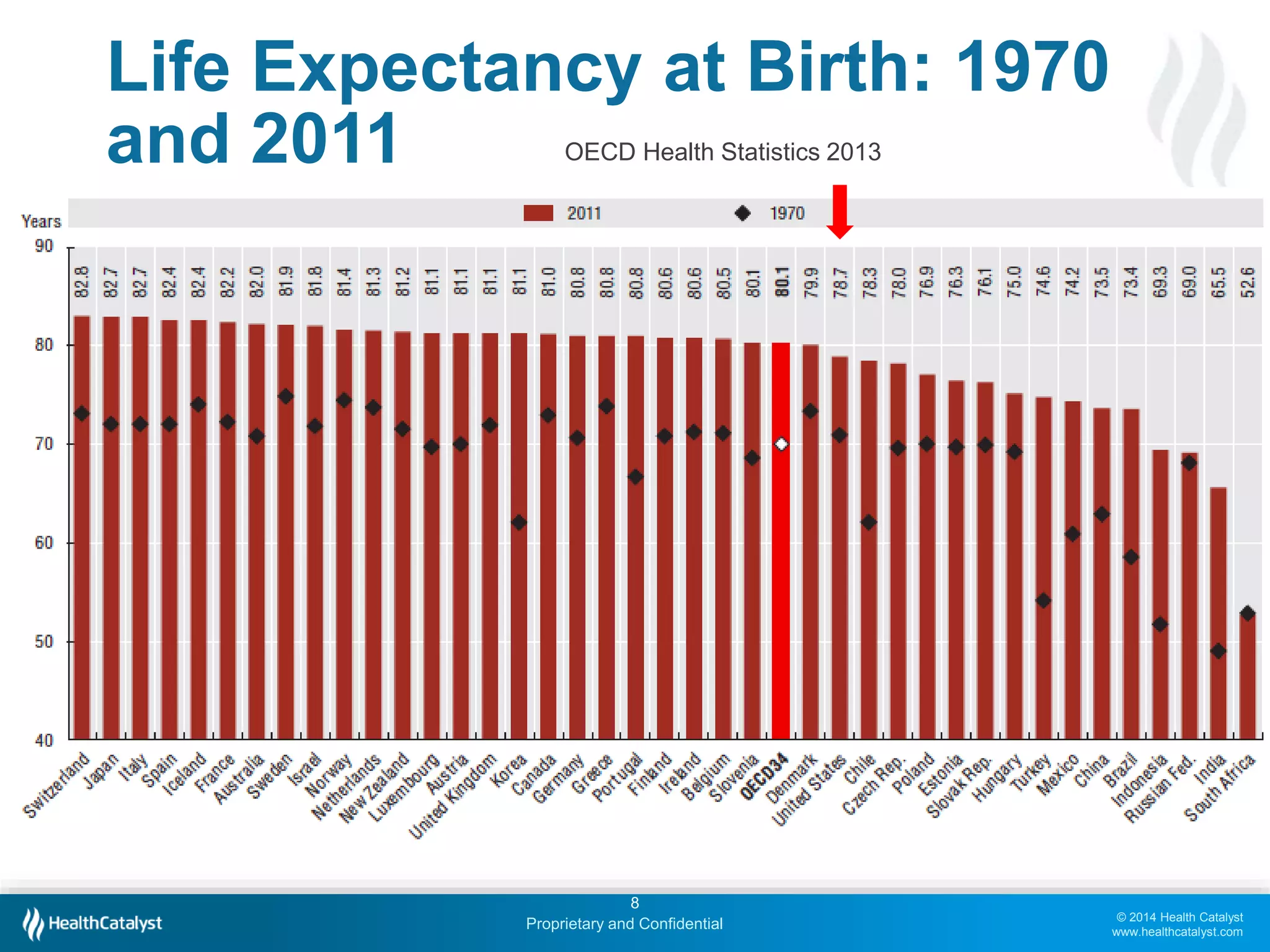
Life Expectancy at Birth: 1970
and 2011 OECD Health Statistics 2013
© 2014 Health Catalyst
www.healthcatalyst.com
Proprietary and Confidential
9
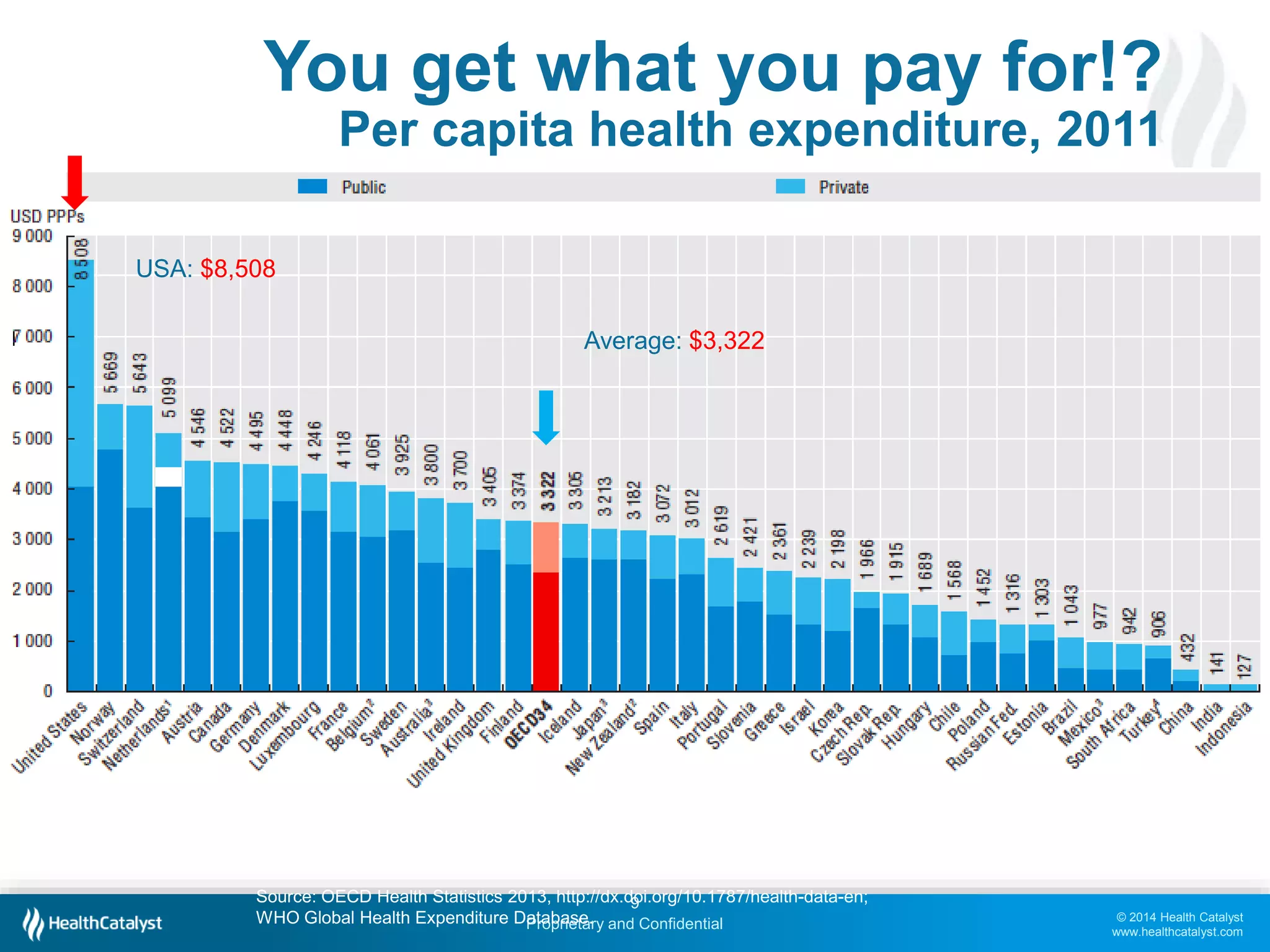
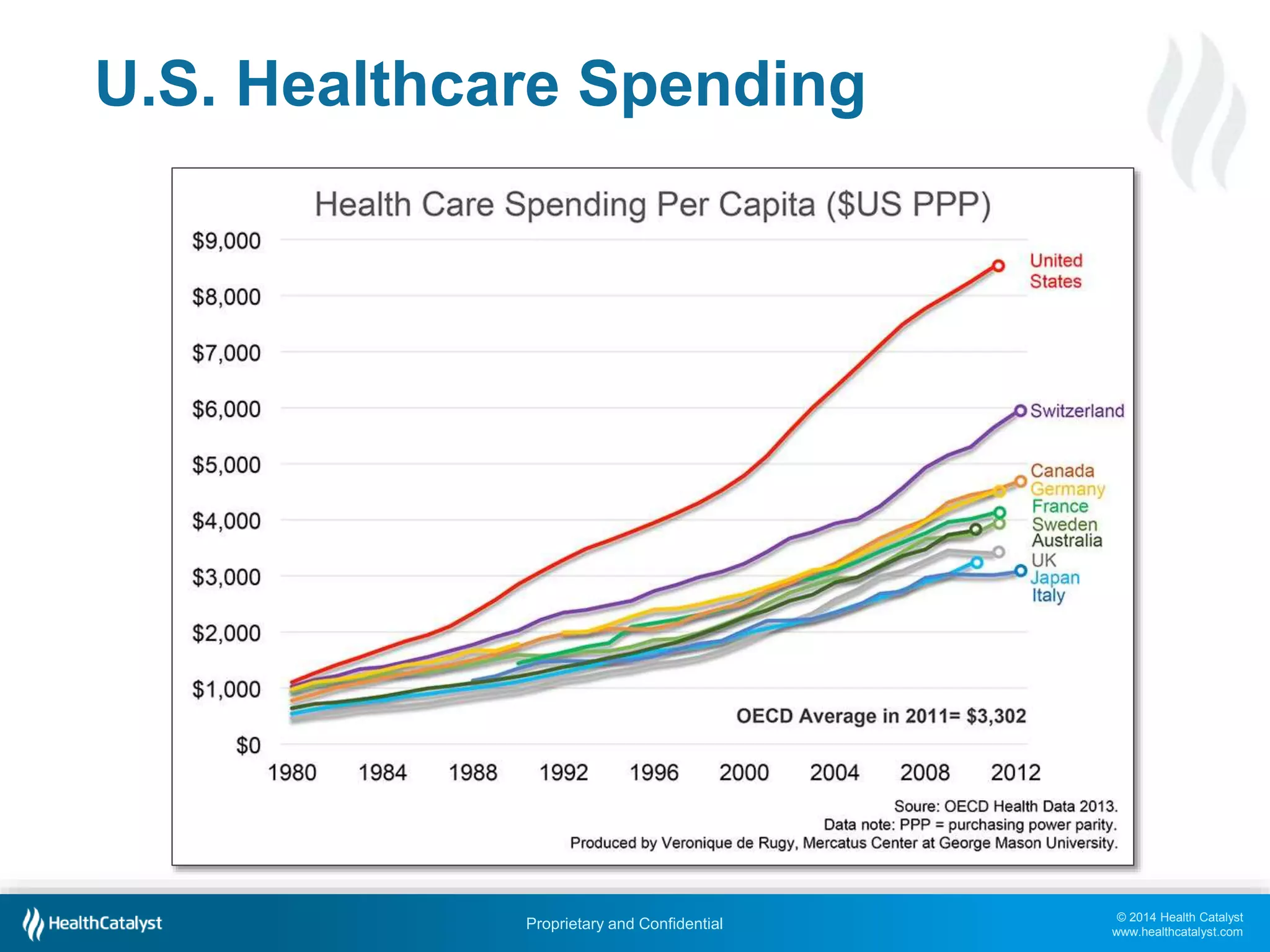
You get what you pay for!?
Per capita health expenditure, 2011
Source: OECD Health Statistics 2013, http://dx.doi.org/10.1787/health-data-en;
WHO Global Health Expenditure Database.
Average: $3,322
USA: $8,508
© 2014 Health Catalyst
www.healthcatalyst.com
Proprietary and Confidential
U.S. Healthcare Spending
© 2014 Health Catalyst
www.healthcatalyst.com
Proprietary and Confidential
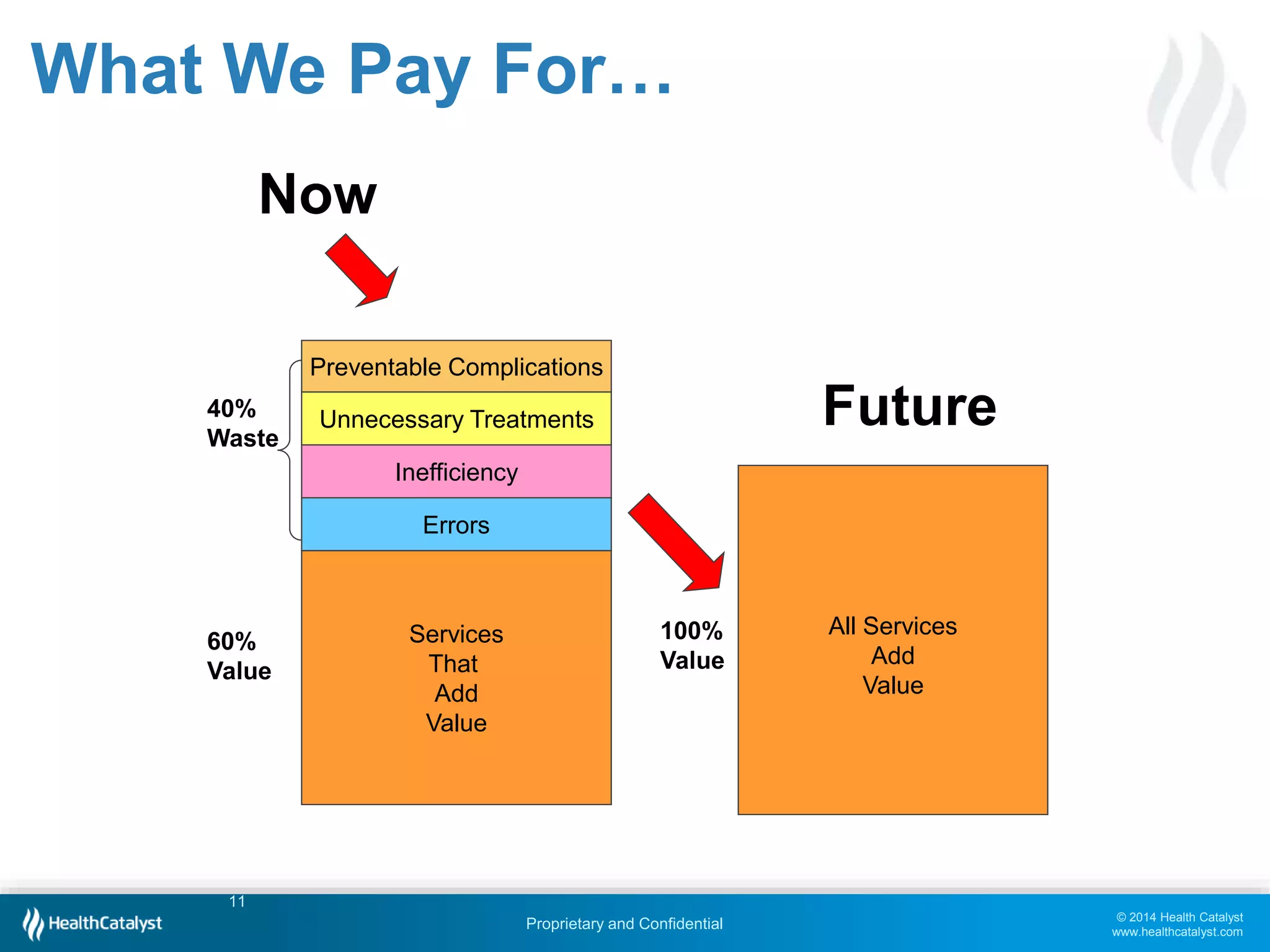
Preventable Complications
Unnecessary Treatments
Inefficiency
Errors
Services
That
Add
Value
40%
Waste
60%
Value
All Services
Add
Value
100%
Value
Future
Now
What We Pay For…
11
© 2014 Health Catalyst
www.healthcatalyst.com
Proprietary and Confidential
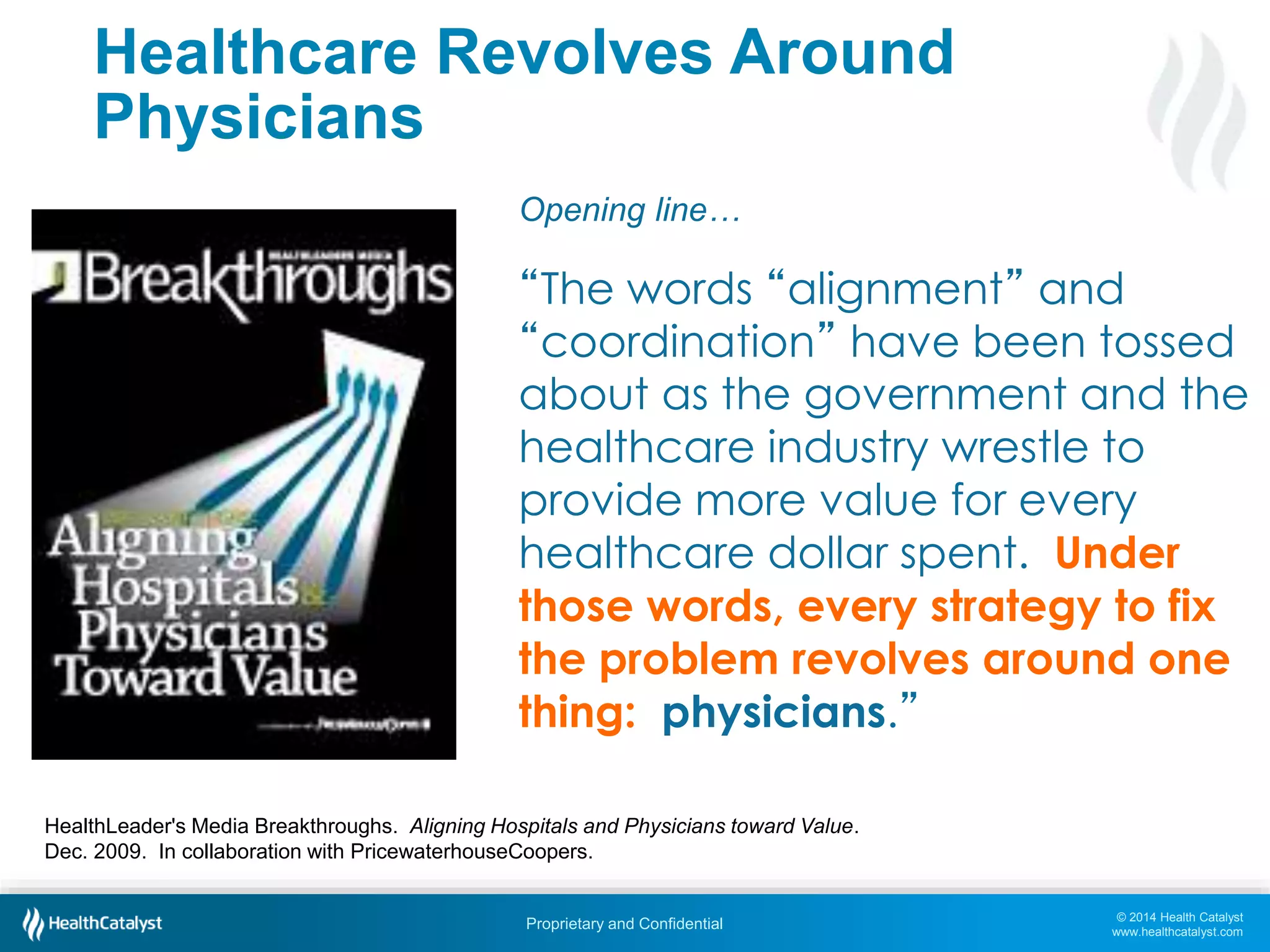
Healthcare Revolves Around
Physicians
Opening line…
“The words “alignment” and
“coordination” have been tossed
about as the government and the
healthcare industry wrestle to
provide more value for every
healthcare dollar spent. Under
those words, every strategy to fix
the problem revolves around one
thing: physicians.”
HealthLeader's Media Breakthroughs. Aligning Hospitals and Physicians toward Value.
Dec. 2009. In collaboration with PricewaterhouseCoopers.
© 2014 Health Catalyst
www.healthcatalyst.com
Proprietary and Confidential
Engagement matters
• 75-85% of the decisions that drive quality and cost
are determined by physicians
• Gallup reported at one health system,
outpatient volume increased +17.5 for
engaged physicians in the top quartile for
improved engagement.
• Disengaged physicians in the bottom quartile,
their outpatient volume declined -11.7%.
© 2014 Health Catalyst
www.healthcatalyst.com
Proprietary and Confidential
Gallup Business
Journal “ what the
doctor ordered”
Sept 8, 2005
© 2014 Health Catalyst
www.healthcatalyst.com
Proprietary and Confidential
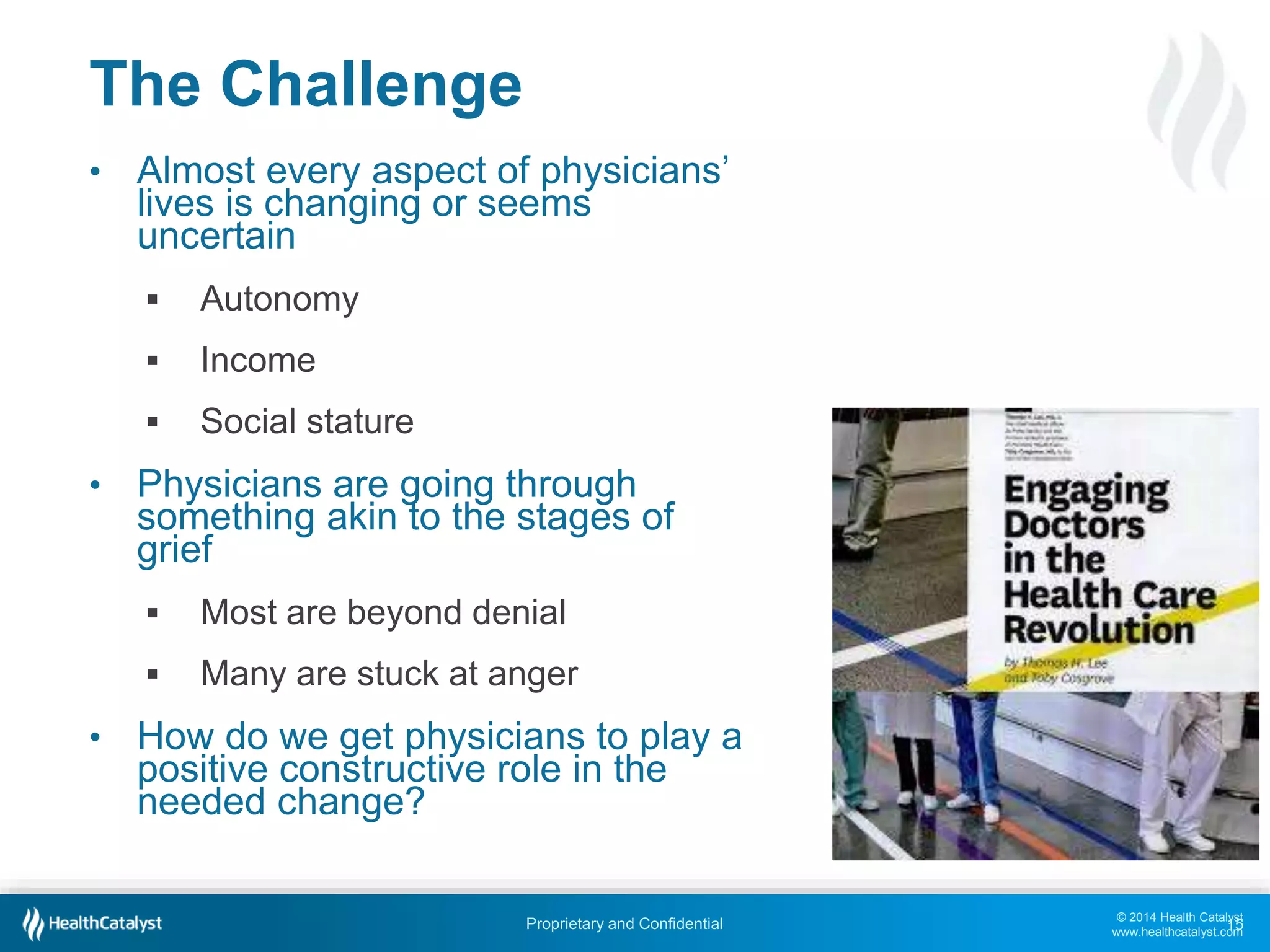
The Challenge
• Almost every aspect of physicians’
lives is changing or seems
uncertain
 Autonomy
 Income
 Social stature
• Physicians are going through
something akin to the stages of
grief
 Most are beyond denial
 Many are stuck at anger
• How do we get physicians to play a
positive constructive role in the
needed change?
15
© 2014 Health Catalyst
www.healthcatalyst.com
Proprietary and Confidential
Systems Issues
• Physicians are too busy
• Physicians are not compensated for their help
• Poor knowledge management support
• Malpractice issues
• Lack of meaningful measurements
• Poor data analytic support
16
© 2014 Health Catalyst
www.healthcatalyst.com
Proprietary and Confidential
Barriers to Strong Physician
Engagement
• Physicians feel overwhelmed and ill-equipped
and have limited understanding of how their
behavior contributes to healthcare waste and
inefficiency
• Providers and payors focusing only on
employment
• Organizations over-weight the importance of
compensation to influence MD behavior
• MD have poor understanding of risk-based
payment models
17
Source: McKinsey Physician Survey, 2011
© 2014 Health Catalyst
www.healthcatalyst.com
Proprietary and Confidential
18
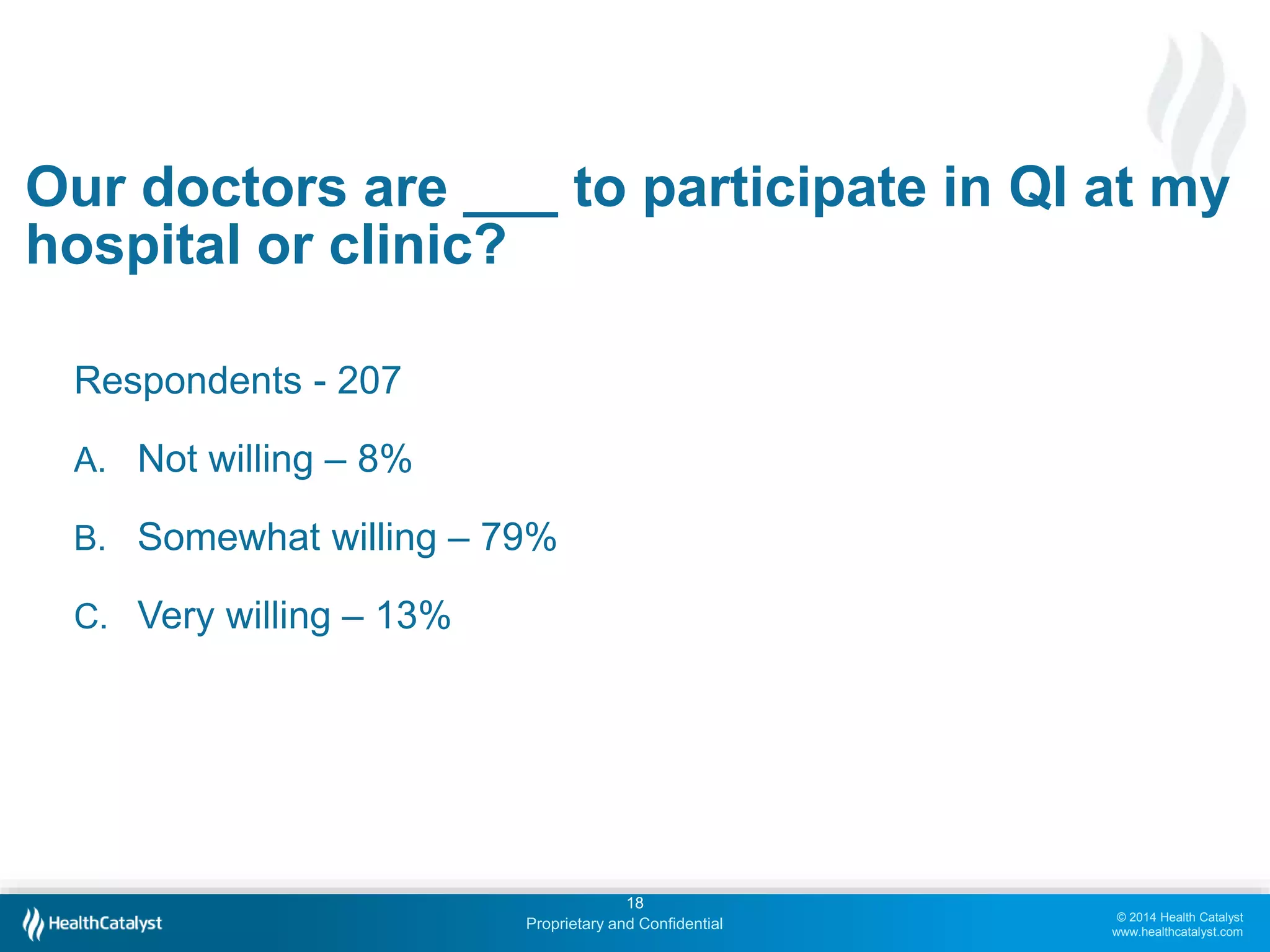
Respondents - 207
A. Not willing – 8%
B. Somewhat willing – 79%
C. Very willing – 13%
Our doctors are ___ to participate in QI at my
hospital or clinic?
© 2014 Health Catalyst
www.healthcatalyst.com
Proprietary and Confidential
MD Willingness to Change:
Removing Waste from Healthcare System
19
Source: McKinsey Physician Survey, 2011
© 2014 Health Catalyst
www.healthcatalyst.com
Proprietary and Confidential
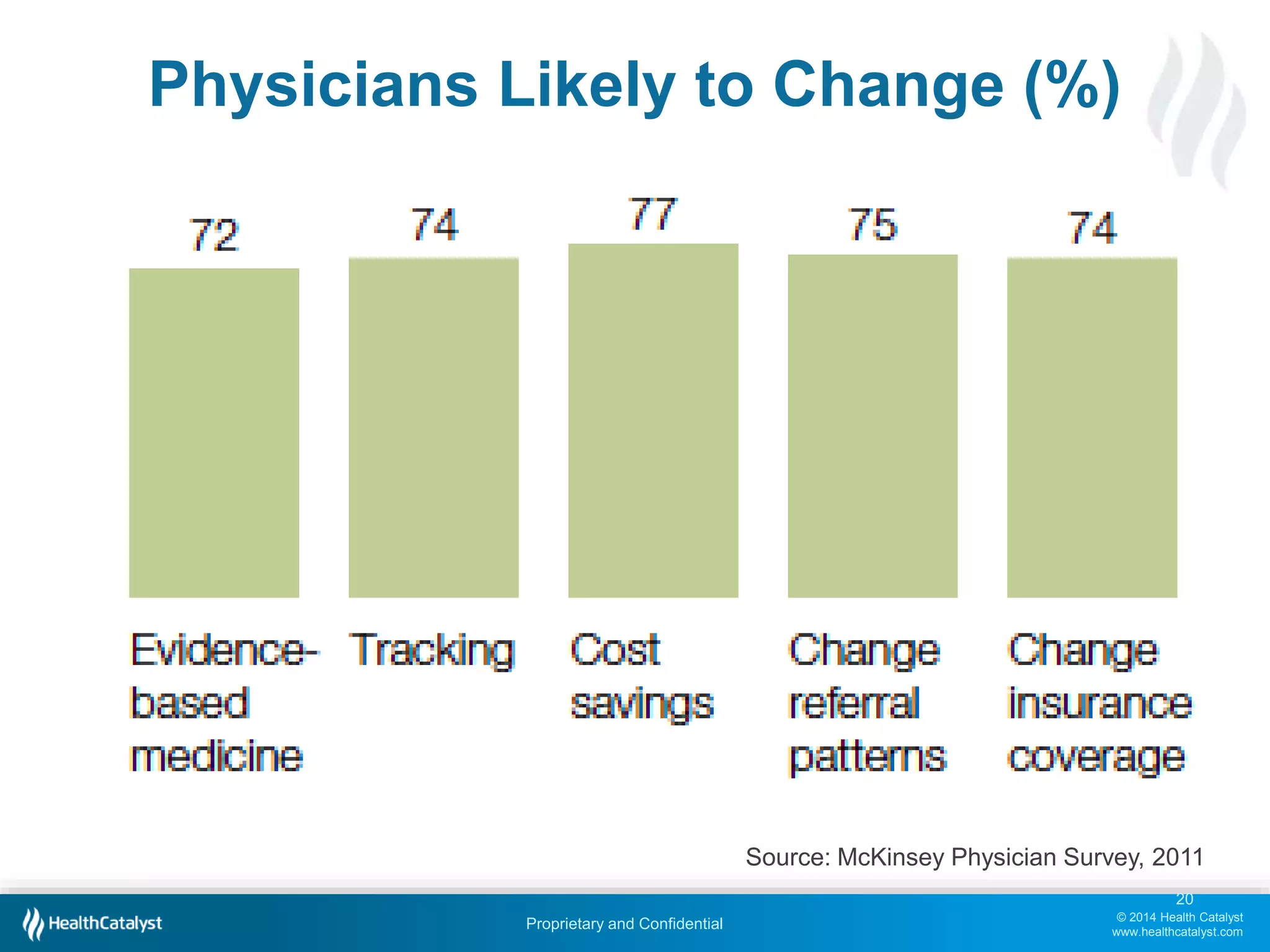
Physicians Likely to Change (%)
20
Source: McKinsey Physician Survey, 2011
© 2014 Health Catalyst
www.healthcatalyst.com
Proprietary and Confidential
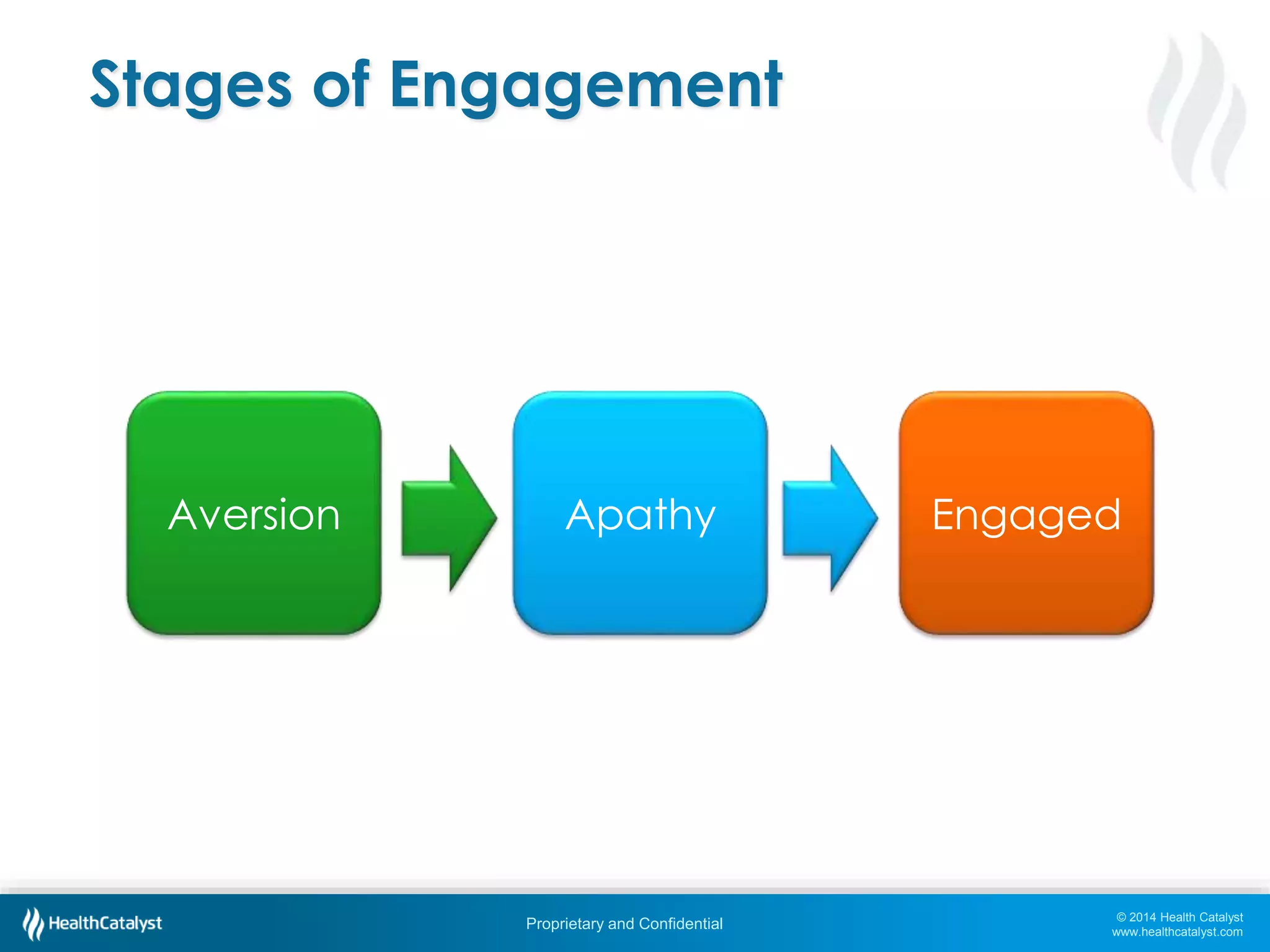
Stages of Engagement
Aversion Apathy Engaged
© 2014 Health Catalyst
www.healthcatalyst.com
Proprietary and Confidential
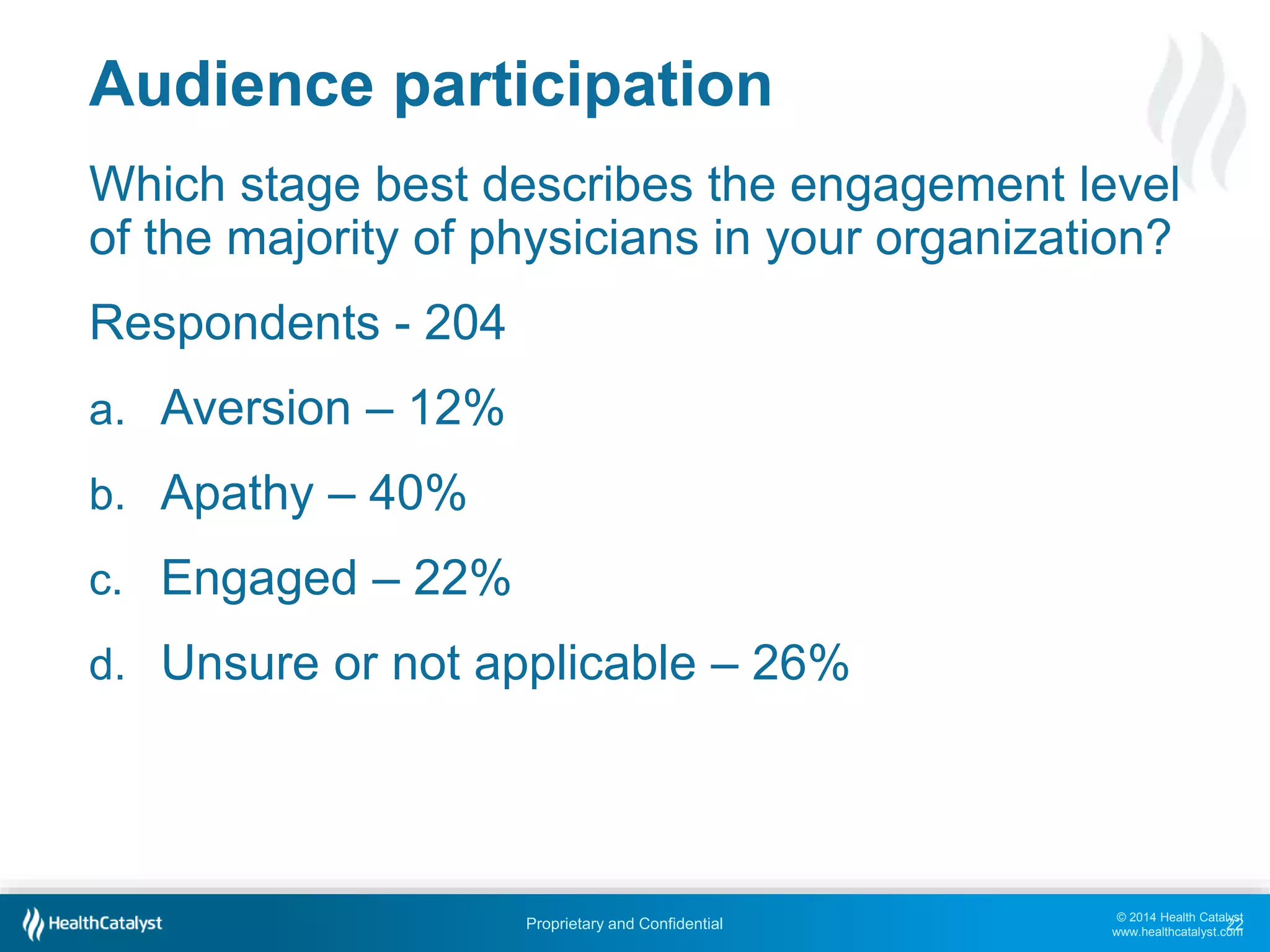
Audience participation
Which stage best describes the engagement level
of the majority of physicians in your organization?
Respondents - 204
a. Aversion – 12%
b. Apathy – 40%
c. Engaged – 22%
d. Unsure or not applicable – 26%
22
© 2014 Health Catalyst
www.healthcatalyst.com
Proprietary and Confidential
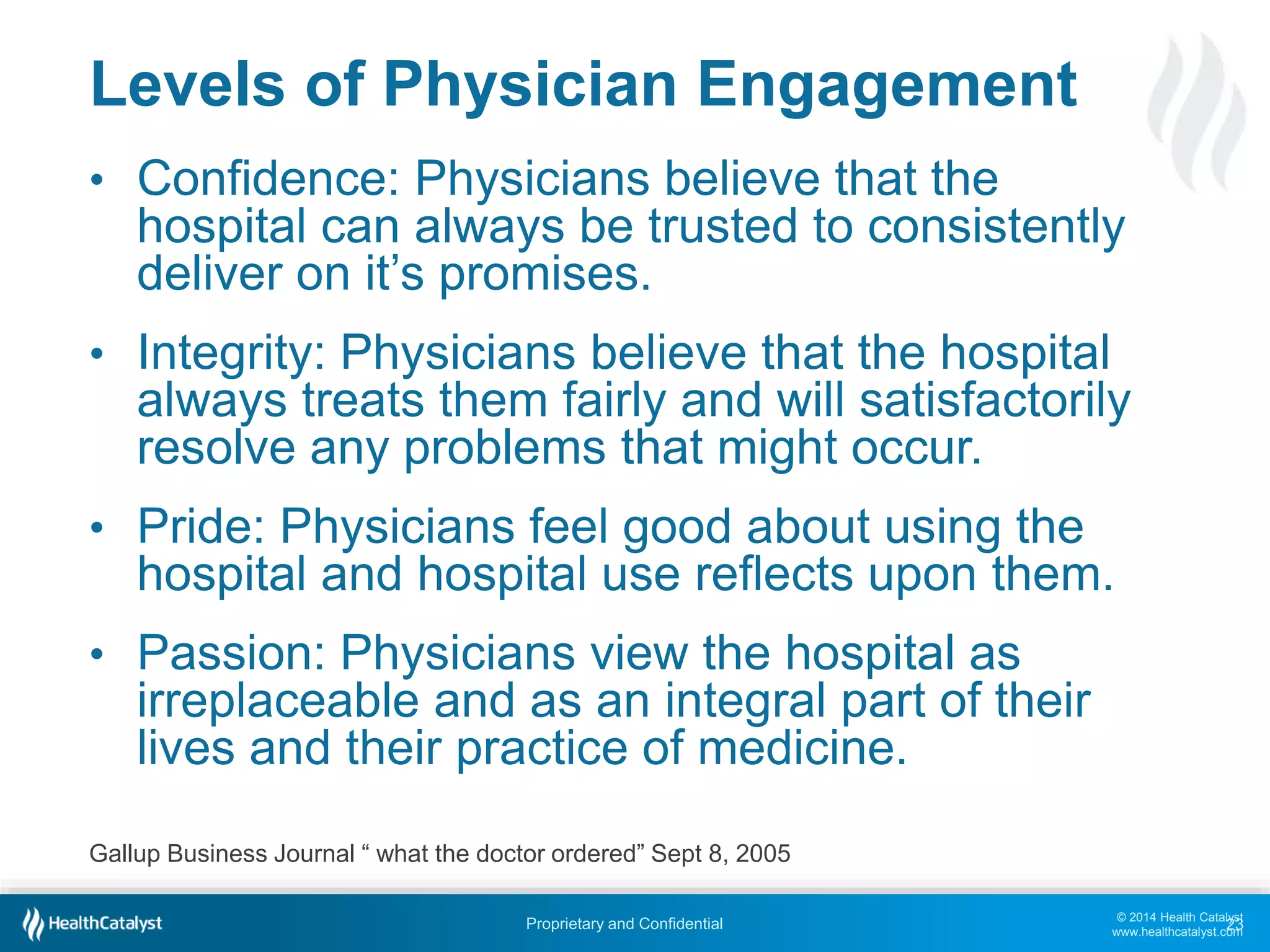
Levels of Physician Engagement
• Confidence: Physicians believe that the
hospital can always be trusted to consistently
deliver on it’s promises.
• Integrity: Physicians believe that the hospital
always treats them fairly and will satisfactorily
resolve any problems that might occur.
• Pride: Physicians feel good about using the
hospital and hospital use reflects upon them.
• Passion: Physicians view the hospital as
irreplaceable and as an integral part of their
lives and their practice of medicine.
23
Gallup Business Journal “ what the doctor ordered” Sept 8, 2005
© 2014 Health Catalyst
www.healthcatalyst.com
Proprietary and Confidential
The best lever to engage physicians
in QI is to?
Respondents - 206
A. Place doctors in leadership positions – 33%
B. Employ them – 10%
C. Create financial incentives – 27%
D. None of the above – 30%
24
© 2014 Health Catalyst
www.healthcatalyst.com
Proprietary and Confidential
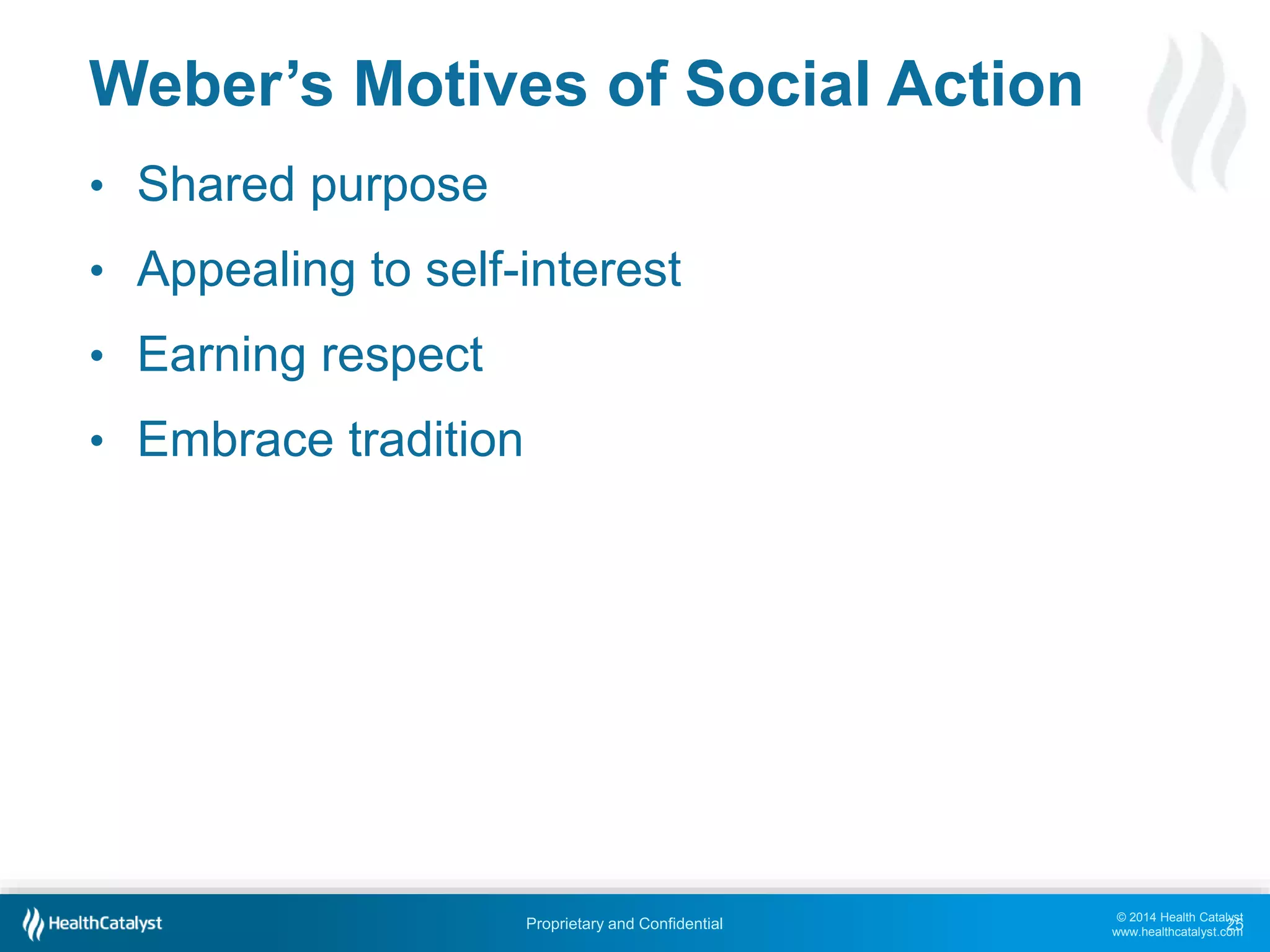
Weber’s Motives of Social Action
• Shared purpose
• Appealing to self-interest
• Earning respect
• Embrace tradition
25
© 2014 Health Catalyst
www.healthcatalyst.com
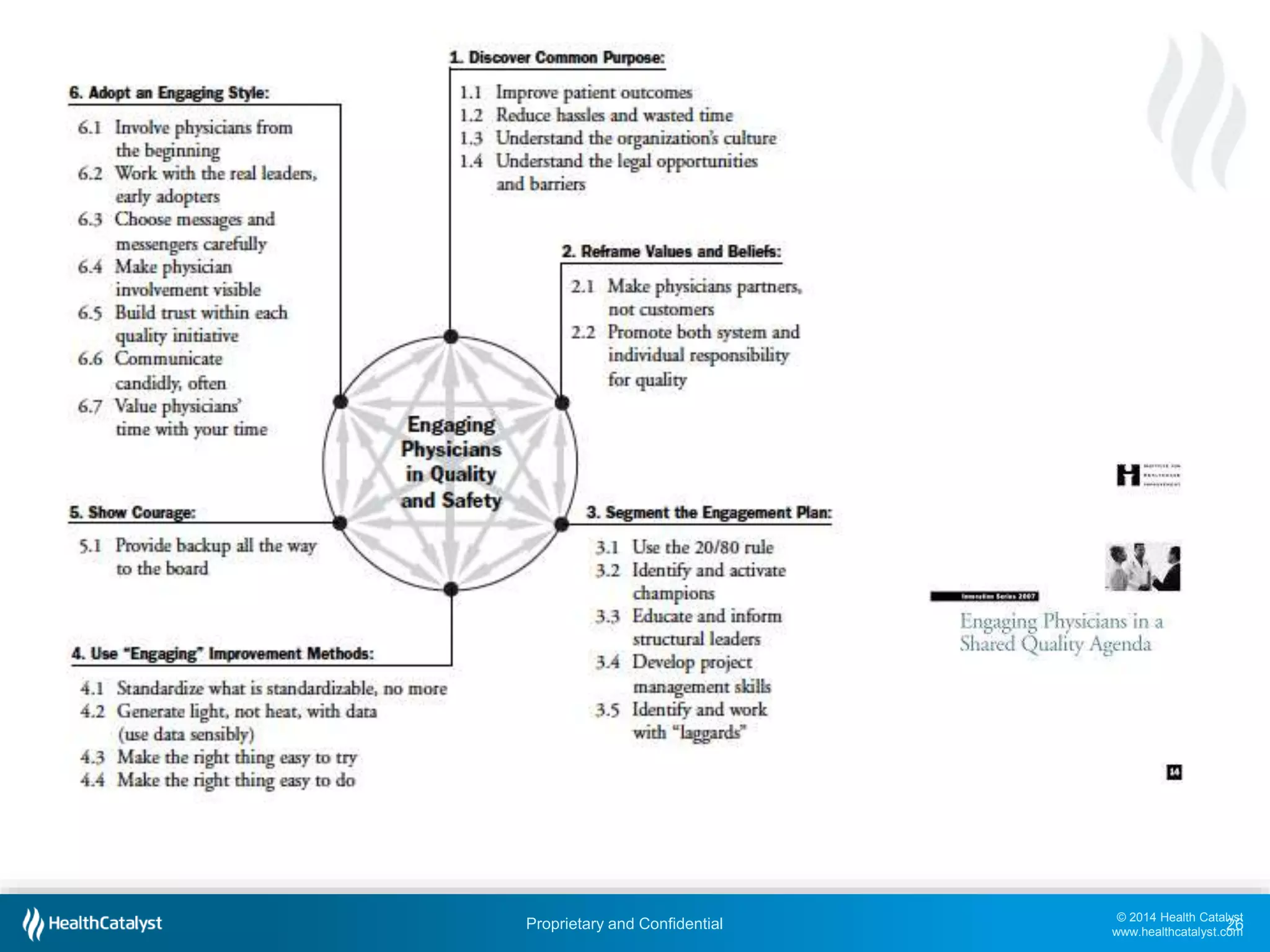
Proprietary and Confidential 26
© 2014 Health Catalyst
www.healthcatalyst.com
Proprietary and Confidential
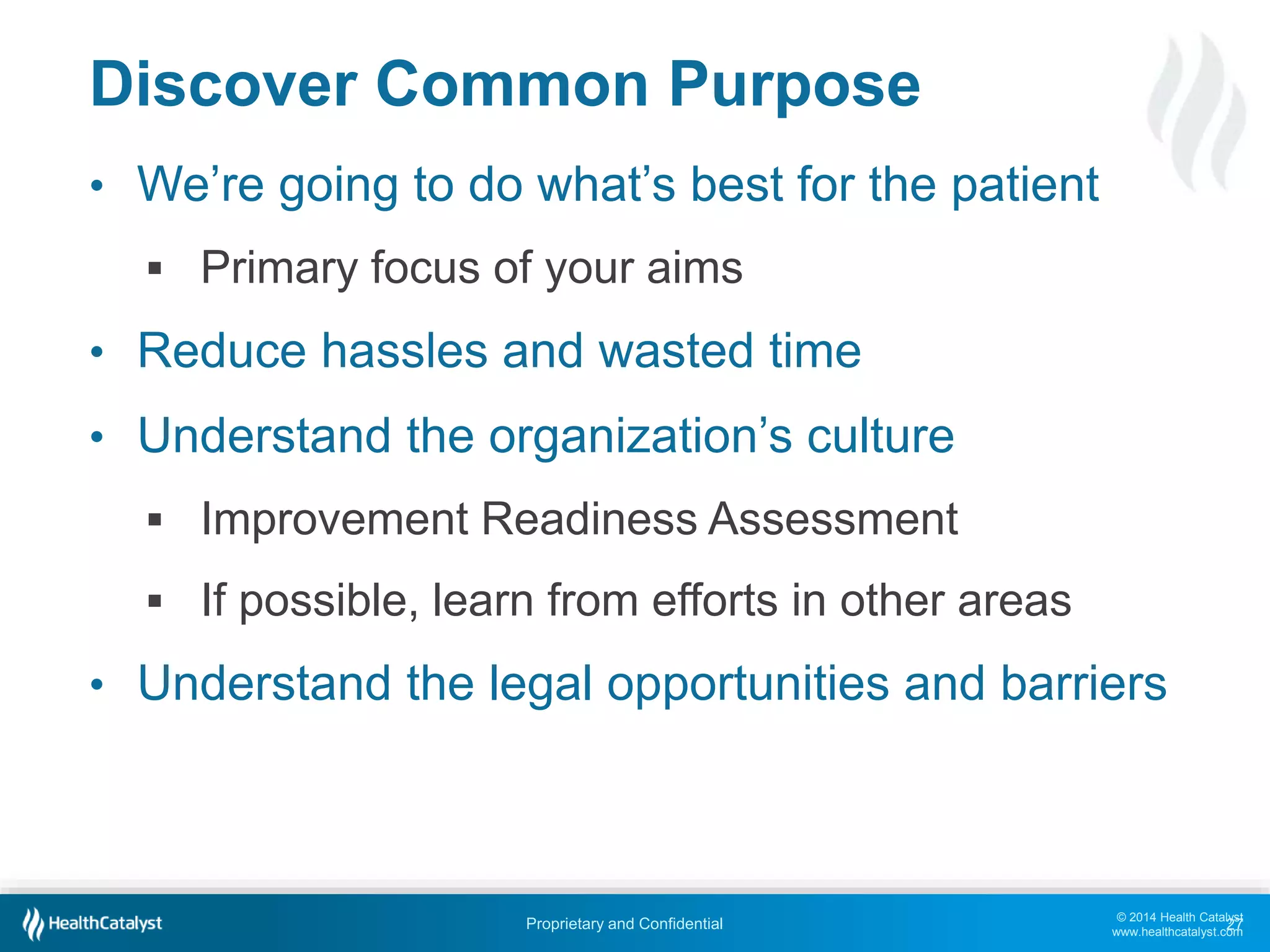
Discover Common Purpose
• We’re going to do what’s best for the patient
 Primary focus of your aims
• Reduce hassles and wasted time
• Understand the organization’s culture
 Improvement Readiness Assessment
 If possible, learn from efforts in other areas
• Understand the legal opportunities and barriers
27
© 2014 Health Catalyst
www.healthcatalyst.com
Proprietary and Confidential
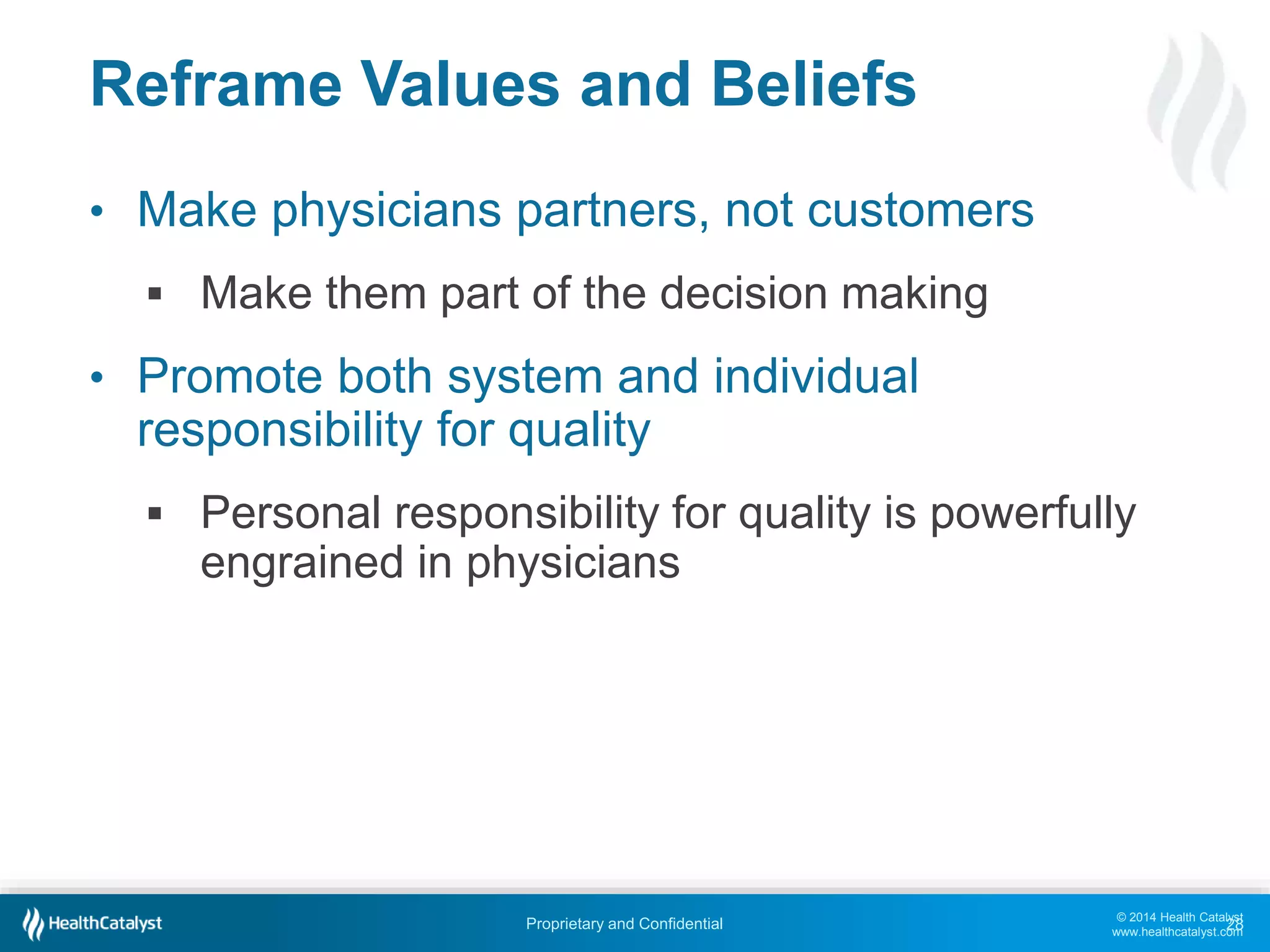
Reframe Values and Beliefs
• Make physicians partners, not customers
 Make them part of the decision making
• Promote both system and individual
responsibility for quality
 Personal responsibility for quality is powerfully
engrained in physicians
28
© 2014 Health Catalyst
www.healthcatalyst.com
Proprietary and Confidential
Audience Participation
How well do you feel the physician and health
system goals are aligned in your organization?
Respondents - 181
a. Not aligned – 8%
b. Somewhat aligned – 53%
c. Moderately aligned – 35%
d. Very aligned – 4%
29
© 2014 Health Catalyst
www.healthcatalyst.com
Proprietary and Confidential
Segment the Engagement Plan
• Identify and activate champions
• Educate and inform structural leaders
 Show them the evidence and be transparent
about the data
 Develop project management skills
• Provide support and education
• Engage the physicians’ intellect
 Allow for review of improvement ideas or tests
of change
30
© 2014 Health Catalyst
www.healthcatalyst.com
Proprietary and Confidential 31
Innovators
early
adopters
early
majority
laggards
(never adopters)
* Adapted from Rogers, E. Diffusion of Innovations. New York, NY: 1995.
late
majority
Innovators. Recruit
innovators to re-
design care delivery
processes (like
Revere)
Early adopters. Recruit
early adopters to chair
improvement and to lead
implementation at each site.
(key individuals who can
rally support)
TheChasm
N = number of individuals in group
N
N = number needed to influence group
(but they must be the right individuals)
© 2014 Health Catalyst
www.healthcatalyst.com
Proprietary and Confidential
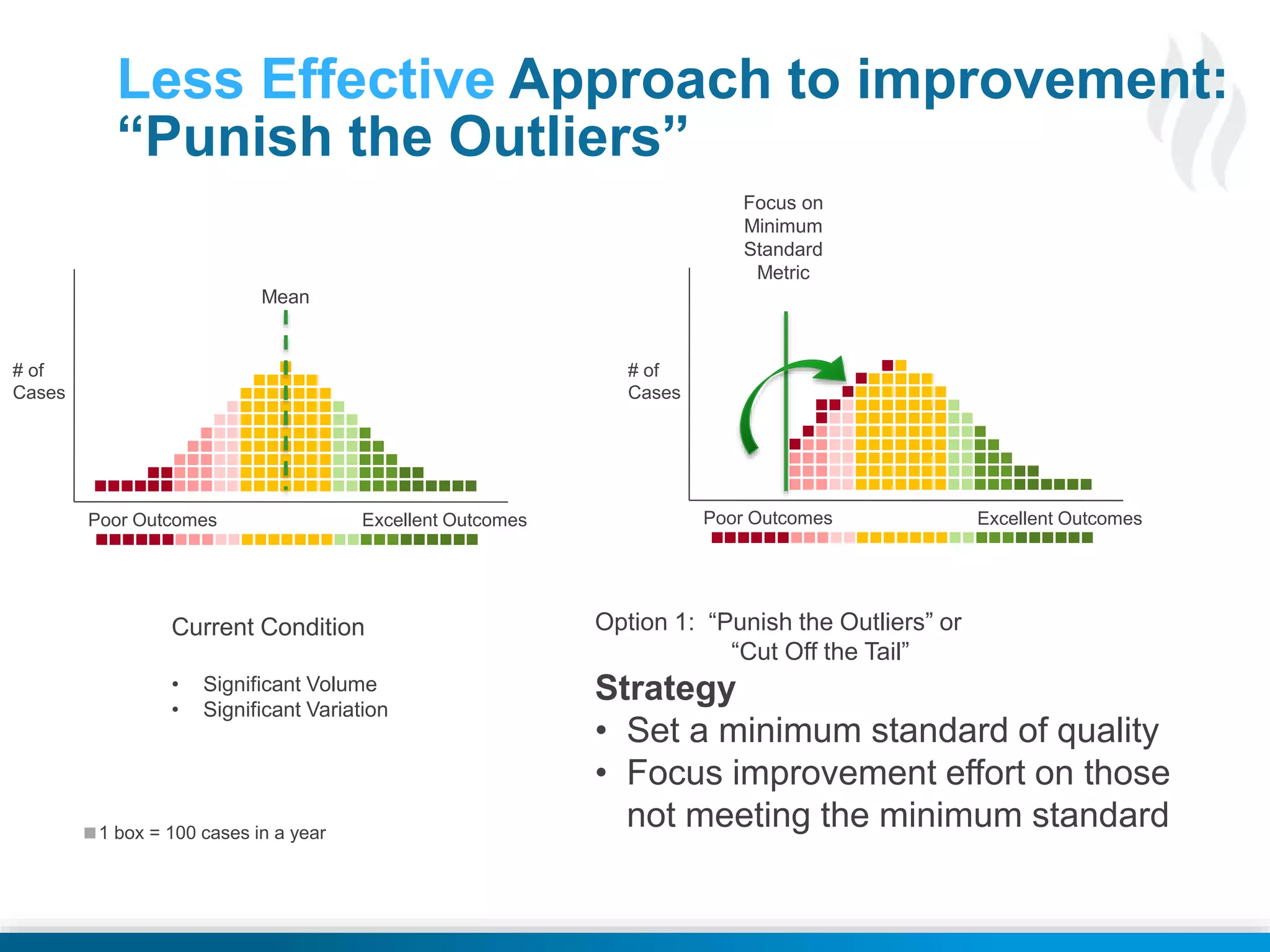
Less Effective Approach to improvement:
“Punish the Outliers”
# of
Cases
Current Condition
• Significant Volume
• Significant Variation
# of
Cases
Option 1: “Punish the Outliers” or
“Cut Off the Tail”
Strategy
• Set a minimum standard of quality
• Focus improvement effort on those
not meeting the minimum standard
Mean
Focus on
Minimum
Standard
Metric
Excellent OutcomesPoor Outcomes Excellent OutcomesPoor Outcomes
1 box = 100 cases in a year
© 2014 Health Catalyst
www.healthcatalyst.com
Proprietary and Confidential
Effective Approach to improvement:
Focus on “Better Care”
Excellent OutcomesPoor Outcomes
# of
Cases
Current Condition
• Significant Volume
• Significant Variation
Excellent Outcomes
# of
Cases
Option 2: Identify Best Practice
“Narrow the curve and shift it to the right”
Strategy
• Identify evidenced based “Shared Baseline”
• Focus improvement effort on reducing
variation by following the “Shared Baseline”
• Often those performing the best make the
greatest improvements
Mean
Focus on
Best Practice
Care Process
Model
Poor Outcomes
1 box = 100 cases in a year
© 2014 Health Catalyst
www.healthcatalyst.com
Proprietary and Confidential
Use “Engaging” Improvement
Methods
• Standardize what is standardizable no more
• Use data sensibly
 Focus on system performance first
• Make the right thing easy to try
 Agile project management
• Make the right thing easy to do
34
© 2014 Health Catalyst
www.healthcatalyst.com
Proprietary and Confidential
Build Trust
• The focus must be on the patient
• Talk about an actual preventable patient safety case.
• Build trust within each quality initiative
• Communicate often and candidly
• Create a communication pathway: M&M,
Grandrounds, department meeting, quality meetings
etc.
• Address concerns and issues in a timely and obvious
manner
• Identify and overcome barriers to engagement
35
© 2014 Health Catalyst
www.healthcatalyst.com
Proprietary and Confidential
Show Courage
Provide backup
all the way to
the board
36
© 2014 Health Catalyst
www.healthcatalyst.com
Proprietary and Confidential
Adopt an Engaging Style
• Involve physicians from the beginning
• Work with the real leaders and early adoptors
• Choose messages and messengers carefully
• Make physician involvement visible
• Build trust within each quality initiative
• Communicate candidly, often
• Value physicians’ time with your time
37
© 2014 Health Catalyst
www.healthcatalyst.com
Proprietary and Confidential
Audience participation
Which do you feel would be the most important to
increase your physician engagement?
Respondents - 186
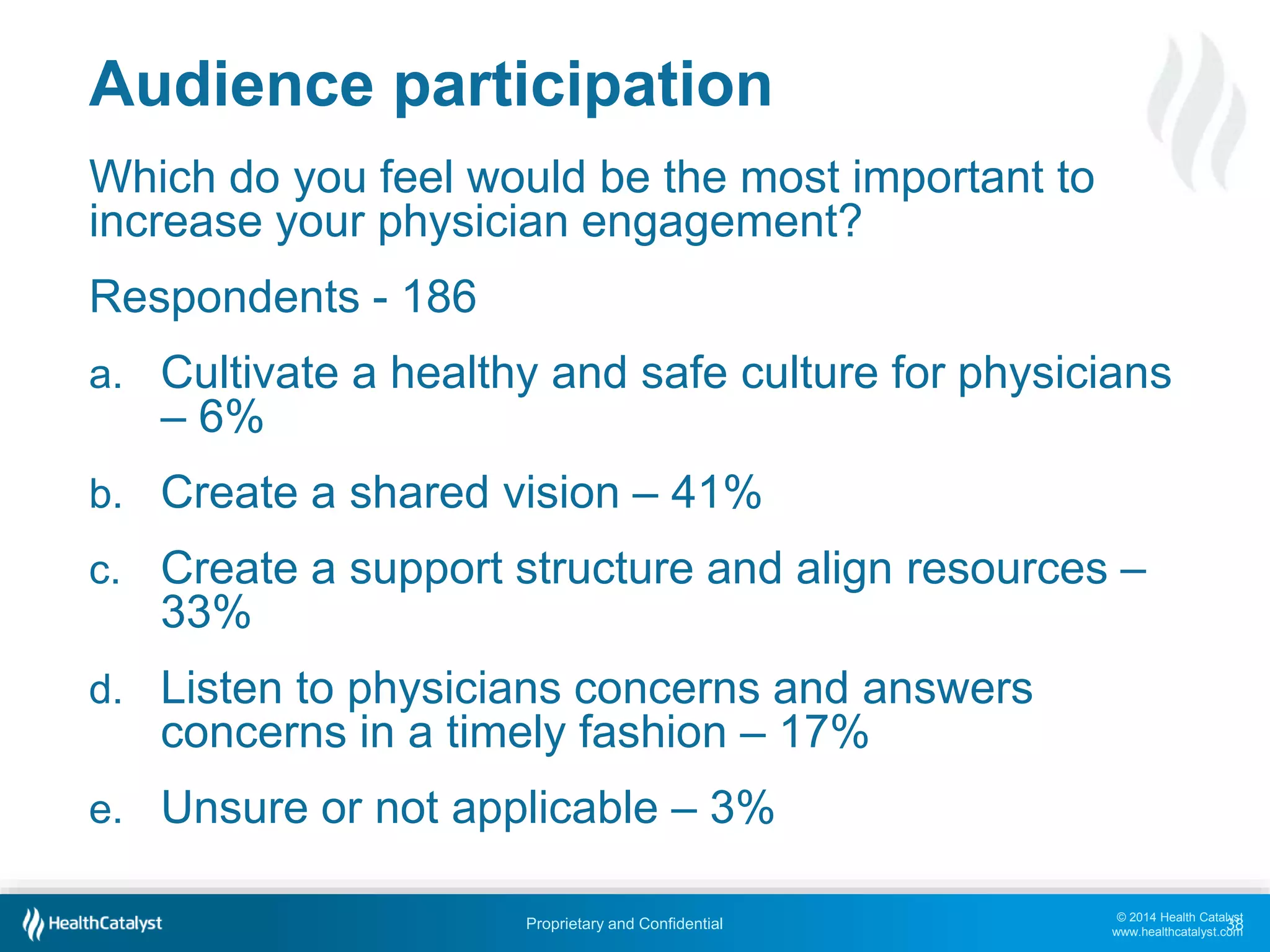
a. Cultivate a healthy and safe culture for physicians
– 6%
b. Create a shared vision – 41%
c. Create a support structure and align resources –
33%
d. Listen to physicians concerns and answers
concerns in a timely fashion – 17%
e. Unsure or not applicable – 3%
38
© 2014 Health Catalyst
www.healthcatalyst.com
Proprietary and Confidential
Summary
• People resist loss not change
• Create a shared vision: Keep the patient as the “North
Star”
• Identify real leaders, early adopters
• Create a support structure and align resources
• Try to surface and mitigate real AND perceived loss
• Create trust: Deliver on Your Promises!
39
© 2014 Health Catalyst
www.healthcatalyst.com
Proprietary and Confidential
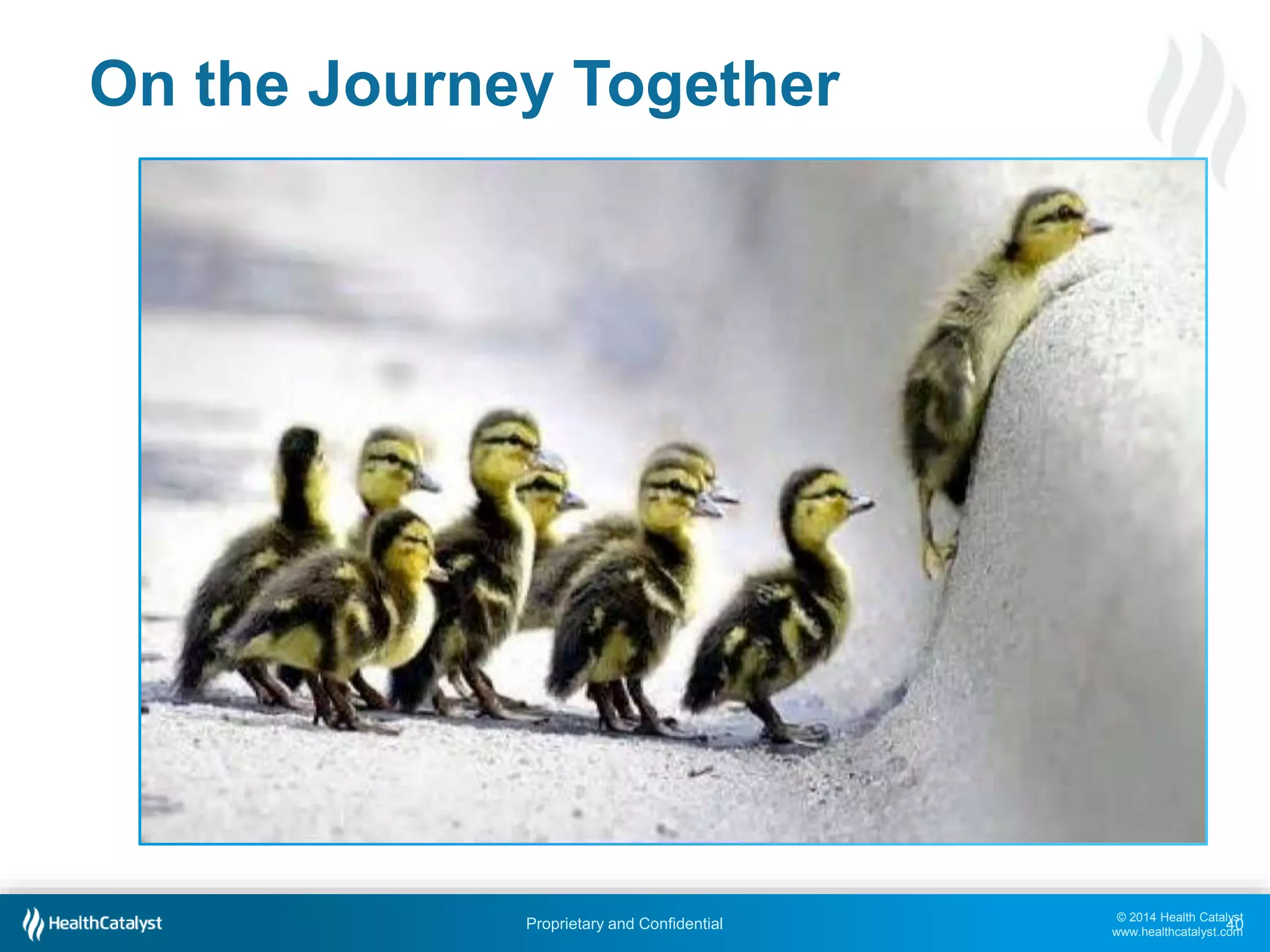
On the Journey Together
40
© 2014 Health Catalyst
www.healthcatalyst.com
Proprietary and Confidential
Questions?
41

Discovering a Common Purpose: Creating Physician Engagement

  • 1.
    © 2014 HealthCatalyst www.healthcatalyst.com Proprietary and Confidential © 2014 Health Catalyst www.healthcatalyst.comProprietary and Confidential March 11, 2015 Physician Engagement Bryan T. Oshiro, MD Chief Medical Officer, Health Catalyst
  • 2.
    © 2014 HealthCatalyst www.healthcatalyst.com Proprietary and Confidential Learning Objectives • To describe the importance of physician engagement in quality improvement (the “why”) • To describe the challenges and barriers to truly have physicians lead quality improvement (the “what”) • To identify strategies to enhance physician engagement (the “how”)
  • 3.
    © 2014 HealthCatalyst www.healthcatalyst.com Proprietary and Confidential Best in the World! • Most American hospitals and physicians provide safe and effective care for the vast majority of patients, the vast majority of the time • Where did Italian Prime Minister Silvio Berlusconi go when he needed a heart operation in 2011? the Cleveland Clinic. • When the late King Hussein of Jordan needed treatment for lymphoma, where did he go? • Western medicine’s ability to save and extend life, and to improve the quality of life for the ill and injured is nothing short of miraculous
  • 4.
    © 2014 HealthCatalyst www.healthcatalyst.com Proprietary and Confidential But are We? • 1999 IOM estimated 48,000 to 98,000 die in U.S. hospitals for preventable errors. • Up to 40% of all maternal deaths in the U.S. may be preventable (Berg 2005) • More people die from hospital-based preventable medical injuries than from breast cancer or AIDS or MVA • Injuries drive direct health care costs totaling $9-$15 billion per year Forster AJ, Fung I, Caughey S, et al. Obstet Gynecol. 2006;108(5):1073-1083.
  • 5.
    © 2014 HealthCatalyst www.healthcatalyst.com Proprietary and Confidential American health care "gets it right” 54.9% of the time. McGlynn EA, Asch SM, Adams J, et al. The quality of health care delivered to adults in the United States. N Engl J Med; 2003;2635-2645
  • 6.
    © 2014 HealthCatalyst www.healthcatalyst.com Proprietary and Confidential Where do we rank in health and wellness world wide on the social progress index? Respondents - 184 A. Top 10 – 4% B. 11-25 – 22% C. 26-50 – 54% D. >50 – 21%
  • 7.
    © 2014 HealthCatalyst www.healthcatalyst.com Proprietary and Confidential 7 Social Progress Index: 2014 Health and Wellness #71
  • 8.
    © 2014 HealthCatalyst www.healthcatalyst.com Proprietary and Confidential 8 Life Expectancy at Birth: 1970 and 2011 OECD Health Statistics 2013
  • 9.
    © 2014 HealthCatalyst www.healthcatalyst.com Proprietary and Confidential 9 You get what you pay for!? Per capita health expenditure, 2011 Source: OECD Health Statistics 2013, http://dx.doi.org/10.1787/health-data-en; WHO Global Health Expenditure Database. Average: $3,322 USA: $8,508
  • 10.
    © 2014 HealthCatalyst www.healthcatalyst.com Proprietary and Confidential U.S. Healthcare Spending
  • 11.
    © 2014 HealthCatalyst www.healthcatalyst.com Proprietary and Confidential Preventable Complications Unnecessary Treatments Inefficiency Errors Services That Add Value 40% Waste 60% Value All Services Add Value 100% Value Future Now What We Pay For… 11
  • 12.
    © 2014 HealthCatalyst www.healthcatalyst.com Proprietary and Confidential Healthcare Revolves Around Physicians Opening line… “The words “alignment” and “coordination” have been tossed about as the government and the healthcare industry wrestle to provide more value for every healthcare dollar spent. Under those words, every strategy to fix the problem revolves around one thing: physicians.” HealthLeader's Media Breakthroughs. Aligning Hospitals and Physicians toward Value. Dec. 2009. In collaboration with PricewaterhouseCoopers.
  • 13.
    © 2014 HealthCatalyst www.healthcatalyst.com Proprietary and Confidential Engagement matters • 75-85% of the decisions that drive quality and cost are determined by physicians • Gallup reported at one health system, outpatient volume increased +17.5 for engaged physicians in the top quartile for improved engagement. • Disengaged physicians in the bottom quartile, their outpatient volume declined -11.7%.
  • 14.
    © 2014 HealthCatalyst www.healthcatalyst.com Proprietary and Confidential Gallup Business Journal “ what the doctor ordered” Sept 8, 2005
  • 15.
    © 2014 HealthCatalyst www.healthcatalyst.com Proprietary and Confidential The Challenge • Almost every aspect of physicians’ lives is changing or seems uncertain  Autonomy  Income  Social stature • Physicians are going through something akin to the stages of grief  Most are beyond denial  Many are stuck at anger • How do we get physicians to play a positive constructive role in the needed change? 15
  • 16.
    © 2014 HealthCatalyst www.healthcatalyst.com Proprietary and Confidential Systems Issues • Physicians are too busy • Physicians are not compensated for their help • Poor knowledge management support • Malpractice issues • Lack of meaningful measurements • Poor data analytic support 16
  • 17.
    © 2014 HealthCatalyst www.healthcatalyst.com Proprietary and Confidential Barriers to Strong Physician Engagement • Physicians feel overwhelmed and ill-equipped and have limited understanding of how their behavior contributes to healthcare waste and inefficiency • Providers and payors focusing only on employment • Organizations over-weight the importance of compensation to influence MD behavior • MD have poor understanding of risk-based payment models 17 Source: McKinsey Physician Survey, 2011
  • 18.
    © 2014 HealthCatalyst www.healthcatalyst.com Proprietary and Confidential 18 Respondents - 207 A. Not willing – 8% B. Somewhat willing – 79% C. Very willing – 13% Our doctors are ___ to participate in QI at my hospital or clinic?
  • 19.
    © 2014 HealthCatalyst www.healthcatalyst.com Proprietary and Confidential MD Willingness to Change: Removing Waste from Healthcare System 19 Source: McKinsey Physician Survey, 2011
  • 20.
    © 2014 HealthCatalyst www.healthcatalyst.com Proprietary and Confidential Physicians Likely to Change (%) 20 Source: McKinsey Physician Survey, 2011
  • 21.
    © 2014 HealthCatalyst www.healthcatalyst.com Proprietary and Confidential Stages of Engagement Aversion Apathy Engaged
  • 22.
    © 2014 HealthCatalyst www.healthcatalyst.com Proprietary and Confidential Audience participation Which stage best describes the engagement level of the majority of physicians in your organization? Respondents - 204 a. Aversion – 12% b. Apathy – 40% c. Engaged – 22% d. Unsure or not applicable – 26% 22
  • 23.
    © 2014 HealthCatalyst www.healthcatalyst.com Proprietary and Confidential Levels of Physician Engagement • Confidence: Physicians believe that the hospital can always be trusted to consistently deliver on it’s promises. • Integrity: Physicians believe that the hospital always treats them fairly and will satisfactorily resolve any problems that might occur. • Pride: Physicians feel good about using the hospital and hospital use reflects upon them. • Passion: Physicians view the hospital as irreplaceable and as an integral part of their lives and their practice of medicine. 23 Gallup Business Journal “ what the doctor ordered” Sept 8, 2005
  • 24.
    © 2014 HealthCatalyst www.healthcatalyst.com Proprietary and Confidential The best lever to engage physicians in QI is to? Respondents - 206 A. Place doctors in leadership positions – 33% B. Employ them – 10% C. Create financial incentives – 27% D. None of the above – 30% 24
  • 25.
    © 2014 HealthCatalyst www.healthcatalyst.com Proprietary and Confidential Weber’s Motives of Social Action • Shared purpose • Appealing to self-interest • Earning respect • Embrace tradition 25
  • 26.
    © 2014 HealthCatalyst www.healthcatalyst.com Proprietary and Confidential 26
  • 27.
    © 2014 HealthCatalyst www.healthcatalyst.com Proprietary and Confidential Discover Common Purpose • We’re going to do what’s best for the patient  Primary focus of your aims • Reduce hassles and wasted time • Understand the organization’s culture  Improvement Readiness Assessment  If possible, learn from efforts in other areas • Understand the legal opportunities and barriers 27
  • 28.
    © 2014 HealthCatalyst www.healthcatalyst.com Proprietary and Confidential Reframe Values and Beliefs • Make physicians partners, not customers  Make them part of the decision making • Promote both system and individual responsibility for quality  Personal responsibility for quality is powerfully engrained in physicians 28
  • 29.
    © 2014 HealthCatalyst www.healthcatalyst.com Proprietary and Confidential Audience Participation How well do you feel the physician and health system goals are aligned in your organization? Respondents - 181 a. Not aligned – 8% b. Somewhat aligned – 53% c. Moderately aligned – 35% d. Very aligned – 4% 29
  • 30.
    © 2014 HealthCatalyst www.healthcatalyst.com Proprietary and Confidential Segment the Engagement Plan • Identify and activate champions • Educate and inform structural leaders  Show them the evidence and be transparent about the data  Develop project management skills • Provide support and education • Engage the physicians’ intellect  Allow for review of improvement ideas or tests of change 30
  • 31.
    © 2014 HealthCatalyst www.healthcatalyst.com Proprietary and Confidential 31 Innovators early adopters early majority laggards (never adopters) * Adapted from Rogers, E. Diffusion of Innovations. New York, NY: 1995. late majority Innovators. Recruit innovators to re- design care delivery processes (like Revere) Early adopters. Recruit early adopters to chair improvement and to lead implementation at each site. (key individuals who can rally support) TheChasm N = number of individuals in group N N = number needed to influence group (but they must be the right individuals)
  • 32.
    © 2014 HealthCatalyst www.healthcatalyst.com Proprietary and Confidential Less Effective Approach to improvement: “Punish the Outliers” # of Cases Current Condition • Significant Volume • Significant Variation # of Cases Option 1: “Punish the Outliers” or “Cut Off the Tail” Strategy • Set a minimum standard of quality • Focus improvement effort on those not meeting the minimum standard Mean Focus on Minimum Standard Metric Excellent OutcomesPoor Outcomes Excellent OutcomesPoor Outcomes 1 box = 100 cases in a year
  • 33.
    © 2014 HealthCatalyst www.healthcatalyst.com Proprietary and Confidential Effective Approach to improvement: Focus on “Better Care” Excellent OutcomesPoor Outcomes # of Cases Current Condition • Significant Volume • Significant Variation Excellent Outcomes # of Cases Option 2: Identify Best Practice “Narrow the curve and shift it to the right” Strategy • Identify evidenced based “Shared Baseline” • Focus improvement effort on reducing variation by following the “Shared Baseline” • Often those performing the best make the greatest improvements Mean Focus on Best Practice Care Process Model Poor Outcomes 1 box = 100 cases in a year
  • 34.
    © 2014 HealthCatalyst www.healthcatalyst.com Proprietary and Confidential Use “Engaging” Improvement Methods • Standardize what is standardizable no more • Use data sensibly  Focus on system performance first • Make the right thing easy to try  Agile project management • Make the right thing easy to do 34
  • 35.
    © 2014 HealthCatalyst www.healthcatalyst.com Proprietary and Confidential Build Trust • The focus must be on the patient • Talk about an actual preventable patient safety case. • Build trust within each quality initiative • Communicate often and candidly • Create a communication pathway: M&M, Grandrounds, department meeting, quality meetings etc. • Address concerns and issues in a timely and obvious manner • Identify and overcome barriers to engagement 35
  • 36.
    © 2014 HealthCatalyst www.healthcatalyst.com Proprietary and Confidential Show Courage Provide backup all the way to the board 36
  • 37.
    © 2014 HealthCatalyst www.healthcatalyst.com Proprietary and Confidential Adopt an Engaging Style • Involve physicians from the beginning • Work with the real leaders and early adoptors • Choose messages and messengers carefully • Make physician involvement visible • Build trust within each quality initiative • Communicate candidly, often • Value physicians’ time with your time 37
  • 38.
    © 2014 HealthCatalyst www.healthcatalyst.com Proprietary and Confidential Audience participation Which do you feel would be the most important to increase your physician engagement? Respondents - 186 a. Cultivate a healthy and safe culture for physicians – 6% b. Create a shared vision – 41% c. Create a support structure and align resources – 33% d. Listen to physicians concerns and answers concerns in a timely fashion – 17% e. Unsure or not applicable – 3% 38
  • 39.
    © 2014 HealthCatalyst www.healthcatalyst.com Proprietary and Confidential Summary • People resist loss not change • Create a shared vision: Keep the patient as the “North Star” • Identify real leaders, early adopters • Create a support structure and align resources • Try to surface and mitigate real AND perceived loss • Create trust: Deliver on Your Promises! 39
  • 40.
    © 2014 HealthCatalyst www.healthcatalyst.com Proprietary and Confidential On the Journey Together 40
  • 41.
    © 2014 HealthCatalyst www.healthcatalyst.com Proprietary and Confidential Questions? 41