HAND
INFECTIONS
by Mr Gauthamen
1
2
Hand
Infection
Nail bed
Infection
Herpetic
Whitlow
Flexor
Tenosynovitis
Deep
Space
Infections
Cellulitis &
Lymphangitis
Animal/
Human bites
Focus of Discussion
1. Nail Bed Infection
• Acute Paronychia
• Chronic Paronychia
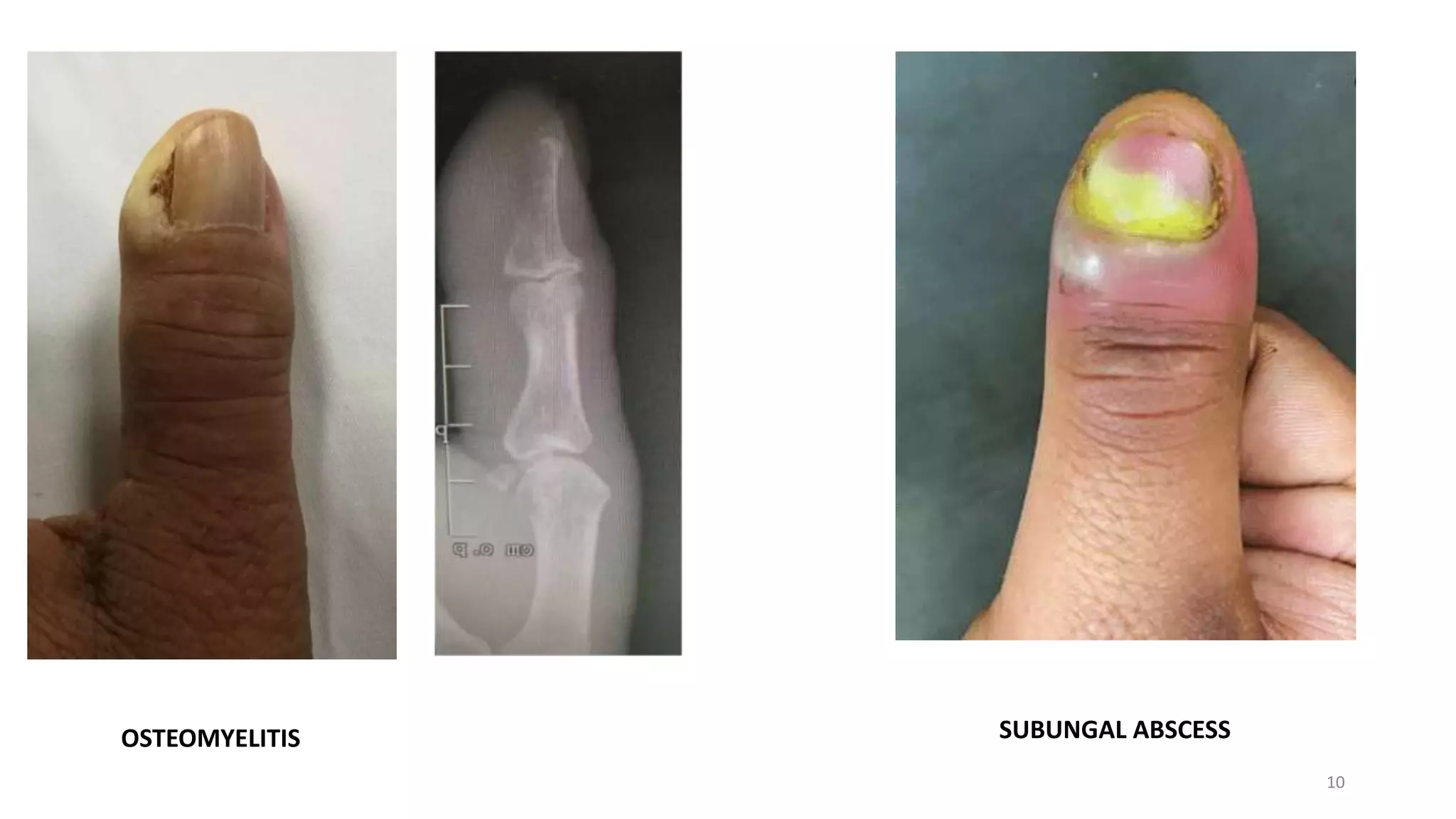
• Subungal Abscess
• Felon
2. Flexor Tenosynovitis
3. Deep Space Infection
3
Nail Bed Infections
4
Anatomy of Nail Complex
5
Acute paronychia
• Infection of the nail fold
• Most common infection in the hand
• S. aureus most common infecting organism
• Common cause:
• Hang nail
• Nail Biting/ Sucking
• Manicures
• Penetrating trauma
6
7
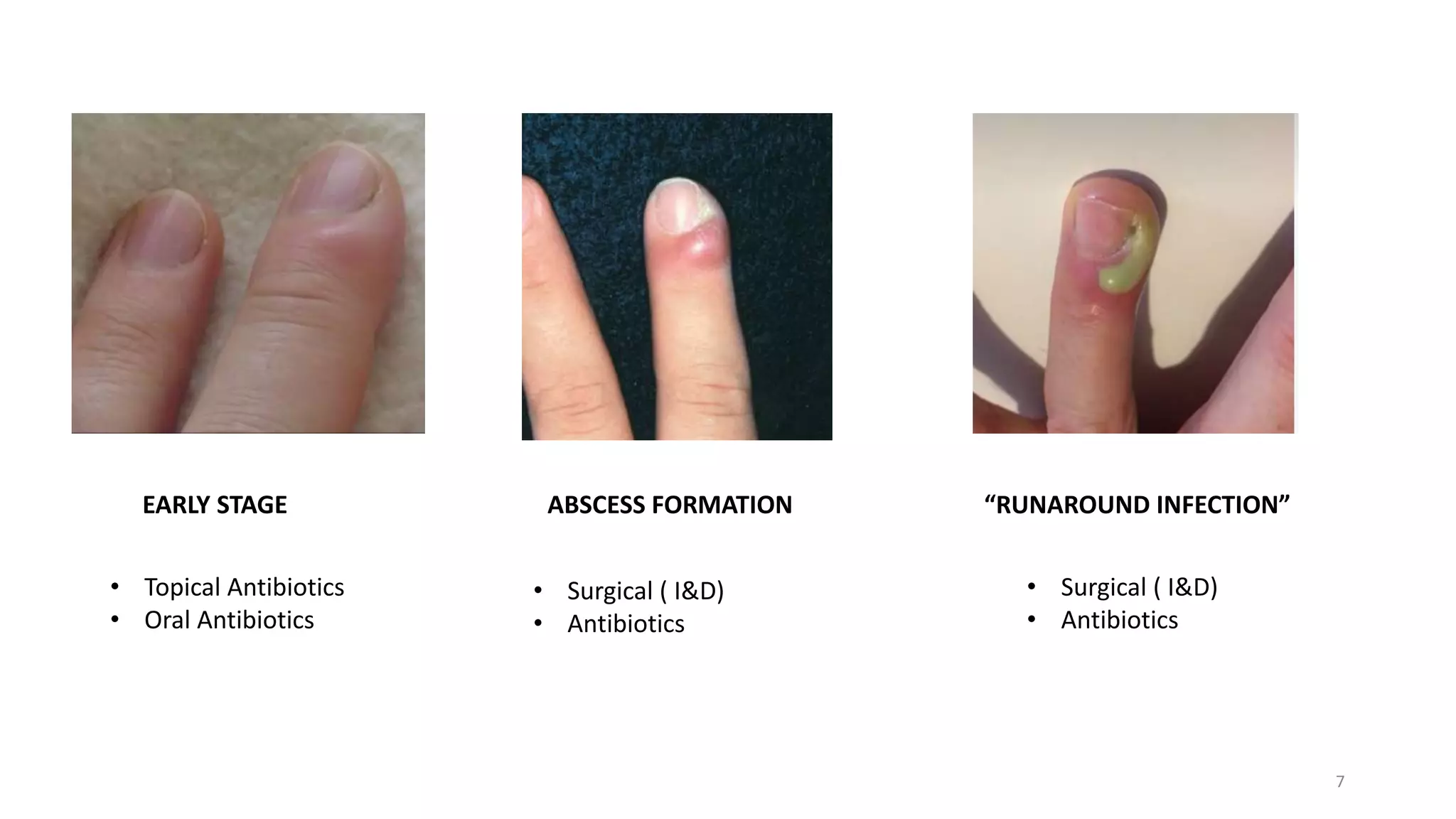
EARLY STAGE ABSCESS FORMATION “RUNAROUND INFECTION”
• Topical Antibiotics
• Oral Antibiotics
• Surgical ( I&D)
• Antibiotics
• Surgical ( I&D)
• Antibiotics
Operative methods
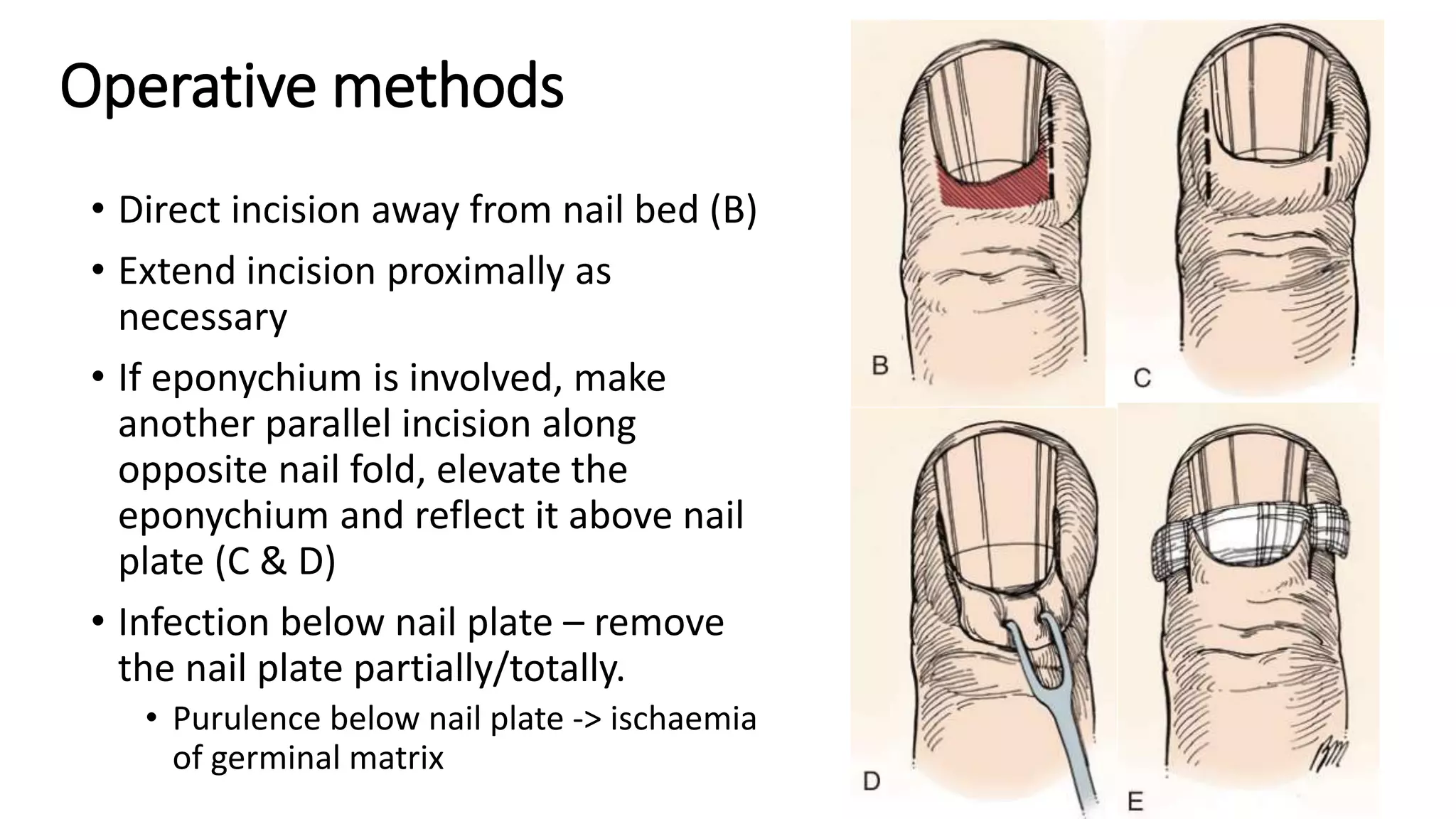
• Direct incision away from nail bed (B)
• Extend incision proximally as
necessary
• If eponychium is involved, make
another parallel incision along
opposite nail fold, elevate the
eponychium and reflect it above nail
plate (C & D)
• Infection below nail plate – remove
the nail plate partially/totally.
• Purulence below nail plate -> ischaemia
of germinal matrix
8
Postop Care
• 7-10 days antibiotic
• Daily soaks in normal saline 5, 2-3 times/day
• Early ROM exercises
• Discontinue packing/wicking at 3-4 days
• Expect tenderness/hypersensitivity around surgical scars lasting
several months
9
10
OSTEOMYELITIS SUBUNGAL ABSCESS
Chronic Paronychia
• Distinct clinical problem from acute
paronychia
• Multifactorial inflammatory reaction of
the proximal nail fold to irritants and
allergens
• Characterized by chronically indurated
and rounded eponychium, may results in
thickening and grooving of the nail plate
• Middle-aged women
• Female : male = 4:1
• Frequent immersion in detergents
• Gram +ve cocci, Gram –ve rods, Candida,
mycobacterial sp.
11
Nail plate
hypertrophy
Nail fold
blunting and
retraction
Transverse
ridges on
nail plate
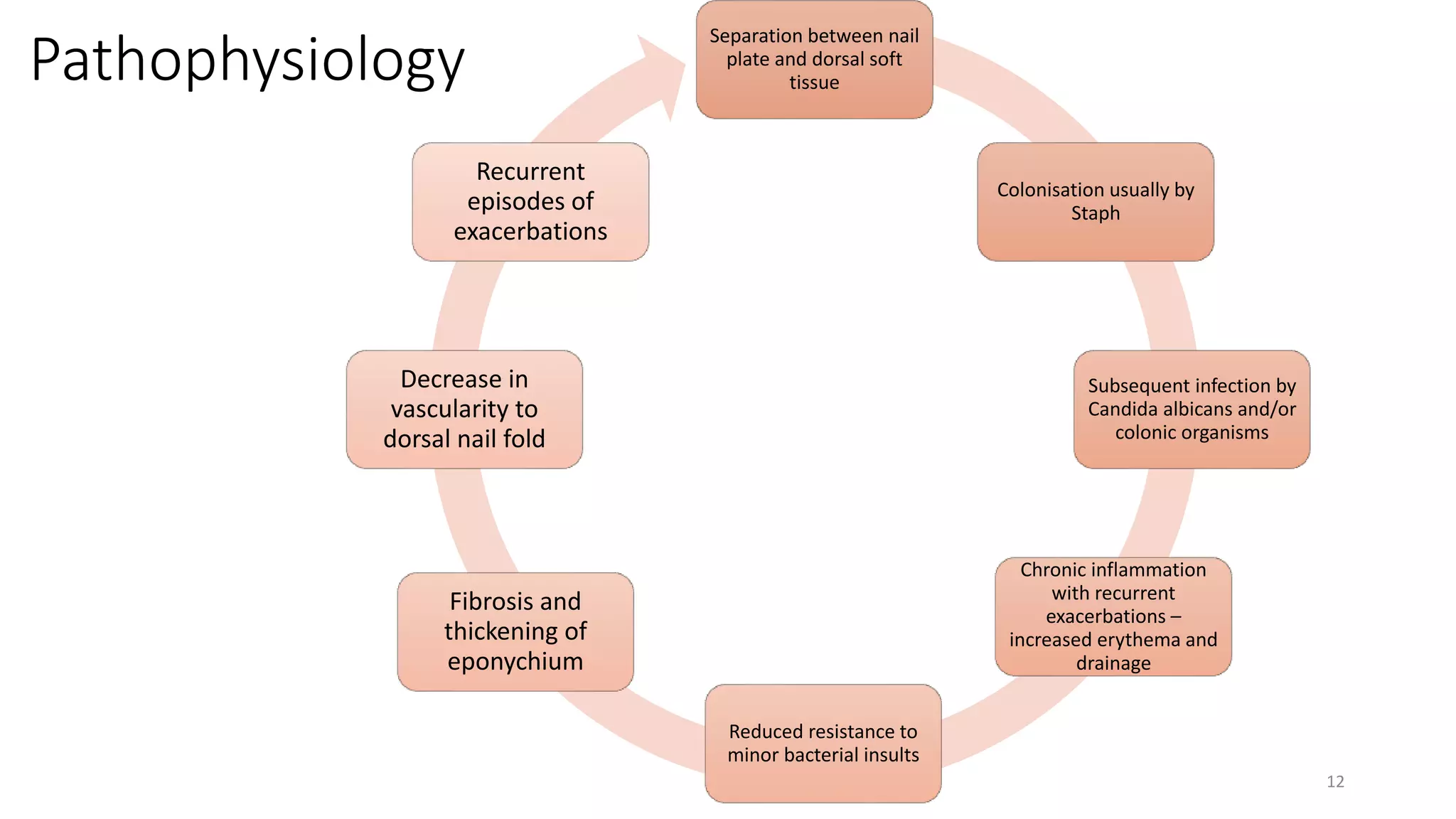
Pathophysiology
12
Separation between nail
plate and dorsal soft
tissue
Colonisation usually by
Staph
Subsequent infection by
Candida albicans and/or
colonic organisms
Chronic inflammation
with recurrent
exacerbations –
increased erythema and
drainage
Reduced resistance to
minor bacterial insults
Fibrosis and
thickening of
eponychium
Decrease in
vascularity to
dorsal nail fold
Recurrent
episodes of
exacerbations
Treatment
• Conservative
• Reduce exposure to irritants
• Topical steroids
• Oral + topical antibiotics and antifungal
• Operative
• Eponychial marsupialisation
• Most common surgical treatment
13
• Crescent-shaped incision 1 mm proximal to distal edge of eponychial
fold extending 3-5 mm proximally.
• Remove crescent tissue down to but not including germinal matrix
14
Postop Care
• Postop dressing removed at 48-72 H
• Soak in normal saline solution 3 times/day
• Continue until 2 days after all drainage has stopped
• Oral antibiotics for 2 weeks
• Wound healing by secondary intention by 3-4 weeks
• Scar sensitivity and nail deformity more common than in acute
paronychia
• Correct environmental factors, systemic comorbidities to avoid
recurrence
15
Felon
18
Felon
• Subcutaneous abscess of distal pulp of
finger/thumb
• Involve multiple septal compartments
• 15-20% of all hand infections
• S. aureus
• Gram –ve oraganisms in
immunocompromised
19
Clinical presentation
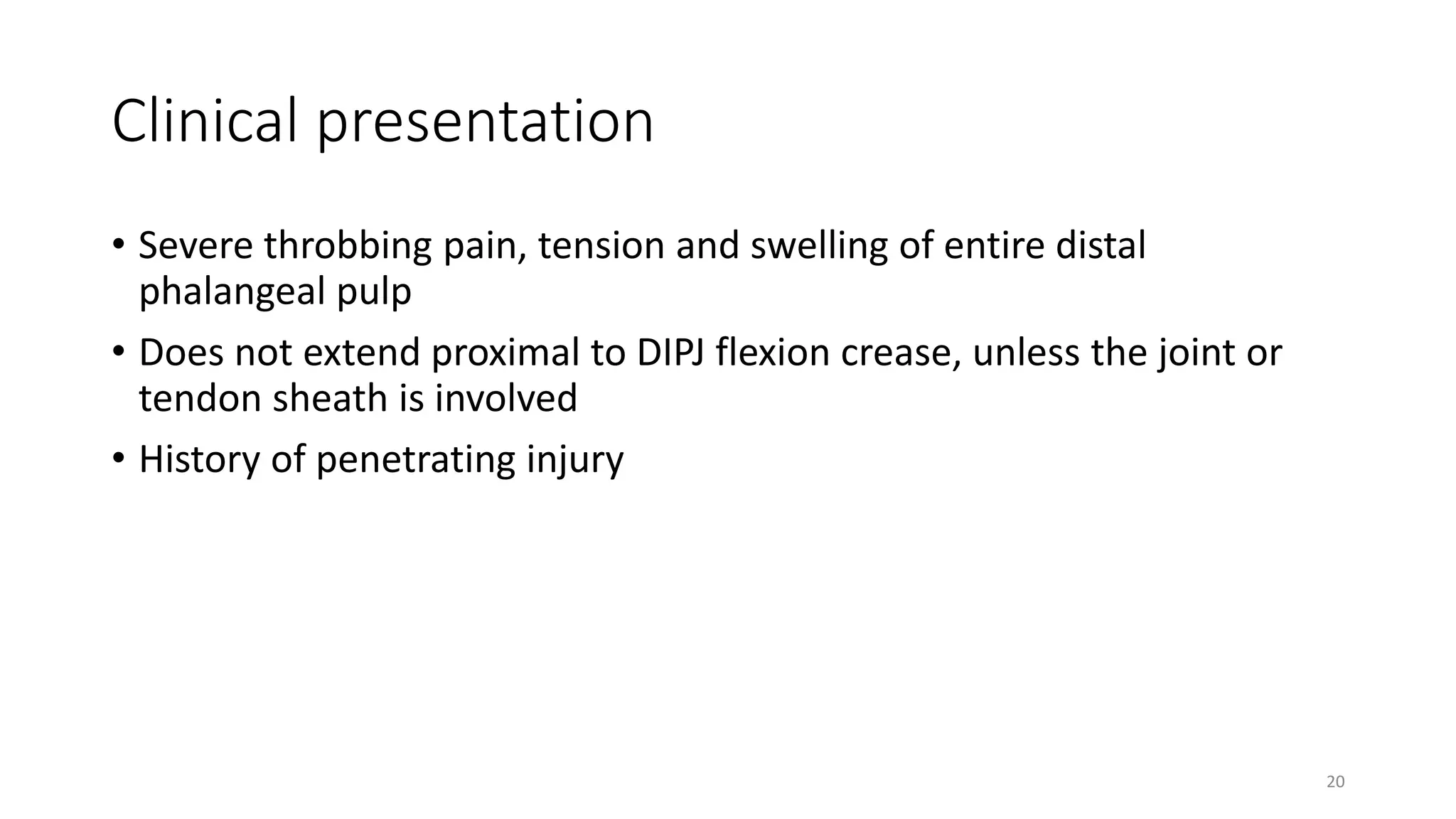
• Severe throbbing pain, tension and swelling of entire distal
phalangeal pulp
• Does not extend proximal to DIPJ flexion crease, unless the joint or
tendon sheath is involved
• History of penetrating injury
20
Treatment
• Nonsurgical only in very early presentation
• Surgical drainage in tense pulp even without abscess
• Aim:
• Avoid injury to digital nerve and vessels
• Non-disabling scar
• Preserve function of finger pupl
• Fine tactile sensibility
• Maintain stable, durable pad for pinch
21
Surgical Drainage
• Incision
• Place incision opposite the pinching surface or at the side of maximal
tenderness
22
Post op care
• Keep wound open for 2-5 days
• Place a gauze wick in the wound up till 3-5 days
• Soak in dilute povidone-iodine 3 times/day
• Allow wound healing by secondary intention
• Early finger ROM
• Expect recovery in 3-4 weeks
• Expect tenderness and hypersensitivity lasting several months
23
Pyogenic Flexor Tenosynovitis
24
Pyogenic Flexor Tenosynovitis
• Closed-space infection of the flexor
tendon sheath of the fingers or thumb
• Destroys tendon gliding mechanism
• Creates adhesions
• Lead to tendon necrosis
• S. aureus and β-hemolytic
Streptococcus
25
26
HORSE SHOE ABSCESS
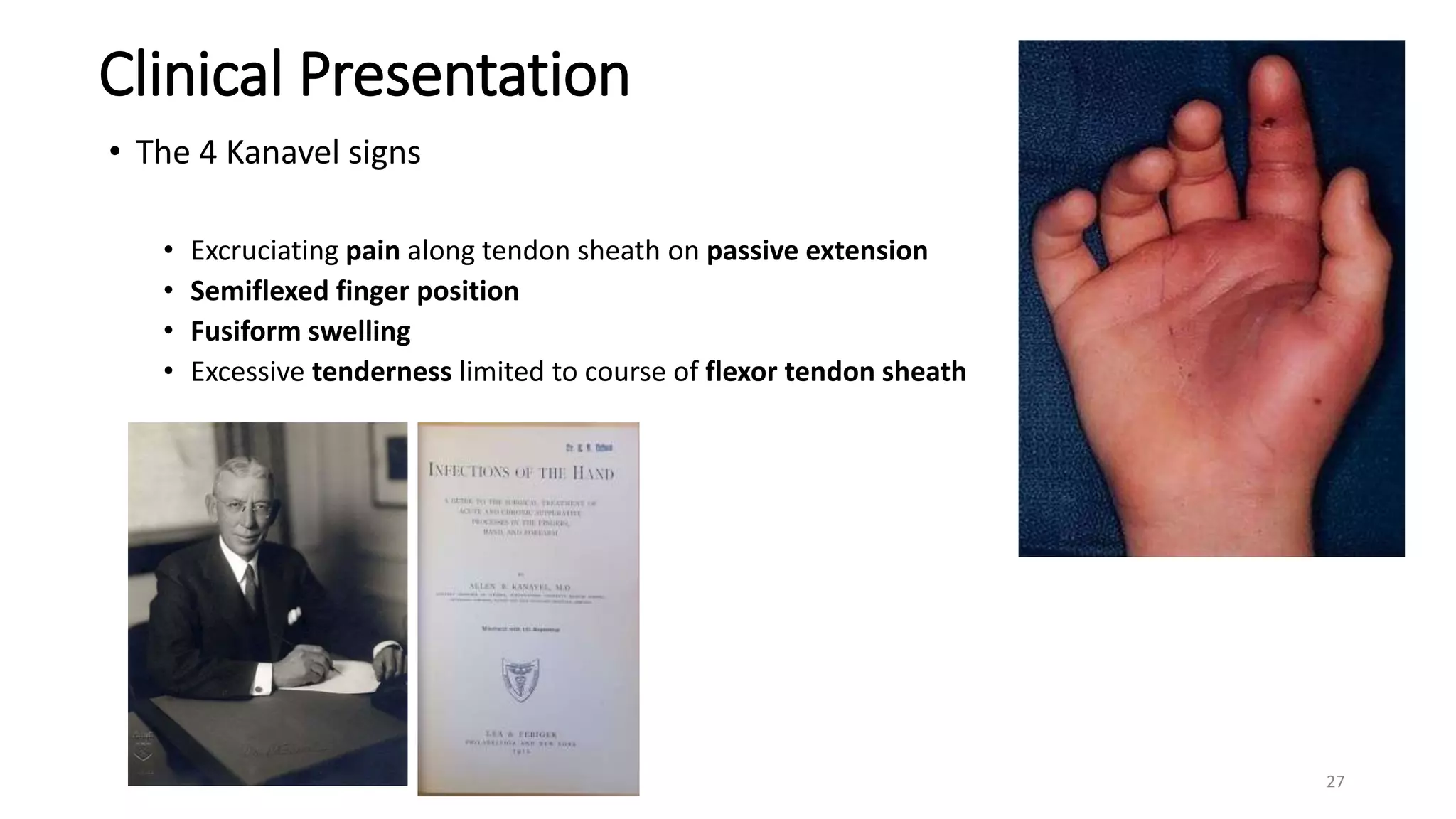
Clinical Presentation
• The 4 Kanavel signs
• Excruciating pain along tendon sheath on passive extension
• Semiflexed finger position
• Fusiform swelling
• Excessive tenderness limited to course of flexor tendon sheath
27
Treatment
• Nonsurgical
• No role
• Orthopaedic Emergency!
• Refer to Orthopaedic
• Surgical
1. Open tendon sheath irrigation method
2. Through-and-through intermittent antibiotic irrigation
3. Closed tendon sheath irrigation
28
Operative Treatment
• 2 principal approaches
• Midlateral
• Brunner
• Multiple variations
• Nevaiser – 2 hourly NS
flush for 48 H +/- another
24 H
Intraop
• Irrigate till clear fluid
seen distally
• Debride any wounds
29
30
Postop care
• Elevate the hand
• IV antibiotic 7-10 days followed by oral to complete a 4-week course
• Early ROM with therapist supervision
• Return to OT no improvement in first 24-36 H
31
Risk factors for poor prognosis
• DM
• Late presentation
• Human bite
• Age >43 years
• Renal failure
• PVD
• Subcutaneous purulence
• Polymicrobial infection
32
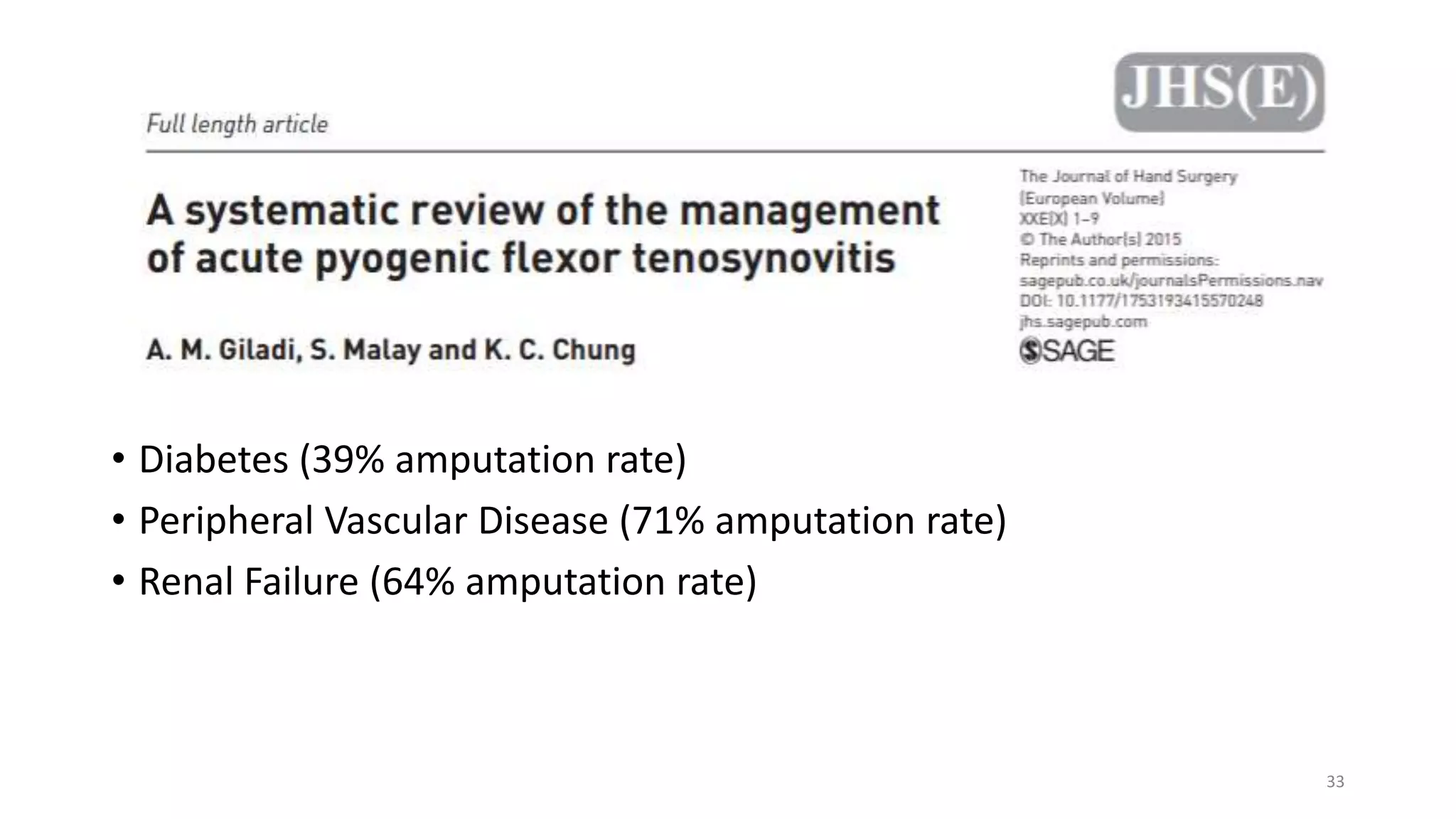
• Diabetes (39% amputation rate)
• Peripheral Vascular Disease (71% amputation rate)
• Renal Failure (64% amputation rate)
33
Deep Space Infections
34
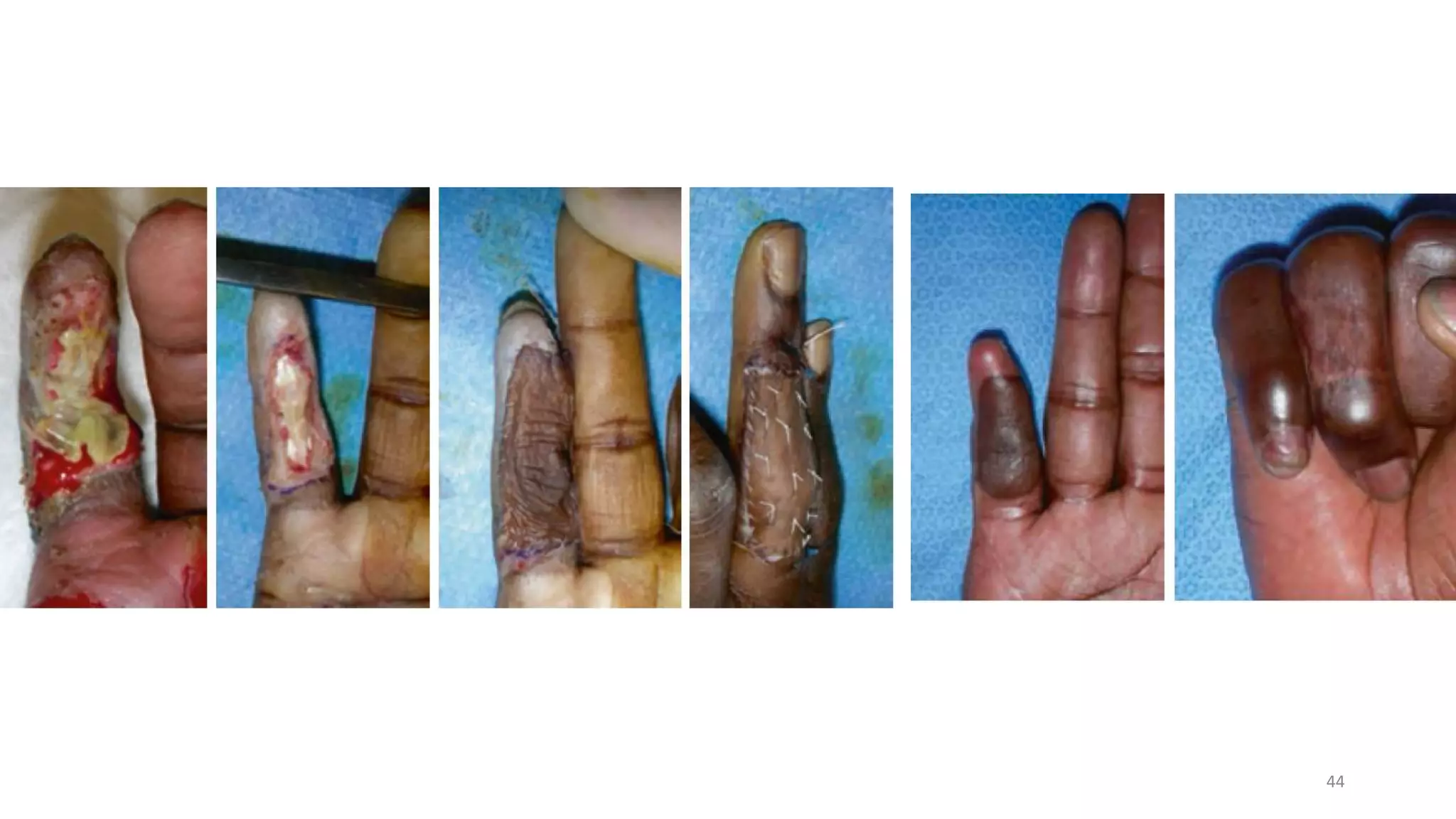
Deep space infections
• Anatomical Spaces in hand
1. Thenar space
2. Hypothenar space
3. Midpalmar space
4. Dorsal subaponeurotic space
5. Web space
6. Dorsal Adductor space
• Dorsal to the adductor pollicis and palmar
to the 1st dorsal interosseous
35
Clinical presentation
• Penetrating trauma
• Thenar and midpalmar space infections can happen from spread of
pyogenic flexor tenosynovitis
• Thenar space – most common deep space infections
• Midpalmar – rare
• Hypothenar – extremely rare, not in continuity with any flexor tendon
sheaths
• All will have exquisite tenderness over the involved palmar space
36
Thenar space
• Swelling of thenar
eminence/entire
hand
• Thumb abducted
• Pain with passive
adduction
Midpalmar space
• Dorsal swelling
predominates
• Loss of palmar
concavity
• Flexed posture of
MF, RF
• Pain with passive
extension of fingers
Hypothenar space
• Localised
tenderness and
swelling of
hypothenar
eminence
• No palmar swelling
• No finger
involvement
37
38
Web space
infection
• Swelling and tenderness
over the web space
• Finger position in “V”
shape
• Known as Collar Button
Abscess if it extend
dorsally
Treatment
• No role of nonsurgical management
• Refer Orthopaedics
• Incision and drainage
39
Thenar Space Drainage
40
Midpalmar Space Drainage
41
• Take home message:
1. Holistic approach during health check-up
• Inspect the hand / foot
• Reinforce Diabetic control
2. Treat hand infections as Orthopaedic
Emergency when significant evidence of
infection / collection
3. Educate patient
• Hand hygiene
• Nail cutting techniques
• Early intervention
• Break the stigma of amputation
42
43
44
45
Thank You
46

Hand Infection .pptx

  • 1.
  • 2.
  • 3.
    Focus of Discussion 1.Nail Bed Infection • Acute Paronychia • Chronic Paronychia • Subungal Abscess • Felon 2. Flexor Tenosynovitis 3. Deep Space Infection 3
  • 4.
  • 5.
    Anatomy of NailComplex 5
  • 6.
    Acute paronychia • Infectionof the nail fold • Most common infection in the hand • S. aureus most common infecting organism • Common cause: • Hang nail • Nail Biting/ Sucking • Manicures • Penetrating trauma 6
  • 7.
    7 EARLY STAGE ABSCESSFORMATION “RUNAROUND INFECTION” • Topical Antibiotics • Oral Antibiotics • Surgical ( I&D) • Antibiotics • Surgical ( I&D) • Antibiotics
  • 8.
    Operative methods • Directincision away from nail bed (B) • Extend incision proximally as necessary • If eponychium is involved, make another parallel incision along opposite nail fold, elevate the eponychium and reflect it above nail plate (C & D) • Infection below nail plate – remove the nail plate partially/totally. • Purulence below nail plate -> ischaemia of germinal matrix 8
  • 9.
    Postop Care • 7-10days antibiotic • Daily soaks in normal saline 5, 2-3 times/day • Early ROM exercises • Discontinue packing/wicking at 3-4 days • Expect tenderness/hypersensitivity around surgical scars lasting several months 9
  • 10.
  • 11.
    Chronic Paronychia • Distinctclinical problem from acute paronychia • Multifactorial inflammatory reaction of the proximal nail fold to irritants and allergens • Characterized by chronically indurated and rounded eponychium, may results in thickening and grooving of the nail plate • Middle-aged women • Female : male = 4:1 • Frequent immersion in detergents • Gram +ve cocci, Gram –ve rods, Candida, mycobacterial sp. 11 Nail plate hypertrophy Nail fold blunting and retraction Transverse ridges on nail plate
  • 12.
    Pathophysiology 12 Separation between nail plateand dorsal soft tissue Colonisation usually by Staph Subsequent infection by Candida albicans and/or colonic organisms Chronic inflammation with recurrent exacerbations – increased erythema and drainage Reduced resistance to minor bacterial insults Fibrosis and thickening of eponychium Decrease in vascularity to dorsal nail fold Recurrent episodes of exacerbations
  • 13.
    Treatment • Conservative • Reduceexposure to irritants • Topical steroids • Oral + topical antibiotics and antifungal • Operative • Eponychial marsupialisation • Most common surgical treatment 13
  • 14.
    • Crescent-shaped incision1 mm proximal to distal edge of eponychial fold extending 3-5 mm proximally. • Remove crescent tissue down to but not including germinal matrix 14
  • 15.
    Postop Care • Postopdressing removed at 48-72 H • Soak in normal saline solution 3 times/day • Continue until 2 days after all drainage has stopped • Oral antibiotics for 2 weeks • Wound healing by secondary intention by 3-4 weeks • Scar sensitivity and nail deformity more common than in acute paronychia • Correct environmental factors, systemic comorbidities to avoid recurrence 15
  • 16.
  • 17.
    Felon • Subcutaneous abscessof distal pulp of finger/thumb • Involve multiple septal compartments • 15-20% of all hand infections • S. aureus • Gram –ve oraganisms in immunocompromised 19
  • 18.
    Clinical presentation • Severethrobbing pain, tension and swelling of entire distal phalangeal pulp • Does not extend proximal to DIPJ flexion crease, unless the joint or tendon sheath is involved • History of penetrating injury 20
  • 19.
    Treatment • Nonsurgical onlyin very early presentation • Surgical drainage in tense pulp even without abscess • Aim: • Avoid injury to digital nerve and vessels • Non-disabling scar • Preserve function of finger pupl • Fine tactile sensibility • Maintain stable, durable pad for pinch 21
  • 20.
    Surgical Drainage • Incision •Place incision opposite the pinching surface or at the side of maximal tenderness 22
  • 21.
    Post op care •Keep wound open for 2-5 days • Place a gauze wick in the wound up till 3-5 days • Soak in dilute povidone-iodine 3 times/day • Allow wound healing by secondary intention • Early finger ROM • Expect recovery in 3-4 weeks • Expect tenderness and hypersensitivity lasting several months 23
  • 22.
  • 23.
    Pyogenic Flexor Tenosynovitis •Closed-space infection of the flexor tendon sheath of the fingers or thumb • Destroys tendon gliding mechanism • Creates adhesions • Lead to tendon necrosis • S. aureus and β-hemolytic Streptococcus 25
  • 24.
  • 25.
    Clinical Presentation • The4 Kanavel signs • Excruciating pain along tendon sheath on passive extension • Semiflexed finger position • Fusiform swelling • Excessive tenderness limited to course of flexor tendon sheath 27
  • 26.
    Treatment • Nonsurgical • Norole • Orthopaedic Emergency! • Refer to Orthopaedic • Surgical 1. Open tendon sheath irrigation method 2. Through-and-through intermittent antibiotic irrigation 3. Closed tendon sheath irrigation 28
  • 27.
    Operative Treatment • 2principal approaches • Midlateral • Brunner • Multiple variations • Nevaiser – 2 hourly NS flush for 48 H +/- another 24 H Intraop • Irrigate till clear fluid seen distally • Debride any wounds 29
  • 28.
  • 29.
    Postop care • Elevatethe hand • IV antibiotic 7-10 days followed by oral to complete a 4-week course • Early ROM with therapist supervision • Return to OT no improvement in first 24-36 H 31
  • 30.
    Risk factors forpoor prognosis • DM • Late presentation • Human bite • Age >43 years • Renal failure • PVD • Subcutaneous purulence • Polymicrobial infection 32
  • 31.
    • Diabetes (39%amputation rate) • Peripheral Vascular Disease (71% amputation rate) • Renal Failure (64% amputation rate) 33
  • 32.
  • 33.
    Deep space infections •Anatomical Spaces in hand 1. Thenar space 2. Hypothenar space 3. Midpalmar space 4. Dorsal subaponeurotic space 5. Web space 6. Dorsal Adductor space • Dorsal to the adductor pollicis and palmar to the 1st dorsal interosseous 35
  • 34.
    Clinical presentation • Penetratingtrauma • Thenar and midpalmar space infections can happen from spread of pyogenic flexor tenosynovitis • Thenar space – most common deep space infections • Midpalmar – rare • Hypothenar – extremely rare, not in continuity with any flexor tendon sheaths • All will have exquisite tenderness over the involved palmar space 36
  • 35.
    Thenar space • Swellingof thenar eminence/entire hand • Thumb abducted • Pain with passive adduction Midpalmar space • Dorsal swelling predominates • Loss of palmar concavity • Flexed posture of MF, RF • Pain with passive extension of fingers Hypothenar space • Localised tenderness and swelling of hypothenar eminence • No palmar swelling • No finger involvement 37
  • 36.
    38 Web space infection • Swellingand tenderness over the web space • Finger position in “V” shape • Known as Collar Button Abscess if it extend dorsally
  • 37.
    Treatment • No roleof nonsurgical management • Refer Orthopaedics • Incision and drainage 39
  • 38.
  • 39.
  • 40.
    • Take homemessage: 1. Holistic approach during health check-up • Inspect the hand / foot • Reinforce Diabetic control 2. Treat hand infections as Orthopaedic Emergency when significant evidence of infection / collection 3. Educate patient • Hand hygiene • Nail cutting techniques • Early intervention • Break the stigma of amputation 42
  • 41.
  • 42.
  • 43.
  • 44.

Editor's Notes

  • #7 bacterial inoculation of the paronychia tissue by a sliver of nail or hangnail, by a manicure instrument, or through nail biting.
  • #9 A, Elevation of the eponychial fold with a flat probe to expose the base of the nail. B, Placement of an incision to drain the paronychia and elevate the eponychial fold for excision of the proximal third of the nail. C to E, Incisions and procedure for elevating the entire eponychial fold with excision of the proximal third of the nail. A gauze pack prevents premature closure of the cavity.
  • #13 Irritants,allergens, trauma to nail cuticle. Seal broken. Nail rounds up and retract, exposing nail grooves further. Retention of moisture.
  • #17 (1/3 of all hand infections)
  • #20 “apical infections” – infection of distal pulp skin, does not involve palmar pad.
  • #22 Treat the compartment
  • #23 Keep distal to DIPJ flexion crease to avoid contracture, tendon sheath breach. A: fish mouth, B hockey stick, C abbreviated hockey stick D/E volar approach, F unilateral longitudinal incision
  • #28 History of
  • #30 Both approaches associated with morbidities. Multiple variations introduced to minimise wound size Nevaiser - 16-gauge polyethylene catheter The catheter is sutured to the skin, and the wound closed around it
  • #34 Giladi 2015
  • #36 The hand has three anatomically defined potential spaces. These septated spaces lie between muscle fascial planes. Weel define anatomic borders. Deep palmar space infections are increasingly rare, likely due to early recognition and surgical treatment of infections and improved antibiotic therapies..
  • #37 T, IF, MF for thenar space RF, LF for midpalmar space
  • #38 The tight fascia on the palmar surface of the hand limits the amount of volar swelling
  • #40 CBC, Radiographs should be routinely obtained to evaluate for a retained foreign body, underlying osteomyelitis, or fracture
  • #41 Volar – thenar crease. Combined approaches should not be connected through the web space, as they can also lead to contracture and/or a painful scar.
  • #42 Whichever skin incision is used, the common digital nerves and arteries as well as superficial palmar arch are protected. The deep dissection is continued longitudinally on either side of these tendons until the abscess is opened. Lubrical channel-Tunnel of fascia surrounding the lubrical muscle communication between web and deep palmar fascial spaces