NERVE
CONDUCTION
  STUDY

   Garaka Rabel
Nerve Conduction Study
            (NCS)
• NCS is a test commonly used to
  evaluate the function of the motor
  and sensory nerves of the human
  body.
• Nerve conduction velocity (NCV) is a
  common measurement made during
  this test.

• The term NCV often is used to mean the actual
  test, but this may be misleading since, velocity is
  only one measurement in the test suite.
Uses
• Nerve conduction studies are used mainly for
  evaluation of paresthesias (numbness,
  tingling, burning) and/or weakness of the
  arms and legs.
• The type of study required is dependent in
  part, by the symptoms presented.
• Some indications of nerve conduction studies
  are:
   – Symptoms indicative of nerve damage as numbness,
     weakness.
   – Differentiation between local or diffuse disease process
     (mononeuropathy or polyneuropathy).
   – Get prognostic information on the type and extent of nerve
     injury.
Common disorders diagnosed by NCS
        Peripheral neuropathy
        • Mononeuropathy (ex: carpal tunnel syndrome)
        • Mononeuritis multiplex (ex: vasculitides, rheumatoid arthritis, lupus
          erythematosus [SLE], sarcoidosis, leprosy, Lyme disease, amyloidosis)
        • Polyneuropathy (ex: diabetic neuropathy,)


        Myopathy
        • Muscular dystrophies (ex: Facioscapulohumeral muscular dystrophy)
        • Myotonia
        • Congenital myopathies
        • Metabolic myopathies


        Radiculopathy (problem in which one or more nerves are
        affected with emphasis on the nerve root; Radix = "root")
        • Nerve damage from herniated discs


        Diseases of neuromuscular junction
        • Myasthenia gravis
NERVE CONDUCTION STUDY


PROCEDURE
Description of the procedure
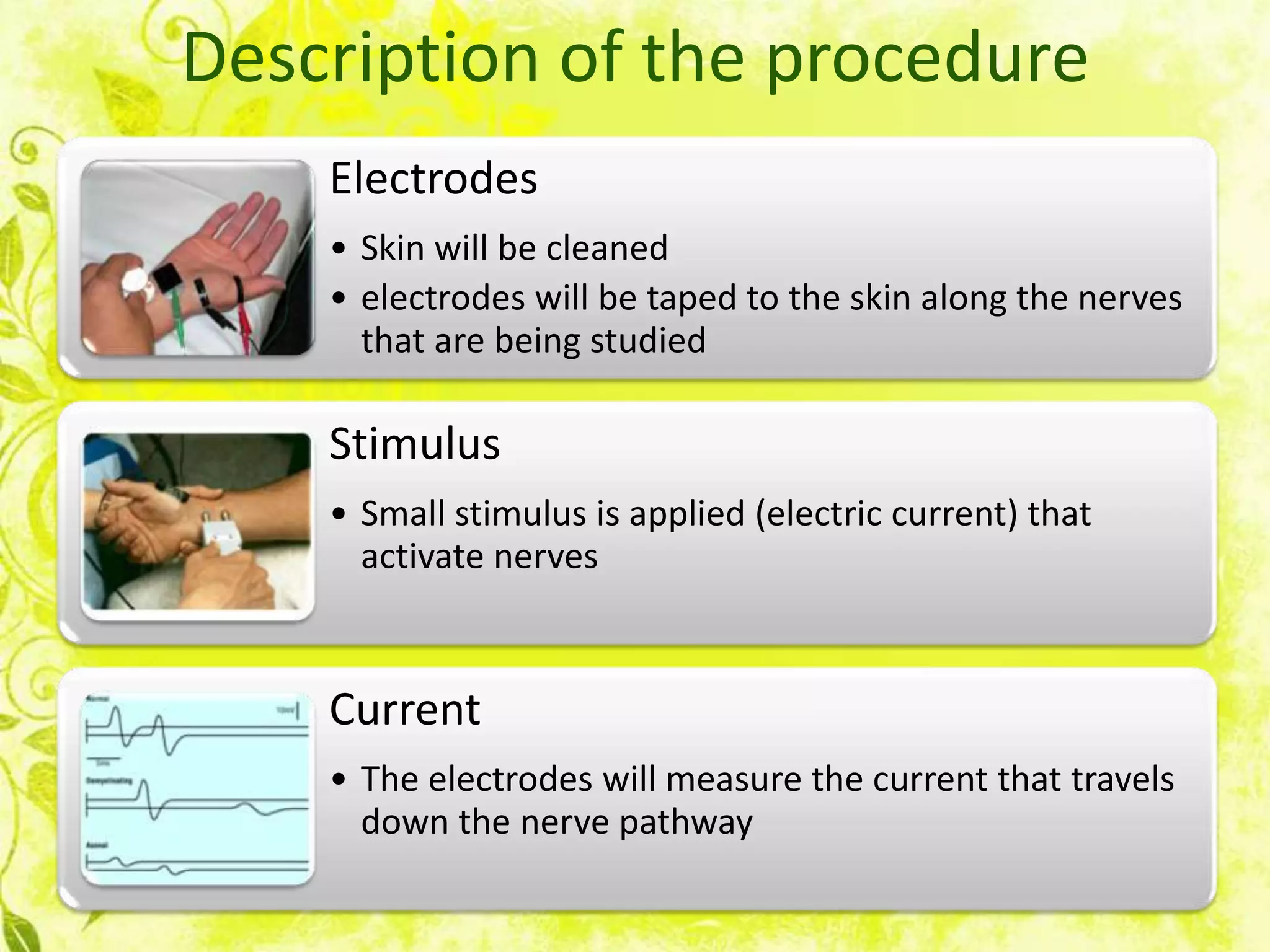
    Electrodes
    • Skin will be cleaned
    • electrodes will be taped to the skin along the nerves
      that are being studied

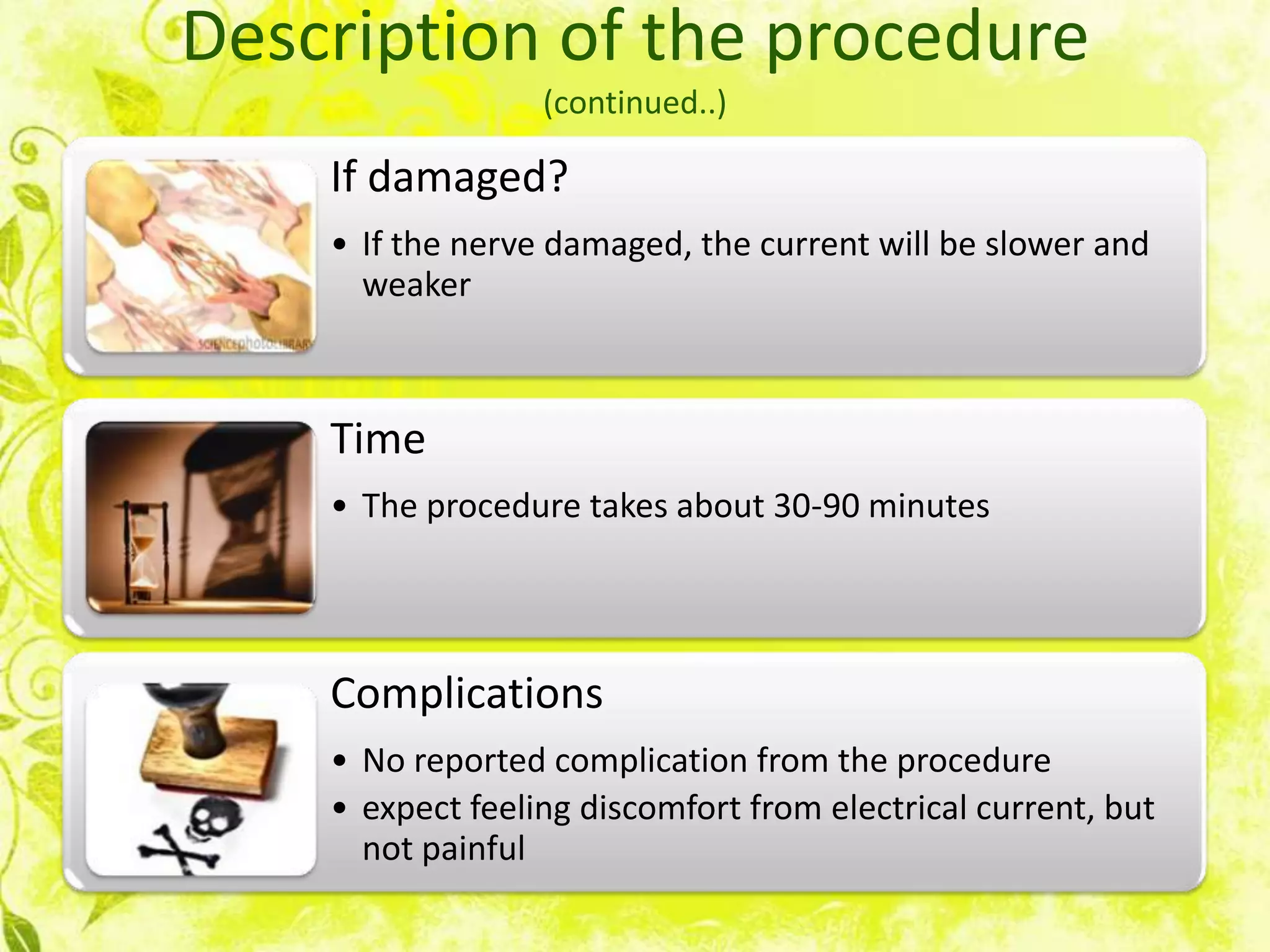
    Stimulus
    • Small stimulus is applied (electric current) that
      activate nerves


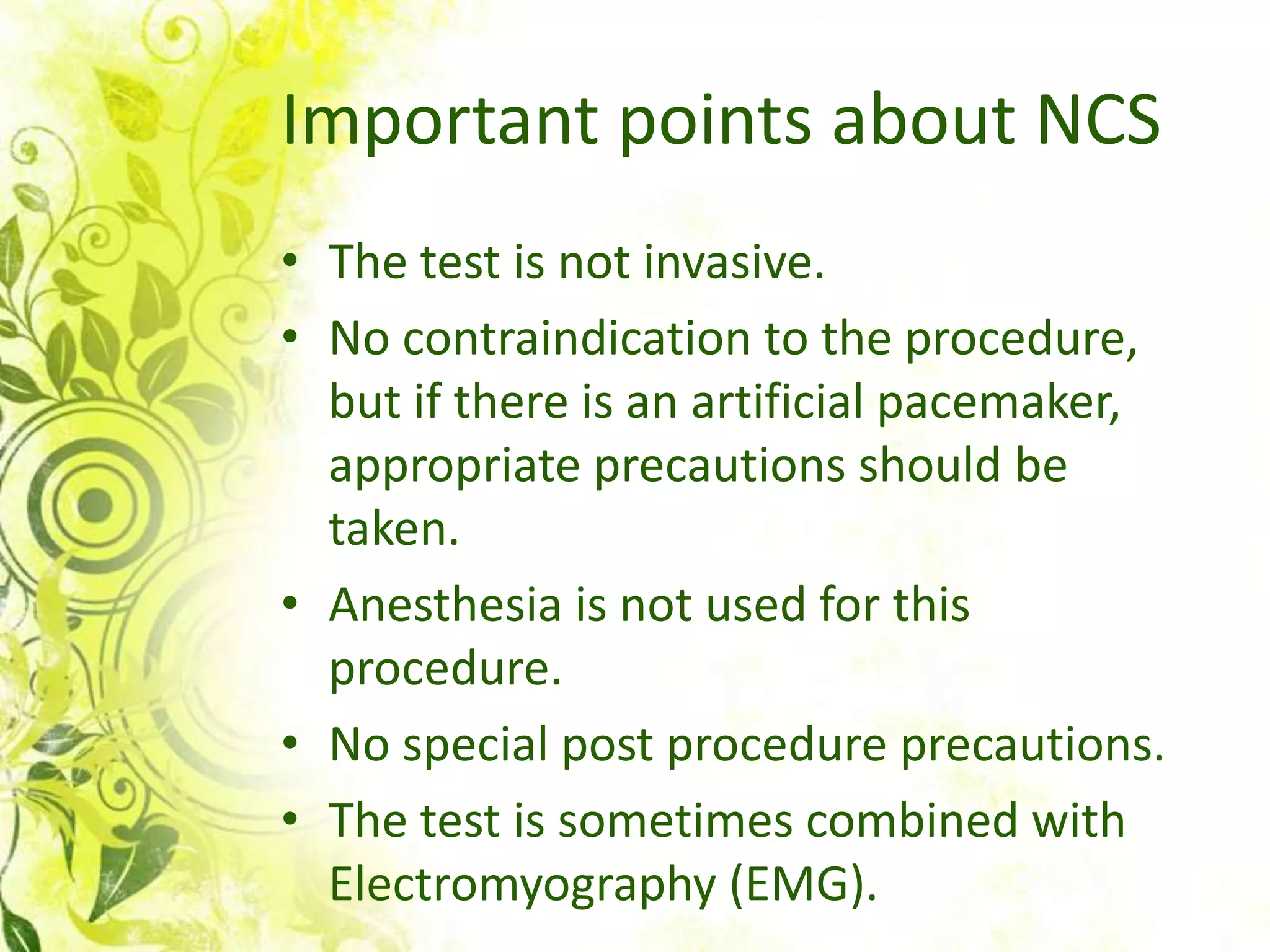
    Current
    • The electrodes will measure the current that travels
      down the nerve pathway
Description of the procedure
                  (continued..)

    If damaged?
    • If the nerve damaged, the current will be slower and
      weaker


    Time
    • The procedure takes about 30-90 minutes


    Complications
    • No reported complication from the procedure
    • expect feeling discomfort from electrical current, but
      not painful
Important points about NCS
• The test is not invasive.
• No contraindication to the procedure,
  but if there is an artificial pacemaker,
  appropriate precautions should be
  taken.
• Anesthesia is not used for this
  procedure.
• No special post procedure precautions.
• The test is sometimes combined with
  Electromyography (EMG).
Components of NCS
• The NCS consists of the following
  components:
  – Compound Motor Action Potential (CMAP);
    also called Motor nerve conduction study
  – Sensory Nerve Action Potential (SNAP);
    also called Sensory nerve conduction study
  – F-wave study
  – H-reflex study
  – A-(Axon) wave study
                                 will not be
  – Blink Reflex study           discussed…
  – Direct Facial Nerve Study
Motor nerve conduction study
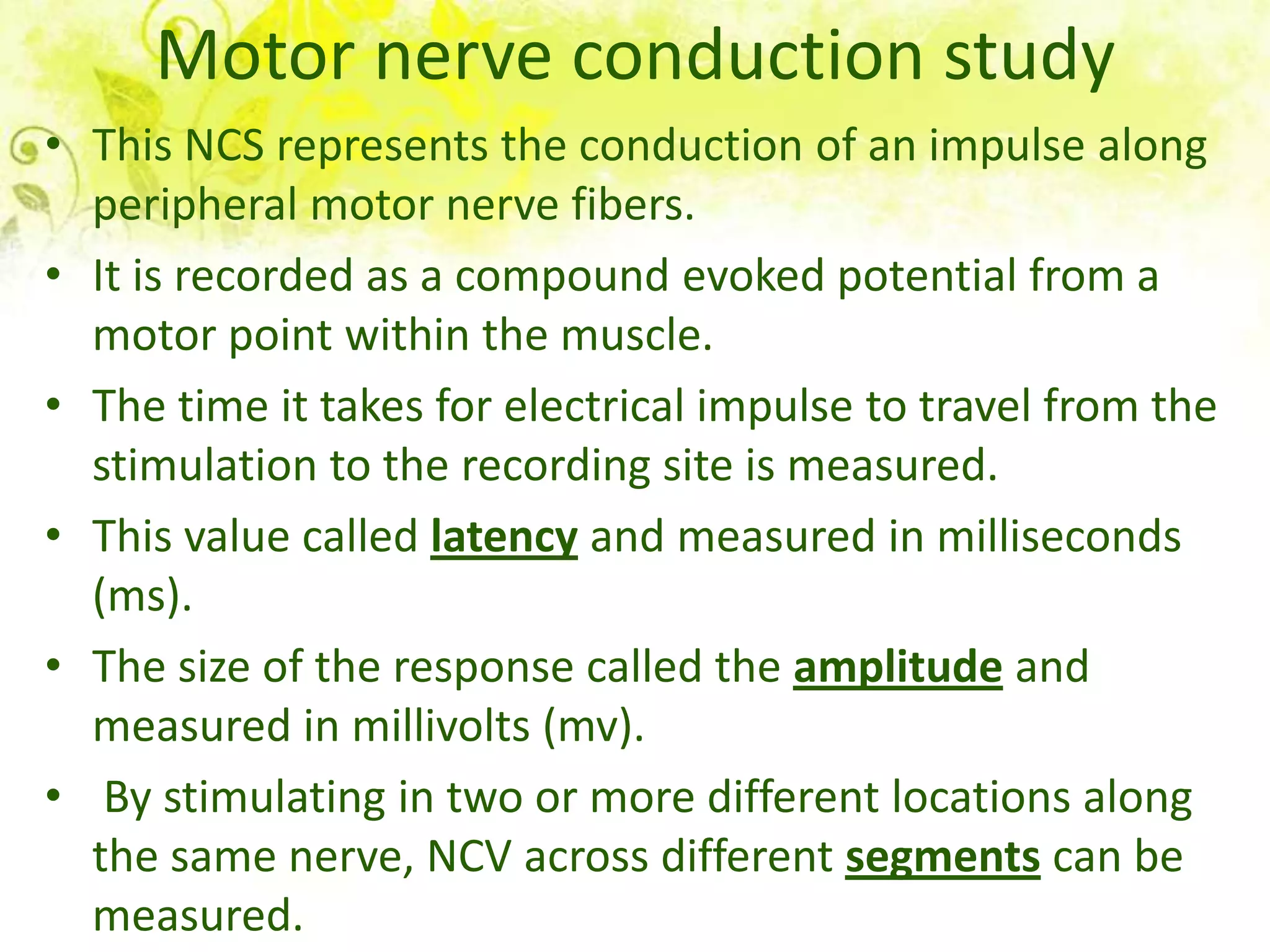
• This NCS represents the conduction of an impulse along
  peripheral motor nerve fibers.
• It is recorded as a compound evoked potential from a
  motor point within the muscle.
• The time it takes for electrical impulse to travel from the
  stimulation to the recording site is measured.
• This value called latency and measured in milliseconds
  (ms).
• The size of the response called the amplitude and
  measured in millivolts (mv).
• By stimulating in two or more different locations along
  the same nerve, NCV across different segments can be
  measured.
Motor nerve conduction study (cont..)
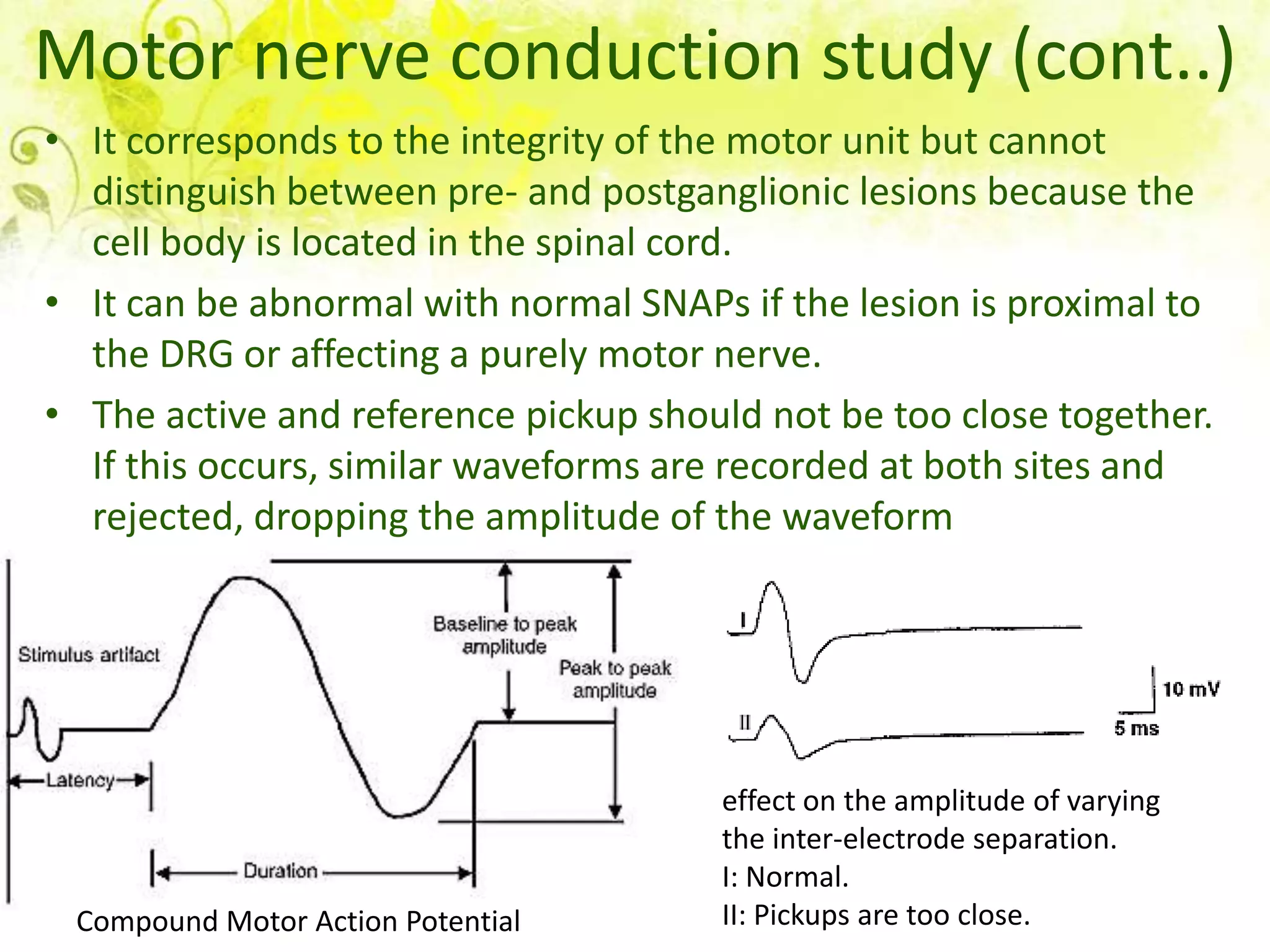
• It corresponds to the integrity of the motor unit but cannot
  distinguish between pre- and postganglionic lesions because the
  cell body is located in the spinal cord.
• It can be abnormal with normal SNAPs if the lesion is proximal to
  the DRG or affecting a purely motor nerve.
• The active and reference pickup should not be too close together.
  If this occurs, similar waveforms are recorded at both sites and
  rejected, dropping the amplitude of the waveform


                                      effect on the amplitude of varying
                                      the inter-electrode separation.
                                      I: Normal.
 Compound Motor Action Potential      II: Pickups are too close.
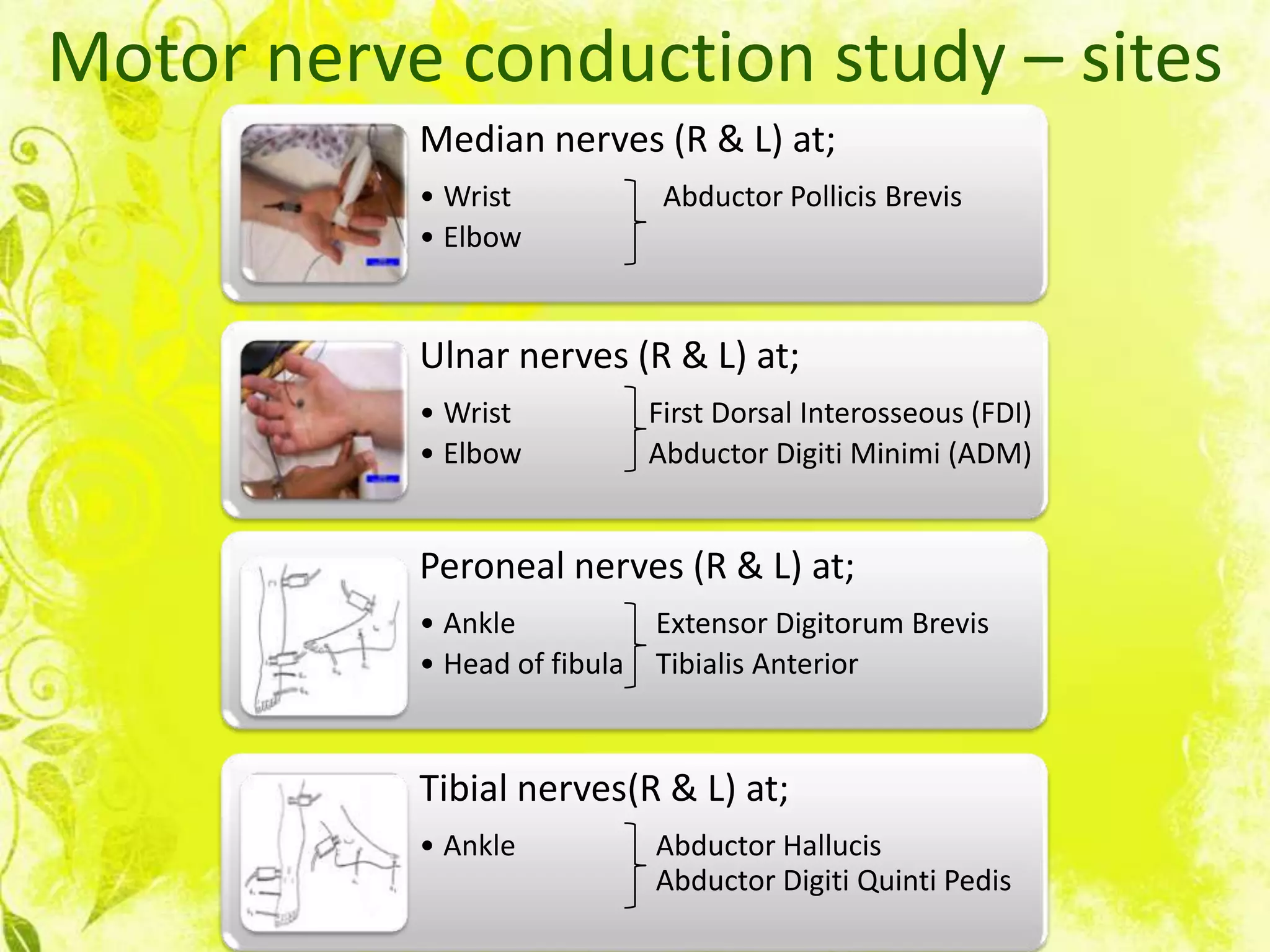
Motor nerve conduction study – sites
           Median nerves (R & L) at;
           • Wrist             Abductor Pollicis Brevis
           • Elbow


           Ulnar nerves (R & L) at;
           • Wrist            First Dorsal Interosseous (FDI)
           • Elbow            Abductor Digiti Minimi (ADM)


           Peroneal nerves (R & L) at;
           • Ankle            Extensor Digitorum Brevis
           • Head of fibula   Tibialis Anterior


           Tibial nerves(R & L) at;
           • Ankle            Abductor Hallucis
                              Abductor Digiti Quinti Pedis
Sensory nerve conduction study
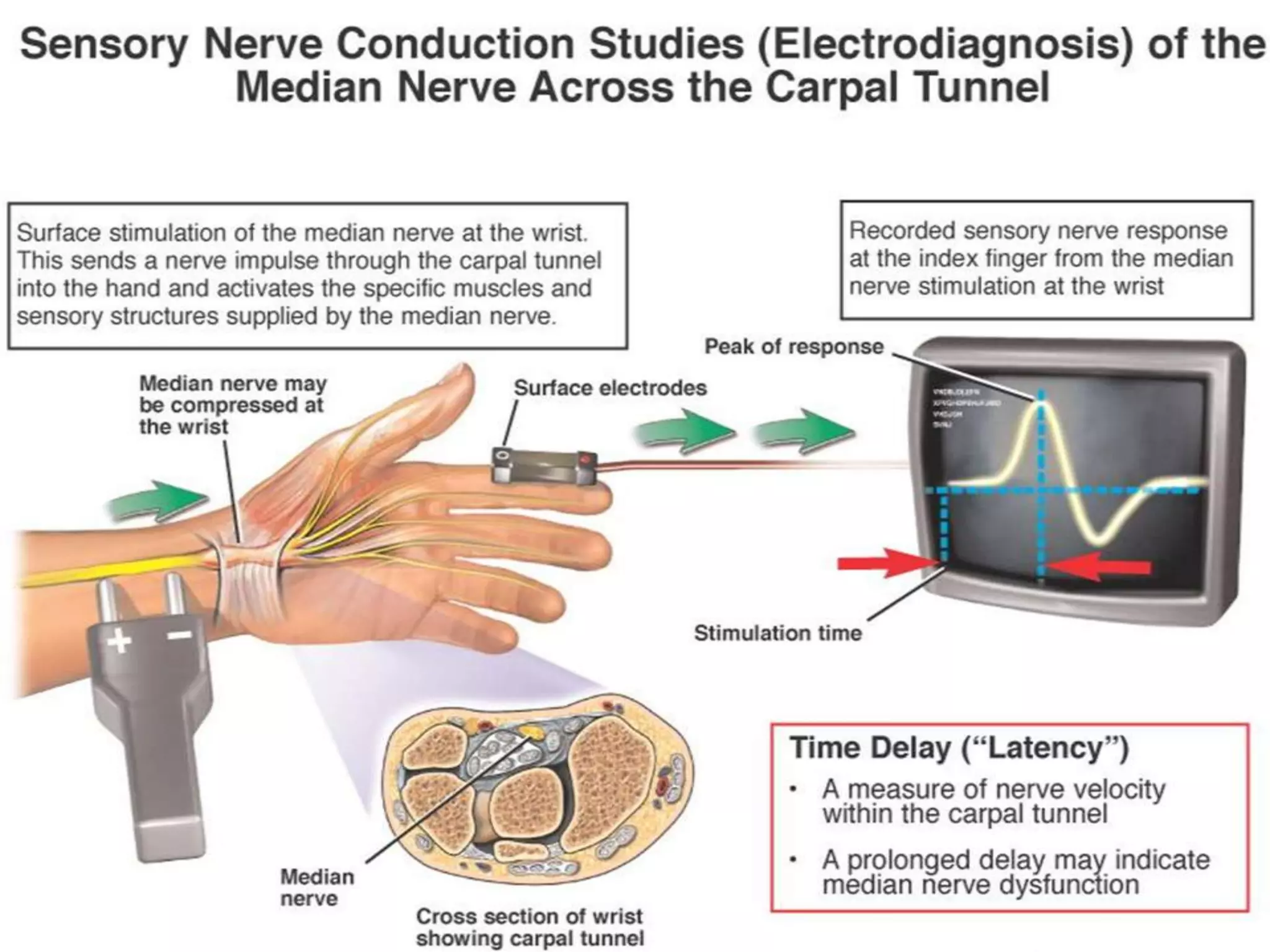
• This NCS represents the conduction of an impulse along the
  sensory nerve fibers.
• It is performed by electrical stimulation of a peripheral nerve
  and recording from a purely sensory portion of the nerve,
  such as on a finger.
• The recording electrode is placed proximal to the stimulating
  electrode. (antidromic nerve impulse is recorded)
• Like the motor studies, sensory latencies are on the scale of
  milliseconds (ms).
• Sensory amplitudes are much smaller than the motor
  amplitudes, usually in the microvolt (μV) range.
• The sensory NCV is calculated based upon the latency and the
  distance between the stimulating and recording electrode.
Sensory nerve conduction study (cont..)
 • It can also be useful in localizing a lesion in relation to the dorsal
   root ganglion (DRG).
 • The DRG is located in the neural foramen and contains the
   sensory cell body. Lesions proximal to it (root, spinal cord)
   preserve the SNAP despite clinical sensory abnormalities.
 • This is because axonal transport from the cell body to the axon
   continues to remain intact.
 • SNAPs are typically considered more sensitive than CMAPs in the
   detection of an incomplete peripheral nerve injury.
 • Antidromic Studies;
    – Are easier to record a response than orthodromic studies
    – Are less uncomfortable when orthodromic studies secondary to less
      stimulation required
    – Have larger amplitudes due to the nerve being more superficial at the
      distal recording sites
Sensory nerve conduction study – sites
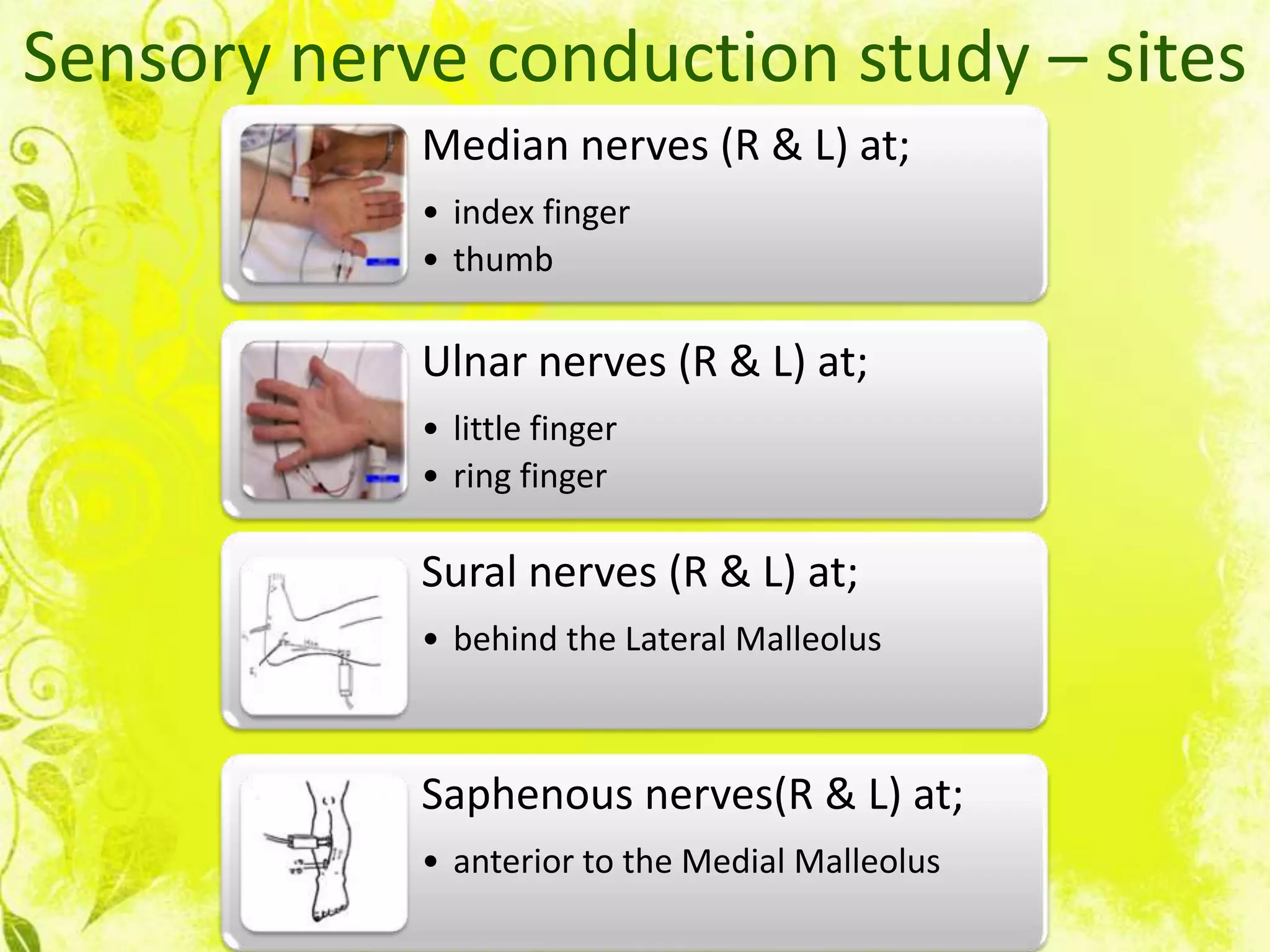
            Median nerves (R & L) at;
            • index finger
            • thumb

            Ulnar nerves (R & L) at;
            • little finger
            • ring finger

            Sural nerves (R & L) at;
            • behind the Lateral Malleolus


            Saphenous nerves(R & L) at;
            • anterior to the Medial Malleolus
F-wave study
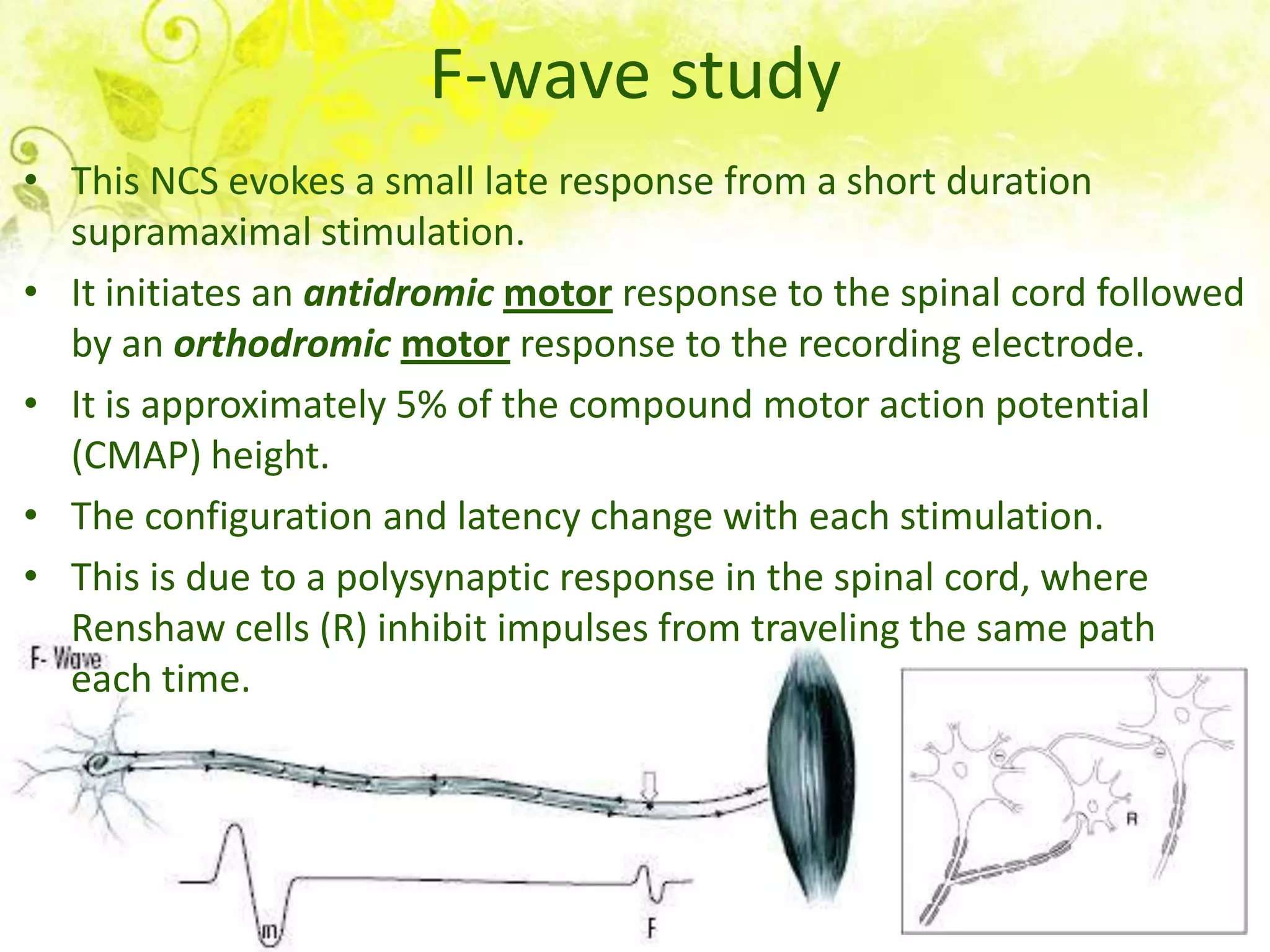
• This NCS evokes a small late response from a short duration
  supramaximal stimulation.
• It initiates an antidromic motor response to the spinal cord followed
  by an orthodromic motor response to the recording electrode.
• It is approximately 5% of the compound motor action potential
  (CMAP) height.
• The configuration and latency change with each stimulation.
• This is due to a polysynaptic response in the spinal cord, where
  Renshaw cells (R) inhibit impulses from traveling the same path
  each time.
F-wave study (continued..)
• This is not a reflex, because action potentials travels from the site
  of the stimulating electrode in a limb to the spinal cord and back to
  the limb in the same nerve that was stimulated.
• The F- waves latency can be used to derive the conduction
  velocity of nerves between the limb and spinal cord, whereas the
  motor and sensory nerve conduction study in the same segment of
  the limb.
• Conduction velocity is derived by measuring the limb length in
  millimeters from the stimulation site to the corresponding spinal
  segment (ex: C7 spinous process to wrist crease for median nerve).
• This is multiplied by 2 as it goes to the cord and returns to the
  muscle.
• Limitation: This evaluates a long neural pathway, which can dilute
  focal lesions and hinder specificity of injury location. It only
  accesses the motor fibers.
H- reflex study (continued..)
• This NCS creates a late response that is an electrically evoked
  analogue to a monosynaptic reflex.
• It is initiated with a submaximal stimulus at a long duration
  (0.5–1.0 milliseconds).
• This preferentially activates the IA afferent nerve fibers,
  causing an orthodromic sensory response to the spinal cord,
  and then an orthodromic motor response back to the
  recording electrode.
• The morphology and latency remains constant with each
  stimulation at the appropriate intensity.
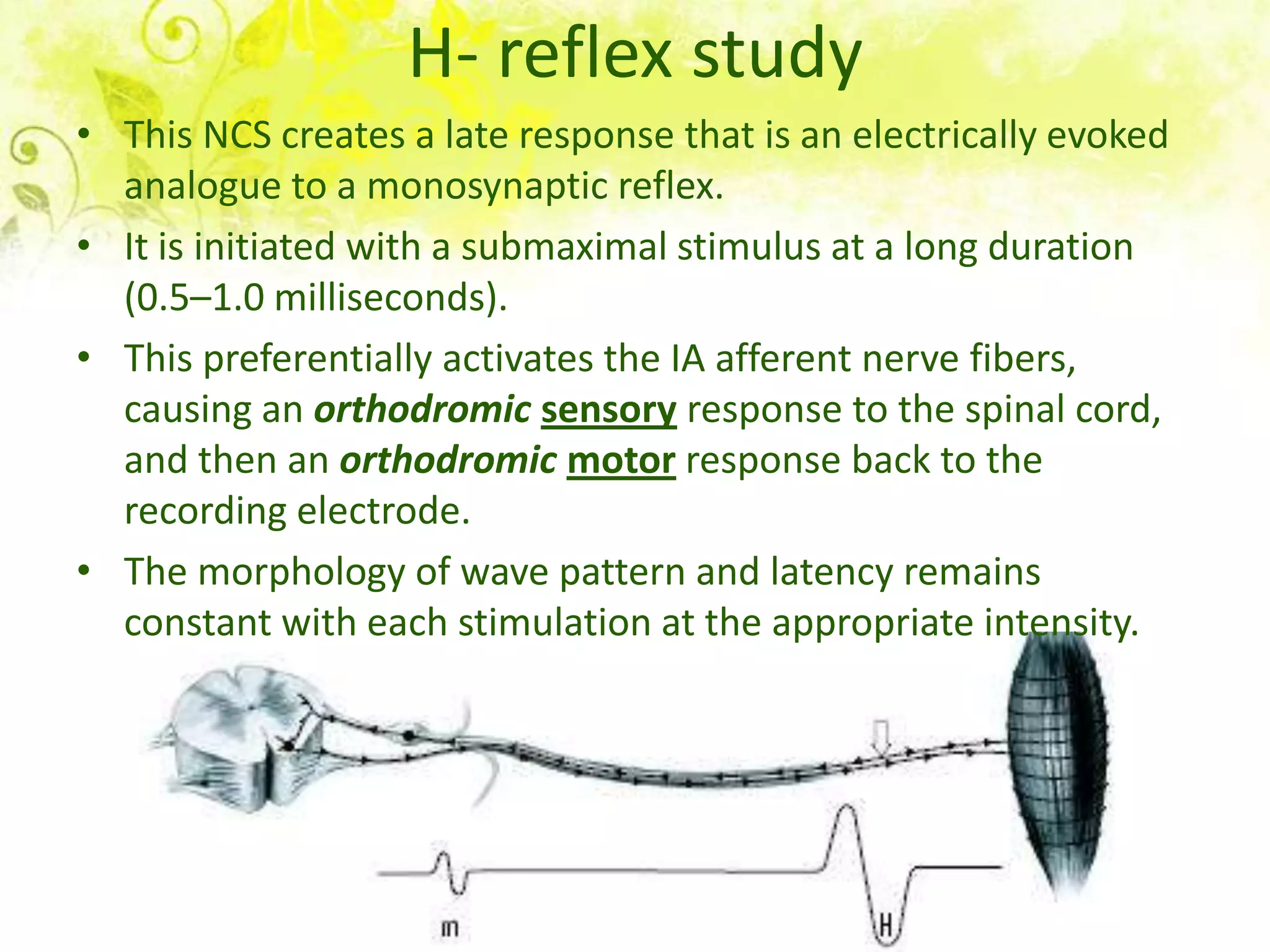
H- reflex study
• This NCS creates a late response that is an electrically evoked
  analogue to a monosynaptic reflex.
• It is initiated with a submaximal stimulus at a long duration
  (0.5–1.0 milliseconds).
• This preferentially activates the IA afferent nerve fibers,
  causing an orthodromic sensory response to the spinal cord,
  and then an orthodromic motor response back to the
  recording electrode.
• The morphology of wave pattern and latency remains
  constant with each stimulation at the appropriate intensity.
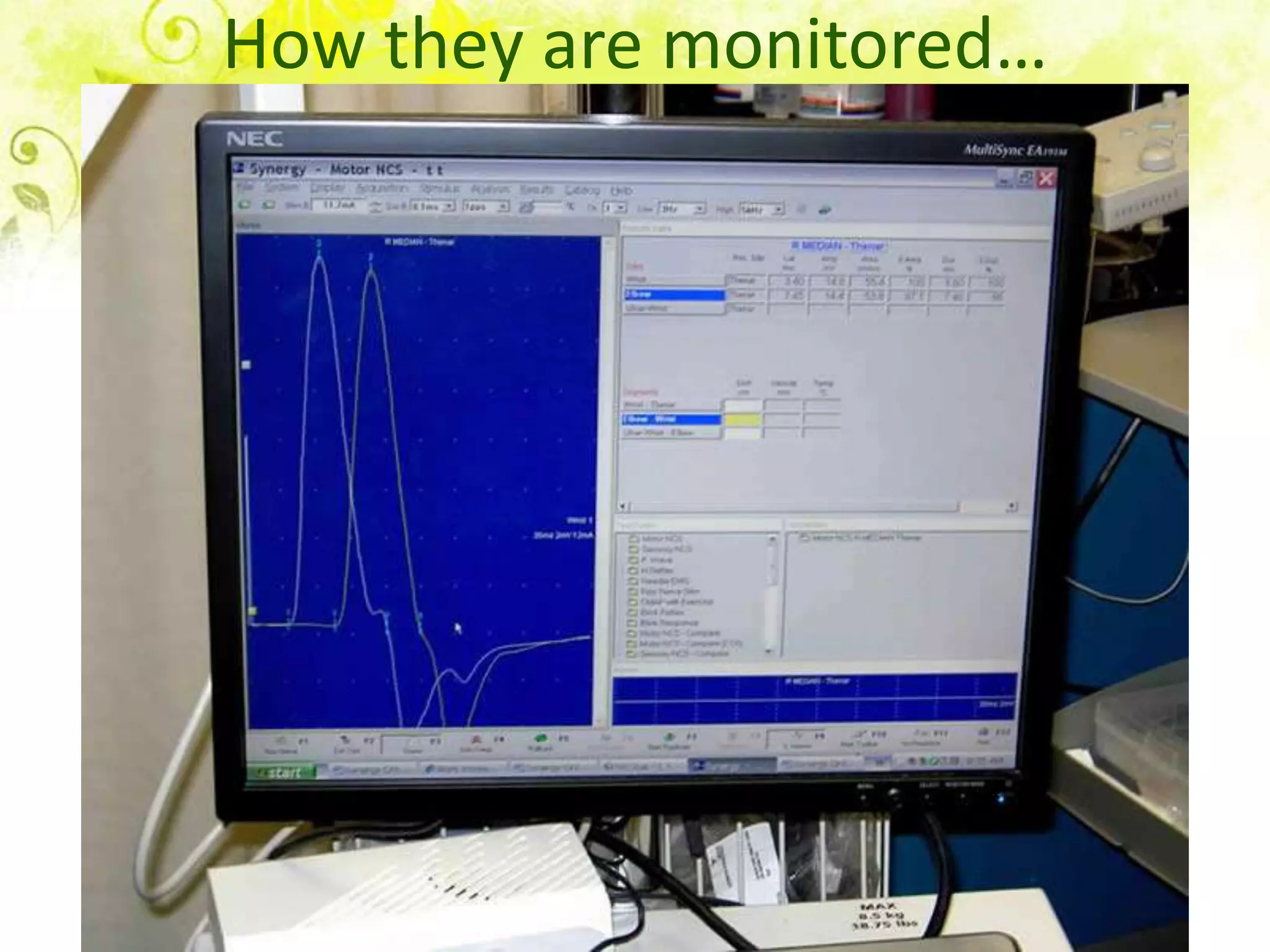
How they are monitored…
Interpretation of nerve conductions
• The speed of nerve conduction is related to
   – the diameter of the nerve and,
   – the degree of myelination (a myelin sheath is a type of "insulation"
     around the nerve).
• A normally functioning nerve will transmit a stronger and
  faster signal than a damaged nerve.
• In general, the range of normal conduction velocity will be
  approximately 50 to 60 meters per second. However, the
  normal conduction velocity may vary from one individual to
  another and from one nerve to another.
• The Interpretation of nerve conductions is complex, but in
  general, different pathological processes result in:
   – changes in the latencies
   – changes in the amplitudes
   – slowing of the conduction velocity
Interpretation of nerve conductions
            (continued..)
• Examples;
  – slowing of the NCS usually indicates there is
    damage to myelin.
  – slowing across the wrist for the motor and sensory
    latencies of the median nerve indicates focal
    compression of the median nerve at the wrist,
    called carpal tunnel syndrome.
  – slowing of all nerve conductions in more than one
    limb indicates generalized peripheral neuropathy
    (eg. in diabetes mellitus).
References
• National Center for Biotechnology Information
  (NCBI) web site (26.06.2011)
     http://www.ncbi.nlm.nih.gov/books/NBK2
     7199/#A7198
• Wikipedia, the free encyclopaedia
  (26.06.2011)
     http://en.wikipedia.org/wiki/Nerve_condu
     ction_study
Special Thanks!
•   Dr. Sudath Gunasekera,
    Consultant Clinical Neurophysiologist,
    NHSL.

Nerve conduction study

  • 1.
  • 2.
    Nerve Conduction Study (NCS) • NCS is a test commonly used to evaluate the function of the motor and sensory nerves of the human body. • Nerve conduction velocity (NCV) is a common measurement made during this test. • The term NCV often is used to mean the actual test, but this may be misleading since, velocity is only one measurement in the test suite.
  • 3.
    Uses • Nerve conductionstudies are used mainly for evaluation of paresthesias (numbness, tingling, burning) and/or weakness of the arms and legs. • The type of study required is dependent in part, by the symptoms presented. • Some indications of nerve conduction studies are: – Symptoms indicative of nerve damage as numbness, weakness. – Differentiation between local or diffuse disease process (mononeuropathy or polyneuropathy). – Get prognostic information on the type and extent of nerve injury.
  • 4.
    Common disorders diagnosedby NCS Peripheral neuropathy • Mononeuropathy (ex: carpal tunnel syndrome) • Mononeuritis multiplex (ex: vasculitides, rheumatoid arthritis, lupus erythematosus [SLE], sarcoidosis, leprosy, Lyme disease, amyloidosis) • Polyneuropathy (ex: diabetic neuropathy,) Myopathy • Muscular dystrophies (ex: Facioscapulohumeral muscular dystrophy) • Myotonia • Congenital myopathies • Metabolic myopathies Radiculopathy (problem in which one or more nerves are affected with emphasis on the nerve root; Radix = "root") • Nerve damage from herniated discs Diseases of neuromuscular junction • Myasthenia gravis
  • 5.
  • 6.
    Description of theprocedure Electrodes • Skin will be cleaned • electrodes will be taped to the skin along the nerves that are being studied Stimulus • Small stimulus is applied (electric current) that activate nerves Current • The electrodes will measure the current that travels down the nerve pathway
  • 7.
    Description of theprocedure (continued..) If damaged? • If the nerve damaged, the current will be slower and weaker Time • The procedure takes about 30-90 minutes Complications • No reported complication from the procedure • expect feeling discomfort from electrical current, but not painful
  • 8.
    Important points aboutNCS • The test is not invasive. • No contraindication to the procedure, but if there is an artificial pacemaker, appropriate precautions should be taken. • Anesthesia is not used for this procedure. • No special post procedure precautions. • The test is sometimes combined with Electromyography (EMG).
  • 9.
    Components of NCS •The NCS consists of the following components: – Compound Motor Action Potential (CMAP); also called Motor nerve conduction study – Sensory Nerve Action Potential (SNAP); also called Sensory nerve conduction study – F-wave study – H-reflex study – A-(Axon) wave study will not be – Blink Reflex study discussed… – Direct Facial Nerve Study
  • 10.
    Motor nerve conductionstudy • This NCS represents the conduction of an impulse along peripheral motor nerve fibers. • It is recorded as a compound evoked potential from a motor point within the muscle. • The time it takes for electrical impulse to travel from the stimulation to the recording site is measured. • This value called latency and measured in milliseconds (ms). • The size of the response called the amplitude and measured in millivolts (mv). • By stimulating in two or more different locations along the same nerve, NCV across different segments can be measured.
  • 11.
    Motor nerve conductionstudy (cont..) • It corresponds to the integrity of the motor unit but cannot distinguish between pre- and postganglionic lesions because the cell body is located in the spinal cord. • It can be abnormal with normal SNAPs if the lesion is proximal to the DRG or affecting a purely motor nerve. • The active and reference pickup should not be too close together. If this occurs, similar waveforms are recorded at both sites and rejected, dropping the amplitude of the waveform effect on the amplitude of varying the inter-electrode separation. I: Normal. Compound Motor Action Potential II: Pickups are too close.
  • 12.
    Motor nerve conductionstudy – sites Median nerves (R & L) at; • Wrist Abductor Pollicis Brevis • Elbow Ulnar nerves (R & L) at; • Wrist First Dorsal Interosseous (FDI) • Elbow Abductor Digiti Minimi (ADM) Peroneal nerves (R & L) at; • Ankle Extensor Digitorum Brevis • Head of fibula Tibialis Anterior Tibial nerves(R & L) at; • Ankle Abductor Hallucis Abductor Digiti Quinti Pedis
  • 13.
    Sensory nerve conductionstudy • This NCS represents the conduction of an impulse along the sensory nerve fibers. • It is performed by electrical stimulation of a peripheral nerve and recording from a purely sensory portion of the nerve, such as on a finger. • The recording electrode is placed proximal to the stimulating electrode. (antidromic nerve impulse is recorded) • Like the motor studies, sensory latencies are on the scale of milliseconds (ms). • Sensory amplitudes are much smaller than the motor amplitudes, usually in the microvolt (μV) range. • The sensory NCV is calculated based upon the latency and the distance between the stimulating and recording electrode.
  • 14.
    Sensory nerve conductionstudy (cont..) • It can also be useful in localizing a lesion in relation to the dorsal root ganglion (DRG). • The DRG is located in the neural foramen and contains the sensory cell body. Lesions proximal to it (root, spinal cord) preserve the SNAP despite clinical sensory abnormalities. • This is because axonal transport from the cell body to the axon continues to remain intact. • SNAPs are typically considered more sensitive than CMAPs in the detection of an incomplete peripheral nerve injury. • Antidromic Studies; – Are easier to record a response than orthodromic studies – Are less uncomfortable when orthodromic studies secondary to less stimulation required – Have larger amplitudes due to the nerve being more superficial at the distal recording sites
  • 16.
    Sensory nerve conductionstudy – sites Median nerves (R & L) at; • index finger • thumb Ulnar nerves (R & L) at; • little finger • ring finger Sural nerves (R & L) at; • behind the Lateral Malleolus Saphenous nerves(R & L) at; • anterior to the Medial Malleolus
  • 17.
    F-wave study • ThisNCS evokes a small late response from a short duration supramaximal stimulation. • It initiates an antidromic motor response to the spinal cord followed by an orthodromic motor response to the recording electrode. • It is approximately 5% of the compound motor action potential (CMAP) height. • The configuration and latency change with each stimulation. • This is due to a polysynaptic response in the spinal cord, where Renshaw cells (R) inhibit impulses from traveling the same path each time.
  • 18.
    F-wave study (continued..) •This is not a reflex, because action potentials travels from the site of the stimulating electrode in a limb to the spinal cord and back to the limb in the same nerve that was stimulated. • The F- waves latency can be used to derive the conduction velocity of nerves between the limb and spinal cord, whereas the motor and sensory nerve conduction study in the same segment of the limb. • Conduction velocity is derived by measuring the limb length in millimeters from the stimulation site to the corresponding spinal segment (ex: C7 spinous process to wrist crease for median nerve). • This is multiplied by 2 as it goes to the cord and returns to the muscle. • Limitation: This evaluates a long neural pathway, which can dilute focal lesions and hinder specificity of injury location. It only accesses the motor fibers.
  • 19.
    H- reflex study(continued..) • This NCS creates a late response that is an electrically evoked analogue to a monosynaptic reflex. • It is initiated with a submaximal stimulus at a long duration (0.5–1.0 milliseconds). • This preferentially activates the IA afferent nerve fibers, causing an orthodromic sensory response to the spinal cord, and then an orthodromic motor response back to the recording electrode. • The morphology and latency remains constant with each stimulation at the appropriate intensity.
  • 20.
    H- reflex study •This NCS creates a late response that is an electrically evoked analogue to a monosynaptic reflex. • It is initiated with a submaximal stimulus at a long duration (0.5–1.0 milliseconds). • This preferentially activates the IA afferent nerve fibers, causing an orthodromic sensory response to the spinal cord, and then an orthodromic motor response back to the recording electrode. • The morphology of wave pattern and latency remains constant with each stimulation at the appropriate intensity.
  • 21.
    How they aremonitored…
  • 22.
    Interpretation of nerveconductions • The speed of nerve conduction is related to – the diameter of the nerve and, – the degree of myelination (a myelin sheath is a type of "insulation" around the nerve). • A normally functioning nerve will transmit a stronger and faster signal than a damaged nerve. • In general, the range of normal conduction velocity will be approximately 50 to 60 meters per second. However, the normal conduction velocity may vary from one individual to another and from one nerve to another. • The Interpretation of nerve conductions is complex, but in general, different pathological processes result in: – changes in the latencies – changes in the amplitudes – slowing of the conduction velocity
  • 23.
    Interpretation of nerveconductions (continued..) • Examples; – slowing of the NCS usually indicates there is damage to myelin. – slowing across the wrist for the motor and sensory latencies of the median nerve indicates focal compression of the median nerve at the wrist, called carpal tunnel syndrome. – slowing of all nerve conductions in more than one limb indicates generalized peripheral neuropathy (eg. in diabetes mellitus).
  • 24.
    References • National Centerfor Biotechnology Information (NCBI) web site (26.06.2011) http://www.ncbi.nlm.nih.gov/books/NBK2 7199/#A7198 • Wikipedia, the free encyclopaedia (26.06.2011) http://en.wikipedia.org/wiki/Nerve_condu ction_study
  • 25.
    Special Thanks! • Dr. Sudath Gunasekera, Consultant Clinical Neurophysiologist, NHSL.