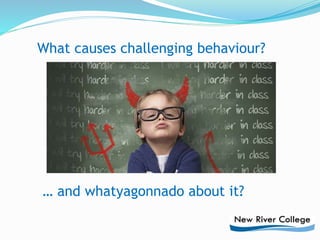
What causes challenging behaviour?
… and whatyagonnado about it?
10th May 2019
What is New River College?
Islington's Pupil Referral Units
o All Islington-resident children who are permanently excluded go first to
NRC.
o Securing Education Board may make the decision that a student needs to
be educated at the PRU if they are not succeeding in a mainstream
setting.
New River College Outreach Service
o New River College Outreach Service aims to increase school’s capacity to
deal with students with SEND, particularly SEMH (Social Emotional Mental
Health) difficulties.
Todays objectives:
 To discuss some of the causes of challenging behaviour.
 To develop some practical strategies to create a positive
learning environment.
 To scrutinise the language we use as teachers and how this
can promote positive behaviour.
 To consider how our own feelings, emotional reactions and
behaviour impacts on children.
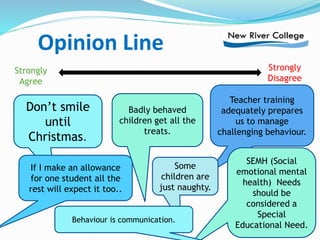
Opinion Line
Strongly
Agree
Strongly
Disagree
Don’t smile
until
Christmas.
Badly behaved
children get all the
treats.
Teacher training
adequately prepares
us to manage
challenging behaviour.
If I make an allowance
for one student all the
rest will expect it too..
Some
children are
just naughty.
SEMH (Social
emotional mental
health) Needs
should be
considered a
Special
Educational Need.
Behaviour is communication.
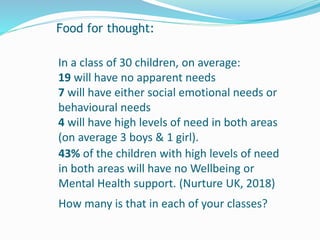
Food for thought:
In a class of 30 children, on average:
19 will have no apparent needs
7 will have either social emotional needs or
behavioural needs
4 will have high levels of need in both areas
(on average 3 boys & 1 girl).
43% of the children with high levels of need
in both areas will have no Wellbeing or
Mental Health support. (Nurture UK, 2018)
How many is that in each of your classes?
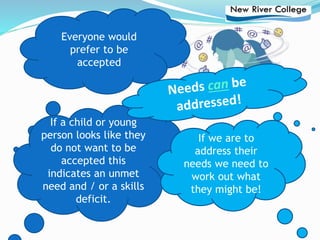
Everyone would
prefer to be
accepted
If a child or young
person looks like they
do not want to be
accepted this
indicates an unmet
need and / or a skills
deficit.
If we are to
address their
needs we need to
work out what
they might be!
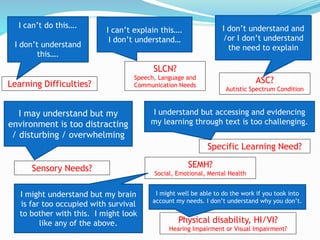
What needs might a child’s behaviour reveal?
I can’t do this….
I don’t understand
this….
I can’t explain this….
I don’t understand…
I don’t understand and
/or I don’t understand
the need to explain
I may understand but my
environment is too distracting
/ disturbing / overwhelming
I understand but accessing and evidencing
my learning through text is too challenging.
Learning Difficulties?
SLCN?
Speech, Language and
Communication Needs
ASC?
Autistic Spectrum Condition
Sensory Needs?
Specific Learning Need?
I might understand but my brain
is far too occupied with survival
to bother with this. I might look
like any of the above.
SEMH?
Social, Emotional, Mental Health
Physical disability, HI/VI?
Hearing Impairment or Visual Impairment?
I might well be able to do the work if you took into
account my needs. I don’t understand why you don’t.
I won’t …
Movement break!
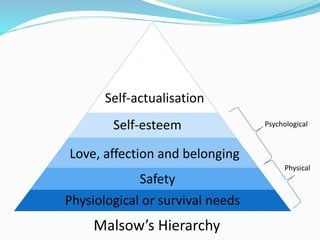
Physiological or survival needs
Safety
Love, affection and belonging
Self-esteem
Self-actualisation
Psychological
Physical
Malsow’s Hierarchy
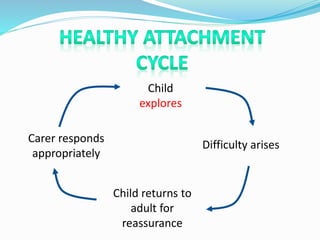
Child
explores
Difficulty arises
Child returns to
adult for
reassurance
Carer responds
appropriately
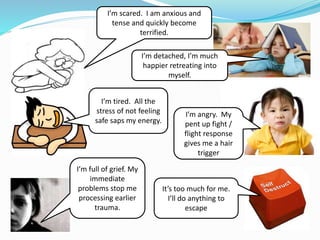
I’m detached, I’m much
happier retreating into
myself.
I’m tired. All the
stress of not feeling
safe saps my energy.
I’m angry. My
pent up fight /
flight response
gives me a hair
trigger
It’s too much for me.
I’ll do anything to
escape
I’m full of grief. My
immediate
problems stop me
processing earlier
trauma.
I’m scared. I am anxious and
tense and quickly become
terrified.
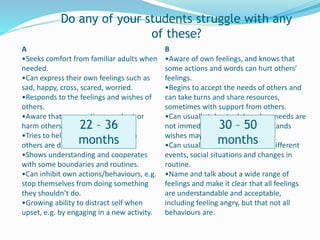
A
•Seeks comfort from familiar adults when
needed.
•Can express their own feelings such as
sad, happy, cross, scared, worried.
•Responds to the feelings and wishes of
others.
•Aware that some actions can hurt or
harm others.
•Tries to help or give comfort when
others are distressed.
•Shows understanding and cooperates
with some boundaries and routines.
•Can inhibit own actions/behaviours, e.g.
stop themselves from doing something
they shouldn’t do.
•Growing ability to distract self when
upset, e.g. by engaging in a new activity.
B
•Aware of own feelings, and knows that
some actions and words can hurt others’
feelings.
•Begins to accept the needs of others and
can take turns and share resources,
sometimes with support from others.
•Can usually tolerate delay when needs are
not immediately met, and understands
wishes may not always be met.
•Can usually adapt behaviour to different
events, social situations and changes in
routine.
•Name and talk about a wide range of
feelings and make it clear that all feelings
are understandable and acceptable,
including feeling angry, but that not all
behaviours are.
Do any of your students struggle with any
of these?
22 – 36
months
30 – 50
months
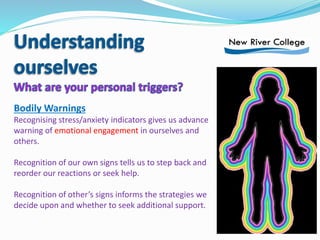
Bodily Warnings
Recognising stress/anxiety indicators gives us advance
warning of emotional engagement in ourselves and
others.
Recognition of our own signs tells us to step back and
reorder our reactions or seek help.
Recognition of other’s signs informs the strategies we
decide upon and whether to seek additional support.
Calm yourself before trying to calm others
Use a calm tone of voice and non-threatening body language. Maintain a
safe distance, hands by side, slow movements, avoiding direct eye contact.
Do not point, wag your fingers or prod.
Speak calmly but assertively. Say how you feel and why, say what you would
like to happen. Use humour, as appropriate.
Focus on the real problem (the primary behaviour) to prevent escalation.
Capitalise on your relationships.
Give any instructions clearly and then give time to do it. Use the language of
choice (not ultimatums) and give time to comply. Keep the options open.
Try to be fair and consistent.
Try to avoid an audience.
Avoid trying to solve a problem when people are angry. Talk to
them later when you, and they are calm.
Know where to go for help and ask for it if you need it.
Know the policy in your school on following up on an incident.
Try to find a common ground and search for solutions.
Our reaction to behaviour will either de-escalate or escalate the
problem – we need to plan and reflect on our approaches
carefully.
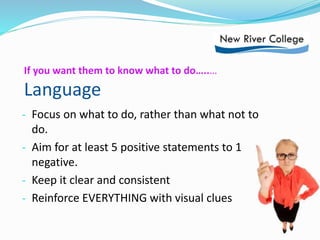
If you want them to know what to do…..…
Language
- Focus on what to do, rather than what not to
do.
- Aim for at least 5 positive statements to 1
negative.
- Keep it clear and consistent
- Reinforce EVERYTHING with visual clues
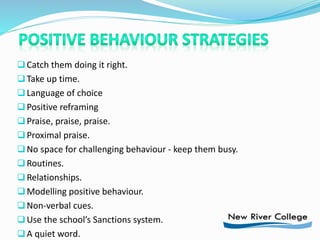
Catch them doing it right.
Take up time.
Language of choice
Positive reframing
Praise, praise, praise.
Proximal praise.
No space for challenging behaviour - keep them busy.
Routines.
Relationships.
Modelling positive behaviour.
Non-verbal cues.
Use the school’s Sanctions system.
A quiet word.
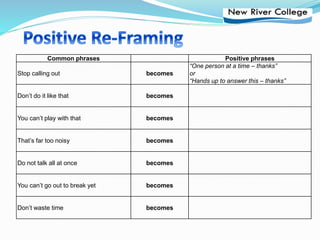
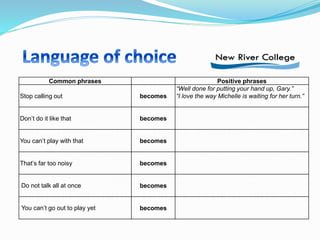
Common phrases Positive phrases
Stop calling out becomes
“One person at a time – thanks”
or
“Hands up to answer this – thanks”
Don’t do it like that becomes
You can’t play with that becomes
That’s far too noisy becomes
Do not talk all at once becomes
You can’t go out to break yet becomes
Don’t waste time becomes
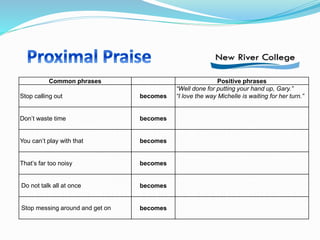
Common phrases Positive phrases
Stop calling out becomes
“Well done for putting your hand up, Gary.”
“I love the way Michelle is waiting for her turn.”
Don’t waste time becomes
You can’t play with that becomes
That’s far too noisy becomes
Do not talk all at once becomes
Stop messing around and get on becomes
Common phrases Positive phrases
Stop calling out becomes
“Well done for putting your hand up, Gary.”
“I love the way Michelle is waiting for her turn.”
Don’t do it like that becomes
You can’t play with that becomes
That’s far too noisy becomes
Do not talk all at once becomes
You can’t go out to play yet becomes
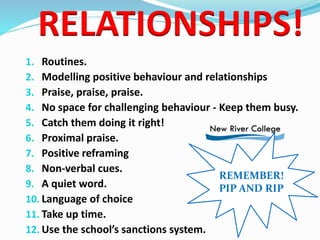
1. Routines.
2. Modelling positive behaviour and relationships
3. Praise, praise, praise.
4. No space for challenging behaviour - Keep them busy.
5. Catch them doing it right!
6. Proximal praise.
7. Positive reframing
8. Non-verbal cues.
9. A quiet word.
10. Language of choice
11. Take up time.
12. Use the school’s sanctions system.
RELATIONSHIPS!
REMEMBER!
PIP AND RIP
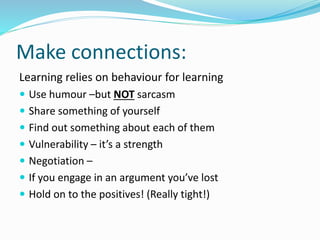
Make connections:
Learning relies on behaviour for learning
 Use humour –but NOT sarcasm
 Share something of yourself
 Find out something about each of them
 Vulnerability – it’s a strength
 Negotiation –
 If you engage in an argument you’ve lost
 Hold on to the positives! (Really tight!)
Managing your own reactions:
HM Govt Health Warning:
THIS IS NOT A QUICK FIX. WITH LUCK THE PERCENTAGE OF
THE TIME YOU GET IT RIGHT WILL INCREASE WITH
EXPERIENCE
DON’T LET IT GET YOU DOWN
Key words
- Relationships
- Calm
- Consistent
- Predictable
Feedback Time!
Positive Behaviour Management.

Positive Behaviour Management.

  • 1.
    What causes challengingbehaviour? … and whatyagonnado about it?
  • 2.
  • 3.
    What is NewRiver College? Islington's Pupil Referral Units o All Islington-resident children who are permanently excluded go first to NRC. o Securing Education Board may make the decision that a student needs to be educated at the PRU if they are not succeeding in a mainstream setting. New River College Outreach Service o New River College Outreach Service aims to increase school’s capacity to deal with students with SEND, particularly SEMH (Social Emotional Mental Health) difficulties.
  • 4.
    Todays objectives:  Todiscuss some of the causes of challenging behaviour.  To develop some practical strategies to create a positive learning environment.  To scrutinise the language we use as teachers and how this can promote positive behaviour.  To consider how our own feelings, emotional reactions and behaviour impacts on children.
  • 5.
    Opinion Line Strongly Agree Strongly Disagree Don’t smile until Christmas. Badlybehaved children get all the treats. Teacher training adequately prepares us to manage challenging behaviour. If I make an allowance for one student all the rest will expect it too.. Some children are just naughty. SEMH (Social emotional mental health) Needs should be considered a Special Educational Need. Behaviour is communication.
  • 6.
    Food for thought: Ina class of 30 children, on average: 19 will have no apparent needs 7 will have either social emotional needs or behavioural needs 4 will have high levels of need in both areas (on average 3 boys & 1 girl). 43% of the children with high levels of need in both areas will have no Wellbeing or Mental Health support. (Nurture UK, 2018) How many is that in each of your classes?
  • 7.
    Everyone would prefer tobe accepted If a child or young person looks like they do not want to be accepted this indicates an unmet need and / or a skills deficit. If we are to address their needs we need to work out what they might be!
  • 8.
    What needs mighta child’s behaviour reveal?
  • 9.
    I can’t dothis…. I don’t understand this…. I can’t explain this…. I don’t understand… I don’t understand and /or I don’t understand the need to explain I may understand but my environment is too distracting / disturbing / overwhelming I understand but accessing and evidencing my learning through text is too challenging. Learning Difficulties? SLCN? Speech, Language and Communication Needs ASC? Autistic Spectrum Condition Sensory Needs? Specific Learning Need? I might understand but my brain is far too occupied with survival to bother with this. I might look like any of the above. SEMH? Social, Emotional, Mental Health Physical disability, HI/VI? Hearing Impairment or Visual Impairment? I might well be able to do the work if you took into account my needs. I don’t understand why you don’t.
  • 10.
  • 12.
  • 13.
    Physiological or survivalneeds Safety Love, affection and belonging Self-esteem Self-actualisation Psychological Physical Malsow’s Hierarchy
  • 14.
    Child explores Difficulty arises Child returnsto adult for reassurance Carer responds appropriately
  • 15.
    I’m detached, I’mmuch happier retreating into myself. I’m tired. All the stress of not feeling safe saps my energy. I’m angry. My pent up fight / flight response gives me a hair trigger It’s too much for me. I’ll do anything to escape I’m full of grief. My immediate problems stop me processing earlier trauma. I’m scared. I am anxious and tense and quickly become terrified.
  • 16.
    A •Seeks comfort fromfamiliar adults when needed. •Can express their own feelings such as sad, happy, cross, scared, worried. •Responds to the feelings and wishes of others. •Aware that some actions can hurt or harm others. •Tries to help or give comfort when others are distressed. •Shows understanding and cooperates with some boundaries and routines. •Can inhibit own actions/behaviours, e.g. stop themselves from doing something they shouldn’t do. •Growing ability to distract self when upset, e.g. by engaging in a new activity. B •Aware of own feelings, and knows that some actions and words can hurt others’ feelings. •Begins to accept the needs of others and can take turns and share resources, sometimes with support from others. •Can usually tolerate delay when needs are not immediately met, and understands wishes may not always be met. •Can usually adapt behaviour to different events, social situations and changes in routine. •Name and talk about a wide range of feelings and make it clear that all feelings are understandable and acceptable, including feeling angry, but that not all behaviours are. Do any of your students struggle with any of these? 22 – 36 months 30 – 50 months
  • 18.
    Bodily Warnings Recognising stress/anxietyindicators gives us advance warning of emotional engagement in ourselves and others. Recognition of our own signs tells us to step back and reorder our reactions or seek help. Recognition of other’s signs informs the strategies we decide upon and whether to seek additional support.
  • 19.
    Calm yourself beforetrying to calm others Use a calm tone of voice and non-threatening body language. Maintain a safe distance, hands by side, slow movements, avoiding direct eye contact. Do not point, wag your fingers or prod. Speak calmly but assertively. Say how you feel and why, say what you would like to happen. Use humour, as appropriate. Focus on the real problem (the primary behaviour) to prevent escalation. Capitalise on your relationships. Give any instructions clearly and then give time to do it. Use the language of choice (not ultimatums) and give time to comply. Keep the options open. Try to be fair and consistent.
  • 20.
    Try to avoidan audience. Avoid trying to solve a problem when people are angry. Talk to them later when you, and they are calm. Know where to go for help and ask for it if you need it. Know the policy in your school on following up on an incident. Try to find a common ground and search for solutions. Our reaction to behaviour will either de-escalate or escalate the problem – we need to plan and reflect on our approaches carefully.
  • 21.
    If you wantthem to know what to do…..… Language - Focus on what to do, rather than what not to do. - Aim for at least 5 positive statements to 1 negative. - Keep it clear and consistent - Reinforce EVERYTHING with visual clues
  • 22.
    Catch them doingit right. Take up time. Language of choice Positive reframing Praise, praise, praise. Proximal praise. No space for challenging behaviour - keep them busy. Routines. Relationships. Modelling positive behaviour. Non-verbal cues. Use the school’s Sanctions system. A quiet word.
  • 23.
    Common phrases Positivephrases Stop calling out becomes “One person at a time – thanks” or “Hands up to answer this – thanks” Don’t do it like that becomes You can’t play with that becomes That’s far too noisy becomes Do not talk all at once becomes You can’t go out to break yet becomes Don’t waste time becomes
  • 24.
    Common phrases Positivephrases Stop calling out becomes “Well done for putting your hand up, Gary.” “I love the way Michelle is waiting for her turn.” Don’t waste time becomes You can’t play with that becomes That’s far too noisy becomes Do not talk all at once becomes Stop messing around and get on becomes
  • 25.
    Common phrases Positivephrases Stop calling out becomes “Well done for putting your hand up, Gary.” “I love the way Michelle is waiting for her turn.” Don’t do it like that becomes You can’t play with that becomes That’s far too noisy becomes Do not talk all at once becomes You can’t go out to play yet becomes
  • 26.
    1. Routines. 2. Modellingpositive behaviour and relationships 3. Praise, praise, praise. 4. No space for challenging behaviour - Keep them busy. 5. Catch them doing it right! 6. Proximal praise. 7. Positive reframing 8. Non-verbal cues. 9. A quiet word. 10. Language of choice 11. Take up time. 12. Use the school’s sanctions system. RELATIONSHIPS! REMEMBER! PIP AND RIP
  • 27.
    Make connections: Learning relieson behaviour for learning  Use humour –but NOT sarcasm  Share something of yourself  Find out something about each of them  Vulnerability – it’s a strength  Negotiation –  If you engage in an argument you’ve lost  Hold on to the positives! (Really tight!)
  • 28.
    Managing your ownreactions: HM Govt Health Warning: THIS IS NOT A QUICK FIX. WITH LUCK THE PERCENTAGE OF THE TIME YOU GET IT RIGHT WILL INCREASE WITH EXPERIENCE DON’T LET IT GET YOU DOWN
  • 29.
    Key words - Relationships -Calm - Consistent - Predictable Feedback Time!

Editor's Notes

  • #4 TW Primary, KS3 Complex Needs, KS3/KS4, Medical. Types of support for NQTs. Outreach – The Bridge, ASC Sam Rhodes – Learning Difficulties Richard Cloudesley – Hearing and Visual Difficulties
  • #5 TW
  • #6 TW & IB by turns
  • #7 ‘Apparent needs’: - note girls often don’t demonstrate their needs.
  • #8 IB Needs may be a skills gap? It’s not a choice, it’s a skills deficit They’re not doing it because they’re naughty, it’s because they don’t know how to do it differently.
  • #9 IB
  • #10 Develop the discussion about how and why SEMH can look like: LD, SLCN, ASC, Sensory needs & SLN
  • #11 TW
  • #12 IB
  • #14 Put up during movement break. TW Discussion about Maslow in the classroom – physiological / survival needs incl for ch with sensory differences, FELT safety,
  • #15 TW Discussion : where might it go wrong? What might you see? What survival looks like in the primary classroom on tables. How many of these behaviours have you already seen in your classroom?
  • #16 Consider alternative causes of each presentation……
  • #17 IB Consider effects of children’s inability to demonstrate these skills affects the teacher’s capacity to teach.
  • #18 IB
  • #19 TW
  • #20 TW / chorus
  • #21 tw
  • #22 TW 100 ways to say well done!
  • #23 TW
  • #24 TW Positive statements, thank you - Don’t tell them what not to do, please.
  • #25 IB Ordering exercise to follow. Don’t move on until the exercise is over!
  • #26 TW Ordering exercise to follow. Don’t move on until the exercise is over!
  • #27 TW & IB
  • #28 IB – Don’t do anything you don’t feel or you can’t follow through….
  • #29 TW
  • #30 HW