3.2 SYSTEMS OF LINEAR
        EQUATIONS


Solving Linear Systems Algebraically
Substitution Method

Today’s objective:
1. I will use substitution to solve
  systems of linear equations in
  two variables.
Solving Systems of Equations
             Algebraically
1.    When you graph, sometimes you cannot find
      the exact point of intersection. We can use
      algebra to find the exact point.

2.    Also, we do not need to put every equation in
      slope-intercept form in order to determine if
      the lines are parallel or the same line.
      Algebraic methods will give us the same
      information.
Methods of Solving Systems
        Algebraically
We will look at TWO methods to solve
systems algebraically:

    1) Substitution

    2) Elimination
Method 1: Substitution
Steps:
   1. Choose one of the two equations
      and isolate one of the variables.
   2. Substitute the new expression into
      the other equation for the variable.
   3. Solve for the remaining variable.
   4. Substitute the solution into the
      other equation to get the solution
      to the second variable.
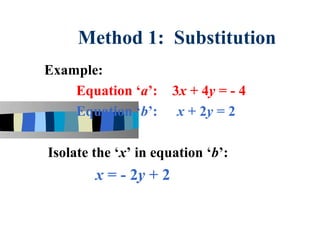
Method 1: Substitution
Example:
    Equation ‘a’:      3x + 4y = - 4
    Equation ‘b’:       x + 2y = 2

Isolate the ‘x’ in equation ‘b’:
        x = - 2y + 2
Method 1: Substitution
Example, continued:
       Equation ‘a’:   3x + 4y = - 4
       Equation ‘b’:   x + 2y = 2


Substitute the new expression,
x = - 2y + 2 for x into equation ‘a’:


             3(- 2y + 2) + 4y = - 4
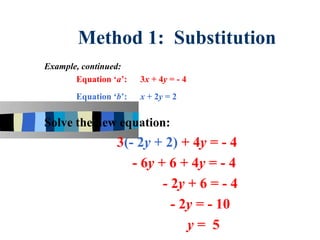
Method 1: Substitution
Example, continued:
       Equation ‘a’:   3x + 4y = - 4
       Equation ‘b’:   x + 2y = 2


Solve the new equation:
                 3(- 2y + 2) + 4y = - 4
                    - 6y + 6 + 4y = - 4
                          - 2y + 6 = - 4
                            - 2y = - 10
                               y= 5
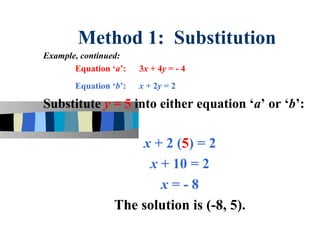
Method 1: Substitution
Example, continued:
       Equation ‘a’:   3x + 4y = - 4
       Equation ‘b’:   x + 2y = 2

Substitute y = 5 into either equation ‘a’ or ‘b’:

                     x + 2 (5) = 2
                      x + 10 = 2
                        x=-8
                 The solution is (-8, 5).
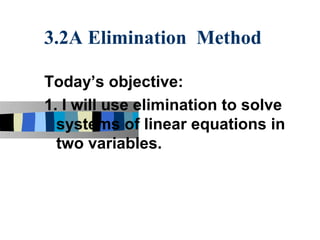
3.2A Elimination Method

Today’s objective:
1. I will use elimination to solve
  systems of linear equations in
  two variables.
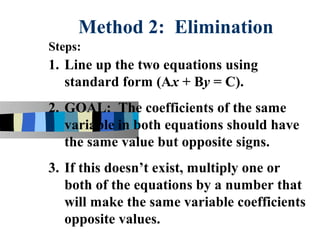
Method 2: Elimination
Steps:
1. Line up the two equations using
   standard form (Ax + By = C).
2. GOAL: The coefficients of the same
   variable in both equations should have
   the same value but opposite signs.
3. If this doesn’t exist, multiply one or
   both of the equations by a number that
   will make the same variable coefficients
   opposite values.
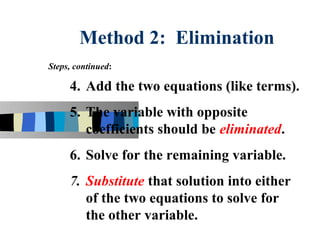
Method 2: Elimination
Steps, continued:

     4. Add the two equations (like terms).
     5. The variable with opposite
        coefficients should be eliminated.
     6. Solve for the remaining variable.
     7. Substitute that solution into either
        of the two equations to solve for
        the other variable.
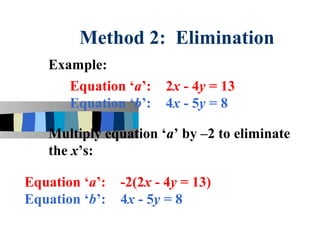
Method 2: Elimination
   Example:
      Equation ‘a’:     2x - 4y = 13
      Equation ‘b’:     4x - 5y = 8

   Multiply equation ‘a’ by –2 to eliminate
   the x’s:

Equation ‘a’:   -2(2x - 4y = 13)
Equation ‘b’:   4x - 5y = 8
Method 2: Elimination
Example, continued:

     Equation ‘a’:    -2(2x - 4y = 13) ------> -4x + 8y = -26
     Equation ‘b’:    4x - 5y = 8      ------> 4x - 5y = 8


Add the equations (the x’s are eliminated):
               -4x + 8y = -26
                4x - 5y = 8
                     3y = -18
                      y = -6
Method 2: Elimination
 Example, continued:
     Equation ‘a’: -2(2x - 4y = 13) ------> -4x + 8y = -26
     Equation ‘b’: 4x - 5y = 8      ------> 4x - 5y = 8

Substitute y = -6 into either equation:
             4x - 5(-6) = 8
              4x + 30 = 8
                4x = -22
                       -22
                  x= 4
                  x= 2-11

                                         -11
                   Solution: ( , -6)      2
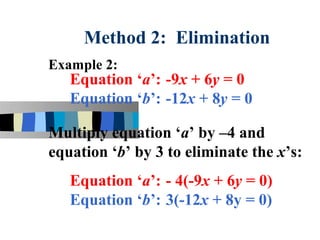
Method 2: Elimination
Example 2:
   Equation ‘a’: -9x + 6y = 0
   Equation ‘b’: -12x + 8y = 0

Multiply equation ‘a’ by –4 and
equation ‘b’ by 3 to eliminate the x’s:
   Equation ‘a’: - 4(-9x + 6y = 0)
   Equation ‘b’: 3(-12x + 8y = 0)
Method 2: Elimination
Example 2, continued:

    Equation ‘a’:       - 4(-9x + 6y = 0)
    Equation ‘b’:       3(-12x + 8y = 0)

                36x - 24y = 0
               -36x + 24y = 0
                        0=0
     What does this answer mean?
     Is it true?
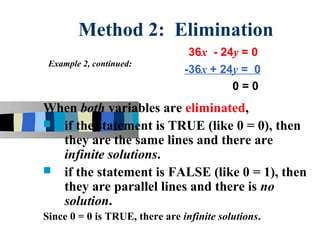
Method 2: Elimination
                                 36x - 24y = 0
 Example 2, continued:
                                -36x + 24y = 0
                                         0=0
When both variables are eliminated,
 if the statement is TRUE (like 0 = 0), then
  they are the same lines and there are
  infinite solutions.
 if the statement is FALSE (like 0 = 1), then
  they are parallel lines and there is no
  solution.
Since 0 = 0 is TRUE, there are infinite solutions.
Solving Systems of Three
     Equations Algebraically
1. When we have three equations in a
   system, we can use the same two
   methods to solve them algebraically
   as with two equations.
2. Whether you use substitution or
   elimination, you should begin by
   numbering the equations!
Solving Systems of Three
         Equations
Substitution Method
  1. Choose one of the three equations
     and isolate one of the variables.
  2. Substitute the new expression into
     each of the other two equations.
  3. These two equations now have the
     same two variables. Solve this 2 x 2
     system as before.
  4. Find the third variable by
     substituting the two known values
     into any equation.
Solving Systems of Three
         Equations
Linear Combination Method
  1. Choose two of the equations and eliminate
     one variable as before.
  2. Now choose one of the equations from step 1
     and the other equation you didn’t use and
     eliminate the same variable.
  3. You should now have two equations (one
     from step 1 and one from step 2) that you
     can solve by elimination.
  4. Find the third variable by substituting the
     two known values into any equation.
-4x – 8y = 16
      6x + 12y = -24
1. Solve the system of linear
 equations using elimination
     (linear combination).

3.2 solving systems algebraically

  • 1.
    3.2 SYSTEMS OFLINEAR EQUATIONS Solving Linear Systems Algebraically
  • 2.
    Substitution Method Today’s objective: 1.I will use substitution to solve systems of linear equations in two variables.
  • 3.
    Solving Systems ofEquations Algebraically 1. When you graph, sometimes you cannot find the exact point of intersection. We can use algebra to find the exact point. 2. Also, we do not need to put every equation in slope-intercept form in order to determine if the lines are parallel or the same line. Algebraic methods will give us the same information.
  • 4.
    Methods of SolvingSystems Algebraically We will look at TWO methods to solve systems algebraically: 1) Substitution 2) Elimination
  • 5.
    Method 1: Substitution Steps: 1. Choose one of the two equations and isolate one of the variables. 2. Substitute the new expression into the other equation for the variable. 3. Solve for the remaining variable. 4. Substitute the solution into the other equation to get the solution to the second variable.
  • 6.
    Method 1: Substitution Example: Equation ‘a’: 3x + 4y = - 4 Equation ‘b’: x + 2y = 2 Isolate the ‘x’ in equation ‘b’: x = - 2y + 2
  • 7.
    Method 1: Substitution Example,continued: Equation ‘a’: 3x + 4y = - 4 Equation ‘b’: x + 2y = 2 Substitute the new expression, x = - 2y + 2 for x into equation ‘a’: 3(- 2y + 2) + 4y = - 4
  • 8.
    Method 1: Substitution Example,continued: Equation ‘a’: 3x + 4y = - 4 Equation ‘b’: x + 2y = 2 Solve the new equation: 3(- 2y + 2) + 4y = - 4 - 6y + 6 + 4y = - 4 - 2y + 6 = - 4 - 2y = - 10 y= 5
  • 9.
    Method 1: Substitution Example,continued: Equation ‘a’: 3x + 4y = - 4 Equation ‘b’: x + 2y = 2 Substitute y = 5 into either equation ‘a’ or ‘b’: x + 2 (5) = 2 x + 10 = 2 x=-8 The solution is (-8, 5).
  • 10.
    3.2A Elimination Method Today’sobjective: 1. I will use elimination to solve systems of linear equations in two variables.
  • 11.
    Method 2: Elimination Steps: 1.Line up the two equations using standard form (Ax + By = C). 2. GOAL: The coefficients of the same variable in both equations should have the same value but opposite signs. 3. If this doesn’t exist, multiply one or both of the equations by a number that will make the same variable coefficients opposite values.
  • 12.
    Method 2: Elimination Steps,continued: 4. Add the two equations (like terms). 5. The variable with opposite coefficients should be eliminated. 6. Solve for the remaining variable. 7. Substitute that solution into either of the two equations to solve for the other variable.
  • 13.
    Method 2: Elimination Example: Equation ‘a’: 2x - 4y = 13 Equation ‘b’: 4x - 5y = 8 Multiply equation ‘a’ by –2 to eliminate the x’s: Equation ‘a’: -2(2x - 4y = 13) Equation ‘b’: 4x - 5y = 8
  • 14.
    Method 2: Elimination Example,continued: Equation ‘a’: -2(2x - 4y = 13) ------> -4x + 8y = -26 Equation ‘b’: 4x - 5y = 8 ------> 4x - 5y = 8 Add the equations (the x’s are eliminated): -4x + 8y = -26 4x - 5y = 8 3y = -18 y = -6
  • 15.
    Method 2: Elimination Example, continued: Equation ‘a’: -2(2x - 4y = 13) ------> -4x + 8y = -26 Equation ‘b’: 4x - 5y = 8 ------> 4x - 5y = 8 Substitute y = -6 into either equation: 4x - 5(-6) = 8 4x + 30 = 8 4x = -22 -22 x= 4 x= 2-11 -11 Solution: ( , -6) 2
  • 16.
    Method 2: Elimination Example2: Equation ‘a’: -9x + 6y = 0 Equation ‘b’: -12x + 8y = 0 Multiply equation ‘a’ by –4 and equation ‘b’ by 3 to eliminate the x’s: Equation ‘a’: - 4(-9x + 6y = 0) Equation ‘b’: 3(-12x + 8y = 0)
  • 17.
    Method 2: Elimination Example2, continued: Equation ‘a’: - 4(-9x + 6y = 0) Equation ‘b’: 3(-12x + 8y = 0) 36x - 24y = 0 -36x + 24y = 0 0=0 What does this answer mean? Is it true?
  • 18.
    Method 2: Elimination 36x - 24y = 0 Example 2, continued: -36x + 24y = 0 0=0 When both variables are eliminated,  if the statement is TRUE (like 0 = 0), then they are the same lines and there are infinite solutions.  if the statement is FALSE (like 0 = 1), then they are parallel lines and there is no solution. Since 0 = 0 is TRUE, there are infinite solutions.
  • 19.
    Solving Systems ofThree Equations Algebraically 1. When we have three equations in a system, we can use the same two methods to solve them algebraically as with two equations. 2. Whether you use substitution or elimination, you should begin by numbering the equations!
  • 20.
    Solving Systems ofThree Equations Substitution Method 1. Choose one of the three equations and isolate one of the variables. 2. Substitute the new expression into each of the other two equations. 3. These two equations now have the same two variables. Solve this 2 x 2 system as before. 4. Find the third variable by substituting the two known values into any equation.
  • 21.
    Solving Systems ofThree Equations Linear Combination Method 1. Choose two of the equations and eliminate one variable as before. 2. Now choose one of the equations from step 1 and the other equation you didn’t use and eliminate the same variable. 3. You should now have two equations (one from step 1 and one from step 2) that you can solve by elimination. 4. Find the third variable by substituting the two known values into any equation.
  • 22.
    -4x – 8y= 16 6x + 12y = -24 1. Solve the system of linear equations using elimination (linear combination).