Gram-negative rodsGram-negative rods
EnterobacteriaceaEnterobacteriacea
Clinical MicrobiologyClinical Microbiology
ARAP KIMOJIN0ARAP KIMOJIN0
MEDICAL MICROBIOLOGY DEPT (UONMEDICAL MICROBIOLOGY DEPT (UON((
Msc. Med Micro (UON), PGD-RM(UONMsc. Med Micro (UON), PGD-RM(UON(,(,
Bsc. Med Micro(JKUAT), Dip MLS, HND Dx MicroBsc. Med Micro(JKUAT), Dip MLS, HND Dx Micro..
FamilyFamily EnterobacteriaceaeEnterobacteriaceae
often referred to asoften referred to as
“enterics“enterics””
..
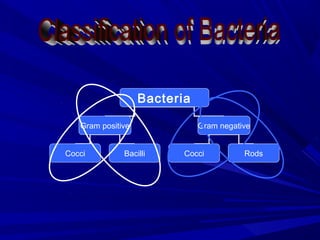
Bacteria
Gram positive Gram negative
Cocci Bacilli Cocci Rods
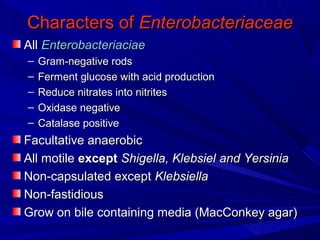
Characters ofCharacters of EnterobacteriaceaeEnterobacteriaceae
AllAll EnterobacteriaciaeEnterobacteriaciae
– Gram-negative rodsGram-negative rods
– Ferment glucose with acid productionFerment glucose with acid production
– Reduce nitrates into nitritesReduce nitrates into nitrites
– Oxidase negativeOxidase negative
– Catalase positiveCatalase positive
Facultative anaerobicFacultative anaerobic
All motileAll motile exceptexcept Shigella, KlebsielShigella, Klebsiel andand YersiniaYersinia
Non-capsulated exceptNon-capsulated except KlebsiellaKlebsiella
Non-fastidiousNon-fastidious
Grow on bile containing media (MacConkey agar(Grow on bile containing media (MacConkey agar(
Microscopic and ColonyMicroscopic and Colony
MorphologyMorphology
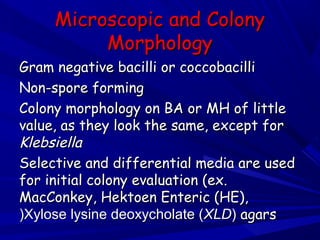
Gram negative bacilli or coccobacilliGram negative bacilli or coccobacilli
Non-spore formingNon-spore forming
Colony morphology on BA or MH of littleColony morphology on BA or MH of little
value, as they look the same, except forvalue, as they look the same, except for
KlebsiellaKlebsiella
Selective and differential media are usedSelective and differential media are used
for initial colony evaluation (ex.for initial colony evaluation (ex.
MacConkey, Hektoen Enteric (HE),MacConkey, Hektoen Enteric (HE),
Xylose lysine deoxycholate (Xylose lysine deoxycholate (XLDXLD(( agarsagars((
EnterobacteriaceaeEnterobacteriaceae
SomeSome EnterobacteriaceaeEnterobacteriaceae are true pathogensare true pathogens
– SalmonellaSalmonella spp.spp.
– ShigellaShigella spp.spp.
– YersiniaYersinia spp.spp.
– Certain strains ofCertain strains of E. coliE. coli (ETEC, EPEC, EIEC, EHEC((ETEC, EPEC, EIEC, EHEC(
Most members of theMost members of the EnterobacteriaceaeEnterobacteriaceae areare
opportunistic or cause secondary infections ofopportunistic or cause secondary infections of
wounds, the urinary and respiratory tracts, andwounds, the urinary and respiratory tracts, and
the circulatory system e.g.the circulatory system e.g. E. coliE. coli..
Enterobacteriaceae divided into TWO mainEnterobacteriaceae divided into TWO main
groups according to action on LACTOSEgroups according to action on LACTOSE
– Lactose Fermenters (LF(Lactose Fermenters (LF(
E. coli, Citrobacter, Klbesiella, EnterobacterE. coli, Citrobacter, Klbesiella, Enterobacter
– Lactose Non-Fermenters (LNF(Lactose Non-Fermenters (LNF(
Salmonella, Shigella, Proteus, YersiniaSalmonella, Shigella, Proteus, Yersinia
Identification ofIdentification of EnterobacteriaceaeEnterobacteriaceae
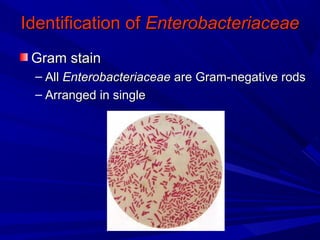
Gram stainGram stain
– AllAll EnterobacteriaceaeEnterobacteriaceae are Gram-negative rodsare Gram-negative rods
– Arranged in singleArranged in single
Identification ofIdentification of EnterobacteriaceaeEnterobacteriaceae
Based on Biochemical reactionsBased on Biochemical reactions
Can be grouped into threeCan be grouped into three:-:-
A) Ability to ferment carbohydrates to acid orA) Ability to ferment carbohydrates to acid or
Acid and gasAcid and gas..
B) Ability to utilize a substrate as the soleB) Ability to utilize a substrate as the sole
source of carbonsource of carbon
C) Ability to enzymaticaly degrade aC) Ability to enzymaticaly degrade a
compoundcompound
Identification ofIdentification of EnterobacteriaceaeEnterobacteriaceae
Biochemical reactionsBiochemical reactions
Oxidase testOxidase test
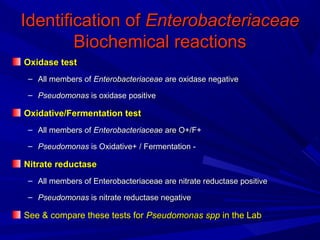
– All members ofAll members of EnterobacteriaceaeEnterobacteriaceae are oxidase negativeare oxidase negative
– PseudomonasPseudomonas is oxidase positiveis oxidase positive
Oxidative/Fermentation testOxidative/Fermentation test
– All members ofAll members of EnterobacteriaceaeEnterobacteriaceae are O+/F+are O+/F+
– PseudomonasPseudomonas is Oxidative+ / Fermentation -is Oxidative+ / Fermentation -
Nitrate reductaseNitrate reductase
– All members of Enterobacteriaceae are nitrate reductase positiveAll members of Enterobacteriaceae are nitrate reductase positive
– PseudomonasPseudomonas is nitrate reductase negativeis nitrate reductase negative
See & compare these tests forSee & compare these tests for Pseudomonas sppPseudomonas spp in the Labin the Lab
Classification ofClassification of EnterobacteriaceaeEnterobacteriaceae
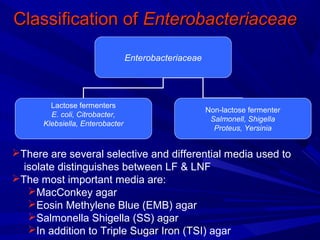
Enterobacteriaceae
Lactose fermenters
E. coli, Citrobacter,
Klebsiella, Enterobacter
Non-lactose fermenter
Salmonell, Shigella
Proteus, Yersinia
There are several selective and differential media used to
isolate distinguishes between LF & LNF
The most important media are:
MacConkey agar
Eosin Methylene Blue (EMB) agar
Salmonella Shigella (SS) agar
In addition to Triple Sugar Iron (TSI) agar
Differentiation between LF & NLF byDifferentiation between LF & NLF by Growth on MacConkey agarGrowth on MacConkey agar
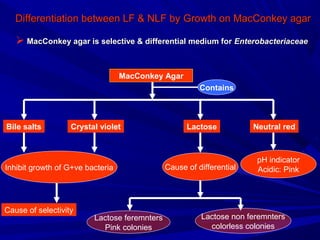
MacConkey Agar
Contains
Bile salts Crystal violet Lactose Neutral red
 MacConkey agar is selective & differential medium forMacConkey agar is selective & differential medium for EnterobacteriaceaeEnterobacteriaceae
Inhibit growth of G+ve bacteria
Cause of selectivity
Cause of differential
pH indicator
Acidic: Pink
Lactose feremnters
Pink colonies
Lactose non feremnters
colorless colonies
Classification ofClassification of EnterobacteriaceaeEnterobacteriaceae according toaccording to
lactose fermentation (growth on MacConkey Agar)lactose fermentation (growth on MacConkey Agar)
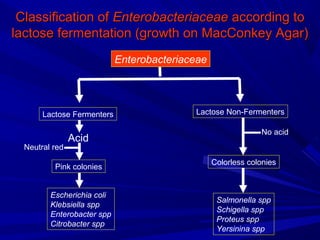
Enterobacteriaceae
Lactose Fermenters Lactose Non-Fermenters
Escherichia coli
Klebsiella spp
Enterobacter spp
Citrobacter spp
Salmonella spp
Schigella spp
Proteus spp
Yersinina spp
Pink colonies
Colorless colonies
Acid
Neutral red
No acid
Identification ofIdentification of EnterobacteriaceaeEnterobacteriaceae
Differentiation between LF & NLF byDifferentiation between LF & NLF by Growth on MacConkey agarGrowth on MacConkey agar
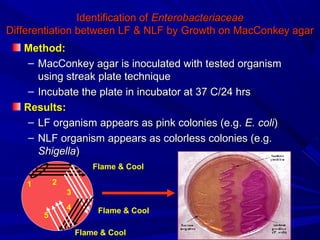
Method:Method:
– MacConkey agar is inoculated with tested organismMacConkey agar is inoculated with tested organism
using streak plate techniqueusing streak plate technique
– Incubate the plate in incubator at 37 C/24 hrsIncubate the plate in incubator at 37 C/24 hrs
Results:Results:
– LF organism appears as pink colonies (e.g.LF organism appears as pink colonies (e.g. E. coliE. coli))
– NLF organism appears as colorless colonies (e.g.NLF organism appears as colorless colonies (e.g.
ShigellaShigella))
Flame & Cool
Flame & Cool
Flame & Cool
1 2
3
4
5
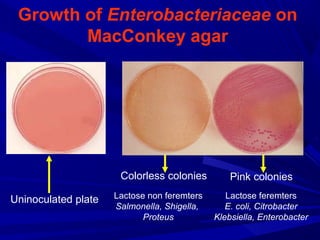
Growth of Enterobacteriaceae on
MacConkey agar
Uninoculated plate Lactose non feremters
Salmonella, Shigella,
Proteus
Lactose feremters
E. coli, Citrobacter
Klebsiella, Enterobacter
Colorless colonies Pink colonies
Reaction on Salmonella Shigella (SS) agarReaction on Salmonella Shigella (SS) agar
SS agar is a selective & differential medium used for isolation ofSS agar is a selective & differential medium used for isolation of
SalmonellaSalmonella andand ShigellaShigella
The selective agents areThe selective agents are bile saltsbile salts, and, and brilliant green dyebrilliant green dye, which, which
inhibit gram-positive organismsinhibit gram-positive organisms
The medium contains onlyThe medium contains only lactoselactose as a differential agent and thusas a differential agent and thus
differentiates on the basis of lactose fermentationdifferentiates on the basis of lactose fermentation
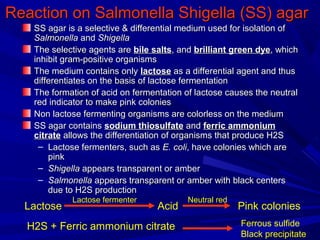
The formation of acid on fermentation of lactose causes the neutralThe formation of acid on fermentation of lactose causes the neutral
red indicator to make pink coloniesred indicator to make pink colonies
Non lactose fermenting organisms are colorless on the mediumNon lactose fermenting organisms are colorless on the medium
SS agar containsSS agar contains sodium thiosulfatesodium thiosulfate andand ferric ammoniumferric ammonium
citratecitrate allows the differentiation of organisms that produce H2Sallows the differentiation of organisms that produce H2S
– Lactose fermenters, such asLactose fermenters, such as E. coliE. coli, have colonies which are, have colonies which are
pinkpink
– ShigellaShigella appears transparent or amberappears transparent or amber
– SalmonellaSalmonella appears transparent or amber with black centersappears transparent or amber with black centers
due to H2S productiondue to H2S production
Lactose
Lactose fermenter
Acid
Neutral red
Pink colonies
Ferrous sulfide
Black precipitate
H2S + Ferric ammonium citrate
Identification ofIdentification of EnterobacteriaceaeEnterobacteriaceae
Differentiation between LF & NLF byDifferentiation between LF & NLF by Growth on SS agarGrowth on SS agar
Method:Method:
– SS agar is inoculated with tested organismSS agar is inoculated with tested organism usingusing
streak plate techniquestreak plate technique
– Incubate the plate in incubator at 37 C/24 hrsIncubate the plate in incubator at 37 C/24 hrs
Flame & Cool
Flame & Cool
Flame & Cool
1 2
3
4
5
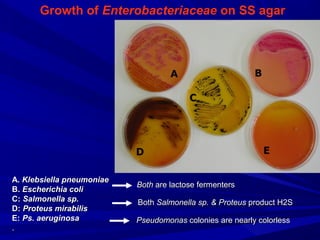
AA.. Klebsiella pneumoniaeKlebsiella pneumoniae
BB.. Escherichia coliEscherichia coli
CC:: Salmonella spSalmonella sp..
DD:: Proteus mirabilisProteus mirabilis
EE:: Ps. aeruginosaPs. aeruginosa
..
BothBoth are lactose fermentersare lactose fermenters
BothBoth Salmonella sp. & ProteusSalmonella sp. & Proteus product H2Sproduct H2S
PseudomonasPseudomonas colonies are nearly colorlesscolonies are nearly colorless
Growth of Enterobacteriaceae on SS agar
Growth ofGrowth of EnterobacteriaceaeEnterobacteriaceae onon
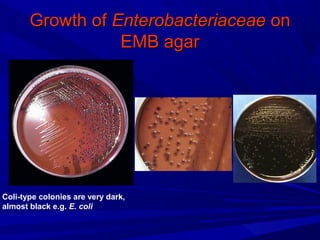
EMB agarEMB agar
Coli-type colonies are very dark,
almost black e.g. E. coli
Reaction on Triple Sugar Iron (TSI) AgarReaction on Triple Sugar Iron (TSI) Agar
TSI containsTSI contains
– Three different types of sugarsThree different types of sugars
Glucose (0.1%)Glucose (0.1%)
Lactose (1%)Lactose (1%)
Sucrose (1%)Sucrose (1%)
– Phenol red (acidic: Yellow)Phenol red (acidic: Yellow)
TSI dispensed in tubes with equal butt & slantTSI dispensed in tubes with equal butt & slant
PrinciplePrinciple
– To determine the ability of an organism to attack a specificTo determine the ability of an organism to attack a specific
carbohydrate incorporated into a basal growth medium, with orcarbohydrate incorporated into a basal growth medium, with or
without the production of gas, along with the determination ofwithout the production of gas, along with the determination of
possible hydrogen sulphide production.possible hydrogen sulphide production.
Reaction on TSIReaction on TSI
Method:Method:
– Inoculate TSI medium with an organism byInoculate TSI medium with an organism by
inoculating needle by stabbing the butt andinoculating needle by stabbing the butt and
streaking the slantstreaking the slant
– Incubate at 37°C for 24 hoursIncubate at 37°C for 24 hours
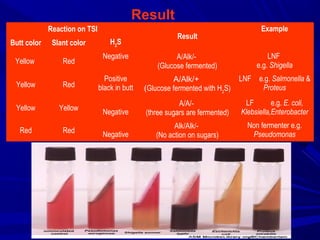
Reaction on TSI
Result
Example
Butt color Slant color H2
S
Yellow Red
Negative A/Alk/-
(Glucose fermented)
LNF
e.g. Shigella
Yellow Red
Positive
black in butt
A/Alk/+
(Glucose fermented with H2
S)
LNF e.g. Salmonella &
Proteus
Yellow Yellow
Negative
A/A/-
(three sugars are fermented)
LF e.g. E. coli,
Klebsiella,Enterobacter
Red Red
Negative
Alk/Alk/-
(No action on sugars)
Non fermenter e.g.
Pseudomonas
Result
s
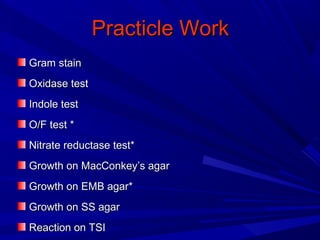
Practicle WorkPracticle Work
Gram stainGram stain
Oxidase testOxidase test
Indole testIndole test
O/F test *O/F test *
Nitrate reductase test*Nitrate reductase test*
Growth on MacConkey’s agarGrowth on MacConkey’s agar
Growth on EMB agar*Growth on EMB agar*
Growth on SS agarGrowth on SS agar
Reaction on TSIReaction on TSI

Gram negative rods

  • 1.
    Gram-negative rodsGram-negative rods EnterobacteriaceaEnterobacteriacea ClinicalMicrobiologyClinical Microbiology ARAP KIMOJIN0ARAP KIMOJIN0 MEDICAL MICROBIOLOGY DEPT (UONMEDICAL MICROBIOLOGY DEPT (UON(( Msc. Med Micro (UON), PGD-RM(UONMsc. Med Micro (UON), PGD-RM(UON(,(, Bsc. Med Micro(JKUAT), Dip MLS, HND Dx MicroBsc. Med Micro(JKUAT), Dip MLS, HND Dx Micro..
  • 2.
    FamilyFamily EnterobacteriaceaeEnterobacteriaceae often referredto asoften referred to as “enterics“enterics”” ..
  • 3.
    Bacteria Gram positive Gramnegative Cocci Bacilli Cocci Rods
  • 4.
    Characters ofCharacters ofEnterobacteriaceaeEnterobacteriaceae AllAll EnterobacteriaciaeEnterobacteriaciae – Gram-negative rodsGram-negative rods – Ferment glucose with acid productionFerment glucose with acid production – Reduce nitrates into nitritesReduce nitrates into nitrites – Oxidase negativeOxidase negative – Catalase positiveCatalase positive Facultative anaerobicFacultative anaerobic All motileAll motile exceptexcept Shigella, KlebsielShigella, Klebsiel andand YersiniaYersinia Non-capsulated exceptNon-capsulated except KlebsiellaKlebsiella Non-fastidiousNon-fastidious Grow on bile containing media (MacConkey agar(Grow on bile containing media (MacConkey agar(
  • 5.
    Microscopic and ColonyMicroscopicand Colony MorphologyMorphology Gram negative bacilli or coccobacilliGram negative bacilli or coccobacilli Non-spore formingNon-spore forming Colony morphology on BA or MH of littleColony morphology on BA or MH of little value, as they look the same, except forvalue, as they look the same, except for KlebsiellaKlebsiella Selective and differential media are usedSelective and differential media are used for initial colony evaluation (ex.for initial colony evaluation (ex. MacConkey, Hektoen Enteric (HE),MacConkey, Hektoen Enteric (HE), Xylose lysine deoxycholate (Xylose lysine deoxycholate (XLDXLD(( agarsagars((
  • 6.
    EnterobacteriaceaeEnterobacteriaceae SomeSome EnterobacteriaceaeEnterobacteriaceae aretrue pathogensare true pathogens – SalmonellaSalmonella spp.spp. – ShigellaShigella spp.spp. – YersiniaYersinia spp.spp. – Certain strains ofCertain strains of E. coliE. coli (ETEC, EPEC, EIEC, EHEC((ETEC, EPEC, EIEC, EHEC( Most members of theMost members of the EnterobacteriaceaeEnterobacteriaceae areare opportunistic or cause secondary infections ofopportunistic or cause secondary infections of wounds, the urinary and respiratory tracts, andwounds, the urinary and respiratory tracts, and the circulatory system e.g.the circulatory system e.g. E. coliE. coli.. Enterobacteriaceae divided into TWO mainEnterobacteriaceae divided into TWO main groups according to action on LACTOSEgroups according to action on LACTOSE – Lactose Fermenters (LF(Lactose Fermenters (LF( E. coli, Citrobacter, Klbesiella, EnterobacterE. coli, Citrobacter, Klbesiella, Enterobacter – Lactose Non-Fermenters (LNF(Lactose Non-Fermenters (LNF( Salmonella, Shigella, Proteus, YersiniaSalmonella, Shigella, Proteus, Yersinia
  • 7.
    Identification ofIdentification ofEnterobacteriaceaeEnterobacteriaceae Gram stainGram stain – AllAll EnterobacteriaceaeEnterobacteriaceae are Gram-negative rodsare Gram-negative rods – Arranged in singleArranged in single
  • 8.
    Identification ofIdentification ofEnterobacteriaceaeEnterobacteriaceae Based on Biochemical reactionsBased on Biochemical reactions Can be grouped into threeCan be grouped into three:-:- A) Ability to ferment carbohydrates to acid orA) Ability to ferment carbohydrates to acid or Acid and gasAcid and gas.. B) Ability to utilize a substrate as the soleB) Ability to utilize a substrate as the sole source of carbonsource of carbon C) Ability to enzymaticaly degrade aC) Ability to enzymaticaly degrade a compoundcompound
  • 9.
    Identification ofIdentification ofEnterobacteriaceaeEnterobacteriaceae Biochemical reactionsBiochemical reactions Oxidase testOxidase test – All members ofAll members of EnterobacteriaceaeEnterobacteriaceae are oxidase negativeare oxidase negative – PseudomonasPseudomonas is oxidase positiveis oxidase positive Oxidative/Fermentation testOxidative/Fermentation test – All members ofAll members of EnterobacteriaceaeEnterobacteriaceae are O+/F+are O+/F+ – PseudomonasPseudomonas is Oxidative+ / Fermentation -is Oxidative+ / Fermentation - Nitrate reductaseNitrate reductase – All members of Enterobacteriaceae are nitrate reductase positiveAll members of Enterobacteriaceae are nitrate reductase positive – PseudomonasPseudomonas is nitrate reductase negativeis nitrate reductase negative See & compare these tests forSee & compare these tests for Pseudomonas sppPseudomonas spp in the Labin the Lab
  • 10.
    Classification ofClassification ofEnterobacteriaceaeEnterobacteriaceae Enterobacteriaceae Lactose fermenters E. coli, Citrobacter, Klebsiella, Enterobacter Non-lactose fermenter Salmonell, Shigella Proteus, Yersinia There are several selective and differential media used to isolate distinguishes between LF & LNF The most important media are: MacConkey agar Eosin Methylene Blue (EMB) agar Salmonella Shigella (SS) agar In addition to Triple Sugar Iron (TSI) agar
  • 11.
    Differentiation between LF& NLF byDifferentiation between LF & NLF by Growth on MacConkey agarGrowth on MacConkey agar MacConkey Agar Contains Bile salts Crystal violet Lactose Neutral red  MacConkey agar is selective & differential medium forMacConkey agar is selective & differential medium for EnterobacteriaceaeEnterobacteriaceae Inhibit growth of G+ve bacteria Cause of selectivity Cause of differential pH indicator Acidic: Pink Lactose feremnters Pink colonies Lactose non feremnters colorless colonies
  • 12.
    Classification ofClassification ofEnterobacteriaceaeEnterobacteriaceae according toaccording to lactose fermentation (growth on MacConkey Agar)lactose fermentation (growth on MacConkey Agar) Enterobacteriaceae Lactose Fermenters Lactose Non-Fermenters Escherichia coli Klebsiella spp Enterobacter spp Citrobacter spp Salmonella spp Schigella spp Proteus spp Yersinina spp Pink colonies Colorless colonies Acid Neutral red No acid
  • 13.
    Identification ofIdentification ofEnterobacteriaceaeEnterobacteriaceae Differentiation between LF & NLF byDifferentiation between LF & NLF by Growth on MacConkey agarGrowth on MacConkey agar Method:Method: – MacConkey agar is inoculated with tested organismMacConkey agar is inoculated with tested organism using streak plate techniqueusing streak plate technique – Incubate the plate in incubator at 37 C/24 hrsIncubate the plate in incubator at 37 C/24 hrs Results:Results: – LF organism appears as pink colonies (e.g.LF organism appears as pink colonies (e.g. E. coliE. coli)) – NLF organism appears as colorless colonies (e.g.NLF organism appears as colorless colonies (e.g. ShigellaShigella)) Flame & Cool Flame & Cool Flame & Cool 1 2 3 4 5
  • 14.
    Growth of Enterobacteriaceaeon MacConkey agar Uninoculated plate Lactose non feremters Salmonella, Shigella, Proteus Lactose feremters E. coli, Citrobacter Klebsiella, Enterobacter Colorless colonies Pink colonies
  • 15.
    Reaction on SalmonellaShigella (SS) agarReaction on Salmonella Shigella (SS) agar SS agar is a selective & differential medium used for isolation ofSS agar is a selective & differential medium used for isolation of SalmonellaSalmonella andand ShigellaShigella The selective agents areThe selective agents are bile saltsbile salts, and, and brilliant green dyebrilliant green dye, which, which inhibit gram-positive organismsinhibit gram-positive organisms The medium contains onlyThe medium contains only lactoselactose as a differential agent and thusas a differential agent and thus differentiates on the basis of lactose fermentationdifferentiates on the basis of lactose fermentation The formation of acid on fermentation of lactose causes the neutralThe formation of acid on fermentation of lactose causes the neutral red indicator to make pink coloniesred indicator to make pink colonies Non lactose fermenting organisms are colorless on the mediumNon lactose fermenting organisms are colorless on the medium SS agar containsSS agar contains sodium thiosulfatesodium thiosulfate andand ferric ammoniumferric ammonium citratecitrate allows the differentiation of organisms that produce H2Sallows the differentiation of organisms that produce H2S – Lactose fermenters, such asLactose fermenters, such as E. coliE. coli, have colonies which are, have colonies which are pinkpink – ShigellaShigella appears transparent or amberappears transparent or amber – SalmonellaSalmonella appears transparent or amber with black centersappears transparent or amber with black centers due to H2S productiondue to H2S production Lactose Lactose fermenter Acid Neutral red Pink colonies Ferrous sulfide Black precipitate H2S + Ferric ammonium citrate
  • 16.
    Identification ofIdentification ofEnterobacteriaceaeEnterobacteriaceae Differentiation between LF & NLF byDifferentiation between LF & NLF by Growth on SS agarGrowth on SS agar Method:Method: – SS agar is inoculated with tested organismSS agar is inoculated with tested organism usingusing streak plate techniquestreak plate technique – Incubate the plate in incubator at 37 C/24 hrsIncubate the plate in incubator at 37 C/24 hrs Flame & Cool Flame & Cool Flame & Cool 1 2 3 4 5
  • 17.
    AA.. Klebsiella pneumoniaeKlebsiellapneumoniae BB.. Escherichia coliEscherichia coli CC:: Salmonella spSalmonella sp.. DD:: Proteus mirabilisProteus mirabilis EE:: Ps. aeruginosaPs. aeruginosa .. BothBoth are lactose fermentersare lactose fermenters BothBoth Salmonella sp. & ProteusSalmonella sp. & Proteus product H2Sproduct H2S PseudomonasPseudomonas colonies are nearly colorlesscolonies are nearly colorless Growth of Enterobacteriaceae on SS agar
  • 18.
    Growth ofGrowth ofEnterobacteriaceaeEnterobacteriaceae onon EMB agarEMB agar Coli-type colonies are very dark, almost black e.g. E. coli
  • 19.
    Reaction on TripleSugar Iron (TSI) AgarReaction on Triple Sugar Iron (TSI) Agar TSI containsTSI contains – Three different types of sugarsThree different types of sugars Glucose (0.1%)Glucose (0.1%) Lactose (1%)Lactose (1%) Sucrose (1%)Sucrose (1%) – Phenol red (acidic: Yellow)Phenol red (acidic: Yellow) TSI dispensed in tubes with equal butt & slantTSI dispensed in tubes with equal butt & slant PrinciplePrinciple – To determine the ability of an organism to attack a specificTo determine the ability of an organism to attack a specific carbohydrate incorporated into a basal growth medium, with orcarbohydrate incorporated into a basal growth medium, with or without the production of gas, along with the determination ofwithout the production of gas, along with the determination of possible hydrogen sulphide production.possible hydrogen sulphide production.
  • 20.
    Reaction on TSIReactionon TSI Method:Method: – Inoculate TSI medium with an organism byInoculate TSI medium with an organism by inoculating needle by stabbing the butt andinoculating needle by stabbing the butt and streaking the slantstreaking the slant – Incubate at 37°C for 24 hoursIncubate at 37°C for 24 hours
  • 21.
    Reaction on TSI Result Example Buttcolor Slant color H2 S Yellow Red Negative A/Alk/- (Glucose fermented) LNF e.g. Shigella Yellow Red Positive black in butt A/Alk/+ (Glucose fermented with H2 S) LNF e.g. Salmonella & Proteus Yellow Yellow Negative A/A/- (three sugars are fermented) LF e.g. E. coli, Klebsiella,Enterobacter Red Red Negative Alk/Alk/- (No action on sugars) Non fermenter e.g. Pseudomonas Result s
  • 22.
    Practicle WorkPracticle Work GramstainGram stain Oxidase testOxidase test Indole testIndole test O/F test *O/F test * Nitrate reductase test*Nitrate reductase test* Growth on MacConkey’s agarGrowth on MacConkey’s agar Growth on EMB agar*Growth on EMB agar* Growth on SS agarGrowth on SS agar Reaction on TSIReaction on TSI