Bioenergetics & Laws of 
Thermodynamics
BIOENERGETICS 
• It is the quantitative study of energy 
transduction,i.e.release,storage and use of 
energy in living cells along with the study of 
study of the nature and functions of chemical 
processes underlying these energy changes.
Laws of thermodynamics 
• 1. For any physical or chemical change, the 
total amount of energy in the universe 
remains constant; energy may changed from 
or it may be transported from one region to 
another, but it can not be created or 
destroyed
• 2. The universe always tends toward 
increasing disorder: in all natural processes 
the entropy of the universe increases. 
• The total disorder of a system must increase if 
a process to occur spontaneously and called 
entropy.
• The reacting system may be an organism, a cell or 
two reacting compounds. The reacting system 
and its surroundings together constitute the 
universe. 
• In the laboratory some chemical or physical 
processes can be carried out in closed systems 
and no material or energy is exchanged with the 
surroundings 
• However living organisms are open systems. They 
exchange both material and energy with their 
surroundings
• Living systems are never at equilibrium with 
their surroundings 
• Gibbs free energy (G): G expresses the amount 
of energy capable of doing work during a 
reaction at constant temperature and pressure.
• When a reaction proceeds with the release of 
free energy (that is, when the system changes 
so as to posses less free energy) ΔG has a 
negative value and the reaction is said to be 
exergonic 
• In endergonic reactions, the system gains free 
energy and ΔG is positive 
• The unit of ΔG is joules/mole or calories/mole
• Enthalpy (H): H is the heat content of the 
reacting system. H reflects the number and 
kinds of chemical bounds in the reactants and 
products. 
• When a chemical reaction releases heat, it is 
said to be exothermic, the heat content of the 
products is less than that of the reactants and 
ΔH has a negative value 
• Reacting systems that take up heat from their 
surroundings are endothermic and have 
positive values of ΔH
• The unit of ΔH is joules/mole or calories/mole 
• Entropy (S): S is a quantitative expression for 
the randomness or a disorder in a system 
• The unit of ΔS is joules/mole. Kelvin
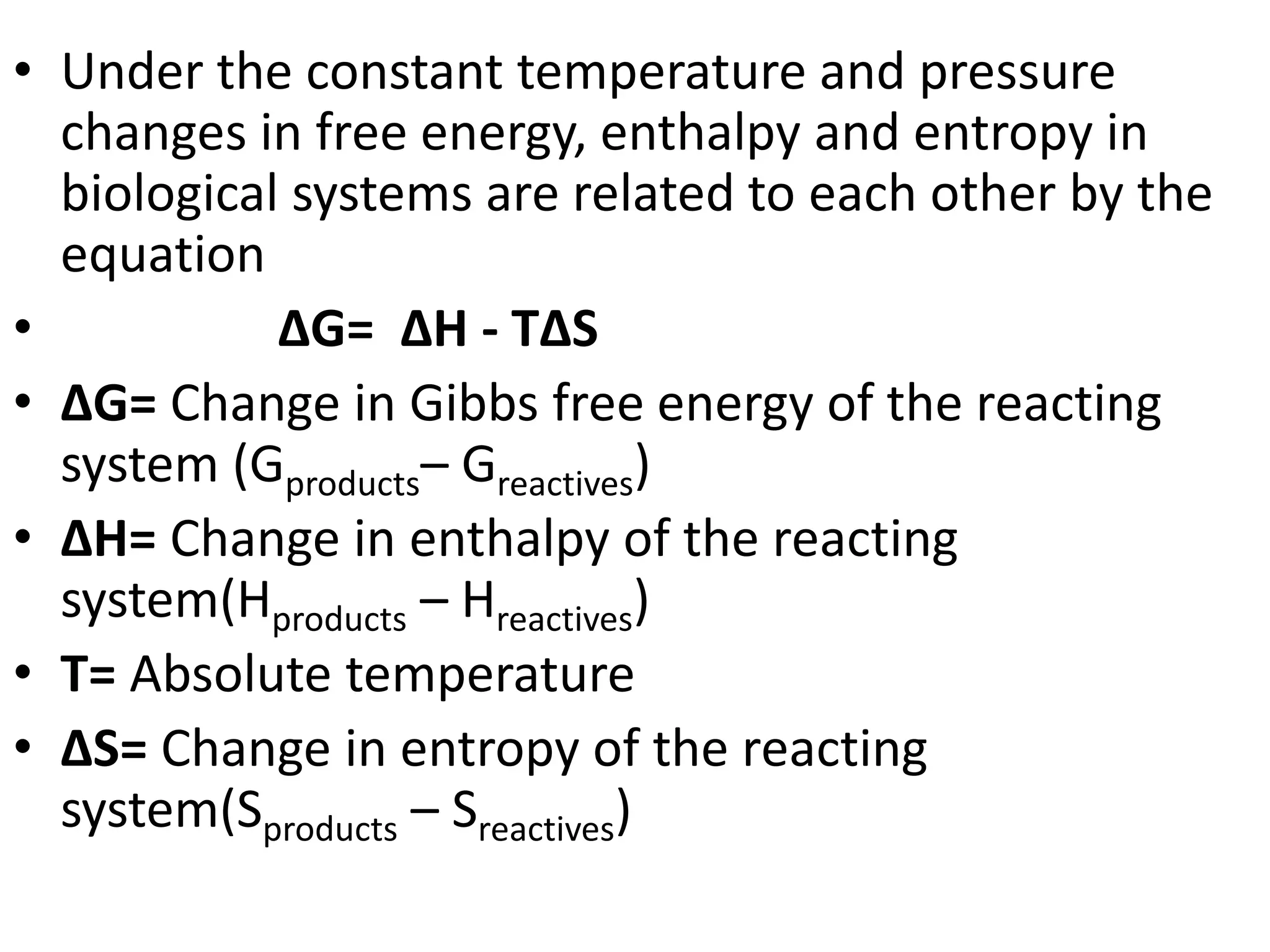
• Under the constant temperature and pressure 
changes in free energy, enthalpy and entropy in 
biological systems are related to each other by the 
equation 
• ΔG= ΔH - TΔS 
• ΔG= Change in Gibbs free energy of the reacting 
system (Gproducts– Greactives) 
• ΔH= Change in enthalpy of the reacting 
system(Hproducts – Hreactives) 
• T= Absolute temperature 
• ΔS= Change in entropy of the reacting 
system(Sproducts – Sreactives)
• Living organisms preserve their internal order by 
taking free energy from their surroundings in the 
form of nutrients or sunlight and returning to 
their surroundings an equal amount of energy as 
heat and entropy
Example:The oxidation of glucose 
• Aerobic organisms extract free energy from glucose 
obtained from their surrouindings by oxidizing the 
glucose with oxygen (also obtained from 
surroundings). The end products of this oxidation 
reaction are CO2 and H2O and they are returned to 
the surroundings. At the end of this process, the 
surroundings undergo an increase in entropy, 
whereas the organism itself remains in a steady 
state and no change occurs in its internal order
• Whenever a chemical reaction results in an 
increase in the number of molecules the 
entropy of the surroundings increases 
• Whenever a solid substance is converted into 
liquid or gaseous forms the entropy of the 
surroundings increases. Because this 
transformations allow the molecule more 
freedom for movement
Cells require sources of free energy 
• Living organisms acquire free energy from 
nutrient molecules. Cells transform this free 
energy into ATP and other energy-rich 
compounds 
• They are capable of providing energy for 
biological work at constant temparature.
• The composition of a reacting system tends to 
continue changing until equilibrium is reached. At 
the equilibrium the rates of the forward and revers 
reactions are equal and no further change occurs in 
the system.
• The Keq is defined by the molar concentrations 
of products and reactants at equilibrium 
• aA+bB cC+ dD 
• [C]c [D]d 
• Keq = 
• [A]a [B]b
• When a reacting system is not at equilibrium, the 
tendency to move toward the equilibrium 
represents a driving force. The magnitude of this 
driving force is expressed as free energy change 
(ΔG). 
• 
• Under standard conditions (250C), when reactants 
and products are initially at the 1 M concentrations 
the force driving the system toward equilibrium is 
defined as the standard free energy change (ΔG0)
• By this definiation, standart state for reactions 
involves [H+] = 1M or pH=0. 
• However most biochemical reactions occur in well-buffered 
aqueous solutions near pH=7 
• For convenience of calculations, biochemists define 
a different standard state in which the 
concentration of [H+] is 10-7 M , and for reactions 
that involve Mg2+ (available in most reactions 
involving ATP), its concentration in solution is 
commonly taken to be constant at 1mM 
•
• Physical constants based on this biochemical 
standard state are called standard transformed 
constants and written as ΔG'0 and K'eq to 
distinguish them from the untransformed 
constants which are used by chemists.
• ΔG'0 is the difference between the free energy 
content of the products and the free energy 
contents of the reactants under standard conditions 
• ΔG'0 = ΔG'0 
products– ΔG'0 
reactives) 
• When ΔG'0 is negative, the products contain less 
free energy than the reactants and the reaction 
will proceed spontaneously under standard 
conditions 
• When ΔG'0 is positive, the products contain more 
free energy than the reactants and the reaction will 
tend to go in the revers direction under standard 
conditions
• Each chemical reaction has a characteristic 
standard free energy change which may be positive, 
negative or zero depending on the equilibrium 
constant of the reaction 
• ΔG'0 tell us in which direction and how far a given 
reaction must go to reach equilibrium when the 
initial concentration of each component is 1M, the 
pH is 7, the temparature is 250C. 
• Thus ΔG'0 is a constant; a characteristic for a given 
reaction
Actual free energy change 
• Actual free energy change (ΔG) is a function of 
reactant and product concentrations and of the 
temparature prevailing during the reaction which 
will not necessarily match the standard 
conditions as defined before
• An example: 
• A+B C+D 
• Reaction is taking place at the standard 
temparature and pressure 
• But the concentrations of A,B,C and D are not equal 
and none of them at the 1M concentration 
• In order to determine actual ΔG under these non-standard 
concentrations as the reaction proceeds 
from left to right, we enter the actual 
concentrations of A,B,C and D in this equation.
• Rest of the terms in the equation (R,T, ΔG'0 ) are 
standard values 
• When the reaction is at equilibrium there is no 
force driving the reaction in either direction and ΔG 
is zero, thus equation reduces to 
• [C] [D] 
• 0= ΔG'0 + RTln 
• [A] [B] 
• ΔG'0 = -RT lnK'eq ΔG'0
• The criteria for spontaneity of a reaction is the 
value of ΔG not ΔG'0 
• Standard free energy changes are additive. 
• In the case of two sequential chemical reactions, 
• A B ΔG'0 
1 
• B C ΔG'0 
2
• Since the two reactions are sequential, we can 
write the overall reaction as 
• A C ΔG'0 
total 
• The ΔG'0 values of sequential reactions are 
additive. 
• ΔG'0 
total = ΔG'0 
1 + ΔG'0 
2
• A B ΔG'0 
1 
• B C ΔG'0 
2 
• Sum: A C ΔG'0 
1 + ΔG'0 
2 
• This principle of bioenergetics explains how a 
thermodynamically unfavorable (endergonic) 
reaction can be driven in the forward direction by 
coupling it to a highly exergonic reaction through a 
common intermediate
• The main rule in biochemical reactions in 
living organisms: 
• All endergonic reactions are coupled to an 
exergonic reaction. There is an energy cycle 
in cells that links anabolic and catabolic 
reactions.
An example: The first step of glycolysis 
• Glucose + Pi Glucose 6-phosphate+H2O 
• ΔG'0 =13,8 kj/mol 
• ΔG'0 >0 reaction is not spontaneous
• Another very exergonic cellular reaction: 
• Hydrolysis of ATP 
• ATP + H2O ADP + Pi 
• ΔG'0 = -30,5 kj/mol 
• These two reactions share the common 
intermediates H2O and Pi and may be expressed 
as sequential reactions:
• Glucose + Pi Glucose 6-phosphate+H2O 
• ATP + H2O ADP + Pi 
• Sum: Glucose+ATP Glucose 6-phosphate+ADP 
• The overall standard free energy changes: 
• ΔG'0 =13,8 kj/mol + (-30,5 kj/mol)= -16,7 kj/mol 
• Overall reaction is exergonic
• Energy stored in ATP is used to drive to synthesis 
of glycose 6-phosphate, eventhough its 
formation from glucose and Pi is endergonic. 
• This strategy works only if compounds such as 
ATP are continuously available.
Phosphoryl group transfer and ATP 
• Living cells obtain free energy in a chemical form 
by the catabolism of nutrient molecules 
• They use that energy to make ATP from ADP and Pi 
. 
• ATP donates some of its chemical energy to 
• 1. Endergonic processes such as the synthesis of 
metabolic intermediates and macromolecules 
from smaller precursors
• 2. The transport of substances across membranes 
against concentration gradients 
• 3. Mechanical motion (muscle contraction) 
• This donation of energy from ATP can occur in the 
two form 
• A) ATP ADP+ Pi or 
• B) ATP AMP+ 2 Pi

Bioenergetics and thermodynamics

  • 1.
    Bioenergetics & Lawsof Thermodynamics
  • 2.
    BIOENERGETICS • Itis the quantitative study of energy transduction,i.e.release,storage and use of energy in living cells along with the study of study of the nature and functions of chemical processes underlying these energy changes.
  • 3.
    Laws of thermodynamics • 1. For any physical or chemical change, the total amount of energy in the universe remains constant; energy may changed from or it may be transported from one region to another, but it can not be created or destroyed
  • 4.
    • 2. Theuniverse always tends toward increasing disorder: in all natural processes the entropy of the universe increases. • The total disorder of a system must increase if a process to occur spontaneously and called entropy.
  • 5.
    • The reactingsystem may be an organism, a cell or two reacting compounds. The reacting system and its surroundings together constitute the universe. • In the laboratory some chemical or physical processes can be carried out in closed systems and no material or energy is exchanged with the surroundings • However living organisms are open systems. They exchange both material and energy with their surroundings
  • 6.
    • Living systemsare never at equilibrium with their surroundings • Gibbs free energy (G): G expresses the amount of energy capable of doing work during a reaction at constant temperature and pressure.
  • 7.
    • When areaction proceeds with the release of free energy (that is, when the system changes so as to posses less free energy) ΔG has a negative value and the reaction is said to be exergonic • In endergonic reactions, the system gains free energy and ΔG is positive • The unit of ΔG is joules/mole or calories/mole
  • 8.
    • Enthalpy (H):H is the heat content of the reacting system. H reflects the number and kinds of chemical bounds in the reactants and products. • When a chemical reaction releases heat, it is said to be exothermic, the heat content of the products is less than that of the reactants and ΔH has a negative value • Reacting systems that take up heat from their surroundings are endothermic and have positive values of ΔH
  • 9.
    • The unitof ΔH is joules/mole or calories/mole • Entropy (S): S is a quantitative expression for the randomness or a disorder in a system • The unit of ΔS is joules/mole. Kelvin
  • 10.
    • Under theconstant temperature and pressure changes in free energy, enthalpy and entropy in biological systems are related to each other by the equation • ΔG= ΔH - TΔS • ΔG= Change in Gibbs free energy of the reacting system (Gproducts– Greactives) • ΔH= Change in enthalpy of the reacting system(Hproducts – Hreactives) • T= Absolute temperature • ΔS= Change in entropy of the reacting system(Sproducts – Sreactives)
  • 11.
    • Living organismspreserve their internal order by taking free energy from their surroundings in the form of nutrients or sunlight and returning to their surroundings an equal amount of energy as heat and entropy
  • 12.
    Example:The oxidation ofglucose • Aerobic organisms extract free energy from glucose obtained from their surrouindings by oxidizing the glucose with oxygen (also obtained from surroundings). The end products of this oxidation reaction are CO2 and H2O and they are returned to the surroundings. At the end of this process, the surroundings undergo an increase in entropy, whereas the organism itself remains in a steady state and no change occurs in its internal order
  • 14.
    • Whenever achemical reaction results in an increase in the number of molecules the entropy of the surroundings increases • Whenever a solid substance is converted into liquid or gaseous forms the entropy of the surroundings increases. Because this transformations allow the molecule more freedom for movement
  • 15.
    Cells require sourcesof free energy • Living organisms acquire free energy from nutrient molecules. Cells transform this free energy into ATP and other energy-rich compounds • They are capable of providing energy for biological work at constant temparature.
  • 16.
    • The compositionof a reacting system tends to continue changing until equilibrium is reached. At the equilibrium the rates of the forward and revers reactions are equal and no further change occurs in the system.
  • 17.
    • The Keqis defined by the molar concentrations of products and reactants at equilibrium • aA+bB cC+ dD • [C]c [D]d • Keq = • [A]a [B]b
  • 18.
    • When areacting system is not at equilibrium, the tendency to move toward the equilibrium represents a driving force. The magnitude of this driving force is expressed as free energy change (ΔG). • • Under standard conditions (250C), when reactants and products are initially at the 1 M concentrations the force driving the system toward equilibrium is defined as the standard free energy change (ΔG0)
  • 19.
    • By thisdefiniation, standart state for reactions involves [H+] = 1M or pH=0. • However most biochemical reactions occur in well-buffered aqueous solutions near pH=7 • For convenience of calculations, biochemists define a different standard state in which the concentration of [H+] is 10-7 M , and for reactions that involve Mg2+ (available in most reactions involving ATP), its concentration in solution is commonly taken to be constant at 1mM •
  • 20.
    • Physical constantsbased on this biochemical standard state are called standard transformed constants and written as ΔG'0 and K'eq to distinguish them from the untransformed constants which are used by chemists.
  • 21.
    • ΔG'0 isthe difference between the free energy content of the products and the free energy contents of the reactants under standard conditions • ΔG'0 = ΔG'0 products– ΔG'0 reactives) • When ΔG'0 is negative, the products contain less free energy than the reactants and the reaction will proceed spontaneously under standard conditions • When ΔG'0 is positive, the products contain more free energy than the reactants and the reaction will tend to go in the revers direction under standard conditions
  • 22.
    • Each chemicalreaction has a characteristic standard free energy change which may be positive, negative or zero depending on the equilibrium constant of the reaction • ΔG'0 tell us in which direction and how far a given reaction must go to reach equilibrium when the initial concentration of each component is 1M, the pH is 7, the temparature is 250C. • Thus ΔG'0 is a constant; a characteristic for a given reaction
  • 23.
    Actual free energychange • Actual free energy change (ΔG) is a function of reactant and product concentrations and of the temparature prevailing during the reaction which will not necessarily match the standard conditions as defined before
  • 24.
    • An example: • A+B C+D • Reaction is taking place at the standard temparature and pressure • But the concentrations of A,B,C and D are not equal and none of them at the 1M concentration • In order to determine actual ΔG under these non-standard concentrations as the reaction proceeds from left to right, we enter the actual concentrations of A,B,C and D in this equation.
  • 25.
    • Rest ofthe terms in the equation (R,T, ΔG'0 ) are standard values • When the reaction is at equilibrium there is no force driving the reaction in either direction and ΔG is zero, thus equation reduces to • [C] [D] • 0= ΔG'0 + RTln • [A] [B] • ΔG'0 = -RT lnK'eq ΔG'0
  • 26.
    • The criteriafor spontaneity of a reaction is the value of ΔG not ΔG'0 • Standard free energy changes are additive. • In the case of two sequential chemical reactions, • A B ΔG'0 1 • B C ΔG'0 2
  • 27.
    • Since thetwo reactions are sequential, we can write the overall reaction as • A C ΔG'0 total • The ΔG'0 values of sequential reactions are additive. • ΔG'0 total = ΔG'0 1 + ΔG'0 2
  • 28.
    • A BΔG'0 1 • B C ΔG'0 2 • Sum: A C ΔG'0 1 + ΔG'0 2 • This principle of bioenergetics explains how a thermodynamically unfavorable (endergonic) reaction can be driven in the forward direction by coupling it to a highly exergonic reaction through a common intermediate
  • 29.
    • The mainrule in biochemical reactions in living organisms: • All endergonic reactions are coupled to an exergonic reaction. There is an energy cycle in cells that links anabolic and catabolic reactions.
  • 30.
    An example: Thefirst step of glycolysis • Glucose + Pi Glucose 6-phosphate+H2O • ΔG'0 =13,8 kj/mol • ΔG'0 >0 reaction is not spontaneous
  • 31.
    • Another veryexergonic cellular reaction: • Hydrolysis of ATP • ATP + H2O ADP + Pi • ΔG'0 = -30,5 kj/mol • These two reactions share the common intermediates H2O and Pi and may be expressed as sequential reactions:
  • 32.
    • Glucose +Pi Glucose 6-phosphate+H2O • ATP + H2O ADP + Pi • Sum: Glucose+ATP Glucose 6-phosphate+ADP • The overall standard free energy changes: • ΔG'0 =13,8 kj/mol + (-30,5 kj/mol)= -16,7 kj/mol • Overall reaction is exergonic
  • 33.
    • Energy storedin ATP is used to drive to synthesis of glycose 6-phosphate, eventhough its formation from glucose and Pi is endergonic. • This strategy works only if compounds such as ATP are continuously available.
  • 34.
    Phosphoryl group transferand ATP • Living cells obtain free energy in a chemical form by the catabolism of nutrient molecules • They use that energy to make ATP from ADP and Pi . • ATP donates some of its chemical energy to • 1. Endergonic processes such as the synthesis of metabolic intermediates and macromolecules from smaller precursors
  • 35.
    • 2. Thetransport of substances across membranes against concentration gradients • 3. Mechanical motion (muscle contraction) • This donation of energy from ATP can occur in the two form • A) ATP ADP+ Pi or • B) ATP AMP+ 2 Pi