1
THE SECOND LAW OF THERMODYNAMICS
Mohammad Arief Zargar
Assistant Professor
Department of Botany
University of Kashmir
THE SECOND LAW OF THERMODYNAMICS
The second law of thermodynamics says that
the universe always tends toward increasing
disorder: in all natural processes, the entropy of
the universe increases.
Entropy, S, is a quantitative expression for the
randomness or disorder in a system. Entropy
has been variously described as a measure of
randomness, disorder, or chaos.
2
3
Various Versions of Second Law
The second law of thermodynamics can be stated in
several forms:
The entropy of the universe tends toward a
maximum (R. J. Clausius, 1879 ).
Any system not at absolute zero has an
irreducible minimum amount of energy that
is an inevitable property of that system at that
temperature (Atkinson, 1977).
That is, a system requires a certain amount of
energy just to be at any specified temperature. 4
“Entropy is an index of exhaustion; the more a
system has lost its capacity for spontaneous change,
the more this capacity has been exhausted, the greater
is the entropy” (Klotz 1967).
Conversely, the farther a system is from equilibrium,
the greater is its capacity for change and the less its
entropy.
A cell is the epitome of a state that is remote from
equilibrium.
5
6
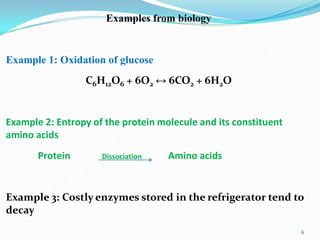
Examples from biology
Example 1: Oxidation of glucose
C6H12O6 + 6O2 ↔ 6CO2 + 6H2O
Example 2: Entropy of the protein molecule and its constituent
amino acids
Protein Dissociation Amino acids
Example 3: Costly enzymes stored in the refrigerator tend to
decay
7
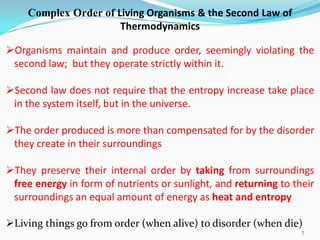
Complex Order of Living Organisms & the Second Law of
Thermodynamics
Organisms maintain and produce order, seemingly violating the
second law; but they operate strictly within it.
Second law does not require that the entropy increase take place
in the system itself, but in the universe.
The order produced is more than compensated for by the disorder
they create in their surroundings
They preserve their internal order by taking from surroundings
free energy in form of nutrients or sunlight, and returning to their
surroundings an equal amount of energy as heat and entropy
Living things go from order (when alive) to disorder (when die)
8
Spontaneity of a process according to second law
For spontaneous process, ΔS(universe) is +positive
For non-spontaneous process, ΔS(universe) is – negative
A process can take place spontaneously when ΔS for the system
and its surroundings is positive;
a process for which ΔS is negative cannot take place
spontaneously, but the opposite process can;
and for a system at equilibrium, the entropy of the system plus
its surroundings is maximal and ΔS is zero.
9
Some energy
interconversion in living
organisms.
10
 Besides isothermally unavailable energy, some energy will be
available under isothermal conditions to do work.
 This energy, available to do work, is called free energy or Gibbs
free energy. Gibbs free energy, G, expresses the amount of
energy capable of doing work during a reaction at constant
temperature and pressure.
 Total heat energy (enthalpy, H) is comprised of isothermally
unavailable energy (TS) plus free energy (G).
H = G + TS
 Free energy (G) G = H - TS
 Neither convenient nor relevant to measure absolute energies
(either G or S), but changes. Therefore, ΔG = ΔH - TΔS
Concept of Free Energy
11
Enthalpy
change,ΔH
Entropy
change,ΔS
Free-energy change
ΔG = ΔH - TΔS
Remarks
- + -
Enthalpically & entropically favoured;
spontaneous
- - + or – Enthalpically favoured but entropically
opposed; may be spontaneous or
nonspontaneous
+ + + or – Enthalpically opposed but entropically
favoured; may be spontaneous or
nonspontaneous
+ - +
Enthalpically & entropically opposed;
nonspontaneous
When a chemical reaction occurs at constant temperature, free-energy
change, ΔG, is determined by enthalpy change and entropy change,
12
Applications of free energy change
 Changes in free energy can tell us much about a reaction.
 It can tell us the
 feasibility (prediction of the direction) of reactions actually
taking place,
 exact equilibrium position,
 amount of work that might be done
 ΔG doesn’t tell us anything about the rate of a reaction,
which is determined by kinetic rather than
thermodynamic factors.
13
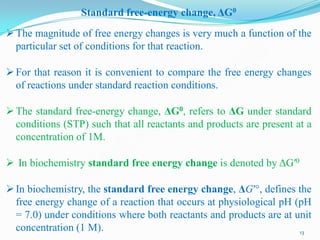
Standard free-energy change, ΔG0
The magnitude of free energy changes is very much a function of the
particular set of conditions for that reaction.
For that reason it is convenient to compare the free energy changes
of reactions under standard reaction conditions.
The standard free-energy change, ΔG0, refers to ΔG under standard
conditions (STP) such that all reactants and products are present at a
concentration of 1M.
 In biochemistry standard free energy change is denoted by ΔG′0
In biochemistry, the standard free energy change, ΔG′°, defines the
free energy change of a reaction that occurs at physiological pH (pH
= 7.0) under conditions where both reactants and products are at unit
concentration (1 M).
FIGURE: The free energy of a reaction as a function of its displacement from equilibrium.
K is the mass-action ratio when the reaction is at equilibrium. Vertical arrows indicate the slope of
the free energy curve, or change in free energy, as reactant is converted to product. Note that the
free energy change at equilibrium is zero and that the magnitude of the free energy change,
indicated by the length of the arrow, increases as the reaction moves away from equilibrium toward
pure reactant or pure product. A downward arrow indicates a negative free energy change; an
upward arrow indicates a positive free energy change. 14
∆G = - RT ln (Keq/Q)
∆G = - 2.3 RT log (Keq/Q)
15
Free Energy and Chemical Potential
Chemical potential (μ) is defined as the free energy
per mole of the substance
μ = ∆G/n where n is the number of moles
Chemical potential is a measure of the capacity of a
substance to react or move (units are J mol–1).
It is related to concentration as:
μA = μA° + RT ln [A]
16
Important equations
= −2.3RT log Keq
= −2.3RT log K′eq
17
When K'eq is . . . When ΔG'° is . . .
Starting with all
components at 1 M, the
reaction is . . .
>1.0 negative proceeds forward
1.0 zero is at equilibrium
<1.0 positive proceeds in reverse
= −2.3RT log K′eq
Relationships among K'eq, ΔG'° and the
Direction of Chemical Reactions
18
K'eq ΔG'°
(kJ/mol) (kcal/mol)
103 −17.1 −4.1
102 −11.4 −2.7
101 −5.7 −1.4
1 0. 0 0.0
10−1 5.7 1.4
10−2 11.4 2.7
10−3 17.1 4.1
10−4 22.8 5.5
10−5 28.5 6.8
10−6 34.2 8.2
Relatively small changes in ΔG'° correspond to large changes in
K'eq, because relationship between ΔG'° & K'eq is exponential
= −2.3RT log K′eq
19
Important points
Some thermodynamically favorable reactions do not occur at
measurable rates, because the activation energy for such reactions
is higher than the energy available at room temperature.
The free energy change for a reaction is independent of the pathway
by which the reaction occurs
ΔG'° values of sequential chemical reactions are additive.
A thermodynamically unfavorable (endergonic) reaction can be
driven in the forward direction by coupling it to a highly exergonic
reaction through a common intermediate.

Bioenergetics2_For online class.pdf

  • 1.
    1 THE SECOND LAWOF THERMODYNAMICS Mohammad Arief Zargar Assistant Professor Department of Botany University of Kashmir
  • 2.
    THE SECOND LAWOF THERMODYNAMICS The second law of thermodynamics says that the universe always tends toward increasing disorder: in all natural processes, the entropy of the universe increases. Entropy, S, is a quantitative expression for the randomness or disorder in a system. Entropy has been variously described as a measure of randomness, disorder, or chaos. 2
  • 3.
  • 4.
    Various Versions ofSecond Law The second law of thermodynamics can be stated in several forms: The entropy of the universe tends toward a maximum (R. J. Clausius, 1879 ). Any system not at absolute zero has an irreducible minimum amount of energy that is an inevitable property of that system at that temperature (Atkinson, 1977). That is, a system requires a certain amount of energy just to be at any specified temperature. 4
  • 5.
    “Entropy is anindex of exhaustion; the more a system has lost its capacity for spontaneous change, the more this capacity has been exhausted, the greater is the entropy” (Klotz 1967). Conversely, the farther a system is from equilibrium, the greater is its capacity for change and the less its entropy. A cell is the epitome of a state that is remote from equilibrium. 5
  • 6.
    6 Examples from biology Example1: Oxidation of glucose C6H12O6 + 6O2 ↔ 6CO2 + 6H2O Example 2: Entropy of the protein molecule and its constituent amino acids Protein Dissociation Amino acids Example 3: Costly enzymes stored in the refrigerator tend to decay
  • 7.
    7 Complex Order ofLiving Organisms & the Second Law of Thermodynamics Organisms maintain and produce order, seemingly violating the second law; but they operate strictly within it. Second law does not require that the entropy increase take place in the system itself, but in the universe. The order produced is more than compensated for by the disorder they create in their surroundings They preserve their internal order by taking from surroundings free energy in form of nutrients or sunlight, and returning to their surroundings an equal amount of energy as heat and entropy Living things go from order (when alive) to disorder (when die)
  • 8.
    8 Spontaneity of aprocess according to second law For spontaneous process, ΔS(universe) is +positive For non-spontaneous process, ΔS(universe) is – negative A process can take place spontaneously when ΔS for the system and its surroundings is positive; a process for which ΔS is negative cannot take place spontaneously, but the opposite process can; and for a system at equilibrium, the entropy of the system plus its surroundings is maximal and ΔS is zero.
  • 9.
  • 10.
    10  Besides isothermallyunavailable energy, some energy will be available under isothermal conditions to do work.  This energy, available to do work, is called free energy or Gibbs free energy. Gibbs free energy, G, expresses the amount of energy capable of doing work during a reaction at constant temperature and pressure.  Total heat energy (enthalpy, H) is comprised of isothermally unavailable energy (TS) plus free energy (G). H = G + TS  Free energy (G) G = H - TS  Neither convenient nor relevant to measure absolute energies (either G or S), but changes. Therefore, ΔG = ΔH - TΔS Concept of Free Energy
  • 11.
    11 Enthalpy change,ΔH Entropy change,ΔS Free-energy change ΔG =ΔH - TΔS Remarks - + - Enthalpically & entropically favoured; spontaneous - - + or – Enthalpically favoured but entropically opposed; may be spontaneous or nonspontaneous + + + or – Enthalpically opposed but entropically favoured; may be spontaneous or nonspontaneous + - + Enthalpically & entropically opposed; nonspontaneous When a chemical reaction occurs at constant temperature, free-energy change, ΔG, is determined by enthalpy change and entropy change,
  • 12.
    12 Applications of freeenergy change  Changes in free energy can tell us much about a reaction.  It can tell us the  feasibility (prediction of the direction) of reactions actually taking place,  exact equilibrium position,  amount of work that might be done  ΔG doesn’t tell us anything about the rate of a reaction, which is determined by kinetic rather than thermodynamic factors.
  • 13.
    13 Standard free-energy change,ΔG0 The magnitude of free energy changes is very much a function of the particular set of conditions for that reaction. For that reason it is convenient to compare the free energy changes of reactions under standard reaction conditions. The standard free-energy change, ΔG0, refers to ΔG under standard conditions (STP) such that all reactants and products are present at a concentration of 1M.  In biochemistry standard free energy change is denoted by ΔG′0 In biochemistry, the standard free energy change, ΔG′°, defines the free energy change of a reaction that occurs at physiological pH (pH = 7.0) under conditions where both reactants and products are at unit concentration (1 M).
  • 14.
    FIGURE: The freeenergy of a reaction as a function of its displacement from equilibrium. K is the mass-action ratio when the reaction is at equilibrium. Vertical arrows indicate the slope of the free energy curve, or change in free energy, as reactant is converted to product. Note that the free energy change at equilibrium is zero and that the magnitude of the free energy change, indicated by the length of the arrow, increases as the reaction moves away from equilibrium toward pure reactant or pure product. A downward arrow indicates a negative free energy change; an upward arrow indicates a positive free energy change. 14 ∆G = - RT ln (Keq/Q) ∆G = - 2.3 RT log (Keq/Q)
  • 15.
    15 Free Energy andChemical Potential Chemical potential (μ) is defined as the free energy per mole of the substance μ = ∆G/n where n is the number of moles Chemical potential is a measure of the capacity of a substance to react or move (units are J mol–1). It is related to concentration as: μA = μA° + RT ln [A]
  • 16.
    16 Important equations = −2.3RTlog Keq = −2.3RT log K′eq
  • 17.
    17 When K'eq is. . . When ΔG'° is . . . Starting with all components at 1 M, the reaction is . . . >1.0 negative proceeds forward 1.0 zero is at equilibrium <1.0 positive proceeds in reverse = −2.3RT log K′eq Relationships among K'eq, ΔG'° and the Direction of Chemical Reactions
  • 18.
    18 K'eq ΔG'° (kJ/mol) (kcal/mol) 103−17.1 −4.1 102 −11.4 −2.7 101 −5.7 −1.4 1 0. 0 0.0 10−1 5.7 1.4 10−2 11.4 2.7 10−3 17.1 4.1 10−4 22.8 5.5 10−5 28.5 6.8 10−6 34.2 8.2 Relatively small changes in ΔG'° correspond to large changes in K'eq, because relationship between ΔG'° & K'eq is exponential = −2.3RT log K′eq
  • 19.
    19 Important points Some thermodynamicallyfavorable reactions do not occur at measurable rates, because the activation energy for such reactions is higher than the energy available at room temperature. The free energy change for a reaction is independent of the pathway by which the reaction occurs ΔG'° values of sequential chemical reactions are additive. A thermodynamically unfavorable (endergonic) reaction can be driven in the forward direction by coupling it to a highly exergonic reaction through a common intermediate.