Lymphatic System
By
Dr.Faris Muhammed
PhD Anatomy
MSc. General Surgery
2022
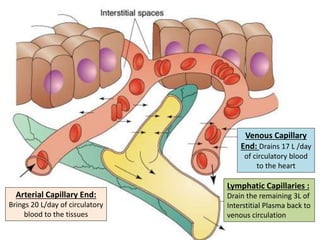
Venous Capillary
End: Drains 17 L /day
of circulatory blood
to the heart
Arterial Capillary End:
Brings 20 L/day of circulatory
blood to the tissues
Lymphatic Capillaries :
Drain the remaining 3L of
Interstitial Plasma back to
venous circulation
Plan Of Lymphatic Drainage
Superficial Lymphatic's (accompany superficial veins)
Superficial L.N.s
Communicating Lymphatic's
Deep L.N.s
Deep Lymphatic's (accompany arteries)
Lymph Trunks
Either:
1. Rt Lymphatic Duct
2. Thoracic Duct
Venous
Circulation
Head & Neck Lymphatics
Plan of Head & Neck Lymphatic Drainage
A. The components of this system include:
1. superficial nodes around the head along the
external jugular vein
2. deep cervical nodes forming a chain along the
internal jugular vein
B. The basic pattern of drainage is that:
1. superficial lymphatic vessels to drain to the
superficial nodes
2. Some of these drain to the superficial cervical nodes
on their way to the deep cervical nodes
3. others drain directly to the deep cervical nodes.
Superficial lymph nodes (SLN)
• groups of superficial lymph nodes form a ring around the head and are
primarily responsible for the lymphatic drainage of the face and scalp.
• Their pattern of drainage is around the area of distribution of the arteries
• Include the followings:
1. occipital nodes,
2. mastoid nodes,
3. parotid nodes,
4. submandibular nodes
5. submental nodes
5
Lymphatic drainage from SLNs have
several directions:
1. From:
1. From:
superficial cervical LNs
(along the Ex.J.V)
Occipital LNs
Mastoid LNs
Pre-auricular LNs
Parotid LNs,
Submandibular LNs
Submental LNs
Deep Cervical LNs
(along I.J.V)
Submental
1. Occipital LNs:
near the attachment of the
Trapezius muscle to the skull
and associated with the
occipital artery, lymphatic
drainage is from the
posterior scalp and neck
2. Mastoid LNs (retro-auricular
/posterior auricular LNs):
posterior to the ear near the
attachment of Sternocleido-
mastoid muscle and associated
with the posterior auricular aa. ,
lymphatic drainage is from the
posterolateral half of the scalp
3. Pre-auricular and parotid LNs. :
anterior to the ear and associated with
the superficial temporal and transverse
facial arteries lymphatic drainage is from
the anterior surface of:
the auricle,
the anterolateral scalp,
the upper half of the face,
the eyelids, and
the cheeks;
4. Submandibular nodes:
inferior to the body of the
mandible and associated with
the facial artery— lymphatic
drainage is from structures
along the path of the facial
artery as high as the forehead,
as well as the gingivae, the
teeth, and the tongue;
5. Submental nodes:
inferior and posterior to
the chin— lymphatic
drainage is from the
center part of the lower
lip, the chin, the floor of
the mouth, the tip of the
tongue, and the lower
incisor teeth.
Superficial cervical lymph nodes
are a collection of lymph nodes along
the E. J.V on the superficial surface of
the sternocleidomastoid muscle. They
primarily receive lymphatic drainage
from the posterior and posterolateral
regions of the scalp through the
occipital and mastoid nodes, and send
lymphatic vessels in the direction of
the deep cervical nodes.
Deep cervical lymph nodes (DLNs)
• are a collection of lymph nodes
that form a chain along the IJV.
• They are divided into upper &
lower groups where the
intermediate tendon of the
omohyoid muscle crosses the
common carotid artery and the
internal jugular vein.
• The most superior node in the
upper deep cervical group
is the jugulodigastric node.
This large node is where the
posterior belly of the digastric
muscle crosses the I.J.V and
receives lymphatic drainage from
the tonsils and tonsillar region.
1. Jugulodigastric LN
associated with the lower deep
cervical group because it is at or
just inferior to the intermediate
tendon of the omohyoid muscle,
is the jugulo-omohyoid node .
This node receives lymphatic
drainage from the tongue.
2. Jugulo-omohyoid LN
• The DLNs eventually all lymph-atic
drainage from the head and neck either directly
or through regional groups of nodes.
• From the deep cervical nodes, lymphatic vessels
form the right and left jugular trunks, which
empty into the right lymphatic duct on the right
side or the thoracic duct on the left side.
Receive
Superior deep cervical
Inferior deep cervical
Prelaryngeal
Paratracheal
pretracheal
C
Lymph nodes, lymphatic
trunks and thoracic ducts
Planes of
Cervical LNs
Face & scalp
lymphatics
Occipital
Mastoid
Parotid
Buccal
Submandibular
Submental
Superficial cervical
Deep cervical
* Retropharyngeal
Lymph node groups
To Submental lymph nodes
Lymphatic Drainage of Palate
Lymphatic Drainage of Gingiva
Jugulodigastric LNs
Jugulo-Omohyoid LNs
Retropharyngeal LNs
lymphatics of thyroid,
larynx and trachea
Pathway of
Lymphatics :
pharynx & tonsils
( waldeyer ring )
To Submental lymph nodes
Pathway of
Lymphatics :
pharynx & tonsils
( waldeyer ring )
Robbins Classification:
Neck regions (levels)
that are used clinically
to evaluate LNs
a
b
lymphatics of thyoid,
larynx and trachea
Axillary LNs
• All lymphatics from the upper limb, shoulder 75% of
the mammary gland drain into LNs in the axilla
• In addition, axillary LNs receive drainage from an
extensive area on the adjacent trunk, which includes
regions of the upper back, the lower neck, the chest,
and the upper anterolateral abdominal wall.
Axillary nodes also receive drainage from
approximately The 20–30 axillary nodes are generally
divided into five groups on the basis of location:
1. Humeral (lateral) nodes
2. Pectoral (anterior) nodes
3. Subscapular (posterior) nodes
4. Central nodes
5. Apical nodes
posteromedial to the
axillary vein receive most
of the lymphatic drainage
from upper limb
Humeral (lateral) nodes
Pectoral (anterior) nodes
• occur along the inferior margin
of the pectoralis minor muscle
along the course of the lateral
thoracic vessels and receive
drainage from the abdominal
wall, the chest, and the
mammary gland.
Subscapular (posterior) nodes
on the posterior axillary wall in
association with the subscapular
vessels drain the posterior
axillary wall and receive
lymphatics from the back, the
shoulder, and the neck.
Central nodes
are embedded in axillary fat and
receive tributaries from
humeral, subscapular, and
pectoral groups of nodes.
Apical nodes
are the most superior group of nodes
in the axilla, at the lateral border
of 1st rib and drain all other groups
of nodes in the region. In addition,
they receive lymphatic vessels that
accompany the cephalic vein as well
as vessels that drain the superior
region of the mammary gland.
• Efferent vessels from the apical group
converge to form the subclavian trunk
(Rt. Lymphatic duct), which usually joins the
venous system at the junction between the
right subclavian vein and the right internal
jugular vein in the neck. On the left, the
subclavian trunk usually joins the thoracic
duct in the base of the neck.
Lymphatic drainage of the breast
Infraclavicular
group LNs
Supratroclear LNs
Lateral axillary
group LNs
Cisterna Chyli
Thoracic Lymphatics
Chest Wall Lymphatics
Mediastinal Lymphatics
Esophageal Lymphatic Drainage
1. Cervical esophagus
deep cervcal LNs
2. Thoracic esophagus
posterior mediastinal LNs
3. Abdominal esophagus
preaortic & coeliac LNs
1
2
3
Tracheobronchial LNs
A single lymphatic vessel ascend
Between PA and LA
Lymphatic vessels
in coronary grooves
Subendocardial lymphatic plexus
Lymphatics Of The Heart
Lower Limb Lymphatics
Lymphatic Drainage Of
Abdominopelvis
Spleen/Pancreatic Lymphatic Drainage
Kidney/Ureter Lymphatic Drainage
Lymphatic
Drainage
Of The
Uterus
Lumbar(caval/Aortic)
Inferior Mesenteric
Common Illiac
Internal Iliac
External Iliac
Superficial Inguinal
Deep Inguinal
Sacral
Pararectal
Lumbar(caval/Aortic)
Inferior Mesenteric
Common Illiac
Internal Iliac
External Iliac
Superficial Inguinal
Deep Inguinal
Sacral
Pararectal
Lymphatic  system 2022

Lymphatic system 2022

  • 1.
    Lymphatic System By Dr.Faris Muhammed PhDAnatomy MSc. General Surgery 2022
  • 3.
    Venous Capillary End: Drains17 L /day of circulatory blood to the heart Arterial Capillary End: Brings 20 L/day of circulatory blood to the tissues Lymphatic Capillaries : Drain the remaining 3L of Interstitial Plasma back to venous circulation
  • 6.
    Plan Of LymphaticDrainage Superficial Lymphatic's (accompany superficial veins) Superficial L.N.s Communicating Lymphatic's Deep L.N.s Deep Lymphatic's (accompany arteries) Lymph Trunks Either: 1. Rt Lymphatic Duct 2. Thoracic Duct Venous Circulation
  • 8.
    Head & NeckLymphatics
  • 9.
    Plan of Head& Neck Lymphatic Drainage A. The components of this system include: 1. superficial nodes around the head along the external jugular vein 2. deep cervical nodes forming a chain along the internal jugular vein B. The basic pattern of drainage is that: 1. superficial lymphatic vessels to drain to the superficial nodes 2. Some of these drain to the superficial cervical nodes on their way to the deep cervical nodes 3. others drain directly to the deep cervical nodes.
  • 10.
    Superficial lymph nodes(SLN) • groups of superficial lymph nodes form a ring around the head and are primarily responsible for the lymphatic drainage of the face and scalp. • Their pattern of drainage is around the area of distribution of the arteries • Include the followings: 1. occipital nodes, 2. mastoid nodes, 3. parotid nodes, 4. submandibular nodes 5. submental nodes 5
  • 11.
    Lymphatic drainage fromSLNs have several directions: 1. From: 1. From: superficial cervical LNs (along the Ex.J.V) Occipital LNs Mastoid LNs Pre-auricular LNs Parotid LNs, Submandibular LNs Submental LNs Deep Cervical LNs (along I.J.V)
  • 12.
  • 13.
    1. Occipital LNs: nearthe attachment of the Trapezius muscle to the skull and associated with the occipital artery, lymphatic drainage is from the posterior scalp and neck
  • 14.
    2. Mastoid LNs(retro-auricular /posterior auricular LNs): posterior to the ear near the attachment of Sternocleido- mastoid muscle and associated with the posterior auricular aa. , lymphatic drainage is from the posterolateral half of the scalp
  • 15.
    3. Pre-auricular andparotid LNs. : anterior to the ear and associated with the superficial temporal and transverse facial arteries lymphatic drainage is from the anterior surface of: the auricle, the anterolateral scalp, the upper half of the face, the eyelids, and the cheeks;
  • 16.
    4. Submandibular nodes: inferiorto the body of the mandible and associated with the facial artery— lymphatic drainage is from structures along the path of the facial artery as high as the forehead, as well as the gingivae, the teeth, and the tongue;
  • 17.
    5. Submental nodes: inferiorand posterior to the chin— lymphatic drainage is from the center part of the lower lip, the chin, the floor of the mouth, the tip of the tongue, and the lower incisor teeth.
  • 18.
    Superficial cervical lymphnodes are a collection of lymph nodes along the E. J.V on the superficial surface of the sternocleidomastoid muscle. They primarily receive lymphatic drainage from the posterior and posterolateral regions of the scalp through the occipital and mastoid nodes, and send lymphatic vessels in the direction of the deep cervical nodes.
  • 19.
    Deep cervical lymphnodes (DLNs) • are a collection of lymph nodes that form a chain along the IJV. • They are divided into upper & lower groups where the intermediate tendon of the omohyoid muscle crosses the common carotid artery and the internal jugular vein.
  • 20.
    • The mostsuperior node in the upper deep cervical group is the jugulodigastric node. This large node is where the posterior belly of the digastric muscle crosses the I.J.V and receives lymphatic drainage from the tonsils and tonsillar region. 1. Jugulodigastric LN
  • 21.
    associated with thelower deep cervical group because it is at or just inferior to the intermediate tendon of the omohyoid muscle, is the jugulo-omohyoid node . This node receives lymphatic drainage from the tongue. 2. Jugulo-omohyoid LN
  • 22.
    • The DLNseventually all lymph-atic drainage from the head and neck either directly or through regional groups of nodes. • From the deep cervical nodes, lymphatic vessels form the right and left jugular trunks, which empty into the right lymphatic duct on the right side or the thoracic duct on the left side. Receive
  • 23.
    Superior deep cervical Inferiordeep cervical Prelaryngeal Paratracheal pretracheal C Lymph nodes, lymphatic trunks and thoracic ducts
  • 25.
  • 26.
  • 27.
  • 29.
  • 30.
  • 32.
  • 33.
  • 34.
    Pathway of Lymphatics : pharynx& tonsils ( waldeyer ring )
  • 35.
  • 36.
    Pathway of Lymphatics : pharynx& tonsils ( waldeyer ring )
  • 37.
    Robbins Classification: Neck regions(levels) that are used clinically to evaluate LNs
  • 38.
  • 39.
  • 40.
    Axillary LNs • Alllymphatics from the upper limb, shoulder 75% of the mammary gland drain into LNs in the axilla • In addition, axillary LNs receive drainage from an extensive area on the adjacent trunk, which includes regions of the upper back, the lower neck, the chest, and the upper anterolateral abdominal wall.
  • 41.
    Axillary nodes alsoreceive drainage from approximately The 20–30 axillary nodes are generally divided into five groups on the basis of location: 1. Humeral (lateral) nodes 2. Pectoral (anterior) nodes 3. Subscapular (posterior) nodes 4. Central nodes 5. Apical nodes
  • 42.
    posteromedial to the axillaryvein receive most of the lymphatic drainage from upper limb Humeral (lateral) nodes
  • 43.
    Pectoral (anterior) nodes •occur along the inferior margin of the pectoralis minor muscle along the course of the lateral thoracic vessels and receive drainage from the abdominal wall, the chest, and the mammary gland.
  • 44.
    Subscapular (posterior) nodes onthe posterior axillary wall in association with the subscapular vessels drain the posterior axillary wall and receive lymphatics from the back, the shoulder, and the neck.
  • 45.
    Central nodes are embeddedin axillary fat and receive tributaries from humeral, subscapular, and pectoral groups of nodes.
  • 46.
    Apical nodes are themost superior group of nodes in the axilla, at the lateral border of 1st rib and drain all other groups of nodes in the region. In addition, they receive lymphatic vessels that accompany the cephalic vein as well as vessels that drain the superior region of the mammary gland.
  • 47.
    • Efferent vesselsfrom the apical group converge to form the subclavian trunk (Rt. Lymphatic duct), which usually joins the venous system at the junction between the right subclavian vein and the right internal jugular vein in the neck. On the left, the subclavian trunk usually joins the thoracic duct in the base of the neck.
  • 49.
  • 54.
  • 55.
  • 56.
  • 58.
  • 61.
  • 62.
    Esophageal Lymphatic Drainage 1.Cervical esophagus deep cervcal LNs 2. Thoracic esophagus posterior mediastinal LNs 3. Abdominal esophagus preaortic & coeliac LNs 1 2 3
  • 65.
    Tracheobronchial LNs A singlelymphatic vessel ascend Between PA and LA Lymphatic vessels in coronary grooves Subendocardial lymphatic plexus Lymphatics Of The Heart
  • 70.
  • 73.
  • 86.
  • 89.
  • 93.
  • 94.
    Lumbar(caval/Aortic) Inferior Mesenteric Common Illiac InternalIliac External Iliac Superficial Inguinal Deep Inguinal Sacral Pararectal
  • 95.
    Lumbar(caval/Aortic) Inferior Mesenteric Common Illiac InternalIliac External Iliac Superficial Inguinal Deep Inguinal Sacral Pararectal