Queues 3/16/14
1
Queues 1
Queues
© 2014 Goodrich, Tamassia, Goldwasser
Presentation for use with the textbook Data Structures and
Algorithms in Java, 6th edition, by M. T. Goodrich, R. Tamassia,
and M. H. Goldwasser, Wiley, 2014
Queues 2
The Queue ADT
q  The Queue ADT stores arbitrary
objects
q  Insertions and deletions follow
the first-in first-out scheme
q  Insertions are at the rear of the
queue and removals are at the
front of the queue
q  Main queue operations:
n  enqueue(object): inserts an
element at the end of the
queue
n  object dequeue(): removes and
returns the element at the front
of the queue
q  Auxiliary queue
operations:
n  object first(): returns the
element at the front without
removing it
n  integer size(): returns the
number of elements stored
n  boolean isEmpty(): indicates
whether no elements are
stored
q  Boundary cases:
n  Attempting the execution of
dequeue or first on an
empty queue returns null
© 2014 Goodrich, Tamassia, Goldwasser
Queues 3/16/14
2
Queues 3
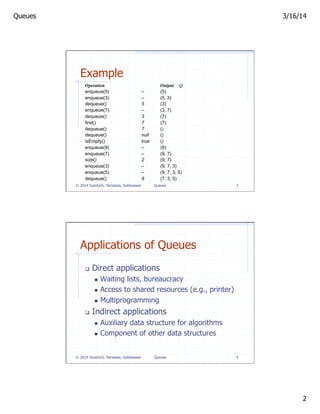
Example
Operation 	


Output 	

Q
enqueue(5) – (5)
enqueue(3) – (5, 3)
dequeue() 5 (3)
enqueue(7) – (3, 7)
dequeue() 3 (7)
first() 7 (7)
dequeue() 7 ()
dequeue() null ()
isEmpty() true ()
enqueue(9) – (9)
enqueue(7) – (9, 7)
size() 2 (9, 7)
enqueue(3) – (9, 7, 3)
enqueue(5) – (9, 7, 3, 5)
dequeue() 9 (7, 3, 5)
© 2014 Goodrich, Tamassia, Goldwasser
Queues 4
Applications of Queues
q  Direct applications
n  Waiting lists, bureaucracy
n  Access to shared resources (e.g., printer)
n  Multiprogramming
q  Indirect applications
n  Auxiliary data structure for algorithms
n  Component of other data structures
© 2014 Goodrich, Tamassia, Goldwasser
Queues 3/16/14
3
Queues 5
Array-based Queue
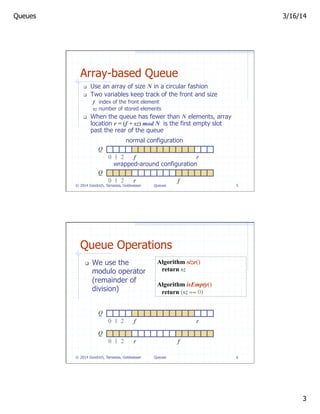
q  Use an array of size N in a circular fashion
q  Two variables keep track of the front and size
f index of the front element
sz number of stored elements
q  When the queue has fewer than N elements, array
location r = (f + sz) mod N is the first empty slot
past the rear of the queue
Q
0 1 2 r
f
normal configuration
Q
0 1 2 f
r
wrapped-around configuration
© 2014 Goodrich, Tamassia, Goldwasser
Queues 6
Queue Operations
q  We use the
modulo operator
(remainder of
division)
Algorithm size()
return sz
Algorithm isEmpty()
return (sz == 0)
Q
0 1 2 r
f
Q
0 1 2 f
r
© 2014 Goodrich, Tamassia, Goldwasser
Queues 3/16/14
4
Queues 7
Queue Operations (cont.)
Algorithm enqueue(o)
if size() = N - 1 then
throw IllegalStateException
else
r ← (f + sz) mod N
Q[r] ← o
sz ← (sz + 1)
q  Operation enqueue
throws an exception if
the array is full
q  This exception is
implementation-
dependent
Q
0 1 2 r
f
Q
0 1 2 f
r
© 2014 Goodrich, Tamassia, Goldwasser
Queues 8
Queue Operations (cont.)
q  Note that operation
dequeue returns null
if the queue is empty
Algorithm dequeue()
if isEmpty() then
return null
else
o ← Q[f]
f ← (f + 1) mod N
sz ← (sz - 1)
return o
Q
0 1 2 r
f
Q
0 1 2 f
r
© 2014 Goodrich, Tamassia, Goldwasser
Queues 3/16/14
5
Queues 9
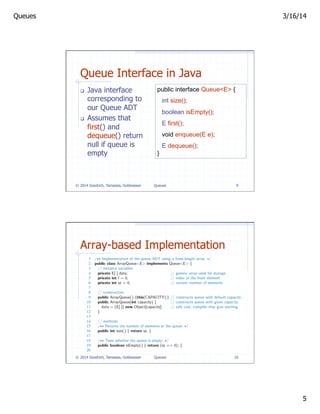
Queue Interface in Java
q  Java interface
corresponding to
our Queue ADT
q  Assumes that
first() and
dequeue() return
null if queue is
empty
public interface Queue<E> {
int size();
boolean isEmpty();
E first();
void enqueue(E e);
E dequeue();
}
© 2014 Goodrich, Tamassia, Goldwasser
Array-based Implementation
© 2014 Goodrich, Tamassia, Goldwasser 10
Queues
Queues 3/16/14
6
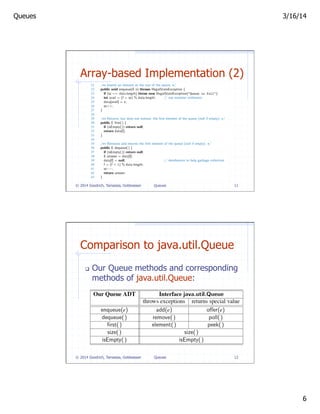
Array-based Implementation (2)
© 2014 Goodrich, Tamassia, Goldwasser 11
Queues
Comparison to java.util.Queue
q  Our Queue methods and corresponding
methods of java.util.Queue:
© 2014 Goodrich, Tamassia, Goldwasser 12
Queues
Queues 3/16/14
7
Queues 13
Application: Round Robin Schedulers
q  We can implement a round robin scheduler using a
queue Q by repeatedly performing the following
steps:
1.  e = Q.dequeue()
2.  Service element e
3.  Q.enqueue(e)
© 2014 Goodrich, Tamassia, Goldwasser
Shared
Service
Queue
Enqueue
Dequeue

Queues-handouts

  • 1.
    Queues 3/16/14 1 Queues 1 Queues ©2014 Goodrich, Tamassia, Goldwasser Presentation for use with the textbook Data Structures and Algorithms in Java, 6th edition, by M. T. Goodrich, R. Tamassia, and M. H. Goldwasser, Wiley, 2014 Queues 2 The Queue ADT q  The Queue ADT stores arbitrary objects q  Insertions and deletions follow the first-in first-out scheme q  Insertions are at the rear of the queue and removals are at the front of the queue q  Main queue operations: n  enqueue(object): inserts an element at the end of the queue n  object dequeue(): removes and returns the element at the front of the queue q  Auxiliary queue operations: n  object first(): returns the element at the front without removing it n  integer size(): returns the number of elements stored n  boolean isEmpty(): indicates whether no elements are stored q  Boundary cases: n  Attempting the execution of dequeue or first on an empty queue returns null © 2014 Goodrich, Tamassia, Goldwasser
  • 2.
    Queues 3/16/14 2 Queues 3 Example Operation Output Q enqueue(5) – (5) enqueue(3) – (5, 3) dequeue() 5 (3) enqueue(7) – (3, 7) dequeue() 3 (7) first() 7 (7) dequeue() 7 () dequeue() null () isEmpty() true () enqueue(9) – (9) enqueue(7) – (9, 7) size() 2 (9, 7) enqueue(3) – (9, 7, 3) enqueue(5) – (9, 7, 3, 5) dequeue() 9 (7, 3, 5) © 2014 Goodrich, Tamassia, Goldwasser Queues 4 Applications of Queues q  Direct applications n  Waiting lists, bureaucracy n  Access to shared resources (e.g., printer) n  Multiprogramming q  Indirect applications n  Auxiliary data structure for algorithms n  Component of other data structures © 2014 Goodrich, Tamassia, Goldwasser
  • 3.
    Queues 3/16/14 3 Queues 5 Array-basedQueue q  Use an array of size N in a circular fashion q  Two variables keep track of the front and size f index of the front element sz number of stored elements q  When the queue has fewer than N elements, array location r = (f + sz) mod N is the first empty slot past the rear of the queue Q 0 1 2 r f normal configuration Q 0 1 2 f r wrapped-around configuration © 2014 Goodrich, Tamassia, Goldwasser Queues 6 Queue Operations q  We use the modulo operator (remainder of division) Algorithm size() return sz Algorithm isEmpty() return (sz == 0) Q 0 1 2 r f Q 0 1 2 f r © 2014 Goodrich, Tamassia, Goldwasser
  • 4.
    Queues 3/16/14 4 Queues 7 QueueOperations (cont.) Algorithm enqueue(o) if size() = N - 1 then throw IllegalStateException else r ← (f + sz) mod N Q[r] ← o sz ← (sz + 1) q  Operation enqueue throws an exception if the array is full q  This exception is implementation- dependent Q 0 1 2 r f Q 0 1 2 f r © 2014 Goodrich, Tamassia, Goldwasser Queues 8 Queue Operations (cont.) q  Note that operation dequeue returns null if the queue is empty Algorithm dequeue() if isEmpty() then return null else o ← Q[f] f ← (f + 1) mod N sz ← (sz - 1) return o Q 0 1 2 r f Q 0 1 2 f r © 2014 Goodrich, Tamassia, Goldwasser
  • 5.
    Queues 3/16/14 5 Queues 9 QueueInterface in Java q  Java interface corresponding to our Queue ADT q  Assumes that first() and dequeue() return null if queue is empty public interface Queue<E> { int size(); boolean isEmpty(); E first(); void enqueue(E e); E dequeue(); } © 2014 Goodrich, Tamassia, Goldwasser Array-based Implementation © 2014 Goodrich, Tamassia, Goldwasser 10 Queues
  • 6.
    Queues 3/16/14 6 Array-based Implementation(2) © 2014 Goodrich, Tamassia, Goldwasser 11 Queues Comparison to java.util.Queue q  Our Queue methods and corresponding methods of java.util.Queue: © 2014 Goodrich, Tamassia, Goldwasser 12 Queues
  • 7.
    Queues 3/16/14 7 Queues 13 Application:Round Robin Schedulers q  We can implement a round robin scheduler using a queue Q by repeatedly performing the following steps: 1.  e = Q.dequeue() 2.  Service element e 3.  Q.enqueue(e) © 2014 Goodrich, Tamassia, Goldwasser Shared Service Queue Enqueue Dequeue