QUEUE – DATASTRUCTURE
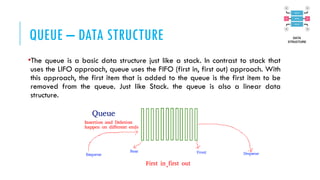
•The queue is a basic data structure just like a stack. In contrast to stack that
uses the LIFO approach, queue uses the FIFO (first in, first out) approach. With
this approach, the first item that is added to the queue is the first item to be
removed from the queue. Just like Stack. the queue is also a linear data
structure.
3.
QUEUE – DATASTRUCTURE
•In a real-world analogy, we can imagine a bus queue where the passengers
wait for the bus in a queue or a line. The first passenger in the line enters the
bus first as that passenger happens to be the one who had come first.
•A queue is a useful data structure in programming. It is similar to the ticket
queue outside a cinema hall, where the first person entering the queue is the
first person who gets the ticket.
•Queue follows the First In First Out(FIFO) rule - the item that goes in first is the
item that comes out first too.
QUEUE – DATASTRUCTURE
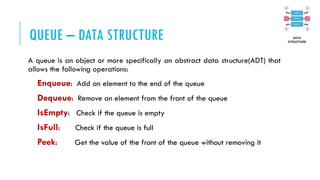
A queue is an object or more specifically an abstract data structure(ADT) that
allows the following operations:
Enqueue: Add an element to the end of the queue
Dequeue: Remove an element from the front of the queue
IsEmpty: Check if the queue is empty
IsFull: Check if the queue is full
Peek: Get the value of the front of the queue without removing it
6.
QUEUE – DATASTRUCTURE
How Queue Works?
Queue operations work as follows:
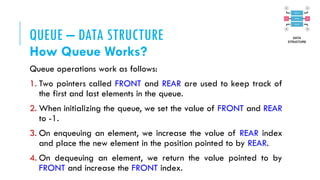
1. Two pointers called FRONT and REAR are used to keep track of
the first and last elements in the queue.
2. When initializing the queue, we set the value of FRONT and REAR
to -1.
3. On enqueuing an element, we increase the value of REAR index
and place the new element in the position pointed to by REAR.
4. On dequeuing an element, we return the value pointed to by
FRONT and increase the FRONT index.
7.
QUEUE – DATASTRUCTURE
How Queue Works?
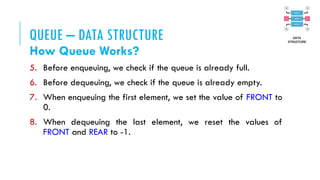
5. Before enqueuing, we check if the queue is already full.
6. Before dequeuing, we check if the queue is already empty.
7. When enqueuing the first element, we set the value of FRONT to
0.
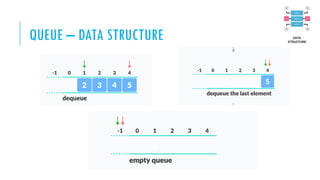
8. When dequeuing the last element, we reset the values of
FRONT and REAR to -1.
QUEUE – DATASTRUCTURE
Queue In C++
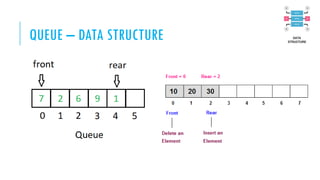
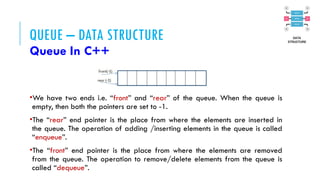
•We have two ends i.e. “front” and “rear” of the queue. When the queue is
empty, then both the pointers are set to -1.
•The “rear” end pointer is the place from where the elements are inserted in
the queue. The operation of adding /inserting elements in the queue is called
“enqueue”.
•The “front” end pointer is the place from where the elements are removed
from the queue. The operation to remove/delete elements from the queue is
called “dequeue”.
11.
QUEUE – DATASTRUCTURE
•We have two ends i.e. “front” and “rear” of the queue. When the queue is empty,
then both the pointers are set to -1.
•The “rear” end pointer is the place from where the elements are inserted in the
queue. The operation of adding /inserting elements in the queue is called
“enqueue”.
•The “front” end pointer is the place from where the elements are removed from
the queue. The operation to remove/delete elements from the queue is called
“dequeue”.
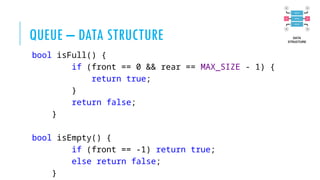
•When the rear pointer value is size-1, then we say that the queue is full. When
the front is null, then the queue is empty.
12.
QUEUE – DATASTRUCTURE
Enqueue
In this process, the following steps are
performed:
•Check if the queue is full.
•If full, produce overflow error and exit.
•Else, increment ‘rear’.
•Add an element to the location pointed by ‘rear’.
•Return success.
13.
QUEUE – DATASTRUCTURE
Dequeue
Dequeue operation consists of the following
steps:
•Check if the queue is empty.
•If empty, display an underflow error and exit.
•Else, the access element is pointed out by ‘front’.
•Increment the ‘front’ to point to the next accessible data.
•Return success.
14.
QUEUE – DATASTRUCTURE
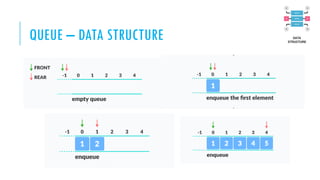
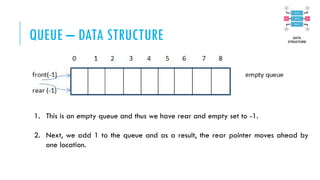
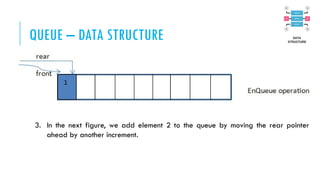
1. This is an empty queue and thus we have rear and empty set to -1.
2. Next, we add 1 to the queue and as a result, the rear pointer moves ahead by
one location.
15.
QUEUE – DATASTRUCTURE
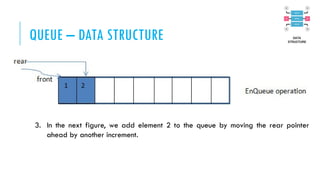
3. In the next figure, we add element 2 to the queue by moving the rear pointer
ahead by another increment.
16.
QUEUE – DATASTRUCTURE
3. In the next figure, we add element 2 to the queue by moving the rear pointer
ahead by another increment.
17.
QUEUE – DATASTRUCTURE
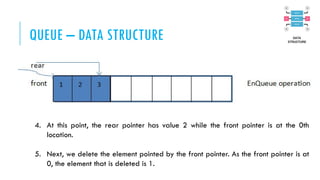
4. At this point, the rear pointer has value 2 while the front pointer is at the 0th
location.
5. Next, we delete the element pointed by the front pointer. As the front pointer is at
0, the element that is deleted is 1.
18.
QUEUE – DATASTRUCTURE
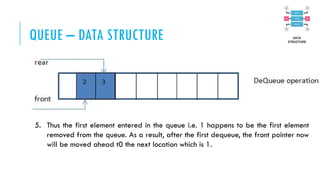
5. Thus the first element entered in the queue i.e. 1 happens to be the first element
removed from the queue. As a result, after the first dequeue, the front pointer now
will be moved ahead t0 the next location which is 1.
19.
QUEUE – DATASTRUCTURE
C++ Implementation
#include <iostream>
#define MAX_SIZE 5
using namespace std;
class Queue {
private:
int myqueue[MAX_SIZE], front, rear;
public:
Queue() {
front = -1;
rear = -1;
}
QUEUE – DATASTRUCTURE
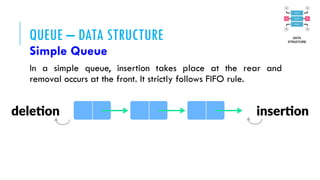
Simple Queue
In a simple queue, insertion takes place at the rear and
removal occurs at the front. It strictly follows FIFO rule.
26.
QUEUE – DATASTRUCTURE
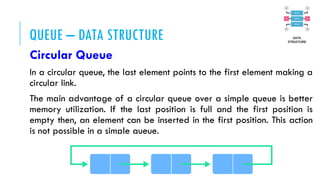
Circular Queue
In a circular queue, the last element points to the first element making a
circular link.
The main advantage of a circular queue over a simple queue is better
memory utilization. If the last position is full and the first position is
empty then, an element can be inserted in the first position. This action
is not possible in a simple queue.
27.
QUEUE – DATASTRUCTURE
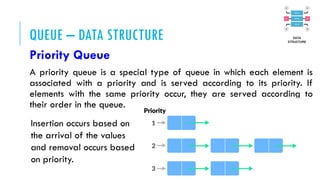
Priority Queue
A priority queue is a special type of queue in which each element is
associated with a priority and is served according to its priority. If
elements with the same priority occur, they are served according to
their order in the queue.
Insertion occurs based on
the arrival of the values
and removal occurs based
on priority.
28.
QUEUE – DATASTRUCTURE
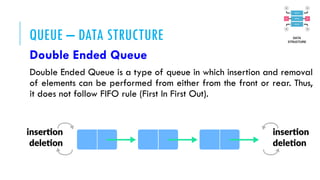
Double Ended Queue
Double Ended Queue is a type of queue in which insertion and removal
of elements can be performed from either from the front or rear. Thus,
it does not follow FIFO rule (First In First Out).
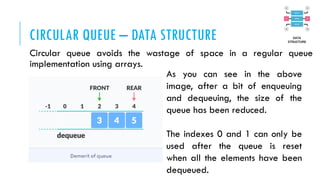
CIRCULAR QUEUE –DATA STRUCTURE
Circular queue avoids the wastage of space in a regular queue
implementation using arrays.
As you can see in the above
image, after a bit of enqueuing
and dequeuing, the size of the
queue has been reduced.
The indexes 0 and 1 can only be
used after the queue is reset
when all the elements have been
dequeued.
31.
CIRCULAR QUEUE –DATA STRUCTURE
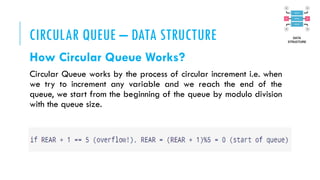
How Circular Queue Works?
Circular Queue works by the process of circular increment i.e. when
we try to increment any variable and we reach the end of the
queue, we start from the beginning of the queue by modulo division
with the queue size.
32.
CIRCULAR QUEUE –DATA STRUCTURE
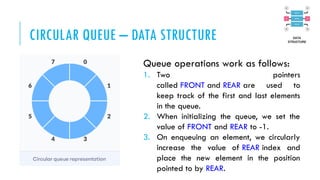
Queue operations work as follows:
1. Two pointers
called FRONT and REAR are used to
keep track of the first and last elements
in the queue.
2. When initializing the queue, we set the
value of FRONT and REAR to -1.
3. On enqueuing an element, we circularly
increase the value of REAR index and
place the new element in the position
pointed to by REAR.
33.
CIRCULAR QUEUE –DATA STRUCTURE
4. On dequeuing an element, we return the value pointed to
by FRONT and circularly increase the FRONT index.
5. Before enqueuing, we check if the queue is already full.
6. Before dequeuing, we check if the queue is already empty.
7. When enqueuing the first element, we set the value
of FRONT to 0.
8. When dequeuing the last element, we reset the values
of FRONT and REAR to -1.
34.
CIRCULAR QUEUE –DATA STRUCTURE
However, the check for full queue has a new additional case:
Case 1: FRONT = 0 && REAR == SIZE - 1
Case 2: FRONT = REAR + 1
The second case happens when REAR starts from 0 due to circular
increment and when its value is just 1 less than FRONT, the queue is
full.
35.
CIRCULAR QUEUE –DATA STRUCTURE
Circular Queue Complexity
The complexity of the enqueue and dequeue operations of a
circular queue is O(1) for (array implementations).
Circular Queue Applications
• CPU scheduling
• Memory management
• Traffic Management
PRIORITY QUEUE –DATA STRUCTURE
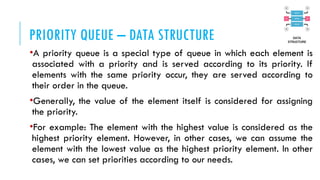
•A priority queue is a special type of queue in which each element is
associated with a priority and is served according to its priority. If
elements with the same priority occur, they are served according to
their order in the queue.
•Generally, the value of the element itself is considered for assigning
the priority.
•For example: The element with the highest value is considered as the
highest priority element. However, in other cases, we can assume the
element with the lowest value as the highest priority element. In other
cases, we can set priorities according to our needs.
PRIORITY QUEUE –DATA STRUCTURE
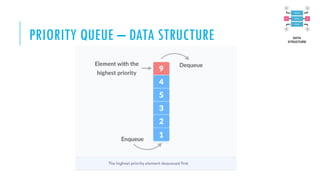
How does priority queue differ from a queue?
In a queue, the first-in-first-out rule is implemented whereas, in a
priority queue, the values are removed on the basis of priority. The
element with the highest priority is removed first.
Implementation of Priority Queue
Priority queue can be implemented using an array, a linked list, a heap
data structure or a binary search tree. Among these data structures,
heap data structure provides an efficient implementation of priority
queues.
40.
PRIORITY QUEUE –DATA STRUCTURE
Priority Queue Operations
Basic operations of a priority queue are inserting, removing and
peeking elements.
Priority Queue Applications
Some of the applications of a priority queue are:
1. Dijkstra's algorithm
2. for implementing stack
3. for load balancing and interrupt handling in an operating system
4. for data compression in Huffman code
DOUBLE ENDED QUEUE– DATA STRUCTURE
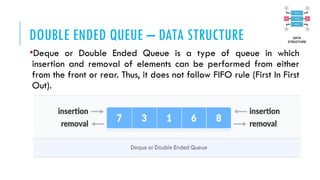
•Deque or Double Ended Queue is a type of queue in which
insertion and removal of elements can be performed from either
from the front or rear. Thus, it does not follow FIFO rule (First In First
Out).
43.
DOUBLE ENDED QUEUE– DATA STRUCTURE
Types of Deque
Input Restricted Deque
In this deque, input is restricted at a single end but allows deletion at
both the ends.
Output Restricted Deque
In this deque, output is restricted at a single end but allows insertion at
both the ends.
44.
DOUBLE ENDED QUEUE– DATA STRUCTURE
Operations on a Double Ended Queue
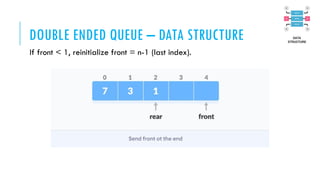
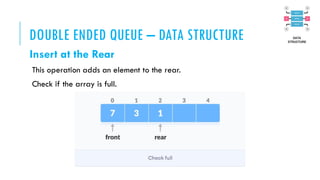
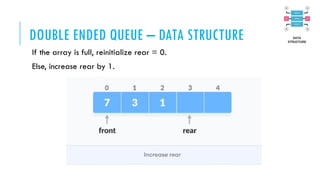
• In a circular array, if the array is full, we start from the beginning.
• But in a linear array implementation, if the array is full, no more elements can
be inserted. In each of the operations below, if the array is full, "overflow
message" is thrown.
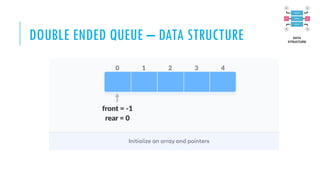
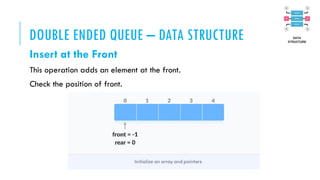
• Before performing the following operations, these steps are followed.
• Take an array of size n.
• Set two pointers at the first position and set front = -1 and rear = 0.
DOUBLE ENDED QUEUE– DATA STRUCTURE
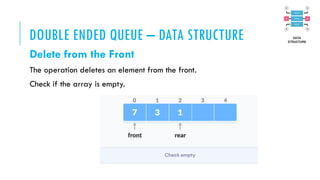
Delete from the Front
The operation deletes an element from the front.
Check if the array is empty.
53.
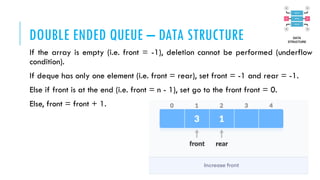
DOUBLE ENDED QUEUE– DATA STRUCTURE
If the array is empty (i.e. front = -1), deletion cannot be performed (underflow
condition).
If deque has only one element (i.e. front = rear), set front = -1 and rear = -1.
Else if front is at the end (i.e. front = n - 1), set go to the front front = 0.
Else, front = front + 1.
54.
DOUBLE ENDED QUEUE– DATA STRUCTURE
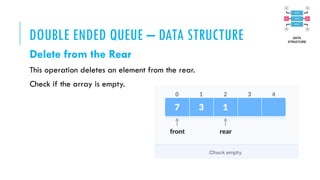
Delete from the Rear
This operation deletes an element from the rear.
Check if the array is empty.
55.
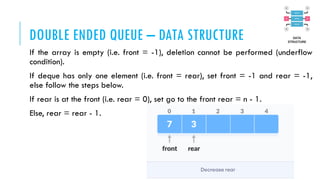
DOUBLE ENDED QUEUE– DATA STRUCTURE
If the array is empty (i.e. front = -1), deletion cannot be performed (underflow
condition).
If deque has only one element (i.e. front = rear), set front = -1 and rear = -1,
else follow the steps below.
If rear is at the front (i.e. rear = 0), set go to the front rear = n - 1.
Else, rear = rear - 1.
56.
DOUBLE ENDED QUEUE– DATA STRUCTURE
Check Empty
This operation checks if the array is empty. If front = -1, the deque is empty.
Check Full
This operation checks if the deque is full. If front = 0 and rear = n - 1, the deque
is full.
Double Ended Queue Complexities
The time complexity of all the above operations is constant i.e. O(1).
57.
DOUBLE ENDED QUEUE– DATA STRUCTURE
Double Ended Queue Applications
1. In undo operations on softwares.
2. To store history in browsers.
3. For implementing both stacks and queues.
![QUEUE – DATA STRUCTURE
C++ Implementation
#include <iostream>
#define MAX_SIZE 5
using namespace std;
class Queue {
private:
int myqueue[MAX_SIZE], front, rear;
public:
Queue() {
front = -1;
rear = -1;
}](https://image.slidesharecdn.com/lecture11-queueanditstypes-250925175429-1fe20a14/85/Lecture-11-Queue-and-its-types-data-sturctures-pptx-19-320.jpg)
![QUEUE – DATA STRUCTURE
void enQueue(int value) {
if (isFull()) {
cout << endl << "Queue is full!!";
}
else {
if (front == -1) front = 0;
rear++;
myqueue[rear] = value;
cout << value << " ";
}](https://image.slidesharecdn.com/lecture11-queueanditstypes-250925175429-1fe20a14/85/Lecture-11-Queue-and-its-types-data-sturctures-pptx-21-320.jpg)
![QUEUE – DATA STRUCTURE
void displayQueue()
{
int i;
if (isEmpty()) {
cout << endl << "Queue is Empty!!" << endl;
}
else {
cout << endl << "Front = " << front;
cout << endl << "Queue elements : ";
for (i = front; i <= rear; i++)
cout << myqueue[i] << "t";
cout << endl << "Rear = " << rear << endl;
}](https://image.slidesharecdn.com/lecture11-queueanditstypes-250925175429-1fe20a14/85/Lecture-11-Queue-and-its-types-data-sturctures-pptx-22-320.jpg)
![QUEUE – DATA STRUCTURE
int deQueue() {
int value;
if (isEmpty()) {
cout << "Queue is empty!!" << endl; return(-1);
}
else {
value = myqueue[front]; if (front >= rear) { //only one element
in queue
front = -1;
rear = -1;
}
else {
front++;
}
cout << endl << "Deleted => " << value << " from myqueue";
return(value);
}
}](https://image.slidesharecdn.com/lecture11-queueanditstypes-250925175429-1fe20a14/85/Lecture-11-Queue-and-its-types-data-sturctures-pptx-23-320.jpg)
![DOUBLE ENDED QUEUE – DATA STRUCTURE
Else, decrease front by 1.
Add the new key 5 into array[front].](https://image.slidesharecdn.com/lecture11-queueanditstypes-250925175429-1fe20a14/85/Lecture-11-Queue-and-its-types-data-sturctures-pptx-48-320.jpg)
![DOUBLE ENDED QUEUE – DATA STRUCTURE
Add the new key 5 into array[rear].](https://image.slidesharecdn.com/lecture11-queueanditstypes-250925175429-1fe20a14/85/Lecture-11-Queue-and-its-types-data-sturctures-pptx-51-320.jpg)