Essentialism
Proponents
(Theodore Sizer)
Proponents
(William Bagley)
Essentialists Beliefs
• Essentialism tries to instill all students with
the most basic knowledge, skills, and
character development.
• Essentialists believe that students should be
taught to be a model citizen.
• Essentialists believe that teachers should
teach traditional moral values and virtues.
• Essentialists believe in mastery learning.
Purpose of Schooling
• Prepare students to be productive, contributing
members of society.
• For essentialist, the aim of education is to teach
the young the essentials they need to live well
in the modern world.
• Essentialists teach the basic subjects.
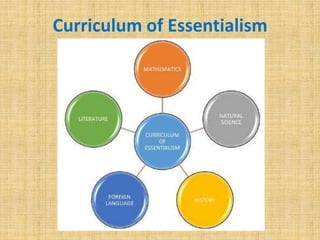
Curriculum of Essentialism
• The teacher teaches
discipline and hard work.
• The teacher is an expert of
content knowledge.
• The teacher is accountable
for student learning.
TEACHER’S ROLE
• As an expert
• Impart essential knowledge
• Direct focused tasks
Teacher’s Role
Teaching Strategies
• Use instructional strategies
• Lecture
• Memorization
• Homework
• Teacher and subject centered
• Mastery learning
Students should be
passive and be ready
to learn what the
teacher presents to
them.
STUDENT’S ROLE
• Listen and learn
• Trust that the
teacher knows best
Role of the Student
Curriculum
• Strong emphasis on basic skills in elementary
schools and on disciplined knowledge and
scholastic achievement in secondary schools.
• There should be a common core curriculum
that is taught to all students.
• Essentialists believe that the core knowledge
could change.
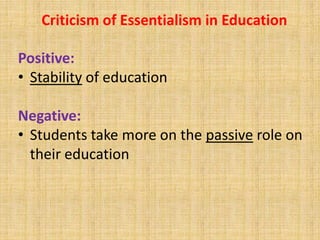
Criticism of Essentialism in Education
Positive:
• Stability of education
Negative:
• Students take more on the passive role on
their education
https://www.youtube.com/watch?v=EMIW3dzuPsQ
Essentialism in Education

Essentialism in Education

  • 1.
  • 2.
  • 3.
  • 4.
    Essentialists Beliefs • Essentialismtries to instill all students with the most basic knowledge, skills, and character development. • Essentialists believe that students should be taught to be a model citizen. • Essentialists believe that teachers should teach traditional moral values and virtues. • Essentialists believe in mastery learning.
  • 5.
    Purpose of Schooling •Prepare students to be productive, contributing members of society. • For essentialist, the aim of education is to teach the young the essentials they need to live well in the modern world. • Essentialists teach the basic subjects.
  • 6.
  • 7.
    • The teacherteaches discipline and hard work. • The teacher is an expert of content knowledge. • The teacher is accountable for student learning. TEACHER’S ROLE • As an expert • Impart essential knowledge • Direct focused tasks Teacher’s Role
  • 8.
    Teaching Strategies • Useinstructional strategies • Lecture • Memorization • Homework • Teacher and subject centered • Mastery learning
  • 9.
    Students should be passiveand be ready to learn what the teacher presents to them. STUDENT’S ROLE • Listen and learn • Trust that the teacher knows best Role of the Student
  • 10.
    Curriculum • Strong emphasison basic skills in elementary schools and on disciplined knowledge and scholastic achievement in secondary schools. • There should be a common core curriculum that is taught to all students. • Essentialists believe that the core knowledge could change.
  • 11.
    Criticism of Essentialismin Education Positive: • Stability of education Negative: • Students take more on the passive role on their education
  • 12.