
“Genres are created through a process of
repetition and recognition leading to
anticipation and expectation.”
Graham Burton (2000) GENRE THEORY
Genre & Expectation
• As genres become established audiences
begin to have certain expectations
• Every genre contains generic conventions
that audiences would expect and gain
gratification from
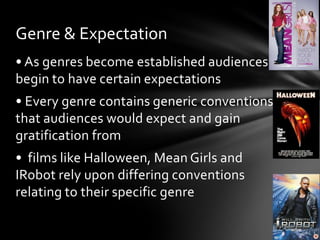
• films like Halloween, Mean Girls and
IRobot rely upon differing conventions
relating to their specific genre
Why do We Like Genre?
Genre texts are successful because AUDIENCES like
their…

- Familiarity (like a warm blanket!)
- - They give us an informed choice
PRODUCERS of media texts like them as they..

- - Give them a blueprint or toolbox to use and
experiment with
- - They have a proven popularity

- - so they can (almost always) guarantee some success
- - They can target their audience more easily - marketing
campaigns etc…
How Genres Change
All genre texts combine…

• “The familiar and the unexpected”
(G.Burton 2000)
• The “same but different” (Nick Lacey
1999)
How Genres Change
• Repetition of the conventions could lead to boredom.
To keep us interested producers offer us what we know
with a twist
This can be …
- Hybridity

- New Techniques
- Modern Social Issues
- Different characters
Genre
Hybridity/Hybrid: The fusion or combination of
different genre styles
• Repetition and Difference:
Most media texts have a pattern of repetition and
difference.
They have identifiable similarities, but also
contain new elements or similar elements used in
new ways.
Steve Neale

‘Genres are instances of repetition and
difference’.
He adds that difference is absolutely
essential to the economy of genre’ :mere
repetition would not attract an audience.
What do genres mean for audiences?
Audiences...
- can select texts based on their genre.
• have expectations about a text based on its
genre, allowing them to draw pleasures from its
conventions, such as repeated narratives.
However, pleasure can also be drawn from
differences
- identify with repeated elements in generic texts
and may shape their own identity in response.
What do genres mean for producers?
Producers…
- market texts according to genre because an
audience of fans of that genre has already been
established.
- - standardise production practices according to
genre conventions.
- - subscribe to established conventions but also
allow creativity within a given format to keep
the genre fresh/modern .
GENRE CONCLUSIONS
• Genres have a certain amount of predictability and
repeated elements, which make them distinctive
and which help to define them.
• All genres have a portfolio of key elements
(conventions)from which they are composed.

• Not all examples of a genre will have all the
elements all the time.
• It is these elements which make up the formula or
a repetition of elements of a given genre.
• Genres can be combined to create new forms or
Hybrids

A2 Media Studies Genre

  • 2.
    “Genres are createdthrough a process of repetition and recognition leading to anticipation and expectation.” Graham Burton (2000) GENRE THEORY
  • 3.
    Genre & Expectation •As genres become established audiences begin to have certain expectations • Every genre contains generic conventions that audiences would expect and gain gratification from • films like Halloween, Mean Girls and IRobot rely upon differing conventions relating to their specific genre
  • 4.
    Why do WeLike Genre? Genre texts are successful because AUDIENCES like their… - Familiarity (like a warm blanket!) - - They give us an informed choice PRODUCERS of media texts like them as they.. - - Give them a blueprint or toolbox to use and experiment with - - They have a proven popularity - - so they can (almost always) guarantee some success - - They can target their audience more easily - marketing campaigns etc…
  • 5.
    How Genres Change Allgenre texts combine… • “The familiar and the unexpected” (G.Burton 2000) • The “same but different” (Nick Lacey 1999)
  • 6.
    How Genres Change •Repetition of the conventions could lead to boredom. To keep us interested producers offer us what we know with a twist This can be … - Hybridity - New Techniques - Modern Social Issues - Different characters
  • 7.
    Genre Hybridity/Hybrid: The fusionor combination of different genre styles • Repetition and Difference: Most media texts have a pattern of repetition and difference. They have identifiable similarities, but also contain new elements or similar elements used in new ways.
  • 8.
    Steve Neale ‘Genres areinstances of repetition and difference’. He adds that difference is absolutely essential to the economy of genre’ :mere repetition would not attract an audience.
  • 9.
    What do genresmean for audiences? Audiences... - can select texts based on their genre. • have expectations about a text based on its genre, allowing them to draw pleasures from its conventions, such as repeated narratives. However, pleasure can also be drawn from differences - identify with repeated elements in generic texts and may shape their own identity in response.
  • 10.
    What do genresmean for producers? Producers… - market texts according to genre because an audience of fans of that genre has already been established. - - standardise production practices according to genre conventions. - - subscribe to established conventions but also allow creativity within a given format to keep the genre fresh/modern .
  • 11.
    GENRE CONCLUSIONS • Genreshave a certain amount of predictability and repeated elements, which make them distinctive and which help to define them. • All genres have a portfolio of key elements (conventions)from which they are composed. • Not all examples of a genre will have all the elements all the time. • It is these elements which make up the formula or a repetition of elements of a given genre. • Genres can be combined to create new forms or Hybrids