





Recommendations for the Shear
Assessment of Reinforced Concrete Solid
Slab Bridges
Eva Lantsoght – Universidad San Francisco de Quito & Delft University of
Technology
Cor van der Veen - Delft University of Technology
Ane de Boer – Rijkswaterstaat
Joost Walraven – Delft University of Technology
Problem statement
Bridges from 60s and 70s
The Hague in 1959
Increased live loads
common heavy and long truck (600 kN)
End of service life + larger loads
Highway network in the Netherlands
• NL: 60% of bridges built before
1976
• Assessment: shear critical in 600
slab bridges
• Residual capacity?
Highways in the Netherlands
Assessment practice
• Development of NEN 8700 series for existing structures
Load Levels: New, Repair, Unfit for Use
– Repair level: β < 3.8 (3.6 for bridges built before 2012) – EC
• Level of Approximation approach in Model Code
– LoA I: Quick Scan => unity check
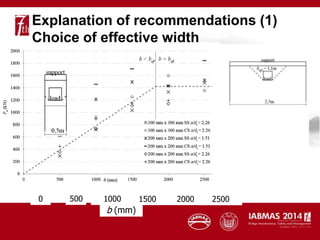
Explanation of recommendations (1)
Choice of effective width
5000 1000 1500 2000 2500
b (mm)
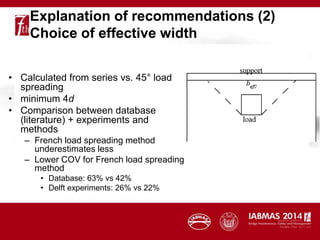
Explanation of recommendations (2)
Choice of effective width
• Calculated from series vs. 45° load
spreading
• minimum 4d
• Comparison between database
(literature) + experiments and
methods
– French load spreading method
underestimates less
– Lower COV for French load spreading
method
• Database: 63% vs 42%
• Delft experiments: 26% vs 22%
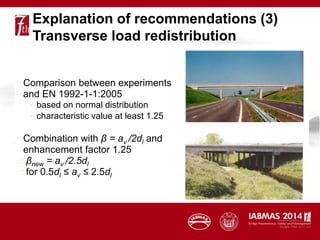
Explanation of recommendations (3)
Transverse load redistribution
• Comparison between experiments
and EN 1992-1-1:2005
• based on normal distribution
• characteristic value at least 1.25
• Combination with β = av /2dl and
enhancement factor 1.25
βnew = av /2.5dl
for 0.5dl ≤ av ≤ 2.5dl
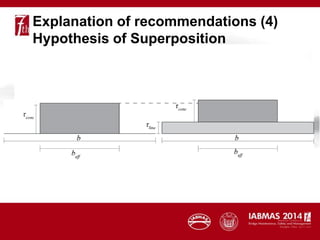
Explanation of recommendations (4)
Hypothesis of Superposition
Explanation of recommendations (5)
Hypothesis of Superposition
combination line conc   
'
,
3
'
,
c combi
c conc
f
f
Application to practice
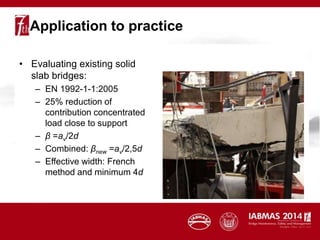
• Evaluating existing solid
slab bridges:
– EN 1992-1-1:2005
– 25% reduction of
contribution concentrated
load close to support
– β =av/2d
– Combined: βnew =av/2,5d
– Effective width: French
method and minimum 4d
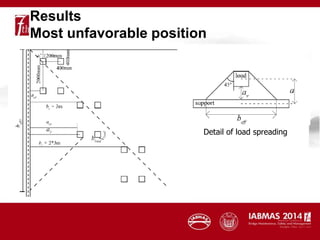
Results
Most unfavorable position
Detail of load spreading
Results
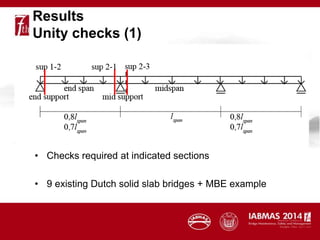
Unity checks (1)
• Checks required at indicated sections
• 9 existing Dutch solid slab bridges + MBE example
Results
Unity checks (2)
• Shear stresses: influence of recommendations
– QS-EC2: wheel loads at av = 2.5dl
– QS-Dutch Code: wheel loads at av = dl
– QS-EC2 18% reduction in loads
• Shear capacity:
– QS-EC2: vRd,c ~ ρ, d
– low reinforcement + deep section = small shear capacity
– QS-DutchCode: τ1 ~ fck only
• QS-EC2 improved selection ability
Summary & Conclusion
• Recommendations:
– effective width from French method
– minimum 4d
– reduction factor βnew = av /2.5dl
– superposition valid
• Quick Scan: tool for first round of
assessments
Contact:
Eva Lantsoght
E.O.L.Lantsoght@tudelft.nl / elantsoght@usfq.edu.ec

Recommendations for the Shear Assessment of Reinforced Concrete Solid Slab Bridges

  • 1.
    Recommendations for theShear Assessment of Reinforced Concrete Solid Slab Bridges Eva Lantsoght – Universidad San Francisco de Quito & Delft University of Technology Cor van der Veen - Delft University of Technology Ane de Boer – Rijkswaterstaat Joost Walraven – Delft University of Technology
  • 2.
    Problem statement Bridges from60s and 70s The Hague in 1959 Increased live loads common heavy and long truck (600 kN) End of service life + larger loads
  • 3.
    Highway network inthe Netherlands • NL: 60% of bridges built before 1976 • Assessment: shear critical in 600 slab bridges • Residual capacity? Highways in the Netherlands
  • 4.
    Assessment practice • Developmentof NEN 8700 series for existing structures Load Levels: New, Repair, Unfit for Use – Repair level: β < 3.8 (3.6 for bridges built before 2012) – EC • Level of Approximation approach in Model Code – LoA I: Quick Scan => unity check
  • 5.
    Explanation of recommendations(1) Choice of effective width 5000 1000 1500 2000 2500 b (mm)
  • 6.
    Explanation of recommendations(2) Choice of effective width • Calculated from series vs. 45° load spreading • minimum 4d • Comparison between database (literature) + experiments and methods – French load spreading method underestimates less – Lower COV for French load spreading method • Database: 63% vs 42% • Delft experiments: 26% vs 22%
  • 7.
    Explanation of recommendations(3) Transverse load redistribution • Comparison between experiments and EN 1992-1-1:2005 • based on normal distribution • characteristic value at least 1.25 • Combination with β = av /2dl and enhancement factor 1.25 βnew = av /2.5dl for 0.5dl ≤ av ≤ 2.5dl
  • 8.
    Explanation of recommendations(4) Hypothesis of Superposition
  • 9.
    Explanation of recommendations(5) Hypothesis of Superposition combination line conc    ' , 3 ' , c combi c conc f f
  • 10.
    Application to practice •Evaluating existing solid slab bridges: – EN 1992-1-1:2005 – 25% reduction of contribution concentrated load close to support – β =av/2d – Combined: βnew =av/2,5d – Effective width: French method and minimum 4d
  • 11.
  • 12.
    Results Unity checks (1) •Checks required at indicated sections • 9 existing Dutch solid slab bridges + MBE example
  • 13.
    Results Unity checks (2) •Shear stresses: influence of recommendations – QS-EC2: wheel loads at av = 2.5dl – QS-Dutch Code: wheel loads at av = dl – QS-EC2 18% reduction in loads • Shear capacity: – QS-EC2: vRd,c ~ ρ, d – low reinforcement + deep section = small shear capacity – QS-DutchCode: τ1 ~ fck only • QS-EC2 improved selection ability
  • 14.
    Summary & Conclusion •Recommendations: – effective width from French method – minimum 4d – reduction factor βnew = av /2.5dl – superposition valid • Quick Scan: tool for first round of assessments
  • 15.