MANUAL HANDLING
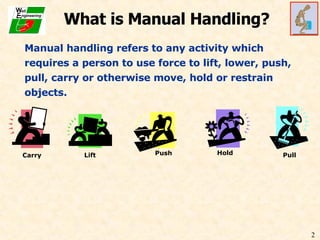
What is Manual Handling? Manual handling refers to any activity which requires a person to use force to lift, lower, push, pull, carry or otherwise move, hold or restrain objects. Carry Lift Push Pull Hold
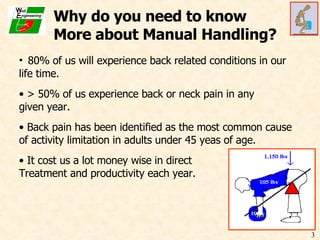
Why do you need to know More about Manual Handling? 80% of us will experience back related conditions in our  life time. > 50% of us experience back or neck pain in any  given year. Back pain has been identified as the most common cause  of activity limitation in adults under 45 yeas of age. It cost us a lot money wise in direct Treatment and productivity each year.
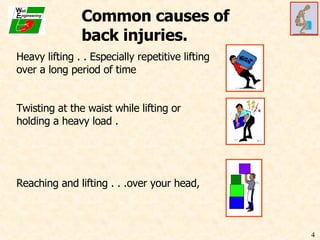
Common causes of  back injuries. Heavy lifting . . Especially repetitive lifting over a long period of time Twisting at the waist while lifting or holding a heavy load . Reaching and lifting . . .over your head,
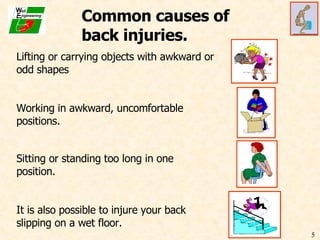
Common causes of  back injuries. Lifting or carrying objects with awkward or odd shapes Working in awkward, uncomfortable positions. Sitting or standing too long in one position.  It is also possible to injure your back slipping on a wet floor.
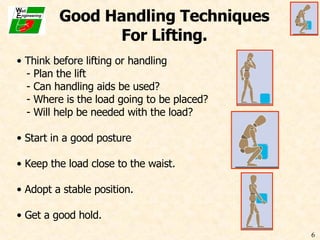
Good Handling Techniques For Lifting. Think before lifting or handling - Plan the lift - Can handling aids be used? - Where is the load going to be placed? - Will help be needed with the load? Start in a good posture Keep the load close to the waist. Adopt a stable position. Get a good hold.
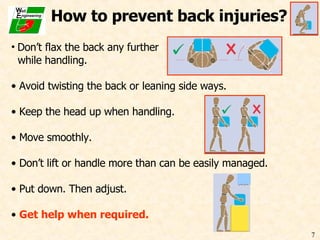
How to prevent back injuries? Don’t flax the back any further  while handling. Avoid twisting the back or leaning side ways. Keep the head up when handling.  Move smoothly. Don’t lift or handle more than can be easily managed. Put down. Then adjust.  Get help when required.
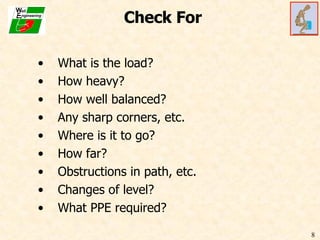
Check For What is the load? How heavy? How well balanced? Any sharp corners, etc. Where is it to go? How far? Obstructions in path, etc. Changes of level? What PPE required?
Kinetic Lifting Technique for a Simple Load Lifting Techniques
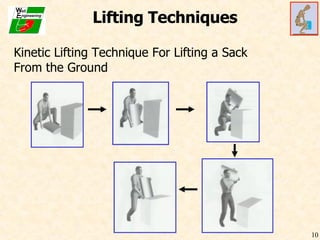
Lifting Techniques Kinetic Lifting Technique For Lifting a Sack From the Ground
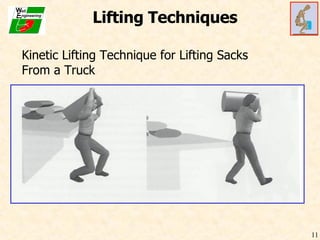
Lifting Techniques Kinetic Lifting Technique for Lifting Sacks From a Truck
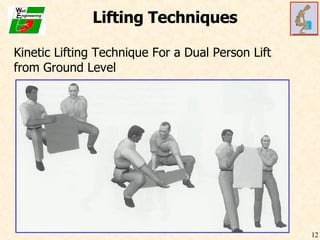
Lifting Techniques Kinetic Lifting Technique For a Dual Person Lift from Ground Level
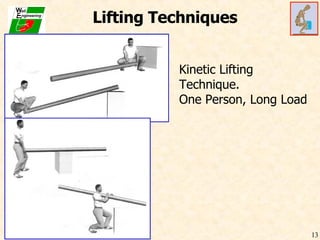
Lifting Techniques Kinetic Lifting Technique. One Person, Long Load
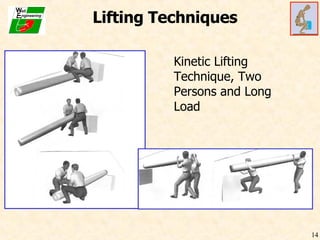
Lifting Techniques Kinetic Lifting Technique, Two Persons and Long Load
Lifting Techniques WRONG RIGHT Kinetic Lifting Technique, Sheets/Boards
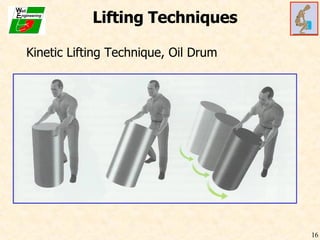
Lifting Techniques Kinetic Lifting Technique, Oil Drum
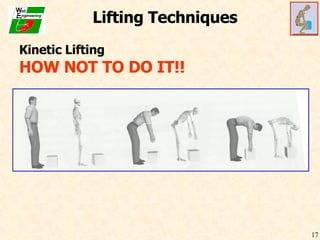
Lifting Techniques Kinetic Lifting HOW NOT TO DO IT!!
Things You Can Do To  Help Your Back. You can minimize problems with your back by exercises  that tone the muscles in your back, hips and thighs. Before beginning any exercise program, you should check  with your doctor and follow his advice.
Final Thoughts Take care of your back… And it will take care of you Exercise daily Avoid Heavy Lifting Get Help with heavy or bulky objects Avoid twisting at the waist when carrying objects Always watch where you’re going. Practicing good lifting technique does not enable you to lift more than you could before.  It means that, whatever your individual capabilities, your chances of injury are reduced.
Thank You

Manual Lifting

  • 1.
  • 2.
    What is ManualHandling? Manual handling refers to any activity which requires a person to use force to lift, lower, push, pull, carry or otherwise move, hold or restrain objects. Carry Lift Push Pull Hold
  • 3.
    Why do youneed to know More about Manual Handling? 80% of us will experience back related conditions in our life time. > 50% of us experience back or neck pain in any given year. Back pain has been identified as the most common cause of activity limitation in adults under 45 yeas of age. It cost us a lot money wise in direct Treatment and productivity each year.
  • 4.
    Common causes of back injuries. Heavy lifting . . Especially repetitive lifting over a long period of time Twisting at the waist while lifting or holding a heavy load . Reaching and lifting . . .over your head,
  • 5.
    Common causes of back injuries. Lifting or carrying objects with awkward or odd shapes Working in awkward, uncomfortable positions. Sitting or standing too long in one position. It is also possible to injure your back slipping on a wet floor.
  • 6.
    Good Handling TechniquesFor Lifting. Think before lifting or handling - Plan the lift - Can handling aids be used? - Where is the load going to be placed? - Will help be needed with the load? Start in a good posture Keep the load close to the waist. Adopt a stable position. Get a good hold.
  • 7.
    How to preventback injuries? Don’t flax the back any further while handling. Avoid twisting the back or leaning side ways. Keep the head up when handling. Move smoothly. Don’t lift or handle more than can be easily managed. Put down. Then adjust. Get help when required.
  • 8.
    Check For Whatis the load? How heavy? How well balanced? Any sharp corners, etc. Where is it to go? How far? Obstructions in path, etc. Changes of level? What PPE required?
  • 9.
    Kinetic Lifting Techniquefor a Simple Load Lifting Techniques
  • 10.
    Lifting Techniques KineticLifting Technique For Lifting a Sack From the Ground
  • 11.
    Lifting Techniques KineticLifting Technique for Lifting Sacks From a Truck
  • 12.
    Lifting Techniques KineticLifting Technique For a Dual Person Lift from Ground Level
  • 13.
    Lifting Techniques KineticLifting Technique. One Person, Long Load
  • 14.
    Lifting Techniques KineticLifting Technique, Two Persons and Long Load
  • 15.
    Lifting Techniques WRONGRIGHT Kinetic Lifting Technique, Sheets/Boards
  • 16.
    Lifting Techniques KineticLifting Technique, Oil Drum
  • 17.
    Lifting Techniques KineticLifting HOW NOT TO DO IT!!
  • 18.
    Things You CanDo To Help Your Back. You can minimize problems with your back by exercises that tone the muscles in your back, hips and thighs. Before beginning any exercise program, you should check with your doctor and follow his advice.
  • 19.
    Final Thoughts Takecare of your back… And it will take care of you Exercise daily Avoid Heavy Lifting Get Help with heavy or bulky objects Avoid twisting at the waist when carrying objects Always watch where you’re going. Practicing good lifting technique does not enable you to lift more than you could before. It means that, whatever your individual capabilities, your chances of injury are reduced.
  • 20.

Editor's Notes

  • #2 Some results of heat strain: In one night, 123 of 186 British Soldiers died of heat stroke in Black Hole of Calcutta In one night, 194 of 281 civilians died while imprisoned for one night in the Sudan In the First World War, in Mesopotamia, 426 heat stroke deaths were counted in one month. In the Second World War, 125 army recruits died in intensive training camps in the Southern USA in one year There is a general figure of around 2 per 1000 workers expected to be at risk