8/23/2013 1
HEALTH HAZARDS OF
BIOMEDICAL WASTE &
ITS MANAGEMENT
PRESENTED BY :- DR.NAVIN KUMAR
8/23/2013 2
LET THE WASTE OF THE
“SICK” NOT CONTAMINATE
THE LIVES OF
“THE HEALTHY”.
K.park
8/23/2013 3
DEFINITION
CATEGORIES OF BIOMEDICAL WASTE
PROBLEM ASSOCIATED WITH BIOMEDICAL WASTE
NEED FOR BIOMEDICAL WASTE MANAGEMENT
STEP TO MANAGE HAZARDOUS WASTE
TREATMENT TECHNIQUES
BIOMEDICAL WASTE MANAGEMENT IN INDIA
ENVIRONMENTAL LEGISLATION
CONCLUSION
CONTENTS
8/23/2013 4
DEFINATION:
ANY WASTE WHICH IS
GENERATED DURING THE
DIAGNOSIS, TREATMENT OR
IMMUNIZATION OF HUMAN
BEINGS OR ANIMALS OR IN
RESEARCH ACTIVITIES
PERTAINING THERE TO OR IN THE
PRODUCTION OR TESTING OF BIO
MEDICALS.
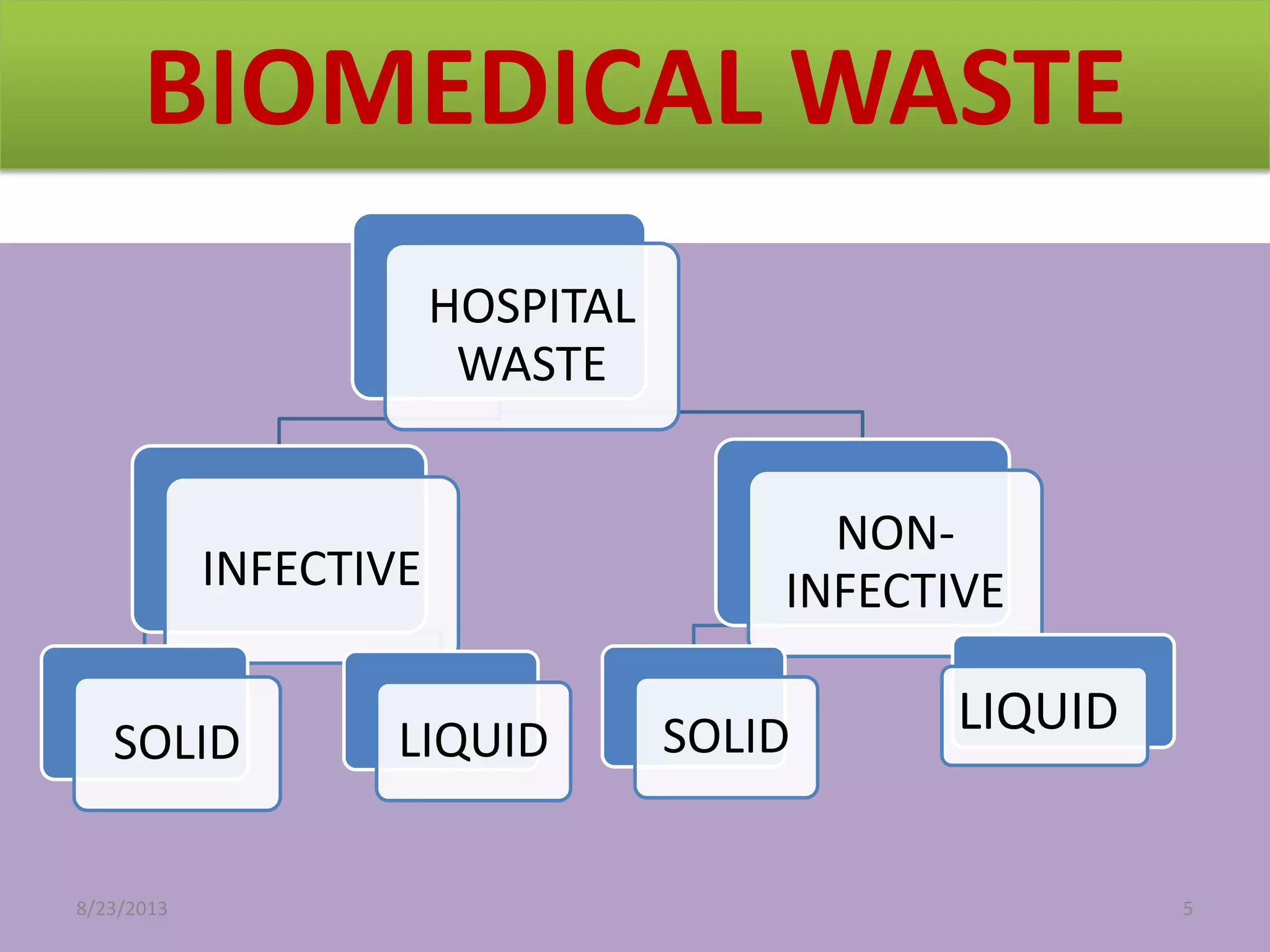
BIOMEDICAL WASTE
HOSPITAL
WASTE
INFECTIVE
SOLID LIQUID
NON-
INFECTIVE
SOLID
8/23/2013 5
LIQUID
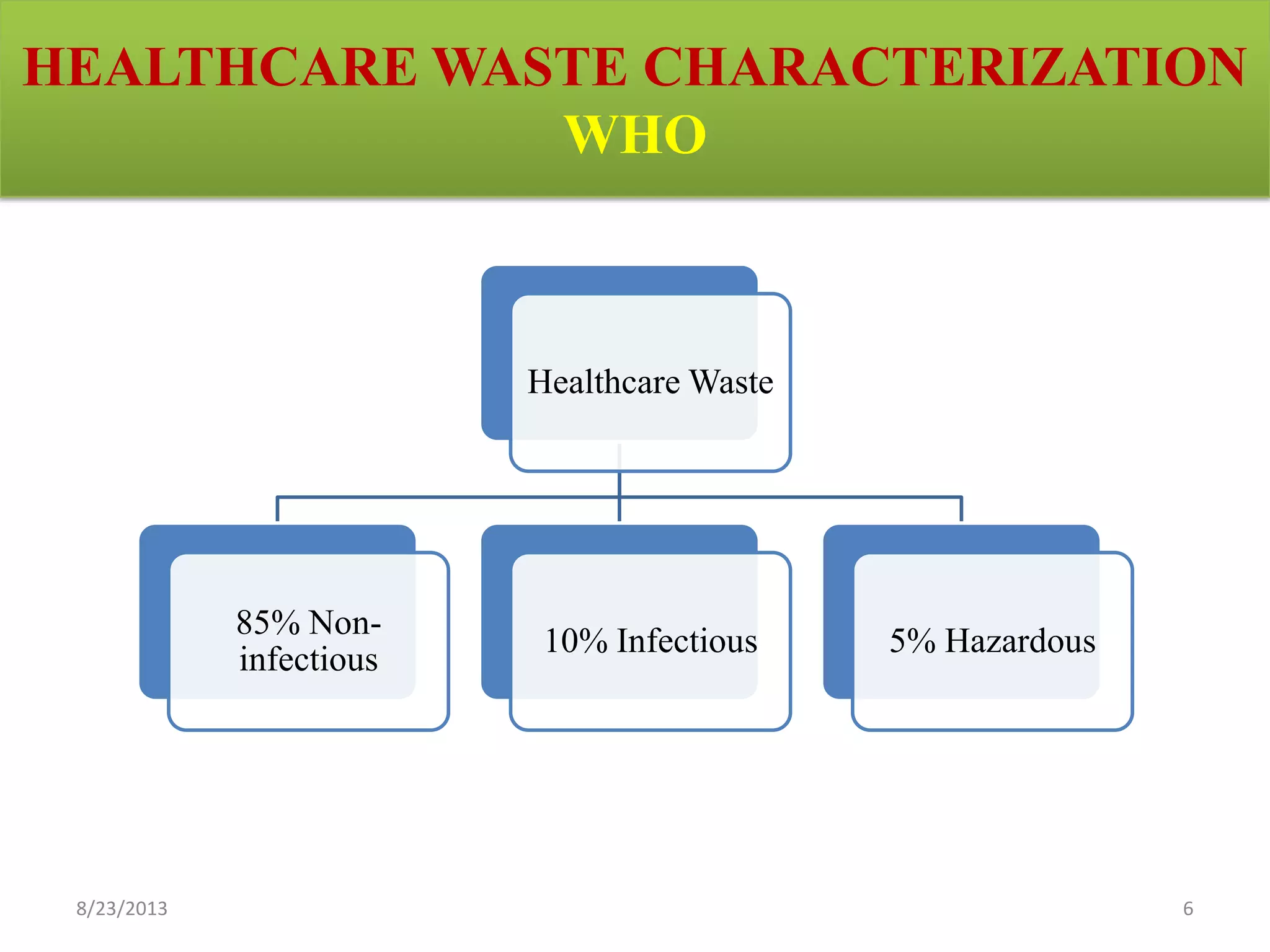
HEALTHCARE WASTE CHARACTERIZATION
WHO
8/23/2013 6
Healthcare Waste
85% Non-
infectious
10% Infectious 5% Hazardous
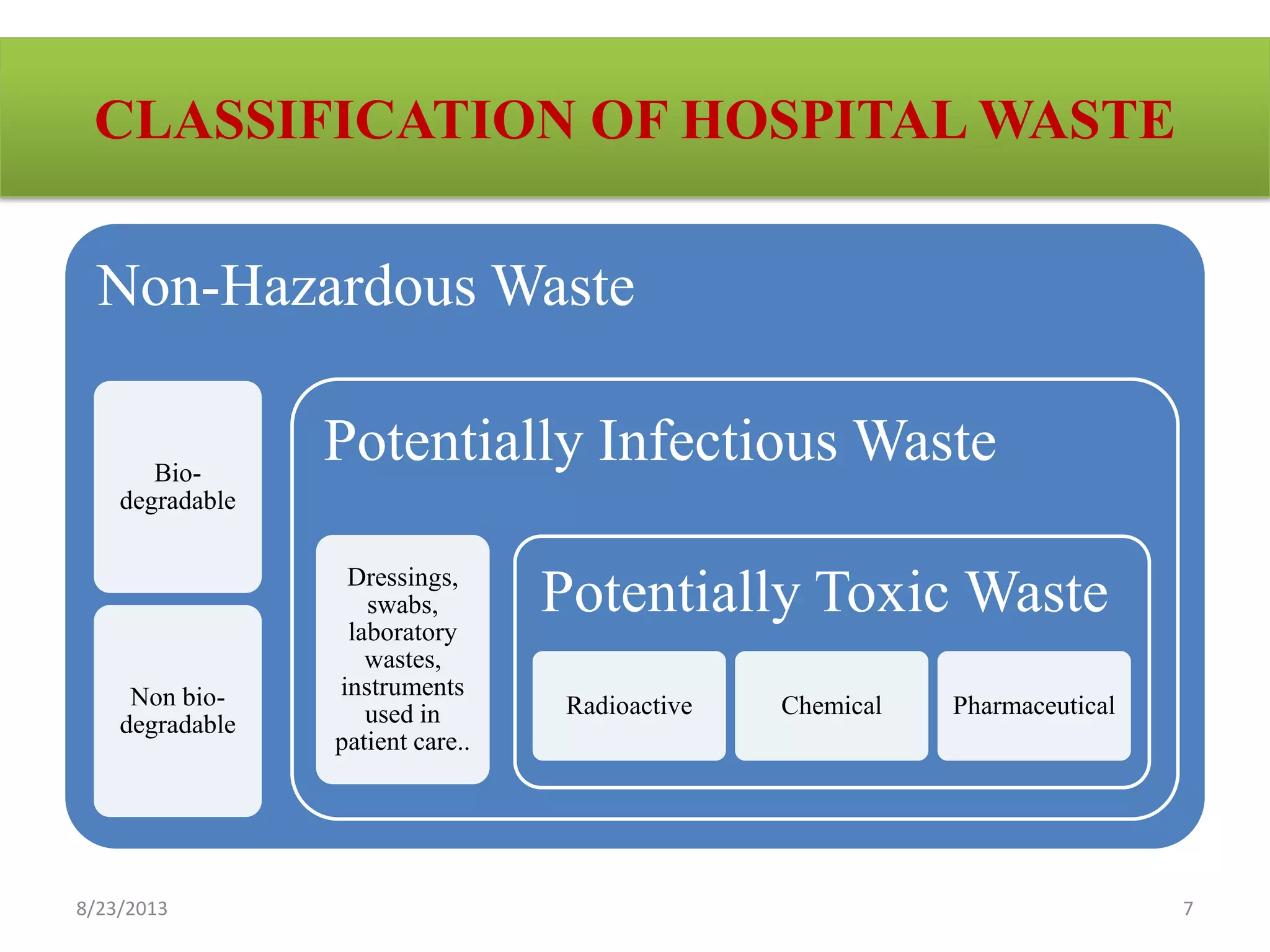
CLASSIFICATION OF HOSPITAL WASTE
Non-Hazardous Waste
Bio-
degradable
Non bio-
degradable
Potentially Infectious Waste
Dressings,
swabs,
laboratory
wastes,
instruments
used in
patient care..
Potentially Toxic Waste
Radioactive Chemical Pharmaceutical
8/23/2013 7
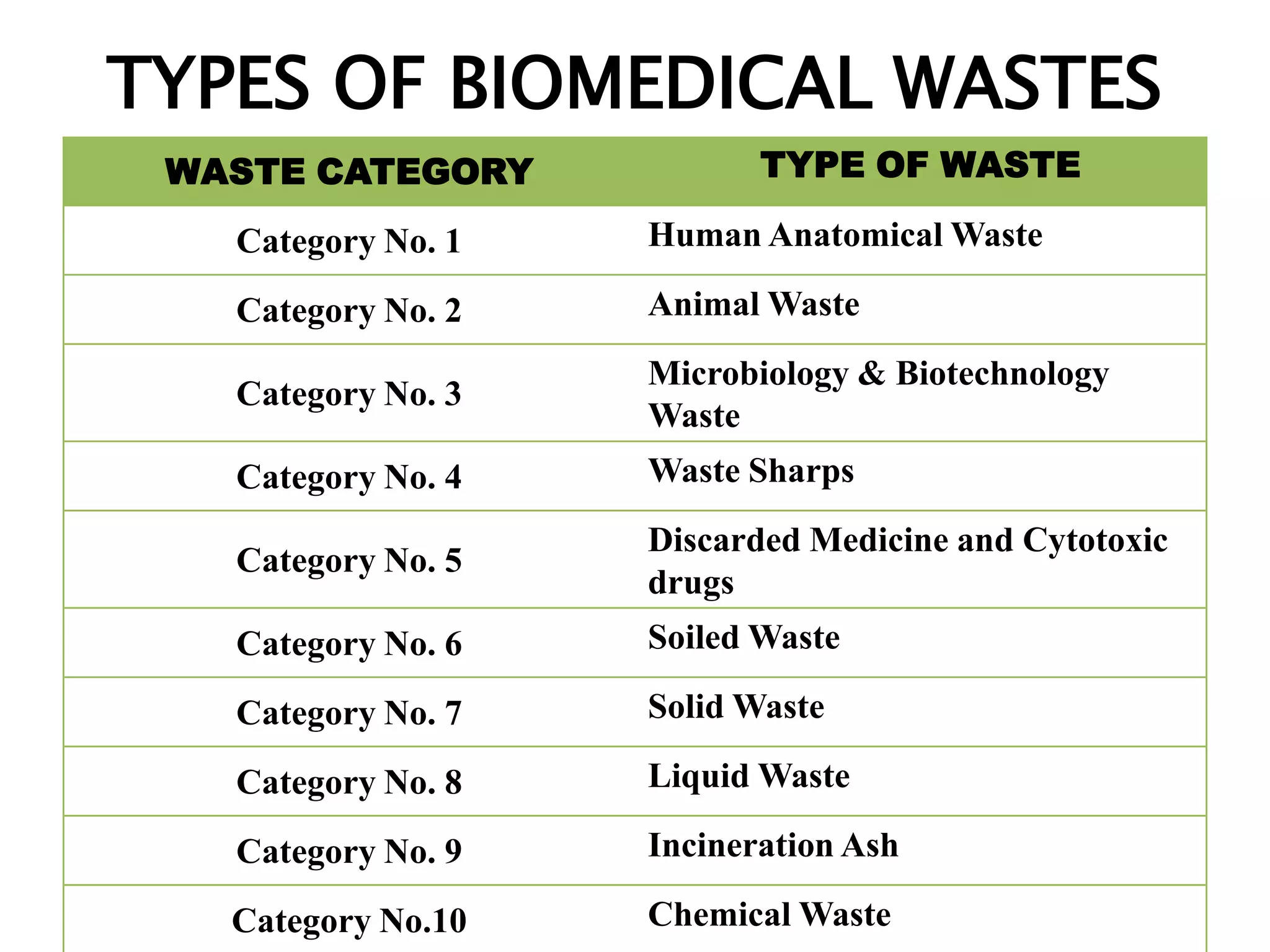
TYPES OF BIOMEDICAL WASTES
WASTE CATEGORY TYPE OF WASTE
Category No. 1 Human Anatomical Waste
Category No. 2 Animal Waste
Category No. 3
Microbiology & Biotechnology
Waste
Category No. 4 Waste Sharps
Category No. 5
Discarded Medicine and Cytotoxic
drugs
Category No. 6 Soiled Waste
Category No. 7 Solid Waste
Category No. 8 Liquid Waste
Category No. 9 Incineration Ash
Category No.10 Chemical Waste
 Chemical
waste
 Waste with
high content of
heavy metals
 Pressurized
containers
 Radioactive
waste
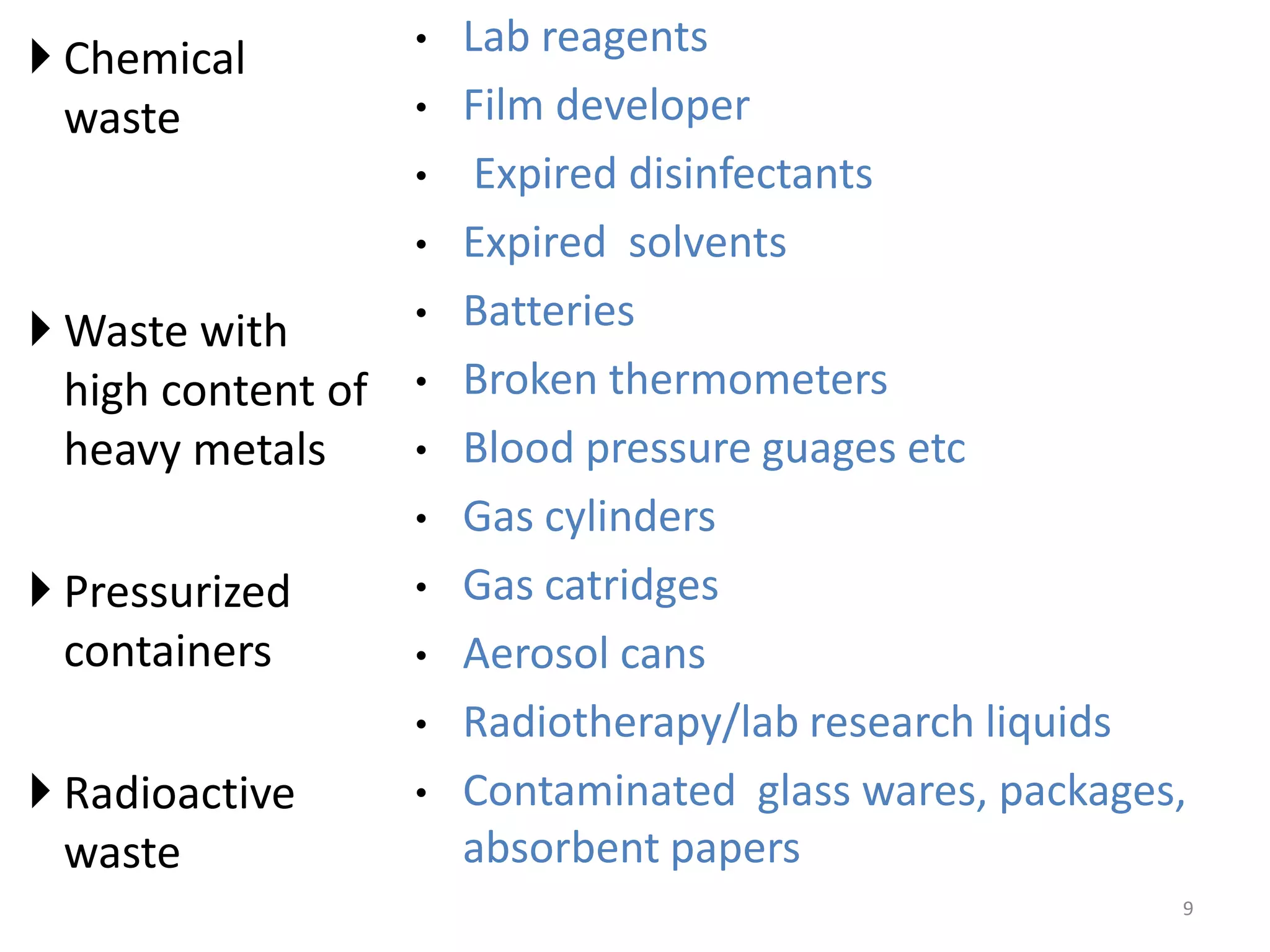
• Lab reagents
• Film developer
• Expired disinfectants
• Expired solvents
• Batteries
• Broken thermometers
• Blood pressure guages etc
• Gas cylinders
• Gas catridges
• Aerosol cans
• Radiotherapy/lab research liquids
• Contaminated glass wares, packages,
absorbent papers
9
 Sharp waste
 Pharmaceutical
waste
 Genotoxic waste
• Needles
• Infusion Sets
• Scalpels
• Knives Blades
• Broken Glass
• Expired Pharmaceuticals
• Contaminated Pharmaceuticals
• Banned Pharmaceuticals
• Waste Containing Cytotoxic
Drugs(often Used In Cancer
Therapy)
• Genotoxic Chemicals
10
HISTORY OF BIOMEDICAL WASTE
August 13, 1987, prompted expansive closures of
numerous New Jersey and New York beaches due to
a “30-mile garbage slick” composed primarily
of medical and household wastes because of illegal
disposal of the waste
private waste contractors to dump illegally to avoid
high fees.
Medical Waste Tracking Act of 1988 (MWTA).
8/23/2013 11
8/23/2013 12
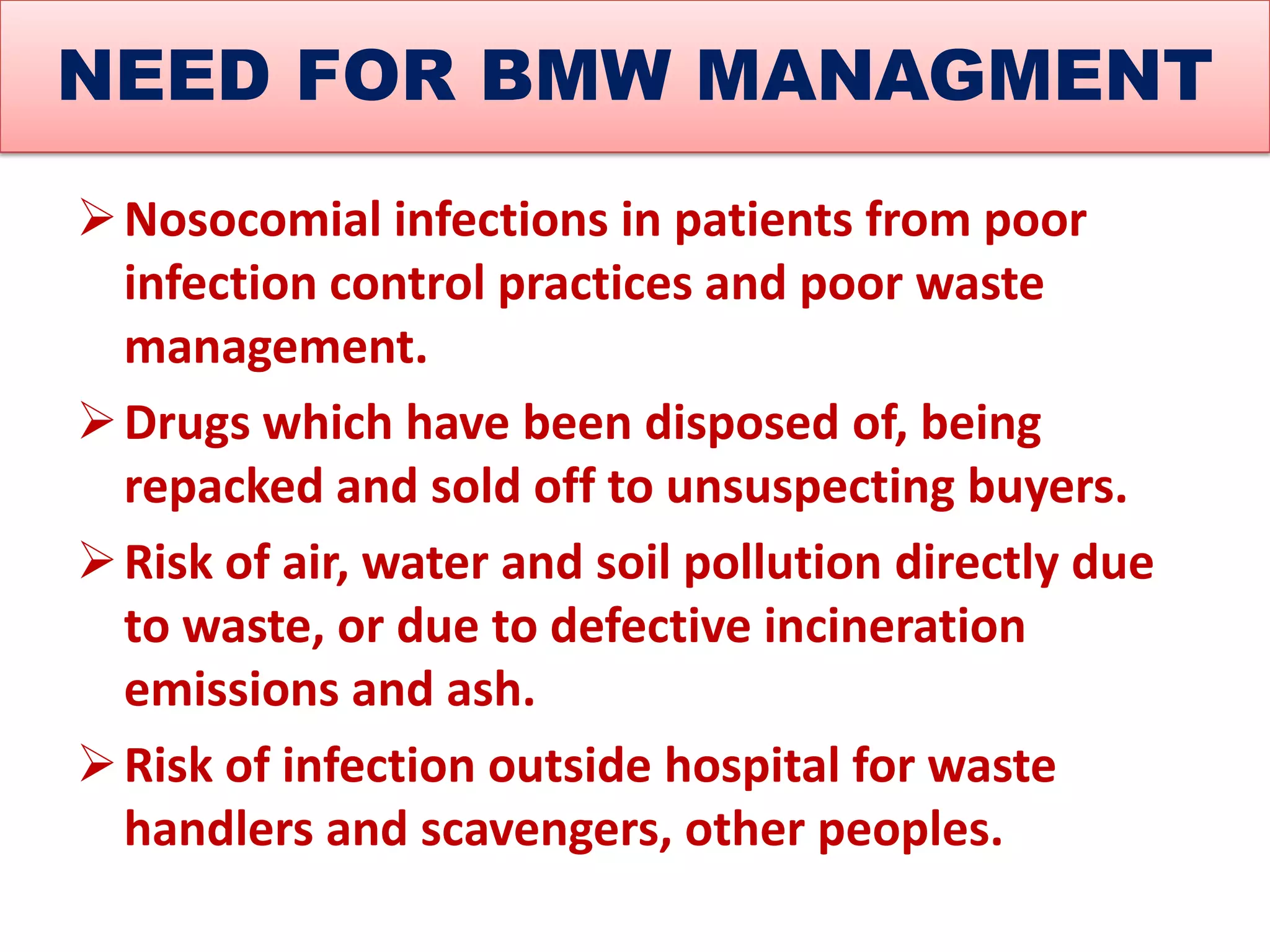
NEED FOR BMW MANAGMENT
Nosocomial infections in patients from poor
infection control practices and poor waste
management.
Drugs which have been disposed of, being
repacked and sold off to unsuspecting buyers.
Risk of air, water and soil pollution directly due
to waste, or due to defective incineration
emissions and ash.
Risk of infection outside hospital for waste
handlers and scavengers, other peoples.
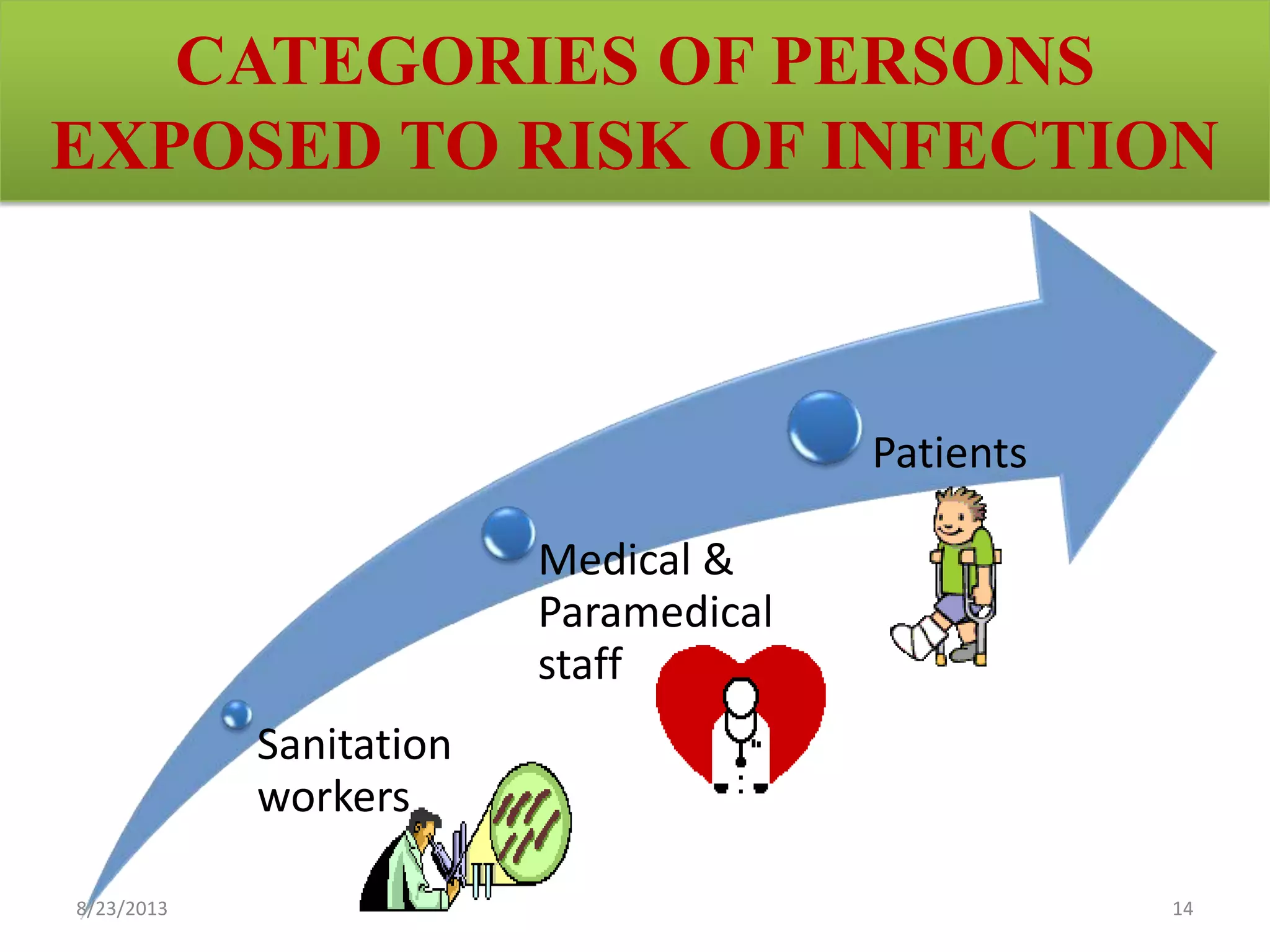
CATEGORIES OF PERSONS
EXPOSED TO RISK OF INFECTION
Sanitation
workers
Medical &
Paramedical
staff
Patients
8/23/2013 14
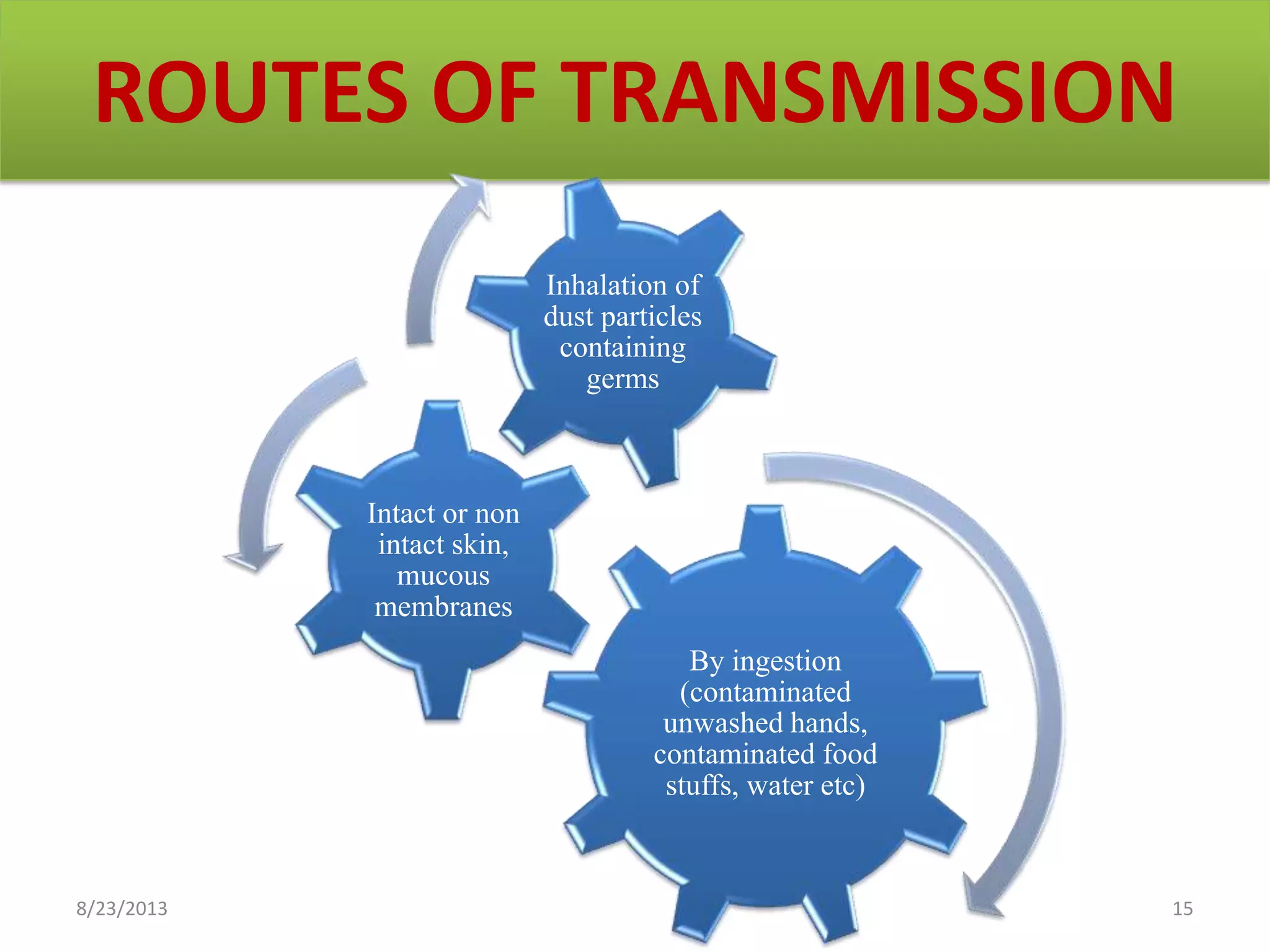
ROUTES OF TRANSMISSION
By ingestion
(contaminated
unwashed hands,
contaminated food
stuffs, water etc)
Intact or non
intact skin,
mucous
membranes
Inhalation of
dust particles
containing
germs
8/23/2013 15
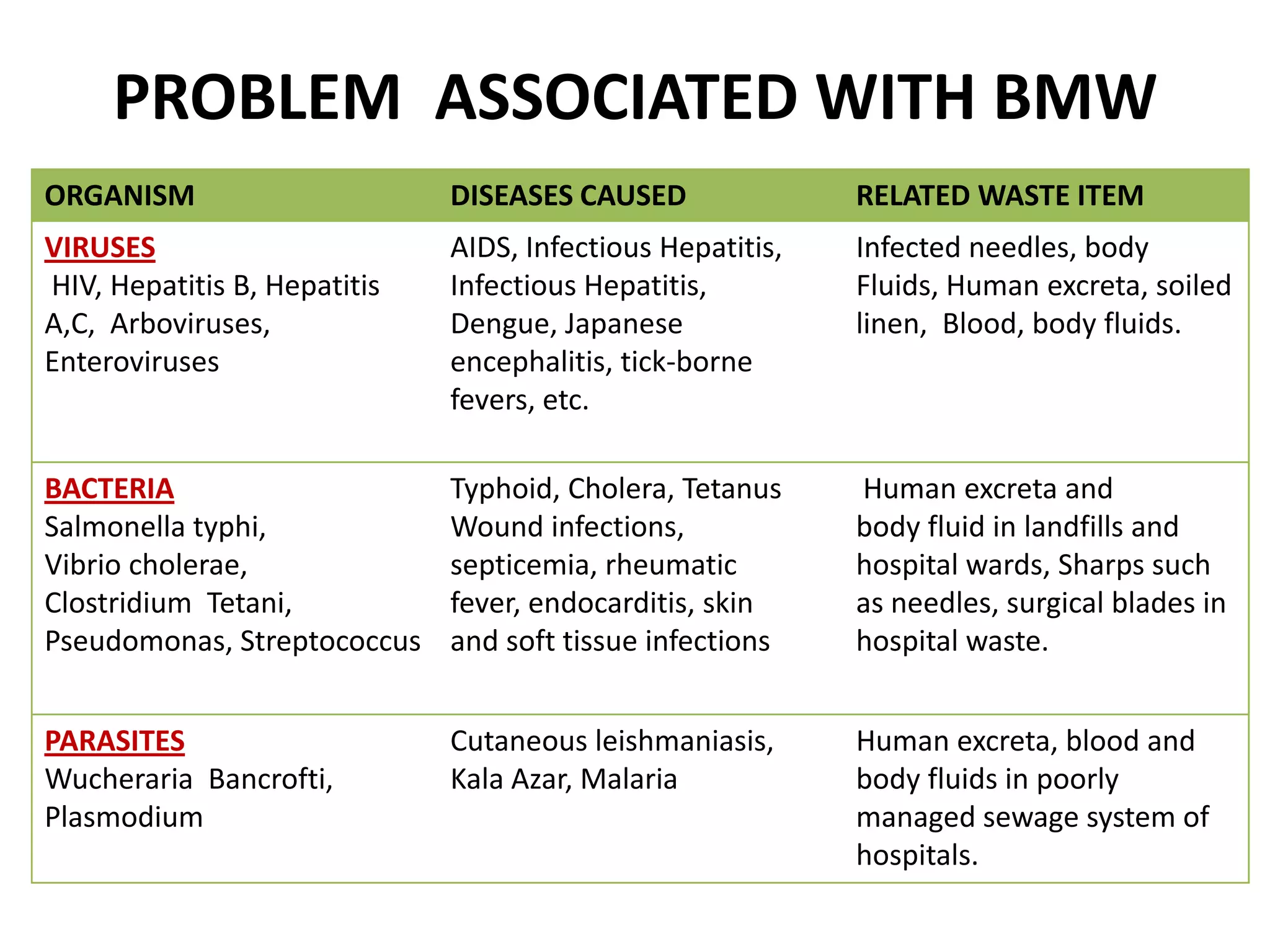
PROBLEM ASSOCIATED WITH BMW
ORGANISM DISEASES CAUSED RELATED WASTE ITEM
VIRUSES
HIV, Hepatitis B, Hepatitis
A,C, Arboviruses,
Enteroviruses
AIDS, Infectious Hepatitis,
Infectious Hepatitis,
Dengue, Japanese
encephalitis, tick-borne
fevers, etc.
Infected needles, body
Fluids, Human excreta, soiled
linen, Blood, body fluids.
BACTERIA
Salmonella typhi,
Vibrio cholerae,
Clostridium Tetani,
Pseudomonas, Streptococcus
Typhoid, Cholera, Tetanus
Wound infections,
septicemia, rheumatic
fever, endocarditis, skin
and soft tissue infections
Human excreta and
body fluid in landfills and
hospital wards, Sharps such
as needles, surgical blades in
hospital waste.
PARASITES
Wucheraria Bancrofti,
Plasmodium
Cutaneous leishmaniasis,
Kala Azar, Malaria
Human excreta, blood and
body fluids in poorly
managed sewage system of
hospitals.
8/23/2013 17
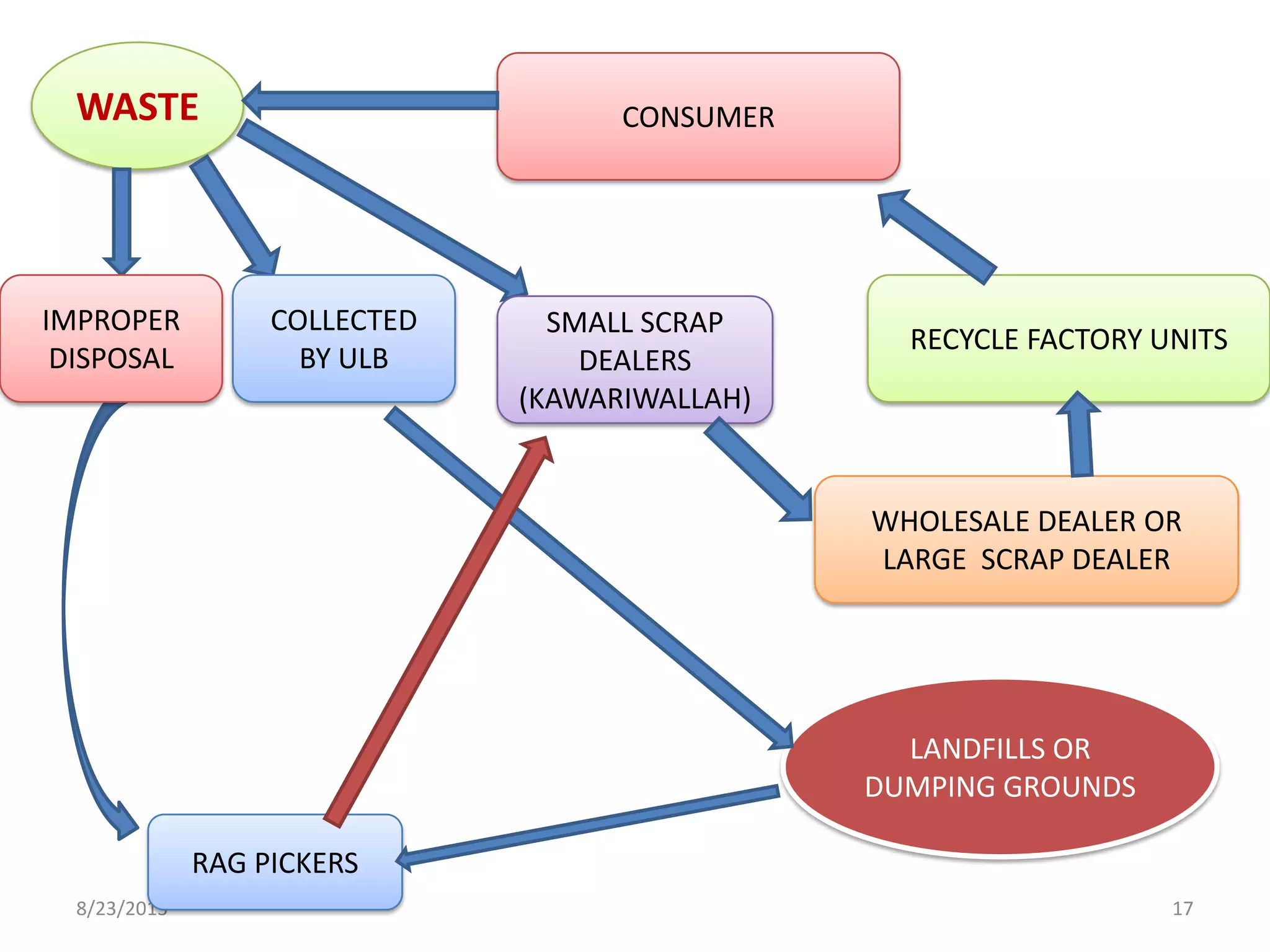
WASTE
IMPROPER
DISPOSAL
COLLECTED
BY ULB
SMALL SCRAP
DEALERS
(KAWARIWALLAH)
RAG PICKERS
LANDFILLS OR
DUMPING GROUNDS
WHOLESALE DEALER OR
LARGE SCRAP DEALER
RECYCLE FACTORY UNITS
CONSUMER
8/23/2013 18
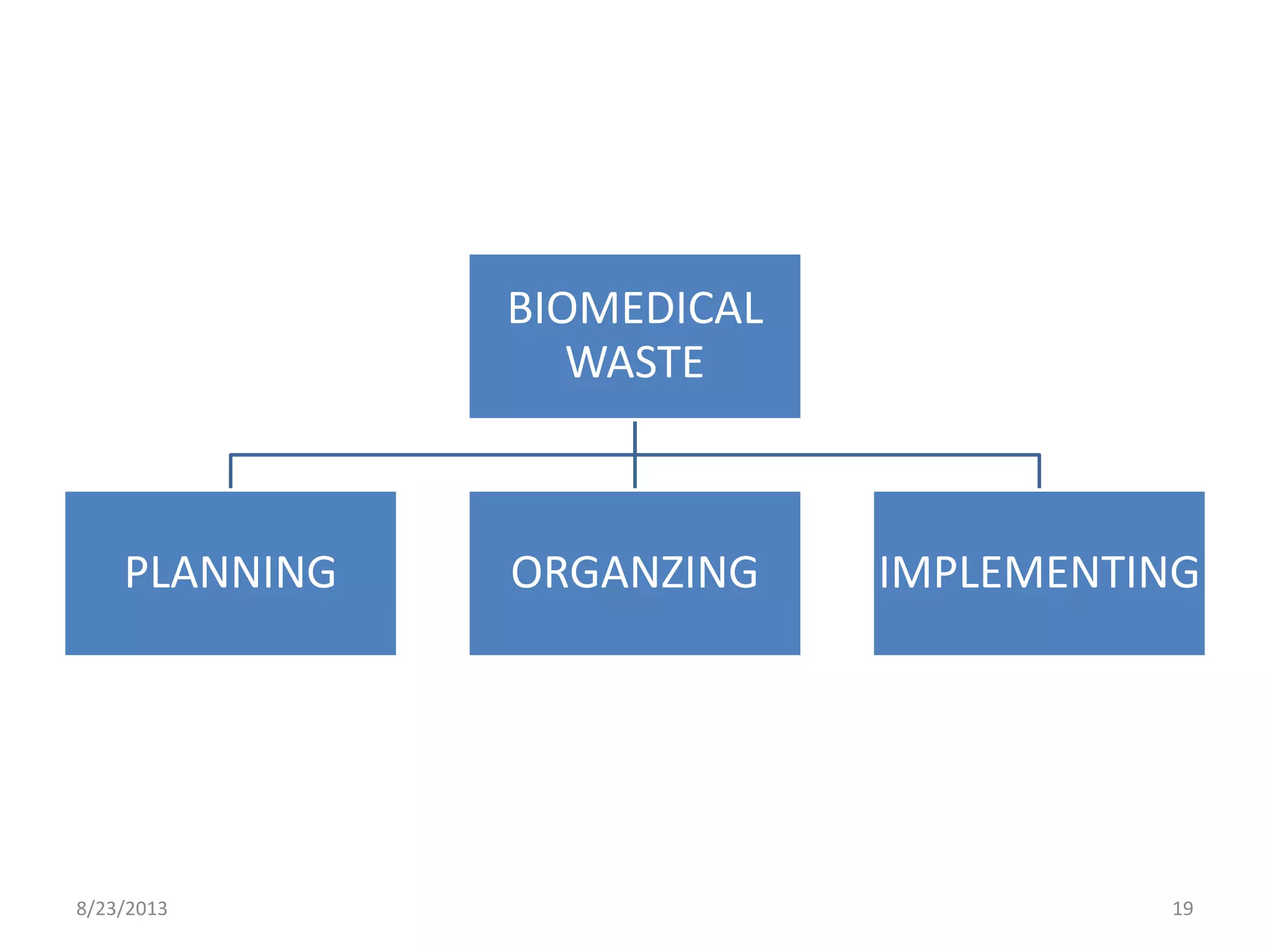
BIOMEDICAL
WASTE
PLANNING ORGANZING IMPLEMENTING
8/23/2013 19
WASTE HIERARCHY PYRAMID
8/23/2013 20
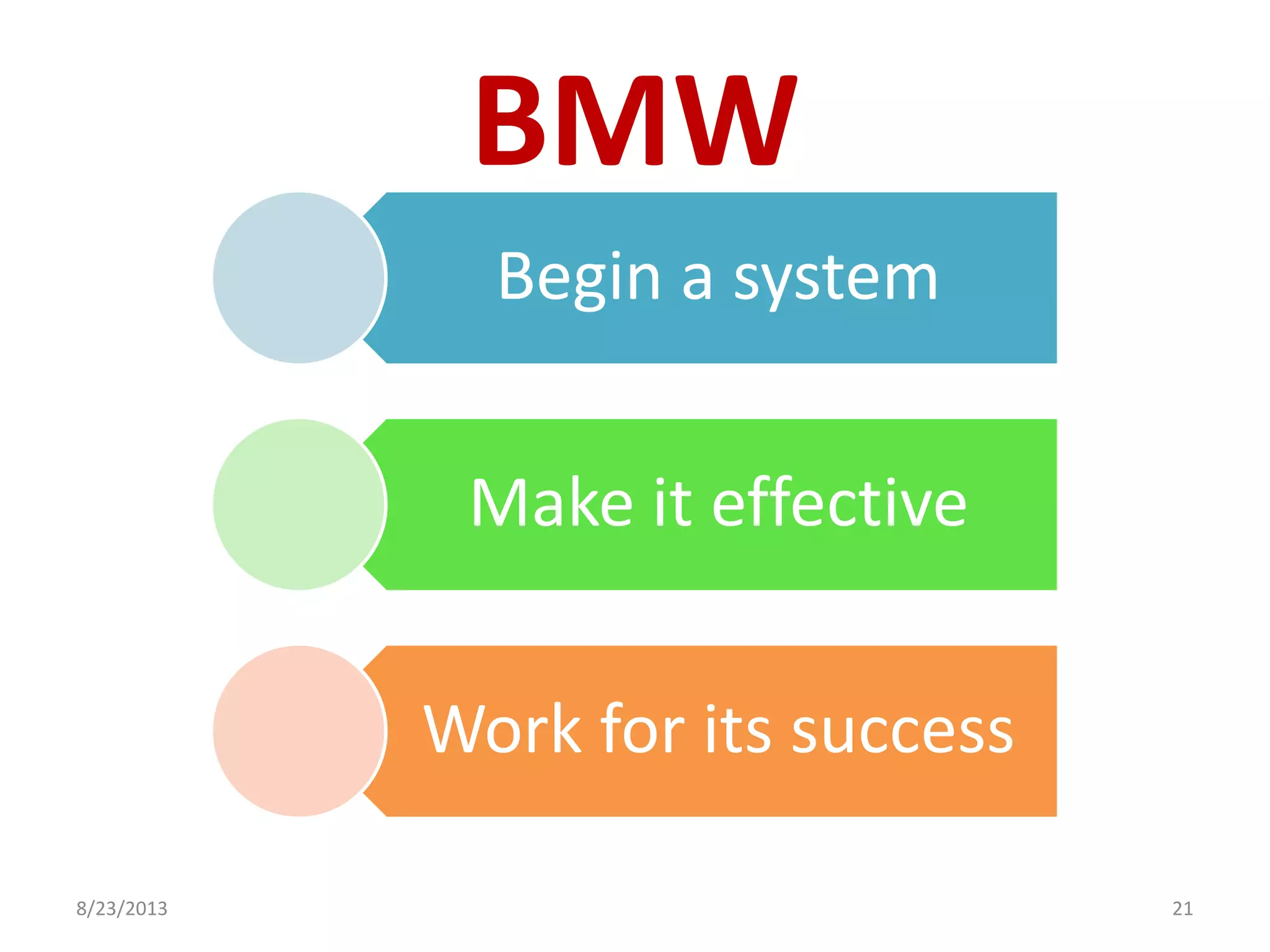
BMW
Begin a system
Make it effective
Work for its success
8/23/2013 21
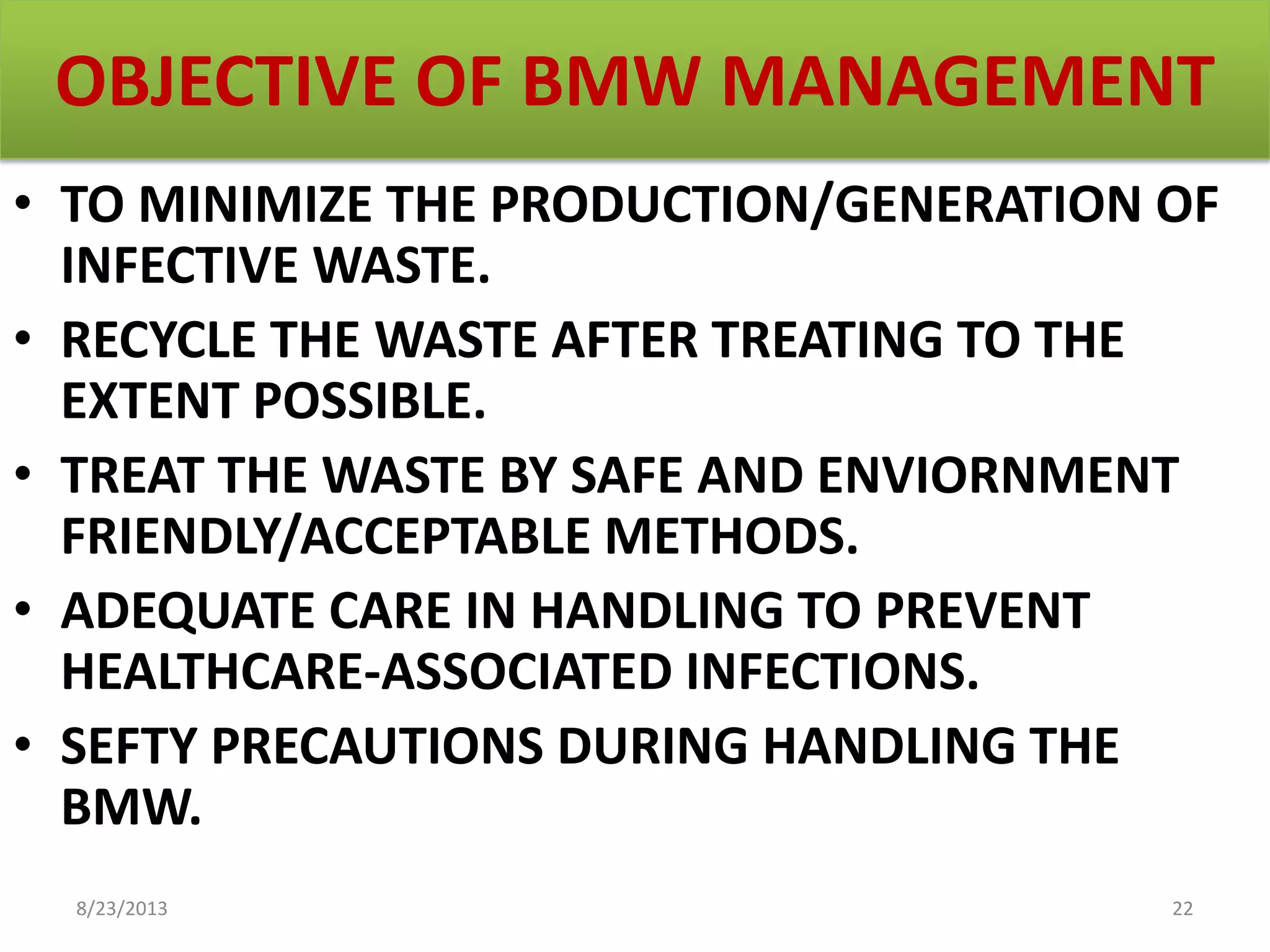
OBJECTIVE OF BMW MANAGEMENT
• TO MINIMIZE THE PRODUCTION/GENERATION OF
INFECTIVE WASTE.
• RECYCLE THE WASTE AFTER TREATING TO THE
EXTENT POSSIBLE.
• TREAT THE WASTE BY SAFE AND ENVIORNMENT
FRIENDLY/ACCEPTABLE METHODS.
• ADEQUATE CARE IN HANDLING TO PREVENT
HEALTHCARE-ASSOCIATED INFECTIONS.
• SEFTY PRECAUTIONS DURING HANDLING THE
BMW.
8/23/2013 22
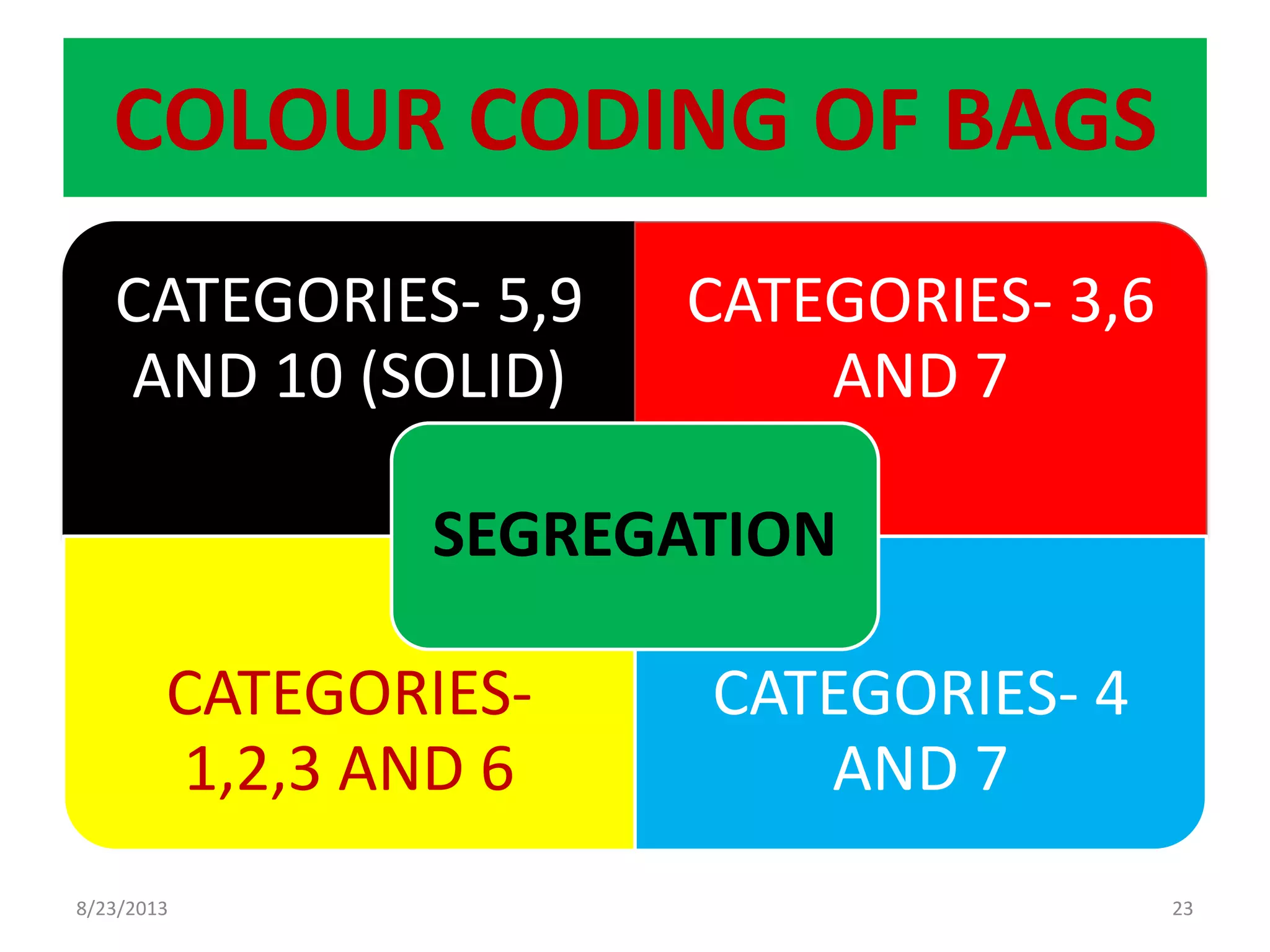
COLOUR CODING OF BAGS
CATEGORIES- 5,9
AND 10 (SOLID)
CATEGORIES- 3,6
AND 7
CATEGORIES-
1,2,3 AND 6
CATEGORIES- 4
AND 7
SEGREGATION
8/23/2013 23
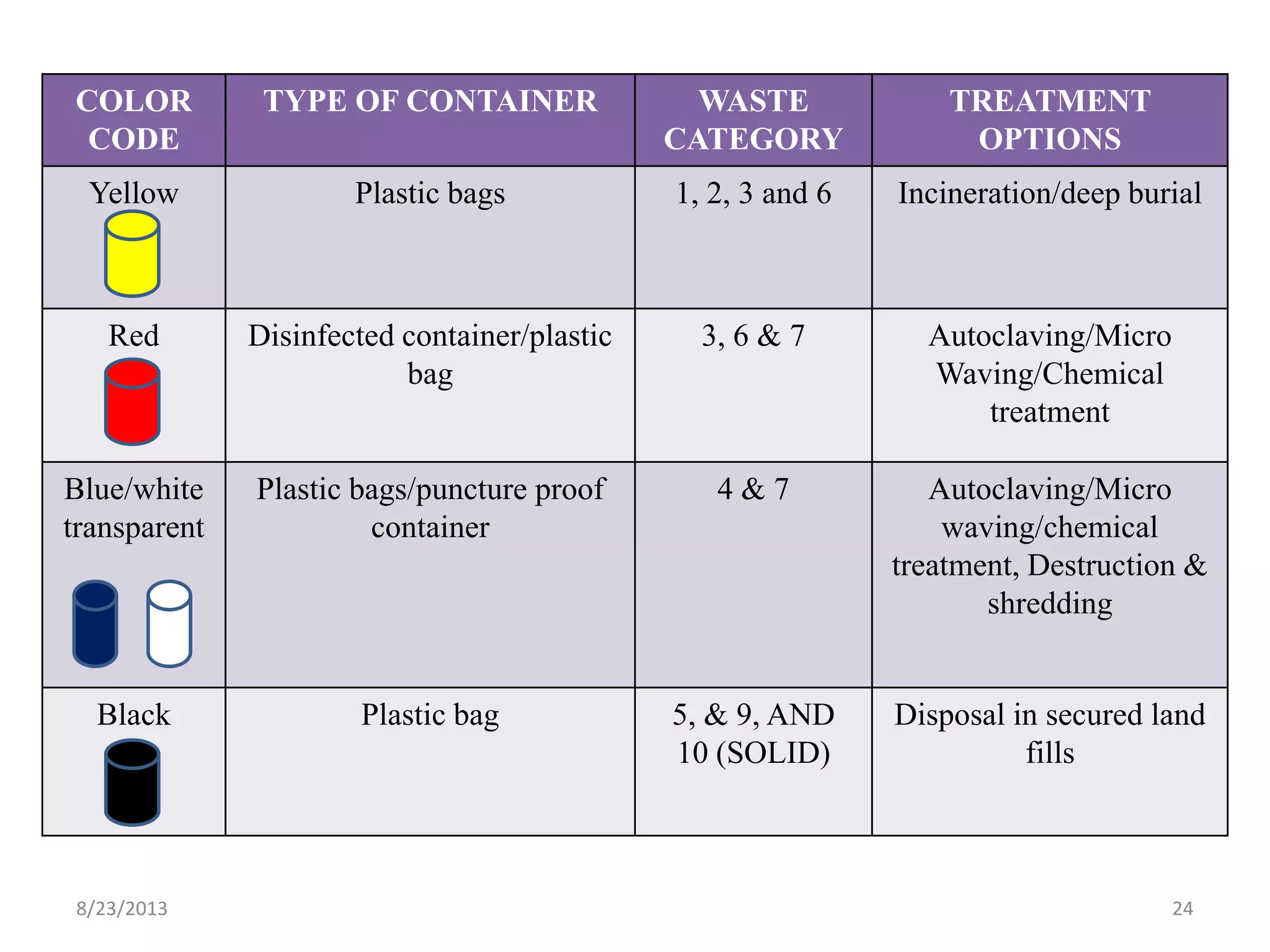
COLOR
CODE
TYPE OF CONTAINER WASTE
CATEGORY
TREATMENT
OPTIONS
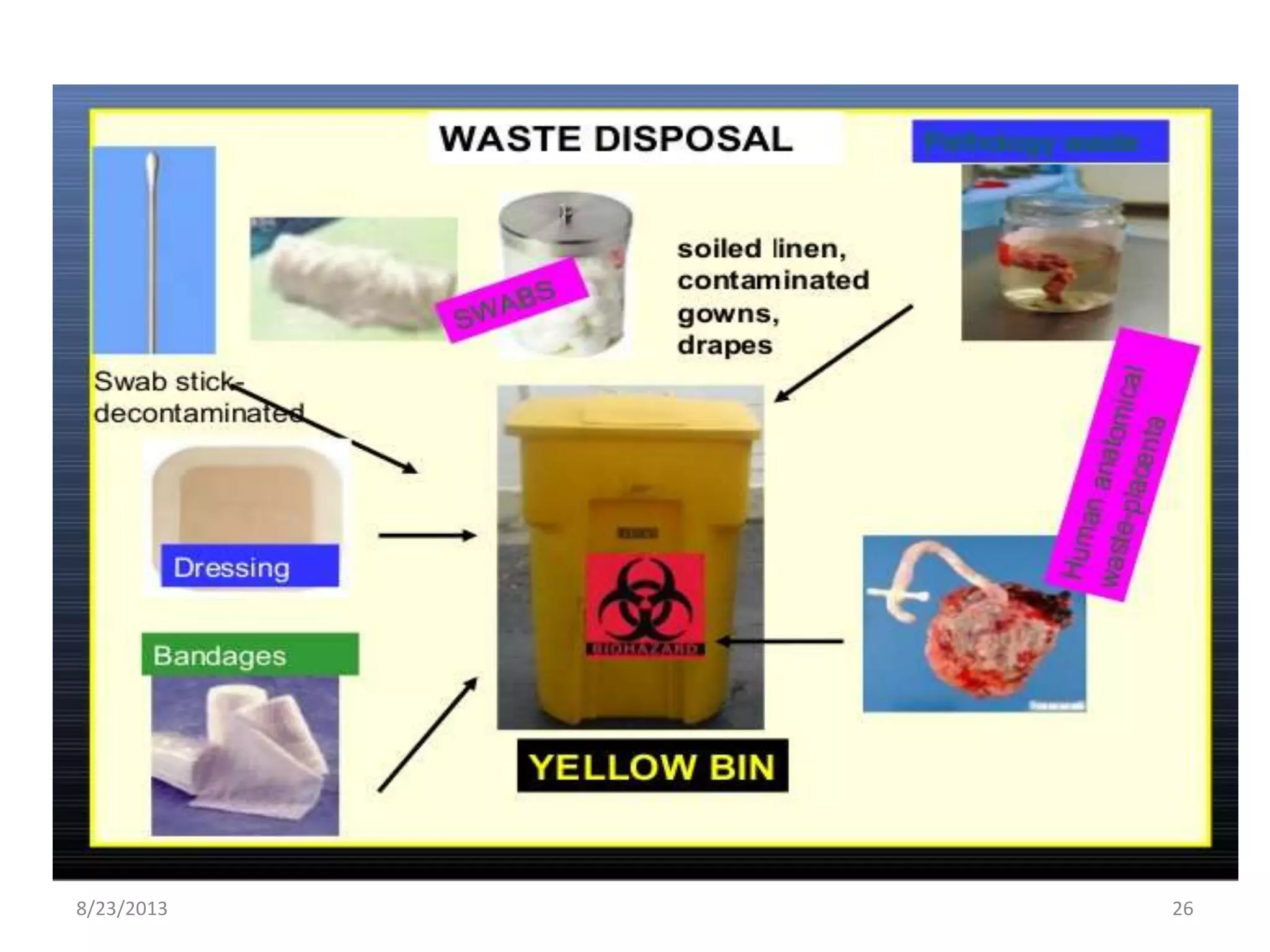
Yellow Plastic bags 1, 2, 3 and 6 Incineration/deep burial
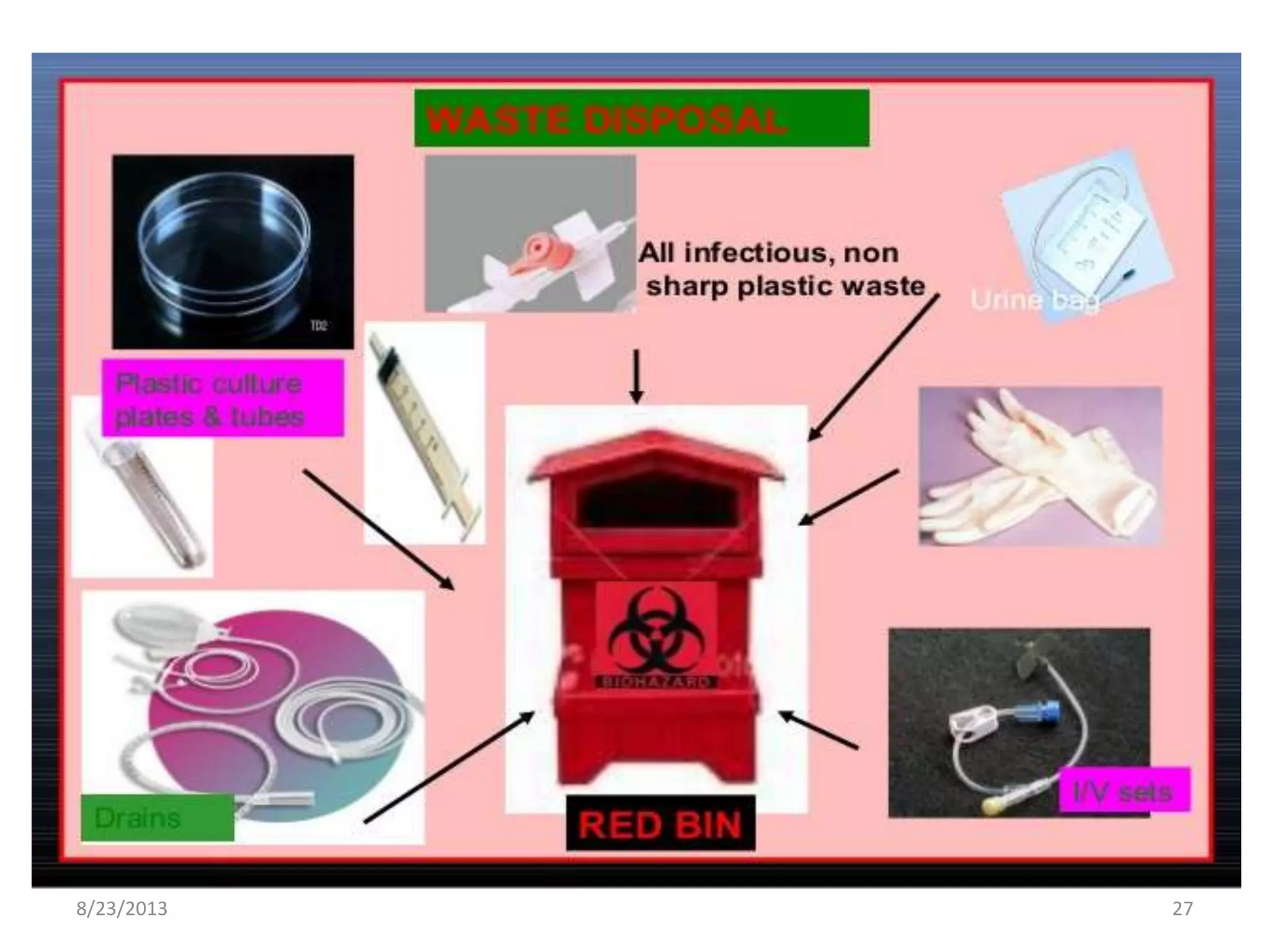
Red Disinfected container/plastic
bag
3, 6 & 7 Autoclaving/Micro
Waving/Chemical
treatment
Blue/white
transparent
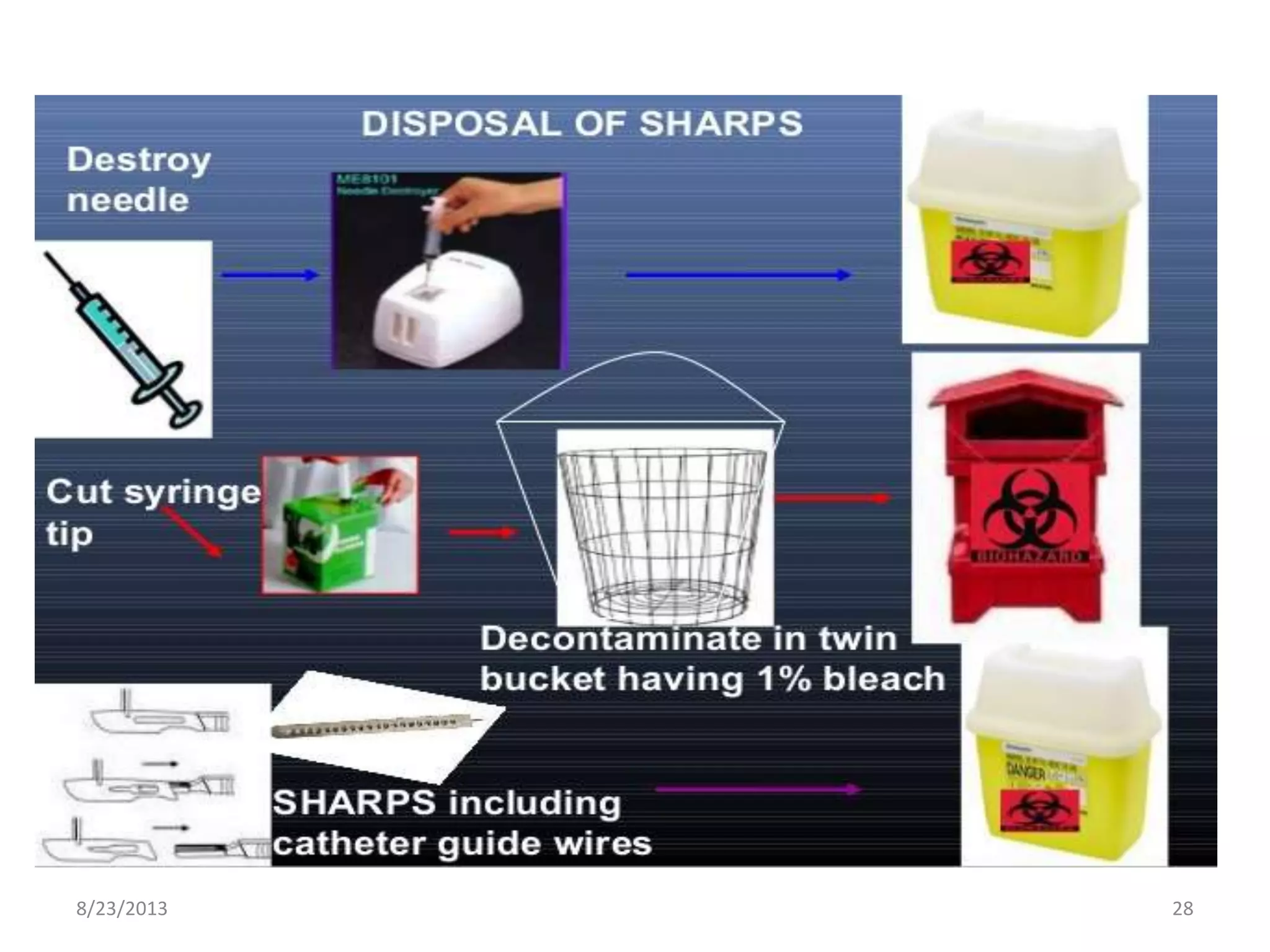
Plastic bags/puncture proof
container
4 & 7 Autoclaving/Micro
waving/chemical
treatment, Destruction &
shredding
Black Plastic bag 5, & 9, AND
10 (SOLID)
Disposal in secured land
fills
8/23/2013 24
8/23/2013 25
8/23/2013 26
8/23/2013 27
8/23/2013 28
8/23/2013 29
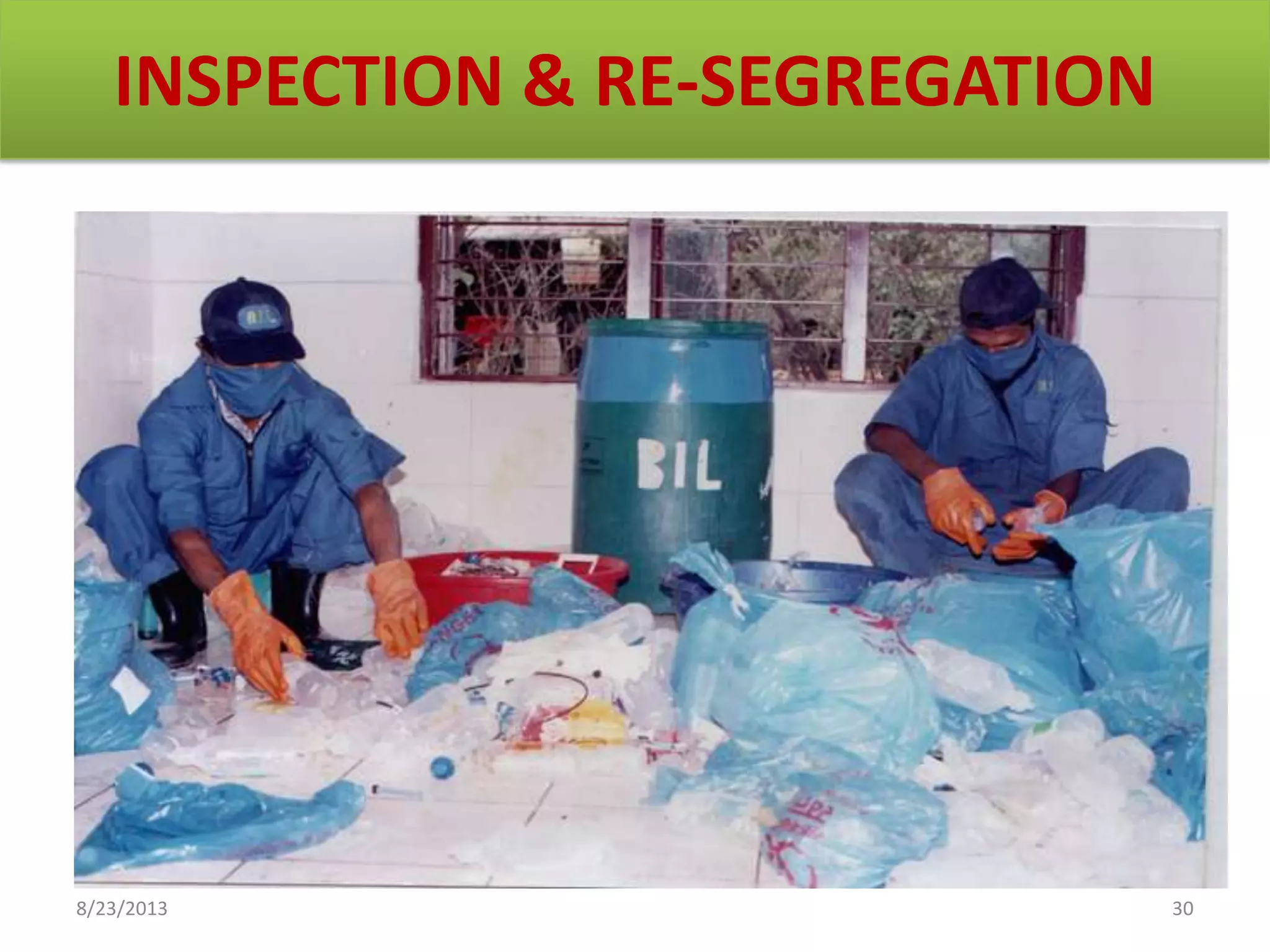
INSPECTION & RE-SEGREGATION
8/23/2013 30
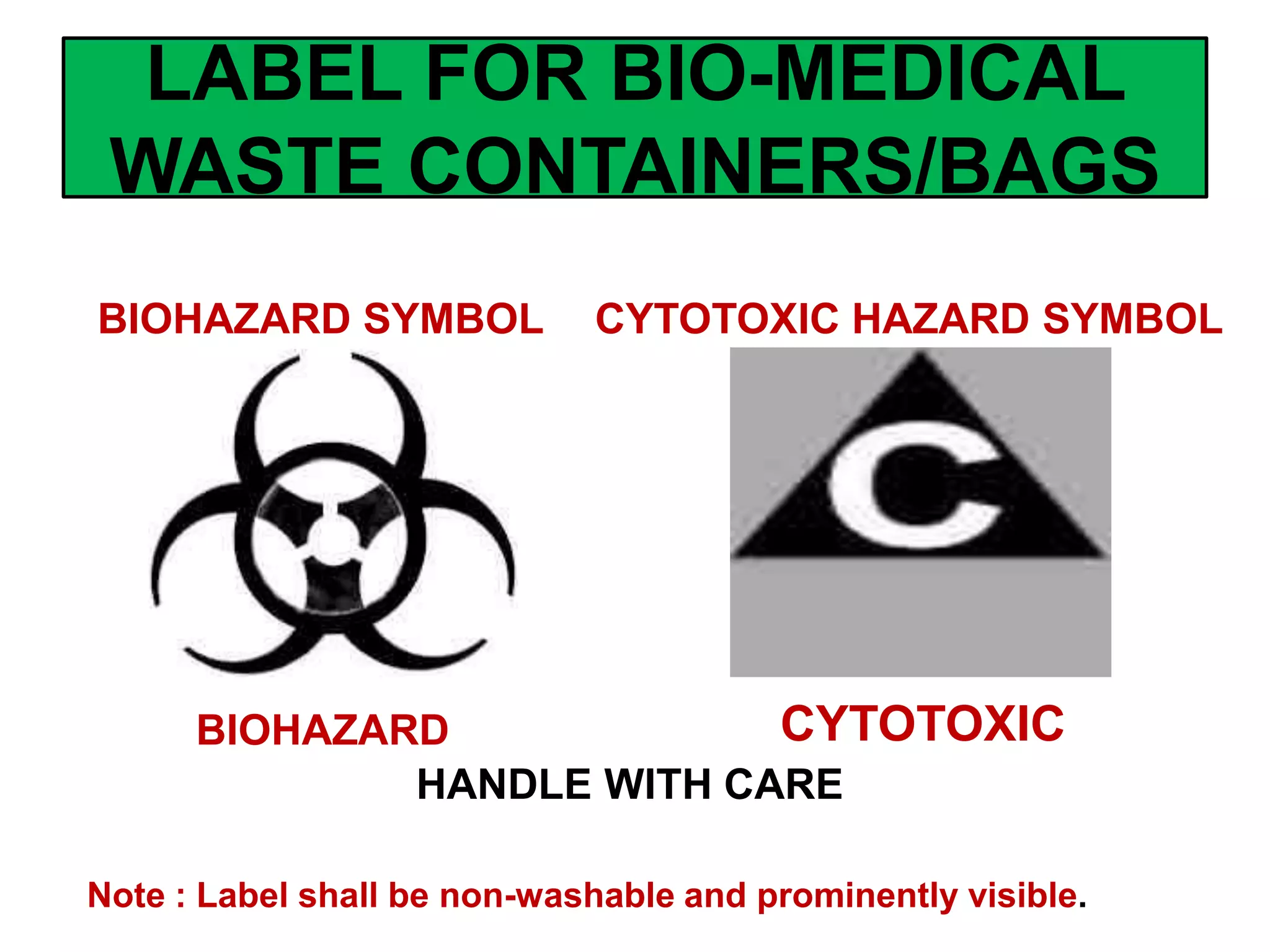
LABEL FOR BIO-MEDICAL
WASTE CONTAINERS/BAGS
Note : Label shall be non-washable and prominently visible.
HANDLE WITH CARE
BIOHAZARD CYTOTOXIC
BIOHAZARD SYMBOL CYTOTOXIC HAZARD SYMBOL
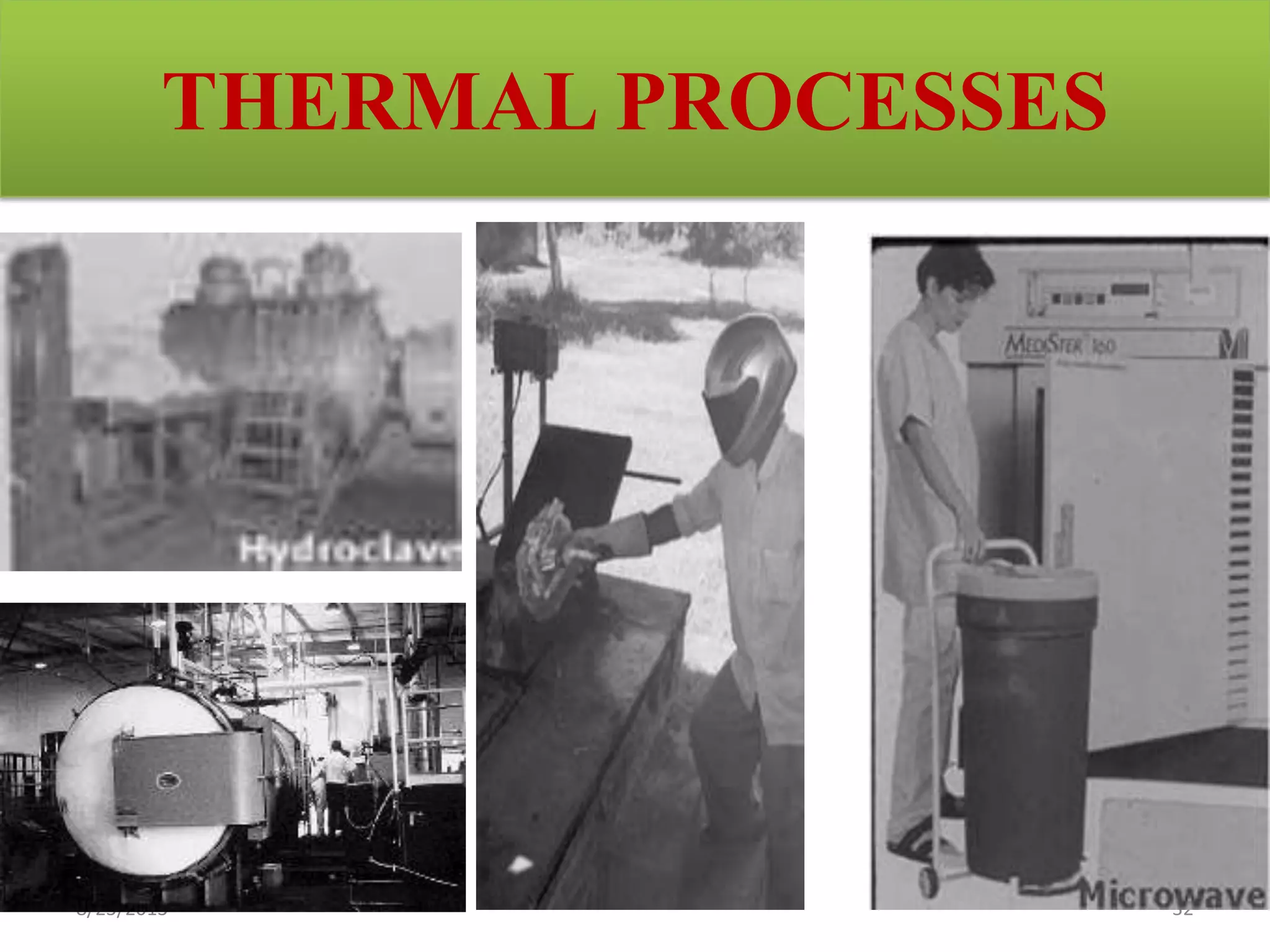
THERMAL PROCESSES
8/23/2013 32
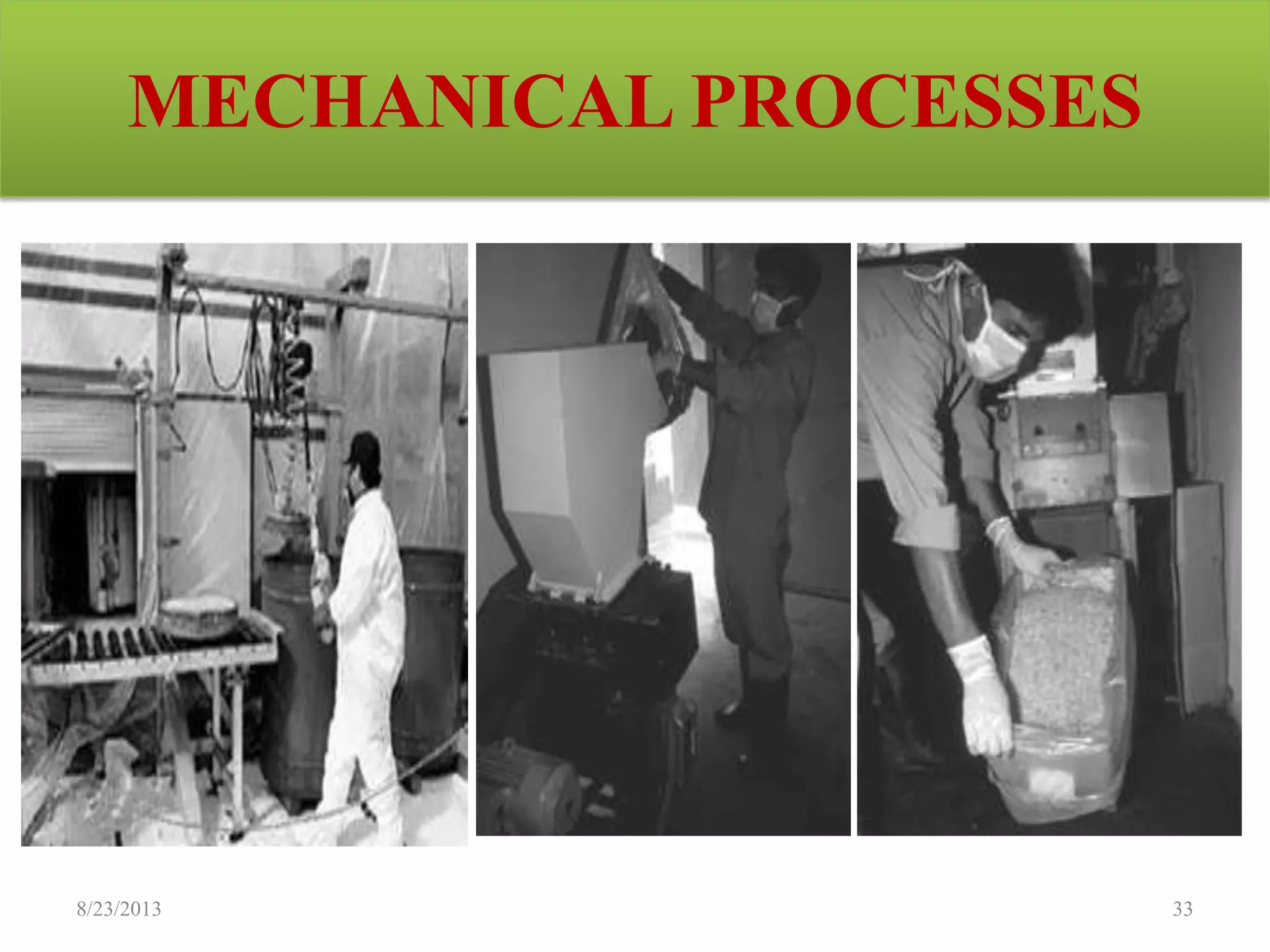
MECHANICAL PROCESSES
8/23/2013 33
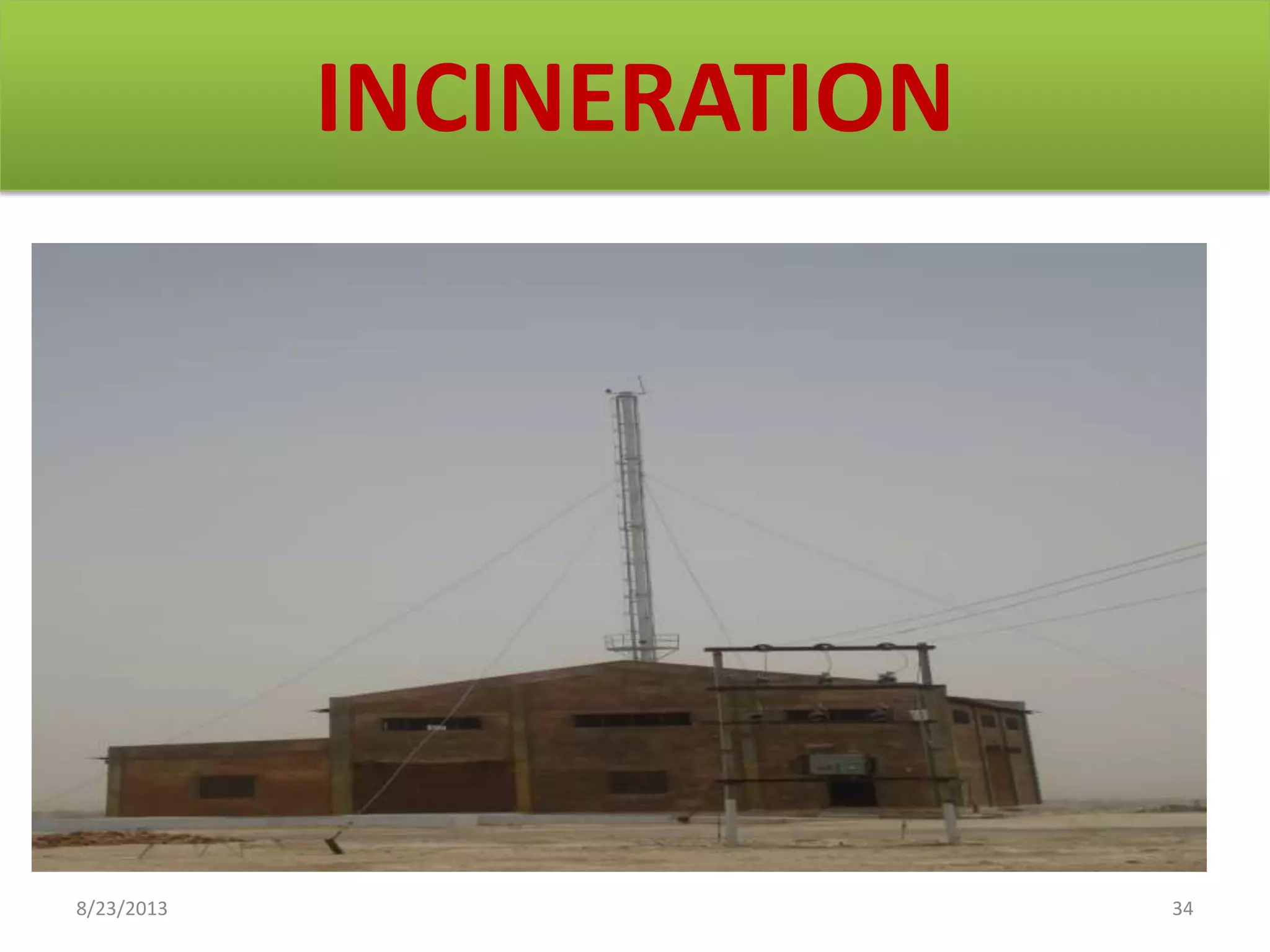
INCINERATION
8/23/2013 34
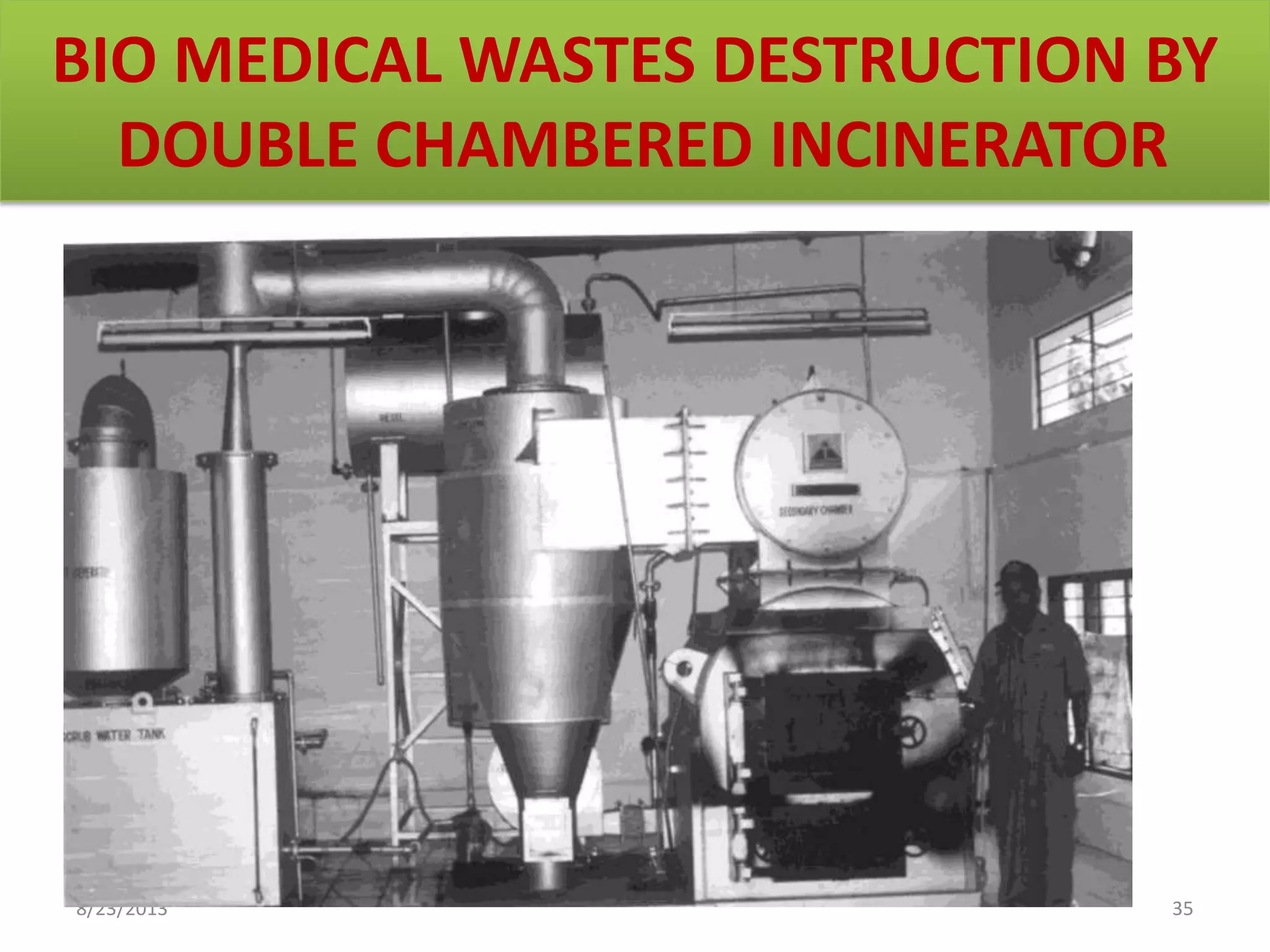
BIO MEDICAL WASTES DESTRUCTION BY
DOUBLE CHAMBERED INCINERATOR
8/23/2013 35
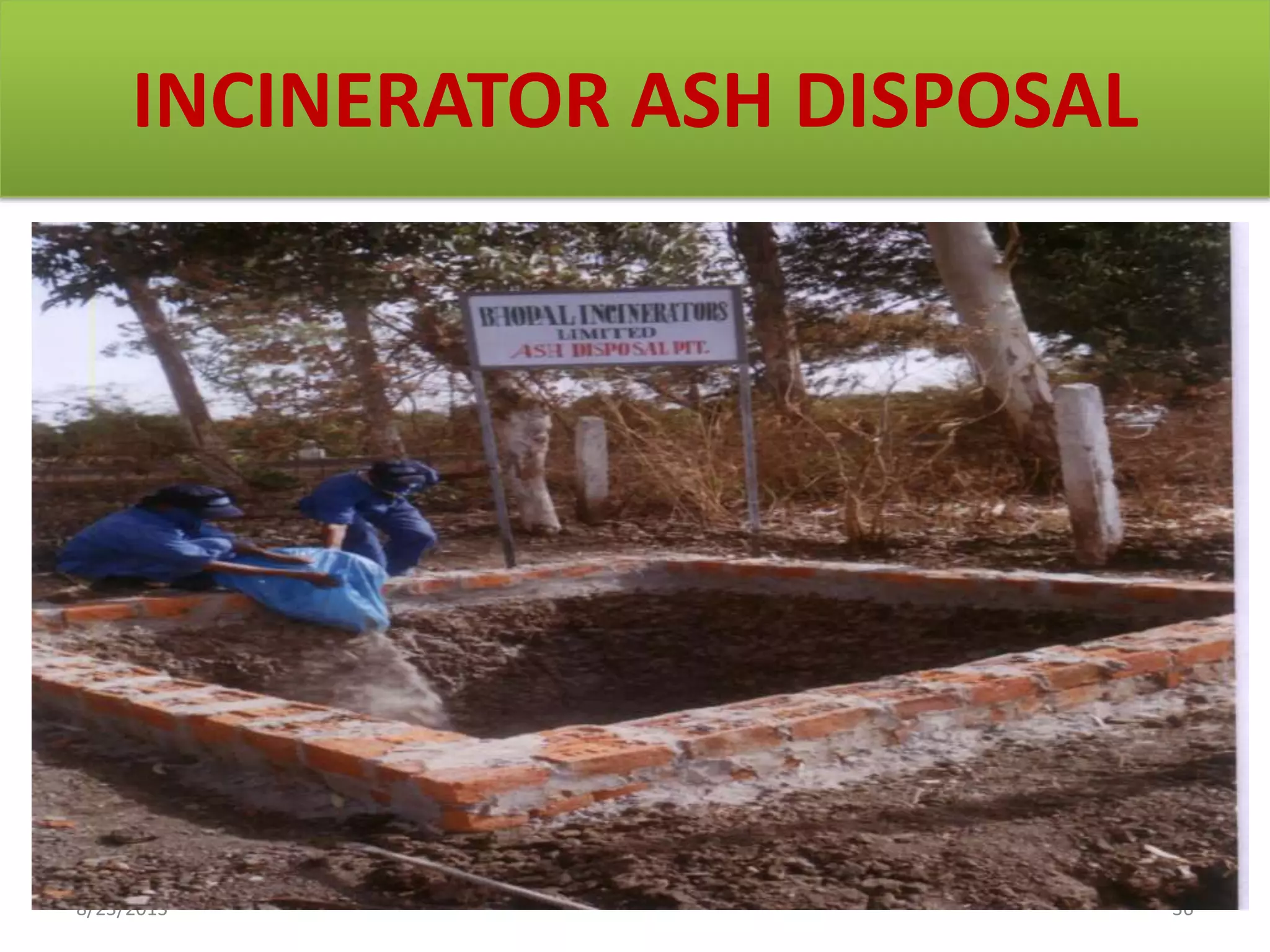
INCINERATOR ASH DISPOSAL
8/23/2013 36
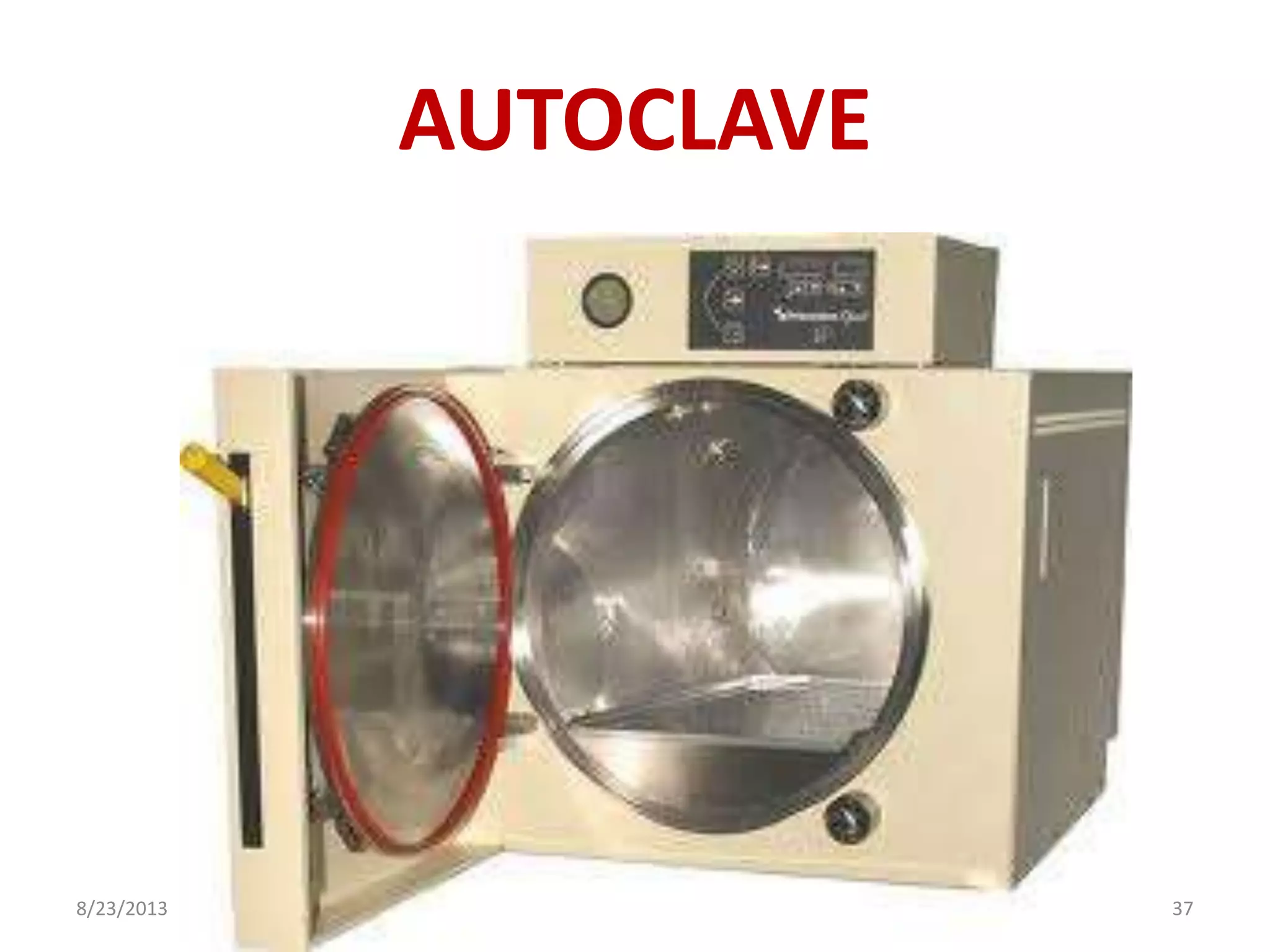
AUTOCLAVE
8/23/2013 37
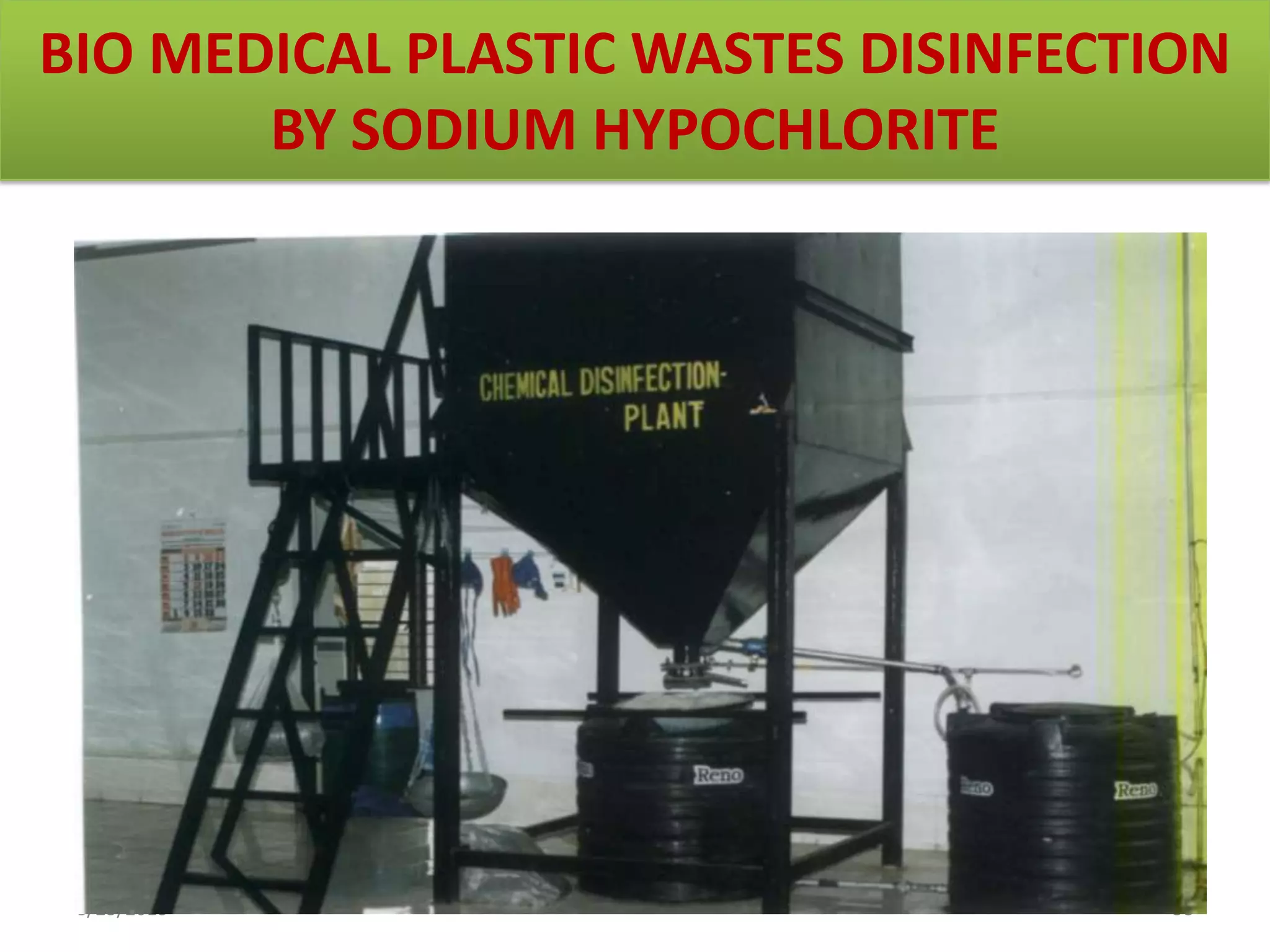
BIO MEDICAL PLASTIC WASTES DISINFECTION
BY SODIUM HYPOCHLORITE
8/23/2013 38
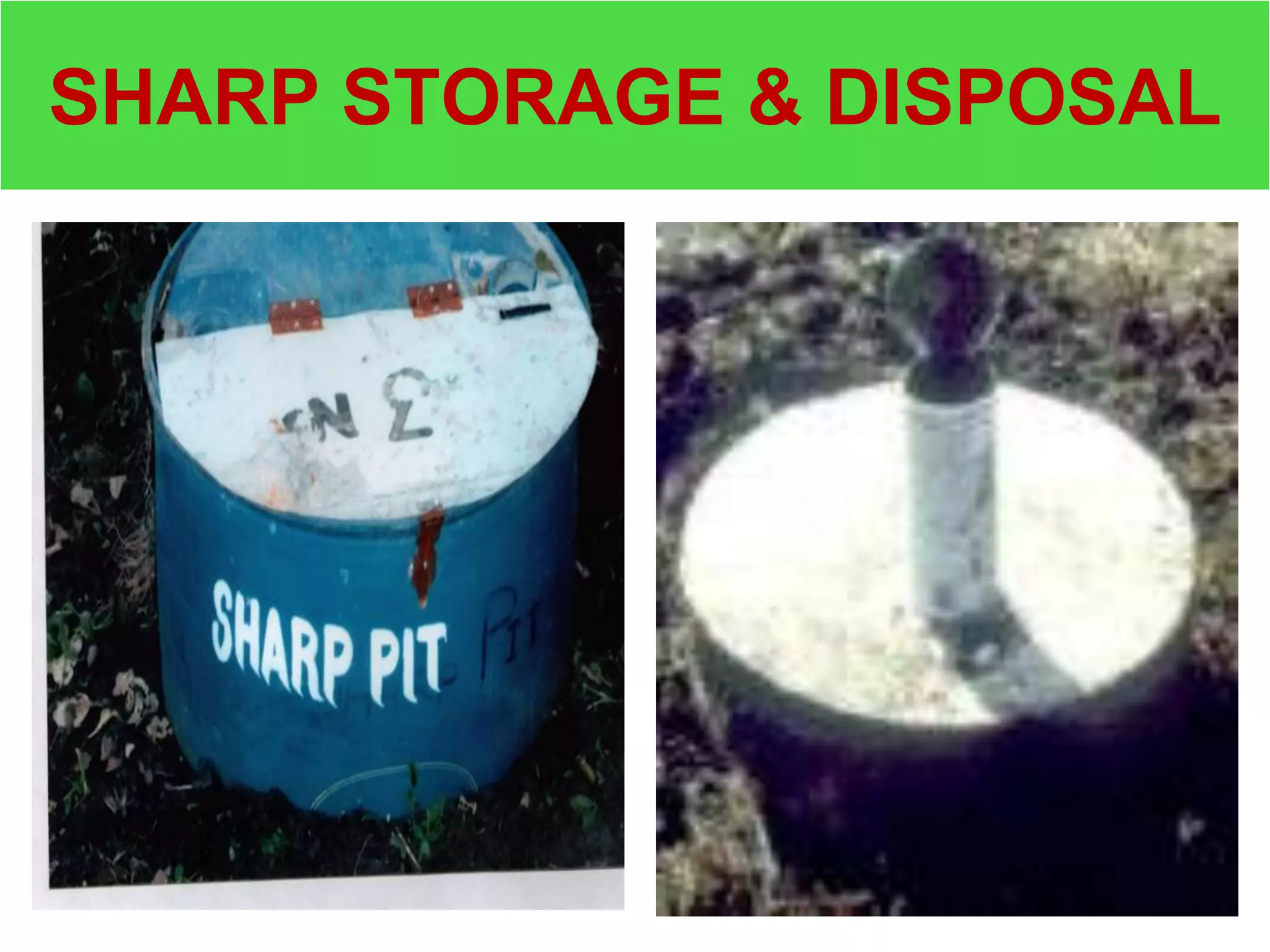
SHARP STORAGE & DISPOSAL
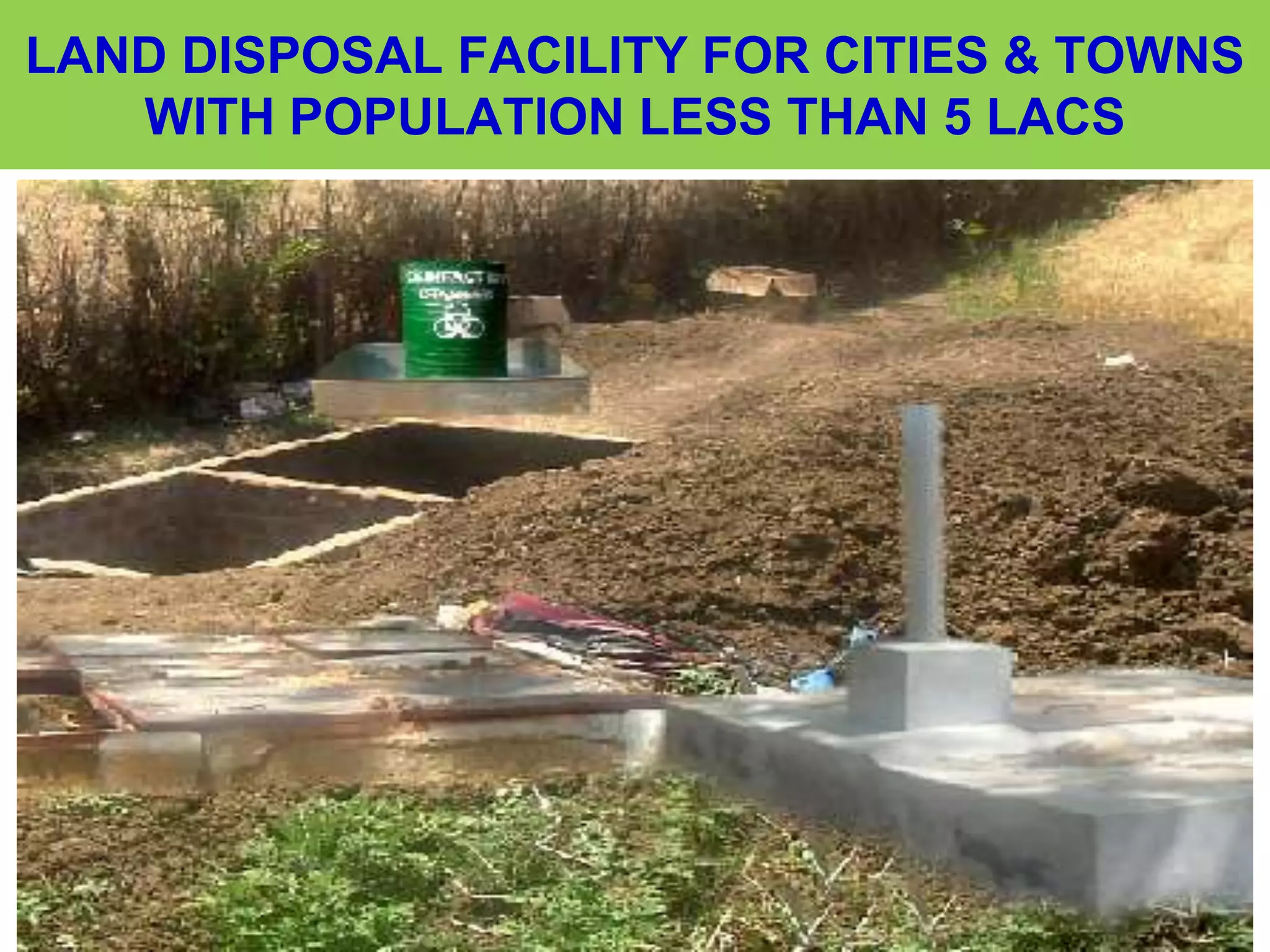
LAND DISPOSAL FACILITY FOR CITIES & TOWNS
WITH POPULATION LESS THAN 5 LACS
BIO MEDICAL WASTE
MANAGEMENT IN INDIA
THIS RULE APPLIES TO THOSE WHO
GENERATE, COLLECT, RECEIVE, STORE,
DISPOSE, TREAT OR HANDLE BIO
MEDICAL WASTE IN ANY MANNER.
BIOMEDICAL WASTE (MANAGEMENT AND
HANDLING) RULE 1998, PRESCRIBED BY
THE MINISTRY OF ENVIRONMENT AND
FORESTS, GOVT OF INDIA, CAME INTO
FORCE ON 20TH JULY 1998.
41
• THUS BIO MEDICAL WASTE
SHOULD BE SEGREGATED INTO
CONTAINERS/BAGS AT THE POINT
OF GENERATION OF WASTE.
8/23/2013 42
UNDER ENVIRONMENT PROTECTION ACT,1998
BIO-MEDICAL WASTE (Management & handling) RULES 1998
1st Amendment Rules vide S.O.201(E) Dated 06/03/2000
2ndAmendment Rules vide S.O.1069(E) Dated 17/09/2003
• THE AUTHORIZATION IS REQUIRED FOR
 Generation/Collection/Reception/Storage
 Transportation
 Treatment/Disposal
 or any other form of handling.8/23/2013 43
44
ENVIRONMENTAL LEGISLATION
 The Environment (Protection) Act, 1986
 The Biomedical Waste (Management & Handling)
Rules, 1998
 The Municipal Solid Waste (Management &
Handling) Rules, 2000
 The Hazardous Waste (Management & Handling)
Rules, 1989
 The National Environmental Tribunal Act, 1995
 The Air (Prevention and Control of Pollution) Act,
1981
CONCLUSION
• Thus refuse disposal cannot be solved without
public education.
• Individual participation is required.
• Municipality and government should pay
importance to disposal of waste economically.
• Thus educating and motivating oneself first is
important and then preach others about it.
• Start disposing waste first from within your
home, then outside home, then neighborhood
,then your street, your area ,city and then the
nation and the world.
• Lets make this world a better place to live
in. 45
Hazards of biomedical waste & its management

Hazards of biomedical waste & its management

  • 1.
    8/23/2013 1 HEALTH HAZARDSOF BIOMEDICAL WASTE & ITS MANAGEMENT PRESENTED BY :- DR.NAVIN KUMAR
  • 2.
    8/23/2013 2 LET THEWASTE OF THE “SICK” NOT CONTAMINATE THE LIVES OF “THE HEALTHY”. K.park
  • 3.
    8/23/2013 3 DEFINITION CATEGORIES OFBIOMEDICAL WASTE PROBLEM ASSOCIATED WITH BIOMEDICAL WASTE NEED FOR BIOMEDICAL WASTE MANAGEMENT STEP TO MANAGE HAZARDOUS WASTE TREATMENT TECHNIQUES BIOMEDICAL WASTE MANAGEMENT IN INDIA ENVIRONMENTAL LEGISLATION CONCLUSION CONTENTS
  • 4.
    8/23/2013 4 DEFINATION: ANY WASTEWHICH IS GENERATED DURING THE DIAGNOSIS, TREATMENT OR IMMUNIZATION OF HUMAN BEINGS OR ANIMALS OR IN RESEARCH ACTIVITIES PERTAINING THERE TO OR IN THE PRODUCTION OR TESTING OF BIO MEDICALS.
  • 5.
  • 6.
    HEALTHCARE WASTE CHARACTERIZATION WHO 8/23/20136 Healthcare Waste 85% Non- infectious 10% Infectious 5% Hazardous
  • 7.
    CLASSIFICATION OF HOSPITALWASTE Non-Hazardous Waste Bio- degradable Non bio- degradable Potentially Infectious Waste Dressings, swabs, laboratory wastes, instruments used in patient care.. Potentially Toxic Waste Radioactive Chemical Pharmaceutical 8/23/2013 7
  • 8.
    TYPES OF BIOMEDICALWASTES WASTE CATEGORY TYPE OF WASTE Category No. 1 Human Anatomical Waste Category No. 2 Animal Waste Category No. 3 Microbiology & Biotechnology Waste Category No. 4 Waste Sharps Category No. 5 Discarded Medicine and Cytotoxic drugs Category No. 6 Soiled Waste Category No. 7 Solid Waste Category No. 8 Liquid Waste Category No. 9 Incineration Ash Category No.10 Chemical Waste
  • 9.
     Chemical waste  Wastewith high content of heavy metals  Pressurized containers  Radioactive waste • Lab reagents • Film developer • Expired disinfectants • Expired solvents • Batteries • Broken thermometers • Blood pressure guages etc • Gas cylinders • Gas catridges • Aerosol cans • Radiotherapy/lab research liquids • Contaminated glass wares, packages, absorbent papers 9
  • 10.
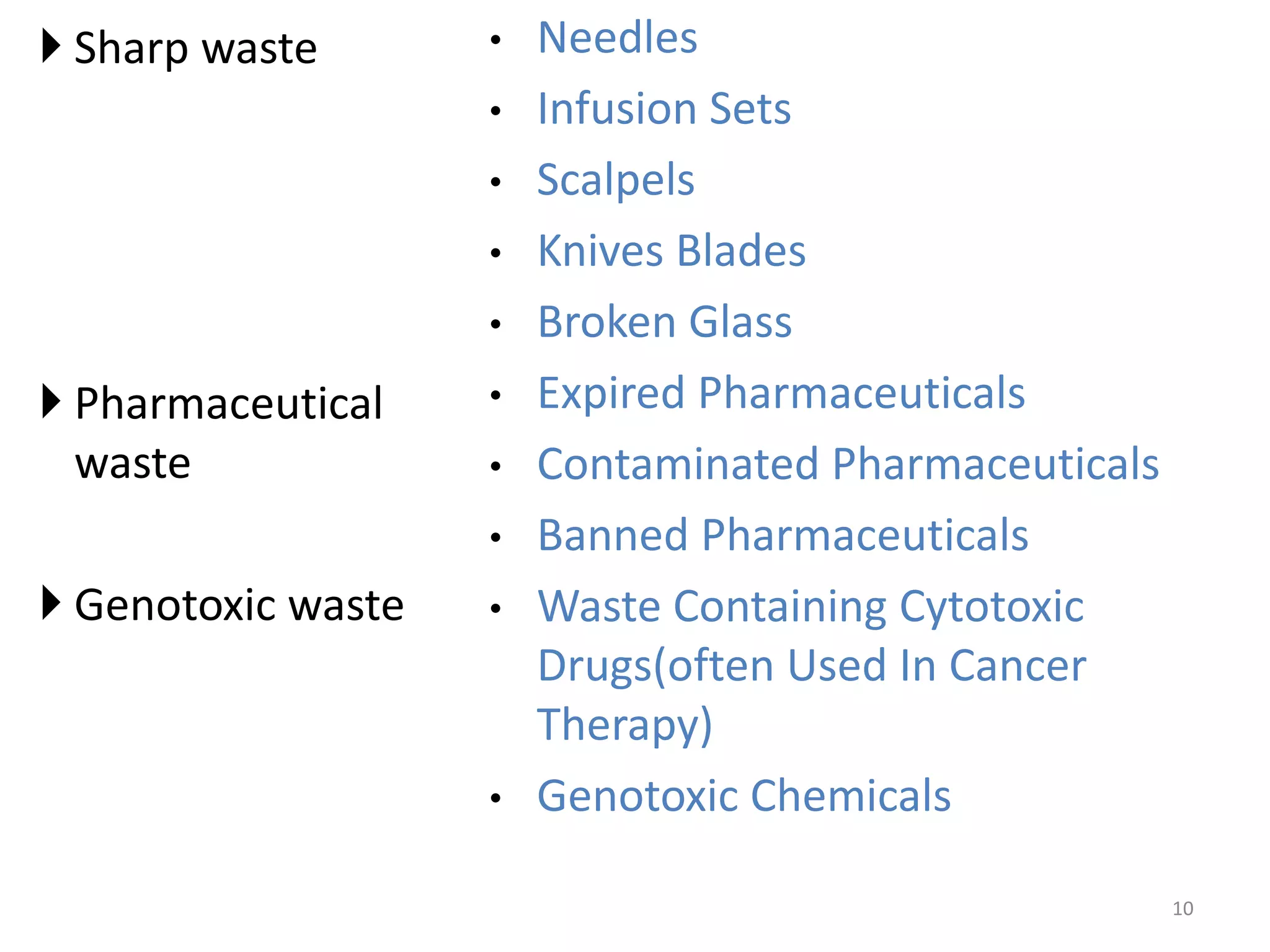
     Sharp waste Pharmaceutical waste  Genotoxic waste • Needles • Infusion Sets • Scalpels • Knives Blades • Broken Glass • Expired Pharmaceuticals • Contaminated Pharmaceuticals • Banned Pharmaceuticals • Waste Containing Cytotoxic Drugs(often Used In Cancer Therapy) • Genotoxic Chemicals 10
  • 11.
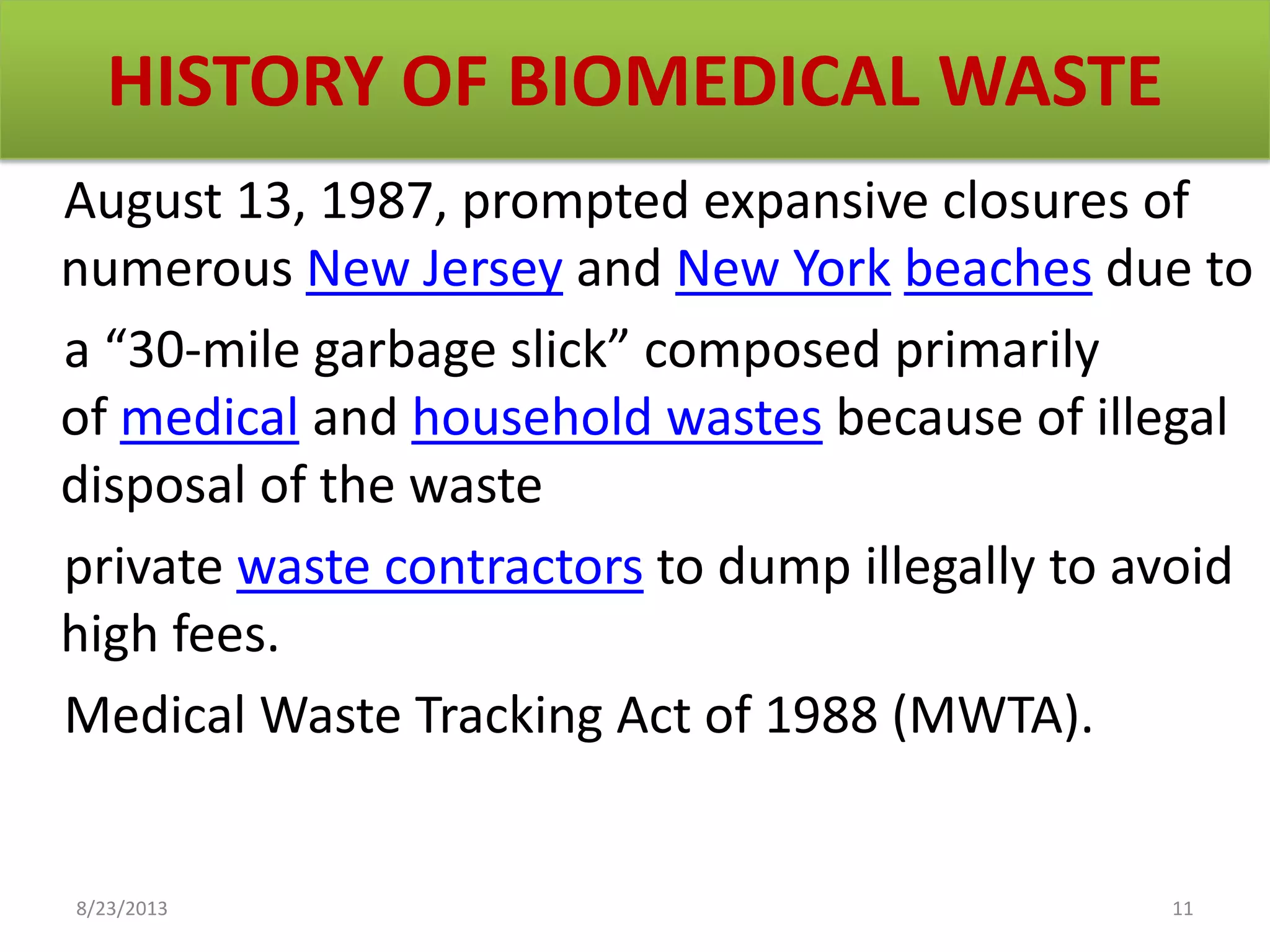
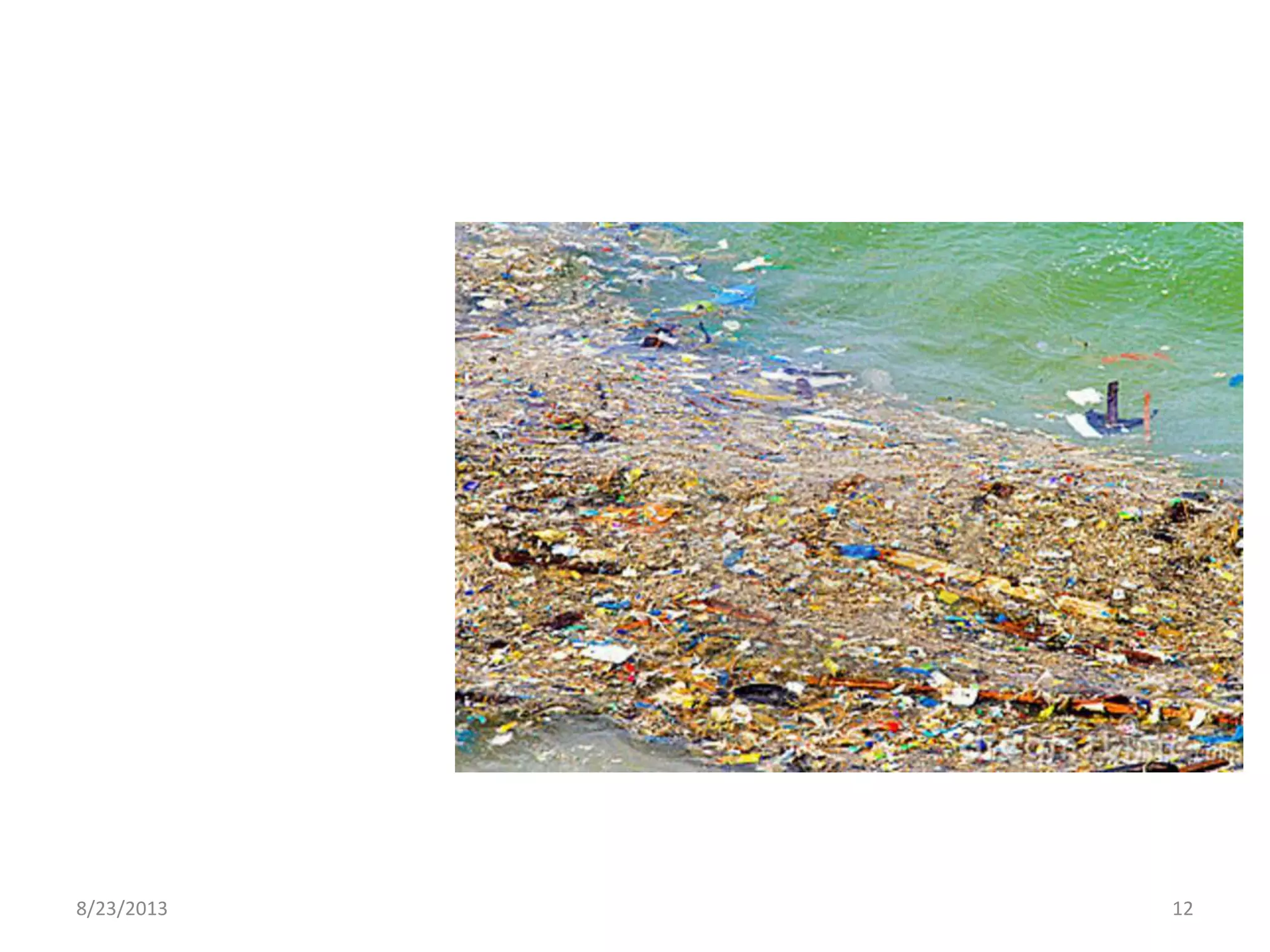
    HISTORY OF BIOMEDICALWASTE August 13, 1987, prompted expansive closures of numerous New Jersey and New York beaches due to a “30-mile garbage slick” composed primarily of medical and household wastes because of illegal disposal of the waste private waste contractors to dump illegally to avoid high fees. Medical Waste Tracking Act of 1988 (MWTA). 8/23/2013 11
  • 12.
  • 13.
    NEED FOR BMWMANAGMENT Nosocomial infections in patients from poor infection control practices and poor waste management. Drugs which have been disposed of, being repacked and sold off to unsuspecting buyers. Risk of air, water and soil pollution directly due to waste, or due to defective incineration emissions and ash. Risk of infection outside hospital for waste handlers and scavengers, other peoples.
  • 14.
    CATEGORIES OF PERSONS EXPOSEDTO RISK OF INFECTION Sanitation workers Medical & Paramedical staff Patients 8/23/2013 14
  • 15.
    ROUTES OF TRANSMISSION Byingestion (contaminated unwashed hands, contaminated food stuffs, water etc) Intact or non intact skin, mucous membranes Inhalation of dust particles containing germs 8/23/2013 15
  • 16.
    PROBLEM ASSOCIATED WITHBMW ORGANISM DISEASES CAUSED RELATED WASTE ITEM VIRUSES HIV, Hepatitis B, Hepatitis A,C, Arboviruses, Enteroviruses AIDS, Infectious Hepatitis, Infectious Hepatitis, Dengue, Japanese encephalitis, tick-borne fevers, etc. Infected needles, body Fluids, Human excreta, soiled linen, Blood, body fluids. BACTERIA Salmonella typhi, Vibrio cholerae, Clostridium Tetani, Pseudomonas, Streptococcus Typhoid, Cholera, Tetanus Wound infections, septicemia, rheumatic fever, endocarditis, skin and soft tissue infections Human excreta and body fluid in landfills and hospital wards, Sharps such as needles, surgical blades in hospital waste. PARASITES Wucheraria Bancrofti, Plasmodium Cutaneous leishmaniasis, Kala Azar, Malaria Human excreta, blood and body fluids in poorly managed sewage system of hospitals.
  • 17.
    8/23/2013 17 WASTE IMPROPER DISPOSAL COLLECTED BY ULB SMALLSCRAP DEALERS (KAWARIWALLAH) RAG PICKERS LANDFILLS OR DUMPING GROUNDS WHOLESALE DEALER OR LARGE SCRAP DEALER RECYCLE FACTORY UNITS CONSUMER
  • 18.
  • 19.
  • 20.
  • 21.
    BMW Begin a system Makeit effective Work for its success 8/23/2013 21
  • 22.
    OBJECTIVE OF BMWMANAGEMENT • TO MINIMIZE THE PRODUCTION/GENERATION OF INFECTIVE WASTE. • RECYCLE THE WASTE AFTER TREATING TO THE EXTENT POSSIBLE. • TREAT THE WASTE BY SAFE AND ENVIORNMENT FRIENDLY/ACCEPTABLE METHODS. • ADEQUATE CARE IN HANDLING TO PREVENT HEALTHCARE-ASSOCIATED INFECTIONS. • SEFTY PRECAUTIONS DURING HANDLING THE BMW. 8/23/2013 22
  • 23.
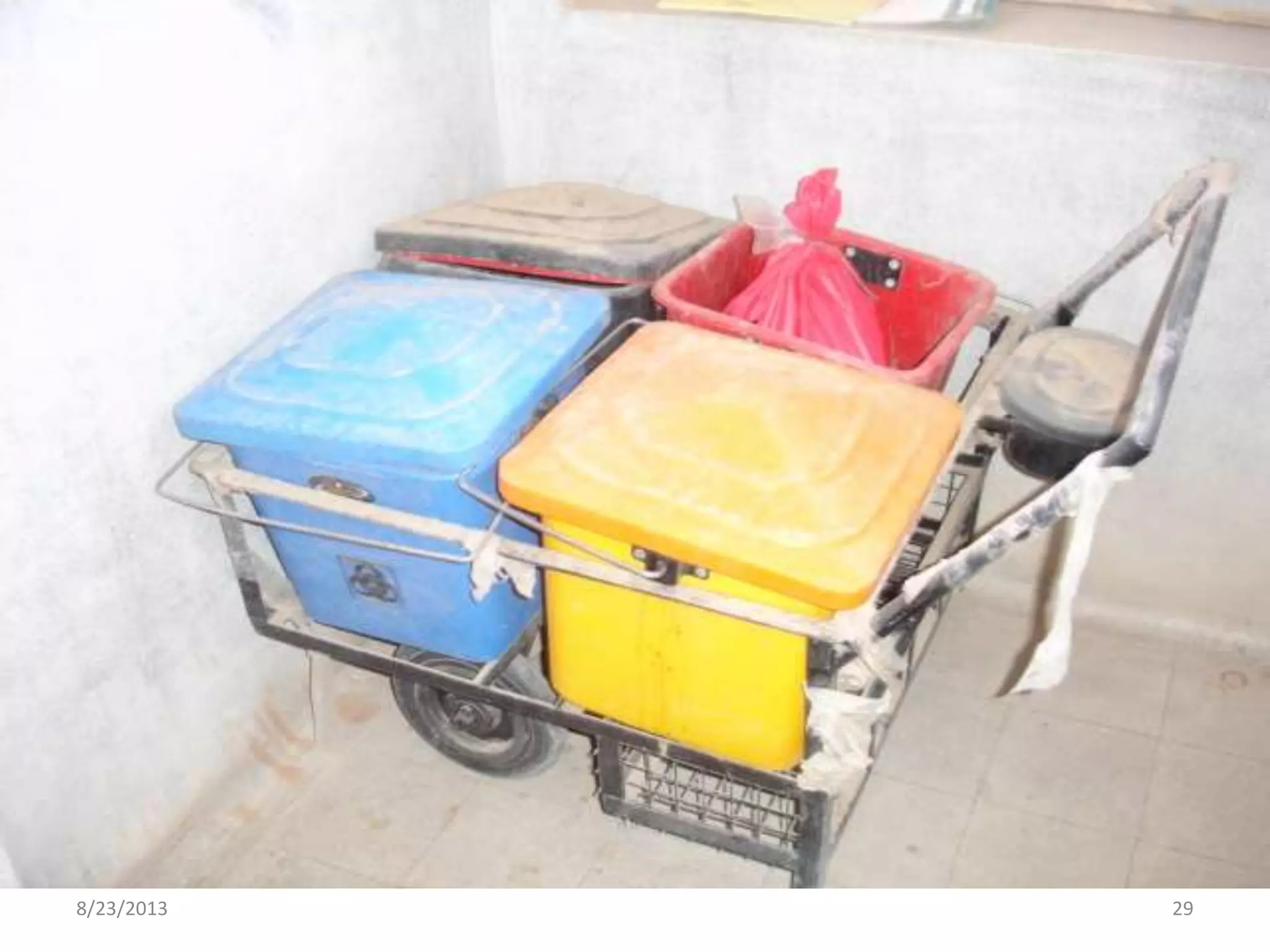
    COLOUR CODING OFBAGS CATEGORIES- 5,9 AND 10 (SOLID) CATEGORIES- 3,6 AND 7 CATEGORIES- 1,2,3 AND 6 CATEGORIES- 4 AND 7 SEGREGATION 8/23/2013 23
  • 24.
    COLOR CODE TYPE OF CONTAINERWASTE CATEGORY TREATMENT OPTIONS Yellow Plastic bags 1, 2, 3 and 6 Incineration/deep burial Red Disinfected container/plastic bag 3, 6 & 7 Autoclaving/Micro Waving/Chemical treatment Blue/white transparent Plastic bags/puncture proof container 4 & 7 Autoclaving/Micro waving/chemical treatment, Destruction & shredding Black Plastic bag 5, & 9, AND 10 (SOLID) Disposal in secured land fills 8/23/2013 24
  • 25.
  • 26.
  • 27.
  • 28.
  • 29.
  • 30.
  • 31.
    LABEL FOR BIO-MEDICAL WASTECONTAINERS/BAGS Note : Label shall be non-washable and prominently visible. HANDLE WITH CARE BIOHAZARD CYTOTOXIC BIOHAZARD SYMBOL CYTOTOXIC HAZARD SYMBOL
  • 32.
  • 33.
  • 34.
  • 35.
    BIO MEDICAL WASTESDESTRUCTION BY DOUBLE CHAMBERED INCINERATOR 8/23/2013 35
  • 36.
  • 37.
  • 38.
    BIO MEDICAL PLASTICWASTES DISINFECTION BY SODIUM HYPOCHLORITE 8/23/2013 38
  • 39.
  • 40.
    LAND DISPOSAL FACILITYFOR CITIES & TOWNS WITH POPULATION LESS THAN 5 LACS
  • 41.
    BIO MEDICAL WASTE MANAGEMENTIN INDIA THIS RULE APPLIES TO THOSE WHO GENERATE, COLLECT, RECEIVE, STORE, DISPOSE, TREAT OR HANDLE BIO MEDICAL WASTE IN ANY MANNER. BIOMEDICAL WASTE (MANAGEMENT AND HANDLING) RULE 1998, PRESCRIBED BY THE MINISTRY OF ENVIRONMENT AND FORESTS, GOVT OF INDIA, CAME INTO FORCE ON 20TH JULY 1998. 41
  • 42.
    • THUS BIOMEDICAL WASTE SHOULD BE SEGREGATED INTO CONTAINERS/BAGS AT THE POINT OF GENERATION OF WASTE. 8/23/2013 42
  • 43.
    UNDER ENVIRONMENT PROTECTIONACT,1998 BIO-MEDICAL WASTE (Management & handling) RULES 1998 1st Amendment Rules vide S.O.201(E) Dated 06/03/2000 2ndAmendment Rules vide S.O.1069(E) Dated 17/09/2003 • THE AUTHORIZATION IS REQUIRED FOR  Generation/Collection/Reception/Storage  Transportation  Treatment/Disposal  or any other form of handling.8/23/2013 43
  • 44.
    44 ENVIRONMENTAL LEGISLATION  TheEnvironment (Protection) Act, 1986  The Biomedical Waste (Management & Handling) Rules, 1998  The Municipal Solid Waste (Management & Handling) Rules, 2000  The Hazardous Waste (Management & Handling) Rules, 1989  The National Environmental Tribunal Act, 1995  The Air (Prevention and Control of Pollution) Act, 1981
  • 45.
    CONCLUSION • Thus refusedisposal cannot be solved without public education. • Individual participation is required. • Municipality and government should pay importance to disposal of waste economically. • Thus educating and motivating oneself first is important and then preach others about it. • Start disposing waste first from within your home, then outside home, then neighborhood ,then your street, your area ,city and then the nation and the world. • Lets make this world a better place to live in. 45

Editor's Notes

  • #33 Autoclaving, Microwaving, Incinerator & Hydroclaving
  • #34 These processes are used to change the physical form or characteristics of the waste either to facilitate waste handling or to process the waste in conjunction with other treatment steps. The two primary mechanical processes areCompaction - used to reduce the volume of the wasteShredding - used to destroy plastic and paper waste to prevent their reuse. Only the disinfected waste can be used in a shredder.
  • #44 With clinical waste, the colour of the container can help to identify the type of waste within. Here are some of the container types / colours that you will come across at the University. Black bags should only ever be used for uncontaminated or decontaminated, non-offensive waste. For example, in some areas they are used for autoclaved laboratory plastics. Otherwise, lab plastics will go in orange bags.Carcass / anatomical material will only ever be placed in a yellow container, etc.Other coloured containers or lids may be in use in your laboratory or area. If they are, be certain that you know what they are for.