TYPES OF IV FLUIDS
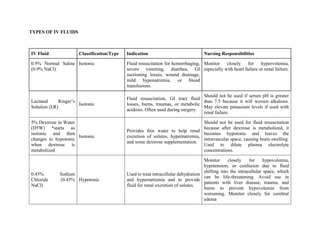
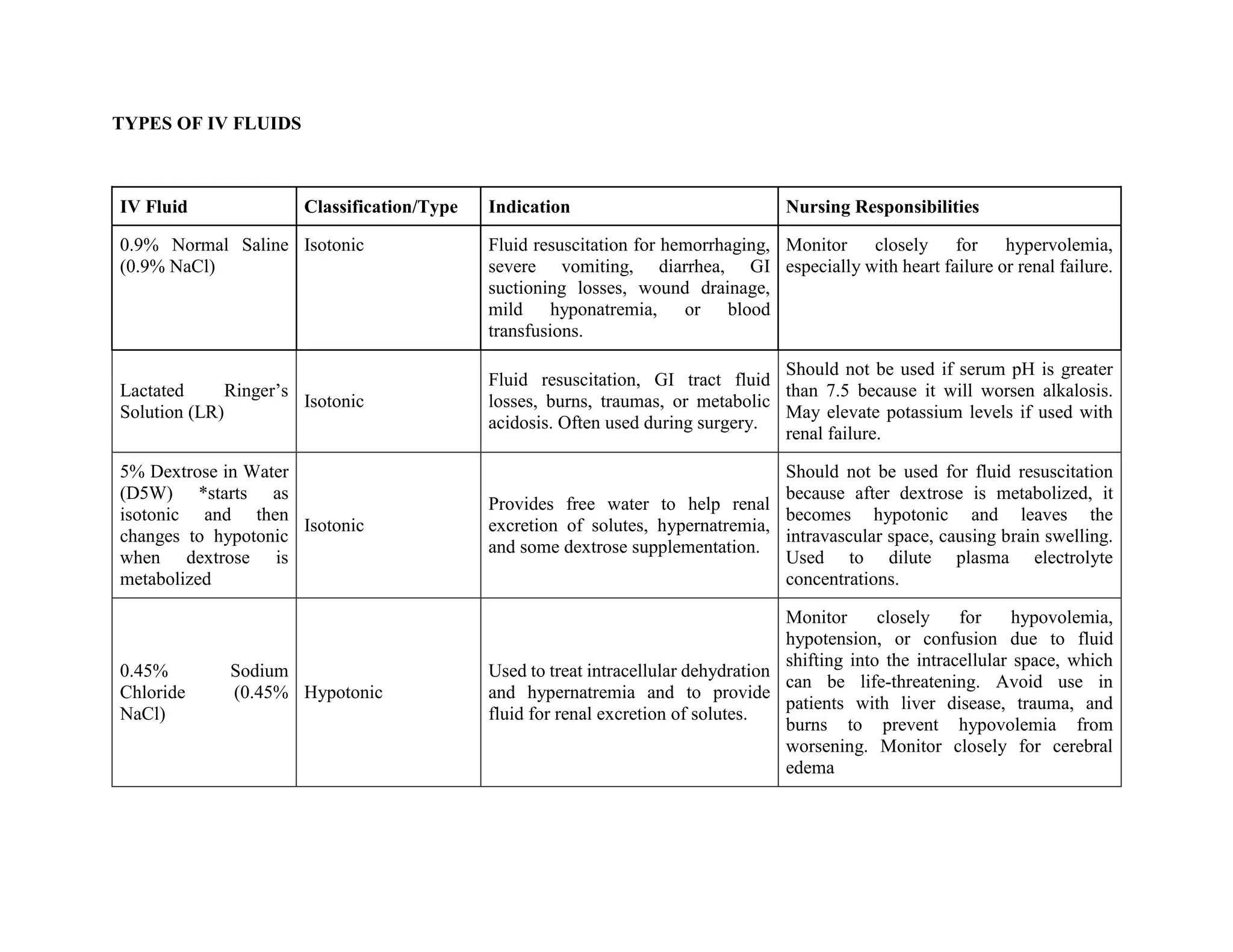
IV Fluid Classification/Type Indication Nursing Responsibilities
0.9% Normal Saline
(0.9% NaCl)
Isotonic Fluid resuscitation for hemorrhaging,
severe vomiting, diarrhea, GI
suctioning losses, wound drainage,
mild hyponatremia, or blood
transfusions.
Monitor closely for hypervolemia,
especially with heart failure or renal failure.
Lactated Ringer’s
Solution (LR)
Isotonic
Fluid resuscitation, GI tract fluid
losses, burns, traumas, or metabolic
acidosis. Often used during surgery.
Should not be used if serum pH is greater
than 7.5 because it will worsen alkalosis.
May elevate potassium levels if used with
renal failure.
5% Dextrose in Water
(D5W) *starts as
isotonic and then
changes to hypotonic
when dextrose is
metabolized
Isotonic
Provides free water to help renal
excretion of solutes, hypernatremia,
and some dextrose supplementation.
Should not be used for fluid resuscitation
because after dextrose is metabolized, it
becomes hypotonic and leaves the
intravascular space, causing brain swelling.
Used to dilute plasma electrolyte
concentrations.
0.45% Sodium
Chloride (0.45%
NaCl)
Hypotonic
Used to treat intracellular dehydration
and hypernatremia and to provide
fluid for renal excretion of solutes.
Monitor closely for hypovolemia,
hypotension, or confusion due to fluid
shifting into the intracellular space, which
can be life-threatening. Avoid use in
patients with liver disease, trauma, and
burns to prevent hypovolemia from
worsening. Monitor closely for cerebral
edema
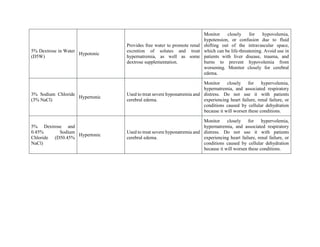
5% Dextrose in Water
(D5W)
Hypotonic
Provides free water to promote renal
excretion of solutes and treat
hypernatremia, as well as some
dextrose supplementation.
Monitor closely for hypovolemia,
hypotension, or confusion due to fluid
shifting out of the intravascular space,
which can be life-threatening. Avoid use in
patients with liver disease, trauma, and
burns to prevent hypovolemia from
worsening. Monitor closely for cerebral
edema.
3% Sodium Chloride
(3% NaCl)
Hypertonic
Used to treat severe hyponatremia and
cerebral edema.
Monitor closely for hypervolemia,
hypernatremia, and associated respiratory
distress. Do not use it with patients
experiencing heart failure, renal failure, or
conditions caused by cellular dehydration
because it will worsen these conditions.
5% Dextrose and
0.45% Sodium
Chloride (D50.45%
NaCl)
Hypertonic
Used to treat severe hyponatremia and
cerebral edema.
Monitor closely for hypervolemia,
hypernatremia, and associated respiratory
distress. Do not use it with patients
experiencing heart failure, renal failure, or
conditions caused by cellular dehydration
because it will worsen these conditions.
OR INSTRUMENTS
ALLIS
BABCOCK
DEBAKEY
MAYO
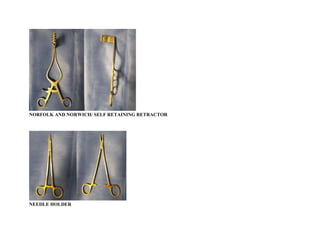
NORFOLK AND NORWICH/ SELF RETAINING RETRACTOR
NEEDLE HOLDER
TOWEL CLIPS
SCALPEL HANDLE
METZENBAUM
KELLY CURVE
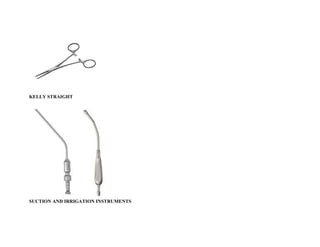
KELLY STRAIGHT
SUCTION AND IRRIGATION INSTRUMENTS
RECTAL SPECULUM
TOWEL CLAMP
SURGICAL BLADES
SURGICAL MALLET
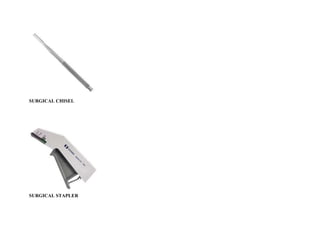
SURGICAL CHISEL
SURGICAL STAPLER
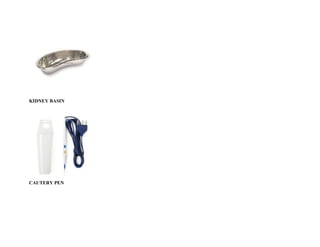
KIDNEY BASIN
CAUTERY PEN
RING CUTTER
TISSUE FORCEPS
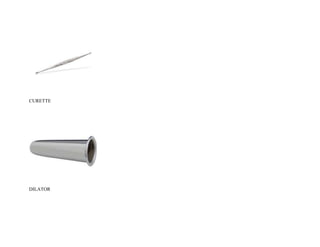
CURETTE
DILATOR
ADSON FORCEPS

TYPES OF IV FLUIDS.docx

  • 1.
    TYPES OF IVFLUIDS IV Fluid Classification/Type Indication Nursing Responsibilities 0.9% Normal Saline (0.9% NaCl) Isotonic Fluid resuscitation for hemorrhaging, severe vomiting, diarrhea, GI suctioning losses, wound drainage, mild hyponatremia, or blood transfusions. Monitor closely for hypervolemia, especially with heart failure or renal failure. Lactated Ringer’s Solution (LR) Isotonic Fluid resuscitation, GI tract fluid losses, burns, traumas, or metabolic acidosis. Often used during surgery. Should not be used if serum pH is greater than 7.5 because it will worsen alkalosis. May elevate potassium levels if used with renal failure. 5% Dextrose in Water (D5W) *starts as isotonic and then changes to hypotonic when dextrose is metabolized Isotonic Provides free water to help renal excretion of solutes, hypernatremia, and some dextrose supplementation. Should not be used for fluid resuscitation because after dextrose is metabolized, it becomes hypotonic and leaves the intravascular space, causing brain swelling. Used to dilute plasma electrolyte concentrations. 0.45% Sodium Chloride (0.45% NaCl) Hypotonic Used to treat intracellular dehydration and hypernatremia and to provide fluid for renal excretion of solutes. Monitor closely for hypovolemia, hypotension, or confusion due to fluid shifting into the intracellular space, which can be life-threatening. Avoid use in patients with liver disease, trauma, and burns to prevent hypovolemia from worsening. Monitor closely for cerebral edema
  • 2.
    5% Dextrose inWater (D5W) Hypotonic Provides free water to promote renal excretion of solutes and treat hypernatremia, as well as some dextrose supplementation. Monitor closely for hypovolemia, hypotension, or confusion due to fluid shifting out of the intravascular space, which can be life-threatening. Avoid use in patients with liver disease, trauma, and burns to prevent hypovolemia from worsening. Monitor closely for cerebral edema. 3% Sodium Chloride (3% NaCl) Hypertonic Used to treat severe hyponatremia and cerebral edema. Monitor closely for hypervolemia, hypernatremia, and associated respiratory distress. Do not use it with patients experiencing heart failure, renal failure, or conditions caused by cellular dehydration because it will worsen these conditions. 5% Dextrose and 0.45% Sodium Chloride (D50.45% NaCl) Hypertonic Used to treat severe hyponatremia and cerebral edema. Monitor closely for hypervolemia, hypernatremia, and associated respiratory distress. Do not use it with patients experiencing heart failure, renal failure, or conditions caused by cellular dehydration because it will worsen these conditions.
  • 3.
  • 4.
  • 5.
    NORFOLK AND NORWICH/SELF RETAINING RETRACTOR NEEDLE HOLDER
  • 6.
  • 7.
  • 8.
    KELLY STRAIGHT SUCTION ANDIRRIGATION INSTRUMENTS
  • 9.
  • 10.
  • 11.
  • 12.
  • 13.
  • 14.
  • 15.