Divye Garg (10810023) Rahul Agarwal (10810047) Nuclear non proliferation, Disarmament and Indo US Nuclear Deal
Nuclear Non-Proliferation & Disarmament Regime “ International initiatives to prevent the spread of nuclear weapons leading to their total elimination.” A regime of United Nations Security Council & Disarmament Machinery.
What is Proliferation? Horizontal Nuclear proliferation Vertical Nuclear proliferation
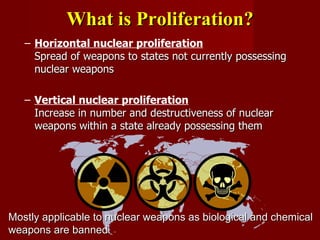
Horizontal nuclear proliferation Spread of weapons to states not currently possessing nuclear weapons Vertical nuclear proliferation Increase in number and destructiveness of nuclear weapons within a state already possessing them What is Proliferation? Mostly applicable to nuclear weapons as biological and chemical weapons are banned.
W HAT IS DISARMAMENT  ? “ It is the total elimination of weapons of mass destruction, including nuclear weapons, through the prohibition on development, production and use and destruction of all such weapons.”
Why is Nuclear Disarmament & Non-proliferation a Priority?
 
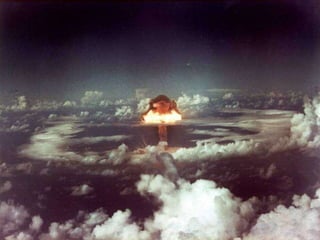
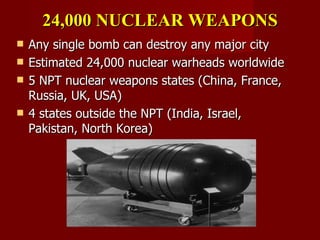
24,000 NUCLEAR WEAPONS Any single bomb can destroy any major city Estimated 24,000 nuclear warheads worldwide 5 NPT nuclear weapons states (China, France, Russia, UK, USA) 4 states outside the NPT (India, Israel, Pakistan, North Korea)
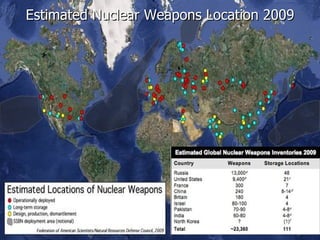
Estimated Nuclear Weapons Location 2009
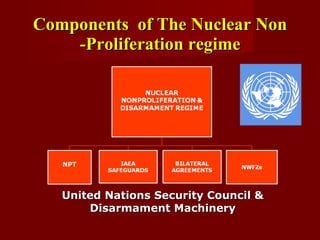
Components  of The Nuclear Non -Proliferation regime United Nations Security Council & Disarmament Machinery
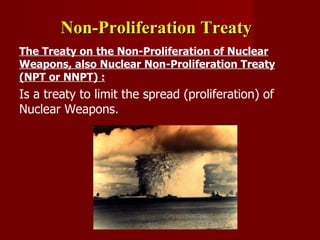
Non-Proliferation Treaty The Treaty on the Non-Proliferation of Nuclear Weapons, also Nuclear Non-Proliferation Treaty (NPT or NNPT) : Is a treaty to limit the spread (proliferation) of Nuclear Weapons .
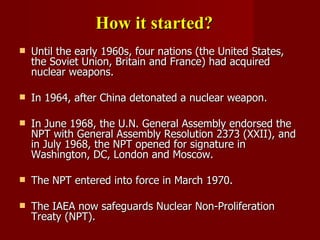
How it started? Until the early 1960s, four nations (the United States, the Soviet Union, Britain and France) had acquired nuclear weapons. In 1964, after China detonated a nuclear weapon.  In June 1968, the U.N. General Assembly endorsed the NPT with General Assembly Resolution 2373 (XXII), and in July 1968, the NPT opened for signature in Washington, DC, London and Moscow.  The NPT entered into force in March 1970. The IAEA now safeguards Nuclear Non-Proliferation Treaty (NPT).
Non-Proliferation Treaty   Embodies the international community's efforts to prevent the further spread of nuclear weapons.  Fulfill the aspirations for global disarmament. To also facilitate the cooperation in the peaceful uses of nuclear energy under safeguards. Entails commitments by both nuclear-weapon and non-nuclear-weapon states. Verification of compliance with nonproliferation undertakings through the application of safeguards that was conferred on the International Atomic Energy Agency (IAEA).
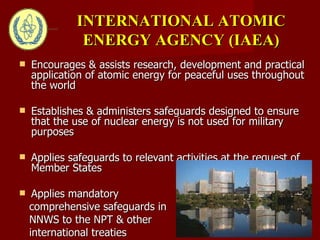
Encourages & assists research, development and practical application of atomic energy for peaceful uses throughout the world Establishes & administers safeguards designed to ensure that the use of nuclear energy is not used for military purposes Applies safeguards to relevant activities at the request of Member States Applies mandatory  comprehensive safeguards in NNWS to the NPT & other international treaties INTERNATIONAL ATOMIC ENERGY AGENCY (IAEA)
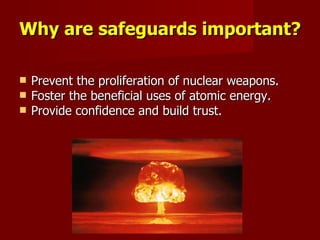
Why are safeguards important? Prevent the proliferation of nuclear weapons. Foster the beneficial uses of atomic energy. Provide confidence and build trust.
Bilateral treaties and agreements between Soviet Union and US Strategic Arms Limitation Talks (SALT 1) – 1969 Anti-Ballistic Missile Treaty (ABM Treaty) - 1972 Strategic Arms Limitation Talks (SALT 2) – 1979 Strategic Arms Reduction Treaty ( START 1) – 1991 Strategic Arms Reduction Treaty ( START 2) – 1993 Intermediate-Rang Nuclear Force Treaty (INF Treaty) – 1987
SALT I Strategic Arms Limitation Talks I SALT I, the first series of Strategic Arms Limitation Talks, started in November 1969. Limitation of Anti-Ballistic Missile Systems (ABMS) and Limitation of Strategic Offensive Arms.  Creation of more favourable conditions and relaxation of international tension and the strengthening of trust between States.  SALT I was brought to conclusion on May 26, 1972 and ABM treaty was signed by  President Nixon and General Secretary Brezhnev
Anti-Ballistic Missile Treaty (ABM Treaty) Background An  anti-ballistic missile  ( ABM ) is a missile designed to counter ballistic missiles. Soviet union introduced ABM systems which was followed by US. Due to economic, political and technological reasons Uncle got afraid and went for the treaty.
Anti-Ballistic Missile Treaty (ABM Treaty) Clauses Deployed ABM systems were limited to two sites:  - One around the national capital with no more than 100 ABM launchers and no more than 100 ABM interceptor missiles - The other, around ICBM launchers with no more than 100 ABM launchers, no more than 100 ABM interceptor missiles, two sites must be separated by no less than thirteen hundred kilometers
SALT II Capped the number of strategic offensive nuclear missiles, limited the number of multiple-warhead missiles, froze the number of permitted delivery systems. Signed in 1979 , it was adhered to by both parties throughout the 1980s. Six months after Soviet Union invaded Afghanistan, the treaty was never formally ratified by the United States.  In 1986 US withdrew from SALT II after accusing the Soviets of violating the pact. Subsequent discussions took place  START and CTBT.
Strategic Arms Reduction Treaty  START I The treaty was signed on 31 July 1991 and entered into force on 5 December 1994 due to dissolution of Russia. Bans and limits the testing and development  of ballistic missiles.
Strategic Arms Reduction Treaty  START I The START I treaty expired 5 December 2009. On 8 April 2010, the replacement New START treaty was signed in Prague by U.S. President Obama and Russian President Medvedev. Following ratification it went into force on 26 January 2011.
Strategic Arms Reduction Treaty  START II Signed January 3, 1993 by U.S. and Russia. Banned the use of multiple independently targetable reentry vehicles (MIRVs) on intercontinental ballistic missiles (ICBMs). On 14 June 2002, Russia withdrew from the treaty in response to U.S. withdrawal from ABM Treaty.
Intermediate-Range Nuclear Force Treaty (INF Treaty)  Agreement between the United States and the Soviet Union in 1987. Elimination of Their Intermediate-Range  ( between 500 and 5,500 km)  and Shorter-Range Missiles. A total of 2,692 missiles ( 846 by U.S. and 1,846 by Soviet Union)  were eliminated by mid-1991. In 2007, Russia withdrew from the treaty.
COMPREHENSIVE NUCLEAR TEST  BAN TREATY (CTBT) Bans any nuclear weapon test explosion or any other nuclear explosion in all environments for military and civilian purposes. Adopted by the UN General Assembly on 10 September 1996 but not yet entered into force. As of May 2010, 153 states have ratified the CTBT and another 29 states have signed but not yet ratified it. China, Egypt, Indonesia, Iran, Israel and the United States  have signed but not yet ratified;  India, North Korea and Pakistan  have not signed. Indonesia has initiated the ratification process.
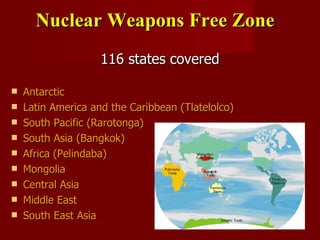
Nuclear Weapons Free Zone  116 states covered Antarctic Latin America and the Caribbean (Tlatelolco) South Pacific (Rarotonga) South Asia (Bangkok) Africa (Pelindaba) Mongolia Central Asia Middle East  South East Asia
Nuclear Weapons Free Zone Blue  – Nuclear Weapon- Free Zones       Red  - NW states       Yellow  - NPT only 189 states are members of NPT except India, Pakistan, Israel and North Korea. NWFZ bans whereas NPT limits the use, development and deployment of nuclear weapons in a given area. States 10 6  km² land Pop NWFZ 116 84 33% NWS 9 41.4 48% NPT only 68 24 19%
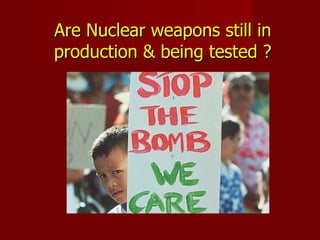
Are Nuclear weapons still in production & being tested ?
Are Nuclear weapons still in production & being tested ? The 1996 Comprehensive Test Ban Treaty bans all explosive nuclear tests, but has not yet entered into force.  In May 1998, India and Pakistan each conducted a series of underground nuclear tests, but all of the NPT nuclear weapon states have refrained from conducting explosive nuclear tests pending entry into force of the CTBT.
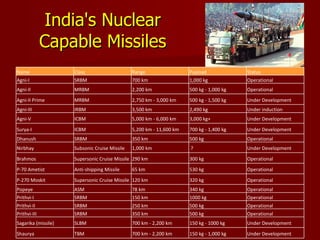
India's Nuclear Capable Missiles Name Class Range Payload Status Agni-I SRBM 700 km 1,000 kg Operational Agni-II MRBM 2,200 km 500 kg - 1,000 kg Operational Agni-II Prime  MRBM 2,750 km - 3,000 km 500 kg - 1,500 kg Under Development Agni-III  IRBM 3,500 km 2,490 kg Under induction Agni-V  ICBM  5,000 km - 6,000 km 3,000 kg+ Under Development Surya-I  ICBM  5,200 km - 11,600 km 700 kg - 1,400 kg Under Development Dhanush  SRBM  350 km 500 kg Operational Nirbhay  Subsonic Cruise Missile  1,000 km   ? Under Development Brahmos  Supersonic Cruise Missile  290 km 300 kg Operational P-70 Ametist  Anti-shipping Missile 65 km 530 kg Operational P-270 Moskit  Supersonic Cruise Missile  120 km 320 kg Operational Popeye  ASM  78 km 340 kg Operational Prithvi-I  SRBM  150 km 1000 kg Operational Prithvi-II  SRBM  250 km 500 kg Operational Prithvi-III  SRBM  350 km 500 kg Operational Sagarika (missile)  SLBM  700 km - 2,200 km 150 kg - 1000 kg Under Development Shaurya  TBM  700 km - 2,200 km 150 kg - 1,000 kg Under Development
About Indo-US Nuclear deal Also known as U.S.-India Civil Nuclear or more commonly known as 123 Agreement India agreed to separate its civil and military nuclear facilities India to place all its civil nuclear facilities under International Atomic Energy Agency (IAEA) safeguards United States agreed to work toward full civil nuclear cooperation with India
Exceptions made for India Amendment of U.S. domestic law, specially the Atomic Energy Act of 1954 Civil-military nuclear Separation Plan in India,  An India-IAEA safeguards (inspections) agreement The grant of an exemption for India by the Nuclear Suppliers Group
Approval at NSG United States approached the Nuclear Suppliers Group (NSG) to grant a waiver to India to commence civilian nuclear trade On September 6, 2008  45-nation NSG granted the waiver to India This approval makes India first country have nuclear arsenal, not a party to NPT and yet allowed nuclear commerce
Hyde Act Also known Henry J. Hyde United States-India Peaceful Atomic Energy Cooperation Act of 2008 U.S. domestic law that modifies the Section 123 of the U.S.  Atomic Energy Act  to permit nuclear cooperation with India The Act was passed by an overwhelming 359–68 in the house of representatives
Major events in the development of the Deal July 18, 2005 – First public announcement March3, 2006 – Bush meets Singh in India July 26, 2006 – Hyde Act passed July 28, 2006 – Left parties demand threadbare discussion in Parliament December 18, 2006 - President Bush signs into law congressional legislation on Indian atomic energy.
Contd.. Aug 13, 2007 – PM Singh makes a suo motu statement on the deal in Parliament. Feb 25, 2006 to July 8, 2008 - Left parties warn the ruling party against the deal and finally withdraws support July 22, 2008 – PM Manmohan Singh survives vote of confidence in Lok Sabha July 24, 2008 - India launches lobbying among the 45-nation NSG for an exemption for nuclear commerce.
Contd.. Sept 11, 2008 - President Bush sends the text of the 123 Agreement to the US Congress for final approval Sept 21, 2008 - US financial crisis diverts attention from N-deal Oct 8, 2008 - President Bush signs legislation to enact the landmark US-India civilian nuclear agreement. Oct 10, 2008 - The 123 Agreement operationalized
What is “123 Agreement” ? It is Section 123 of the United States Atomic Energy Act of 1954 Till date U.S. has entered into roughly twenty-five 123 Agreements  What problems India had with 123 Nuclear Liability Bill  – limited liability
Implications of the Nuclear Deal Indian Constitution does not warrant capping of nuclear liability US Law permits limited liability only, for American vendors Max. compensation of $450 million
Thank You

Non proliferation treaty-23_47

  • 1.
    Divye Garg (10810023)Rahul Agarwal (10810047) Nuclear non proliferation, Disarmament and Indo US Nuclear Deal
  • 2.
    Nuclear Non-Proliferation &Disarmament Regime “ International initiatives to prevent the spread of nuclear weapons leading to their total elimination.” A regime of United Nations Security Council & Disarmament Machinery.
  • 3.
    What is Proliferation?Horizontal Nuclear proliferation Vertical Nuclear proliferation
  • 4.
    Horizontal nuclear proliferationSpread of weapons to states not currently possessing nuclear weapons Vertical nuclear proliferation Increase in number and destructiveness of nuclear weapons within a state already possessing them What is Proliferation? Mostly applicable to nuclear weapons as biological and chemical weapons are banned.
  • 5.
    W HAT ISDISARMAMENT ? “ It is the total elimination of weapons of mass destruction, including nuclear weapons, through the prohibition on development, production and use and destruction of all such weapons.”
  • 6.
    Why is NuclearDisarmament & Non-proliferation a Priority?
  • 7.
  • 8.
    24,000 NUCLEAR WEAPONSAny single bomb can destroy any major city Estimated 24,000 nuclear warheads worldwide 5 NPT nuclear weapons states (China, France, Russia, UK, USA) 4 states outside the NPT (India, Israel, Pakistan, North Korea)
  • 9.
  • 10.
    Components ofThe Nuclear Non -Proliferation regime United Nations Security Council & Disarmament Machinery
  • 11.
    Non-Proliferation Treaty TheTreaty on the Non-Proliferation of Nuclear Weapons, also Nuclear Non-Proliferation Treaty (NPT or NNPT) : Is a treaty to limit the spread (proliferation) of Nuclear Weapons .
  • 12.
    How it started?Until the early 1960s, four nations (the United States, the Soviet Union, Britain and France) had acquired nuclear weapons. In 1964, after China detonated a nuclear weapon. In June 1968, the U.N. General Assembly endorsed the NPT with General Assembly Resolution 2373 (XXII), and in July 1968, the NPT opened for signature in Washington, DC, London and Moscow. The NPT entered into force in March 1970. The IAEA now safeguards Nuclear Non-Proliferation Treaty (NPT).
  • 13.
    Non-Proliferation Treaty Embodies the international community's efforts to prevent the further spread of nuclear weapons. Fulfill the aspirations for global disarmament. To also facilitate the cooperation in the peaceful uses of nuclear energy under safeguards. Entails commitments by both nuclear-weapon and non-nuclear-weapon states. Verification of compliance with nonproliferation undertakings through the application of safeguards that was conferred on the International Atomic Energy Agency (IAEA).
  • 14.
    Encourages & assistsresearch, development and practical application of atomic energy for peaceful uses throughout the world Establishes & administers safeguards designed to ensure that the use of nuclear energy is not used for military purposes Applies safeguards to relevant activities at the request of Member States Applies mandatory comprehensive safeguards in NNWS to the NPT & other international treaties INTERNATIONAL ATOMIC ENERGY AGENCY (IAEA)
  • 15.
    Why are safeguardsimportant? Prevent the proliferation of nuclear weapons. Foster the beneficial uses of atomic energy. Provide confidence and build trust.
  • 16.
    Bilateral treaties andagreements between Soviet Union and US Strategic Arms Limitation Talks (SALT 1) – 1969 Anti-Ballistic Missile Treaty (ABM Treaty) - 1972 Strategic Arms Limitation Talks (SALT 2) – 1979 Strategic Arms Reduction Treaty ( START 1) – 1991 Strategic Arms Reduction Treaty ( START 2) – 1993 Intermediate-Rang Nuclear Force Treaty (INF Treaty) – 1987
  • 17.
    SALT I StrategicArms Limitation Talks I SALT I, the first series of Strategic Arms Limitation Talks, started in November 1969. Limitation of Anti-Ballistic Missile Systems (ABMS) and Limitation of Strategic Offensive Arms. Creation of more favourable conditions and relaxation of international tension and the strengthening of trust between States. SALT I was brought to conclusion on May 26, 1972 and ABM treaty was signed by President Nixon and General Secretary Brezhnev
  • 18.
    Anti-Ballistic Missile Treaty(ABM Treaty) Background An anti-ballistic missile ( ABM ) is a missile designed to counter ballistic missiles. Soviet union introduced ABM systems which was followed by US. Due to economic, political and technological reasons Uncle got afraid and went for the treaty.
  • 19.
    Anti-Ballistic Missile Treaty(ABM Treaty) Clauses Deployed ABM systems were limited to two sites: - One around the national capital with no more than 100 ABM launchers and no more than 100 ABM interceptor missiles - The other, around ICBM launchers with no more than 100 ABM launchers, no more than 100 ABM interceptor missiles, two sites must be separated by no less than thirteen hundred kilometers
  • 20.
    SALT II Cappedthe number of strategic offensive nuclear missiles, limited the number of multiple-warhead missiles, froze the number of permitted delivery systems. Signed in 1979 , it was adhered to by both parties throughout the 1980s. Six months after Soviet Union invaded Afghanistan, the treaty was never formally ratified by the United States. In 1986 US withdrew from SALT II after accusing the Soviets of violating the pact. Subsequent discussions took place START and CTBT.
  • 21.
    Strategic Arms ReductionTreaty START I The treaty was signed on 31 July 1991 and entered into force on 5 December 1994 due to dissolution of Russia. Bans and limits the testing and development of ballistic missiles.
  • 22.
    Strategic Arms ReductionTreaty START I The START I treaty expired 5 December 2009. On 8 April 2010, the replacement New START treaty was signed in Prague by U.S. President Obama and Russian President Medvedev. Following ratification it went into force on 26 January 2011.
  • 23.
    Strategic Arms ReductionTreaty START II Signed January 3, 1993 by U.S. and Russia. Banned the use of multiple independently targetable reentry vehicles (MIRVs) on intercontinental ballistic missiles (ICBMs). On 14 June 2002, Russia withdrew from the treaty in response to U.S. withdrawal from ABM Treaty.
  • 24.
    Intermediate-Range Nuclear ForceTreaty (INF Treaty) Agreement between the United States and the Soviet Union in 1987. Elimination of Their Intermediate-Range ( between 500 and 5,500 km) and Shorter-Range Missiles. A total of 2,692 missiles ( 846 by U.S. and 1,846 by Soviet Union) were eliminated by mid-1991. In 2007, Russia withdrew from the treaty.
  • 25.
    COMPREHENSIVE NUCLEAR TEST BAN TREATY (CTBT) Bans any nuclear weapon test explosion or any other nuclear explosion in all environments for military and civilian purposes. Adopted by the UN General Assembly on 10 September 1996 but not yet entered into force. As of May 2010, 153 states have ratified the CTBT and another 29 states have signed but not yet ratified it. China, Egypt, Indonesia, Iran, Israel and the United States have signed but not yet ratified; India, North Korea and Pakistan have not signed. Indonesia has initiated the ratification process.
  • 26.
    Nuclear Weapons FreeZone 116 states covered Antarctic Latin America and the Caribbean (Tlatelolco) South Pacific (Rarotonga) South Asia (Bangkok) Africa (Pelindaba) Mongolia Central Asia Middle East South East Asia
  • 27.
    Nuclear Weapons FreeZone Blue – Nuclear Weapon- Free Zones       Red - NW states       Yellow - NPT only 189 states are members of NPT except India, Pakistan, Israel and North Korea. NWFZ bans whereas NPT limits the use, development and deployment of nuclear weapons in a given area. States 10 6 km² land Pop NWFZ 116 84 33% NWS 9 41.4 48% NPT only 68 24 19%
  • 28.
    Are Nuclear weaponsstill in production & being tested ?
  • 29.
    Are Nuclear weaponsstill in production & being tested ? The 1996 Comprehensive Test Ban Treaty bans all explosive nuclear tests, but has not yet entered into force. In May 1998, India and Pakistan each conducted a series of underground nuclear tests, but all of the NPT nuclear weapon states have refrained from conducting explosive nuclear tests pending entry into force of the CTBT.
  • 30.
    India's Nuclear CapableMissiles Name Class Range Payload Status Agni-I SRBM 700 km 1,000 kg Operational Agni-II MRBM 2,200 km 500 kg - 1,000 kg Operational Agni-II Prime MRBM 2,750 km - 3,000 km 500 kg - 1,500 kg Under Development Agni-III IRBM 3,500 km 2,490 kg Under induction Agni-V ICBM 5,000 km - 6,000 km 3,000 kg+ Under Development Surya-I ICBM 5,200 km - 11,600 km 700 kg - 1,400 kg Under Development Dhanush SRBM 350 km 500 kg Operational Nirbhay Subsonic Cruise Missile 1,000 km   ? Under Development Brahmos Supersonic Cruise Missile 290 km 300 kg Operational P-70 Ametist Anti-shipping Missile 65 km 530 kg Operational P-270 Moskit Supersonic Cruise Missile 120 km 320 kg Operational Popeye ASM 78 km 340 kg Operational Prithvi-I SRBM 150 km 1000 kg Operational Prithvi-II SRBM 250 km 500 kg Operational Prithvi-III SRBM 350 km 500 kg Operational Sagarika (missile) SLBM 700 km - 2,200 km 150 kg - 1000 kg Under Development Shaurya TBM 700 km - 2,200 km 150 kg - 1,000 kg Under Development
  • 31.
    About Indo-US Nucleardeal Also known as U.S.-India Civil Nuclear or more commonly known as 123 Agreement India agreed to separate its civil and military nuclear facilities India to place all its civil nuclear facilities under International Atomic Energy Agency (IAEA) safeguards United States agreed to work toward full civil nuclear cooperation with India
  • 32.
    Exceptions made forIndia Amendment of U.S. domestic law, specially the Atomic Energy Act of 1954 Civil-military nuclear Separation Plan in India, An India-IAEA safeguards (inspections) agreement The grant of an exemption for India by the Nuclear Suppliers Group
  • 33.
    Approval at NSGUnited States approached the Nuclear Suppliers Group (NSG) to grant a waiver to India to commence civilian nuclear trade On September 6, 2008 45-nation NSG granted the waiver to India This approval makes India first country have nuclear arsenal, not a party to NPT and yet allowed nuclear commerce
  • 34.
    Hyde Act Alsoknown Henry J. Hyde United States-India Peaceful Atomic Energy Cooperation Act of 2008 U.S. domestic law that modifies the Section 123 of the U.S. Atomic Energy Act to permit nuclear cooperation with India The Act was passed by an overwhelming 359–68 in the house of representatives
  • 35.
    Major events inthe development of the Deal July 18, 2005 – First public announcement March3, 2006 – Bush meets Singh in India July 26, 2006 – Hyde Act passed July 28, 2006 – Left parties demand threadbare discussion in Parliament December 18, 2006 - President Bush signs into law congressional legislation on Indian atomic energy.
  • 36.
    Contd.. Aug 13,2007 – PM Singh makes a suo motu statement on the deal in Parliament. Feb 25, 2006 to July 8, 2008 - Left parties warn the ruling party against the deal and finally withdraws support July 22, 2008 – PM Manmohan Singh survives vote of confidence in Lok Sabha July 24, 2008 - India launches lobbying among the 45-nation NSG for an exemption for nuclear commerce.
  • 37.
    Contd.. Sept 11,2008 - President Bush sends the text of the 123 Agreement to the US Congress for final approval Sept 21, 2008 - US financial crisis diverts attention from N-deal Oct 8, 2008 - President Bush signs legislation to enact the landmark US-India civilian nuclear agreement. Oct 10, 2008 - The 123 Agreement operationalized
  • 38.
    What is “123Agreement” ? It is Section 123 of the United States Atomic Energy Act of 1954 Till date U.S. has entered into roughly twenty-five 123 Agreements What problems India had with 123 Nuclear Liability Bill – limited liability
  • 39.
    Implications of theNuclear Deal Indian Constitution does not warrant capping of nuclear liability US Law permits limited liability only, for American vendors Max. compensation of $450 million
  • 40.