“Nuclear Treaties”
Aleksandar Bojić
International Campaign to Abolish Nuclear
Weapons, Southeast Europe – ICAN SEE
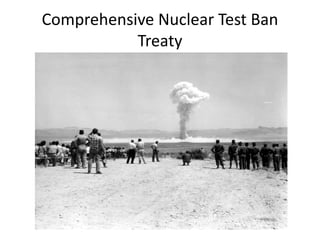
Comprehensive Nuclear Test Ban
Treaty
• Opened for Signature: 24 September 1996.
• Duration: Indefinite
• Number of Signatories: 183
• Number of Ratifications: 164
• Includes a Protocol in three parts:
– International Monitoring System (IMS)
– On-Site Inspections (OSI)
– Confidence Building Measures (CBM)
“The CTBT bans any nuclear weapon test explosion or
any other nuclear explosion”
• CTBT Organization in Vienna which mission is to
ensure the implementation of the treaty`s
provisions
• International Monitoring System – 321
monitoring stations
• Sanctions and settlement of disputes
– “...if the Conference of Executive Council determines
that a case is of particular gravity, it can bring the
issue to the attention of the UN”
Withdrawal: only in case when suprime national
interest is endagered.
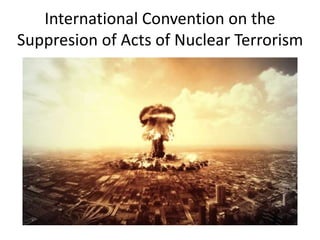
International Convention on the
Suppresion of Acts of Nuclear Terrorism
• Adopted: 13 April 2005
• Opened for Signature: 14 September 2005
• Entered into Force: 7 July 2007
• Number of States Parties: 99
• Signatories that have not ratified: 16
• Report of the UNSG to UNGA Resolution 50/53
“...preventing the use of weapons of mass
destruction (WMD) by terrorists”
• First anti-terrorism treaty adopted since the 11
September 2001 attacks
• Joined the 12 previously existing universal anti-
terrorism conventions
• Obstacles:
– NAM opposed any language that could legitimize the
use of nuc. weapons by military forces of NWS
– Definition of terrorism
– Draft Comprehensive Convention on International
Terrorism
• Provisions:
– “The convention defines the act of nuc terrorism as
the use or threat to use nuc material, nuc fuel,
radioactive products or waste, or any other
radioactive substances with toxic, explosive, or other
dangerous properties. The definition includes the use
or threat to use any nuc installation, nuc explosive, or
radiation devices in order to kill or injure persons ,
damage property, or the environment, or to compel
persons, states, or international organizations to do
or to refrain from doing any act”
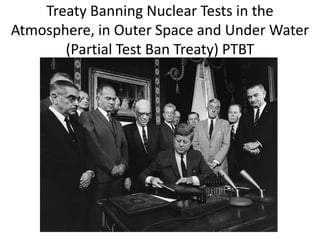
Treaty Banning Nuclear Tests in the
Atmosphere, in Outer Space and Under Water
(Partial Test Ban Treaty) PTBT
• Opened for signature: 5 August 1963.
• Entered into force: 10 October 1963.
• Duration: The Treaty is of unlimited duration.
• Depositories: Russia, United Kingdom, and
United States.
• 1954 – proposition of India
• 1958 – US, USSSR, UK... Conference on the
Discontinuance of Nuclear Tests (Geneva)
• Verification problems
• 1963 – PTBT (LTBT) signed in Moscow
• Obligations:
– “... to prohibit, prevent, and abstain from carrying
out nuclear weapons tests or any other nuclear
explosions in the atmosphere, in outer space, under
water, or in any other environment if such an
explosions cause radioactive debris to be present
outside the territorial limits of tha State that
conducts an explosion...”
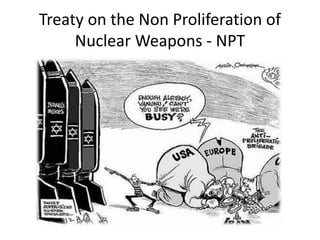
Treaty on the Non Proliferation of
Nuclear Weapons - NPT
• Opened for signature: 1 July 1968
Entered into force: 5 March 1970
Duration: Indefinite (extended in 1995)
Depositaries: Russia, UK, and US
States Parties: 191
• Limit the spread of nuclear weapons
– 1. Non-proliferation
– 2. Disarmament
– 3. Peaceful use of nuclear energy
• States without nuclear weapons will not aquire
them
• States with nuclear weapons will pursue
disarmament
• All states can access nuclear technology for
peaceful purposes, under safeguards
• Nuclear weapon states (NWS)
– Those that had manufactured and detonated a
nuclear explosive device prior to 1st January 1967
• China, France, Russia, the UK, the US
• Non-nuclear weapon states (NNWS)
– All others 
Seabed Treaty
– “Treaty on the Prohibition of the Emplacement of
Nuclear Weapons and Other Weapons of Mass
Destruction on the Seabed and Ocean Floor and in
the Subsoil Thereof”
• Opened for Signature: 11 February 1971.
• Entered into Force: 18 May 1972.
• Number of Parties: 95 States.
• Number of Signatories: 21 States.
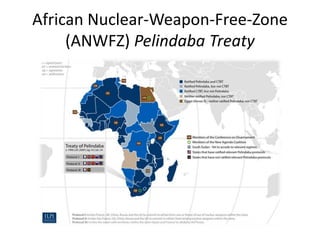
African Nuclear-Weapon-Free-Zone
(ANWFZ) Pelindaba Treaty
• Opened for signature: 11 April 1996
• Entered into Force: 15 July 2009
• Membership: 38
• 1961 – UNGA Resolution on Africa as de-
nuclearized zone
• 1964 – OAU Declaration on the De-
nuclearization of Africa
• Joint group of experts to draft a treaty
– Lome (1992), Harare (1993), Windhoek and Adis
Abeba (1994), Johannesburg and Pelindaba (1995)
• Obligations:
– “...The Parties undertake not to conduct research on,
develop, manufacture, stockpile or otherwise acquire,
possess, or have control over any nuclear explosive
device by any means anywhere; not to seek or receive
any assistance in the research on, development,
manufacture, stockpiling or acquisition, or possession
of any nuclear explosive device; and not to take any
action to assist or encourage to research .. Of any
nuc.explosive devise”.
– Prohibit, in their territory, the stationing of any
nuc.explosive device
– Prohibit testing
• Protocol I
– NWS not to use or threaten to use a nuclear explosive
device against any Party to the Treaty
• Protocol II
– NWS not to test or assist or encourage the testing of
any nuclear explosive device anywhere whithin the
Pelindaba NWFZ
• Protocol III
– Each party, with respect to the territories for which it
is de jure or de facto internationally responsible and
situated within the Pelindaba NWFZ, to apply the
provisions of the Treaty
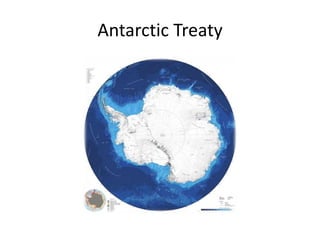
Antarctic Treaty
• Opened for Signature: 1 December 1959.
• Entered into Force: 23 June 1961.
• Number of Parties: 52 states, of which 12 are
original members and Consultative Parties, 29
Consultative Parties with voting status at Antarctic
Treaty Consultative Meetings, and 23 Non-Consultative
Parties with observer status.
• “...Antarctica shall continue forever to be used
exclusively for peaceful purposes and shall not
become the scene or object of international
discord”
• Obligations:
– Antarctica shall be used for peacefull purposes only;
any military measures, with the exception of use of
military assets for scientific research or any other
peaceful purpose, are prohibited.
– Freedom of scientific investigation and cooperation.
– Plans for scientific programs and the observations
and results shall be freely exchanged.
– All national claims are held static from the date of
signature.
– Nuclear explosions and disposal of radioactive waste
are prohibited in Antarctica.
– The provision of the Treaty applies to the area south
of 60° South latitude.
Any disputes between Contracting Parties shall be
resolved by peacefull negotiation, in the last
resort by the International Court of Justice
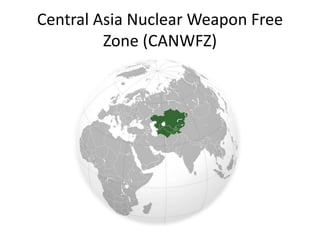
Central Asia Nuclear Weapon Free
Zone (CANWFZ)
• Opened for signature: 8 September 2006
• Entered into force: 21 March 2009.
• Number of signatories: 5 (Kazakhstan,
Kyrgyzstan, Tajikistan, Turkmenistan, and
Uzbekistan).
• Number of ratifications: 5 (Kazakhstan,
Kyrgyzstan, Tajikistan, Turkmenistan, and
Uzbekistan).
• Duration: Unlimited.
• Depositary: Kyrgyzstan.
• Example of Mongolia in 1992.
• 1993 – Islam Karimov, formal request at the
48th session of the UNGA
• 1997 – Almaty Declaration of head of states
• 2002 – Samarkand, first draft by experts
• 2005 – Tashkent, final draft
• Research, development, manufactureing,
stockpiling, acquiring, possessing, have control
over any nuclear weapon is not allowed.
• Nuclear tests
• Respect the Safeguards of IAEA
• Maintain standards of physical protection of
nuclear material
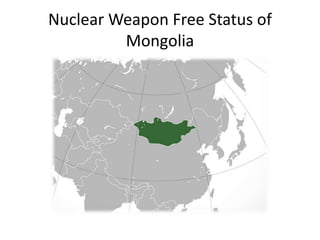
Nuclear Weapon Free Status of
Mongolia
• Declared: 25 September 1992
• Entered into Force: 3 February 2000
• Resolution 3261 F of UNGA FROM 1974 – single
state nuclear weapon free zone
– “...obligations relating to the establishment of
nuclear weapon free zones may be assumed not
only by groups of States, including entire continents
or large geographical regions, but also by small
groups of States and even individual countries”
• An individual, legal person or any foreign State shall
be prohibited on the teritory of Mongolia from
commiting, initiating, or participating in the
following acts or activities relating to nuclear
weapons:
– 1. Developing, manufacturing, or otherwise aquiring,
possesing, or having control over nuclear weapons
– 2. Stationing or transporting nuclear weapons by any
means
– 3. Dumping or disposing nuclear weapons grade
radioactive materials or nuclear waste
• The Treaty covers the territory of Mongolia in its
entirety, including in air space, land, water, and the
sub-soil
Southeast Asia Nuclear Weapon Free
Zone – Bangkok Treaty
• Opened for Signature: 15 December 1995.
• Entered into Force: 28 March 1997.
• 1971 – Kuala Lumpur Declaration on a Zone of
Peace, Freedom and Neutrality (ZOPFAN)
• 1995 – Bangkok Treaty establishing SEANWFZ
• Treaty covers the territories, continental shelves,
and EEZ of the States Parties
• None of the NWS has yet signed the protocols
(security assurances and EEZ definitions)
• Obligation
– Not to develop, manufacture, acquire, possess or
have control over nuc weapons
– Not to station nuc weapons
– Not to test or use nuc weapons
– Take no action to assist ot encourage the
manufacture or aquisition of any nuc explosive
device
– Not to provide fissionable materials to any state
unless if it is for peaceful purposes (IAEA safeguards)
– Not to dump radioactive waste at sea and to prevent
anyone else from doing so in their territorial waters
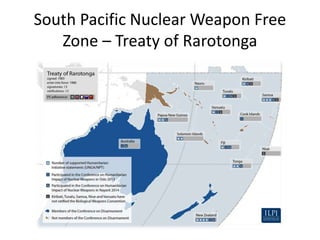
South Pacific Nuclear Weapon Free
Zone – Treaty of Rarotonga
• Opened for Signature: 6 August 1985.
• Entered into Force: 11 December 1986.
• Testing ground
• 1946-1958 United States at Marshall Islands
• 1952-1957 United Kingdom at Maralinga, Emu
Field, Monte Bello Island (Au territories)
• 1966-1996 France at the Mururoa and
Fangataufa sites
• Dumping of nuclear waste at sea
• “...preventing the region from becoming ar arena
for superpower rivalry, preserving peace and
security, and protecting natural resources in
addition to the well being and livelihood of the
South Pacific peoples”
• Dialogue parties: Canada, China, the EU, Japan,
South Korea, the UK, and the US. (France)
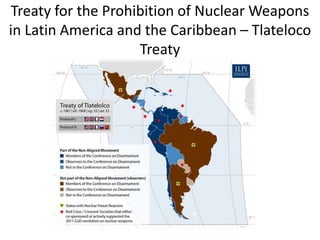
Treaty for the Prohibition of Nuclear Weapons
in Latin America and the Caribbean – Tlateloco
Treaty
• Opened for Signature: 14 February 1967
• Entered into Force: 25 April 1969.
• Member States: 33
• Model for all future NWFZs
• 1958 – OAS Council meeting, Costa Rica propose
a Latin America nuc arms control
• African voices
• Alfonso Garcia Robles, Mexican ambassador to
Brazil
• “ The Treaty aims to prohibit and prevent in the
region: (a) the testing, use, manufacture,
production, or acquisition by any means whatsoever
of any nuclear weapons, by the Parties themselves,
directly or indirectly, on behalf of anyone else, or in
any other way, and (b) the receipt, storaga,
installation, deployment, and any form of posession
of any nuclear weapons, directly or indirectly, by the
Parties themselves, by anyone on their behalf, or in
any other way. The Parties also undertake to refrain
from engaging in encouraging or authorizing,
directly or indirectly, or in any way participating in
the testing, use, manufactre, production,
possession, or control of any nuclear weapons”
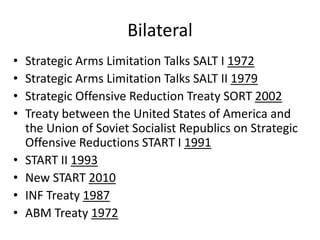
Bilateral
• Strategic Arms Limitation Talks SALT I 1972
• Strategic Arms Limitation Talks SALT II 1979
• Strategic Offensive Reduction Treaty SORT 2002
• Treaty between the United States of America and
the Union of Soviet Socialist Republics on Strategic
Offensive Reductions START I 1991
• START II 1993
• New START 2010
• INF Treaty 1987
• ABM Treaty 1972
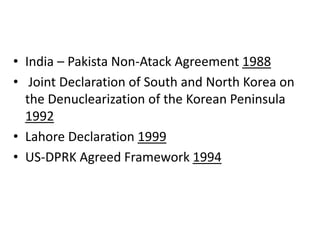
• India – Pakista Non-Atack Agreement 1988
• Joint Declaration of South and North Korea on
the Denuclearization of the Korean Peninsula
1992
• Lahore Declaration 1999
• US-DPRK Agreed Framework 1994
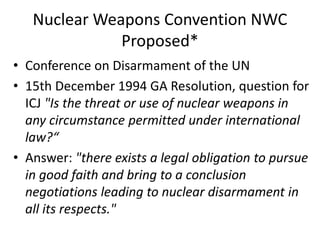
Nuclear Weapons Convention NWC
Proposed*
• Conference on Disarmament of the UN
• 15th December 1994 GA Resolution, question for
ICJ "Is the threat or use of nuclear weapons in
any circumstance permitted under international
law?“
• Answer: "there exists a legal obligation to pursue
in good faith and bring to a conclusion
negotiations leading to nuclear disarmament in
all its respects."
Thanks for attention and comments! ;)