Hamlet: A Revenge Play 
It is an emotion that naturally appeals 
to dramatists since it provides a 
coherent and logical framework for the 
depiction of human passions. 
dilipbarad@gmail.com 
www.dilipbarad.com
Revenge, the desire to retaliate for an injury, is a 
powerful, natural, and dangerous human emotion. 
• Revenge never sleeps – as Thomas Kyd 
dramatically demonstrates in The Spanish 
Tragedy. 
• In Spanish Tragedy, father Hieronimo takes 
revenge for his son Horatio’s death. 
• Hamlet is a play concerned with son’s revenge 
for the murder of his father. It is a story 
concerned with murder, sudden violence and 
the slower but more deadly reaction to that 
violence.
• A series of events can clearly be seen to start 
with some original crime and end once that 
crime has been avenged. 
• The Greek tragedians used it many times and 
it reached the Elizabethans as part of the 
classical heritage through the literature of 
Rome. Aided by their own historical vision, 
and challenged by the particular 
requirements of their own theatre, they 
made the form their own to such an extent 
that the term ‘revenge tragedy’ can usually 
be understood as referring to tragedies 
written between 1580 and 1642.
Seneca & Thomas Kyd: Revenge Tragedy:…. 
• The Spanish Tragedy and Titus Andronicus are the 
early and successful examples of the dramatic use of 
revenge. 
• In both plays an injured man has difficulty, first in 
identifying the people who have harmed him, and 
then in attacking them, since they are both powerful 
and well guarded. 
• Patience, cunning and continuing resolutions are 
necessary in order to achieve revenge. Hieronimo 
avenges murder of his son Horatio in The Spanish 
Tragedy and Titus Andronicus imitates Thyestes in 
Greet Myth – after serving his enemy Tamora, Queen 
of Goths, the minced bodies of her children cooked in 
pie, after she has eaten it, he kills her.
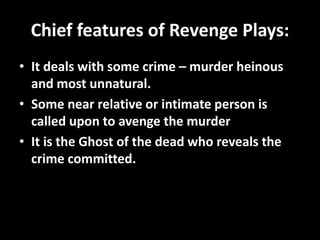
Chief features of Revenge Plays: 
• It deals with some crime – murder heinous 
and most unnatural. 
• Some near relative or intimate person is 
called upon to avenge the murder 
• It is the Ghost of the dead who reveals the 
crime committed.
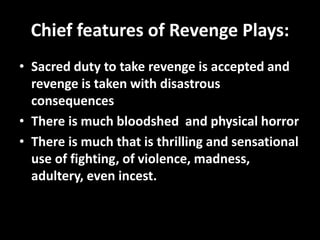
Chief features of Revenge Plays: 
• Sacred duty to take revenge is accepted and 
revenge is taken with disastrous 
consequences 
• There is much bloodshed and physical horror 
• There is much that is thrilling and sensational 
use of fighting, of violence, madness, 
adultery, even incest.
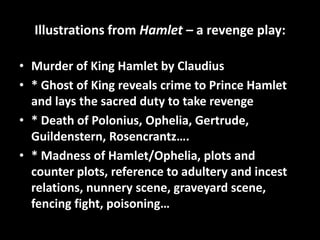
Illustrations from Hamlet – a revenge play: 
• Murder of King Hamlet by Claudius 
• * Ghost of King reveals crime to Prince Hamlet 
and lays the sacred duty to take revenge 
• * Death of Polonius, Ophelia, Gertrude, 
Guildenstern, Rosencrantz…. 
• * Madness of Hamlet/Ophelia, plots and 
counter plots, reference to adultery and incest 
relations, nunnery scene, graveyard scene, 
fencing fight, poisoning…
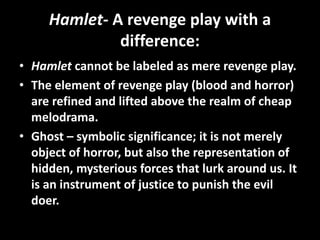
Hamlet- A revenge play with a 
difference: 
• Hamlet cannot be labeled as mere revenge play. 
• The element of revenge play (blood and horror) 
are refined and lifted above the realm of cheap 
melodrama. 
• Ghost – symbolic significance; it is not merely 
object of horror, but also the representation of 
hidden, mysterious forces that lurk around us. It 
is an instrument of justice to punish the evil 
doer.
Hamlet- A revenge play with a 
difference: 
• It is not only tragedy of revenge, but is a 
tragedy of human soul. 
• Hamlet’s suffering in his melancholy, in his 
hesitation, in his inaction at a crucial moment 
in his life, in each one of the aspects of his 
many-sided personality; he typifies some one 
or the other phase of human nature.
Hamlet- A revenge play with a 
difference: 
• His reflections on life, the truths which he 
utters from time to time, are as true-today as 
when they were uttered. 
• His tortured soul is threadbare before us and 
it raises the play above a crude melodrama or 
revenge play.

Hamlet as a Revenge Play

  • 1.
    Hamlet: A RevengePlay It is an emotion that naturally appeals to dramatists since it provides a coherent and logical framework for the depiction of human passions. dilipbarad@gmail.com www.dilipbarad.com
  • 2.
    Revenge, the desireto retaliate for an injury, is a powerful, natural, and dangerous human emotion. • Revenge never sleeps – as Thomas Kyd dramatically demonstrates in The Spanish Tragedy. • In Spanish Tragedy, father Hieronimo takes revenge for his son Horatio’s death. • Hamlet is a play concerned with son’s revenge for the murder of his father. It is a story concerned with murder, sudden violence and the slower but more deadly reaction to that violence.
  • 3.
    • A seriesof events can clearly be seen to start with some original crime and end once that crime has been avenged. • The Greek tragedians used it many times and it reached the Elizabethans as part of the classical heritage through the literature of Rome. Aided by their own historical vision, and challenged by the particular requirements of their own theatre, they made the form their own to such an extent that the term ‘revenge tragedy’ can usually be understood as referring to tragedies written between 1580 and 1642.
  • 4.
    Seneca & ThomasKyd: Revenge Tragedy:…. • The Spanish Tragedy and Titus Andronicus are the early and successful examples of the dramatic use of revenge. • In both plays an injured man has difficulty, first in identifying the people who have harmed him, and then in attacking them, since they are both powerful and well guarded. • Patience, cunning and continuing resolutions are necessary in order to achieve revenge. Hieronimo avenges murder of his son Horatio in The Spanish Tragedy and Titus Andronicus imitates Thyestes in Greet Myth – after serving his enemy Tamora, Queen of Goths, the minced bodies of her children cooked in pie, after she has eaten it, he kills her.
  • 5.
    Chief features ofRevenge Plays: • It deals with some crime – murder heinous and most unnatural. • Some near relative or intimate person is called upon to avenge the murder • It is the Ghost of the dead who reveals the crime committed.
  • 6.
    Chief features ofRevenge Plays: • Sacred duty to take revenge is accepted and revenge is taken with disastrous consequences • There is much bloodshed and physical horror • There is much that is thrilling and sensational use of fighting, of violence, madness, adultery, even incest.
  • 7.
    Illustrations from Hamlet– a revenge play: • Murder of King Hamlet by Claudius • * Ghost of King reveals crime to Prince Hamlet and lays the sacred duty to take revenge • * Death of Polonius, Ophelia, Gertrude, Guildenstern, Rosencrantz…. • * Madness of Hamlet/Ophelia, plots and counter plots, reference to adultery and incest relations, nunnery scene, graveyard scene, fencing fight, poisoning…
  • 8.
    Hamlet- A revengeplay with a difference: • Hamlet cannot be labeled as mere revenge play. • The element of revenge play (blood and horror) are refined and lifted above the realm of cheap melodrama. • Ghost – symbolic significance; it is not merely object of horror, but also the representation of hidden, mysterious forces that lurk around us. It is an instrument of justice to punish the evil doer.
  • 9.
    Hamlet- A revengeplay with a difference: • It is not only tragedy of revenge, but is a tragedy of human soul. • Hamlet’s suffering in his melancholy, in his hesitation, in his inaction at a crucial moment in his life, in each one of the aspects of his many-sided personality; he typifies some one or the other phase of human nature.
  • 10.
    Hamlet- A revengeplay with a difference: • His reflections on life, the truths which he utters from time to time, are as true-today as when they were uttered. • His tortured soul is threadbare before us and it raises the play above a crude melodrama or revenge play.