



The Tragedy of Hamlet, 
Prince of Denmark 
William Shakespeare 
Introduction 
Background 
Discussion Starters
The Tragedy of Hamlet, 
Prince of Denmark 
William Shakespeare
The Tragedy of Hamlet: Introduction 
There’s something 
rotten in the state 
of Denmark . . .
The Tragedy of Hamlet: Introduction 
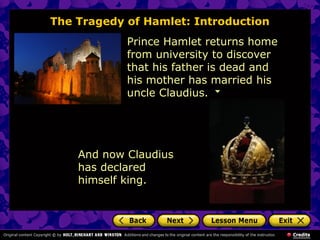
Prince Hamlet returns home 
from university to discover 
that his father is dead and 
his mother has married his 
uncle Claudius. 
And now Claudius 
has declared 
himself king.
The Tragedy of Hamlet: Introduction 
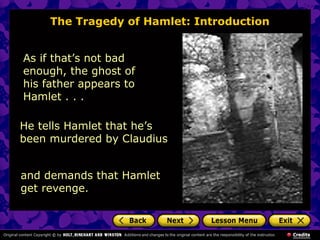
As if that’s not bad 
enough, the ghost of 
his father appears to 
Hamlet . . . 
He tells Hamlet that he’s 
been murdered by Claudius 
and demands that Hamlet 
get revenge.
The Tragedy of Hamlet: Introduction 
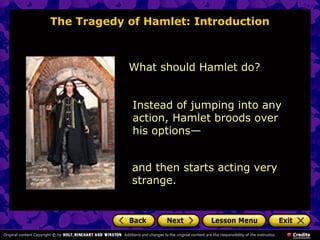
What should Hamlet do? 
Instead of jumping into any 
action, Hamlet broods over 
his options— 
and then starts acting very 
strange.
The Tragedy of Hamlet: Introduction 
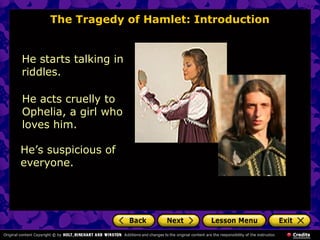
He starts talking in 
riddles. 
He acts cruelly to 
Ophelia, a girl who 
loves him. 
He’s suspicious of 
everyone.
The Tragedy of Hamlet: Introduction 
Why is Hamlet 
acting like this? Is he insane? Or 
faking insanity? 
Will he make up his mind to 
take action? 
Should he kill his 
uncle?
The Tragedy of Hamlet: Background 
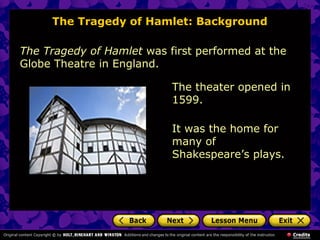
The Tragedy of Hamlet was first performed at the 
Globe Theatre in England. 
The theater opened in 
1599. 
It was the home for 
many of 
Shakespeare’s plays.
The Tragedy of Hamlet: Background 
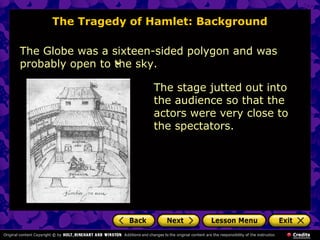
The Globe was a sixteen-sided polygon and was 
probably open to the sky. 
The stage jutted out into 
the audience so that the 
actors were very close to 
the spectators.
The Tragedy of Hamlet: Background 
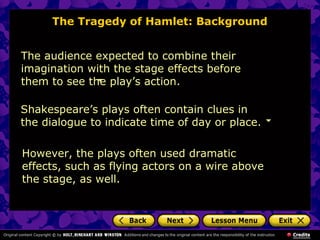
The audience expected to combine their 
imagination with the stage effects before 
them to see the play’s action. 
Shakespeare’s plays often contain clues in 
the dialogue to indicate time of day or place. 
However, the plays often used dramatic 
effects, such as flying actors on a wire above 
the stage, as well.
The Tragedy of Hamlet: Background 
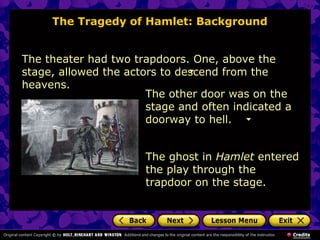
The theater had two trapdoors. One, above the 
stage, allowed the actors to descend from the 
heavens. 
The other door was on the 
stage and often indicated a 
doorway to hell. 
The ghost in Hamlet entered 
the play through the 
trapdoor on the stage.
The Tragedy of Hamlet: Background 
The period in which 
Shakespeare wrote is called 
the Elizabethan period. 
Queen Elizabeth was the 
head of the royal family 
(1558–1603). 
The queen saw many 
of Shakespeare’s 
plays in special court 
performances.
The Tragedy of Hamlet: Background 
Shakespeare may have used the Hamlet story— 
and other plays that featured murdered kings—to 
reflect the concerns of his own time. 
To the Elizabethans, social order was very 
important, yet there had been political and religious 
conflicts before and during Elizabeth’s rule. 
Hamlet depicts a conflict over what to do when 
an orderly state is actually corrupt inside and 
there seems to be no civilized answer.
The Tragedy of Hamlet: Background 
The language of the play is unrhymed. This is 
called blank verse. 
However, it is based on a pattern called iambic 
pentameter.
The Tragedy of Hamlet: Background 
Like dance or rock music, iambic pentameter is 
based on a beat that is pleasing to the ear. 
• It includes an unstressed syllable 
followed by an stressed syllable: 
“To BE or NOT to BE . . .” 
• It matches the sound of a 
beating heart: daDUM daDUM
The Tragedy of Hamlet: Background 
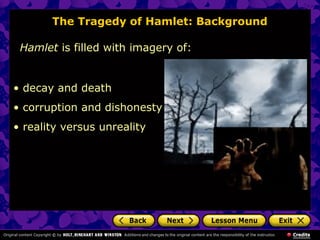
Hamlet is filled with imagery of: 
• decay and death 
• corruption and dishonesty 
• reality versus unreality
The Tragedy of Hamlet: Discussion Starters 
Discuss (1) 
Hamlet is troubled by the marriage of his uncle 
to his mother and by his uncle becoming king. 
• Who would you expect to be king after Hamlet’s 
father dies? 
• If Hamlet were your friend, what advice would 
you give to him? 
• How does power shift in Hamlet’s family after his 
father’s death?
The Tragedy of Hamlet: Discussion Starters 
Discuss (2) 
Hamlet believes that his father’s ghost is asking 
him to get revenge for his murder. 
•How would you react in this situation? Why? 
•Do you think revenge is a good response to 
criminal acts? Why or why not?

Hamlet intro

  • 1.
    The Tragedy ofHamlet, Prince of Denmark William Shakespeare Introduction Background Discussion Starters
  • 2.
    The Tragedy ofHamlet, Prince of Denmark William Shakespeare
  • 3.
    The Tragedy ofHamlet: Introduction There’s something rotten in the state of Denmark . . .
  • 4.
    The Tragedy ofHamlet: Introduction Prince Hamlet returns home from university to discover that his father is dead and his mother has married his uncle Claudius. And now Claudius has declared himself king.
  • 5.
    The Tragedy ofHamlet: Introduction As if that’s not bad enough, the ghost of his father appears to Hamlet . . . He tells Hamlet that he’s been murdered by Claudius and demands that Hamlet get revenge.
  • 6.
    The Tragedy ofHamlet: Introduction What should Hamlet do? Instead of jumping into any action, Hamlet broods over his options— and then starts acting very strange.
  • 7.
    The Tragedy ofHamlet: Introduction He starts talking in riddles. He acts cruelly to Ophelia, a girl who loves him. He’s suspicious of everyone.
  • 8.
    The Tragedy ofHamlet: Introduction Why is Hamlet acting like this? Is he insane? Or faking insanity? Will he make up his mind to take action? Should he kill his uncle?
  • 9.
    The Tragedy ofHamlet: Background The Tragedy of Hamlet was first performed at the Globe Theatre in England. The theater opened in 1599. It was the home for many of Shakespeare’s plays.
  • 10.
    The Tragedy ofHamlet: Background The Globe was a sixteen-sided polygon and was probably open to the sky. The stage jutted out into the audience so that the actors were very close to the spectators.
  • 11.
    The Tragedy ofHamlet: Background The audience expected to combine their imagination with the stage effects before them to see the play’s action. Shakespeare’s plays often contain clues in the dialogue to indicate time of day or place. However, the plays often used dramatic effects, such as flying actors on a wire above the stage, as well.
  • 12.
    The Tragedy ofHamlet: Background The theater had two trapdoors. One, above the stage, allowed the actors to descend from the heavens. The other door was on the stage and often indicated a doorway to hell. The ghost in Hamlet entered the play through the trapdoor on the stage.
  • 13.
    The Tragedy ofHamlet: Background The period in which Shakespeare wrote is called the Elizabethan period. Queen Elizabeth was the head of the royal family (1558–1603). The queen saw many of Shakespeare’s plays in special court performances.
  • 14.
    The Tragedy ofHamlet: Background Shakespeare may have used the Hamlet story— and other plays that featured murdered kings—to reflect the concerns of his own time. To the Elizabethans, social order was very important, yet there had been political and religious conflicts before and during Elizabeth’s rule. Hamlet depicts a conflict over what to do when an orderly state is actually corrupt inside and there seems to be no civilized answer.
  • 15.
    The Tragedy ofHamlet: Background The language of the play is unrhymed. This is called blank verse. However, it is based on a pattern called iambic pentameter.
  • 16.
    The Tragedy ofHamlet: Background Like dance or rock music, iambic pentameter is based on a beat that is pleasing to the ear. • It includes an unstressed syllable followed by an stressed syllable: “To BE or NOT to BE . . .” • It matches the sound of a beating heart: daDUM daDUM
  • 17.
    The Tragedy ofHamlet: Background Hamlet is filled with imagery of: • decay and death • corruption and dishonesty • reality versus unreality
  • 18.
    The Tragedy ofHamlet: Discussion Starters Discuss (1) Hamlet is troubled by the marriage of his uncle to his mother and by his uncle becoming king. • Who would you expect to be king after Hamlet’s father dies? • If Hamlet were your friend, what advice would you give to him? • How does power shift in Hamlet’s family after his father’s death?
  • 19.
    The Tragedy ofHamlet: Discussion Starters Discuss (2) Hamlet believes that his father’s ghost is asking him to get revenge for his murder. •How would you react in this situation? Why? •Do you think revenge is a good response to criminal acts? Why or why not?