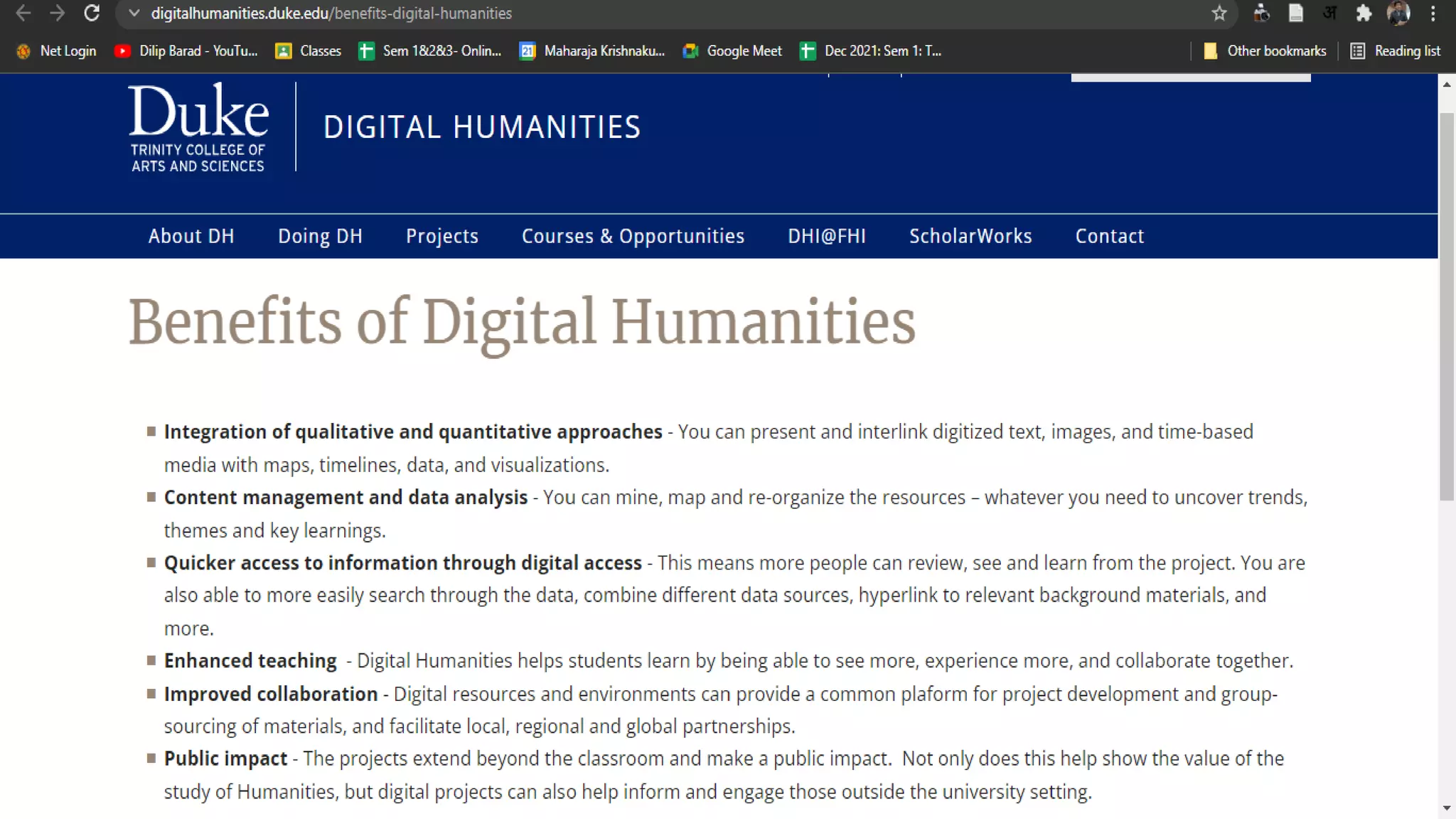
What is Digital Humanities?
•Digital humanities (DH) is an area of scholarly
activity at the intersection of computing or digital
technologies and the disciplines of the humanities. It
includes the systematic use of digital resources in
the humanities, as well as the analysis of their
application.
• Drucker, Johanna (September 2013). "Intro to Digital Humanities:
Introduction". UCLA Center for Digital Humanities
• Terras, Melissa (December 2011). "Quantifying Digital
Humanities" (PDF). UCL Centre for Digital Humanities.
•DH can be defined as new ways of doing
scholarship that involve collaborative,
transdisciplinary, and computationally engaged
research, teaching, and publishing.
• It brings digital tools and methods to the study of the
humanities with the recognition that the printed word
is no longer the main medium for knowledge
production and distribution
• Burdick, Anne; Drucker, Johanna; Lunenfeld, Peter; Presner,
Todd; Schnapp, Jeffrey (November 2012). Digital_Humanities
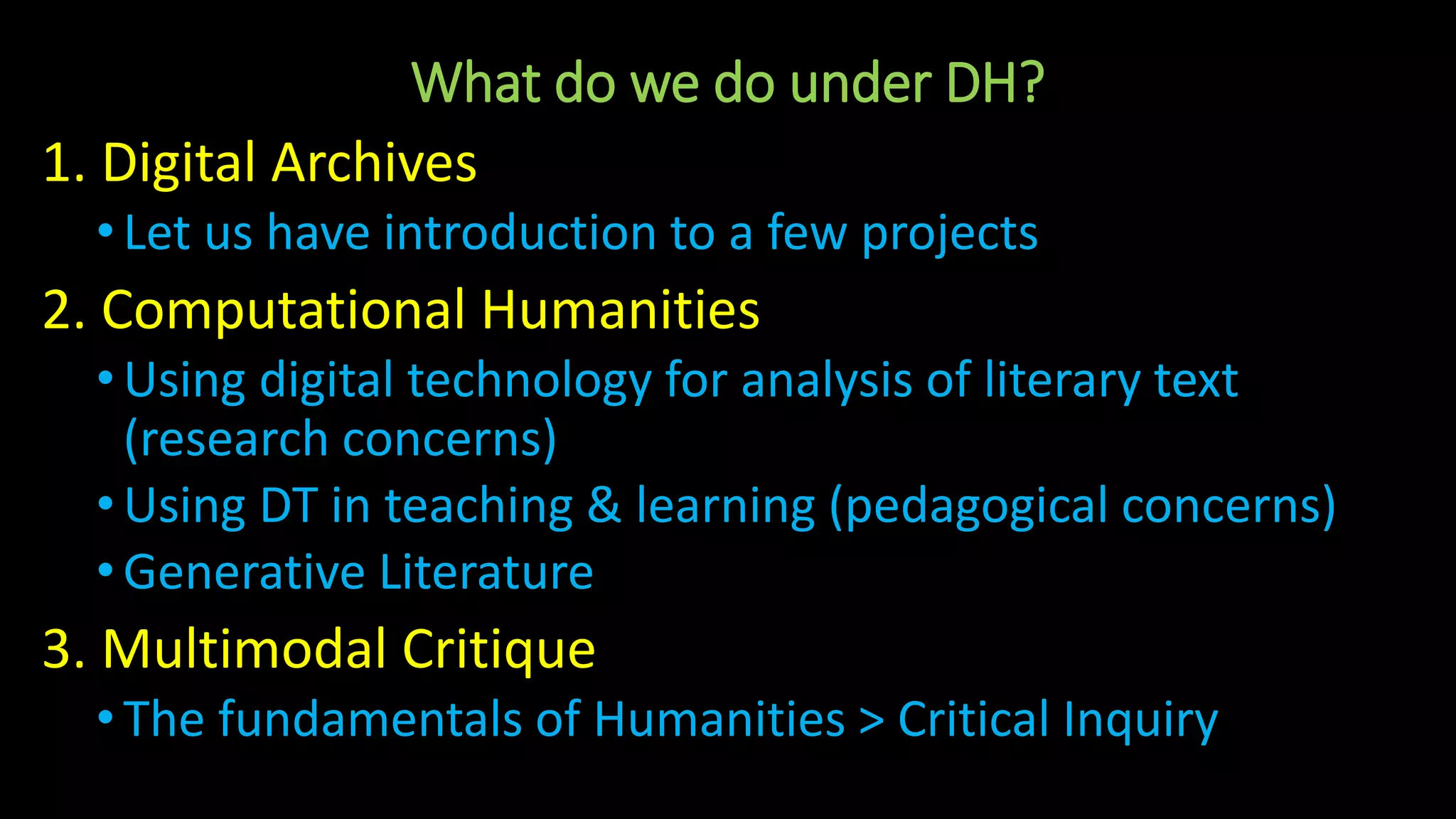
What do we do under DH?
1. Digital Archives
•Let us have introduction to a few projects
2. Computational Humanities
•Using digital technology for analysis of literary text
(research concerns)
•Using DT in teaching & learning (pedagogical concerns)
•Generative Literature
3. Multimodal Critique
•The fundamentals of Humanities > Critical Inquiry
1. Digital Archives
• http://www.rossettiarchive.org/index.html
• https://victorianweb.org/
• https://artsandculture.google.com/
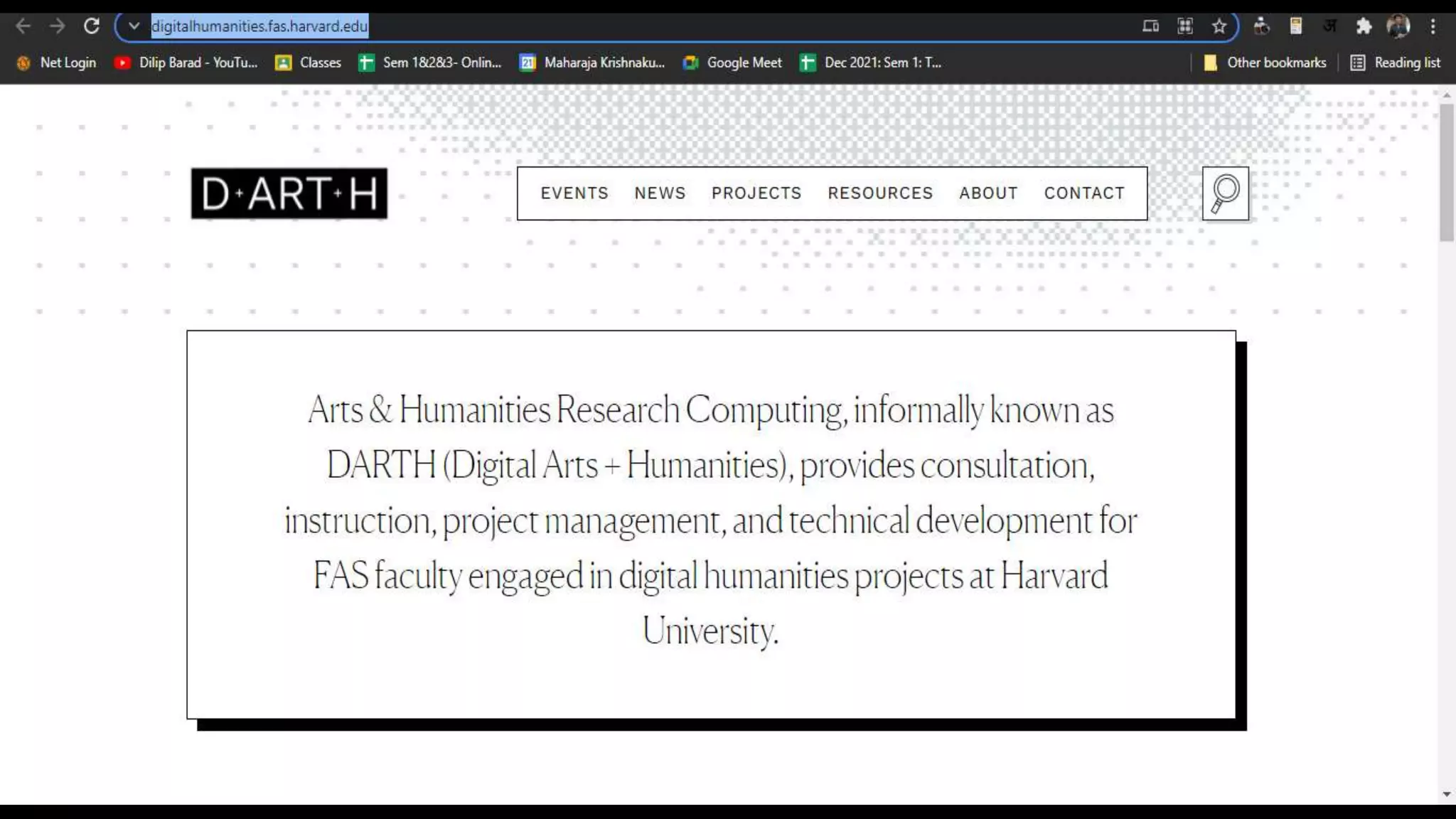
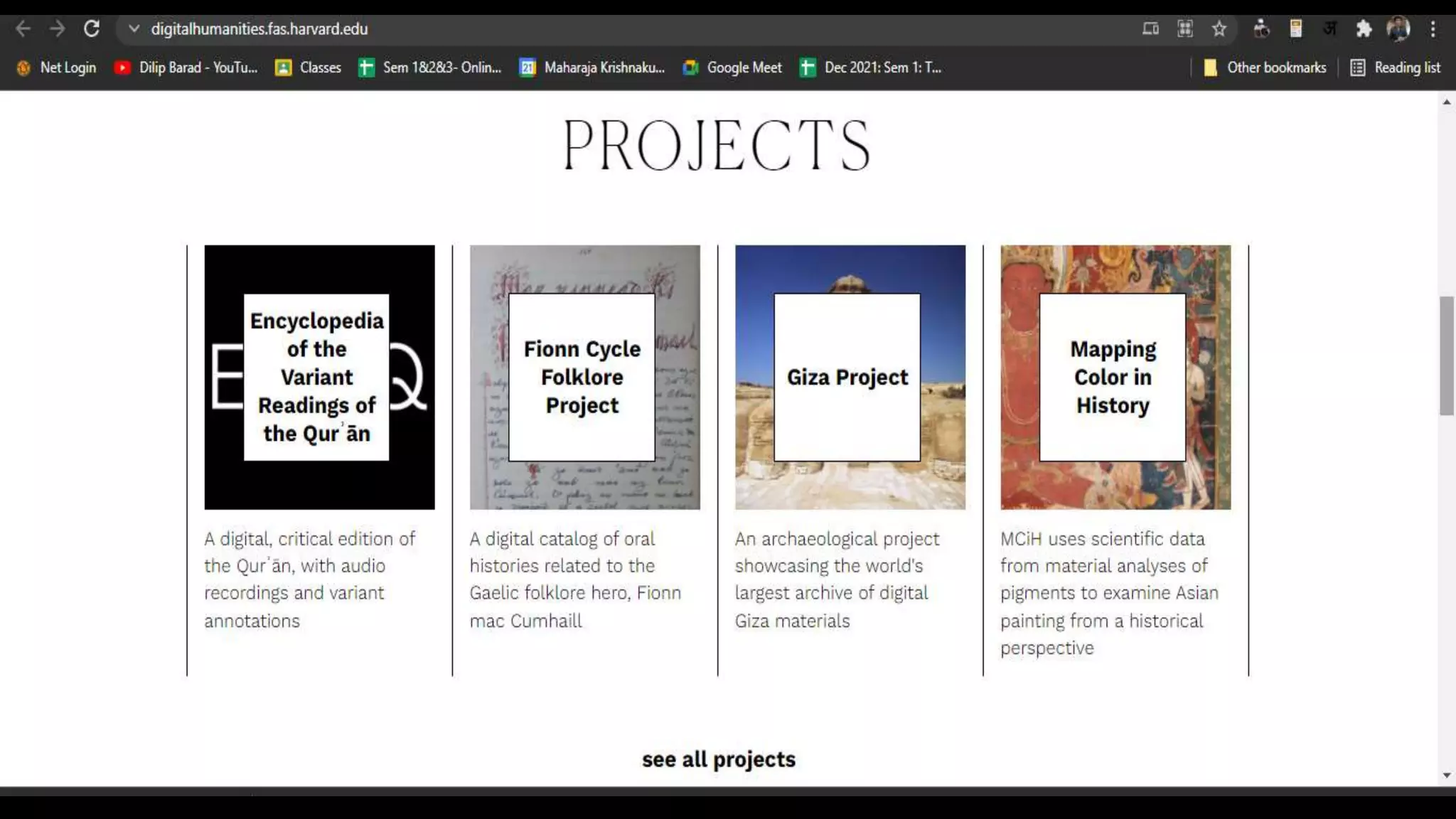
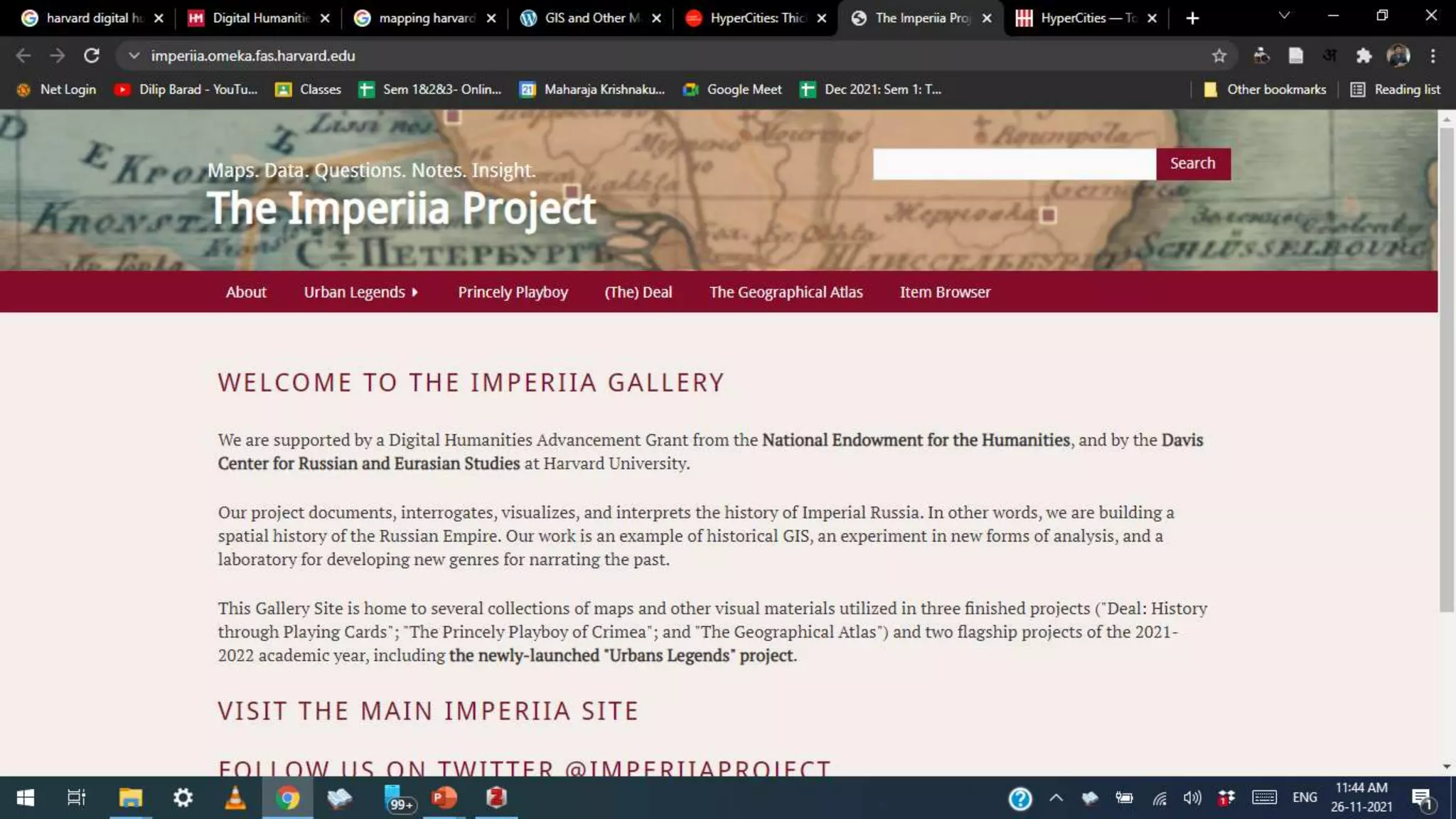
• https://digitalhumanities.fas.harvard.edu/projects/ [D-ART-H]
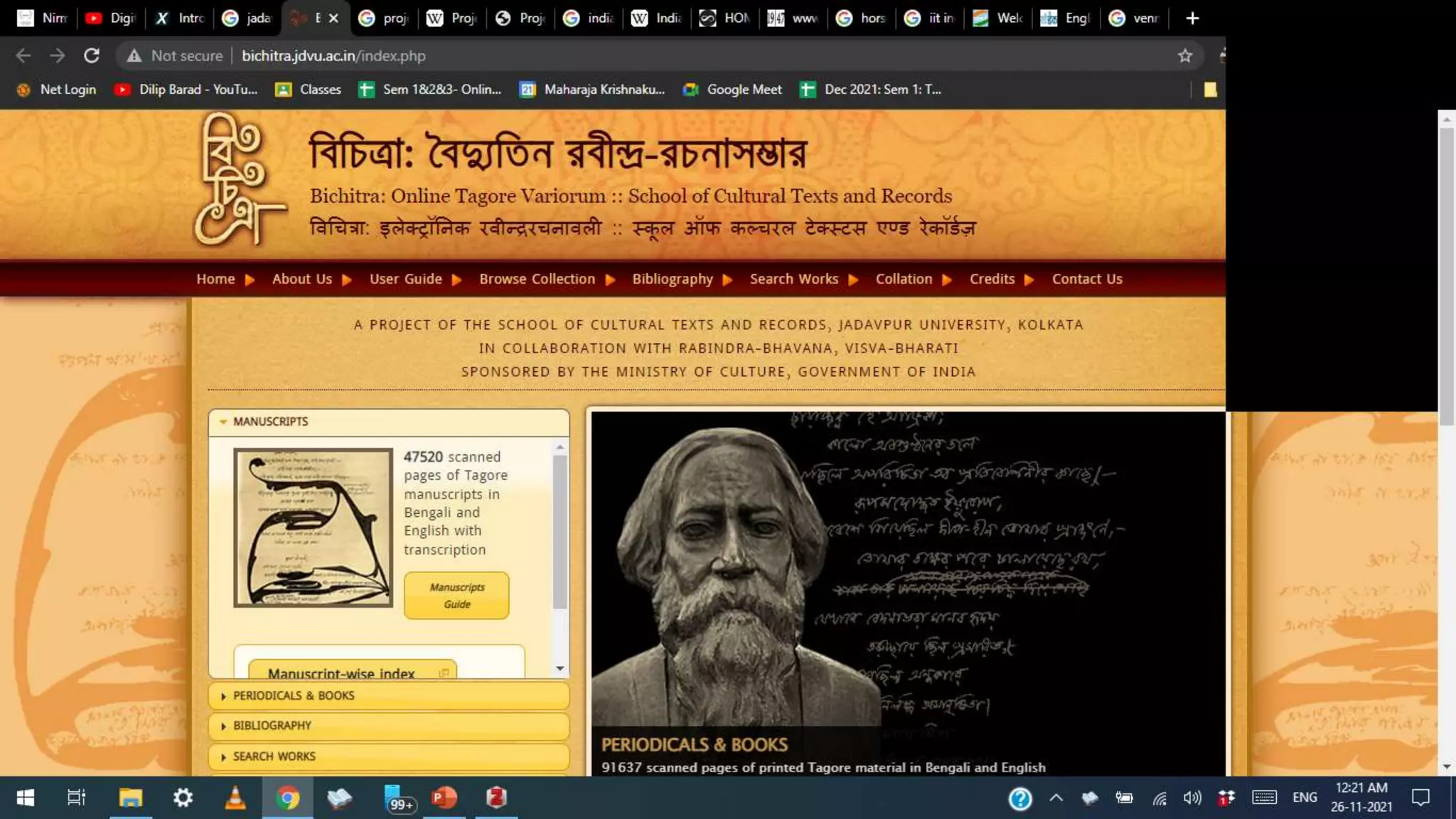
• Indian DH Projects
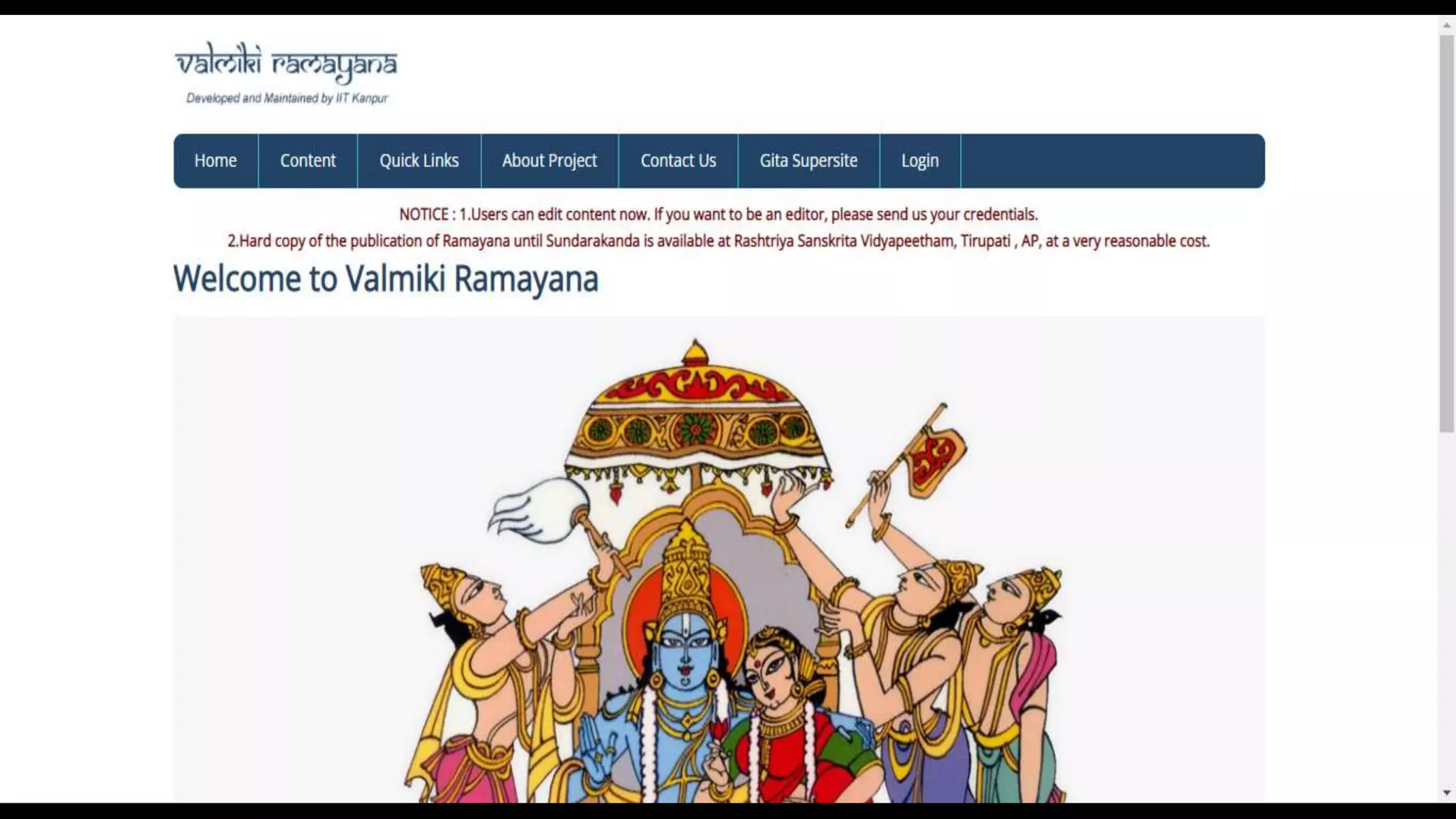
• https://www.valmiki.iitk.ac.in/
• https://www.gandhiashramsevagram.org/
• https://advaitaashrama.org/cw/content.php
2. Computational Humanities
1. Using digital technology for analysis of literary
text (research concerns)
2. Using DT in teaching & learning (pedagogical
concerns)
3. Generative Literature
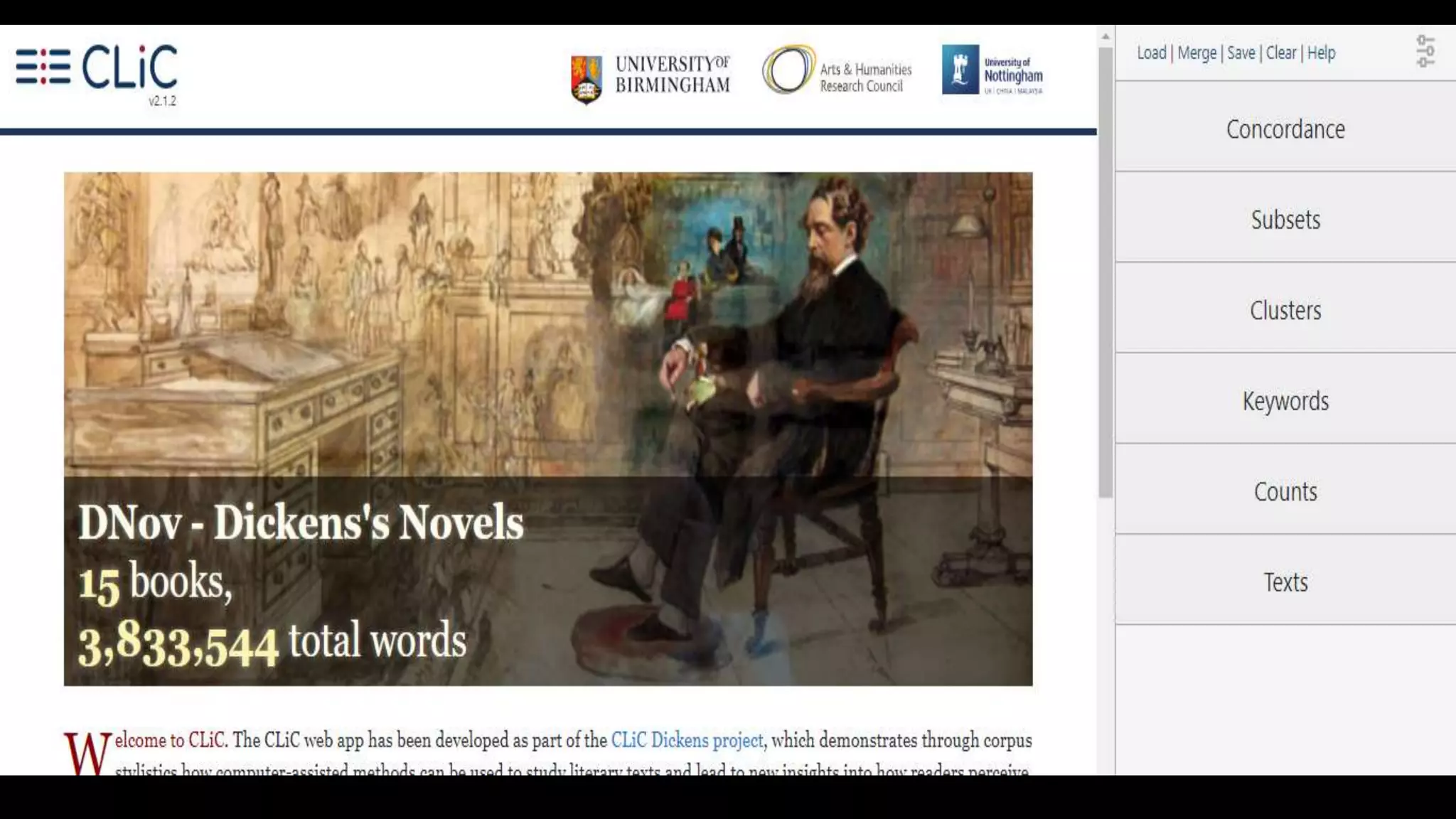
Corpus Linguistics in Context
•The CLiC web app has been developed as part of
the CLiC Dickens project, which demonstrates
through corpus stylistics how computer-assisted
methods can be used to study literary texts and
lead to new insights into how readers perceive
fictional characters.
• Key Word In Context (KWIC) is the most common format
for concordance lines. The term KWIC was first coined by Hans Peter
Luhn
•The Activity Book
Corpus linguistics basics for the study of literature
• Corpus linguistics is an area of linguistics that has become possible
with the arrival of computers.
• Corpus linguists use electronic copies of texts as well as linguistic
data that is born-digital (blogs, twitter data, etc.) to study a
language.
• Corpus linguistics is a good example to show how research
methods develop and enable new perspectives and insights. This is
the same in other disciplines.
• Consider, for instance, how the invention of the miscroscope has
had an impact on biology. As corpus linguistics is part of our
rapidly developing digital world, it occasionally gets mentioned in
the press.
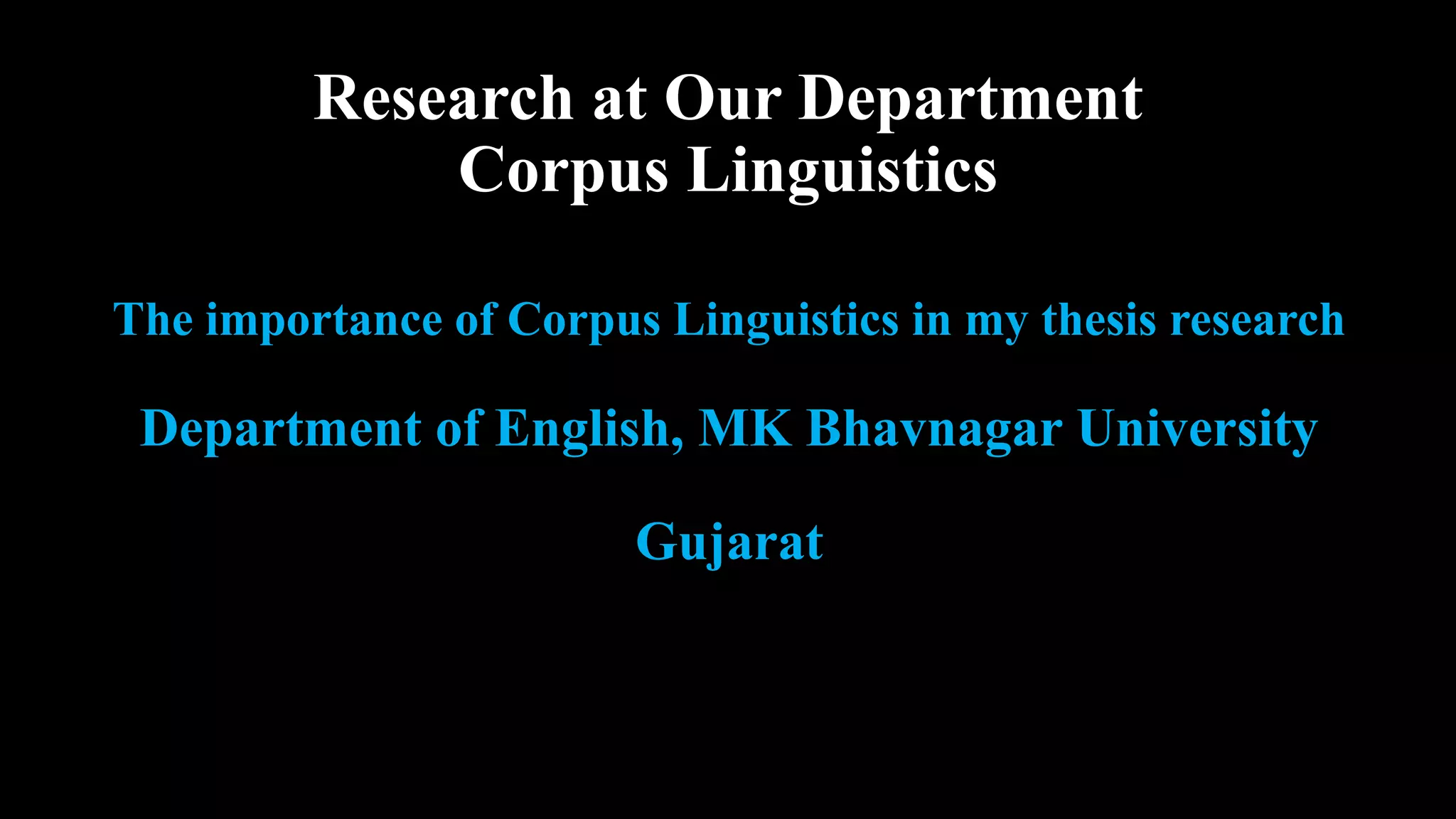
Research at Our Department
Corpus Linguistics
The importance of Corpus Linguistics in my thesis research
Department of English, MK Bhavnagar University
Gujarat
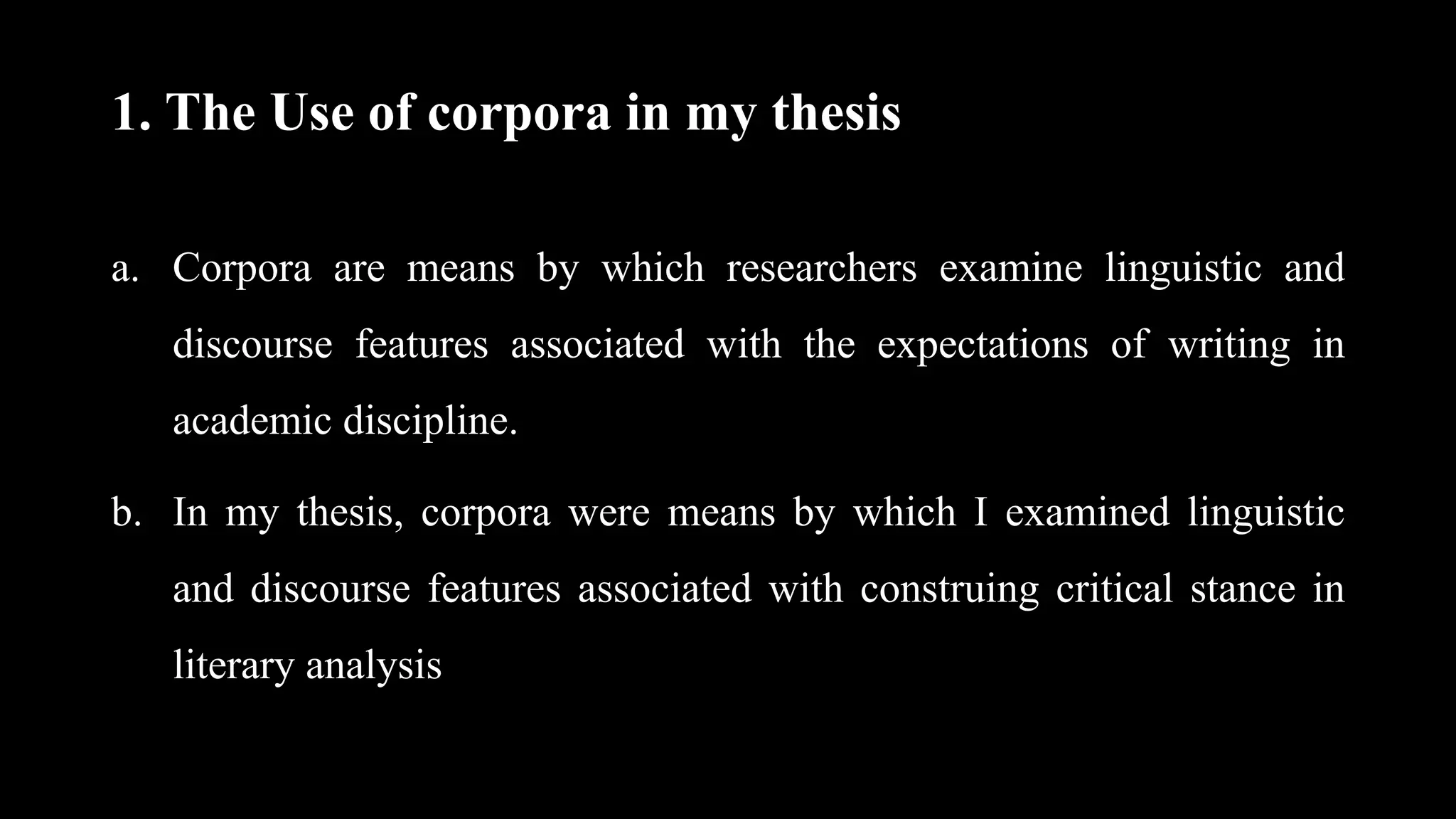
1. The Use of corpora in my thesis
a. Corpora are means by which researchers examine linguistic and
discourse features associated with the expectations of writing in
academic discipline.
b. In my thesis, corpora were means by which I examined linguistic
and discourse features associated with construing critical stance in
literary analysis
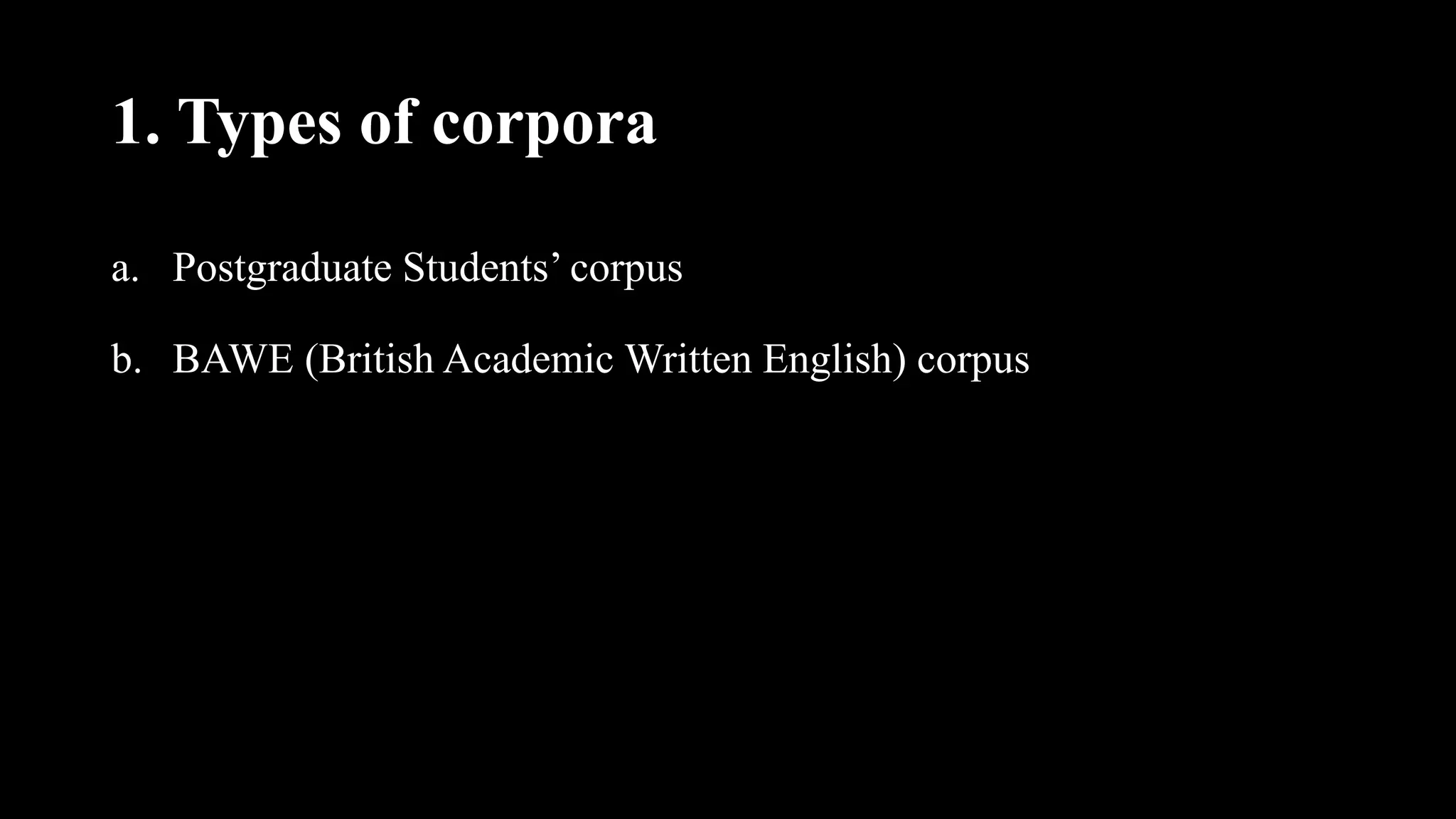
1. Types of corpora
a. Postgraduate Students’ corpus
b. BAWE (British Academic Written English) corpus
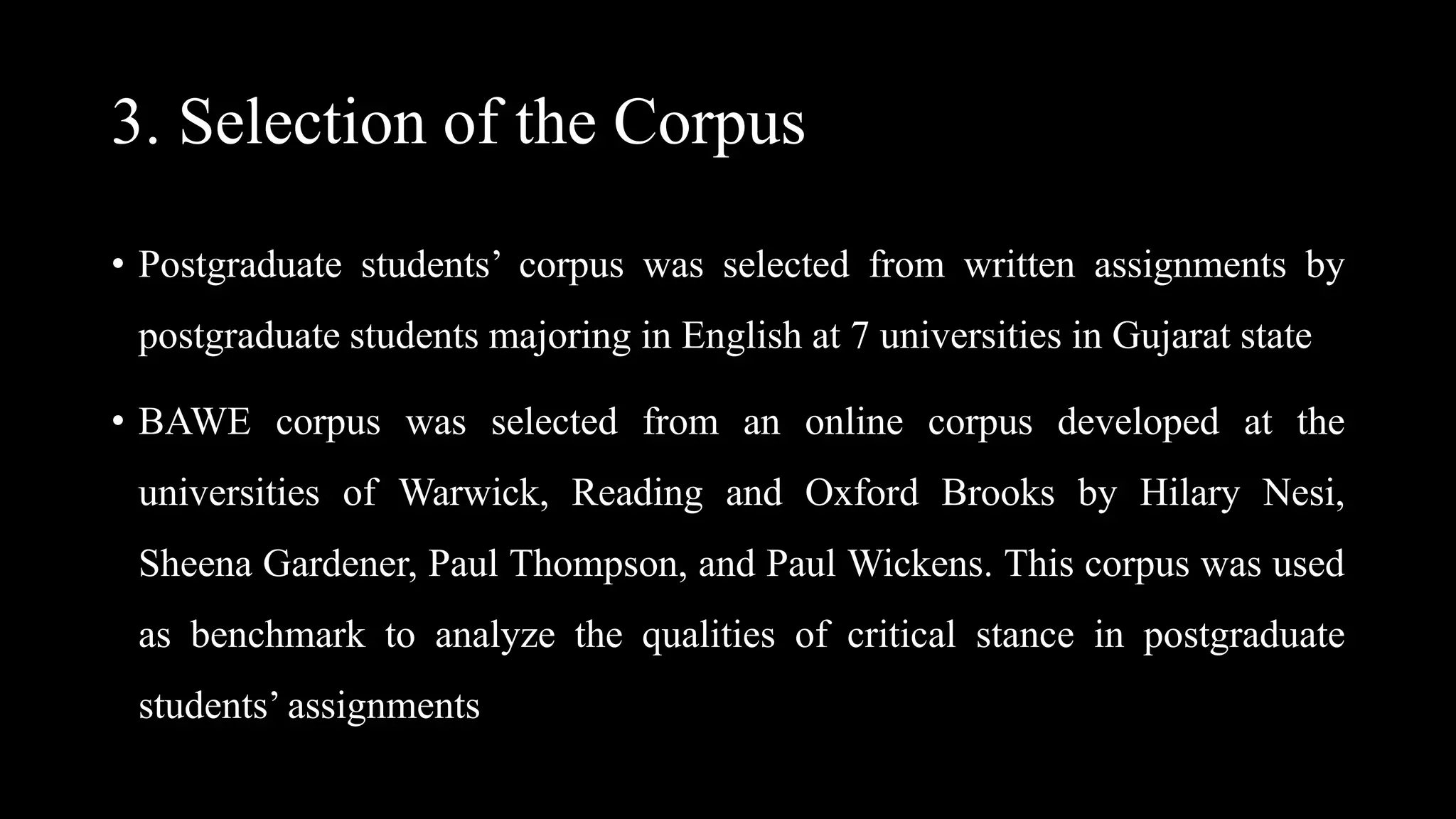
3. Selection of the Corpus
• Postgraduate students’ corpus was selected from written assignments by
postgraduate students majoring in English at 7 universities in Gujarat state
• BAWE corpus was selected from an online corpus developed at the
universities of Warwick, Reading and Oxford Brooks by Hilary Nesi,
Sheena Gardener, Paul Thompson, and Paul Wickens. This corpus was used
as benchmark to analyze the qualities of critical stance in postgraduate
students’ assignments
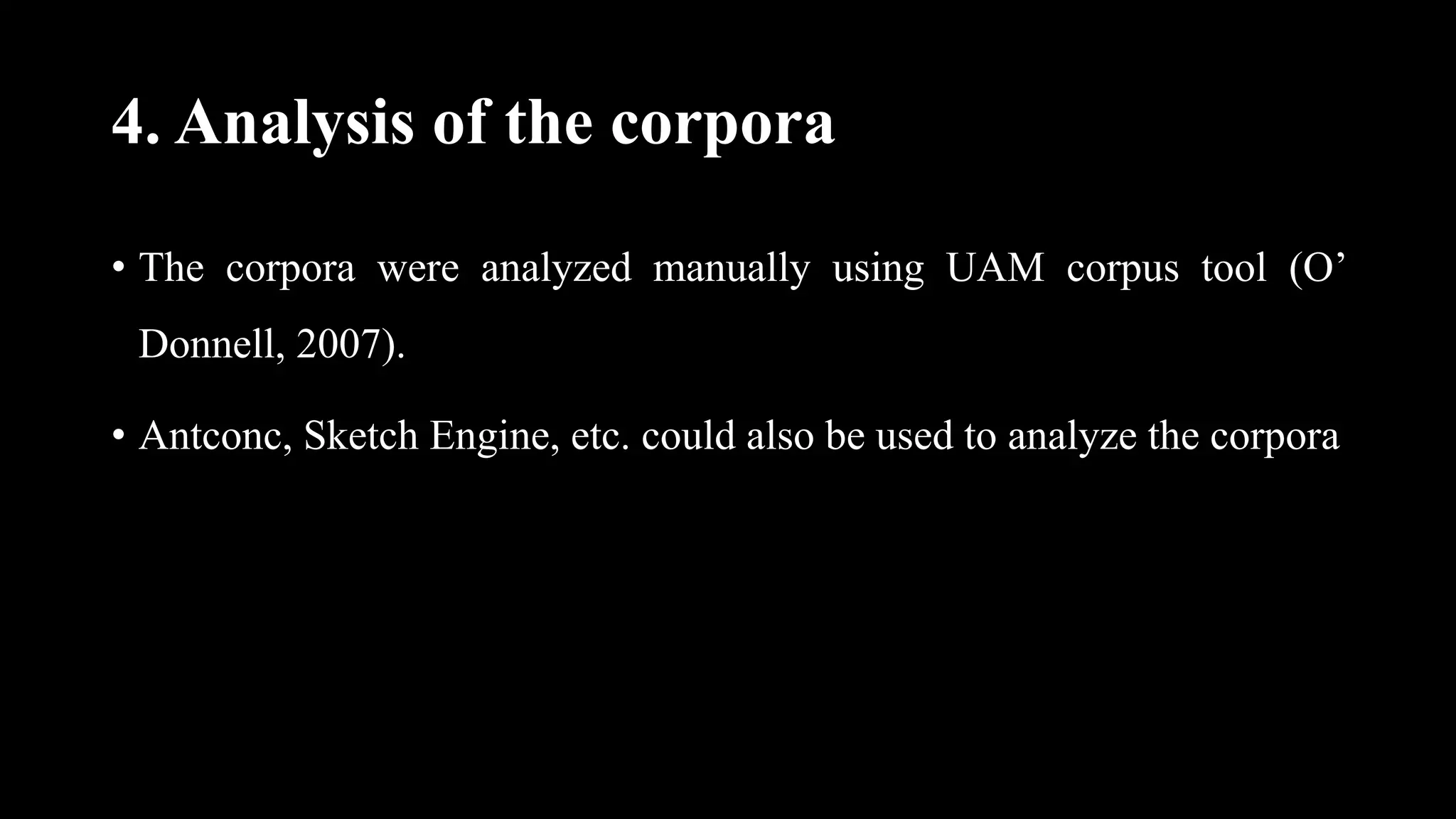
4. Analysis of the corpora
• The corpora were analyzed manually using UAM corpus tool (O’
Donnell, 2007).
• Antconc, Sketch Engine, etc. could also be used to analyze the corpora
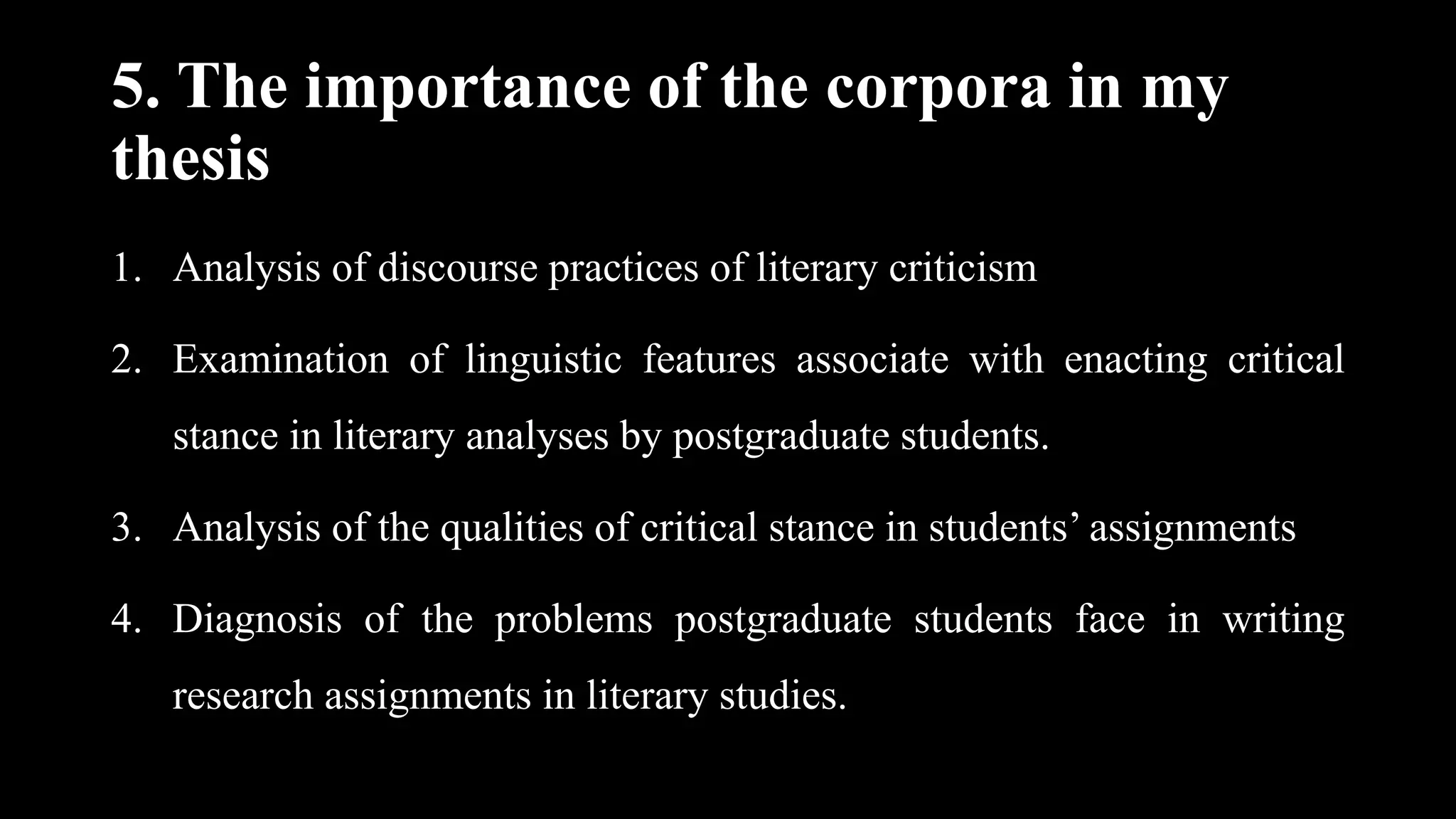
5. The importance of the corpora in my
thesis
1. Analysis of discourse practices of literary criticism
2. Examination of linguistic features associate with enacting critical
stance in literary analyses by postgraduate students.
3. Analysis of the qualities of critical stance in students’ assignments
4. Diagnosis of the problems postgraduate students face in writing
research assignments in literary studies.
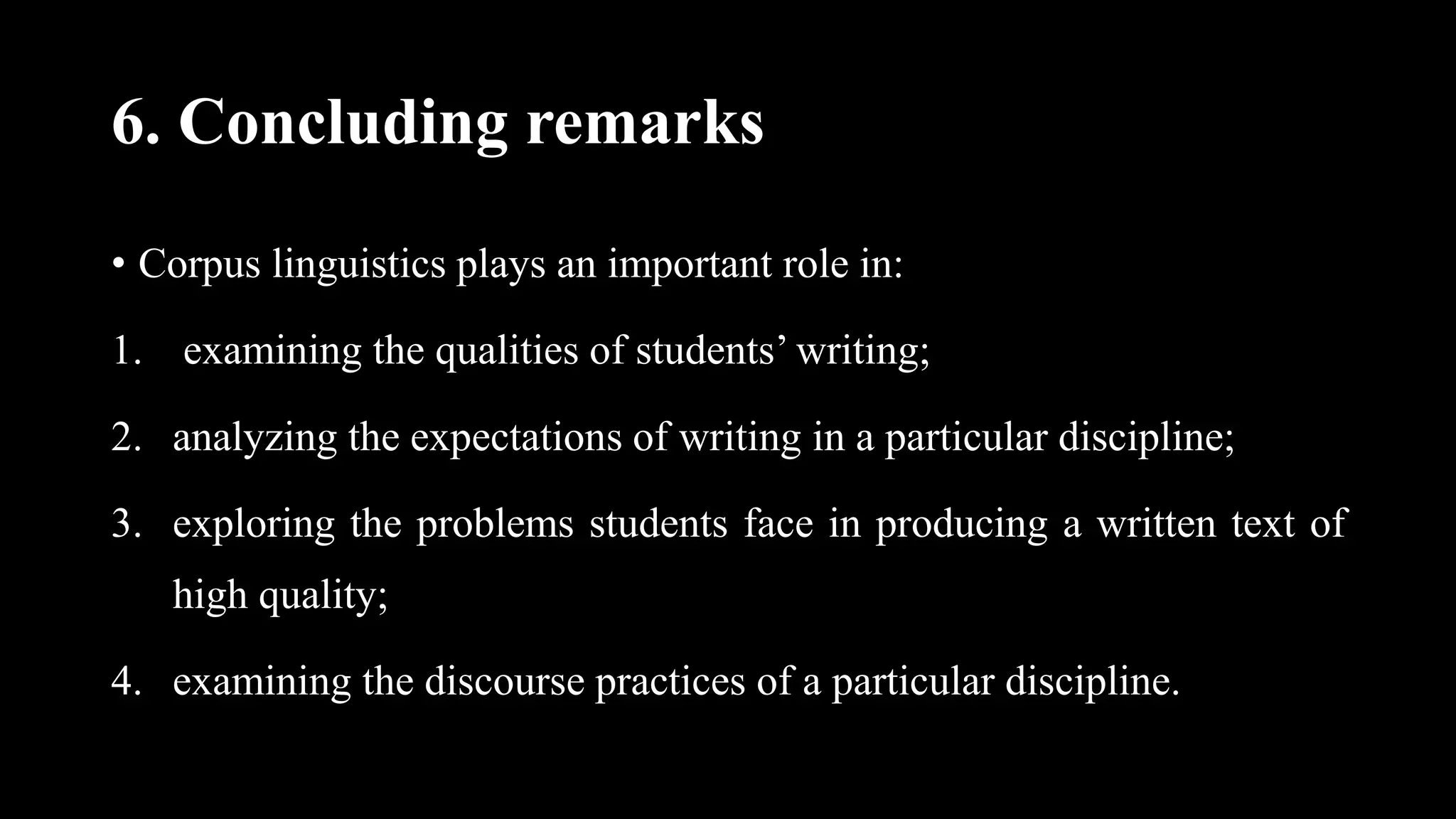
6. Concluding remarks
• Corpus linguistics plays an important role in:
1. examining the qualities of students’ writing;
2. analyzing the expectations of writing in a particular discipline;
3. exploring the problems students face in producing a written text of
high quality;
4. examining the discourse practices of a particular discipline.
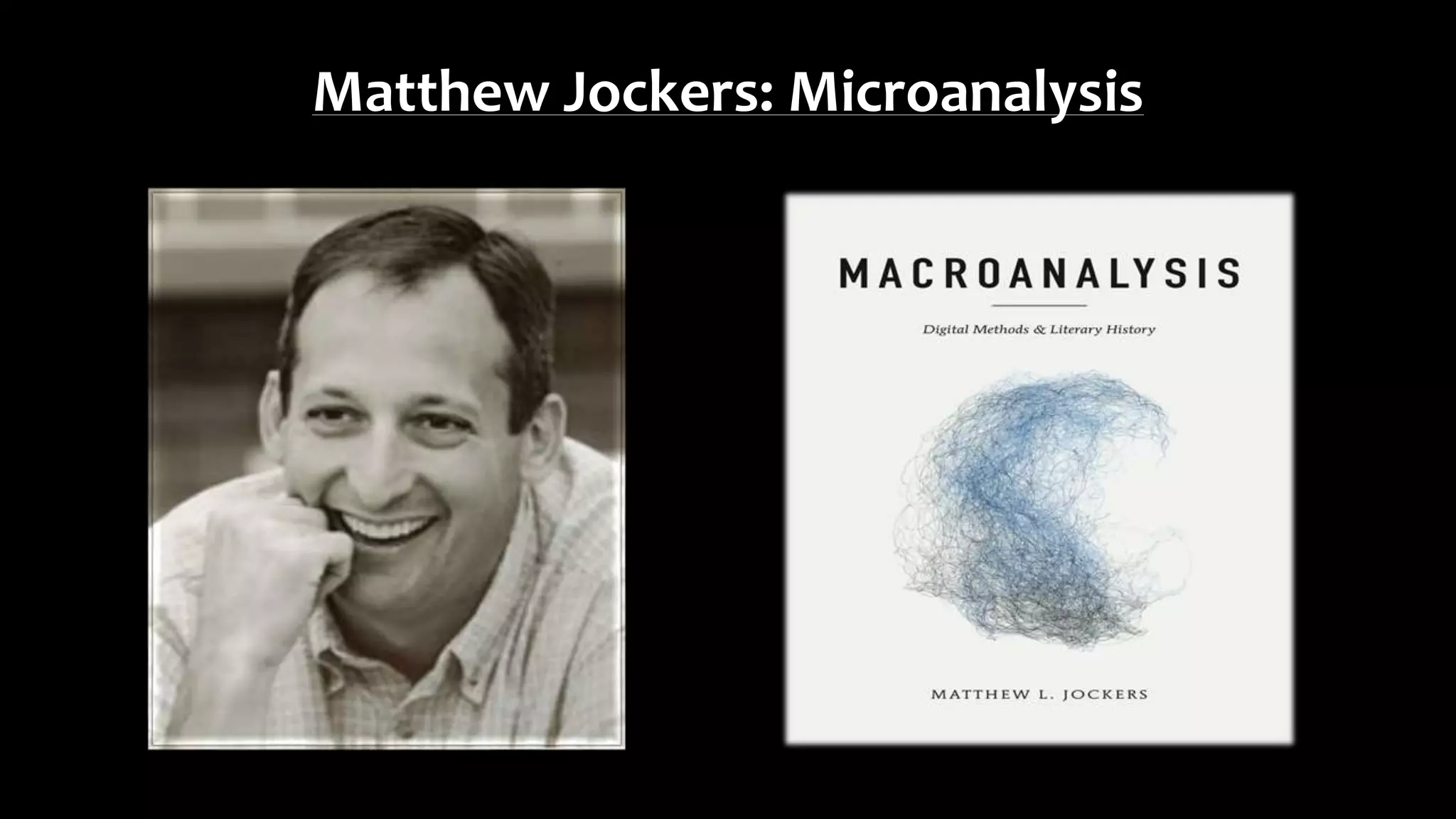
Matthew Jockers: Microanalysis
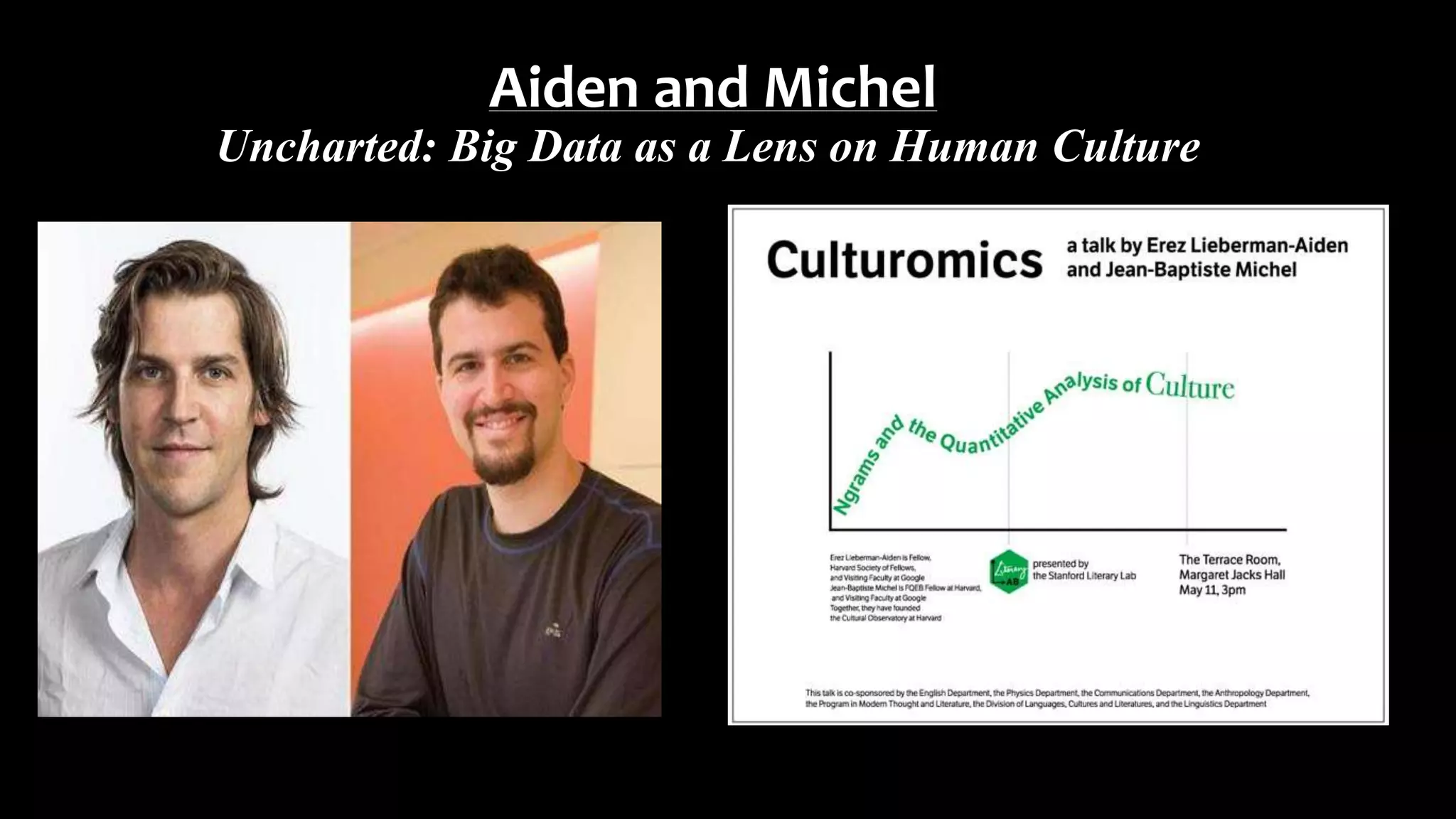
Aiden and Michel
Uncharted: Big Data as a Lens on Human Culture
2. Computational Humanities
1. Using digital technology for analysis of literary
text (research concerns)
2. Using DT in teaching & learning (pedagogical
concerns)
3. Generative Literature
Glass Board / Light board
Using OBS: Teaching Poem with moving pictures
Teaching Poem
Mixed Mode Teaching (continue in Part 2)
2. Computational Humanities
1. Using digital technology for analysis of literary
text (research concerns)
2. Using DT in teaching & learning (pedagogical
concerns)
3. Generative Literature
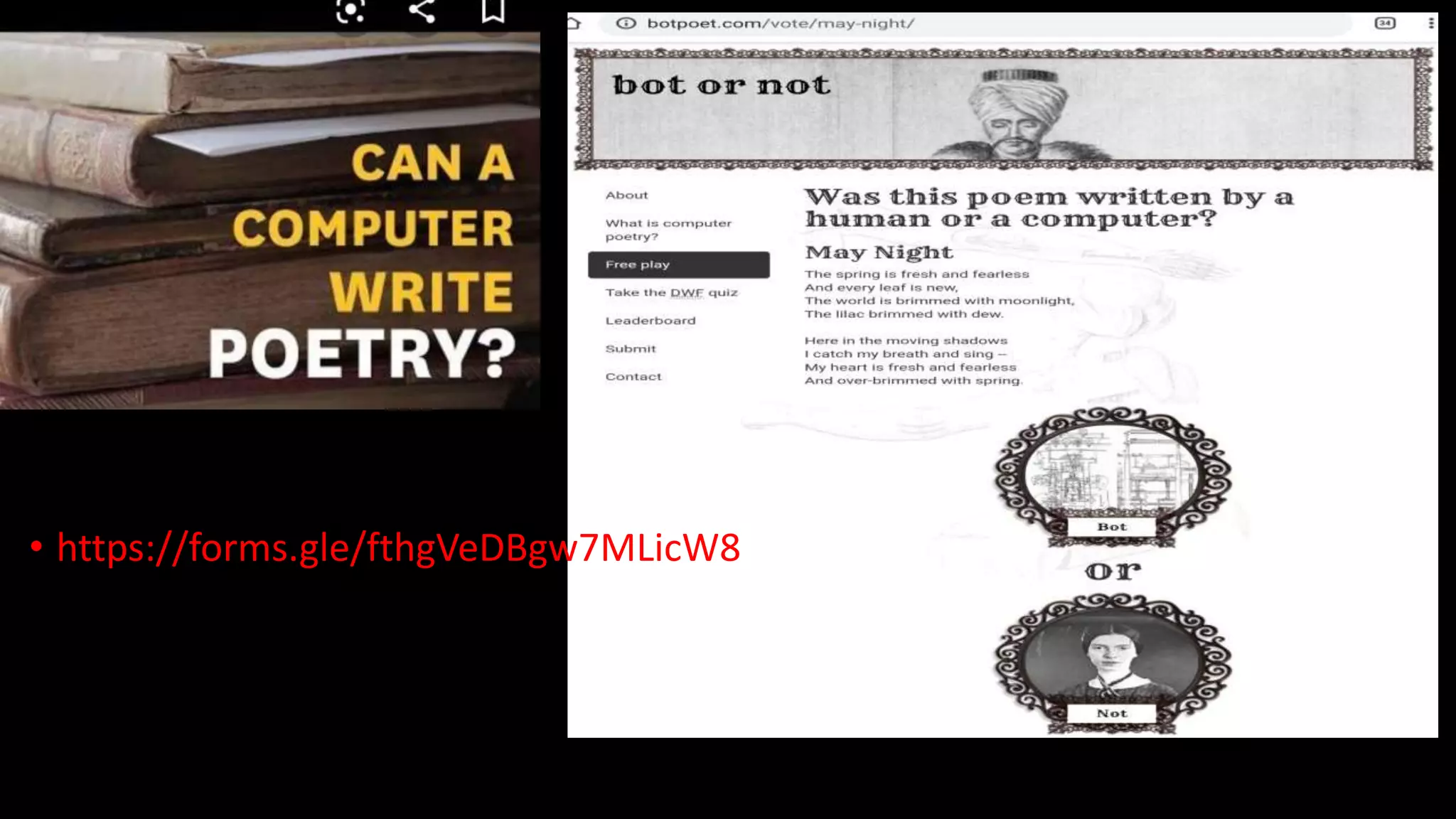
• https://forms.gle/fthgVeDBgw7MLicW8
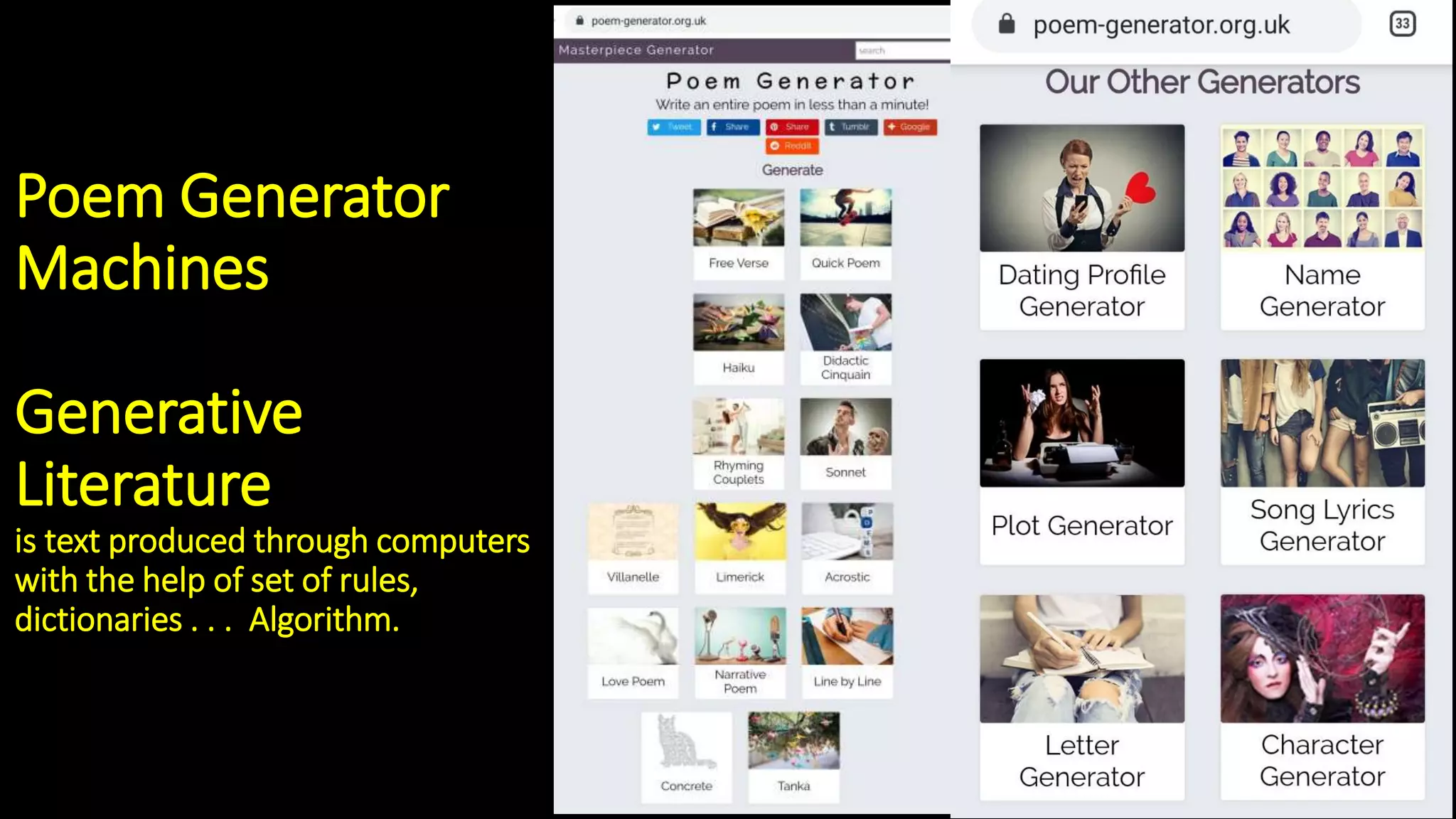
Poem Generator
Machines
Generative
Literature
is text produced through computers
with the help of set of rules,
dictionaries . . . Algorithm.
From Creative Literature to Generative Literature
•Generative literature, defined as the production of
continuously changing literary texts by means of a specific
dictionary, some set of rules and the use of algorithms, is a
very specific form of digital literature which is completely
changing most of the concepts of classical literature.
•Texts being produced by a computer and not written by an
author, require indeed a very special way of engrammation
and, in consequence, also point to a specific way of reading
particularly concerning all the aspects of the literary time.
• Principles and Processes of Generative Literature: Questions to Literature: Jean-Pierre Balpe
The Text
•Digital Text
•Scanned/typed and digitally archived copy of
traditionally or other text
•Hyper Text
•Digital Text which is linked clickable hyperlinks
with other text or media > network of multimedia
texts
•Cyber Text
•Mutually interactive digital text
What do we do under DH?
• Digital Archives
• Let us have introduction to a few projects
• Computational Humanities
• Using digital technology for analysis of literary text (research concerns)
• Using DT in teaching & learning (pedagogical concerns
• Generative Literature
3. Multimodal Critique
•The fundamentals of Humanities > Critical Inquiry
Critique
Critical Inquiry
Dialectics – Thesis # Antithess = Synthesis
Engaging in as agnostically with things happening in digital era
Using it as lens not subject
• New Challenges . . .
• Privacy & Surveillance
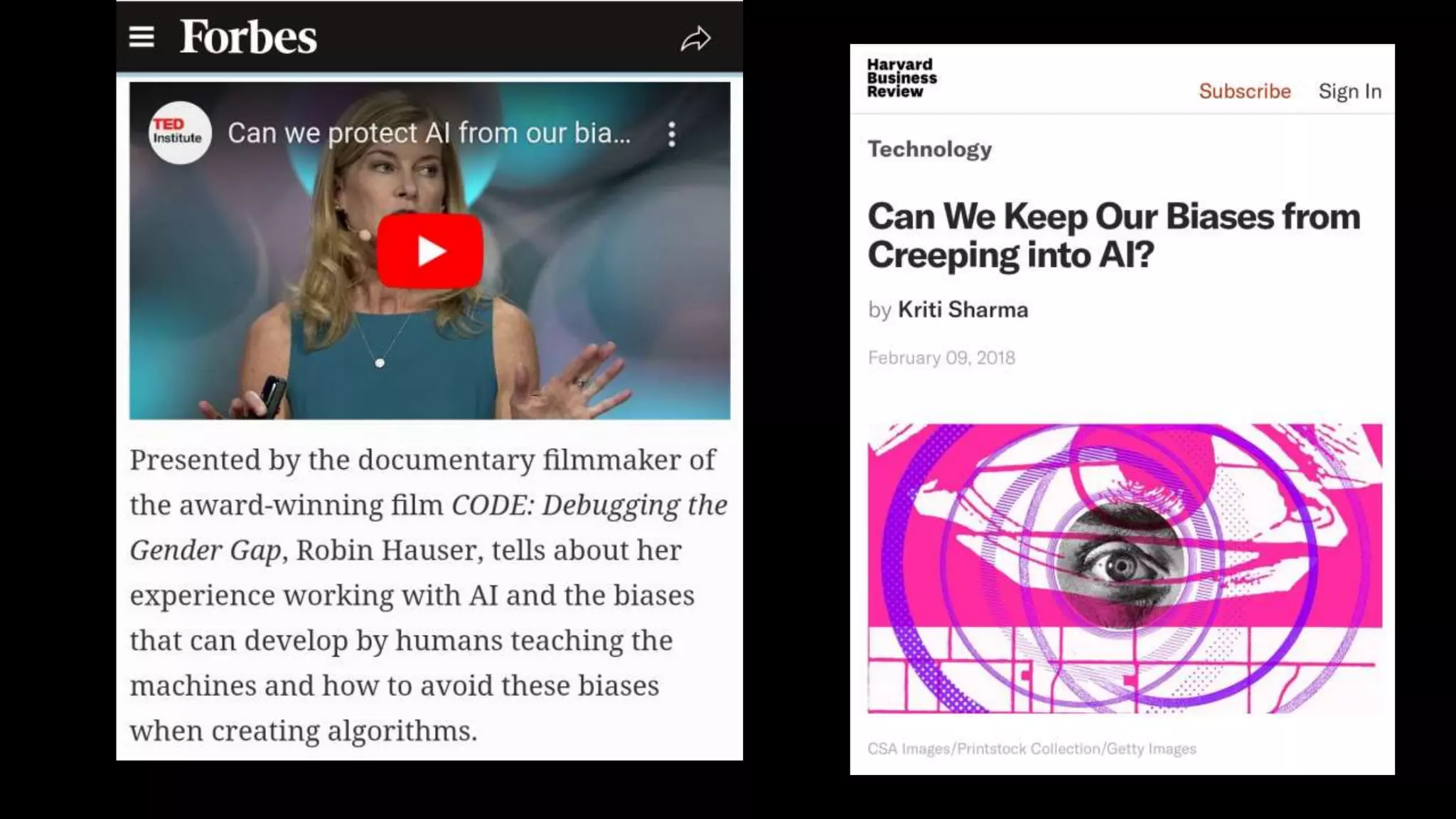
• The Artificial Intelligence & the Unconscious Bias
• Kirti Sharma & Robin Hauser
• Can we protect AI from human biases?
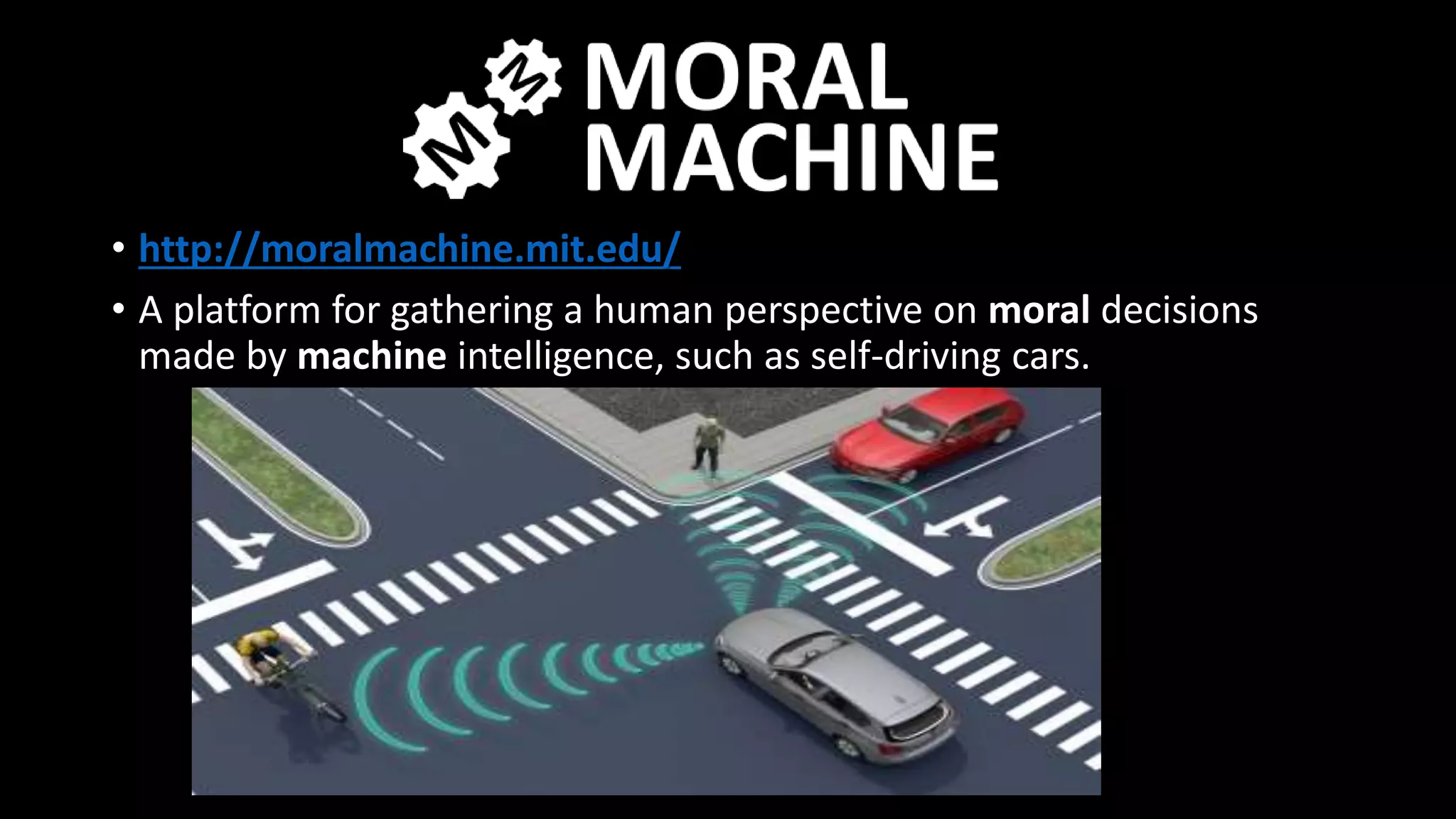
• The Question of Morality - http://moralmachine.mit.edu/
• http://moralmachine.mit.edu/
• A platform for gathering a human perspective on moral decisions
made by machine intelligence, such as self-driving cars.
Thank you
www.dilipbarad.com
•While the literary project for making humans
humane is yet not over, the humanities
people have new challenges to make robots
humane!
•… and . . . So, we want to have more of
Digital Technologies in researches in
Humanities and also in the pedagogy of
teaching literature.
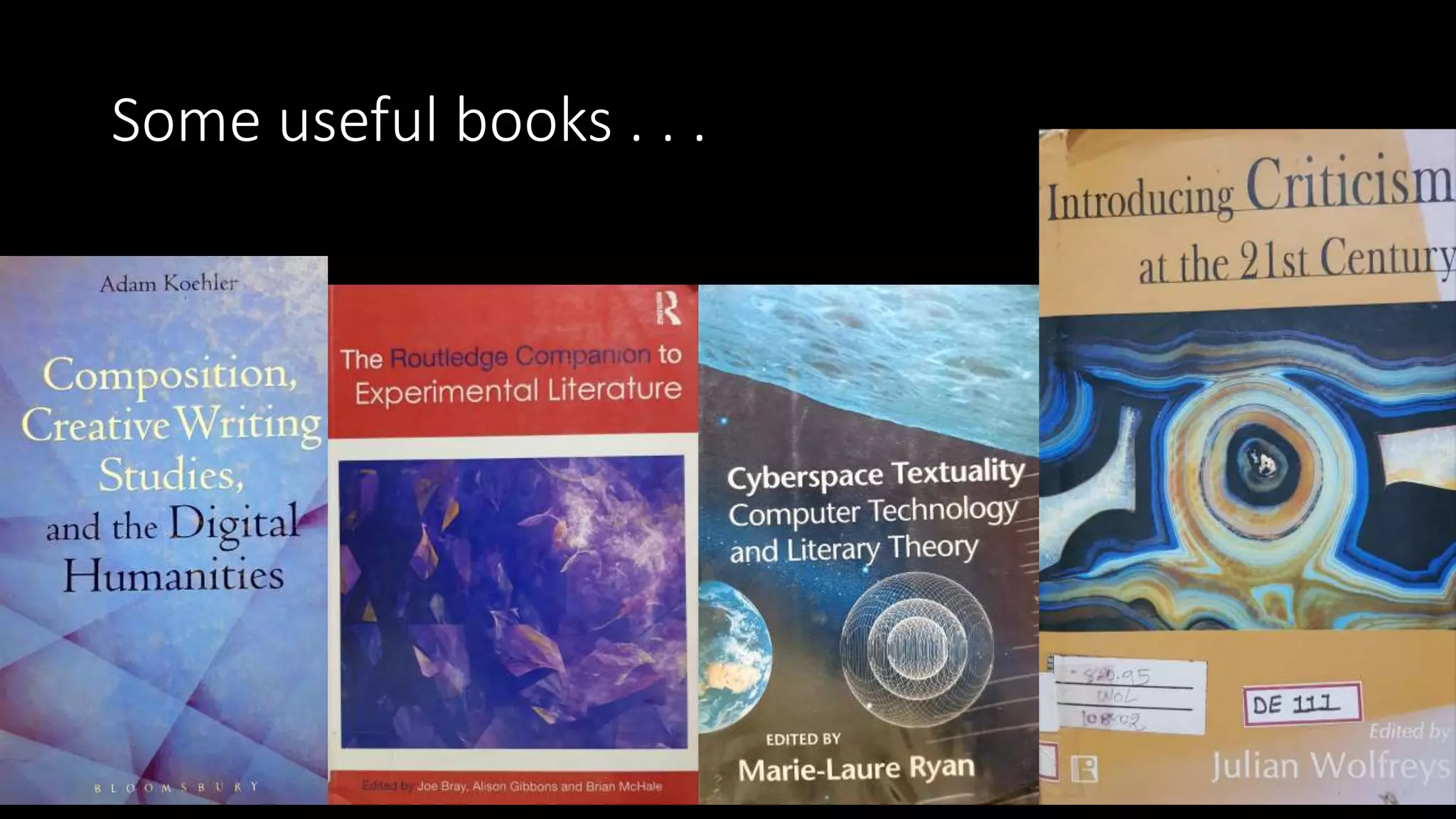
Some useful books . . .
References
• Admin, Dhai. “Nirmala Menon on Marrying Technology and the Humanities.” DHARTI (blog), October 9, 2020.
https://dhdharti.in/2020/10/09/nirmala-menon/.
• “Arts and Humanities Research Computing.” Accessed November 26, 2021.
https://digitalhumanities.fas.harvard.edu/.
• “Bichitra :: Online Tagore Variorum :: School of Cultural Texts and Records, Jadavpur University.” Accessed
November 25, 2021. http://bichitra.jdvu.ac.in/index.php.
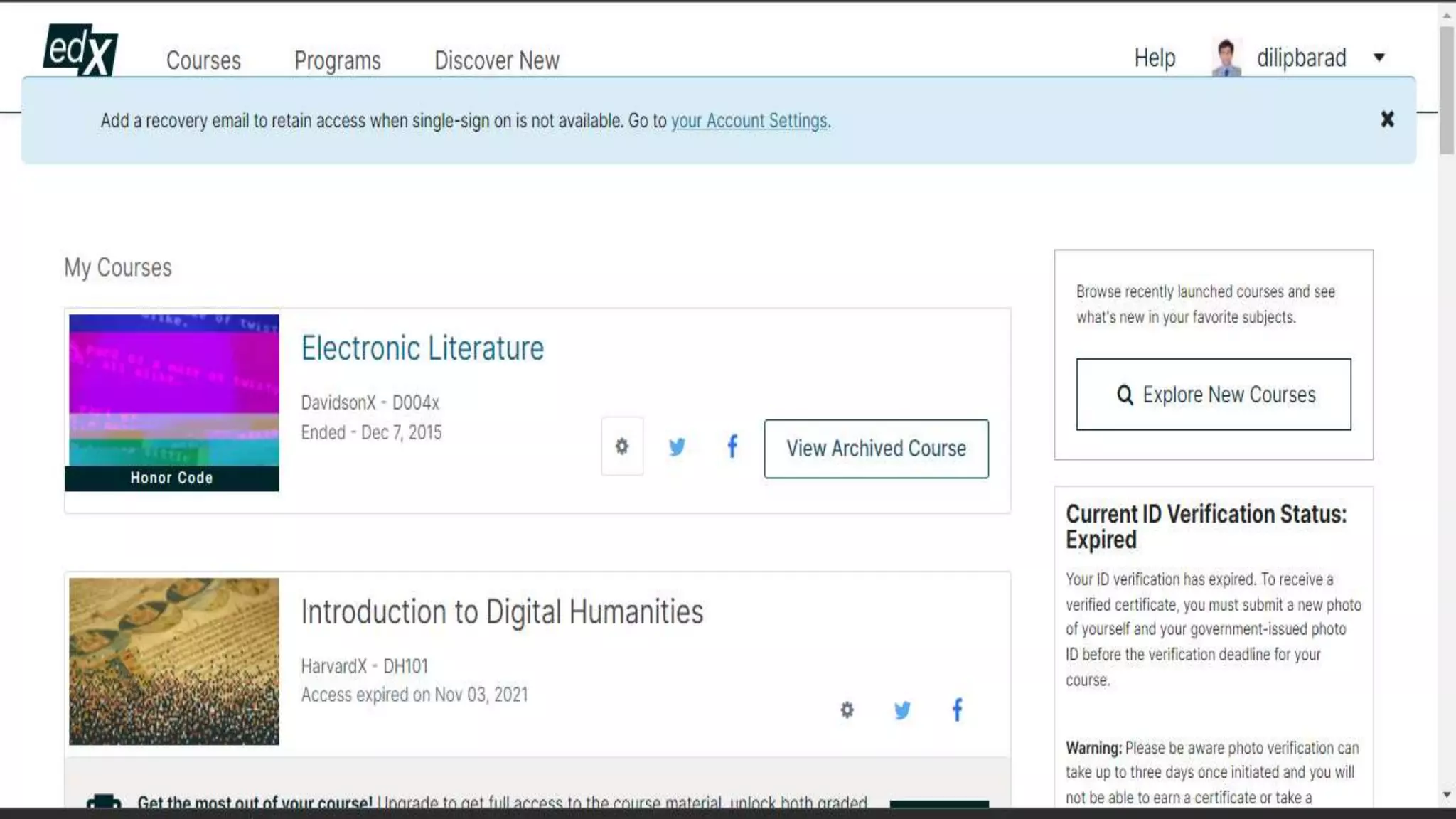
• “Course | Electronic Literature | EdX.” Accessed November 26, 2021. https://learning.edx.org/course/course-
v1:DavidsonX+D004x+3T2015/home.
• DHARTI. “DHARTI.” Accessed November 25, 2021. https://dhdharti.in/.
• Medium. “DHARTI India.” Accessed November 25, 2021. https://dharti-india.medium.com.
• Dr. Kalyani Vallath. Cultural Studies Terms: Digital Humanities NEW AREA IN RESEARCH IN ENGLISH DEPARTMENTS,
2020. https://www.youtube.com/watch?v=3VcXXgmY9Rg.
• Elijah Meeks. An Introduction to Digital Humanities - Bay Area DH, 2014.
https://www.youtube.com/watch?v=AvZToQSX244.
• “Events – Arts and Humanities Research Computing.” Accessed November 26, 2021.
https://digitalhumanities.fas.harvard.edu/events/.
• INDIAN MEMORY PROJECT. “HOME - INDIAN MEMORY PROJECT - FAMILY PHOTOS & NARRATIVES.” Accessed
November 25, 2021. https://www.indianmemoryproject.com/home/.
• edX. “Introduction to Digital Humanities.” Accessed November 26, 2021.
https://www.edx.org/course/introduction-to-digital-humanities.
References
• Joe Bray, Alison Gibbons, and Brian McHale. “The Routledge Companion to Experimental Literature.”
Routledge & CRC Press. Accessed November 29, 2021. https://www.routledge.com/The-Routledge-
Companion-to-Experimental-Literature/Bray-Gibbons-McHale/p/book/9781138797383.
• Koehler`, Adam. “Composition, Creative Writing Studies, and the Digital Humanities.” Bloomsbury.
Accessed November 29, 2021. https://www.bloomsbury.com/us/composition-creative-writing-studies-
and-the-digital-humanities-9781472591968/.
• Moral Machine. “Moral Machine.” Accessed November 29, 2021. http://moralmachine.mit.edu.
• Partition Archive, 1947. “Www.1947partitionarchive.Org |.” Accessed November 25, 2021.
https://in.1947partitionarchive.org/.
• “Project Madurai.” Accessed November 25, 2021. https://www.projectmadurai.org/.
• “Projects – Arts and Humanities Research Computing.” Accessed November 26, 2021.
https://digitalhumanities.fas.harvard.edu/projects/.
• Ryan, Marie-Laure, ed. Cyberspace Textuality : Computer Technology and Literary Theory. Bloomington :
Indiana University Press, 1999. http://archive.org/details/cyberspacetextua0000unse.
• Serious Science. Digital Humanities - Jeffrey Schnapp, 2014.
https://www.youtube.com/watch?v=iYRExzsRC9w.
• T, Shanmugapriya, and Nirmala Menon. “Infrastructure and Social Interaction: Situated Research
Practices in Digital Humanities in India.” Digital Humanities Quarterly 014, no. 3 (September 25, 2020).
• Wolfreys, Julian. “Introducing Criticism in the 21st Century.” Accessed November 29, 2021.
https://edinburghuniversitypress.com/book-introducing-criticism-in-the-21st-century.html.

Digital Humanities: An Introduction

  • 2.
    What is DigitalHumanities? •Digital humanities (DH) is an area of scholarly activity at the intersection of computing or digital technologies and the disciplines of the humanities. It includes the systematic use of digital resources in the humanities, as well as the analysis of their application. • Drucker, Johanna (September 2013). "Intro to Digital Humanities: Introduction". UCLA Center for Digital Humanities • Terras, Melissa (December 2011). "Quantifying Digital Humanities" (PDF). UCL Centre for Digital Humanities.
  • 3.
    •DH can bedefined as new ways of doing scholarship that involve collaborative, transdisciplinary, and computationally engaged research, teaching, and publishing. • It brings digital tools and methods to the study of the humanities with the recognition that the printed word is no longer the main medium for knowledge production and distribution • Burdick, Anne; Drucker, Johanna; Lunenfeld, Peter; Presner, Todd; Schnapp, Jeffrey (November 2012). Digital_Humanities
  • 5.
    What do wedo under DH? 1. Digital Archives •Let us have introduction to a few projects 2. Computational Humanities •Using digital technology for analysis of literary text (research concerns) •Using DT in teaching & learning (pedagogical concerns) •Generative Literature 3. Multimodal Critique •The fundamentals of Humanities > Critical Inquiry
  • 6.
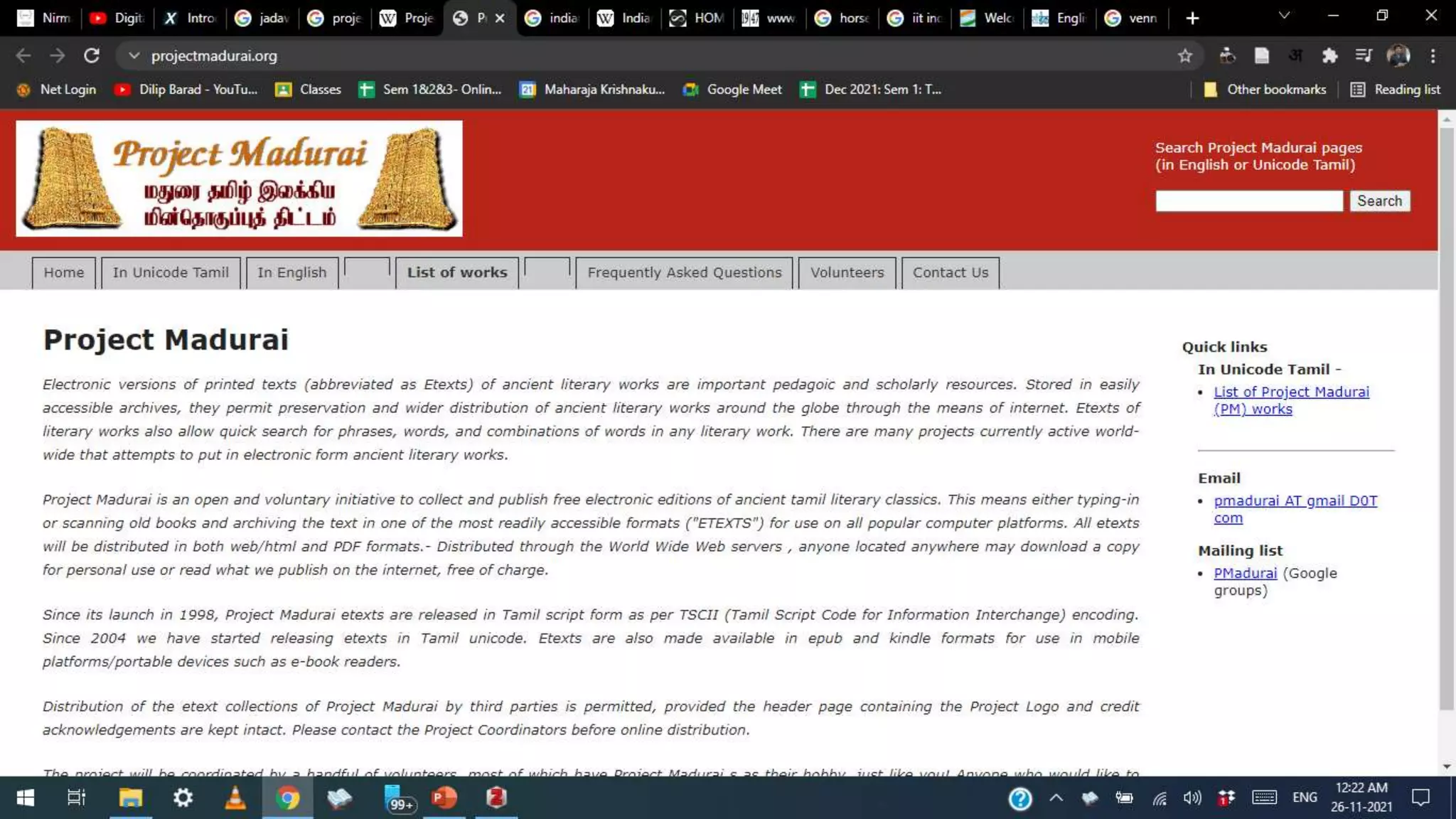
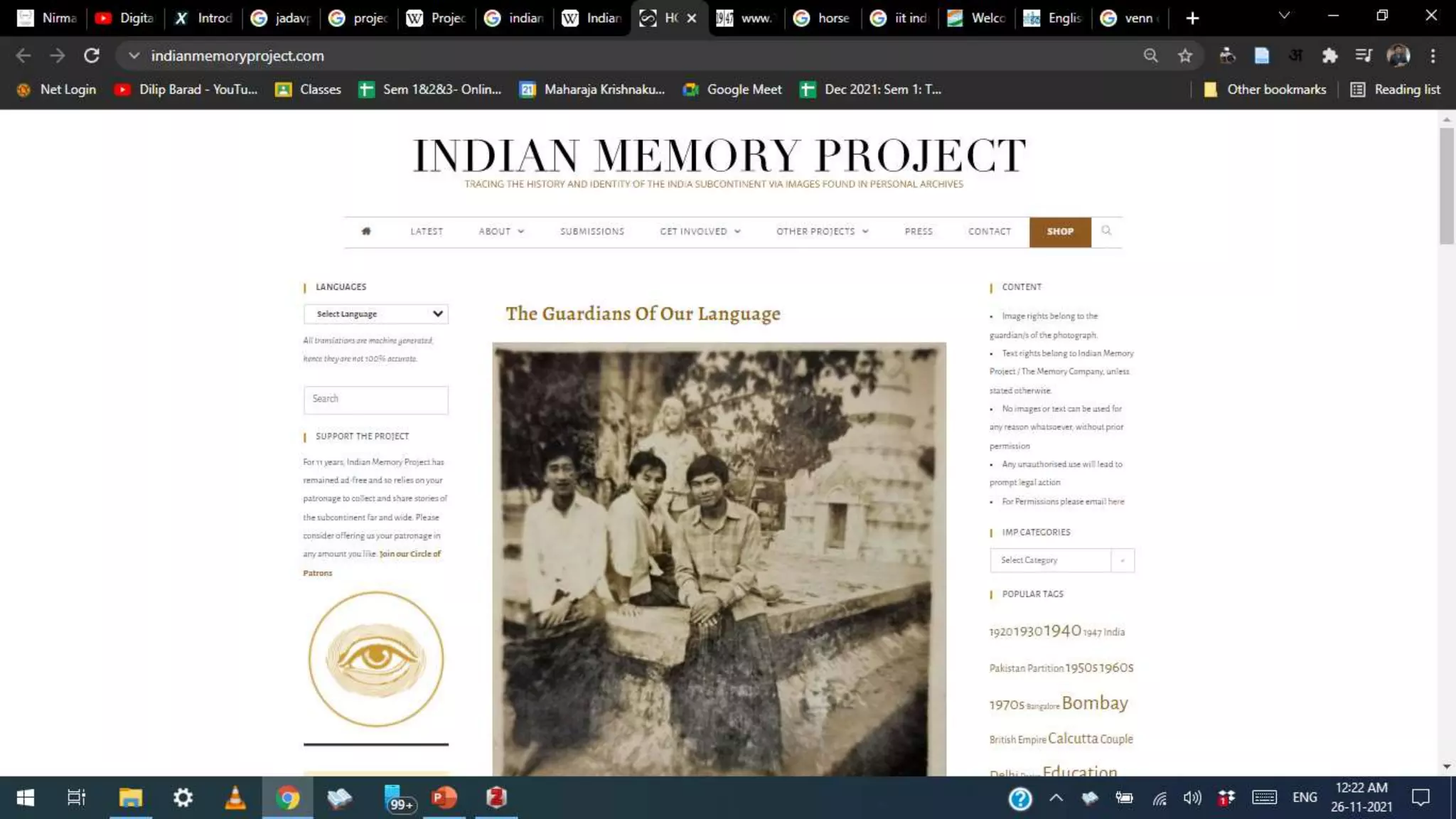
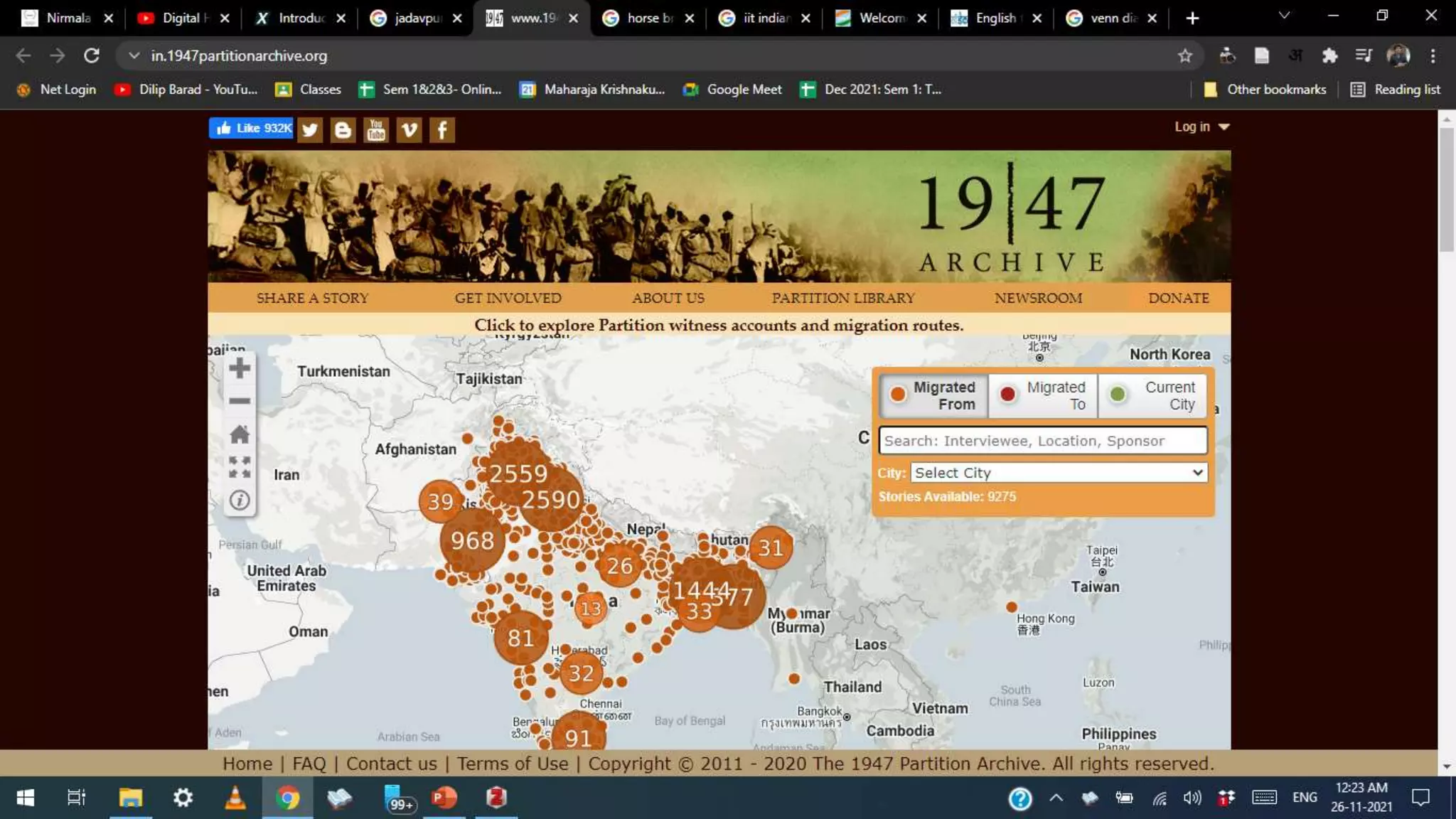
    1. Digital Archives •http://www.rossettiarchive.org/index.html • https://victorianweb.org/ • https://artsandculture.google.com/ • https://digitalhumanities.fas.harvard.edu/projects/ [D-ART-H] • Indian DH Projects • https://www.valmiki.iitk.ac.in/ • https://www.gandhiashramsevagram.org/ • https://advaitaashrama.org/cw/content.php
  • 15.
    2. Computational Humanities 1.Using digital technology for analysis of literary text (research concerns) 2. Using DT in teaching & learning (pedagogical concerns) 3. Generative Literature
  • 17.
    Corpus Linguistics inContext •The CLiC web app has been developed as part of the CLiC Dickens project, which demonstrates through corpus stylistics how computer-assisted methods can be used to study literary texts and lead to new insights into how readers perceive fictional characters. • Key Word In Context (KWIC) is the most common format for concordance lines. The term KWIC was first coined by Hans Peter Luhn •The Activity Book
  • 18.
    Corpus linguistics basicsfor the study of literature • Corpus linguistics is an area of linguistics that has become possible with the arrival of computers. • Corpus linguists use electronic copies of texts as well as linguistic data that is born-digital (blogs, twitter data, etc.) to study a language. • Corpus linguistics is a good example to show how research methods develop and enable new perspectives and insights. This is the same in other disciplines. • Consider, for instance, how the invention of the miscroscope has had an impact on biology. As corpus linguistics is part of our rapidly developing digital world, it occasionally gets mentioned in the press.
  • 20.
    Research at OurDepartment Corpus Linguistics The importance of Corpus Linguistics in my thesis research Department of English, MK Bhavnagar University Gujarat
  • 21.
    1. The Useof corpora in my thesis a. Corpora are means by which researchers examine linguistic and discourse features associated with the expectations of writing in academic discipline. b. In my thesis, corpora were means by which I examined linguistic and discourse features associated with construing critical stance in literary analysis
  • 22.
    1. Types ofcorpora a. Postgraduate Students’ corpus b. BAWE (British Academic Written English) corpus
  • 23.
    3. Selection ofthe Corpus • Postgraduate students’ corpus was selected from written assignments by postgraduate students majoring in English at 7 universities in Gujarat state • BAWE corpus was selected from an online corpus developed at the universities of Warwick, Reading and Oxford Brooks by Hilary Nesi, Sheena Gardener, Paul Thompson, and Paul Wickens. This corpus was used as benchmark to analyze the qualities of critical stance in postgraduate students’ assignments
  • 24.
    4. Analysis ofthe corpora • The corpora were analyzed manually using UAM corpus tool (O’ Donnell, 2007). • Antconc, Sketch Engine, etc. could also be used to analyze the corpora
  • 25.
    5. The importanceof the corpora in my thesis 1. Analysis of discourse practices of literary criticism 2. Examination of linguistic features associate with enacting critical stance in literary analyses by postgraduate students. 3. Analysis of the qualities of critical stance in students’ assignments 4. Diagnosis of the problems postgraduate students face in writing research assignments in literary studies.
  • 26.
    6. Concluding remarks •Corpus linguistics plays an important role in: 1. examining the qualities of students’ writing; 2. analyzing the expectations of writing in a particular discipline; 3. exploring the problems students face in producing a written text of high quality; 4. examining the discourse practices of a particular discipline.
  • 27.
  • 28.
    Aiden and Michel Uncharted:Big Data as a Lens on Human Culture
  • 29.
    2. Computational Humanities 1.Using digital technology for analysis of literary text (research concerns) 2. Using DT in teaching & learning (pedagogical concerns) 3. Generative Literature
  • 30.
    Glass Board /Light board
  • 31.
    Using OBS: TeachingPoem with moving pictures
  • 32.
  • 33.
    Mixed Mode Teaching(continue in Part 2)
  • 35.
    2. Computational Humanities 1.Using digital technology for analysis of literary text (research concerns) 2. Using DT in teaching & learning (pedagogical concerns) 3. Generative Literature
  • 36.
  • 37.
    Poem Generator Machines Generative Literature is textproduced through computers with the help of set of rules, dictionaries . . . Algorithm.
  • 38.
    From Creative Literatureto Generative Literature •Generative literature, defined as the production of continuously changing literary texts by means of a specific dictionary, some set of rules and the use of algorithms, is a very specific form of digital literature which is completely changing most of the concepts of classical literature. •Texts being produced by a computer and not written by an author, require indeed a very special way of engrammation and, in consequence, also point to a specific way of reading particularly concerning all the aspects of the literary time. • Principles and Processes of Generative Literature: Questions to Literature: Jean-Pierre Balpe
  • 39.
    The Text •Digital Text •Scanned/typedand digitally archived copy of traditionally or other text •Hyper Text •Digital Text which is linked clickable hyperlinks with other text or media > network of multimedia texts •Cyber Text •Mutually interactive digital text
  • 40.
    What do wedo under DH? • Digital Archives • Let us have introduction to a few projects • Computational Humanities • Using digital technology for analysis of literary text (research concerns) • Using DT in teaching & learning (pedagogical concerns • Generative Literature 3. Multimodal Critique •The fundamentals of Humanities > Critical Inquiry
  • 41.
    Critique Critical Inquiry Dialectics –Thesis # Antithess = Synthesis Engaging in as agnostically with things happening in digital era Using it as lens not subject • New Challenges . . . • Privacy & Surveillance • The Artificial Intelligence & the Unconscious Bias • Kirti Sharma & Robin Hauser • Can we protect AI from human biases? • The Question of Morality - http://moralmachine.mit.edu/
  • 43.
    • http://moralmachine.mit.edu/ • Aplatform for gathering a human perspective on moral decisions made by machine intelligence, such as self-driving cars.
  • 44.
    Thank you www.dilipbarad.com •While theliterary project for making humans humane is yet not over, the humanities people have new challenges to make robots humane! •… and . . . So, we want to have more of Digital Technologies in researches in Humanities and also in the pedagogy of teaching literature.
  • 46.
  • 47.
    References • Admin, Dhai.“Nirmala Menon on Marrying Technology and the Humanities.” DHARTI (blog), October 9, 2020. https://dhdharti.in/2020/10/09/nirmala-menon/. • “Arts and Humanities Research Computing.” Accessed November 26, 2021. https://digitalhumanities.fas.harvard.edu/. • “Bichitra :: Online Tagore Variorum :: School of Cultural Texts and Records, Jadavpur University.” Accessed November 25, 2021. http://bichitra.jdvu.ac.in/index.php. • “Course | Electronic Literature | EdX.” Accessed November 26, 2021. https://learning.edx.org/course/course- v1:DavidsonX+D004x+3T2015/home. • DHARTI. “DHARTI.” Accessed November 25, 2021. https://dhdharti.in/. • Medium. “DHARTI India.” Accessed November 25, 2021. https://dharti-india.medium.com. • Dr. Kalyani Vallath. Cultural Studies Terms: Digital Humanities NEW AREA IN RESEARCH IN ENGLISH DEPARTMENTS, 2020. https://www.youtube.com/watch?v=3VcXXgmY9Rg. • Elijah Meeks. An Introduction to Digital Humanities - Bay Area DH, 2014. https://www.youtube.com/watch?v=AvZToQSX244. • “Events – Arts and Humanities Research Computing.” Accessed November 26, 2021. https://digitalhumanities.fas.harvard.edu/events/. • INDIAN MEMORY PROJECT. “HOME - INDIAN MEMORY PROJECT - FAMILY PHOTOS & NARRATIVES.” Accessed November 25, 2021. https://www.indianmemoryproject.com/home/. • edX. “Introduction to Digital Humanities.” Accessed November 26, 2021. https://www.edx.org/course/introduction-to-digital-humanities.
  • 48.
    References • Joe Bray,Alison Gibbons, and Brian McHale. “The Routledge Companion to Experimental Literature.” Routledge & CRC Press. Accessed November 29, 2021. https://www.routledge.com/The-Routledge- Companion-to-Experimental-Literature/Bray-Gibbons-McHale/p/book/9781138797383. • Koehler`, Adam. “Composition, Creative Writing Studies, and the Digital Humanities.” Bloomsbury. Accessed November 29, 2021. https://www.bloomsbury.com/us/composition-creative-writing-studies- and-the-digital-humanities-9781472591968/. • Moral Machine. “Moral Machine.” Accessed November 29, 2021. http://moralmachine.mit.edu. • Partition Archive, 1947. “Www.1947partitionarchive.Org |.” Accessed November 25, 2021. https://in.1947partitionarchive.org/. • “Project Madurai.” Accessed November 25, 2021. https://www.projectmadurai.org/. • “Projects – Arts and Humanities Research Computing.” Accessed November 26, 2021. https://digitalhumanities.fas.harvard.edu/projects/. • Ryan, Marie-Laure, ed. Cyberspace Textuality : Computer Technology and Literary Theory. Bloomington : Indiana University Press, 1999. http://archive.org/details/cyberspacetextua0000unse. • Serious Science. Digital Humanities - Jeffrey Schnapp, 2014. https://www.youtube.com/watch?v=iYRExzsRC9w. • T, Shanmugapriya, and Nirmala Menon. “Infrastructure and Social Interaction: Situated Research Practices in Digital Humanities in India.” Digital Humanities Quarterly 014, no. 3 (September 25, 2020). • Wolfreys, Julian. “Introducing Criticism in the 21st Century.” Accessed November 29, 2021. https://edinburghuniversitypress.com/book-introducing-criticism-in-the-21st-century.html.